

Types of Buying Motives: The Practitioner's Guide to Why People Buy
Salesforce data shows 73% of buyers say most sales interactions feel transactional. That's not a data problem or a product problem. It's a motive problem. Reps pitch features when buyers are driven by fear, status, or a deadline they haven't articulated yet. Understanding the types of buying motives is the difference between a transactional pitch and a conversation that converts.
All buying motives fall into three overlapping frameworks: rational vs. emotional, conscious vs. dormant, and product vs. patronage. The rest of this guide gives you the full taxonomy, the neuroscience behind why motives work the way they do, discovery scripts to surface the real driver, and messaging templates to close on it.
What Are Buying Motives?
A buying motive is the internal force that moves someone from "I'm fine" to "I need this." In academic terms, it's a drive - an internal state triggered by some imbalance between where a buyer is and where they want to be.
Vroom's expectancy theory breaks this into three beliefs every buyer holds, whether they realize it or not. First, expectancy: "If I put in effort, will I get the result?" Second, instrumentality: "Will that result actually lead to the outcome I want?" Third, valence: "How much do I value that outcome?" When all three are high, motivation is strong. When any one collapses, the deal stalls.
That's the theory. In practice, your prospect isn't evaluating your product - they're evaluating whether your product closes a gap they feel. Your job is to figure out which gap.
The Neuroscience Behind Buying Decisions
You've probably heard the internet-famous line that "most purchasing decisions are emotional" - usually paired with a shaky Harvard/HBR attribution. The useful takeaway is real even when the viral stat isn't: self-report is limited, and people often justify decisions after the fact.
The dual-system model holds up well in practice. The limbic system generates the initial preference. The neocortex builds the justification afterward. Venkatraman et al. (2015) found that unconscious reactions measured via fMRI predicted product sales better than self-reported preferences, and Liu et al. (2022) showed that ads triggering greater activation in the prefrontal cortex and ventral striatum later produced higher engagement and recall.
The neuromarketing market has grown from roughly $1.44B in 2023 to a projected $3.11B by 2032, at about 8.9% CAGR. Companies are pouring real money into understanding subconscious decision-making. Most sales teams won't use neuroscience tools - and you don't need to. The practical application is simpler than the science: buyers decide emotionally first, then rationalize. Your messaging needs to land on the emotional driver and give the rational brain enough ammunition to defend the purchase internally. A pitch that only hits logic, or only hits emotion, leaves half the decision unsupported.
The Complete Taxonomy
Three Frameworks for Organizing Motives
Before listing individual motives, it helps to understand the three lenses that organize them. These frameworks overlap - a single purchase can be emotional, dormant, and patronage-driven all at once.
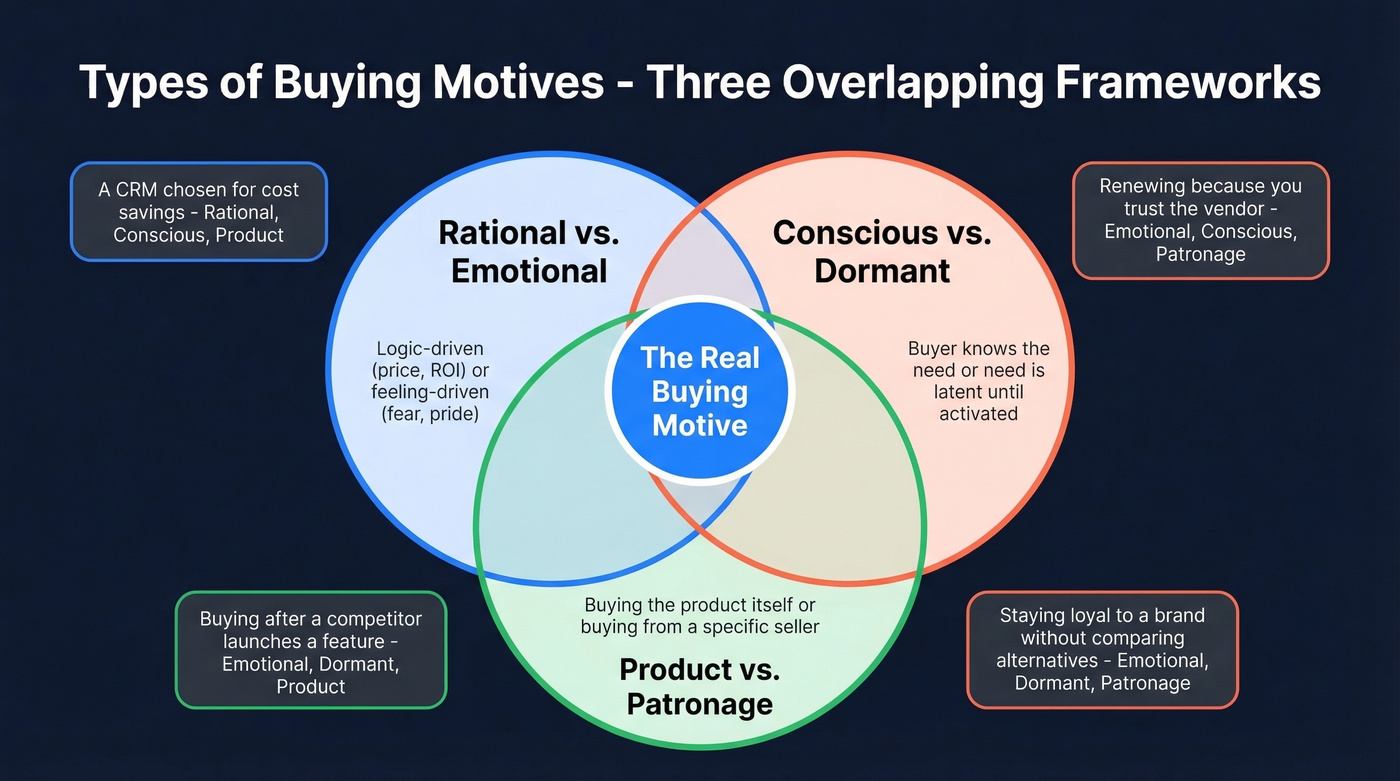
| Framework | Definition | Example |
|---|---|---|
| Rational vs. Emotional | Logic-driven (price, ROI) vs. feeling-driven (fear, pride) | Choosing a CRM for cost savings vs. choosing it because a trusted peer recommended it |
| Conscious vs. Dormant | Buyer knows the need vs. need is latent until activated | "We need a new CRM" vs. "We didn't realize our churn was a data problem" |
| Product vs. Patronage | Buying the product for its features vs. buying from a specific brand/seller | Choosing the cheapest option vs. staying with a vendor you trust |
The 10 Common Motives
Most motives below map cleanly to both B2B and B2C contexts. We've tested messaging against all ten - the ones that tend to move deals fastest are financial gain, fear, and status.
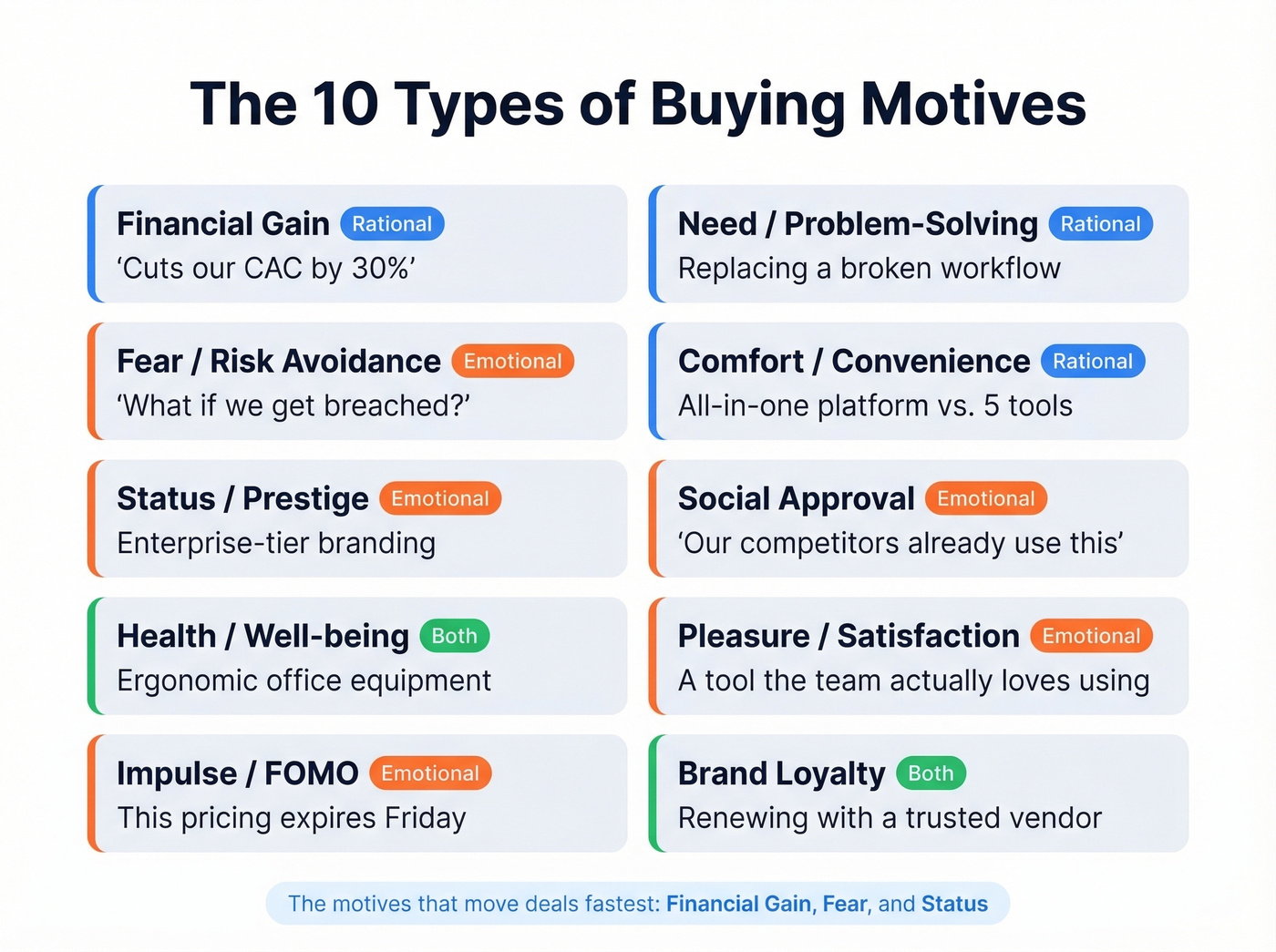
| Motive | Type | B2B Example | B2C Example |
|---|---|---|---|
| Financial Gain | Rational | "This cuts our CAC by 30%" | Switching banks for a higher savings rate |
| Need / Problem-Solving | Rational | Replacing a broken workflow | Buying a winter coat in November |
| Fear / Risk Avoidance | Emotional | "What if we get breached?" | Purchasing home insurance |
| Comfort / Convenience | Rational | All-in-one platform vs. 5 tools | One-click checkout |
| Status / Prestige | Emotional | Enterprise-tier branding | Luxury watch purchase |
| Social Approval | Emotional | "Our competitors use this" | Buying what influencers recommend |
| Health / Well-being | Both | Ergonomic office equipment | Organic groceries |
| Pleasure / Satisfaction | Emotional | A tool the team loves using | A spontaneous vacation booking |
| Impulse / FOMO | Emotional | "This pricing expires Friday" | Flash sale purchase |
| Brand Loyalty (Patronage) | Both | Renewing with a trusted vendor | Buying Apple every upgrade cycle |
The impulse motive deserves a closer look. 84% of shoppers have made impulse purchases, and impulse buying accounts for nearly 40% of all online spending. One in five shoppers has spent $1,000+ on a single impulse buy.
Researchers break impulse purchases into four subtypes: pure (completely unplanned), reminder (seeing a product triggers a forgotten need), suggestion (a new product sparks immediate desire), and planned impulse (entering a store intending to buy something on deal, without a specific product in mind). In B2B, impulse shows up as urgency-driven buying - a competitor just launched a feature, a board meeting is next week, a budget window is closing.
Convenience and social influence matter even more in digital-first buying environments. In 2026, a buyer's first impression of your product is just as likely to be a peer's Slack message or a Reddit thread as your website.
Product Based vs. Patronage Motives
Let's zoom in on the product-vs.-patronage distinction because it shapes how you position against competitors.
Product based buying motives center on the item itself - its features, quality, price, or performance. A buyer driven by product-level motivations will switch vendors the moment a better spec sheet appears. Patronage motives tie the purchase to the seller: trust, service quality, brand reputation, or relationship history. We've seen this play out dozens of times in our own pipeline - a prospect runs a feature comparison, finds a cheaper alternative, and still renews because they trust the support team and don't want to risk a migration.
Recognizing which type dominates a deal tells you whether to lead with a feature comparison or a case study from a similar company.

Knowing your buyer's motive is half the deal. The other half is reaching them. Prospeo gives you 300M+ profiles with 30+ filters - including buyer intent signals across 15,000 topics - so you can match the right message to the right motive at exactly the right moment.
Stop guessing motives. Start targeting them with intent data.
Mapping Motives to Maslow's Hierarchy
Maslow's hierarchy gives you a quick diagnostic lens for where a buyer's head is at. But Maslow himself cautioned in 1943 that the hierarchy isn't rigid - people are multi-motivated, and multiple needs operate simultaneously.
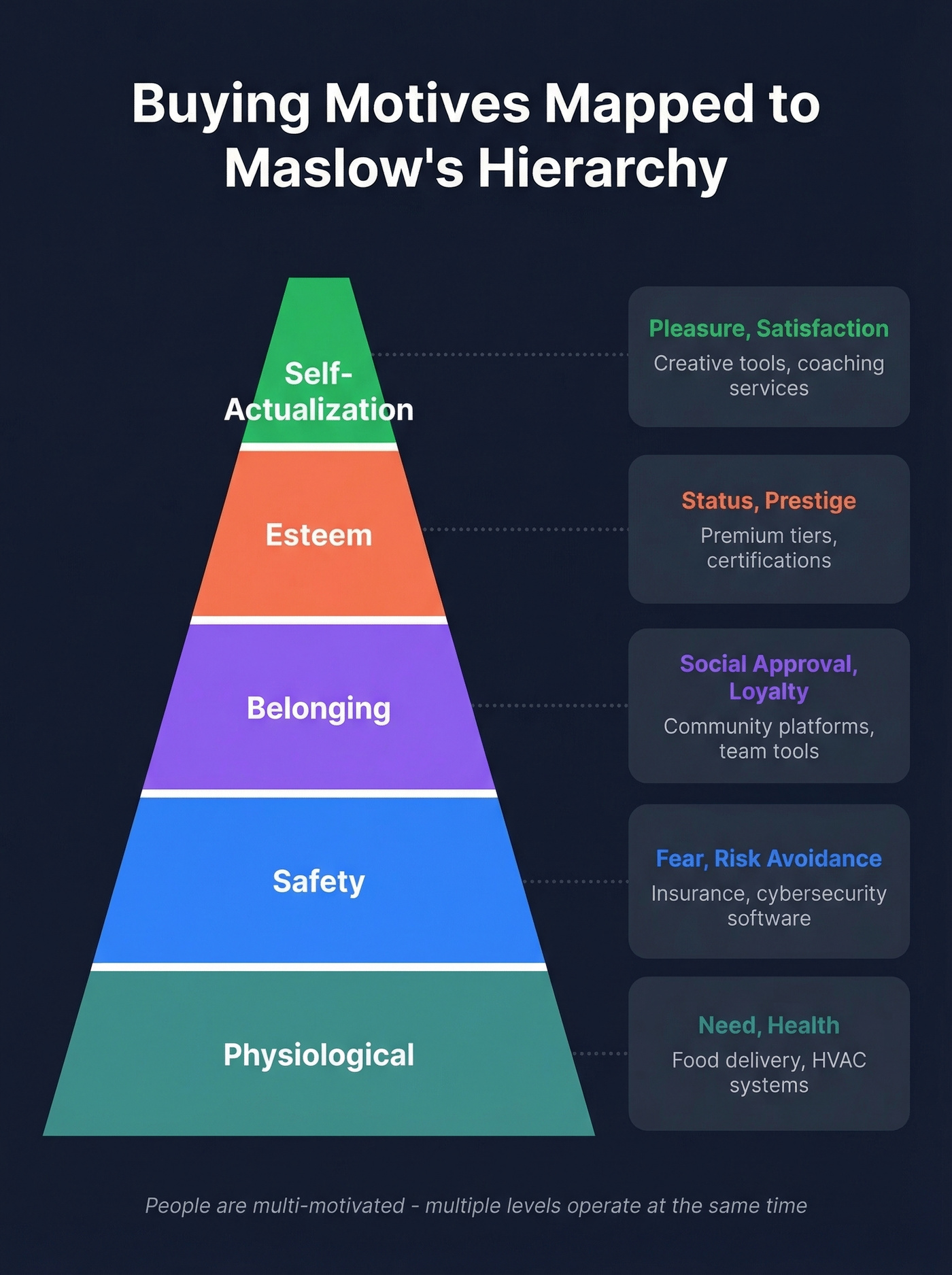
| Maslow Level | Corresponding Motives | Product Examples |
|---|---|---|
| Physiological | Need, Health | Food delivery, HVAC systems |
| Safety | Fear, Risk Avoidance | Insurance, cybersecurity software |
| Belonging | Social Approval, Loyalty | Community platforms, team tools |
| Esteem | Status, Prestige | Premium tiers, certifications |
| Self-Actualization | Pleasure, Satisfaction | Creative tools, coaching services |
The practical value isn't academic purity - it's pattern recognition. When a prospect keeps circling back to "what happens if this fails," they're operating at the safety level. Pitching status features won't land. Match the tier, match the motive.
B2B vs. B2C: How Motives Differ
The motives themselves are the same. What changes is the mix, the speed, and the number of people involved.
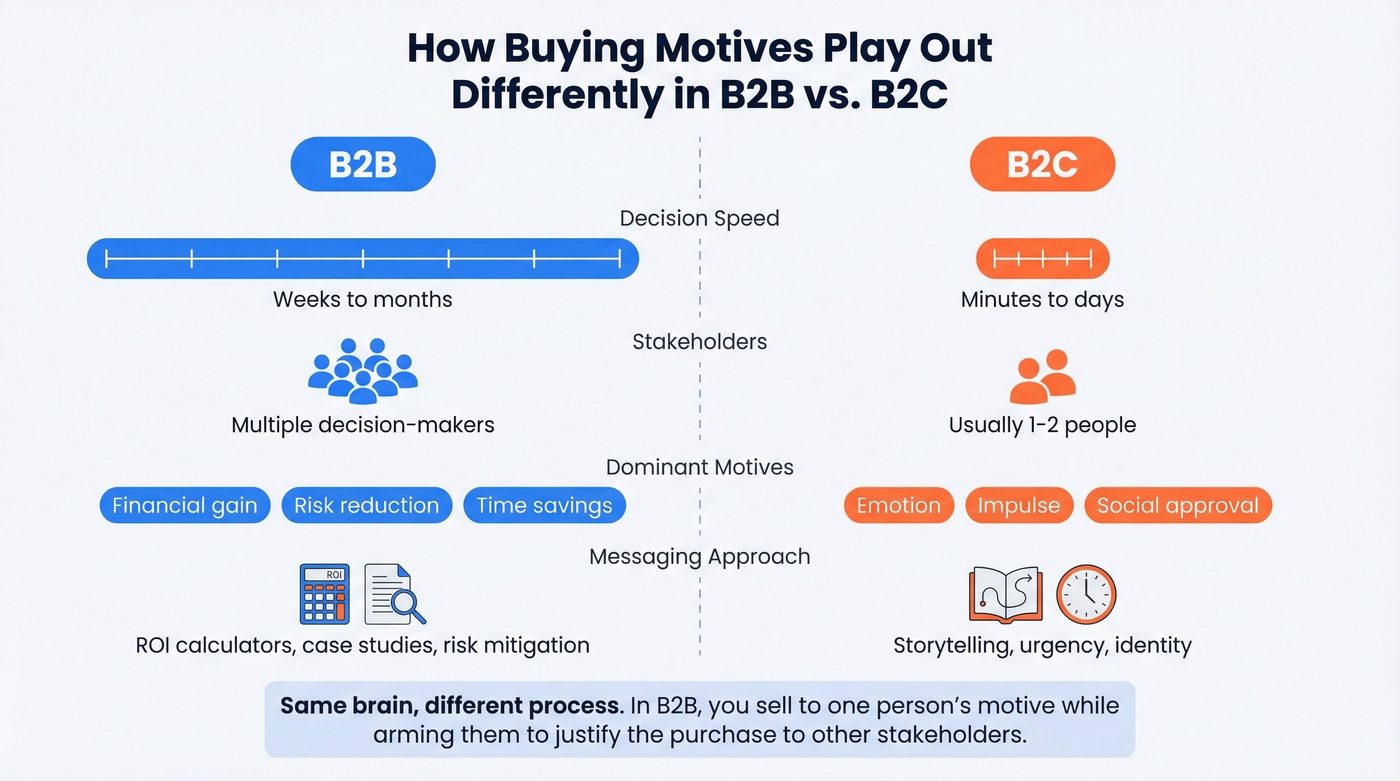
| Dimension | B2B | B2C |
|---|---|---|
| Decision Speed | Weeks to months | Minutes to days |
| Stakeholders | Multiple | Usually 1-2 |
| Dominant Motives | Financial gain, risk reduction, time savings | Emotion, impulse, social approval |
| Messaging Approach | ROI calculators, case studies, risk mitigation | Storytelling, urgency, identity |
A CRM evaluation can take weeks, involve multiple stakeholders, and hinge on a spreadsheet comparing annual cost savings. Buying a pair of running shoes can take seconds and hinge on whether they look good in the product photo. Same brain, completely different buying process. In B2B, you're often selling to one person's motive while arming them to justify the purchase against other stakeholders' motives.
Here's the thing: if your average deal size is under $15K, you probably don't need to map all ten motives. Focus on the top two - financial gain and fear - and you'll cover most of your pipeline. The full taxonomy matters when deals get complex, multi-threaded, and political.
How to Identify a Buyer's Motive
Three-Deep Questioning
The Brooks Group framework is the simplest model we've seen work consistently. Ask an open question. Follow up on the answer. Then dig one level deeper. The real motive almost never surfaces in the first response.
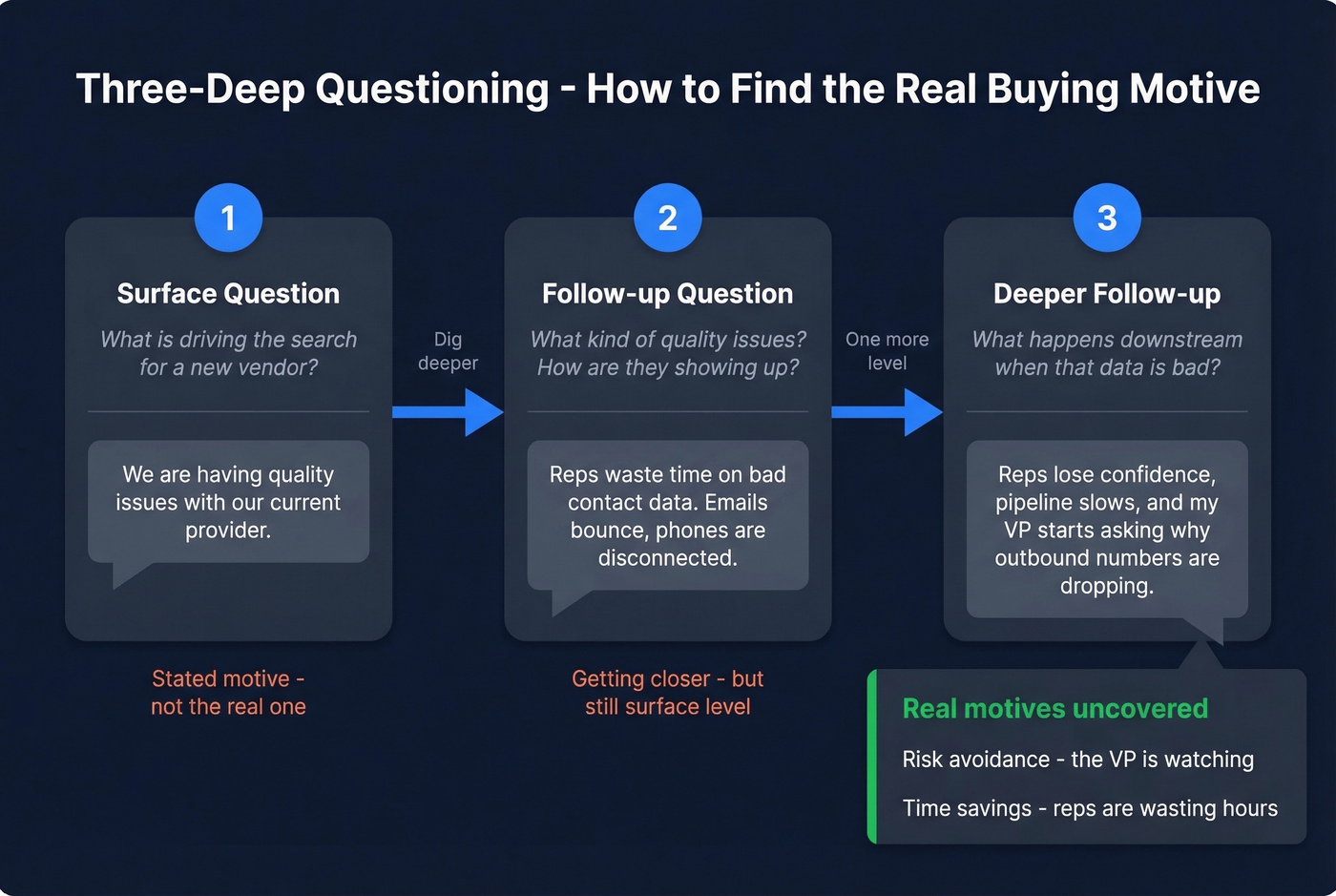
A worked example:
Surface question: "What's driving the search for a new vendor?" Answer: "We're having quality issues with our current provider."
Follow-up: "What kind of quality issues? How are they showing up?" Answer: "Our reps are wasting time on bad contact data. Emails bounce, phones are disconnected."
Deeper follow-up: "What happens downstream when that data is bad?" Answer: "Reps lose confidence in the list, pipeline slows down, and my VP starts asking why outbound numbers are dropping."
Now you've got the real motive: it's not "quality issues." It's risk avoidance (the VP's scrutiny) and time savings (reps wasting hours). Your pitch should address both.
Four Question Types
Structure your discovery around four question types:
- Probing: "What's the biggest bottleneck in your outbound process right now?"
- Process: "Walk me through how your team builds a target list today."
- Provoking: "What happens to pipeline if that bounce rate stays at 30% for another quarter?"
- Validating: "So the core issue is rep productivity, not list size - is that right?"
Most reps ask two or three surface questions and rush to the pitch. That's exactly why 73% of buyers say interactions feel transactional.
Start With the Right Data
The best discovery framework in the world is useless if your emails bounce or your phone numbers are disconnected. 59% of buyers say most sales reps don't bother to research basic information before reaching out. Motive-based selling requires reaching the actual decision-maker, not a generic info@ address.
Tools like Prospeo help here - 98% email accuracy, 125M+ verified mobile numbers, and a 7-day data refresh cycle mean your discovery scripts actually reach the right person with current data. If you're building a modern outbound stack, start with sales prospecting techniques and then tighten your list quality with data enrichment services.
How to Message Each Motive
Once you've identified the motive, your messaging needs to match it in both content and delivery style. The same product benefit, framed differently, converts differently depending on what's driving the buyer.
We've tested both gain and loss framing extensively - loss wins for risk-averse buyers almost every time. Compare these two subject lines for the exact same offer:
- Gain frame: "You'll save $4,200/month with automated enrichment."
- Loss frame: "You're bleeding $4,200/month on manual list building."
Same number. Completely different emotional response. The loss frame activates the fear/risk motive; the gain frame speaks to financial gain. Kahneman and Tversky's prospect theory explains why - losses loom larger than equivalent gains. For more options, pull from these email subject line examples and adapt them to the motive you're targeting.
Match the Motive to the CTA
| Motive | CTA Angle | Example |
|---|---|---|
| Financial Gain | Quantify the ROI | "See your projected savings in 60 seconds" |
| Fear / Risk | Highlight the cost of inaction | "Calculate what bad data costs you per quarter" |
| Need / Problem-Solving | Show the fix | "Watch how teams cut list-building from 6 hours to 30 minutes" |
| Comfort / Convenience | Emphasize simplicity | "One platform. No integrations required." |
| Status / Prestige | Name-drop peers | "Used by 15,000+ companies" |
| Social Proof | Show volume | "40,000+ teams use the Chrome extension" |
Adapt Your Delivery Style
Content is only half the equation. Directive buyers want bottom-line numbers fast - lead with the ROI and skip the preamble. Analytical buyers want the methodology behind your claims, so give them the data sheet. Amiable buyers need to feel the relationship is solid before they'll engage on specifics, which means investing in rapport first. Expressive buyers respond to vision and energy - paint the picture of what success looks like.
Skip the delivery-style matching if you're running high-volume outbound to cold lists. It matters most in live conversations and mid-funnel sequences where you've already had a touchpoint.
Mistakes That Kill Motive-Based Selling
Feature-dumping instead of outcome-selling. Nobody cares about your 47 integrations. They care about whether their reps will hit quota. If you need a tighter structure, use a simple AIDA sales funnel to keep the conversation outcome-first.
Assuming the stated motive is the real motive. "We need better data" usually means "my boss is breathing down my neck about pipeline." Dig deeper. A formal set of discovery questions helps you surface the real driver faster.
Pitching to the wrong stakeholder's motive. The end user cares about ease of use. The VP cares about cost. The CFO cares about contract flexibility. One pitch doesn't fit all three - and in B2B, you need to arm your champion with different arguments for each stakeholder in the room. This is where MEDDIC sales qualification keeps you honest about who cares about what.
Using stale contact data. I can't stress this enough: 59% of buyers say reps don't research basic information. If you're calling someone who left the company six weeks ago, no amount of motive alignment saves you. The consensus on r/sales is brutal about this - bad data kills credibility before you even get to the pitch. If deliverability is part of the problem, start with email bounce rate benchmarks and fixes.
Product motives or patronage motives - neither converts if your email bounces. Prospeo's proprietary 5-step verification delivers 98% email accuracy and a 7-day data refresh cycle. Teams using Prospeo book 26% more meetings than ZoomInfo users because every message actually lands.
Turn motive insight into pipeline with data that connects.
FAQ
What are the most common types of buying motives?
The most common buying motives are rational (price, ROI, features), emotional (fear, status, pleasure), and patronage-based (brand loyalty, seller trust). In B2B, financial gain and risk avoidance dominate. Most purchases involve all three categories working simultaneously.
How do you uncover a buyer's real motive?
Use three-deep questioning: ask an open question, follow up on the answer, then dig one level deeper. The real driver rarely surfaces in the first response. Structure discovery around probing, process, provoking, and validating questions to move past surface-level answers.
Do buying motives differ between B2B and B2C?
The underlying psychology is identical - the buying process changes. B2B clusters around financial gain and risk reduction across multiple stakeholders over weeks or months. B2C leans toward emotion, impulse, and social approval with decisions made in minutes.
What are product based buying motives?
Product based buying motives are purchase reasons tied to the product itself - features, quality, design, or price-to-performance ratio. They contrast with patronage motives, where the decision hinges on the seller's reputation or the buyer's relationship with the brand. Buyers driven by product motives switch vendors the moment a better option appears.
What tools help with motive-based outbound selling?
Motive-based selling requires reaching verified decision-makers, not generic inboxes. Prospeo provides 98%-accurate emails and 125M+ verified mobile numbers on a 7-day refresh cycle. Pair that with a CRM like HubSpot or Salesforce for tracking which motives convert best across your pipeline.