

Unlimited Email Sending Is a Lie - Here's What Actually Works
A Reddit user bought a 10,000-contact CSV, sent four newsletters over eight months, and watched their domain reputation crater so badly that even one-to-one replies started landing in spam. That's what happens when you take "unlimited email sending" at face value. It's the most misleading phrase in email marketing, and the platforms using it know exactly what they're doing.
What You Need (Quick Version)
"Unlimited" always means unlimited connected accounts, not unlimited sends per inbox. Safe cold email caps at roughly 30 emails per inbox per day. Safe marketing email requires warmup, authentication, and verified lists - no exceptions.
Three things to do right now:
- Pick your platform type - marketing/newsletter, cold outreach, or raw SMTP. Different tools, different rules.
- Verify your entire list before sending a single email. Bounces destroy sender reputation faster than anything else.
- Follow the 5-week warmup ramp below. Skip it and you'll end up like the Reddit user above.
What "Unlimited" Actually Means
Here's the thing: every platform advertising "unlimited" knows you'll assume it means something it doesn't.
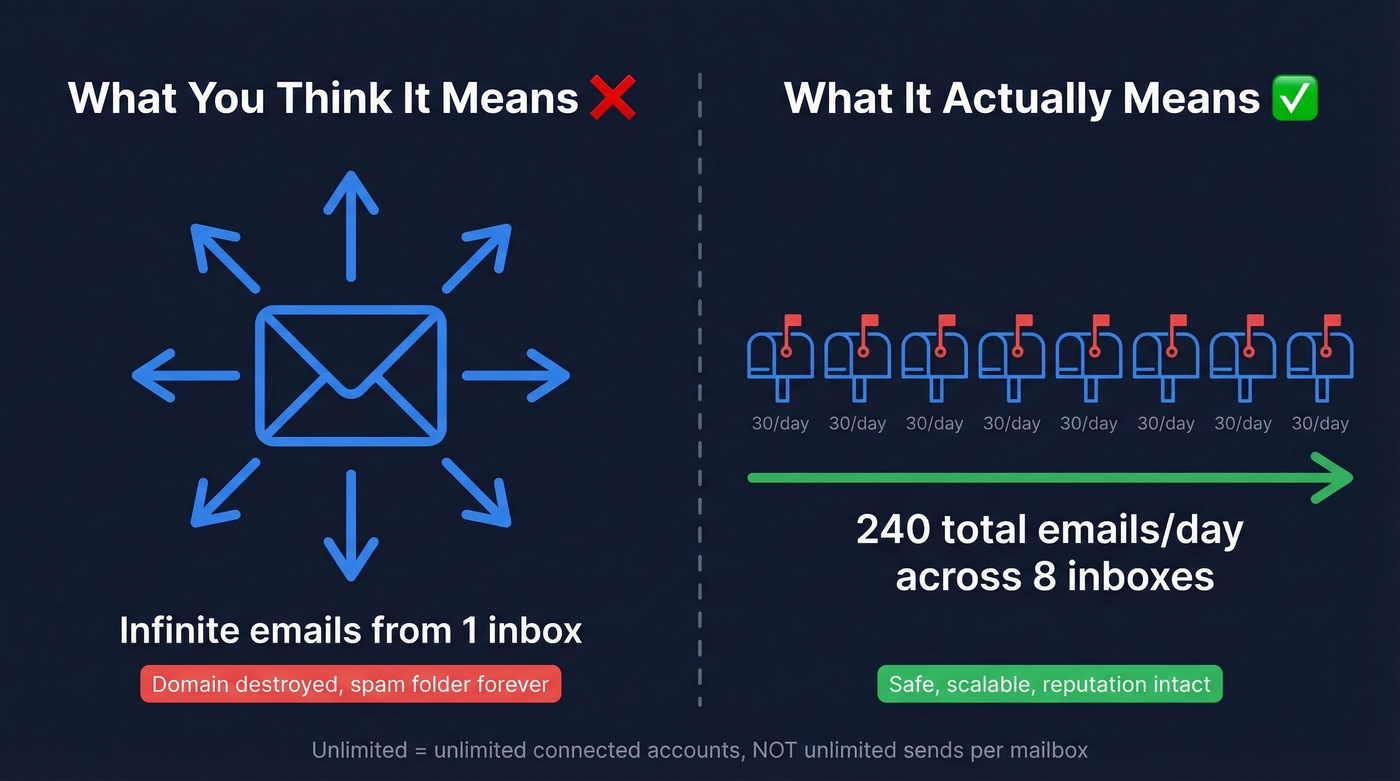
What it is: Unlimited connected sending accounts or inboxes. Instantly defines it this way - you can connect as many mailboxes as you want on any paid plan. That's the "unlimited" part. What it isn't: Unlimited sends from a single mailbox. Every inbox still has a safe daily cap. Instantly's own guidance recommends ramping from 10 to 20 to 30 emails per day per inbox, then holding at ~30 in production. Hard bounces need to stay under 1%, spam complaints under 0.3%.
The distinction matters because "unlimited accounts" means you scale horizontally - more inboxes, not more volume per inbox. Conflating the two is how people torch their domains.
Baseline Provider Limits
Every major email provider enforces daily sending caps. These are the walls that "unlimited" platforms distribute load across:
| Provider | Daily Limit | Notes | |---|---:|---| | Gmail (free) | ~500/day | Personal accounts | | Google Workspace | ~2,000/day | Business accounts | | Outlook.com (Microsoft 365) | 5,000 daily recipients | 500 recipients/message, 1,000 daily non-relationship recipients | | Exchange Online | ~10,000/day | Org-dependent |
If you're sending more than a couple thousand emails a day, you've already outgrown native provider limits. The "unlimited" platforms don't eliminate these rules - they spread the load across enough inboxes that the per-account caps stop being the bottleneck.
Marketing Email vs. Cold Outreach
The word "unlimited" shows up on two completely different categories of tools, and mixing them up leads to bad decisions.
Marketing/newsletter platforms like MailerLite, Brevo, Moosend, and Systeme.io offer "unlimited emails" within a subscriber tier. You pay based on how many contacts you have, and the platform handles deliverability through shared or dedicated IPs. Compliance is CAN-SPAM and GDPR - unsubscribe links, opt-in requirements, the works. These tools are built for people who already have permission to email their audience.
Cold outreach platforms like Instantly, Smartlead, and GMass offer "unlimited connected accounts" and use sender rotation to spread volume across dozens or hundreds of inboxes. Compliance here is about warmup, reputation management, and keeping bounce rates low. Totally different game.
A marketing platform won't help you run cold outbound, and a cold outreach tool is a terrible choice for newsletters. Pick the wrong category and you'll fight the tool the entire time.
If you're comparing tools for outreach, start with cold outreach platforms that match your volume and workflow.

Sending unlimited emails to unverified contacts is the fastest way to torch your domain. Prospeo's 5-step verification and 7-day data refresh keep bounce rates under 1% - the exact threshold this article warns you never to cross. At $0.01 per email, cleaning your list costs less than a single wasted campaign.
Fix your list before you hit send. 98% accuracy, every time.
Platform Pricing Compared
Cold Outreach
Instantly starts at $37/mo (Growth) and scales to $358/mo (Light Speed), with unlimited email accounts on every tier. One analysis based on 8M+ emails across 200+ client accounts puts Instantly at 94% inbox placement vs. Smartlead's 89%, against a 76% industry average. That 5-point gap compounds at scale: on a 50,000-email campaign, it's the difference between 47,000 and 44,500 emails reaching the inbox.
If you're building sequences, a solid B2B cold email sequence matters more than the tool logo.
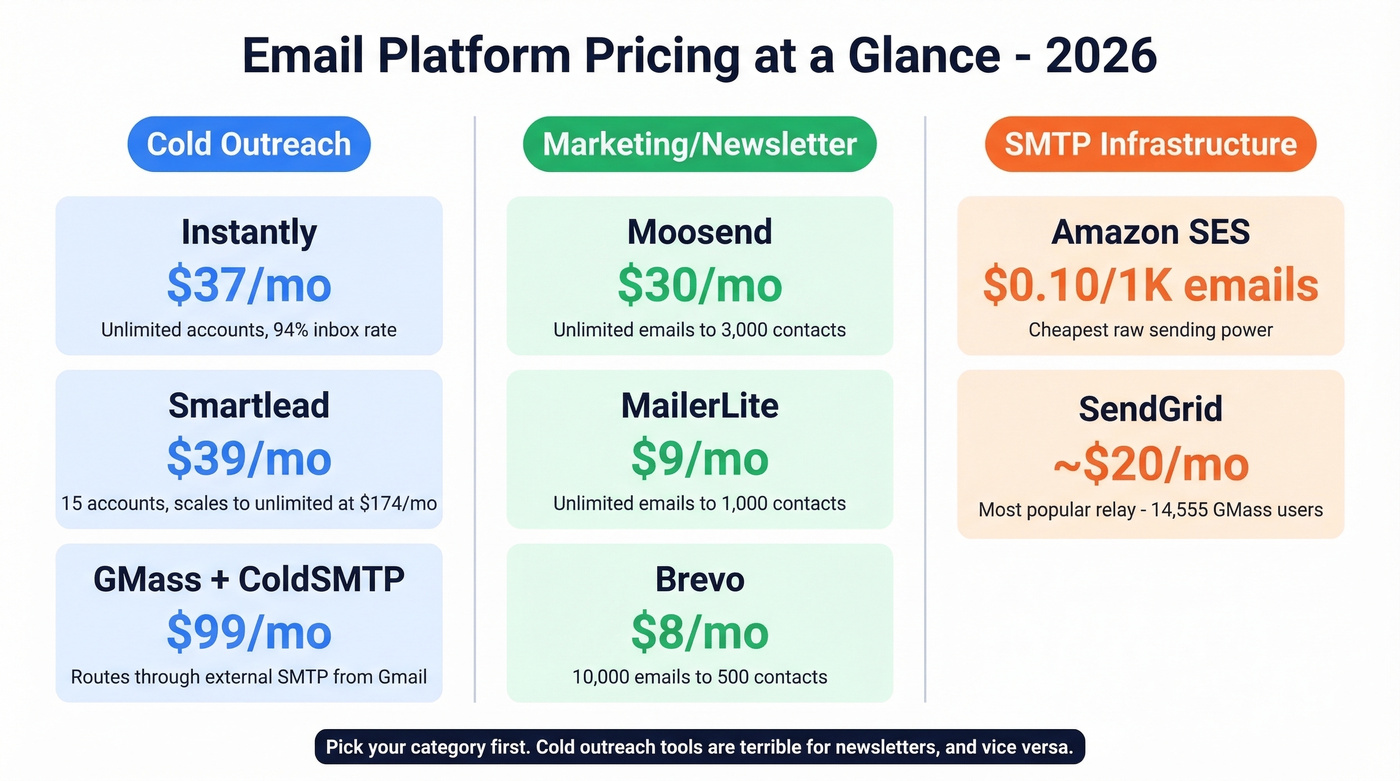
Smartlead starts at $39/mo for 15 accounts, scaling to $174/mo for unlimited. The pricing gap between the two narrows at the top end, but Instantly's unlimited accounts on the cheapest plan makes it the more straightforward starting point.
GMass takes a different approach - it routes sends through external SMTP while managing campaigns from Gmail. For real volume, you'll typically pair it with something like ColdSMTP ($99/mo). If GMass is in your stack, keep an eye on GMass email deliverability as you scale.
Two platforms to skip. DitLead markets aggressively as an "unlimited" platform, but its G2 reviews tell a different story - 3.9/5 from just 5 reviews, with the most recent being a 0/5 titled "Unreliable, Buggy, and Poorly Supported." MorphyMail offers a $199 lifetime deal for "unlimited" cold email sending. Lifetime deals on per-email infrastructure defy basic economics - the math doesn't work unless they cut corners on deliverability, support, or both. We've seen teams burn through domains chasing deals like this.
Marketing/Newsletter
For newsletter and marketing email, the pricing model flips - you pay per contact, not per email. Here's what a $30/month snapshot looks like:
| Platform | $30/mo Gets You |
|---|---|
| Moosend | Unlimited emails to 3,000 contacts |
| MailerLite | Unlimited emails to 1,000 contacts |
| Brevo | 10,000 emails to 500 contacts |
MailerLite starts from $9/mo, Brevo from about $8/mo. Systeme.io offers a free plan with no credit card required. The "unlimited" label means very different things depending on where the cap sits - Moosend gives you the most headroom per dollar at this price point.
SMTP Infrastructure
If you want raw sending power without a platform layer, Amazon SES at $0.10 per 1,000 emails is hard to beat on cost.
SendGrid is the most popular SMTP relay by a wide margin in GMass's live SMTP usage data - 14,555 GMass users connect through smtp.sendgrid.net, far ahead of the next options:
| SMTP Provider | GMass Users | Approx. Cost |
|---|---|---|
| SendGrid | 14,555 | Free plans available; paid ~$20/mo |
| Gmail SMTP | 1,328 | Provider limits apply |
| Mailjet | 1,302 | Varies by plan |
| SparkPost | 1,262 | Varies by plan |
| Mailgun | 1,223 | Varies by plan |
| Brevo SMTP | 677 | Varies by plan |
| Amazon SES | 467 | $0.10 per 1,000 emails |
| SMTP2GO | 241 | Varies by plan |
SES for cost, SendGrid for ease. That's the decision most teams end up making.
If you're unsure where your ceiling is, track email velocity before you scale spend.
Deliverability Guardrails
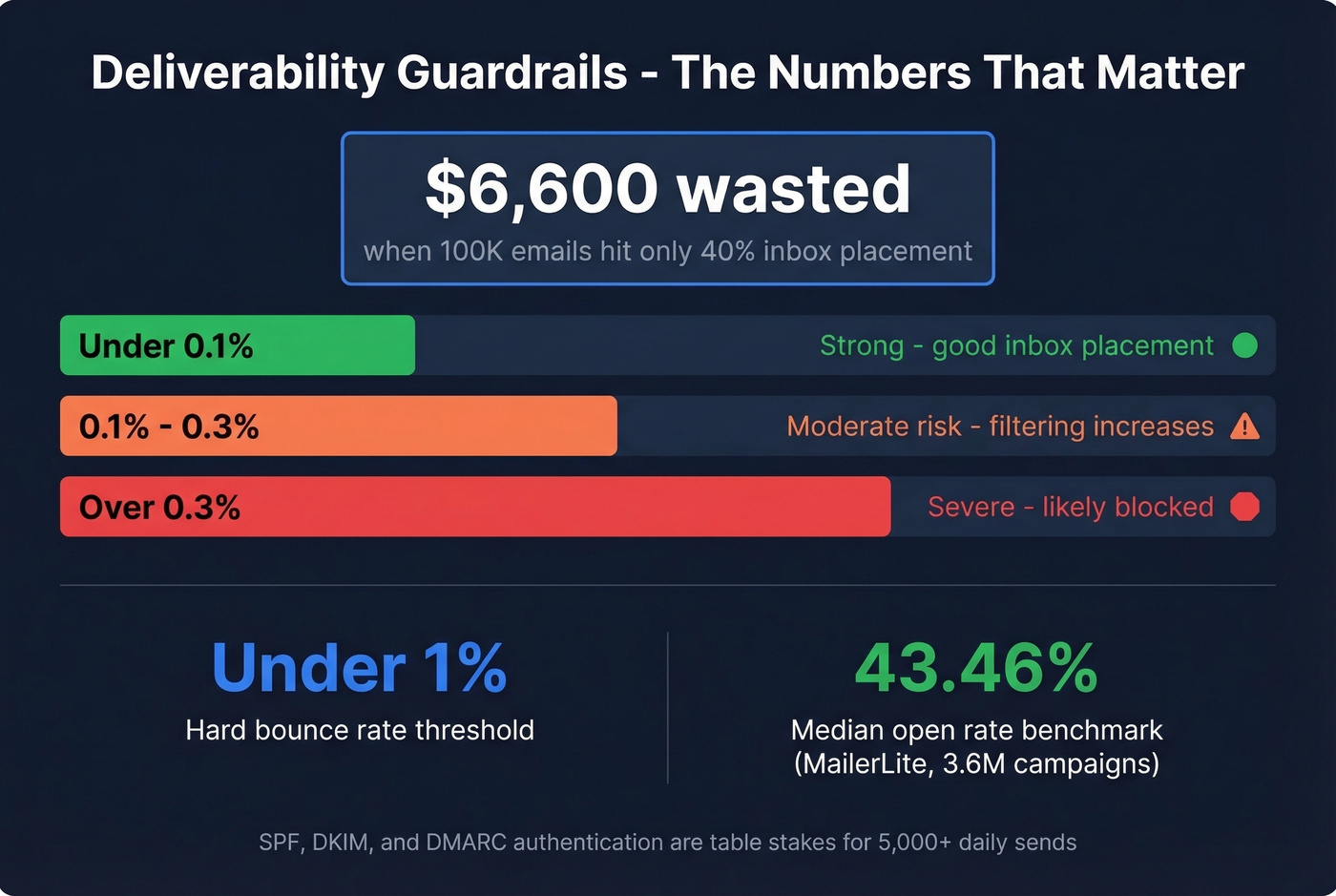
Stop chasing "unlimited." Chase deliverability. A 95% inbox placement rate on 10,000 emails beats 40% placement on 100,000 every single time. Using the common $0.11-per-missed-inbox benchmark, 100,000 sends at 40% placement means roughly $6,600 wasted.
If you want the full checklist, use an email deliverability guide instead of guessing.
| Spam Complaint Rate | Risk Level | What Happens |
|---|---|---|
| <0.1% | Strong | Good inbox placement |
| 0.1%-0.3% | Moderate risk | Filtering increases |
| >0.3% | Severe | Likely blocked |
Hard bounces need to stay below 1%. SPF, DKIM, and DMARC authentication aren't optional - they're table stakes for anyone sending 5,000+ emails a day. If you suspect auth issues, start with SPF record examples and then confirm how to verify DKIM is working.
For context on what "good" looks like: MailerLite's benchmark dataset across 3.6 million campaigns shows a median open rate of 43.46%. If you're well below that, your deliverability has a problem, and volume won't fix it.
Why List Quality Matters More Than Volume
You can connect 200 inboxes and warm them for six weeks, but if 10% of your emails bounce, none of it matters. In our experience, the real bottleneck is never the sending platform - it's the list.

Bounces destroy sender reputation faster than spam complaints, volume spikes, or bad content combined. Invalid addresses, spam traps, and catch-all domains are the silent killers of high-volume campaigns. The consensus on r/coldemail is pretty clear: if you're not verifying before every send, you're gambling with your domain.
Prospeo's 5-step verification catches exactly these problems - spam-trap removal, honeypot filtering, and catch-all domain handling at 98% email accuracy, with data refreshed every 7 days. Stack Optimize scaled to $1M ARR while maintaining 94%+ client deliverability, bounce rates under 3%, and zero domain flags across all clients using Prospeo-verified lists. The free tier covers 75 verifications per month, enough to test the workflow before you commit.
If you're troubleshooting, it helps to know the benchmarks and causes behind email bounce rate before you change tools.
Let's be honest: if your deal sizes sit below five figures, you probably don't need Instantly's $358/mo plan or 200 connected inboxes. You need 5 clean inboxes and a verified list. Most teams over-invest in sending infrastructure and under-invest in data quality. Fix the data first - the volume will follow.
5-Week Warmup Ramp
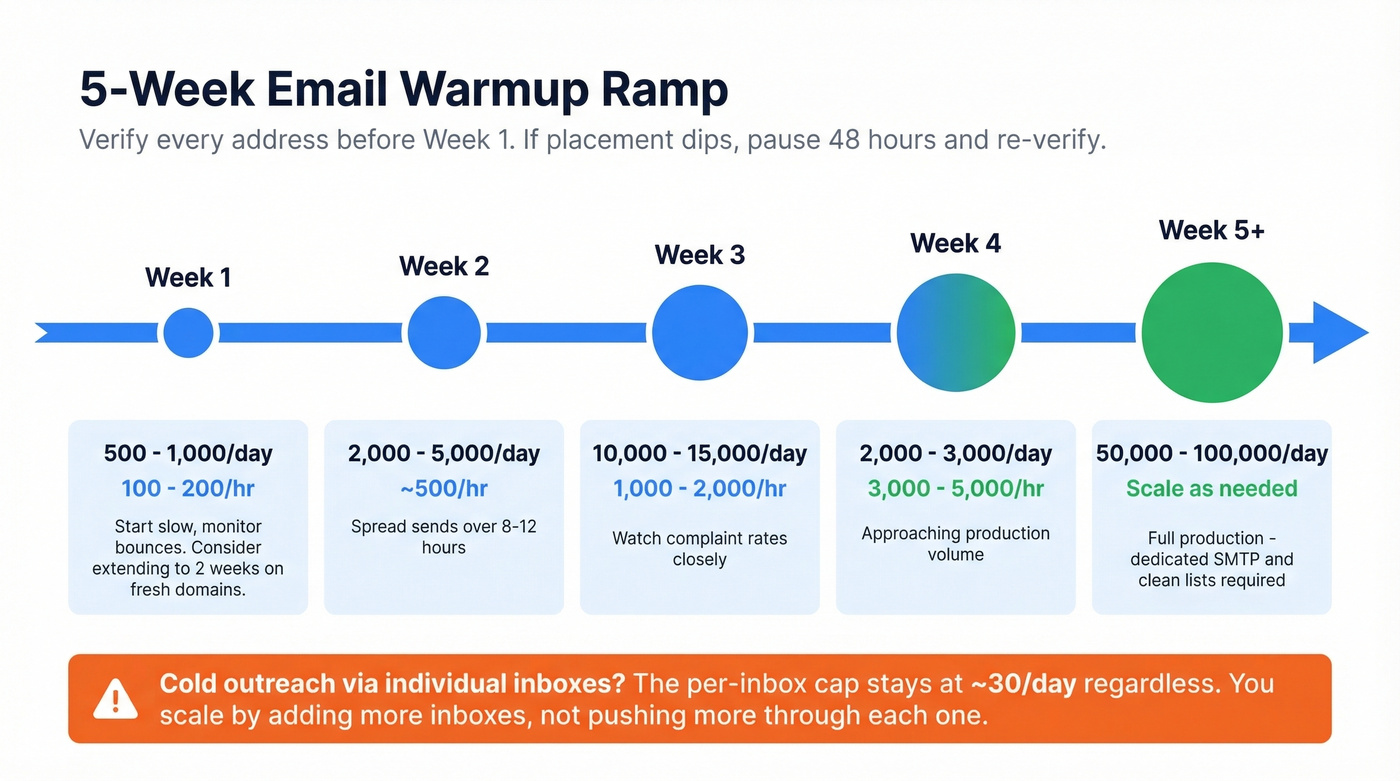
Verify every address before Week 1. Once your list is clean, follow this ramp:
| Week | Daily Volume | Hourly Rate | Notes |
|---|---|---|---|
| Week 1 | 500-1,000 | 100-200/hr | Start slow, monitor bounces |
| Week 2 | 2,000-5,000 | ~500/hr | Spread over 8-12 hours |
| Week 3 | 10,000-15,000 | 1,000-2,000/hr | Watch complaint rates |
| Week 4 | 20,000-30,000 | 3,000-5,000/hr | Approaching production |
| Week 5+ | 50,000-100,000 | Scale as needed | Full production volume |
This schedule assumes dedicated SMTP infrastructure and clean lists. If you're running cold outreach through individual inboxes, the per-inbox cap stays at ~30/day regardless - you scale by adding more inboxes, not by pushing more through each one. We've found most teams benefit from extending Week 1 to a full two weeks, especially on fresh domains.
If your placement dips at any stage, pause for 48 hours, re-verify your list, and resume at a lower volume. Pushing through a dip is how domains end up on blacklists. If you do get listed, follow a proper Spamhaus blacklist removal process instead of blasting more volume.
You just read how bad data turned a 10,000-contact CSV into a domain reputation disaster. Prospeo's 143M+ verified emails are refreshed every 7 days - not every 6 weeks like competitors. That means fewer bounces, fewer spam complaints, and more emails actually reaching the inbox.
Stop scaling sends on stale data. Start with contacts that are actually real.
FAQ
Is there a truly unlimited email sending service?
No. Every platform enforces per-inbox daily caps, fair-use policies, or contact-tier limits. "Unlimited" means unlimited connected accounts or unlimited emails within a subscriber tier - not infinite sends from one mailbox. Safe cold email maxes at ~30 per inbox per day; you scale by adding inboxes, not raising that cap.
How many emails can I send daily without getting blacklisted?
A fully warmed domain on dedicated SMTP can handle 50,000-100,000 per day. A single Gmail inbox caps at ~500/day (free) or ~2,000/day (Workspace). The numbers that actually matter: keep spam complaints below 0.1% and hard bounces below 1%. Volume is secondary to reputation.
Do I need to verify my list before sending at scale?
Yes - it's the single most important step. Unverified lists contain invalid addresses, spam traps, and catch-all domains that destroy sender reputation within days. No amount of warmup compensates for a dirty list.
What's the cheapest way to send bulk emails?
Amazon SES at $0.10 per 1,000 emails is the lowest-cost SMTP option for raw volume. For cold outreach with built-in warmup and rotation, Instantly starts at $37/mo with unlimited accounts. For newsletters, Systeme.io offers a free plan. In every case, pair the platform with verified data - cheap sends to bad addresses cost more than premium sends to clean lists.