

Unsubscribe Rate: What's Normal, Why It Spiked, and How to Fix It
You opened your ESP dashboard Monday morning and your unsubscribe rate had doubled over the weekend. Nothing changed - same list, same content, same send cadence. Before you tear apart your email strategy, there's a good chance the problem isn't you. Gmail quietly rolled out a feature in mid-2025 that's inflating these numbers for many U.S. senders, and most older guides haven't caught up.
The Short Version
- Benchmark: A healthy rate is under 0.5% for opted-in lists. The all-industry average sits at 0.22% across both Mailchimp and HubSpot datasets.
- Gmail context: If your rate spiked mid-2025, Gmail's Manage Subscriptions feature is likely inflating your numbers - not your content. One user action can generate 15+ List-Unsubscribe requests.
- Highest-ROI fix: Build a preference center with frequency controls. Brands with opt-down options see up to 30% fewer unsubscribes without reducing send volume.
What Is Unsubscribe Rate?
Unsubscribe rate measures the percentage of recipients who opt out of your emails after a given send. Sometimes called the email opt-out rate, it's one of the core metrics every sender should track. The formula is straightforward:
Unsubscribe Rate = (Unique Unsubscribes / Delivered Emails) x 100
The denominator matters. Use delivered emails, not sent emails - "delivered" means accepted by the receiving mail server, so bounces don't count. Some ESPs label this denominator differently in their dashboards, which can make your rate look artificially low if you aren't comparing apples to apples. Campaign Monitor and most industry benchmarks standardize on delivered.
This guide focuses on email opt-outs specifically. SMS and push notification unsub rates follow different benchmarks and different mechanics entirely.
Benchmarks by Industry
Two datasets dominate the benchmark conversation: Mailchimp's, based on billions of delivered emails and still the most granular ESP benchmark available despite its December 2023 update, and HubSpot's 2025 report. They align closely on the all-industry average, which adds confidence to the numbers.
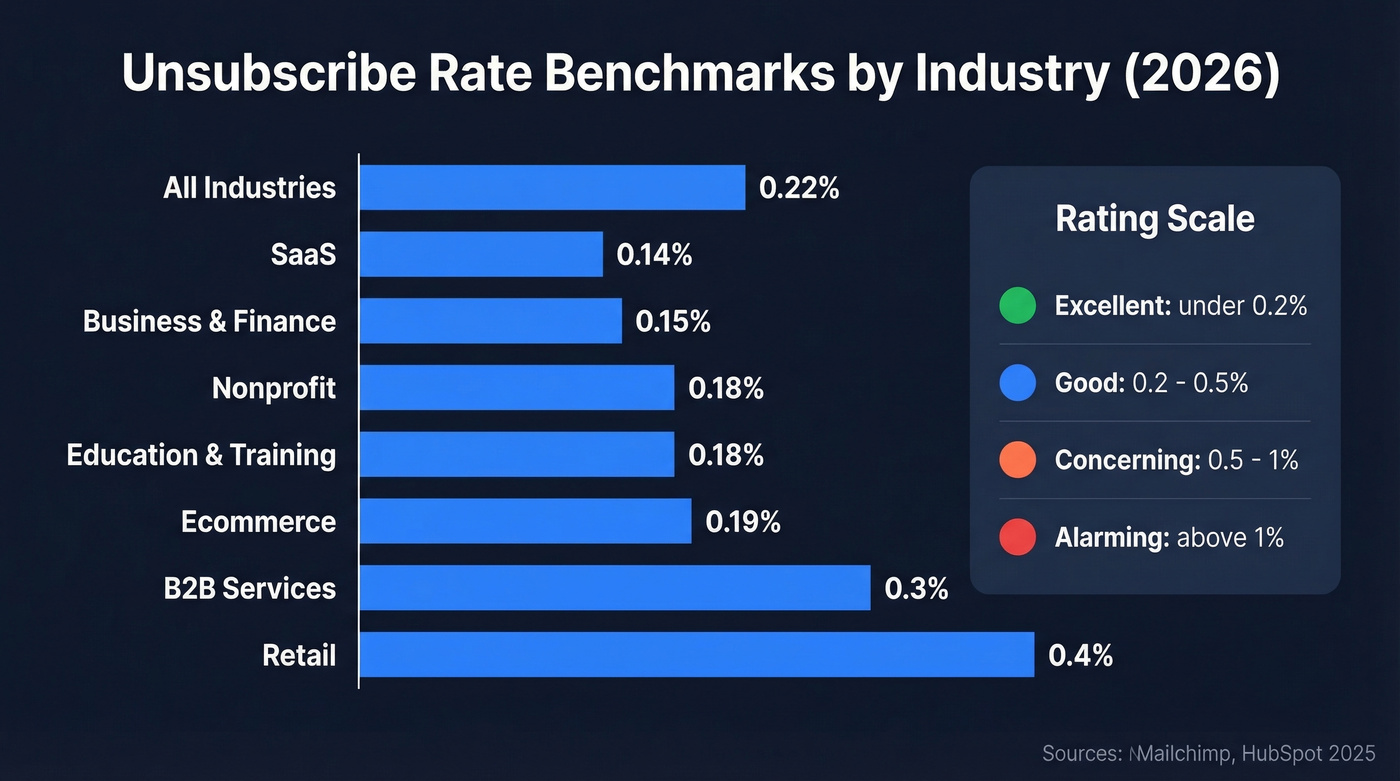
| Industry | Mailchimp | HubSpot 2025 |
|---|---|---|
| All Industries | 0.22% | 0.22% |
| SaaS | - | 0.14% |
| Business & Finance | 0.15% | - |
| Nonprofit | 0.18% | 0.18% |
| Education & Training | 0.18% | - |
| Ecommerce | 0.19% | - |
| B2B Services | - | 0.3% |
| Retail | - | 0.4% |
A dash means the source doesn't report that industry separately. Brevo's 2025 benchmark report, built on a 44 billion email dataset, reinforces that the average email opt-out rate is a standard KPI tracked at global scale.
Here's a quick rating scale:
- Excellent: under 0.2%
- Good: 0.2-0.5%
- Concerning: 0.5-1%
- Alarming: above 1%
So what's a good unsubscribe rate for email? Anything under 0.5% is safe for opted-in lists. The industry standard hovers around 0.2%, but your specific vertical matters - retail and B2B services tend to run higher than SaaS or nonprofit.
Here's the thing: many benchmark guides were written before Gmail's July 2025 Manage Subscriptions rollout, which means their "alarming" thresholds don't account for artificially inflated metrics. We've found that many teams obsess over opt-out numbers when they should be watching spam complaints instead. HubSpot's rule of thumb is simple - under 0.5% is healthy. But before you panic about a number above that, read the next section. Your metrics might be lying to you.

Stop paying for bounced emails. Prospeo verifies every contact with 98% accuracy, refreshed every 7 days.
Start free and only pay for verified contacts
Why Your Rate Spiked (Blame Gmail)
Google rolling out a feature that generates 15 unsubscribe requests from a single user action, without warning senders, is the kind of thing that makes email marketing feel like a rigged game.
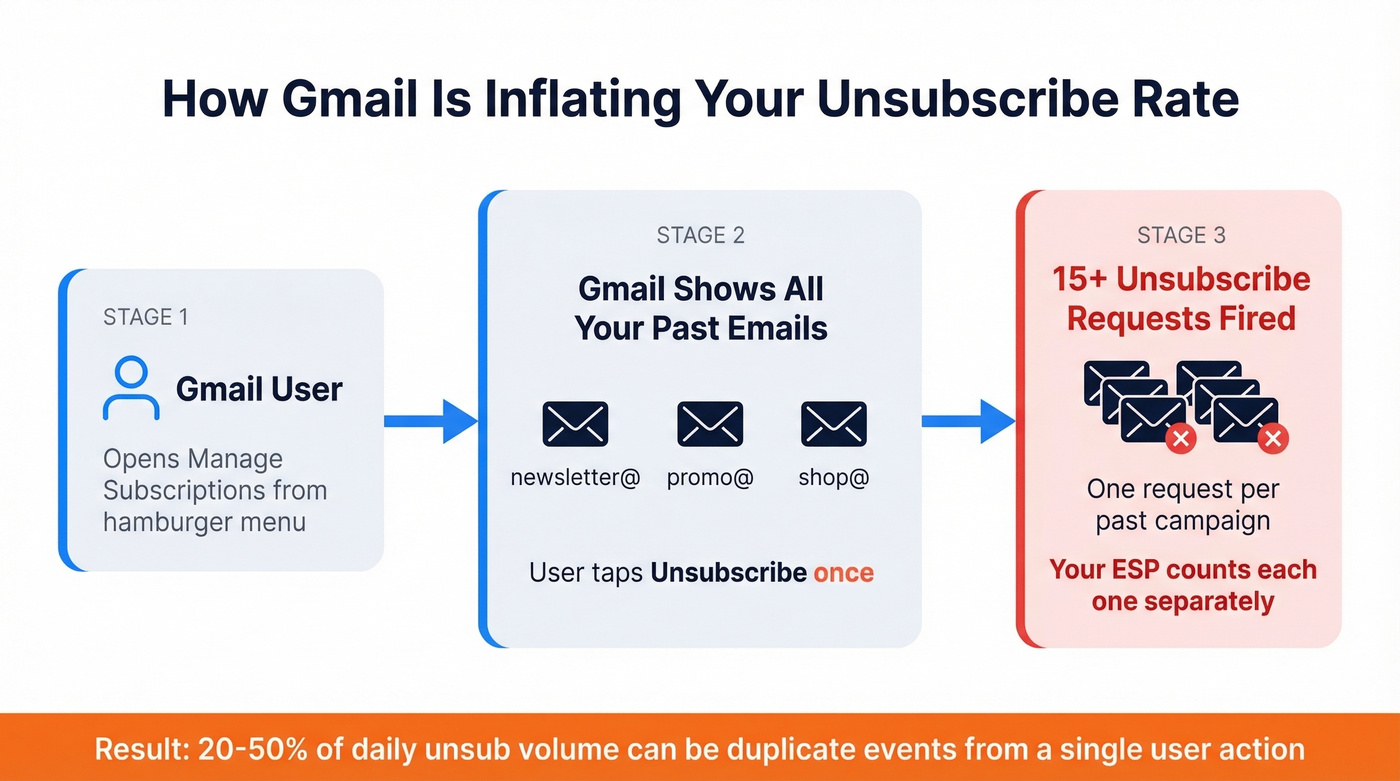
Gmail launched its Manage Subscriptions feature in a phased rollout, with some senders noticing elevated volume as early as mid-June 2025. The official dates:
- July 8 - Gmail web users
- ~July 14 - Android
- ~July 21 - iOS
The feature lives in Gmail's hamburger menu and shows users many of the brands they're subscribed to, grouped by frequency. One tap unsubscribes from a sender.
The impact was immediate. Agencies tracking portfolio-wide metrics reported opt-out increases of 50-150% across their accounts, with spikes peaking in August before settling at a permanently elevated baseline. Some large senders saw unsub volume nearly double overnight.
But the mechanic that's really messing with your data is worse than the headline number suggests. If Gmail shows a user that your brand sent 15 messages and they hit unsubscribe, that can fire 15 separate List-Unsubscribe requests back to your ESP. Salesforce found that these duplicate requests account for 20-50%+ of daily unsub volume for some senders. Validity confirmed the same pattern - the same person unsubscribing dozens of times from campaigns spanning the past year, throwing off reporting entirely. In our experience, the real number skews closer to 30-40% duplicate events for high-volume senders.
It gets worse. Gmail treats different From addresses like newsletter@, promo@, and shop@ as separate subscriptions, so a single brand using three different From addresses can generate three separate unsubscribe events. U.S. senders are disproportionately affected compared to international lists. This also has implications for email deliverability - spikes can trigger ISP throttling if your sending reputation dips.
Most guides saying "1-2% is alarming" haven't accounted for this. Since Gmail's July 2025 rollout, reporting baselines for 2026 senders have shifted. Before you overhaul your strategy, compare your raw unsub count against your unique-subscriber unsub count to see the real number.
Cold Email vs. Opted-In Lists
Those benchmarks above assume opted-in subscribers who asked to hear from you. Cold outreach operates in a completely different universe.
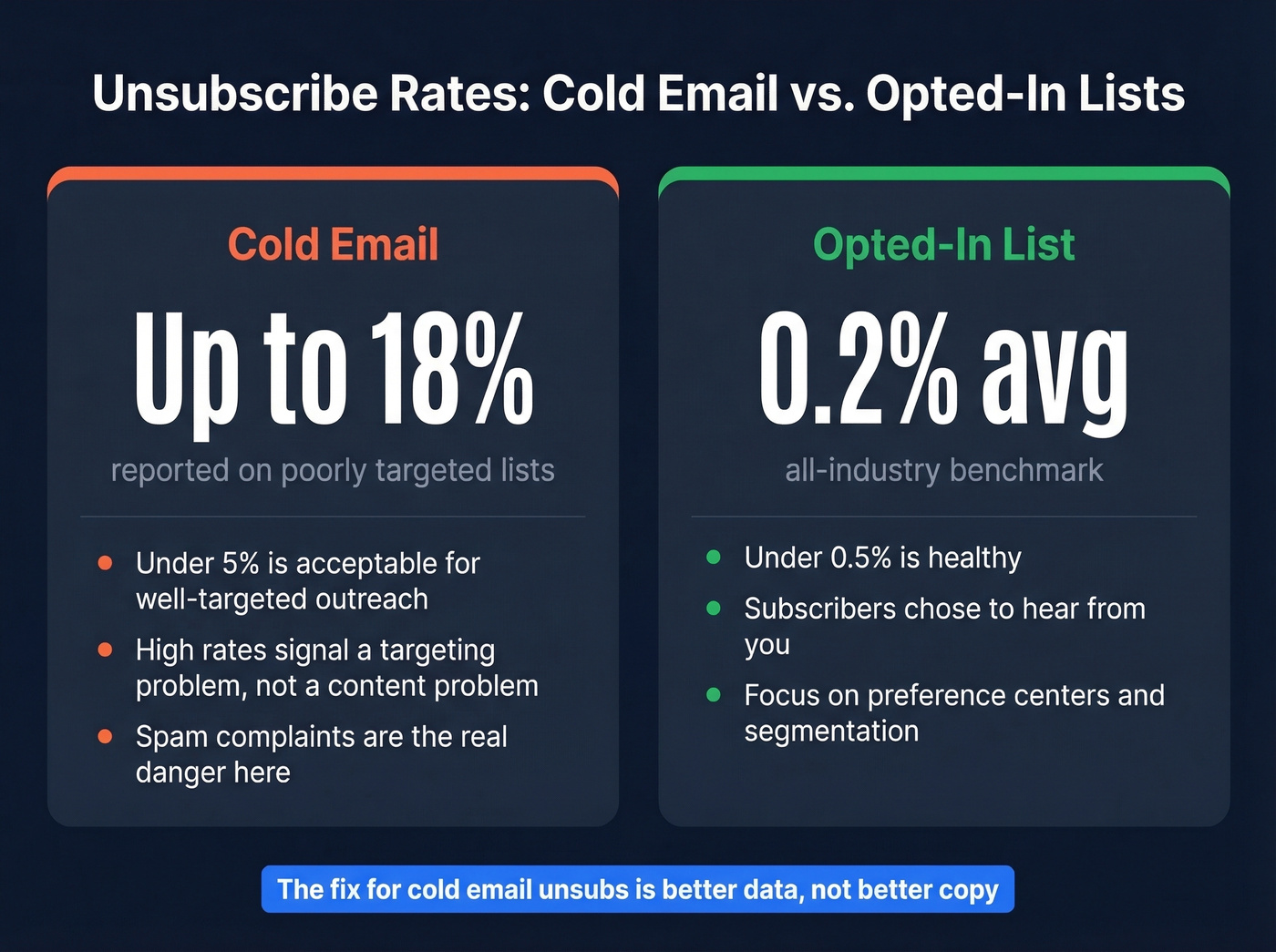
One Reddit poster reported an 18% unsubscribe rate on cold B2B emails - with a 50% open rate. That's not a content problem. That's a targeting problem. When you're emailing people who never opted in, the benchmarks are meaningless without context about how the list was built. A normal cold email opt-out rate is significantly higher than for marketing lists - under 5% is generally considered acceptable for well-targeted prospecting.
If your unsub rate is high on cold emails, the problem isn't your copy - it's your data. Emailing stale addresses or people who changed jobs three months ago doesn't just drive unsubscribes, it drives spam complaints, which are far more damaging. The consensus on r/Emailmarketing is pretty clear: verify contacts before sending, or don't send at all. If you're building outbound at scale, it also helps to tighten your sales prospecting techniques so you're not spraying irrelevant offers.
9 Ways to Reduce Your Unsubscribe Rate
1. Build a Preference Center
This is the single highest-ROI tactic. Instead of offering only "unsubscribe from everything," give subscribers an opt-down path: frequency controls like daily, weekly, or monthly options, content-type selection, and a pause option for people who just need a break. Brands with preference centers see up to 30% fewer full unsubscribes without reducing overall send volume. We've seen this work firsthand - one client added a simple three-option frequency selector and their unsub rate dropped from 0.45% to 0.28% within two months.
2. Segment by Engagement
Split your list into engaged and disengaged cohorts. Reduce frequency for low-engagement segments automatically. There's no reason to email someone daily who hasn't opened in 90 days. If you want a tighter measurement framework, map this to your broader funnel metrics so you can see where engagement actually drops.
3. Set Expectations at Signup
Tell subscribers exactly what they'll get and how often. "Weekly tips every Tuesday" sets a clear contract. Mismatched expectations are one of the top unsub drivers, and they're entirely preventable.
4. Test Send Frequency
Over-sending is the number one reason people unsubscribe. We've seen teams cut their rates in half just by moving from three sends per week to one. Test weekly vs. biweekly and let the data decide. If you're doing outbound, your email velocity matters too.
5. Clean Your List
Invalid and stale addresses don't just bounce - they signal to ISPs that you aren't maintaining your list, which hurts deliverability for everyone on it. Verify before you send. Prospeo checks every address in real time with 98% accuracy on a 7-day refresh cycle, and its 5-step verification process includes catch-all handling, spam-trap removal, and honeypot filtering - the kind of hygiene that prevents deliverability problems before they start. If you're diagnosing issues, start with your email bounce rate and work backward.
6. Authenticate Your Domain
SPF, DKIM, and DMARC aren't optional anymore. Google and Yahoo's 2024 sender requirements made authentication mandatory for bulk senders. Unauthenticated emails land in spam, and people who find your emails in spam are far more likely to unsubscribe. If you need a quick check, use this guide on how to verify DKIM is working.
7. Personalize Beyond First Name
Content relevance based on behavior - what they clicked, what they bought, what page they visited - is what actually reduces unsubs. Generic blasts to your entire list will always have higher opt-out rates than targeted sends. For a practical playbook, see targeted email campaigns.
8. Consolidate From Addresses
Fewer From addresses means fewer entries in Gmail's Subscription Center, which means fewer duplicate unsub events. If you're sending from newsletter@, promo@, and updates@, consolidate to one or two.
9. Run Re-Engagement Campaigns
Win people back before they hit unsubscribe. A simple "We noticed you haven't opened in a while - want to stay?" email with a preference center link gives disengaged subscribers a reason to stick around. Sunset the non-responders after 2-3 attempts.
Skip re-engagement campaigns if your list is under 1,000 subscribers - the sample sizes are too small to learn anything, and you're better off just cleaning the list and moving on.
One more thing: if your unsubscribe rate is under 0.3% and your open rates are declining, you might actually be under-sending. A list that never unsubscribes is often a list that stopped paying attention. Some churn is healthy - it means you're sending enough to stay relevant.
Unsubscribe Rate vs. Spam Complaints
An unsubscribe is a healthy exit. A spam complaint is a fire alarm.
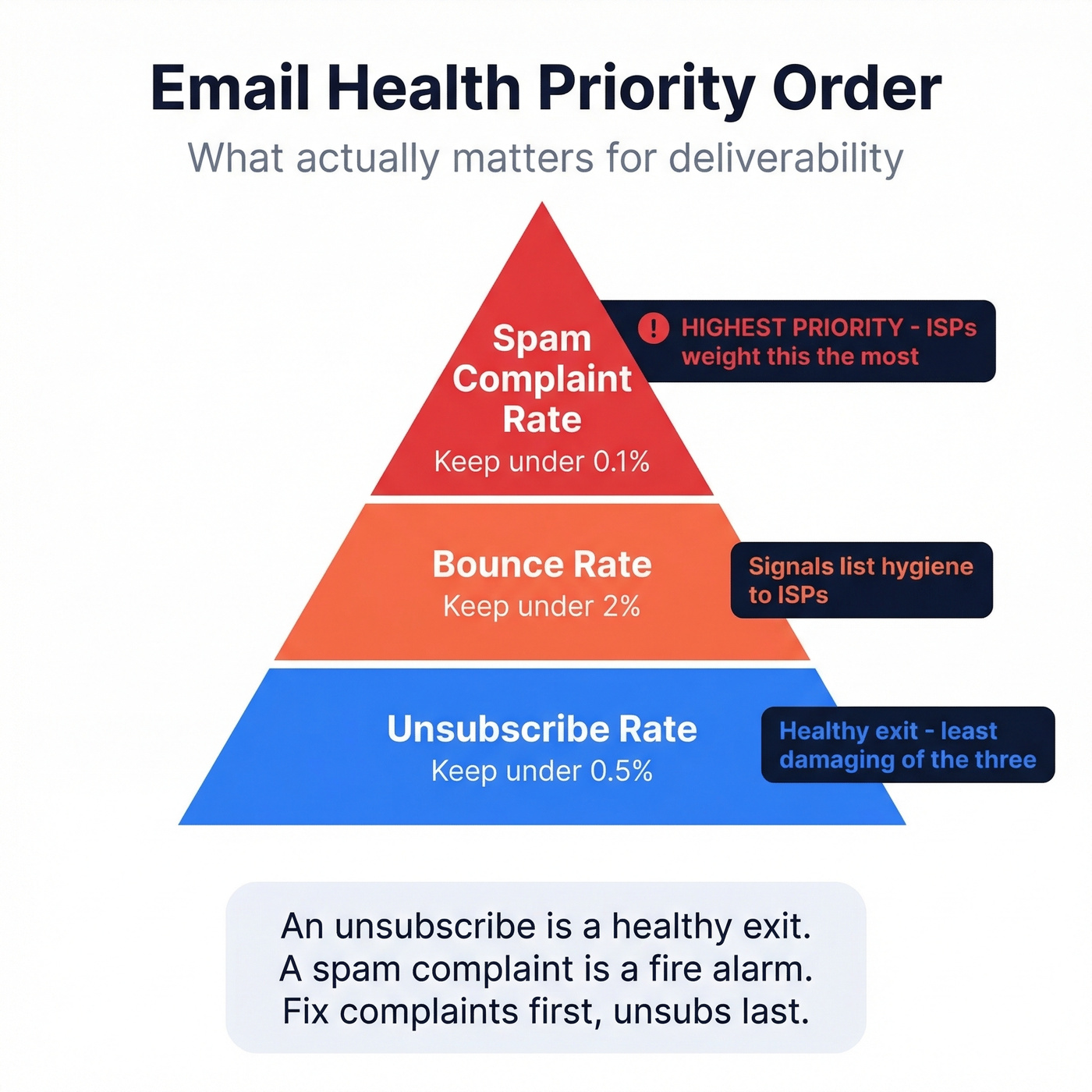
ISPs weight spam complaints far more heavily than opt-outs when deciding whether to deliver your emails. Google and Yahoo require bulk senders to keep spam complaint rates under 0.3%, and best practice is under 0.1%.
Let's be honest about the priority order for email health:
- Spam complaint rate - keep under 0.1%
- Bounce rate - keep under 2%
- Unsubscribe rate - keep under 0.5%
The opt-out metric is the least important of the three. Every person who unsubscribes cleanly is someone who didn't mark you as spam - that's a win. Monitor all three in Google Postmaster Tools if you're sending any volume to Gmail addresses.
Your outbound is only as good as your data. With 300M+ profiles and verified emails at ~$0.01 each, Prospeo keeps your pipeline full.
Try it free - no credit card required
FAQ
What is a good unsubscribe rate?
For opted-in marketing lists, anything under 0.5% is good and under 0.2% is excellent. The all-industry average sits at 0.22%. Your vertical matters - SaaS averages 0.14% while retail runs closer to 0.4%. For cold outreach, under 5% is generally acceptable for well-targeted prospecting.
Is a 1% unsubscribe rate bad?
For a weekly newsletter to an opted-in list, 1% is high and worth investigating. For a re-engagement campaign targeting a cold segment, 1% is expected. Check whether Gmail's Manage Subscriptions is inflating your count with duplicate requests before making changes.
Why did my unsubscribe rate suddenly increase?
If the spike started mid-2025, Gmail's Manage Subscriptions feature is the most likely cause. One user action can generate 15+ List-Unsubscribe requests, and duplicate events can account for 20-50% of daily unsub volume. Compare your raw unsub count against unique-subscriber unsubs to see the real number.
How do I reduce unsubscribes without sending less?
Build a preference center with frequency and content-type controls so subscribers can opt down instead of opting out entirely. Brands with preference centers see up to 30% fewer unsubscribes without reducing send volume. Better segmentation and personalization also help - send the right emails, not fewer emails.
Can bad contact data cause high unsubscribe rates?
Yes - especially in cold outreach. Stale addresses and outdated job titles mean you're reaching people who have zero relevance to your message, driving both unsubscribes and spam complaints. Verifying emails before sending is the simplest fix, and it protects your domain reputation at the same time.