

Urgency in Sales: How to Build It Without Being Pushy
Three great discovery calls. The champion's nodding along, sharing internal docs, introducing you to their VP. Then the email lands: "Love what you showed us - let's revisit next quarter."
The question isn't whether urgency in sales matters. It's whether you know how to build it without torching the relationship.
The Short Version
- Urgency is a discovery outcome, not a closing tactic. If you're manufacturing pressure in the final week of the quarter, you failed in the first call.
- The data is brutal. Opportunities closed within 50 days show a 47% win rate. After that threshold, win rates crater to roughly 20%. Every week of drift costs you.
- The playbook: compelling events, implication questions, multi-threading, and follow-up discipline. Templates and scripts below.
Why Deal Velocity Matters More Than Ever
58% of B2B professionals say their sales cycles got longer over the past year. For companies with 10,000+ employees, the average cycle runs 185 days. Under 10 employees? 38 days.
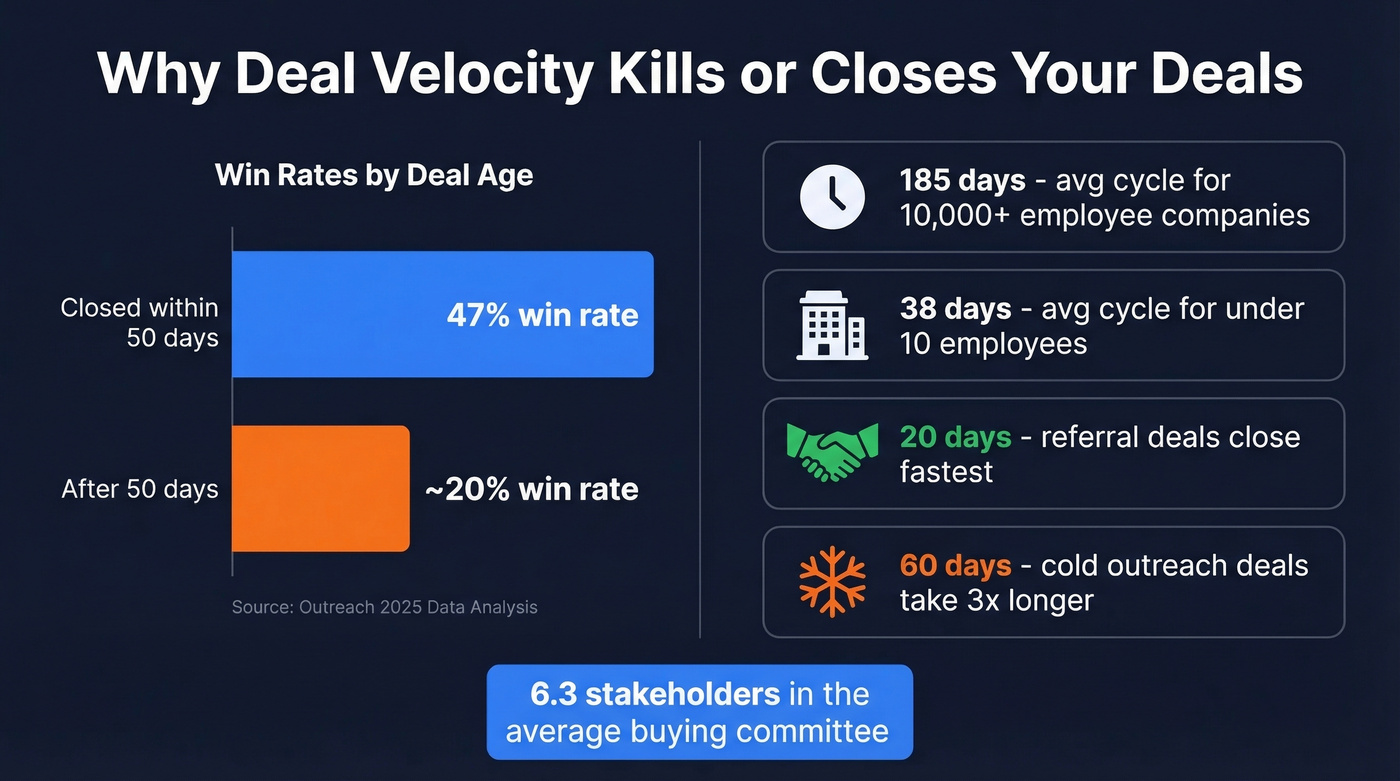
The gap isn't just complexity - it's how many people need to say yes. The average buying committee now includes 6.3 stakeholders, each with their own priorities and reasons to stall.
Channel matters too. Referrals close in about 20 days while cold outreach takes 60, and deals over $500K average 270 days from first touch to signature. The longer a deal sits, the more likely it dies - not because the buyer said no, but because they never said yes fast enough.
You Don't Create Urgency - You Surface It
There's a popular thread on r/sales where the OP argues that "creating urgency is utter bullshit." Honestly? Half right. Manufacturing pressure that doesn't exist - inventing deadlines, faking scarcity - makes you exactly the pushy rep everyone hates.
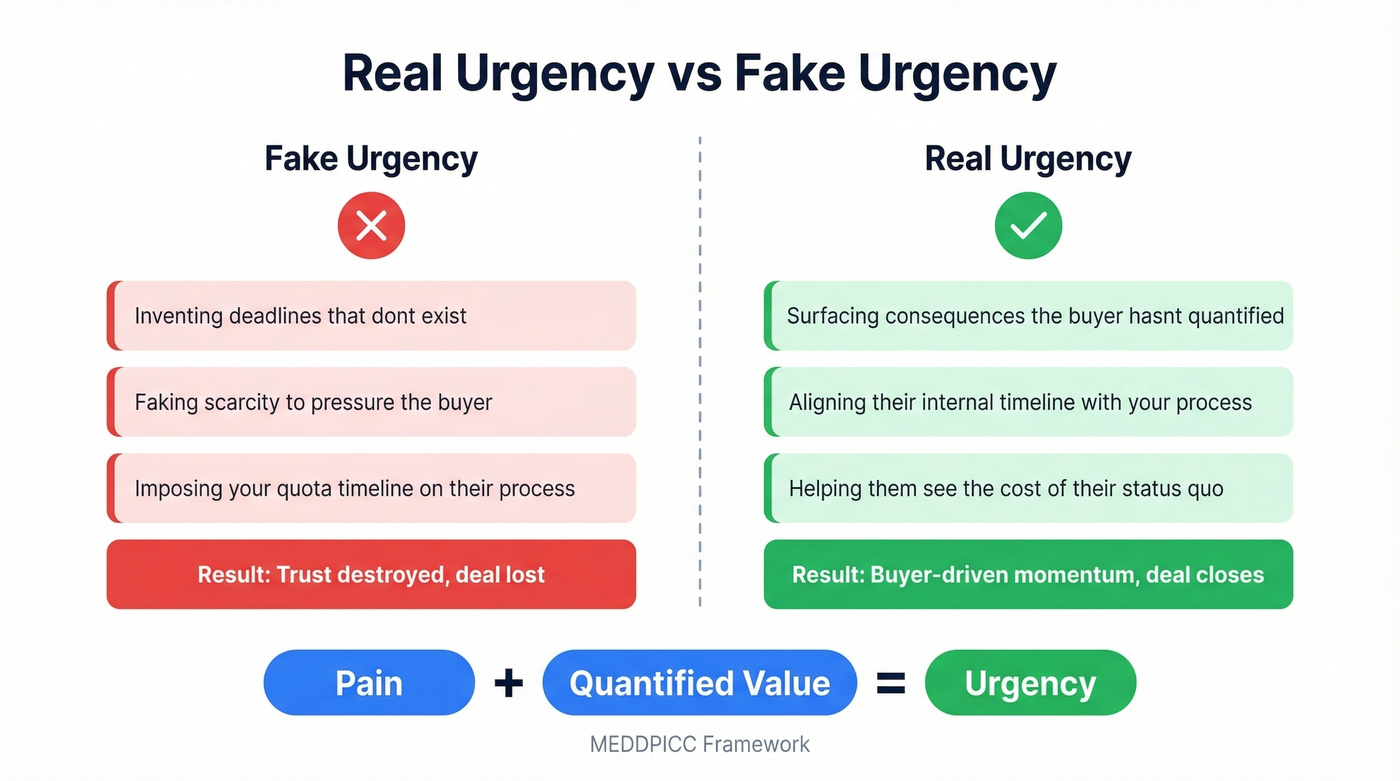
But here's the reframe. The real complaint isn't about urgency itself. It's about fake urgency.
As Jason Lemkin puts it, 95 out of 100 prospects don't need to buy your product right now. Your job isn't to conjure pressure from nothing. It's to surface the consequences of inaction the buyer hasn't fully quantified. The MEDDPICC framework boils it down to a formula: Pain + Quantified Value = Urgency.
The buyer's timeline is driven by internal priorities and budget cycles. The seller's timeline is driven by quota. Momentum happens when you align the two - not when you impose yours on theirs. That distinction changes your entire approach. You stop asking "how do I pressure this person?" and start asking "what's the cost of their status quo, and do they fully understand it?"
Discovery Questions That Build Momentum
Neil Rackham's SPIN Selling framework was built on studying 35,000+ sales calls across 20+ countries. The core insight: top performers spend disproportionate time on Implication questions - the ones that force the buyer to articulate downstream consequences. If you want to know how to create urgency in sales, it starts here, in discovery, not in closing.
Eight implication questions that surface real urgency naturally:
- "What happens to [metric] if this problem continues another quarter?" - Use after the prospect acknowledges a specific pain point. Forces them to project forward.
- "How does this affect your team's ability to hit [goal] by [date]?" - Ties the problem to a timeline they already care about.
- "What's the cost of doing nothing for the next 6 months?" - Direct. Use when the prospect is analytical and responds to numbers.
- "If this doesn't get solved, what does that mean for [initiative they mentioned]?" - Connects pain to a broader strategic priority.
- "Who else on your team is feeling this?" - Opens the door to account-based selling while surfacing organizational pain.
- "What did you try before, and why didn't it work?" - Reveals failed attempts, which amplifies the need to get it right this time.
- "What would it mean for your annual targets if you had this solved by [date]?" - Flips from negative to positive motivation.
- "What's the risk if a competitor solves this before you do?" - Competitive pressure. Use sparingly, but it's powerful in crowded markets.
The Challenger Sale research - based on 6,000 reps across 90 companies - adds another layer. Top performers don't just ask questions. They teach the buyer something new about their problem, tailor the insight to their situation, and take control of the conversation. That's the difference between a discovery call and a checkbox exercise.

Great discovery questions mean nothing if your emails bounce. When 35% of your outreach never lands, urgency dies before it starts. Prospeo delivers 98% verified email accuracy with a 7-day refresh cycle - so every follow-up hits the right inbox at the right moment.
Stop losing momentum to bad data. Start every sequence with verified contacts.
9 Tactics for Creating Urgency in Sales
Quantify the Cost of Inaction
Don't say "this problem is costing you money." Say: "Based on what you told me - 12 reps spending 6 hours a week on manual data entry at $85/hour fully loaded - that's $318K a year in lost selling time." Hours wasted x cost per hour x team size x 12 months. Make the status quo feel expensive.
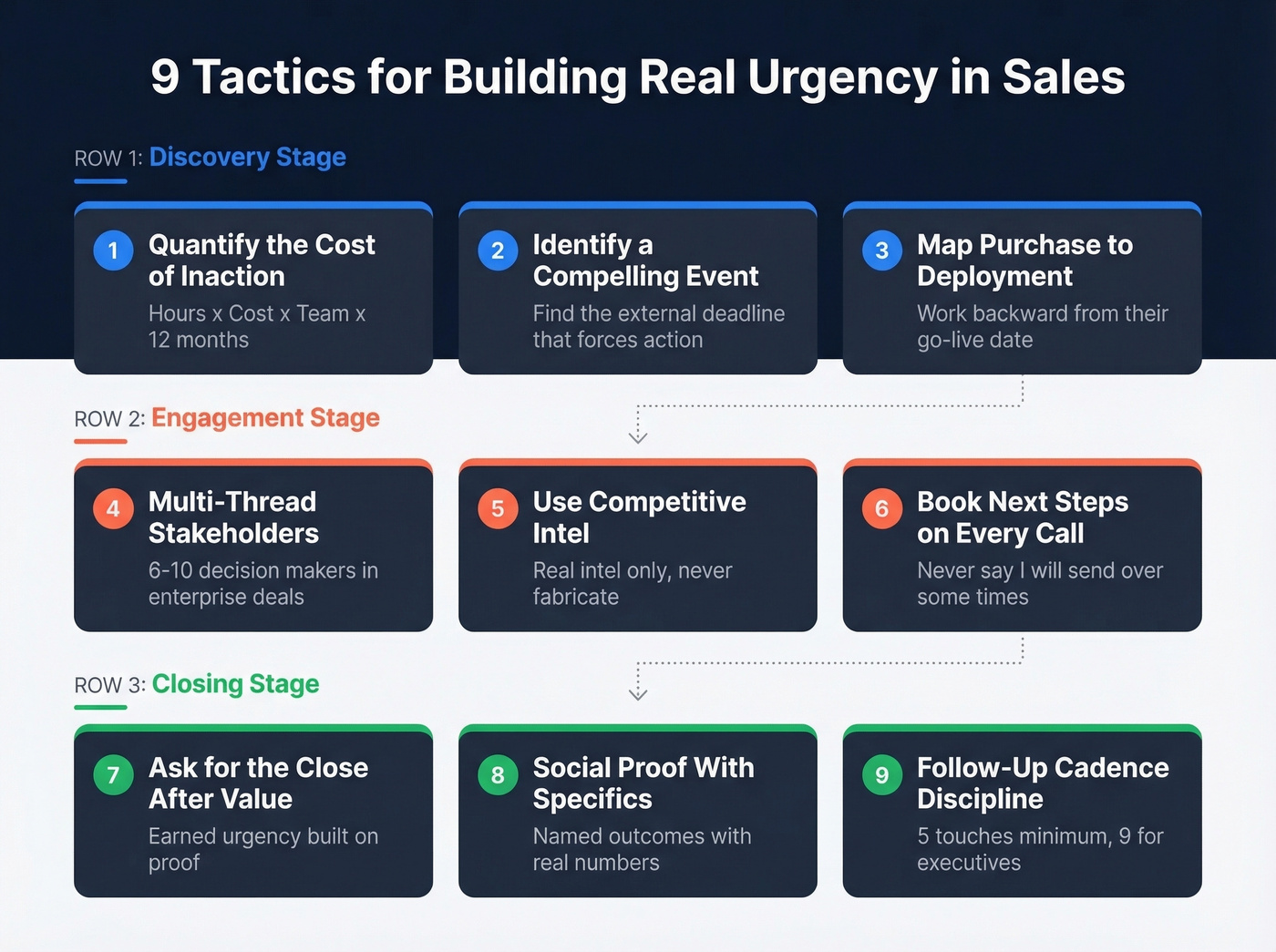
Identify a Compelling Event
A compelling event is an external deadline that forces action: a regulatory change, a board meeting, a fiscal year-end, a new VP starting in 60 days. If your deal doesn't have one, you don't have a real timeline yet - you have a conversation.
Map Purchase to Deployment
If the buyer wants the solution live by Q3, work backward: "Implementation takes X weeks, onboarding takes Y, and procurement/legal adds Z. That means we need a signed contract by [date]." You're not pressuring them - you're helping them hit their own deadline.
Multi-Thread Across Stakeholders
Enterprise deals average 6-10 decision-makers. Single-threaded deals die. Try: "Can you introduce me to [stakeholder]? I want to make sure we're solving for their concerns too." Each new stakeholder you engage is another person with a reason to move.
Use Competitive Intel as a Trigger
Competitive fear is real. "Your top competitor just rolled out [capability]. Here's what that means for your pipeline." Don't fabricate - but if you have the intel, use it. (If you need a system, build sales battle cards so reps can use intel consistently.)
Book the Next Step Before Ending Every Call
Never end a conversation without the next meeting on the calendar. "Before we wrap - can we get the technical review on the calendar for Thursday?" The moment you say "I'll send over some times," you've lost momentum. High-velocity sales conversations always end with a concrete next step, not a vague promise to reconnect.
Ask for the Close After Delivering Value
You just ran a killer POC. The data looks great. Now ask: "We've shown [specific result]. Can we get the contract process started this week?" Frame it as a natural next step, not a pressure play. That's what an earned urgency close looks like - built on proof, not force.
Social Proof With Specificity
"Our customers love us" is worthless. "Company X's 50 AEs cut their bounce rate from 35% to under 5% and generated 200+ new opportunities per month" is a reason to act. Named outcomes with specific numbers make the buyer think "we should be getting those results too."
Follow-Up Cadence Discipline
It takes an average of 5 touches to engage a prospect. For executives, nearly double that. The urgency isn't in any single email - it's in showing up consistently with value. (If you want more options, steal from these sales follow-up templates.)
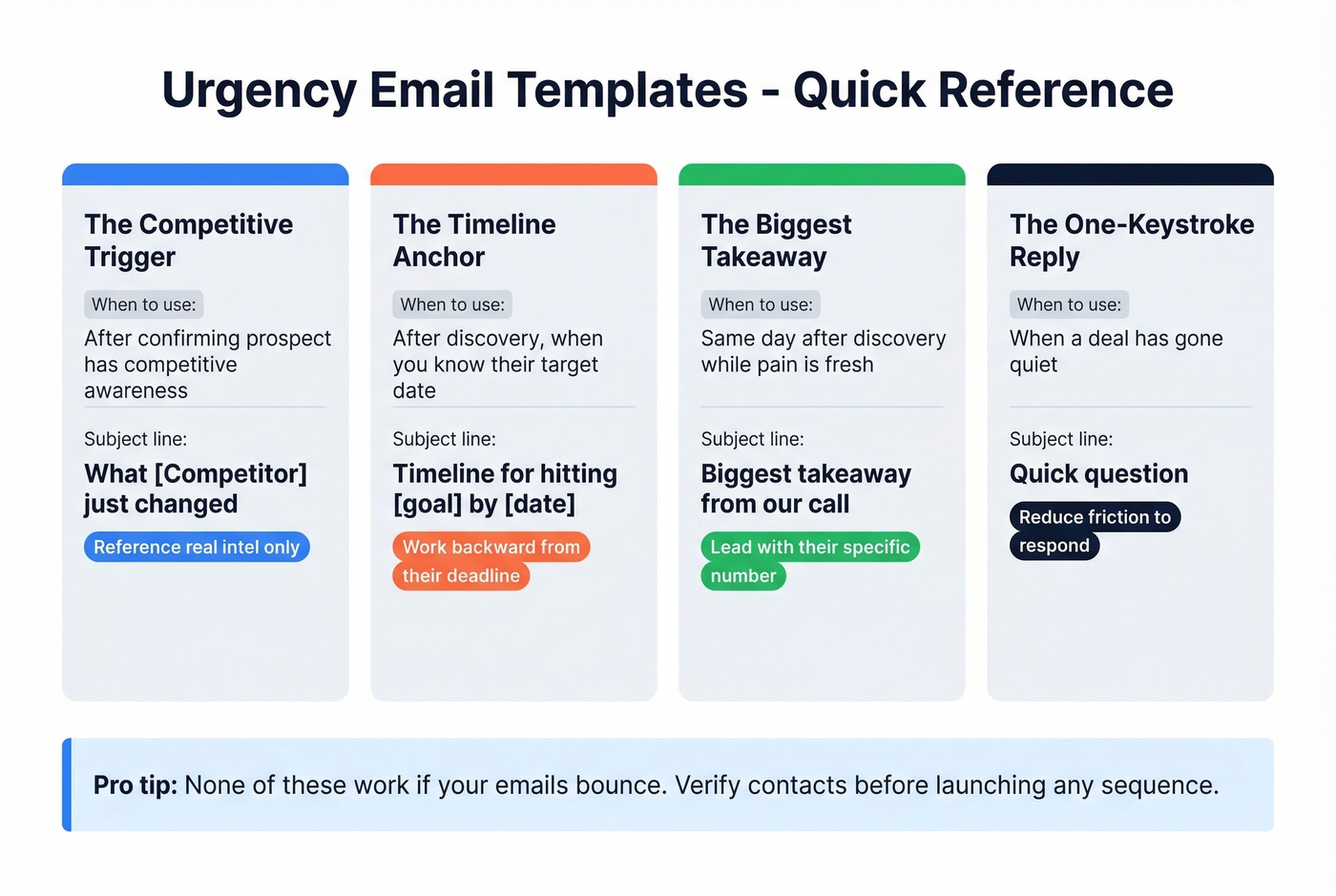
Urgency Email Templates
Template 1 - The Competitive Trigger
Subject: What [Competitor] just changed
Hi [Name], I noticed [Competitor] recently [specific action - new hire, product launch, market expansion]. Based on our conversation about [their goal], this could impact [specific metric]. Worth a 15-minute call this week? I have [two specific times].
Use after you've confirmed the prospect has competitive awareness. Only reference real intel.
Template 2 - The Timeline Anchor
Subject: Timeline for hitting [goal] by [date]
Hi [Name], you mentioned wanting [outcome] by [date]. Working backward from implementation and onboarding, we'd need to kick off by [date]. Can we schedule 20 minutes this week to map the path?
Use after discovery, when you know their target date.
Template 3 - The Biggest Takeaway
Subject: Biggest takeaway from our call
Hi [Name], the number that stuck with me: [specific stat from their situation - e.g., "$318K in lost selling time"]. That's the cost of the status quo for another quarter. Here's a one-pager on how [similar company] eliminated that in 60 days. Worth discussing next steps?
Use same-day after discovery, while the pain is fresh.
Template 4 - The One-Keystroke Reply
Subject: Quick question
Hi [Name], just checking - are you still looking to solve [problem] this quarter? Reply 1 if yes, 2 if timing's changed. Either way, no pressure.
Use when a deal's gone quiet. Reducing friction to respond is itself a momentum tactic.
Here's the thing none of these templates work if your emails bounce. We've seen teams run beautifully crafted sequences that never land because 20% of their list is stale. Before launching a follow-up cadence, verify your contacts - Prospeo checks emails in real time with 98% accuracy so your timing-sensitive outreach actually reaches the inbox.
The Enterprise Playbook for B2B Deals
We've watched this pattern kill six-figure deals: an enterprise AE with 25+ active opportunities, each involving 5-7 stakeholders. Deals stall in proof-of-value. Then they get pushed to next quarter. Then next year. Then they die - or go to a competitor who happened to be in the room when budget opened up.
Enterprise cycles run 6 to 24 months. The playbook for urgency in B2B sales is fundamentally different from SMB. If you're selling into long cycles, it helps to understand enterprise B2B sales mechanics beyond just "follow up more."
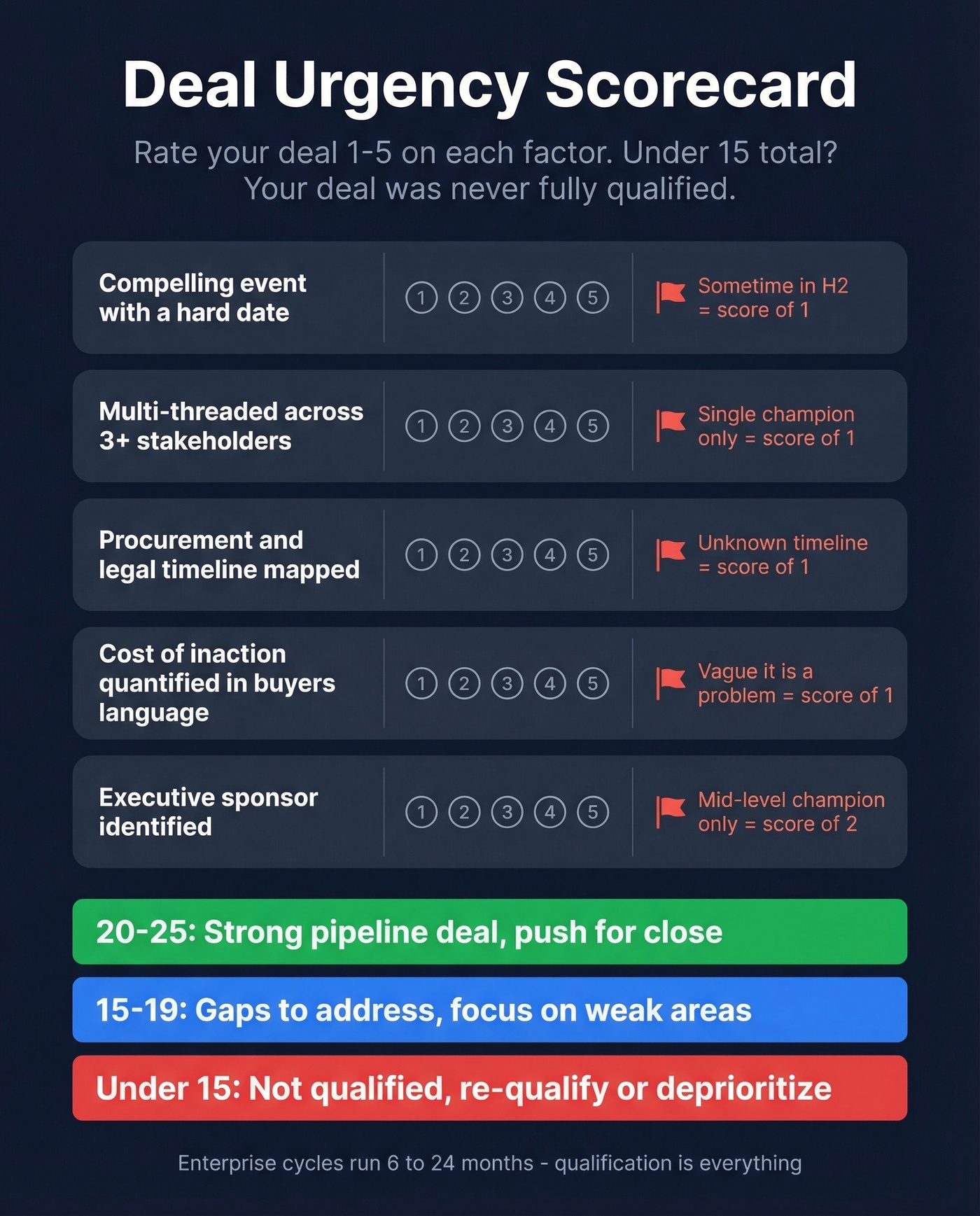
Deal Urgency Scorecard - rate your deal 1-5 on each:
| Factor | Score (1-5) | Red Flag |
|---|---|---|
| Compelling event with a hard date | ___ | "Sometime in H2" = 1 |
| Multi-threaded across 3+ stakeholders | ___ | Single champion = 1 |
| Procurement/legal timeline mapped | ___ | Unknown = 1 |
| Cost of inaction quantified in buyer's language | ___ | Vague "it's a problem" = 1 |
| Executive sponsor identified | ___ | Mid-level champion only = 2 |
If your total is under 15, your deal isn't stalled - it was never fully qualified. Multi-threading is the primary enterprise urgency lever. Every new stakeholder you engage is another person who can push internally when your champion gets pulled into other priorities.
Skip the scorecard if you're running a transactional SMB motion with one decision-maker and a two-week cycle. This is built for deals where organizational complexity is the enemy.
Tactics That Backfire
Not every urgency play works. Some actively destroy trust.
Price-increase warnings are a common lever in enterprise SaaS - "lock in current rates before the increase." Buyers increasingly see through it. If your only lever is a price threat, you haven't built enough value.
Discounting as the default is worse. It trains buyers to wait for better offers and erodes your pricing integrity. It's the laziest tactic and the hardest habit to break.
Countdown timers that reset are an instant credibility killer. If a buyer sees your "offer expires in 24 hours" timer reset when they revisit the page, you've lost all trust. Let's be honest: most urgency advice on the internet is written for ecommerce. Countdown timers and limited-time popups don't work when you're selling a $200K platform to a committee of 7. If your deal size is above $50K, ignore 90% of the "urgency hacks" you see online - they'll make you look desperate, not compelling.
Two more momentum killers worth naming: selling after the yes, where a buyer agrees and the rep keeps pitching features until they second-guess themselves, and single-threading, where you rely on one champion in a 7-person buying committee and the deal dies the moment that person goes on vacation or changes roles.
Measuring Impact on Pipeline Velocity
| Metric | What It Tells You | Benchmark |
|---|---|---|
| Sales cycle length | Overall velocity | 47% win rate at <50 days, ~20% after |
| Win rate by stage age | Where deals stall | Track weekly decay rate |
| Pipeline velocity | Revenue per day | Revenue x win rate / cycle length |
| Touches to close | Cadence effectiveness | 5 avg, 9 for executives |
| Conversion by tactic | Which levers work | Compelling event deals vs. no event |
One metric most teams overlook: email deliverability. If a meaningful chunk of your list bounces, your cadence has gaps the buyer never sees. In our experience, teams that verify contacts before every sequence see dramatically fewer dead spots in their follow-up cadences. If you want the technical side, start with an email deliverability guide and track your email bounce rate weekly.
FAQ
Is urgency in sales manipulative?
Real urgency surfaces consequences the buyer hasn't fully processed - it's consultative, not coercive. Helping a prospect see that their current problem costs $400K per quarter when they haven't quantified that yet is a service. Manipulation is inventing pressure that doesn't exist.
How do you create urgency for "nice to have" products?
Quantify the cost of inaction in dollars. Every "nice to have" has a hidden cost: lost productivity, competitive risk, missed revenue. If you genuinely can't find a cost of inaction, the prospect probably isn't a real opportunity right now.
What's the biggest enterprise urgency mistake?
Single-threading. Relying on one champion instead of multi-threading across 6+ stakeholders is the fastest way to watch a deal die. Each new contact creates organizational momentum that no single person can stall.
How do you build urgency when your contact data is unreliable?
Bounced emails and dead phone numbers kill deal momentum instantly. If 20% of your list bounces, your cadence has gaps the buyer never sees. Verify contacts in real time before every sequence - tools like Prospeo check emails with 98% accuracy and provide 125M+ verified mobiles so your outreach actually lands when timing matters most.
Multi-threading across 6-10 stakeholders requires direct contact data for every decision-maker. Prospeo gives you 300M+ profiles, 125M+ verified mobiles, and 30+ filters - including job changes and buyer intent - so you reach the full buying committee before the deal stalls.
Reach every stakeholder directly for $0.01 per email. No contracts, no gatekeepers.