

US Company Database: Free Sources, Paid Tools, and How to Choose
There are 36.2 million small businesses operating in the United States right now. No single US company database captures them all. That's the uncomfortable truth behind every vendor promising "the complete list" - it doesn't exist, and anyone selling that idea is rounding up aggressively.
Of those 36.2 million businesses, only 5.52 million are employer firms - companies with at least one paid employee. The remaining 29.8 million are nonemployer businesses: freelancers, sole proprietors, side hustles that file a Schedule C but never show up in commercial databases. When a vendor tells you they have "70 million US business records," they're counting nonemployers, counting multiple contacts per company, or pulling from registrations that include dissolved entities. Probably all three.
So the real question isn't "which database has everything?" It's "which one has what you actually need?"
Here's the thing: if your average deal size sits below five figures, you almost certainly don't need a $15K+ enterprise platform. A self-serve tool with verified emails will outperform an expensive database your team barely uses.
Why Record Counts Are Misleading
Every vendor comparison leads with database size. Ignore it - or at least interrogate it hard.
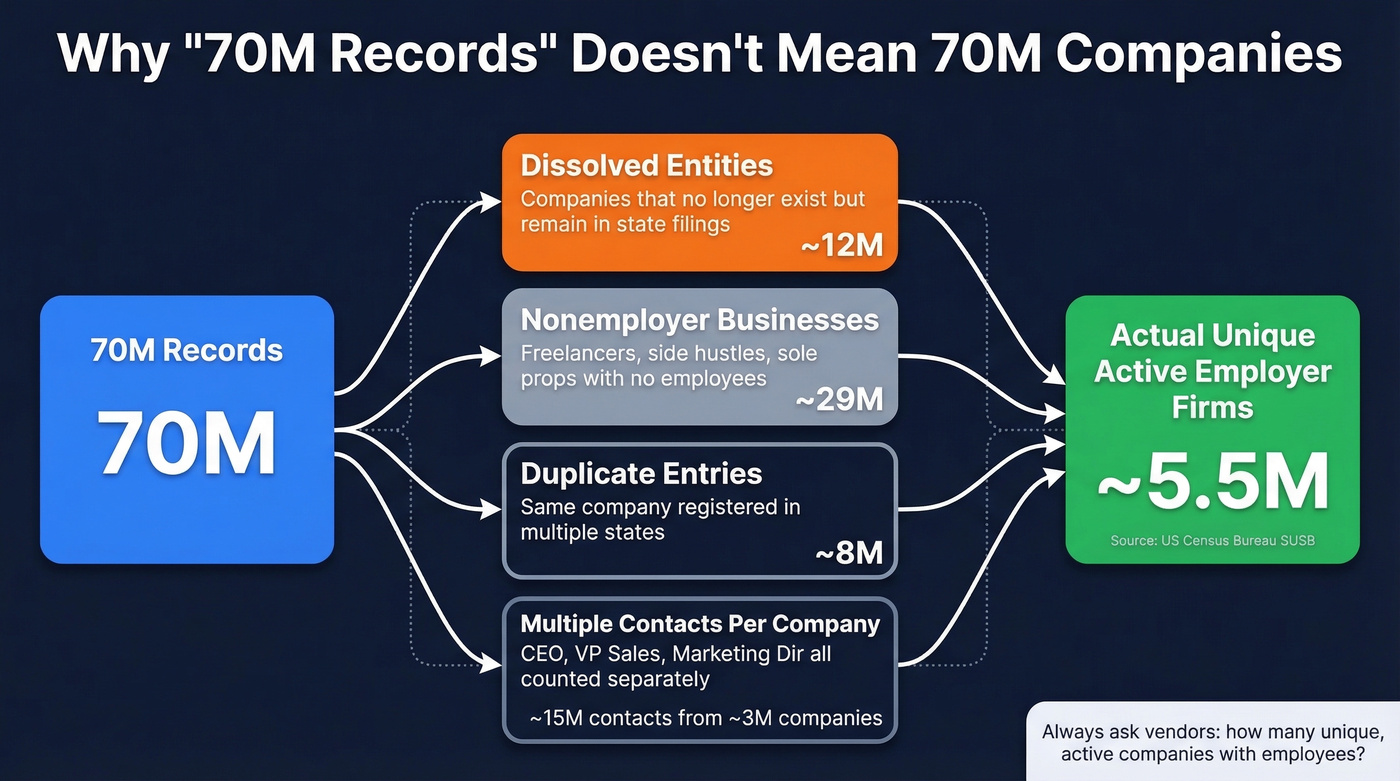
One popular site, uscompanieslist.com, advertises its combined offering as "95 million records." Sounds massive until you realize it almost certainly includes nonemployer businesses, dissolved entities, and duplicate entries across states. A company with 50 employees can generate 15 "records" in a sales database: one for the company itself, plus individual contact records for the CEO, VP of Sales, marketing director, and so on. Vendors who report contact counts alongside company counts are playing a different game than vendors reporting unique business entities.
"Updated" is another word doing heavy lifting. A database can claim "daily updates" while only refreshing a fraction of records each cycle. The only question that matters: how often does the provider re-verify that an email actually works, a phone connects, or a company still exists at that address? The gap between "updated" and "verified" is where bounce rates live (and why email bounce rate should be a KPI, not an afterthought).
Best Free US Company Databases
SEC EDGAR
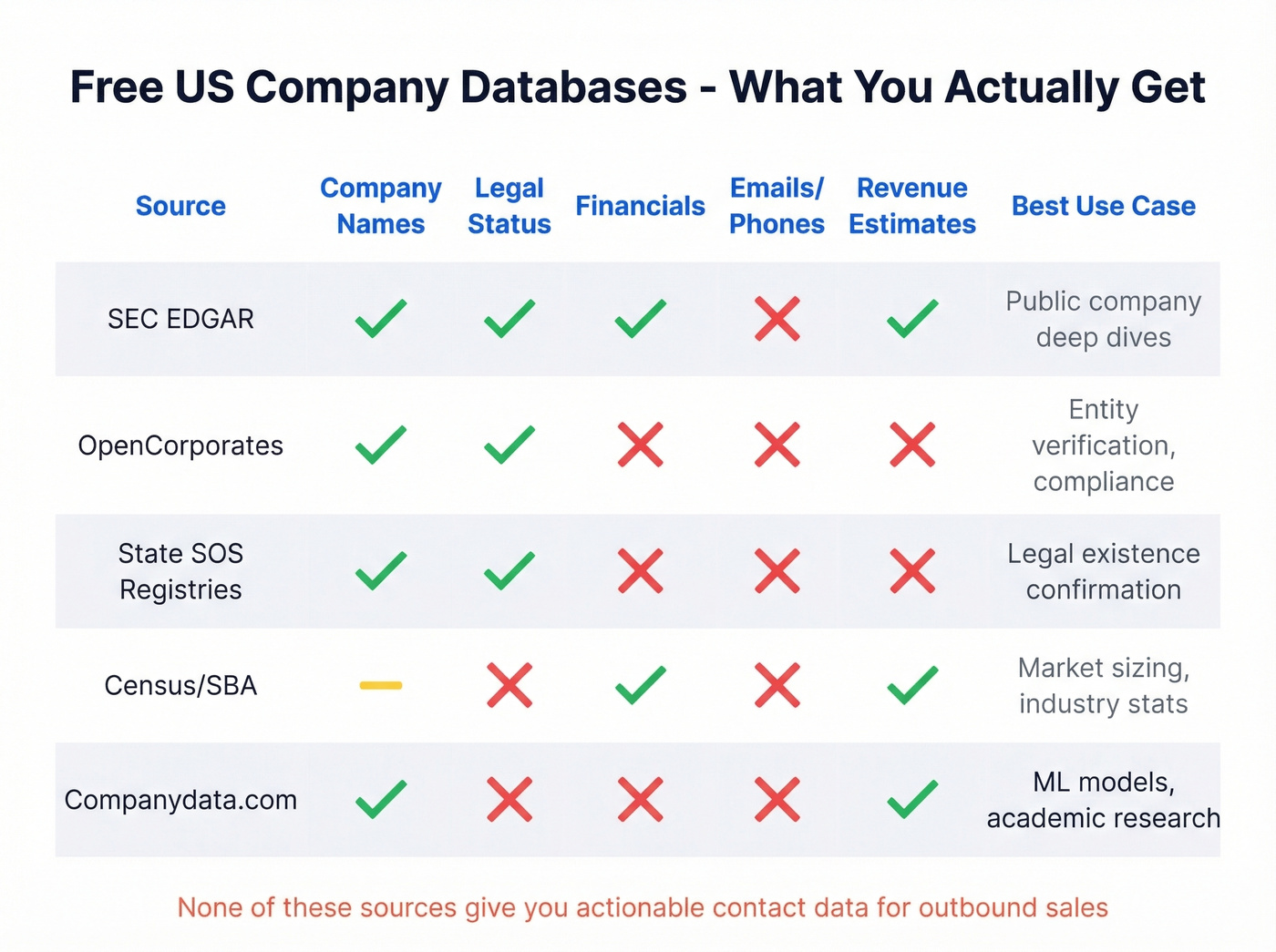
SEC EDGAR is the gold standard for public company research. Every public company filing since 2001 is searchable - 10-Ks, 10-Qs, proxy statements, insider transactions. The full-text search is surprisingly powerful for a government tool. Completely free, but limited to publicly traded companies. You won't find the Series B startup down the street.
OpenCorporates
OpenCorporates is the closest thing to a universal company registry. It covers 200M+ companies globally and aggregates data from government registries worldwide. Every record includes provenance - you can trace exactly which government source it came from, which matters for compliance and due diligence.
For US coverage, OpenCorporates pulls from state-level registries, giving you tens of millions of entities with incorporation details, registered agents, and filing status. What it won't give you: email addresses, phone numbers, or revenue estimates. It's a registry, not a sales intelligence tool. Free API access typically tops out around a few hundred requests per day; commercial licenses are available for bulk research at rates well below paid B2B platforms.
State Secretary of State Registries
Every US state maintains a business entity registry, and most are searchable online for free. These are the authoritative source for confirming a company's legal existence, registered agent, and filing status - essential for compliance, useless for outbound.
Census & SBA Resources
The Census Bureau's SUSB program and the SBA's market research tools provide aggregate statistics on US businesses by industry, geography, and size. Need to know how many plumbing companies operate in Texas? Census has you covered. Need the owner's email? You'll need a commercial tool (or a workflow from free lead generation tools plus verification).
Companydata.com (CC0 Datasets)
Companydata.com publishes free company datasets on GitHub under a Creative Commons Zero license - use them for anything, including commercial projects. The datasets cover millions of companies with revenue, employee size, and industry classification fields. Solid starting point for academic research or ML models at zero cost.
Best Paid US B2B Databases
Prospeo
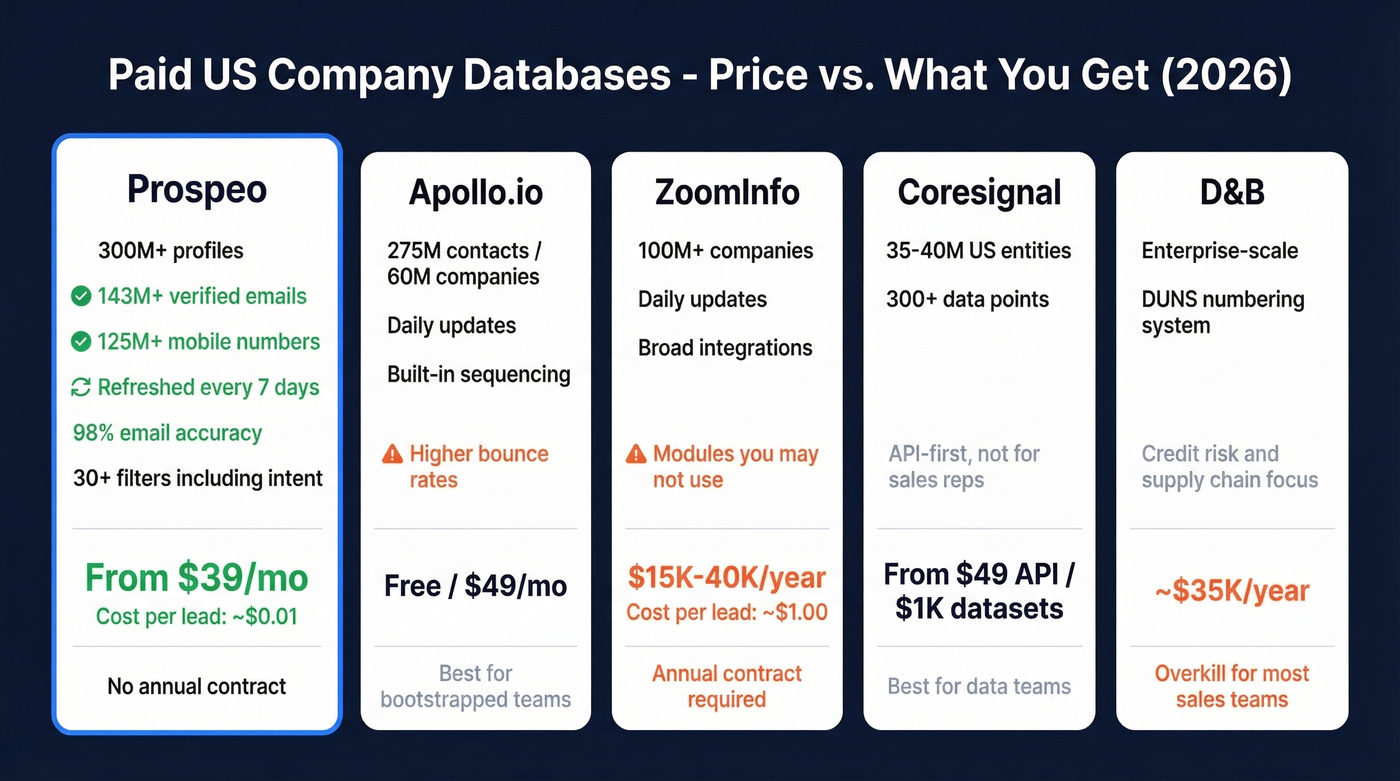
Prospeo is where the concept of a US company database meets data you can actually act on. The platform covers 300M+ professional profiles with 143M+ verified emails and 125M+ verified mobile numbers, all running through proprietary email-finding infrastructure with 5-step verification. That means 98% email accuracy and a 30% mobile pickup rate - numbers we haven't seen matched by any competitor at this price point.

Records refresh every 7 days, compared to the 6-week industry average. The 30+ search filters cover buyer intent powered by Bombora across 15,000 topics, technographics, job changes, headcount growth, department size, funding rounds, and revenue. Pricing is self-serve and transparent: free tier with 75 emails/month + 100 Chrome extension credits/month, paid plans from ~$39/mo at roughly $0.01 per email. For context, that's about 90% cheaper than ZoomInfo's ~$1 per lead. No annual contracts, no sales calls required.
Apollo.io
Skip Apollo if you need pristine data quality. Use it if you're bootstrapped and need volume.
Apollo covers 275M contacts across 60M companies, and its free tier is the most generous in the category - making it the default for early-stage teams. Paid plans typically run $49-$99/mo per user with daily data updates. The built-in sequencing engine means you can find contacts and email them from the same platform (but you’ll still want an email deliverability guide in your process).
The tradeoff: email accuracy. In our testing, Apollo exports produce noticeably higher bounce rates than rigorously verified databases, particularly for mid-market contacts. If your domain reputation matters - and it should - verify Apollo data before sending.
ZoomInfo
Who it's for: Enterprise RevOps teams with budget and implementation resources.
Who should skip it: Anyone who just needs verified contact data.
ZoomInfo offers 100M+ company records, daily updates, and a broad integration ecosystem. A mid-market contract runs $15,000-40,000/year depending on seats and modules. The #1 complaint on r/sales? Paying for modules you don't use. We've watched teams buy ZoomInfo for the database, then realize they're subsidizing intent, chat, and workflow features they never activate. If all you need is verified emails and direct dials, ZoomInfo is overkill.
Data Axle / Salesgenie
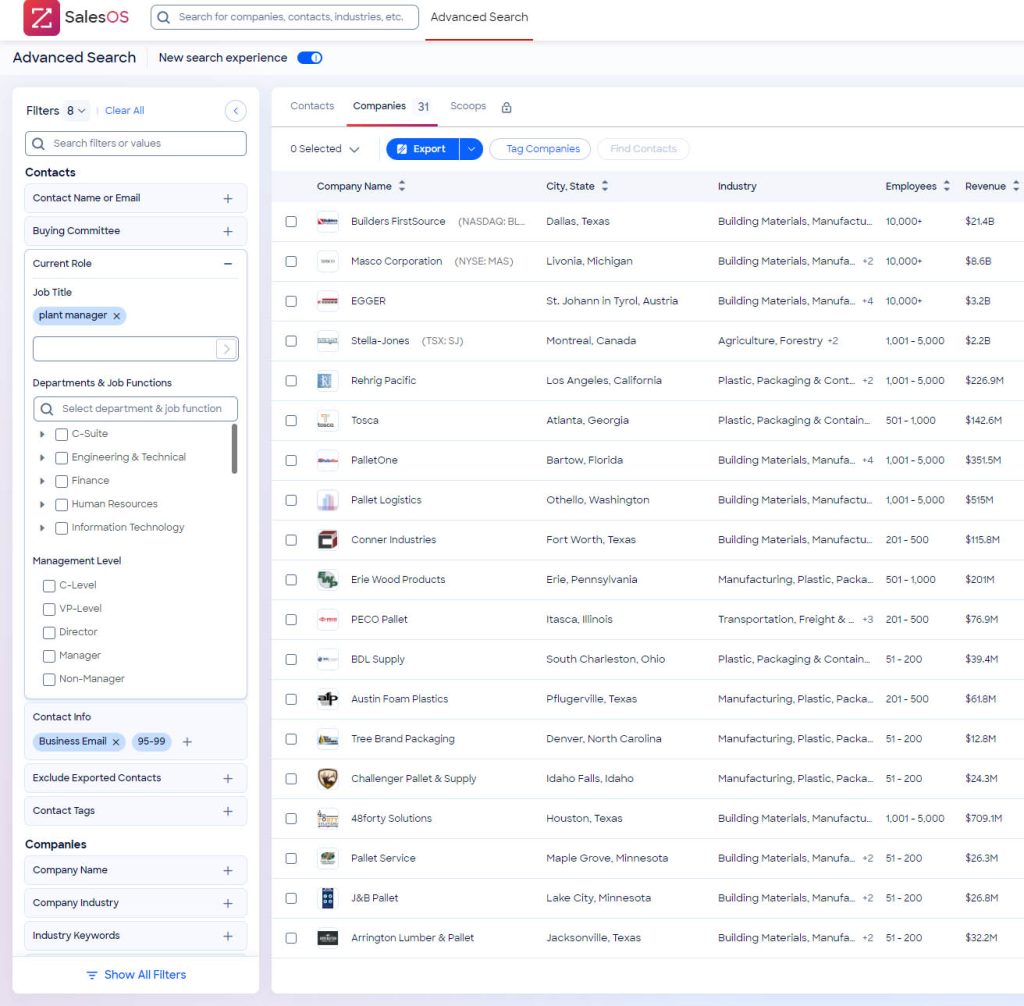
Data Axle maintains 17.8 million US and Canada company records, with about 4 million including email addresses. Their consumer-facing product, Salesgenie, starts at $99/month on a 12-month term with quarterly updates and validation.
Expect some data mismatches. Practitioners on forums report issues like a major public company name appearing at a small private company address - par for the course with compiled databases, but it means you should verify before sending. The search UX also lacks saved search criteria, which gets frustrating on repeated lookups.
Coresignal
Coresignal is built for developers and data teams, not sales reps clicking through a UI. Their database covers 35-40M unique US entities with 300+ data points per record spanning firmographics, technographics, funding, workforce signals, and growth indicators. API access starts at $49, full datasets from $1,000, with update cadence that varies by dataset. Reviewers praise the "huge and well-maintained datasets" but note the user experience can feel unpolished - which makes sense for an API-first product. If you're building enrichment pipelines or ML models, Coresignal's schema is one of the most comprehensive available (and pairs well with data enrichment services when you need contact-level fields).
Dun & Bradstreet
D&B is the legacy enterprise standard. Their DUNS numbering system is embedded in government contracting, supply chain management, and credit decisioning. Full access runs ~$35,000/year. For most sales and marketing teams, D&B is overkill - you're paying for credit risk data and supply chain intelligence you'll never touch. The right choice for procurement and compliance departments, not for filling your outbound pipeline.
Other Notable Options
NAICS.com sells individual company records at $9.95 each - expensive for volume, useful for one-off research. Lusha offers 50M+ company profiles with contact data from $79/month on a credit-based model. Cognism runs $15,000-103,000/year and excels in EMEA coverage, but for US-only needs you're paying a premium for international data you won't use. RocketReach covers 700M+ professional profiles at $140/month.

| Database | US Records | Update Freq. | Starting Price | Best For |
|---|---|---|---|---|
| Apollo.io | 60M companies | Daily | Free / $49/mo | Bootstrapped teams |
| ZoomInfo | 100M+ companies | Daily | ~$15K/year | Enterprise RevOps |
| Data Axle | 17.8M (US+CA) | Quarterly | $99/mo | Local/SMB lists with phones |
| Coresignal | 35-40M companies | Varies | $49 (API) | Data teams / API pipelines |
| D&B | Enterprise-scale | Varies | ~$35K/year | Compliance & credit risk |
| Lusha | 50M companies | Continuous | $79/mo | Quick contact lookups |
| RocketReach | 700M+ profiles | Varies | $140/mo | Broad professional search |
| Cognism | Enterprise-scale | Varies | ~$15K/year | EMEA-heavy teams |
| NAICS.com | Varies | Varies | $9.95/record | One-off company research |

Free databases give you company names. Paid databases give you contacts. Prospeo gives you 143M+ verified emails and 125M+ direct dials refreshed every 7 days - not 6 weeks. Filter by intent, technographics, headcount growth, and 27 more criteria across 300M+ profiles.
Start with 75 free emails and see why 15,000+ companies switched.
What Data Fields to Expect
Not all B2B databases return the same information. Here's what separates the tiers.
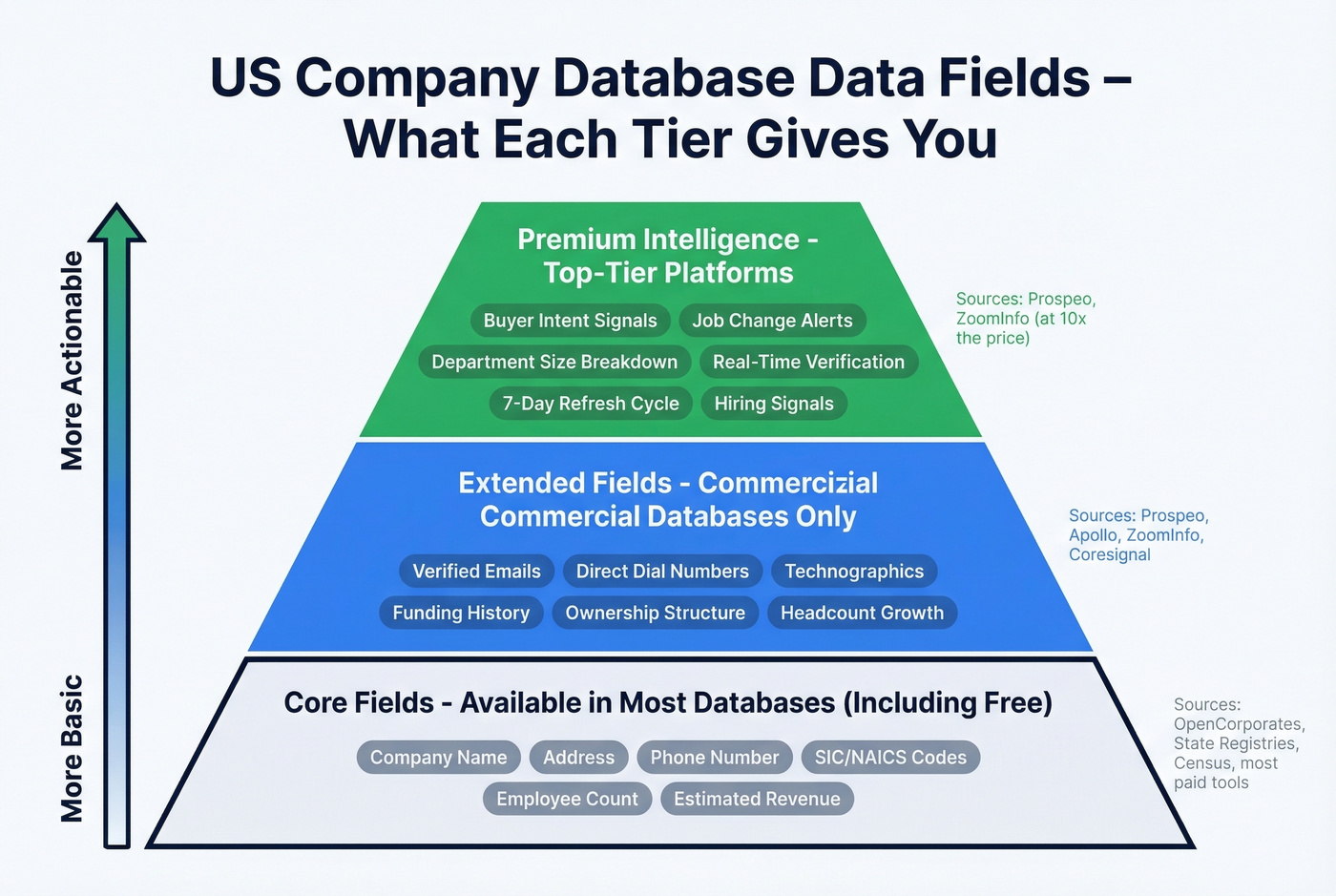
Core fields available in most databases include company name, address, phone number, SIC/NAICS codes, employee count, and estimated revenue. Table stakes. Even free sources like OpenCorporates and state registries cover some of these, though usually without revenue or employee data.
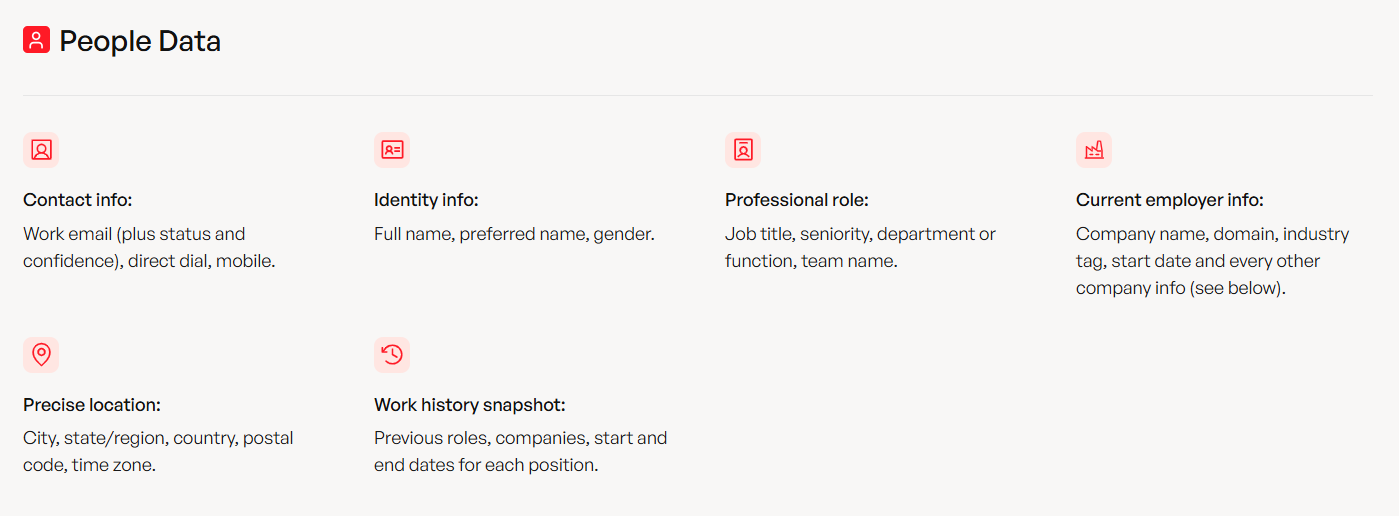
Extended fields in commercial databases add individual contacts with verified emails and direct dials, technographic data showing what software a company uses, funding history, ownership structure, and growth signals like headcount changes. Intent data - revealing which topics a company is actively researching - sits at the top of the stack. In practice, top-tier tools return 50+ data points per enrichment record. Coresignal's schema is a good example of the modern standard, with hundreds of data points spanning firmographics, workforce composition, financials, and competitive intelligence (see firmographic and technographic data for how teams operationalize it).
How to Choose the Right Tool
Your use case determines your tool, not the other way around.
For market research, start with Census/SBA statistical resources and OpenCorporates for entity-level data. Free, authoritative, sufficient for sizing markets (and helpful when defining your addressable market).
For compliance and due diligence, SEC EDGAR handles public companies and state Secretary of State registries handle entity verification. These are the legal sources of record.
For lead generation and outbound, the decision gets interesting. Freshness and email deliverability trump everything else when you're evaluating a US business database for outbound campaigns. Let's be honest - a 30-million-record list with a 40% bounce rate will destroy your domain reputation faster than a 5-million-record list with 98% deliverability. Prospeo leads on data accuracy and cost per lead. Apollo wins on free-tier generosity. ZoomInfo wins on breadth and enterprise integration depth (and if you want a broader landscape, compare against other sales prospecting databases).
For academic research or data science, OpenCorporates gives you open data with provenance, and Companydata.com's CC0 datasets on GitHub are permissively licensed. Both free.
After You Get Your List
Getting a list is step one. Here's what happens next.
Verify emails before sending. A bounce rate above 5% signals spam to inbox providers, and domain reputation damage takes months to repair. We've seen teams download 30,000 records from a cheap provider, blast them through Instantly, and tank their sender reputation in a single afternoon. Don't be that team (use a real process to improve sender reputation).
Enrich to fill gaps. Most databases have holes - missing phone numbers, outdated titles, no intent signals. Run your list through an enrichment step to fill what's missing before you start sequencing (a solid lead enrichment workflow usually pays for itself fast).
Check compliance. CAN-SPAM requires a physical address and opt-out mechanism in every commercial email. TCPA governs cold calls to mobile numbers. These aren't suggestions - they're laws with real penalties.
You just read that record counts are misleading and 'updated' doesn't mean verified. Prospeo runs every email through 5-step verification with catch-all handling, spam-trap removal, and honeypot filtering - delivering 98% accuracy at ~$0.01 per email. That's 90% cheaper than ZoomInfo with higher accuracy.
Get US company data that actually connects you to real buyers.
FAQ
What is the most complete US company database?
No single database covers all 36.2 million US businesses. SEC EDGAR is authoritative for public companies. For broad B2B coverage with verified contact data, Prospeo covers 300M+ professional profiles with 98% email accuracy, while ZoomInfo offers 100M+ company records at enterprise pricing.
Is there a free database of all US companies?
No free source covers every US business. OpenCorporates aggregates 200M+ companies globally from government registries. SEC EDGAR covers public companies. Companydata.com offers CC0-licensed datasets on GitHub for commercial or academic use.
How often are company databases updated?
Frequency varies dramatically. Prospeo refreshes records every 7 days. Apollo and ZoomInfo claim daily updates. Government sources like Census update annually. Freshness matters most for contact data - emails and phone numbers decay far faster than firmographics like revenue or employee count.
Why do vendor database sizes vary so much?
Vendors count differently. Some report contacts - multiple per company - while others report unique entities. Some include the 29.8 million nonemployer businesses, others only count the 5.52 million employer firms. Always ask whether a number represents companies or contacts, and whether it includes dissolved entities.
What's the difference between a business registry and a sales database?
Registries like SEC EDGAR and state Secretary of State sites confirm a company legally exists - incorporation date, registered agent, filing status. Sales databases layer on verified emails, direct phone numbers, technographics, and firmographic data needed for outreach. Registries verify existence; a B2B database enables action.