

The Value-Based Selling Methodology Your Team Will Actually Use
Your VP of Sales just announced a "value selling initiative." Half the team is rolling their eyes because they've sat through three methodology trainings in two years and nothing stuck. The uncomfortable truth: only 19% of reps consistently apply a value-based selling methodology, but those who do see 48% higher win rates and 35% larger deals. The gap between knowing and doing is where revenue lives.
Value selling is the value layer. MEDDIC/MEDDPICC is the qualification layer, and frameworks like SPIN or Challenger shape how you run the conversation. This guide gives you the process, the ROI formula, the discovery questions, and the rollout playbook.
What Value-Based Selling Actually Is
Value-based selling means every conversation anchors to the buyer's measurable business outcomes - not your product's feature list. The mental model that works is the value triad: revenue/performance gains, cost reduction, and emotional contribution like trust, credibility, and reduced career risk for the buyer. Feature selling says "we have 99.9% uptime." Value selling says "that uptime saved Acme Corp $340K in lost transactions last quarter."
The buyer behavior data backs this up. [96% of prospects research](https://www.gartner.com/en/newsroom/press-releases/2025-06-25-gartner-sales-survey-finds-61-percent-of-b2b-buyers-prefer-a-rep-free-buying-experience) before engaging sales, and 71% prefer doing that research independently. By the time a buyer talks to your rep, they already know your features. What they don't know is how those features translate into dollars for their situation. That's the entire job.
Value Selling vs. SPIN, Challenger, and MEDDIC
Here's what most teams get wrong: a value-based sales methodology isn't competing with SPIN, Challenger, or MEDDIC. It's the operating system. Those frameworks are apps running on top of it.
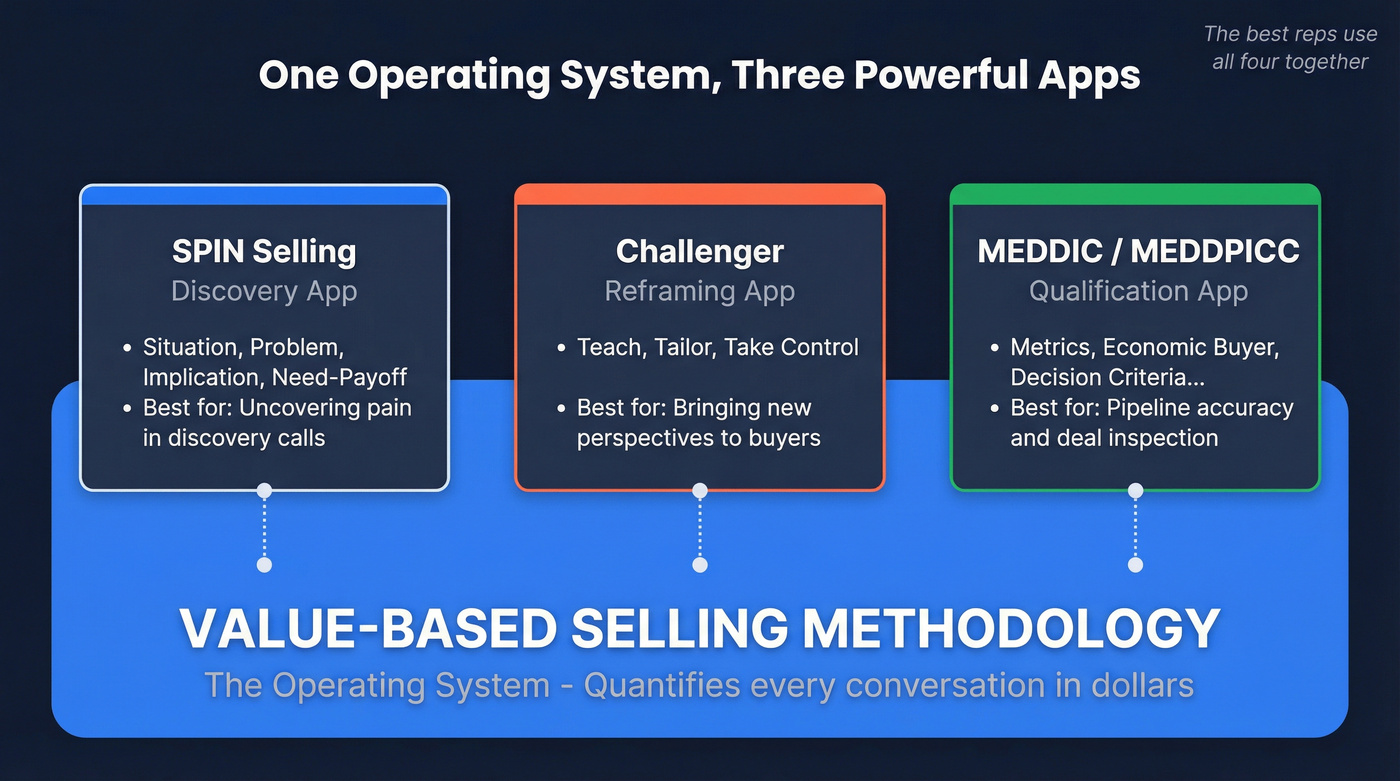
| Framework | Origin | What It Solves | Key Limitation | Value Layer |
|---|---|---|---|---|
| SPIN | 35K calls, 12 yrs | Discovery questioning | No qualification gate | Quantifies SPIN's pain |
| Challenger | 6K reps (CEB) | Insight-led reframing | High skill barrier | Grounds insights in ROI |
| MEDDIC | 1990s, PTC | Pipeline accuracy | Doesn't run the call | Fills the "Metrics" gap |
Xerox saw a 17% increase in sales after implementing Challenger. But Challenger without value quantification is just provocative storytelling - it reframes the problem without proving the payoff.
The best reps Frankenstein frameworks together. They use SPIN for discovery, Challenger for reframing, MEDDIC for qualification, and value selling as the connective tissue that makes all three about dollars. That's not a bug. It's the correct approach, and we've seen it work across dozens of mid-market teams.

Step 1 of value selling is reaching the economic buyer - not a dead inbox. Prospeo gives you 98% verified emails, 125M+ direct dials, and intent data across 15,000 topics so you walk into discovery with the right person and the right context.
Stop building ROI cases for people who can't sign the check.
The 5-Step Value-Based Sales Process
Step 1: Research
Value selling dies before it starts when your message hits a dead inbox or the wrong person. Before any outreach, identify the economic buyer and at least one champion. This means having accurate contact data - verified emails, direct dials, and enough context on the prospect's company to personalize your approach from the first touch.

Step 2: Discover
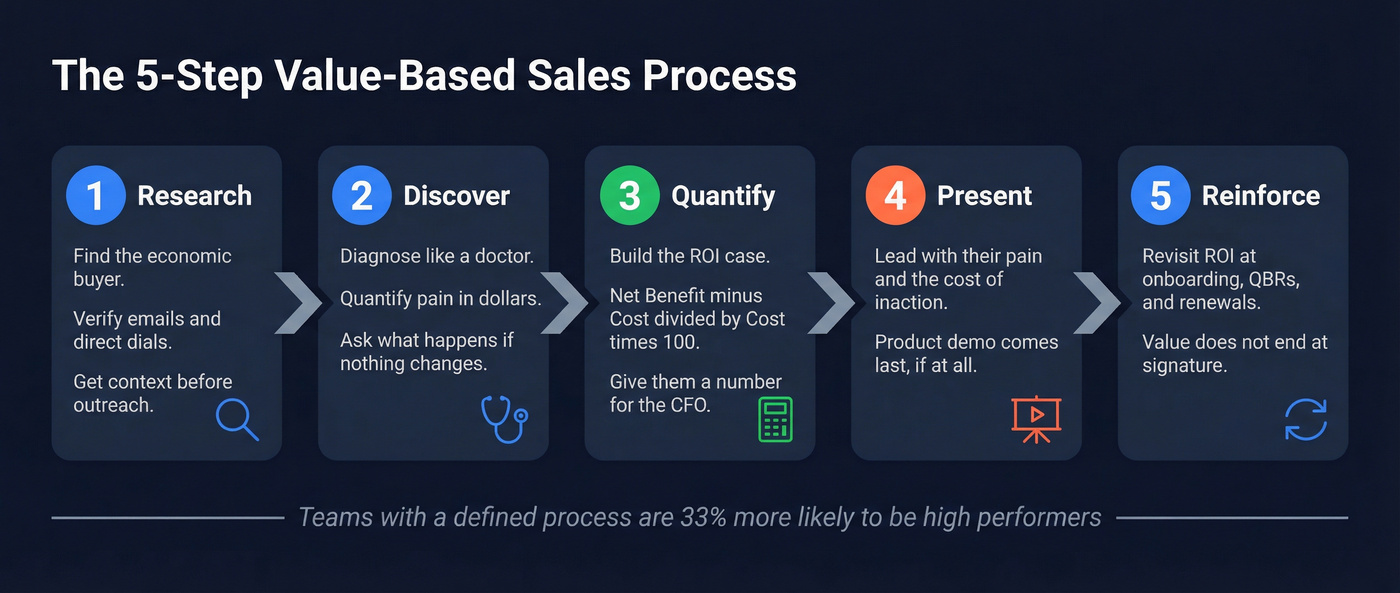
Run discovery like a doctor, not a detective. You're diagnosing, not interrogating:
- "What's the current process costing you in time, headcount, or missed revenue?"
- "If you had to quantify this problem in dollars, what's the number?"
- "What happens to your team's goals if nothing changes in 6 months?"
- "Who else is affected, and how does it show up in their metrics?"
RAIN Group found that sales winners are 3x more likely to bring new perspectives and 63% more likely to excel at making ROI cases. Discovery is where both advantages get built.
Step 3: Quantify
This is where most reps bail. They'll say "we save you time" instead of "we save you $185K annually."
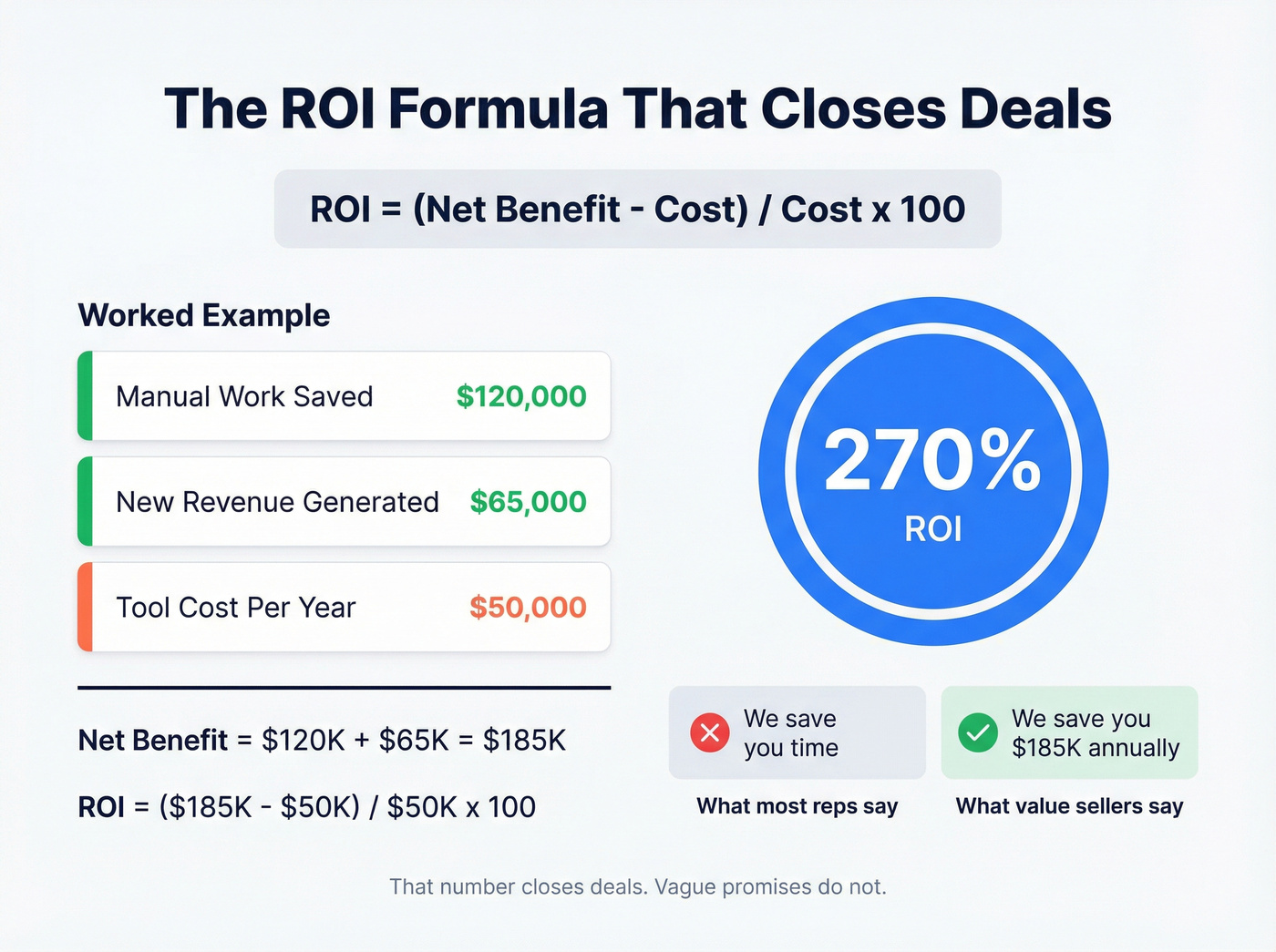
Worked example: Your tool costs $50K/year. It saves 2 FTEs of manual work ($120K) and generates $65K in new revenue. Net benefit = $185K. ROI = ($185K - $50K) / $50K x 100 = 270%. That number closes deals. "We save you time" doesn't.
Step 4: Present
Don't open with a product demo. Open with the buyer's world.
Structure the conversation as: their pain, the cost of inaction, the measurable result, then how you deliver it. We've watched reps flip a stalled deal by leading with "Your team is losing $22K per month to this problem" instead of "Let me show you our dashboard." The product demo comes last - if it comes at all.
If you want a tighter call flow, use a discovery call script to standardize what gets quantified.
Step 5: Reinforce
Value doesn't end at signature. Revisit the ROI case during onboarding, QBRs, and renewals. Readymode adopted a value-selling approach and reported a 72% win rate on sales-accepted opportunities. Companies with a well-defined sales process are 33% more likely to be high performers - and that process includes post-sale value reinforcement.
To make QBRs actually drive renewals, keep a running list of QBR questions to ask tied to the original ROI case.
Why This Methodology Fails
Five mistakes kill most value-selling initiatives.
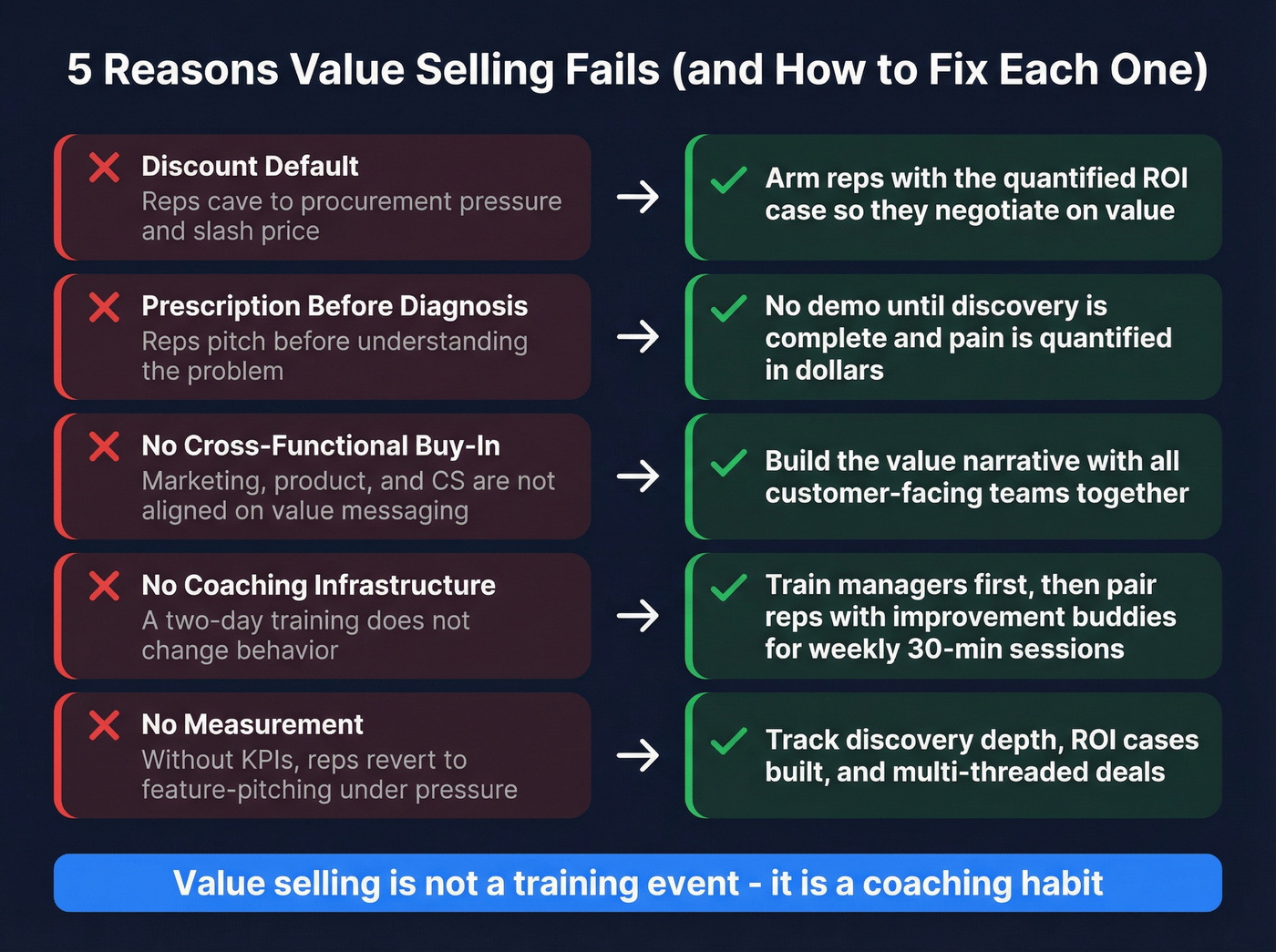
Discount default. Reps cave to procurement pressure. Fix: arm them with the quantified ROI case so they negotiate on value, not price. (If discounting is chronic, teach reps how to anchor in negotiation before procurement sets the frame.)
Prescription before diagnosis. Reps pitch before understanding the problem. No demo until discovery is complete and pain is quantified.
No cross-functional buy-in. Marketing, product, and CS aren't aligned on value messaging. Build the value narrative with all customer-facing teams, not just sales. This is where marketing enablement prevents "random acts of messaging."
No coaching infrastructure. A two-day training doesn't change behavior. One r/salesengineers thread debated whether methodology trainings are outright "scams" - the real issue isn't the framework, it's that nobody coaches it afterward. Train managers first, then pair reps with improvement buddies for weekly 30-minute sessions.
No measurement. If you don't track discovery depth, ROI cases built, and multi-threaded deals, reps revert to feature-pitching under pressure. Build value-selling KPIs into your existing sales operations metrics.
Let's be honest: a value-based selling methodology isn't a training event. It's a coaching habit. The teams that treat it like a one-time workshop are the ones still complaining about discounting six months later.
Skip the full methodology if your average deal size is under $10K. A solid discovery call and a one-page ROI summary will get you 80% of the way there. Save the formal framework for deals where the math actually moves a CFO.
Proof It Works
Named results from companies that committed:
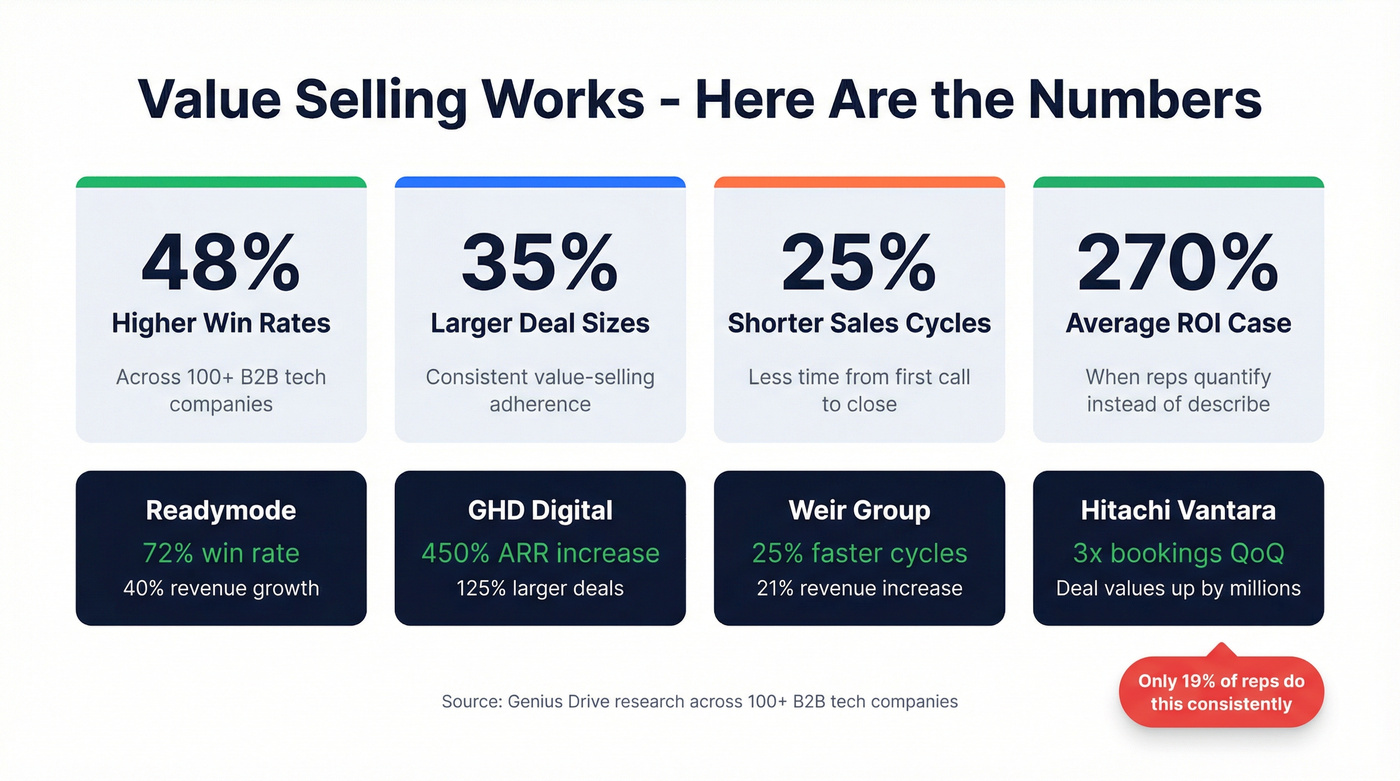
- Readymode: 40% annual revenue growth, 72% win rate on sales-accepted opportunities.
- GHD Digital: 450% ARR increase over two years, 125% larger average deal size.
- Weir Group: 25% faster sales cycles, 21% revenue increase.
- Hitachi Vantara: 3x bookings quarter-over-quarter, deal values up by millions.
Genius Drive's research across 100+ B2B tech companies found the same pattern: consistent value-selling adherence correlates with 48% higher win rates, 35% larger deals, and 25% shorter cycles. In our experience testing outbound strategies across mid-market SaaS teams, these numbers hold. The methodology works. The adoption is what's broken.
If you're trying to operationalize this across the org, treat it like sales execution - not a one-off training.
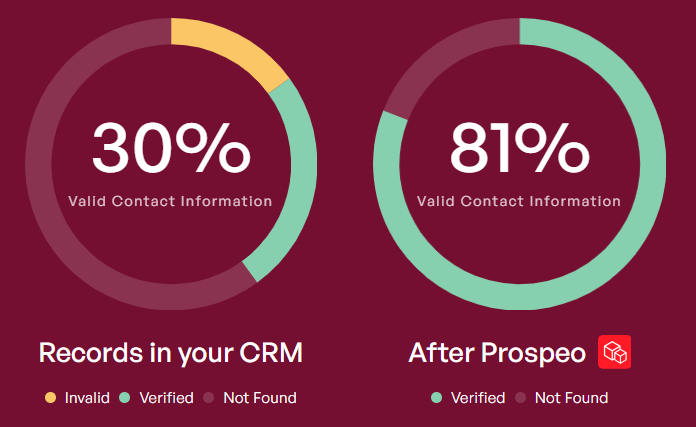
You just built a 270% ROI case. Now imagine it lands in a bounced inbox. Teams using Prospeo cut bounce rates from 35% to under 4% and book 26% more meetings - because value selling only works when your message reaches a real buyer.
Your ROI formula is worthless if the email never arrives.
FAQ
What's the difference between value selling and consultative selling?
Value selling is consultative selling with a calculator. Both diagnose before prescribing, but a value-based approach hands the buyer a specific number - like a 270% ROI projection - they can take to their CFO. Consultative selling stops at qualitative insight; value selling quantifies it.
How long does it take to implement?
Core training takes 2-4 weeks. Real adoption requires 3-6 months of weekly manager coaching. Structured rollout with improvement buddies is what separates teams that sustain 48% higher win rates from those that revert to discounting within a quarter.
What tools support a value-selling workflow?
Three essentials: a CRM for tracking deal progression and value metrics, an ROI calculator for quantifying outcomes in discovery, and a B2B data platform like Prospeo for finding verified emails and direct dials on economic buyers before the first call. Layering in buyer intent signals and job-change data helps reps target the right stakeholders from the start.