

Value Selling Methodology: What It Actually Is and How to Do It
Every sales methodology article collapses into the same advice: understand the buyer, qualify properly, talk to the right stakeholders. The Reddit consensus isn't wrong - most frameworks share the same skeleton. But the value selling methodology isn't a "methodology" the way most teams mean it. It's the quantification discipline that makes every other methodology actually work. Without it, you're just having nice conversations that end in "no decision."
What Value Selling Actually Is
A common misconception - one that shows up in job interviews, onboarding decks, and Reddit threads - is that value selling means "adding value at every touchpoint." Share an insight before asking for the meeting. That's good selling etiquette, but it's not value-based selling. (If you want the stage-by-stage version, see adding value in sales.)
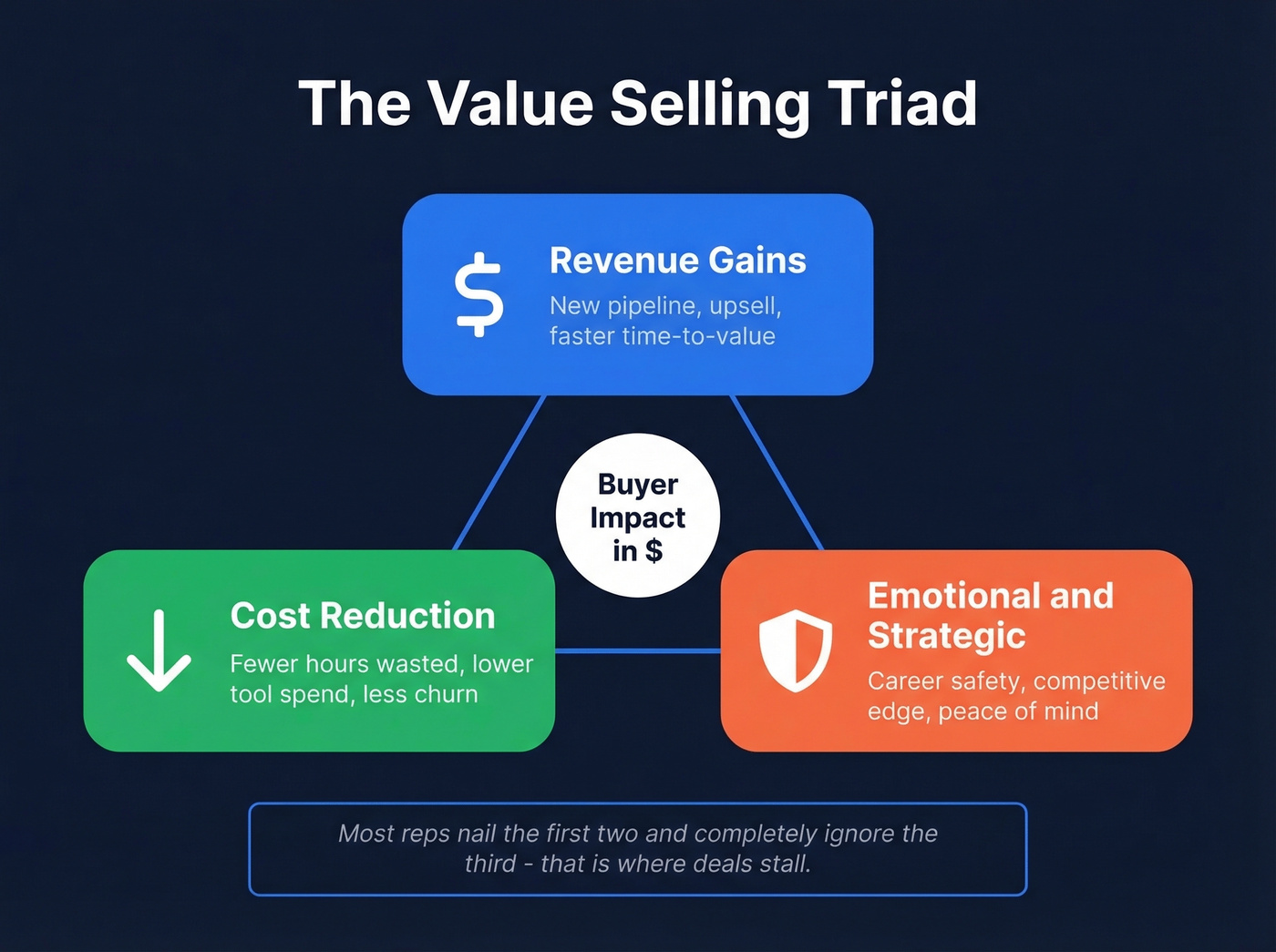
Value selling is the practice of quantifying the economic impact your solution creates for the buyer, in dollars, so they can build an internal business case without guessing. The value sits on a triad: revenue gains, cost reduction, and emotional or strategic contribution - career risk, competitive positioning, peace of mind. Many reps nail the first two and ignore the third entirely.
Prescription before diagnosis is malpractice. If you're pitching ROI before you've diagnosed the buyer's specific pain in their specific context, you're not value selling - you're doing math at people. (A tighter discovery questions system helps here.)
Why It Matters in 2026
Gartner reports that 93% of B2B buyers now require a business case before making a tech investment. Deals involve 10+ stakeholders. Buyers define their requirements 83% of the time before talking to a rep. And Forrester predicts more than half of $1M+ B2B transactions will be processed through digital self-serve channels.
Here's the thing: your champion is presenting your value story in rooms you'll never enter. If you haven't armed them with quantified impact - real numbers, not "improve productivity" - deals stall. 40-60% of qualified pipeline ends in no decision, not a competitor win. The status quo is your real opponent. 86% of purchases stall during the buying process because teams can't align internally, and the first vendor to communicate a clear vision of value to executives wins 74% of the time. Speed and specificity matter more than ever. (This is also why enterprise B2B sales teams obsess over internal alignment.)
Four Steps to Execute Value Selling
Four steps, executed well, cover the entire sales cycle. One critical point we've learned working with outbound teams: value quantification should start in discovery, not be saved for the proposal stage. By then it's too late. (If your pipeline is messy, start with sales pipeline challenges.)
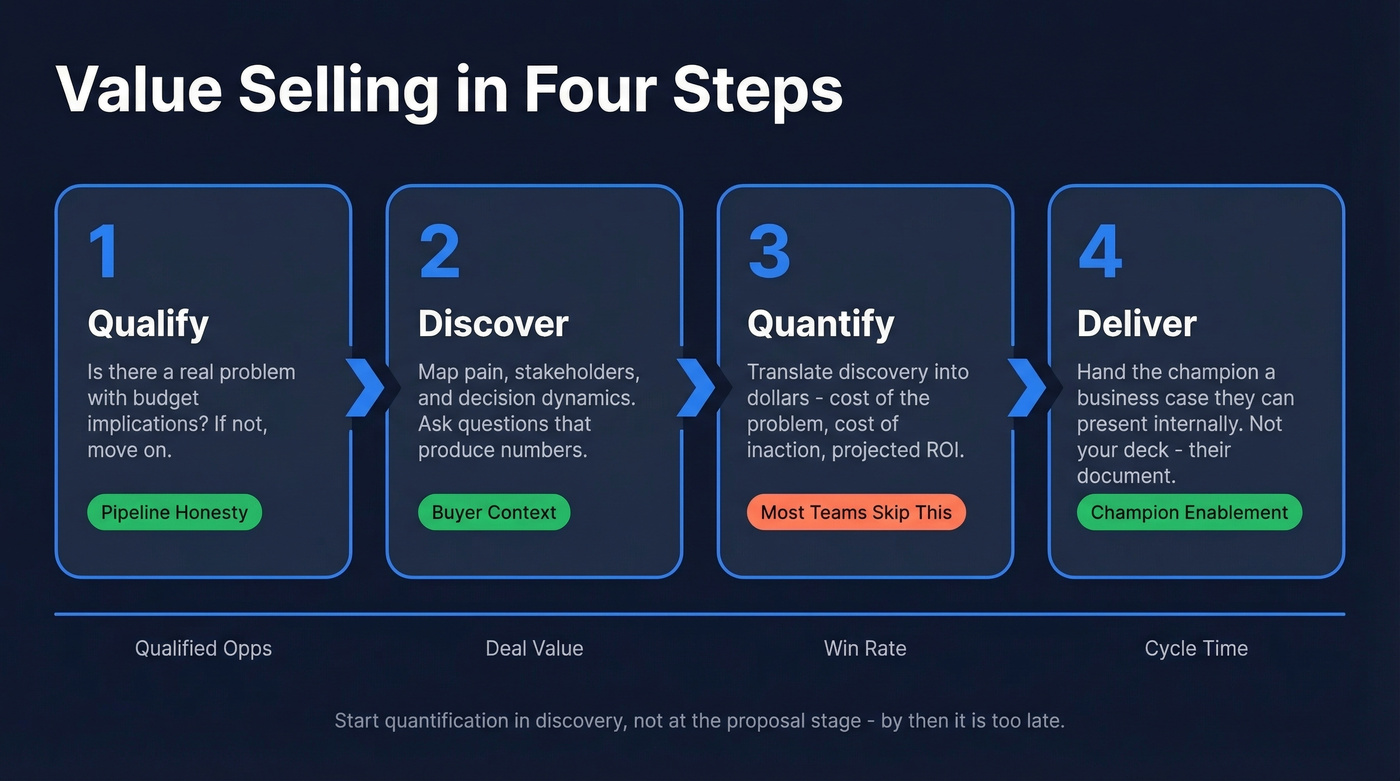
- Qualify. Confirm there's a real problem with budget implications. This keeps your pipeline honest. (Use MEDDIC sales qualification to keep it consistent.)
- Discover. Map the buyer's pain, stakeholders, and decision dynamics. This is where most reps think the work ends.
- Quantify. Translate discovery into dollars - cost of the problem, cost of inaction, projected ROI. Most teams skip this entirely, defaulting to generic case studies instead of buyer-specific math.
- Deliver. Present the business case in a format the champion can carry internally. Not your slide deck. Their business case.
These steps map directly to the sales velocity levers that matter: qualified opportunities, deal value, win rate, and cycle time.

You just built a bulletproof business case. Now it needs to reach the economic buyer - not bounce. Prospeo delivers 98% email accuracy with a 7-day refresh cycle, so your quantified ROI lands in the right inbox every time. Teams book 26% more meetings because the message actually connects.
Stop losing deals to stale data. Reach the decision-maker who signs off.
Discovery Questions That Quantify Impact
Good discovery isn't about asking more questions - it's about asking questions that produce numbers. MEDDPICC maps cleanly as an internal compass alongside these; the buyer doesn't need to know you're running a framework. (If you need a dedicated set, pull from MEDDIC discovery questions.)
Pain Identification
- "What's prompting you to explore solutions now - what changed?"
- "Walk me through what happens when this problem hits. Who feels it first?"
Business Impact Quantification
- "What is this challenge costing you in time, resources, or revenue today?"
- "If you had to quantify the impact in dollars - even a rough range - where would you land?"
Cost of Inaction
- "What happens if nothing changes in the next quarter?"
Cost of inaction is the most powerful number in value-based selling. It reframes the conversation from "is this worth buying?" to "can we afford not to?"
Personal Win and Stakeholder Dynamics
- "What would success look like for you personally - not just the team?"
The personal win question is underused. People buy for organizational reasons and personal ones - career advancement, reduced stress, looking smart in front of the board. These rarely surface unless you ask directly. Once you have answers, convert them into a one-page stakeholder map and draft business case your champion can actually present. We've seen reps close six-figure deals faster simply because they handed the champion a pre-built one-pager with the CFO's language already baked in. (Related: how to find and win the economic buyer.)
Why Value Selling Fails
This approach is a skill, not a slogan. Five mistakes kill it consistently.
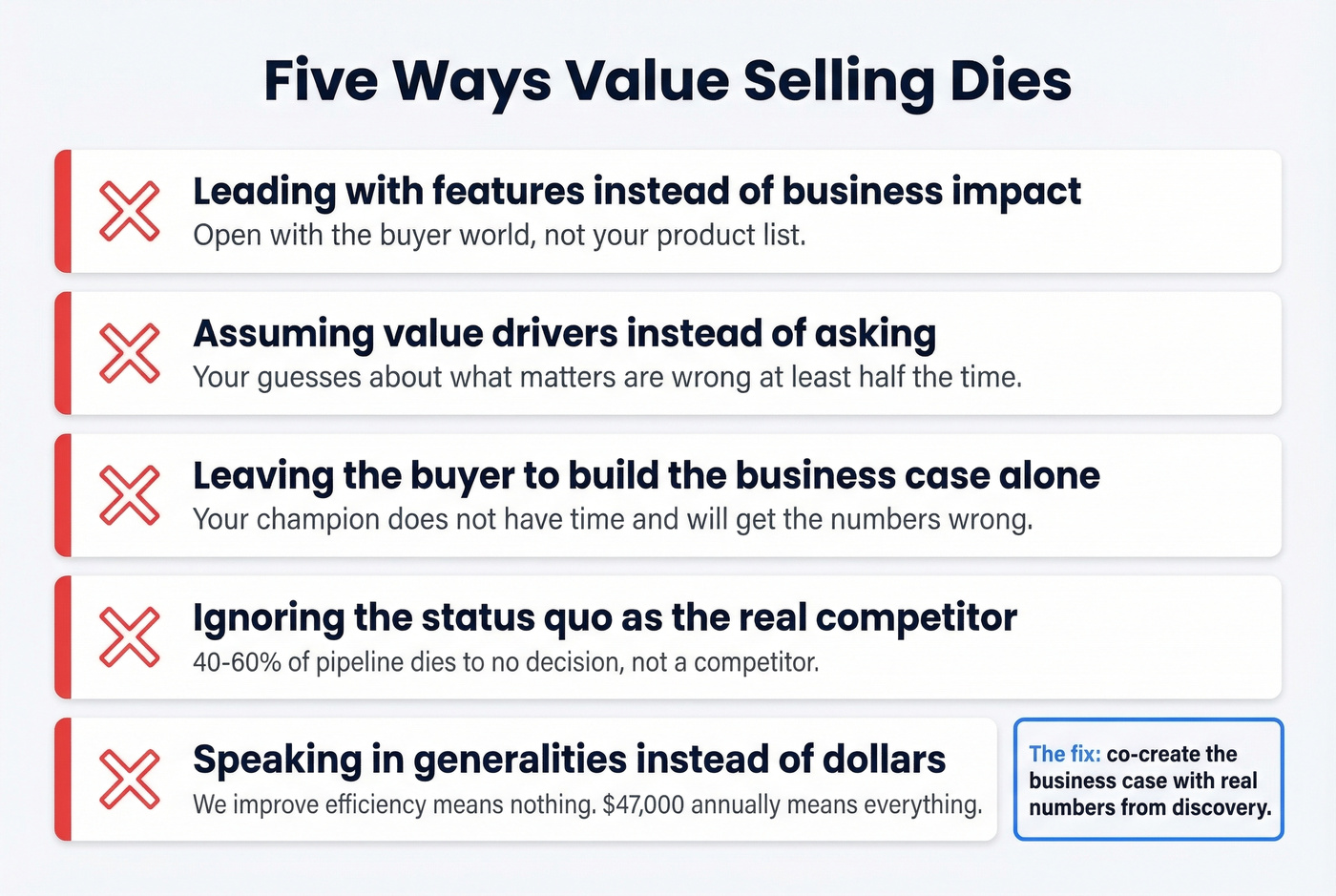
Leading with features instead of business impact. Open every conversation with the buyer's world, not your product. The moment you start listing capabilities, you've lost the frame.
Assuming value drivers instead of asking. Never fill in the "why they'd buy" section of your CRM without direct quotes from the buyer. Your assumptions about what matters are wrong at least half the time.
Leaving the buyer to build the business case alone. This is where deals die. Your champion doesn't have time to build your ROI story - and even if they do, they'll get the numbers wrong. Co-create the business case and hand them a ready-to-present document.
There's an execution gap nobody talks about: your value message only works if it reaches the economic buyer. If your prospect data is stale - bounced emails, disconnected numbers - the business case you built never arrives. Prospeo's 98% email accuracy and 7-day data refresh cycle solve exactly this, and teams using it book 26% more meetings than those relying on legacy data providers because the message actually lands. (If you're diagnosing deliverability, start with email bounce rate.)
Ignoring the status quo as the real competitor. Quantify the cost of doing nothing. Make inaction feel expensive.
Speaking in generalities instead of dollars. "We improve efficiency" means nothing. "We save your team 12 hours per week, which at your blended rate is $47,000 annually" means everything.
How It Compares to Other Frameworks
The value selling methodology doesn't replace other frameworks - it layers on top of them.
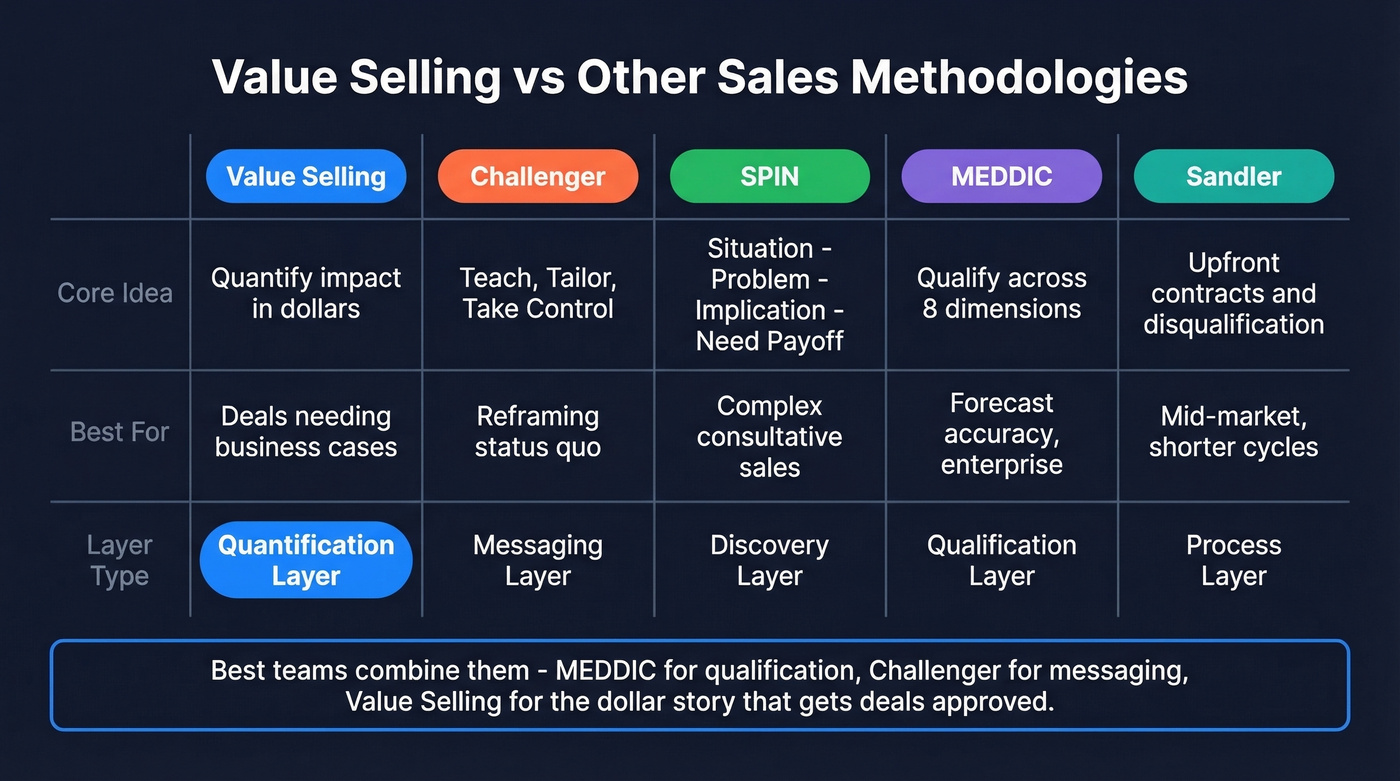
| Methodology | Core Idea | Best For | Common Citations |
|---|---|---|---|
| Value Selling | Quantify impact in $ | Deals needing business cases | Forrester, Corporate Visions |
| Challenger | Teach, Tailor, Take Control | Reframing status quo as risk | CEB, 6,000+ reps |
| SPIN | Situation - Problem - Implication - Need-Payoff | Complex consultative selling | 35,000+ calls, 12 years |
| MEDDIC/MEDDPICC | Qualification across 8 dimensions | Forecast accuracy, enterprise | Widely adopted |
| Sandler | Upfront contracts, disqualification | Mid-market, shorter cycles | Practitioner-driven |
Let's be honest: the best sales orgs don't pick one methodology. They use MEDDIC for qualification rigor - one team we worked with saved a $72K ARR forecast by catching a missing economic buyer - Challenger for insight-led messaging, and value selling for the quantification layer that gets deals approved. These aren't competing religions. They're complementary tools. (If you want the operational layer, see sales execution.)
Reddit has plenty of practitioners skeptical of paid methodology training, and they're not wrong to be. ValueSelling Associates' branded framework is one formalized option (Justworks reported a 30% win rate increase after implementing it), but enterprise methodology training typically runs in the tens of thousands depending on team size. Skip the expensive certification if budget is tight - the principles in this article work regardless of whose training you buy.
Value selling fails when your champion can't reach stakeholders internally - and it fails even harder when you can't reach them externally. Prospeo gives you 300M+ verified profiles with 30+ filters including buyer intent and job changes, so you target prospects already feeling the pain you quantify.
Arm your outreach with the same precision you bring to your business case.
FAQ
Is value selling the same as solution selling?
No. Solution selling matches capabilities to needs. Value selling quantifies the economic impact in dollars, giving the buyer a defensible business case when the CFO asks "what's the ROI?" Solution selling answers "what does it do?" - value selling answers "what is it worth?"
Can you combine value selling with MEDDIC?
Yes, and you should. MEDDIC is your internal qualification compass - it tells you whether a deal is real. Value selling is the external conversation that gives the champion ammunition. They're complementary by design, and most enterprise teams run both simultaneously.
How do you quantify value when the buyer won't share numbers?
Anchor with industry benchmarks. Say "companies your size typically lose $X per quarter to this problem - does that feel directionally right?" Most buyers will correct you with their real number, which is exactly what you need to build the business case.
What's the biggest mistake teams make with value selling?
Saving the quantification for the proposal stage. By then, the buyer has already formed opinions about whether your solution is worth pursuing, and you've missed the window to shape how they think about the problem's cost. Start building the dollar story in your first discovery call.