

How to Get Verified Business Email Addresses That Actually Work
You send 500 cold emails. 40 bounce. Your domain gets flagged. The sequence you spent two weeks writing never reaches a single inbox.
That's what happens when your "verified" business email addresses aren't actually verified. SDRs already spend 20-40% of their time on manual data research instead of selling, and bad data makes that number worse. Here's the thing most teams miss: you don't have a prospecting problem - you have a data quality problem. Fix your bounce rate and your existing sequences will outperform any new copy you write.
What You Actually Need
You need an email finder (discovers addresses) AND an email verifier (confirms they won't bounce). Some tools do both in one step. Our recommended stack: Prospeo for combined find + verify with 98% accuracy, Hunter as a free-tier starting point, and Clay for complex waterfall workflows.
The target is simple: keep your bounce rate under 5%. If your current tool delivers 70-80% accuracy, one in four emails is wasted spend - and wasted domain reputation.
Email Finder vs. Email Verifier
Confusing these two is how teams end up with a 12% bounce rate.
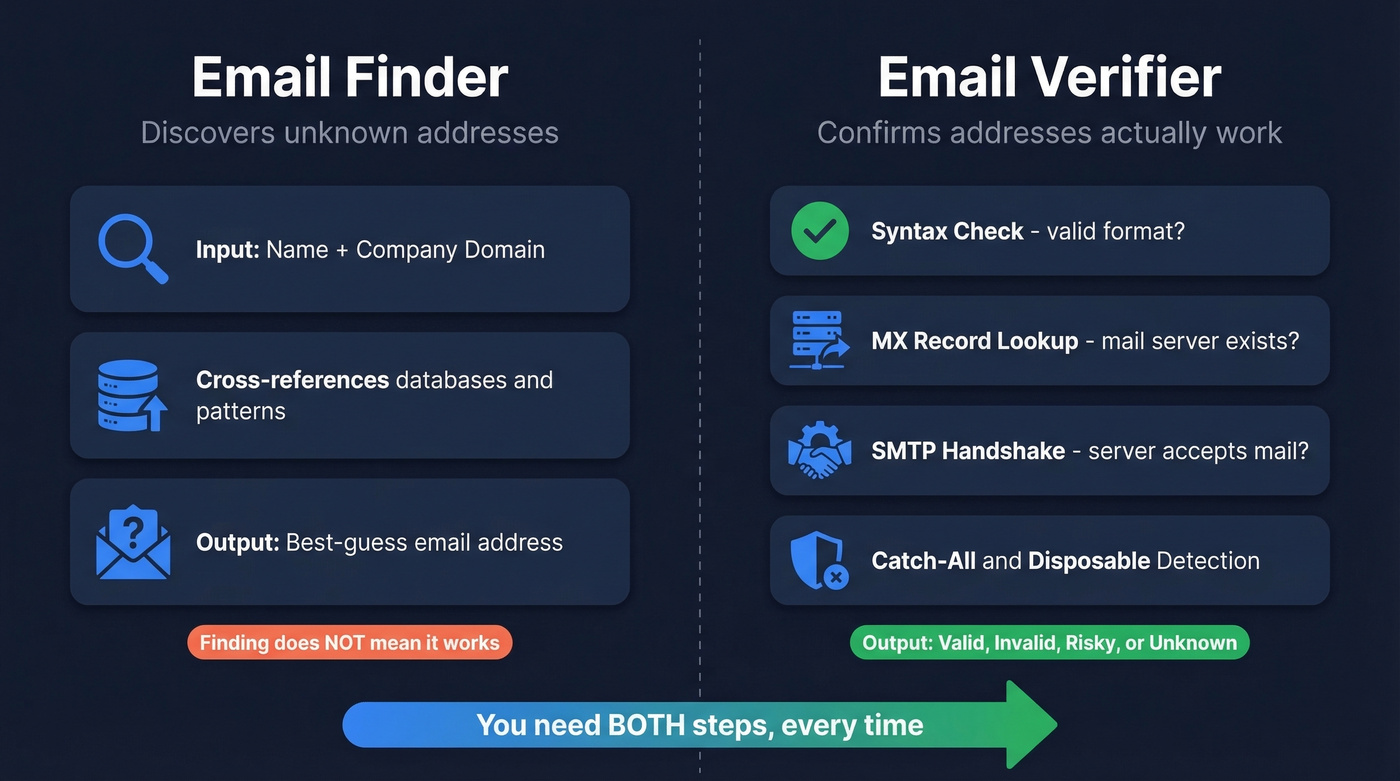
An email finder discovers an unknown email address from inputs like a person's name and company domain. It's guessing intelligently, cross-referencing databases, and returning its best match. An email verifier takes an existing email and checks whether it can actually receive mail, returning a status like valid, invalid, risky, or unknown.
Finding an email doesn't mean it works. We've seen teams skip the verification step and then wonder why their sender reputation tanks after the first campaign. You need both steps, every time.
How Email Verification Works
Verification isn't magic. It's a technical pipeline with distinct stages:
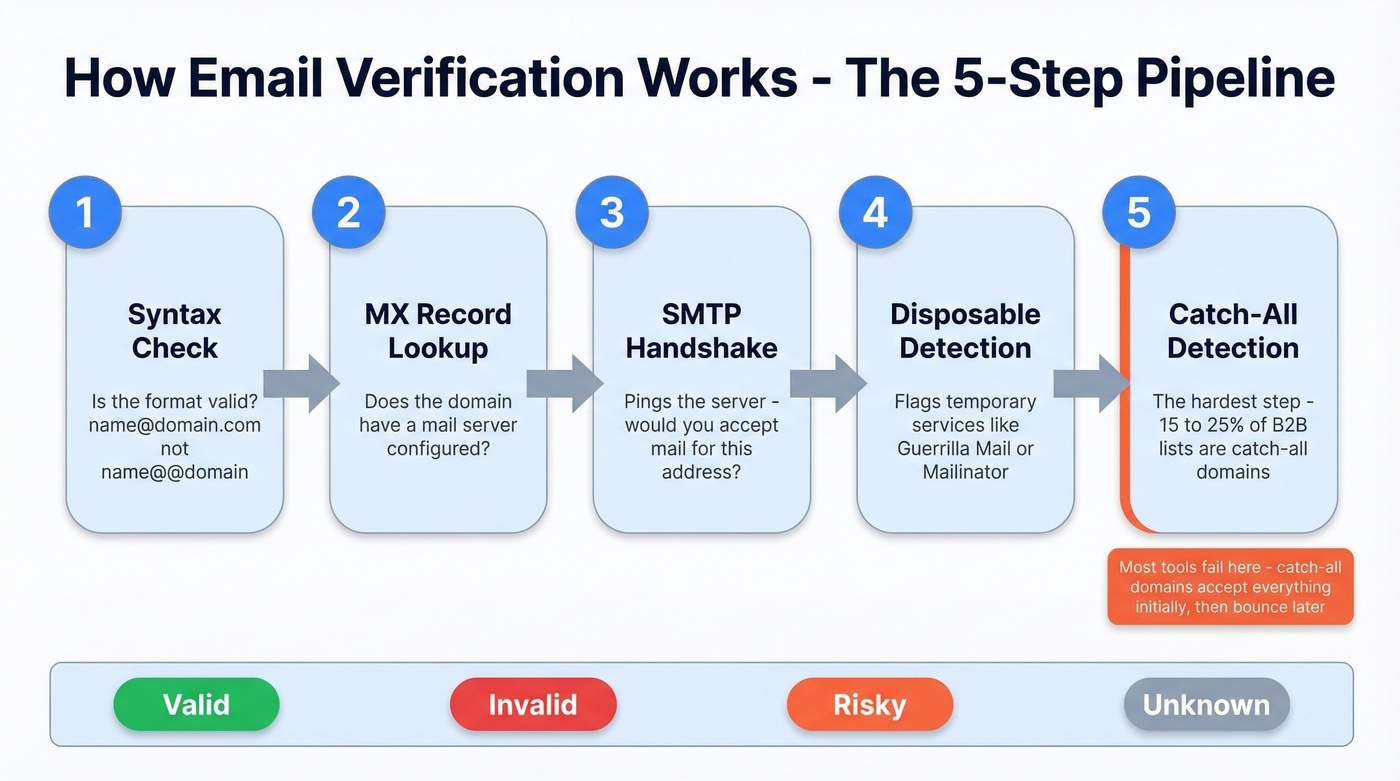
- Syntax check - does the email follow valid formatting rules?
name@domain.com, notname@@domain. - MX record lookup - does the domain have a mail server configured to receive email?
- SMTP handshake - the verifier pings the mail server to ask "would you accept a message for this address?" without actually sending one.
- Disposable domain detection - flagging temporary email services like Guerrilla Mail or Mailinator that exist for a few hours and then vanish.
A fifth layer matters more than most people realize: catch-all detection. Roughly 15-25% of B2B email lists are catch-all addresses - domains configured to accept everything initially, then bounce later. Practitioners on r/coldemail consistently report catch-all verifiers returning false-positive "valid" results that still bounce. It's the most unreliable category in any email list, and any tool you choose needs to handle it explicitly.


Most tools skip catch-all detection - the #1 reason 'verified' emails still bounce. Prospeo's 5-step verification includes catch-all handling, spam-trap removal, and honeypot filtering across 143M+ emails refreshed every 7 days. That's how teams like Meritt cut bounce rates from 35% to under 4%.
Find and verify business emails in one pass - 75 free every month.
The Find-to-Verify Workflow
The smartest outbound teams run a waterfall approach. Start with free sources: scrape company About pages, pull emails from niche industry directories, check conference speaker lists. Then enrich the gaps with a paid finder, but only for rows that came back empty. Finally, verify everything before it touches a sequence.
One Reddit practitioner documented this exact workflow using Clay and GPT-4o-mini, getting costs down to $0.00075 per successful find. The catch? About 40% of sites had no visible email address, and the scraper sometimes grabbed web agency emails instead of the actual business contact. You still need a verification step no matter how clever your sourcing is.
Paying separately for a finder and a verifier is a tax on disorganization. Tools that combine both steps - paste a URL or upload a CSV, get confirmed professional contacts back - cut the workflow in half and eliminate the gap where bad data sneaks through.
If you're building this into a repeatable outbound motion, it helps to standardize your lead generation workflow so verification is never optional.
Best Tools for Finding and Verifying B2B Emails
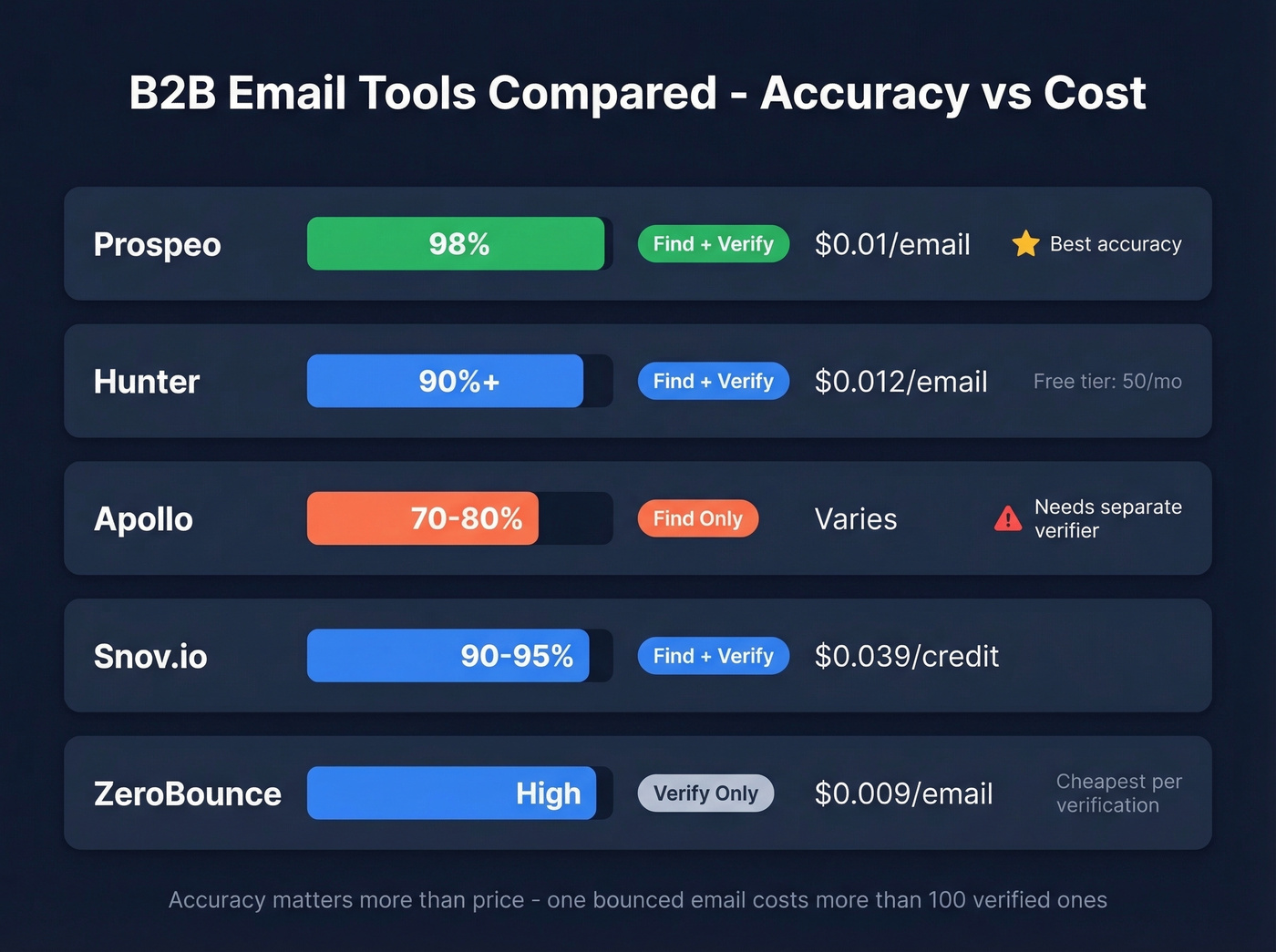
| Tool | Finds + Verifies? | Accuracy | Cost/Email | Starting Price | Best For |
|---|---|---|---|---|---|
| Prospeo | Yes | 98% | ~$0.01 | Free (75/mo) | Accuracy + speed |
| Hunter | Yes | 90%+ | ~$0.012 | Free (50/mo) | Free-tier testing |
| Apollo | Find only | 70-80% | Varies by plan | $49/mo | Large database + workflows |
| Snov.io | Yes | 90-95% | ~$0.039/credit | $39/mo | Mid-range budgets |
| ZeroBounce | Verify only | High | ~$0.009 | $18/mo | Bulk verification |
Prospeo
Use this if you want finding and verification in a single pass with the highest accuracy on the market. Prospeo's database covers 300M+ professional profiles with 143M+ verified emails, refreshed every 7 days - not the roughly 6-week cycle most providers run. The 5-step verification process with proprietary infrastructure (catch-all handling, spam-trap removal, honeypot filtering) delivers 98% email accuracy at about $0.01 per usable email.
The free tier gives you 75 verified emails per month. No contract, no sales call.
The Chrome extension has 40,000+ users for one-click prospecting from any website. Real results: Meritt went from a 35% bounce rate to under 4% after switching, and Stack Optimize maintains 94%+ deliverability across all clients with zero domain flags. It integrates natively with Smartlead, Instantly, Lemlist, Salesforce, HubSpot, Clay, Zapier, and Make, so it slots in as the data layer of whatever stack you're already running.
If you're comparing options beyond this shortlist, see our breakdown of sales prospecting databases and data enrichment services.
Paying $0.01 per verified email beats paying with your domain reputation. Prospeo combines finding and verification into a single step across 300M+ profiles with 98% accuracy - no separate verifier needed, no bad data sneaking through.
Keep your bounce rate under 5% without duct-taping two tools together.
Hunter
Hunter is the most recognized name in email finding, with 6M+ users and a Chrome extension that has 600,000+ users and a 4.7 rating from 12,000+ reviews. The free plan gives you 50 credits per month - enough to test the workflow. Starter runs $34/mo annually or $49/mo monthly for 2,000 credits, with verification costing 0.5 credits per email. Accuracy sits at 90%+, though the find rate is more limited than dedicated database tools. It's a solid starting point, but you'll outgrow it fast at scale.
If you're evaluating similar tools, compare against our list of Hunter alternatives.

Apollo - Huge Database, Questionable Accuracy
Apollo starts at $49/mo and gives you a massive database. The problem: 70-80% email accuracy. One in four emails might bounce, and that's not "verified" by any reasonable definition. If you're already in Apollo for your outbound workflows, run every list through a dedicated verifier before sending. Don't trust the green checkmark.
Skip Apollo as a standalone email source unless you're pairing it with a real verification layer. (If you're troubleshooting bounces, use this email bounce rate guide to diagnose what’s happening.)
Snov.io and ZeroBounce
Snov.io hits 90-95% verified accuracy from $39/mo for 1,000 credits. Solid mid-range option if you need finding and verification without a big commitment - the workflow is straightforward and the pricing is transparent.
ZeroBounce is verification-only, no email finding, starting at $18/mo for 2,000 verifications. That's the cheapest per-verification cost on this list at ~$0.009/email. Useful if you already have lists from other sources and just need to clean them before sending.
For more verifier-first options, see our roundup of Bouncer alternatives.
Compliance You Can't Ignore
Even verified business email addresses don't exempt you from the law. Let's be honest - most outbound teams treat compliance as an afterthought until they get burned.
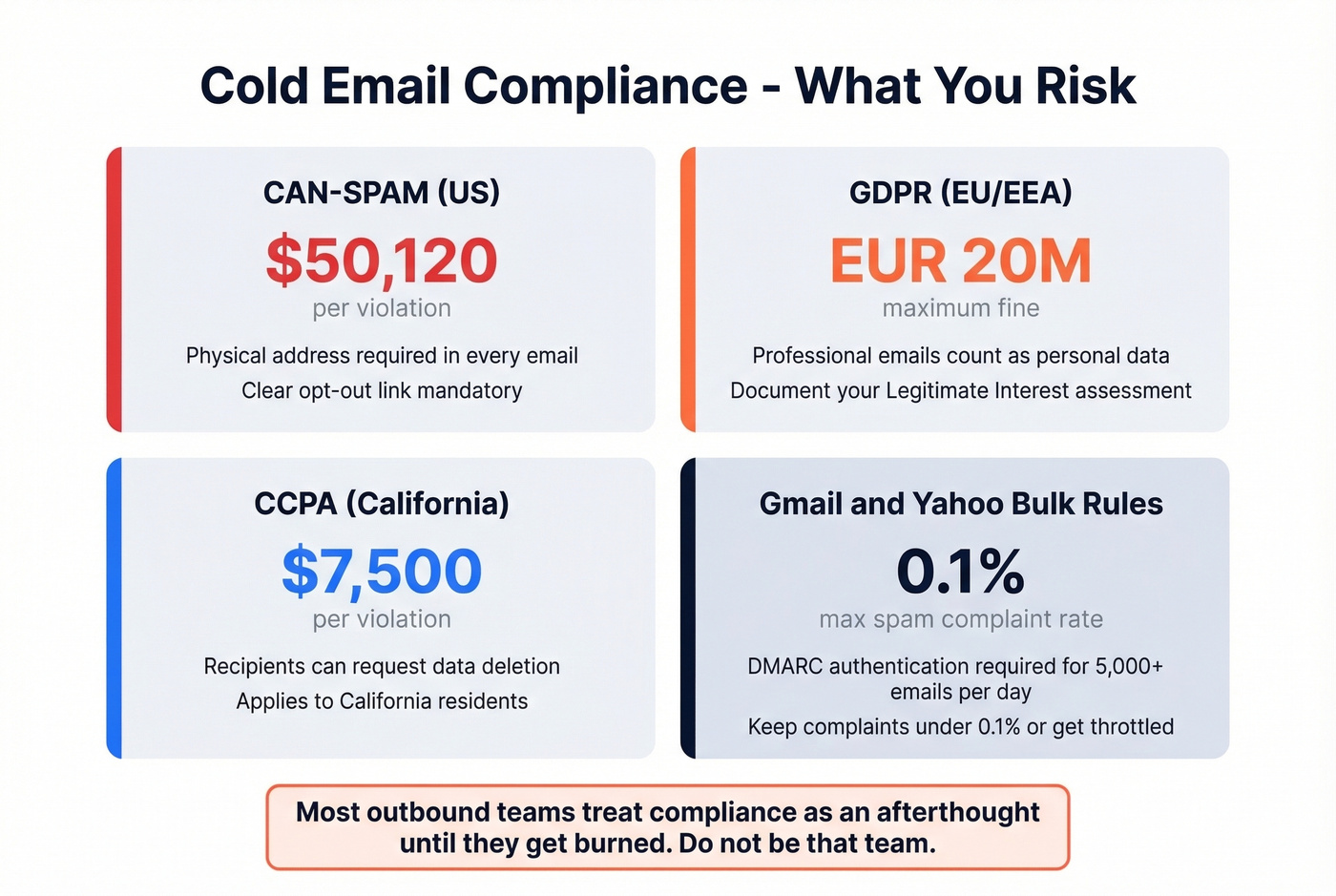
- CAN-SPAM (US): Physical address and clear opt-out required. Penalties run up to $50,120 per violation.
- GDPR (EU/EEA): Professional emails are personal data. Document your Legitimate Interest assessment. Fines reach up to EUR 20M.
- CCPA (California): Recipients can request deletion. Up to $7,500 per violation.
- Gmail/Yahoo bulk sender rules: Send 5,000+ emails/day to Google or Yahoo users and you need DMARC authentication. Keep spam complaints under 0.1%.
If you're sending at scale, pair verification with an email deliverability guide and a dedicated email spam checker.
FAQ
What's a good bounce rate for cold email?
The average cold email bounce rate runs 7-8%. Keep yours under 5%. Above that, your sender reputation degrades and emails land in spam instead of the primary inbox. In our experience, teams that verify every address before sending consistently stay under 3%.
Can I verify catch-all emails?
Only partially. Catch-all domains accept everything initially but may bounce later, and they make up 15-25% of B2B lists. Segment them as risky and send in small batches, or use a tool with dedicated catch-all handling to flag these before they damage your domain.
How often does B2B email data go stale?
Faster than most teams realize. B2B contact data decays at roughly 30% per year as people change roles and companies. Most providers refresh around every 6 weeks - by then, a meaningful chunk of your list has gone bad. Weekly refresh cycles are the difference between a clean list and a domain reputation problem.
How do I find verified business email addresses for free?
Start with company About pages, niche industry directories, and conference speaker lists. Hunter's free tier gives you 50 credits/month, and Prospeo's free plan includes 75 verified emails/month with full verification. The key: always run addresses through a verifier before sending, even if the source looks reliable.