

=== CURRENT ARTICLE (slug: virtual-prospecting-intent-data) ===
Virtual Prospecting Intent Data: The 2026 Playbook
Most teams buy intent data and never do anything useful with it. Roughly two-thirds struggle to turn signals into actual outreach - not because the data is bad, but because there's no workflow connecting "this account is surging" to "this SDR is calling the right person." Meanwhile, 61-75% of prospects prefer a rep-free buying experience, which means virtual prospecting isn't a nice-to-have anymore. It's the default motion.
The gap isn't data. It's execution.
If your deal size sits below $15k, you almost certainly don't need a six-figure intent platform. Start with first-party signals and a self-serve tool before committing to $25k+ enterprise contracts.
What Intent Data Actually Tells You
First-party signals come from properties you own: website visits, CRM activity, content downloads. High reliability, but limited - you only see what happens on your turf.
Third-party signals come from external networks. Bombora's publisher co-op model is one of the most common: a network of publishers pools aggregated content consumption signals and flags when a company's topic consumption spikes above baseline. Bidstream data - tracking ad-exchange bid requests - is cheaper but noisier, and its long-term viability is shaky as cookie deprecation continues.
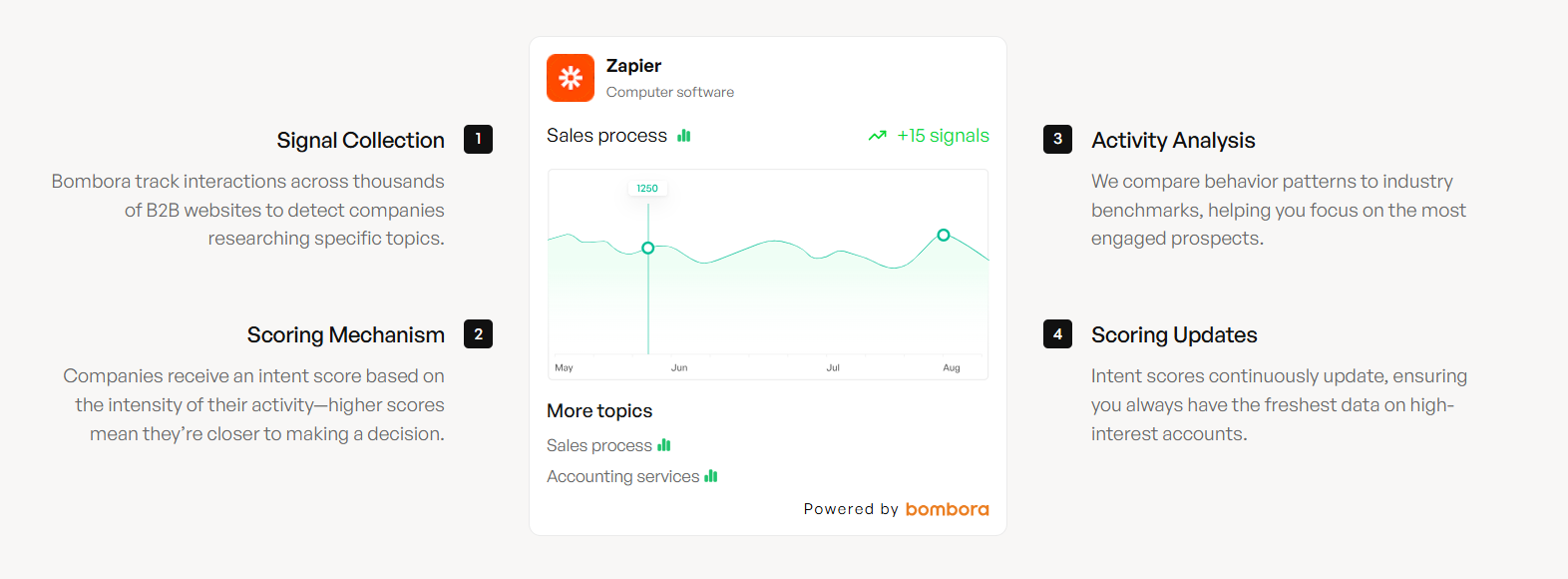
Here's the distinction most teams miss: nearly all third-party intent data is account-level, not buyer-level. You know Company X is researching "endpoint security." You don't know who at Company X is doing the research. That gap is the central problem this entire playbook solves.
Building a Scoring Model That Works
Raw intent signals are useless without a scoring framework. We've tested several approaches, and the simplest one that actually holds up is a point-based system where you assign values to each behavior, then bucket accounts by total score.
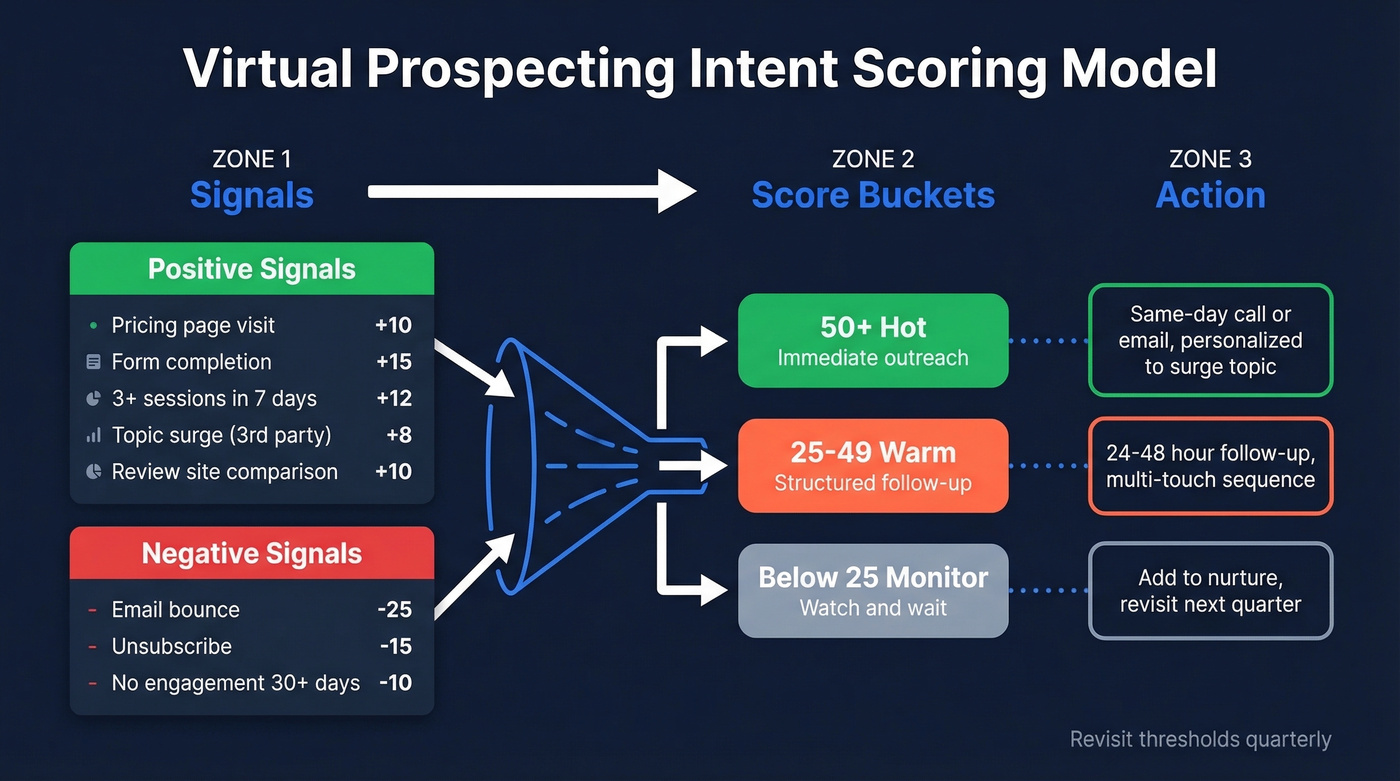
| Signal | Points |
|---|---|
| Pricing page visit | +10 |
| Form completion | +15 |
| 3+ sessions in 7 days | +12 |
| Topic surge (3rd party) | +8 |
| Review-site comparison | +10 |
| Email bounce | -25 |
| Unsubscribe | -15 |
| No engagement 30+ days | -10 |
Threshold bands: 50+ is hot (immediate outreach), 25-49 is warm (structured follow-up), below 25 is monitor-only.
Negative signals matter as much as positive ones. A bounce or unsubscribe should aggressively pull a score down. If you're weighting email opens, stop - Apple Mail Privacy Protection makes open-rate signals unreliable for a huge chunk of your audience. Weight on-site behavior instead. And layer in job-change signals: a new VP of Engineering at a surging account is a higher-priority target than a stable org chart.
Revisit thresholds quarterly. If your hot bucket generates more accounts than your team can work, raise the bar.
Signal Decay and Response Tiers
Intent data has a shelf life. A topic surge from six weeks ago is noise, not signal.
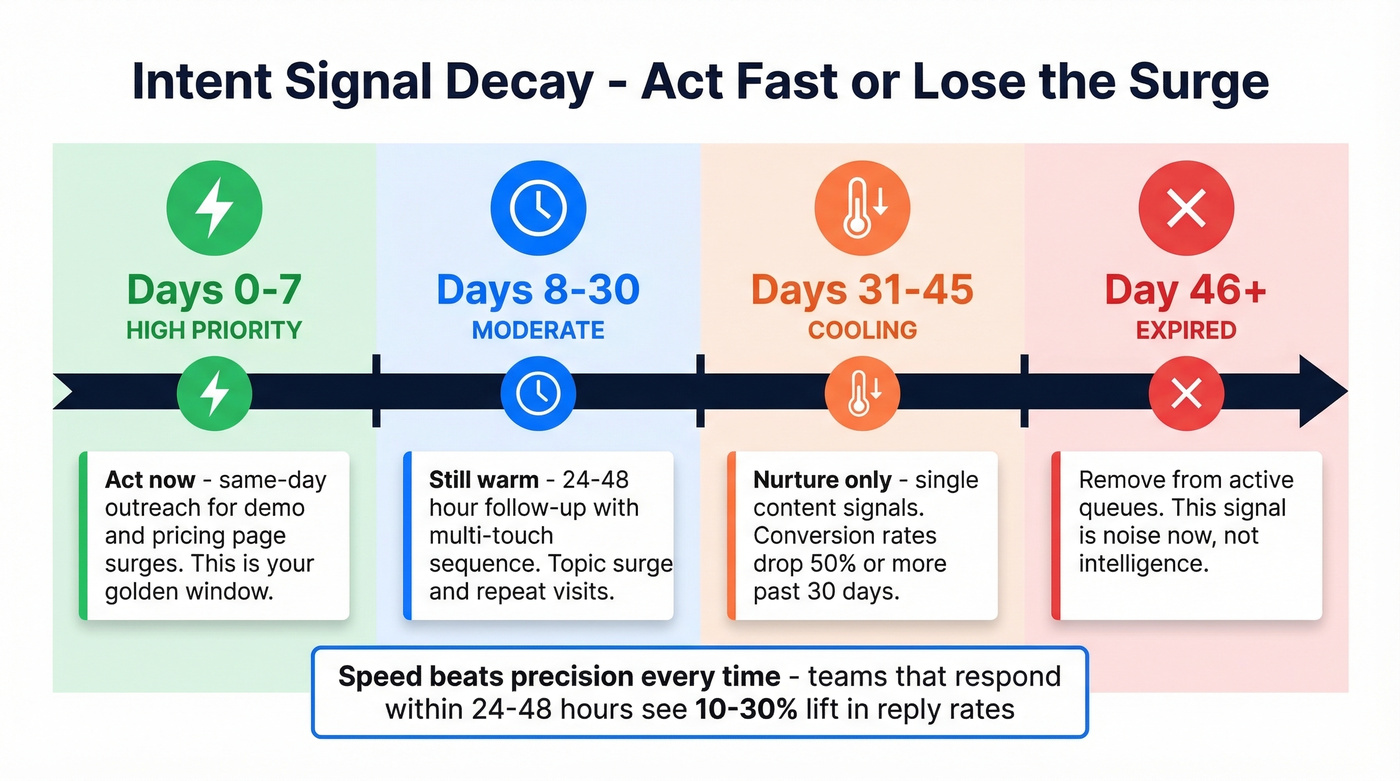
| Window | Priority |
|---|---|
| 0-7 days | High - act now |
| 8-30 days | Moderate - still warm |
| 31-45 days | Cooling - nurture only |
| 46+ days | Expired - remove |
Pair decay windows with response SLAs:
| Tier | Trigger | SLA |
|---|---|---|
| Tier 1 | Demo/pricing page + surge | Same-day outreach |
| Tier 2 | Topic surge or repeat visits | 24-48 hour follow-up |
| Tier 3 | Single content signal | Nurture sequence only |
Speed is a bigger factor than most people realize. Aim to act within 24-48 hours of a surge, while the account is still actively researching. Teams that combine intent signals with fast follow-up typically see a 10-30% lift in reply and meeting rates. We've seen teams with mediocre scoring models outperform teams with sophisticated ones, purely because they responded faster. Speed beats precision every time.

Intent data without verified contacts is a dead end. Prospeo layers 15,000 Bombora intent topics directly onto 300M+ profiles refreshed every 7 days - so when an account surges, you get the right person's verified email at 98% accuracy, not a stale CRM record from 2023.
Stop wasting surges on bounced emails. Act on intent with contacts you can actually reach.
From Account Signals to Verified Contacts
This is where most intent programs fall apart. You've got a Bombora surge telling you Acme Corp is researching your category - then your SDR opens the CRM and finds three stale contacts from 2023, two of whom have left the company.
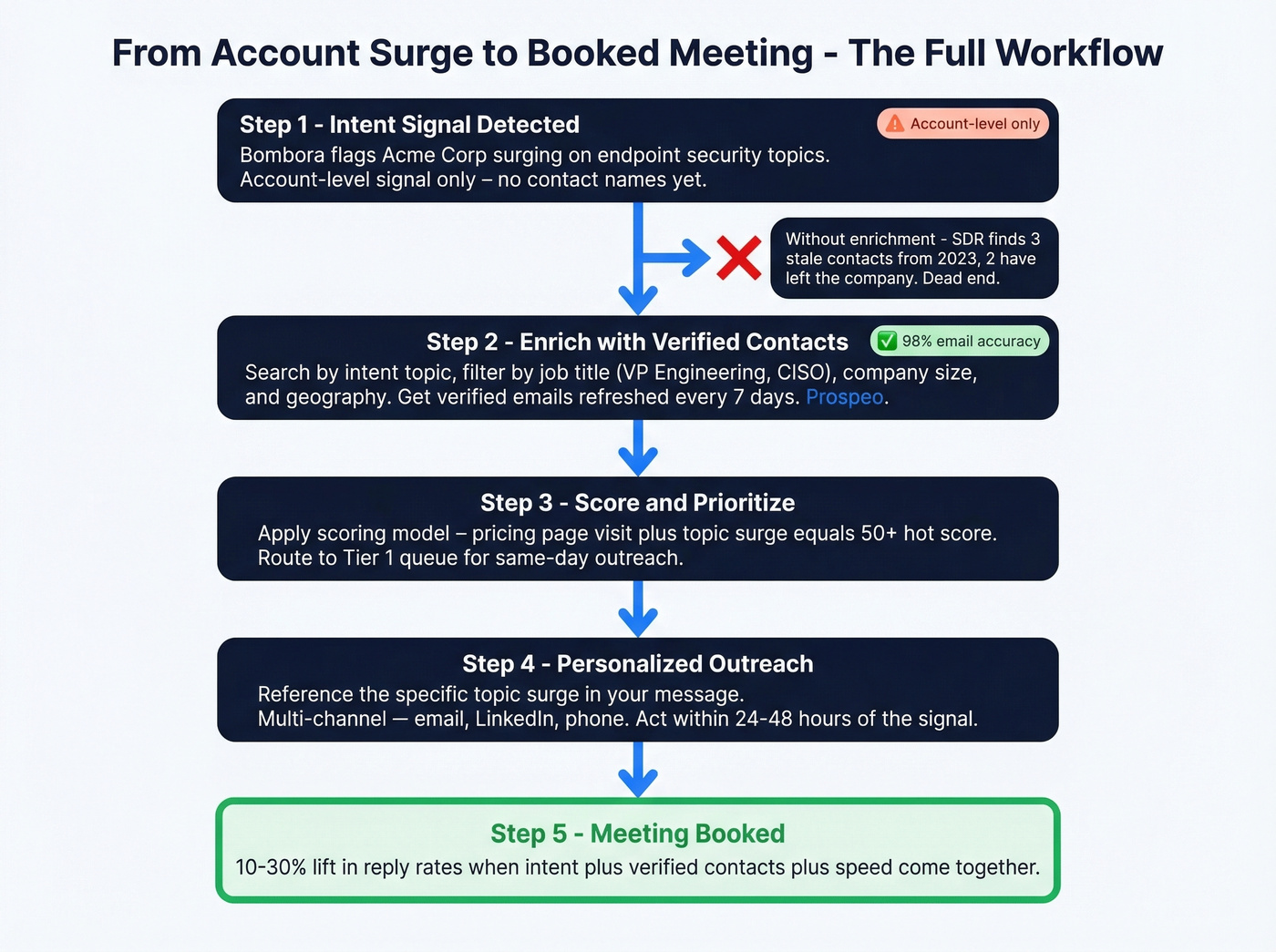
Account-level intent without verified contact data is a dead end.
Prospeo bridges this gap by combining 15,000 Bombora-powered intent topics with 300M+ professional profiles and 143M+ verified emails on a 7-day refresh cycle. Search by intent topic, filter by job title and company size, and get contact data at 98% email accuracy. Instead of buying intent data from one vendor and enrichment from another, you get both in one platform with no annual contract.
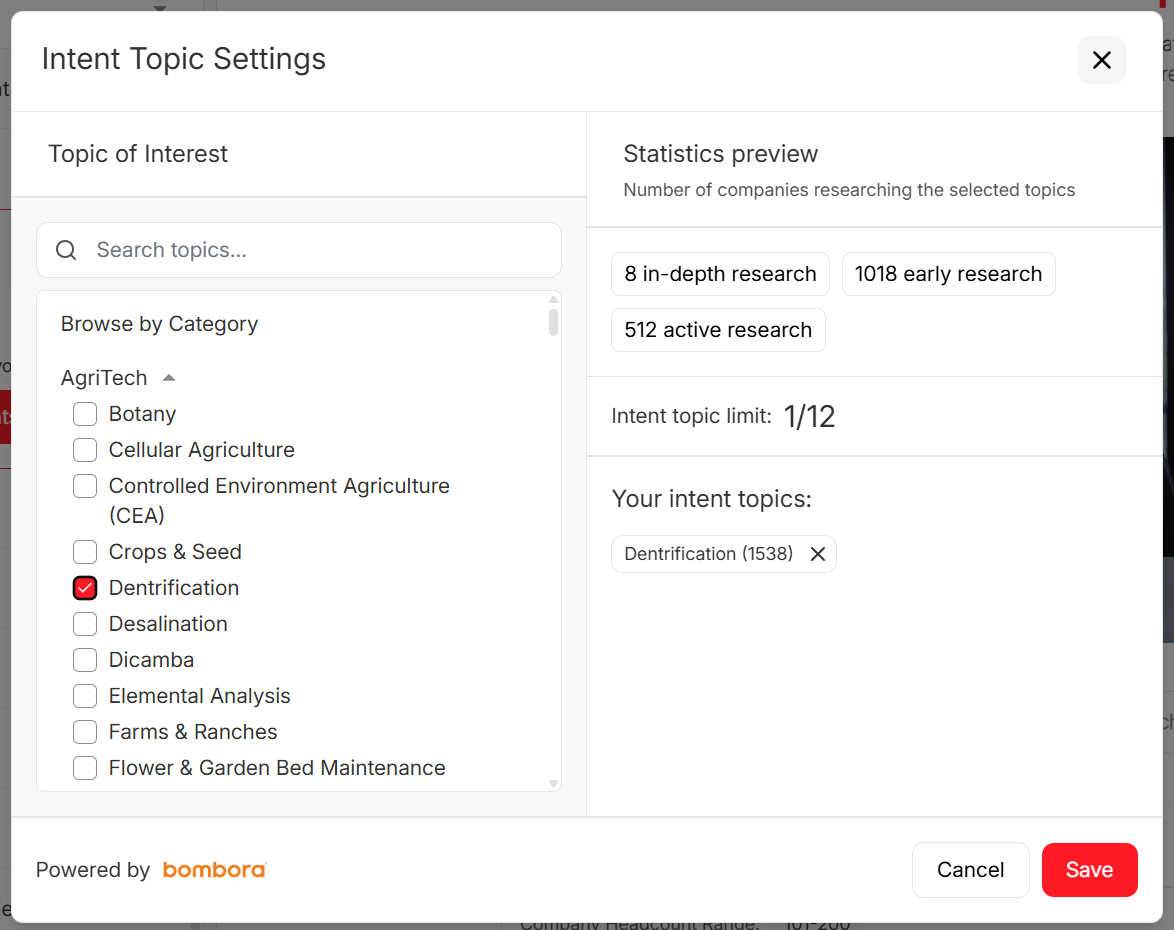
Enterprise intent platforms cost $25K-$150K/year and take months to deploy. Prospeo gives you Bombora-powered buyer intent, 30+ search filters, and verified contact data at ~$0.01/email - no annual contract, no implementation timeline, no sales call required.
Get enterprise intent data at 90% less cost. Start prospecting in minutes, not months.
What Intent Data Costs in 2026
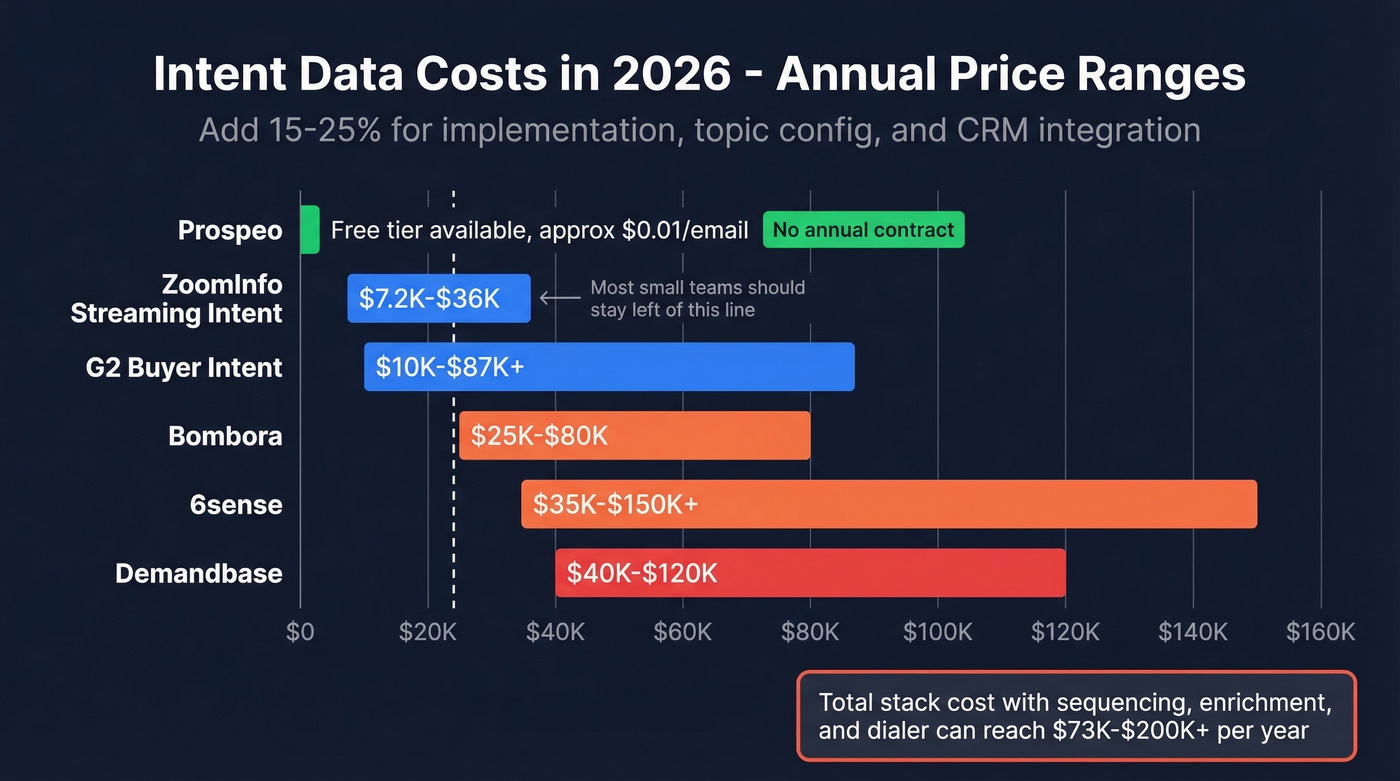
Intent data providers range from $7,000 to $150,000+ per year, and most require annual contracts. Here's how the market breaks down:
| Provider | Annual Range | Best For |
|---|---|---|
| Prospeo | Free tier available; ~$0.01/email | Teams under $25k budget |
| ZoomInfo Streaming Intent | $7.2k-$36k | Mid-market with existing ZI contract |
| G2 Buyer Intent | $10k-$87k+ | Product-led companies on G2 |
| Bombora | $25k-$80k | Enterprise ABM programs |
| 6sense | $35k-$150k+ | Full-funnel revenue teams |
| Demandbase | $40k-$120k | Large-scale ABM orchestration |
Those license fees aren't the full picture. Plan for 15-25% above the license cost for implementation, topic configuration, and CRM integration. A mid-market Bombora deployment with sequencing tools, enrichment, and a dialer can run $73,600-$200,000+ per year in total stack cost. The consensus on r/sales and r/salestechnology is that Bombora is "extremely pricey" for smaller firms, and the threads are full of teams who signed annual contracts before proving ROI.
Let's be honest: 6sense and Demandbase implementations take 6-12 weeks for mid-market teams and 3-6 months for enterprise ABM rollouts. Factor that into your ROI timeline before signing anything. If you're a 10-person sales team, skip these entirely - the implementation overhead alone will eat your quarter.
If you want a deeper breakdown of vendors and pricing, start with intent data platforms and intent data pricing.
Remote Teams and Buyer Intent Signals
Distributed sales teams face a unique challenge. Without a shared office, there's no manager walking the floor to make sure surging accounts get worked immediately. For reps prospecting from home, the scoring model and SLAs above become even more critical because they replace the informal accountability of an in-person bullpen.
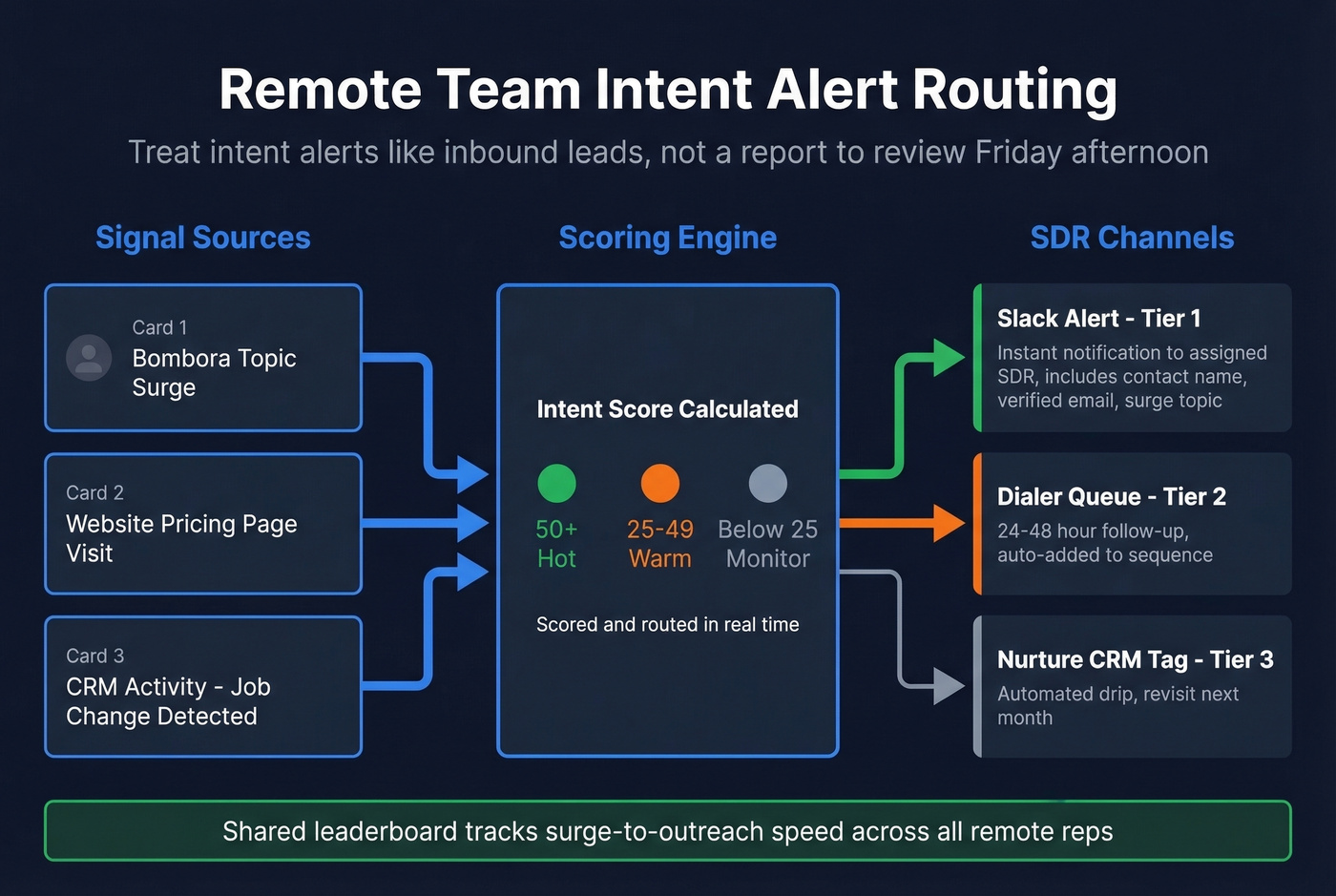
Route Tier 1 alerts directly to Slack or your dialer queue so remote SDRs see them the moment they fire - not buried in a dashboard they check once a day. Pair that with a shared leaderboard tracking surge-to-outreach speed, and remote teams can match or beat the response times of co-located ones. In our experience, the teams that nail this treat intent alerts like inbound leads, not like a report to review at the end of the week.
If you're building this motion from scratch, borrow a proven lead follow up system and standardize your sales workflow before you add more tools.
Compliance Snapshot
Regulations around third-party data are tightening fast. California's DELETE Act and the DROP platform take effect January 1, 2026, enabling consumers to submit a single deletion request across all registered data brokers. The CPPA already forced one data broker - Background Alert - to shut down operations through 2028 as an enforcement precedent.
For GDPR, third-party intent data requires transparent consent mechanisms and Standard Contractual Clauses for cross-border transfers. CCPA mandates clear opt-out mechanisms for any data sale or sharing. Choose providers with documented opt-out enforcement and native GDPR compliance. Cutting corners on compliance isn't a cost savings - it's a liability that can dwarf your entire data budget.
For a practical checklist, align your stack with compliant B2B data and a GDPR compliant database.
FAQ
What's the difference between first-party and third-party intent data?
First-party comes from your own properties - website, CRM, product analytics. Third-party comes from external publisher co-ops like Bombora. First-party is more reliable and free; third-party gives broader market coverage but starts at $7k-$25k/year.
How quickly do intent signals go stale?
Signals are highest-value within 7 days of the surge. After 30 days, reliability drops sharply - conversion rates on stale signals fall by 50% or more. By 46+ days, treat the signal as expired and remove it from active queues.
Can small teams afford intent data for virtual prospecting?
Yes. Start with first-party signals like website visitor tracking, then layer in a self-serve platform. Prospeo offers 15,000 Bombora-powered intent topics bundled with verified contact data starting on a free tier - no annual contract or six-figure commitment required.
How do I turn account-level intent into contact-level outreach?
Pair your intent provider with a contact enrichment tool that maps surging accounts to verified decision-makers. Filter by intent topic, job title, and company size to surface contacts with verified emails and direct dials, refreshed on a weekly cycle. That's the workflow that actually converts surges into booked meetings.