

How to Collect First-Party Data: A Practitioner's Playbook for 2026
Pixel-based retargeting used to work. Now it feels like throwing spaghetti at a wall - iOS changes gutted lookalike audiences, Meta's algorithm is a black box, and that "goldmine" of emails and purchase history in your CRM? Still sitting there, untouched. 56% of brands rate themselves average or below at actually using first-party data. If you're figuring out how to collect first-party data, the problem isn't awareness. It's execution.
What You Need (Quick Version)
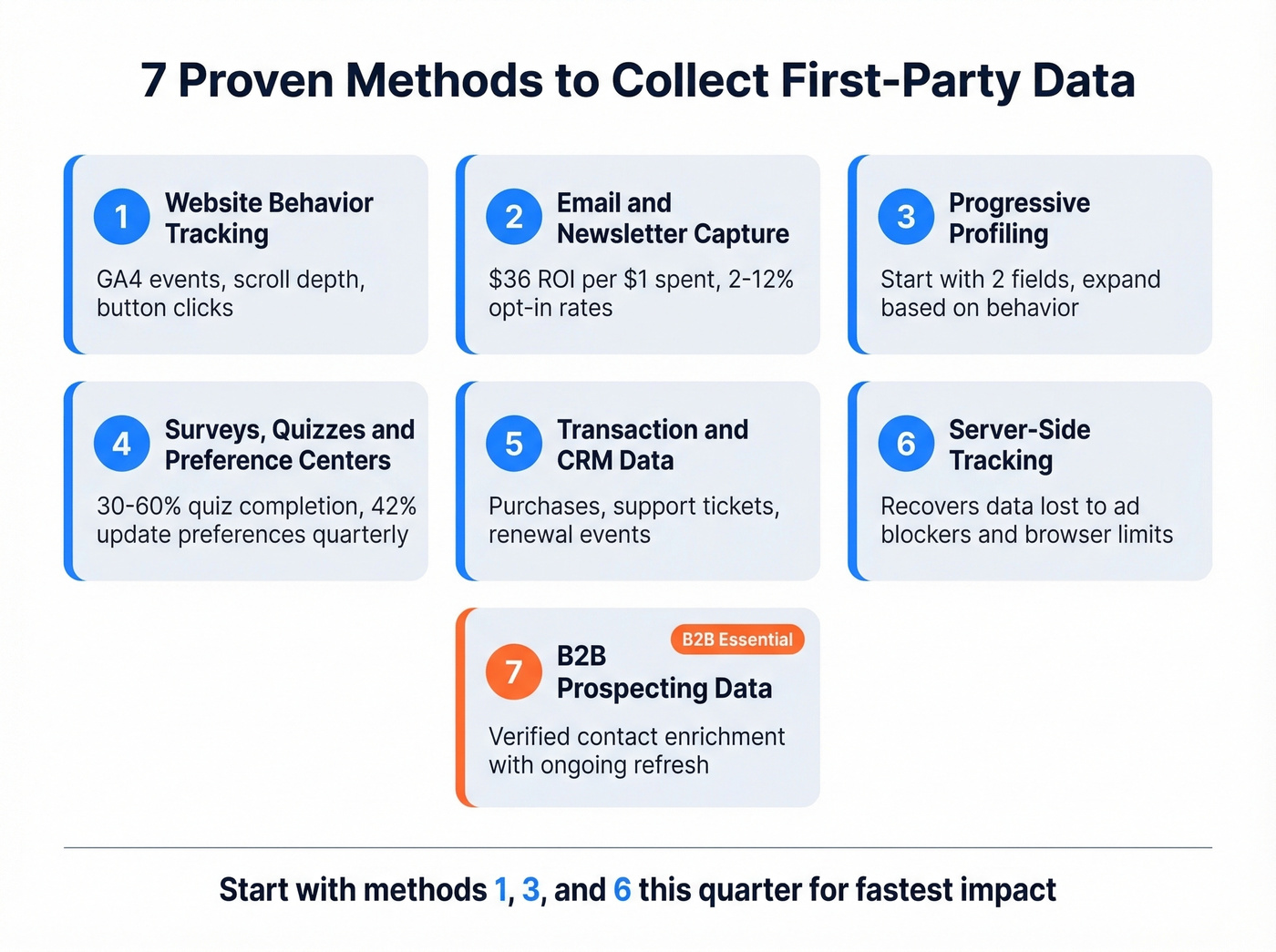
If you do three things this quarter, make it these:
- Add progressive profiling to your forms. Start with two fields. Expand later based on behavior.
- Set up server-side tracking via GTM. Client-side data loss from ad blockers and browser restrictions runs 20-40%. You're flying partially blind.
- Verify every email before it hits your CRM. Lists decay 20-30% annually. Bad data compounds fast. (If you need options, start with email verification.)
These three changes improve data quality faster than buying a CDP. Only 5% of brands believe they create relevant experiences from first-party data - and the gap is almost always operational, not technological. A solid first-party data strategy closes that gap by connecting collection to activation from day one.
First-Party Data in 30 Seconds
| Type | Definition | Example |
|---|---|---|
| First-party | Observed behavior on your channels | Page views, purchases, clicks |
| Zero-party | Intentionally shared by the customer | Survey answers, quiz results |
| Third-party | Bought from external aggregators | Cookie-based audience segments |
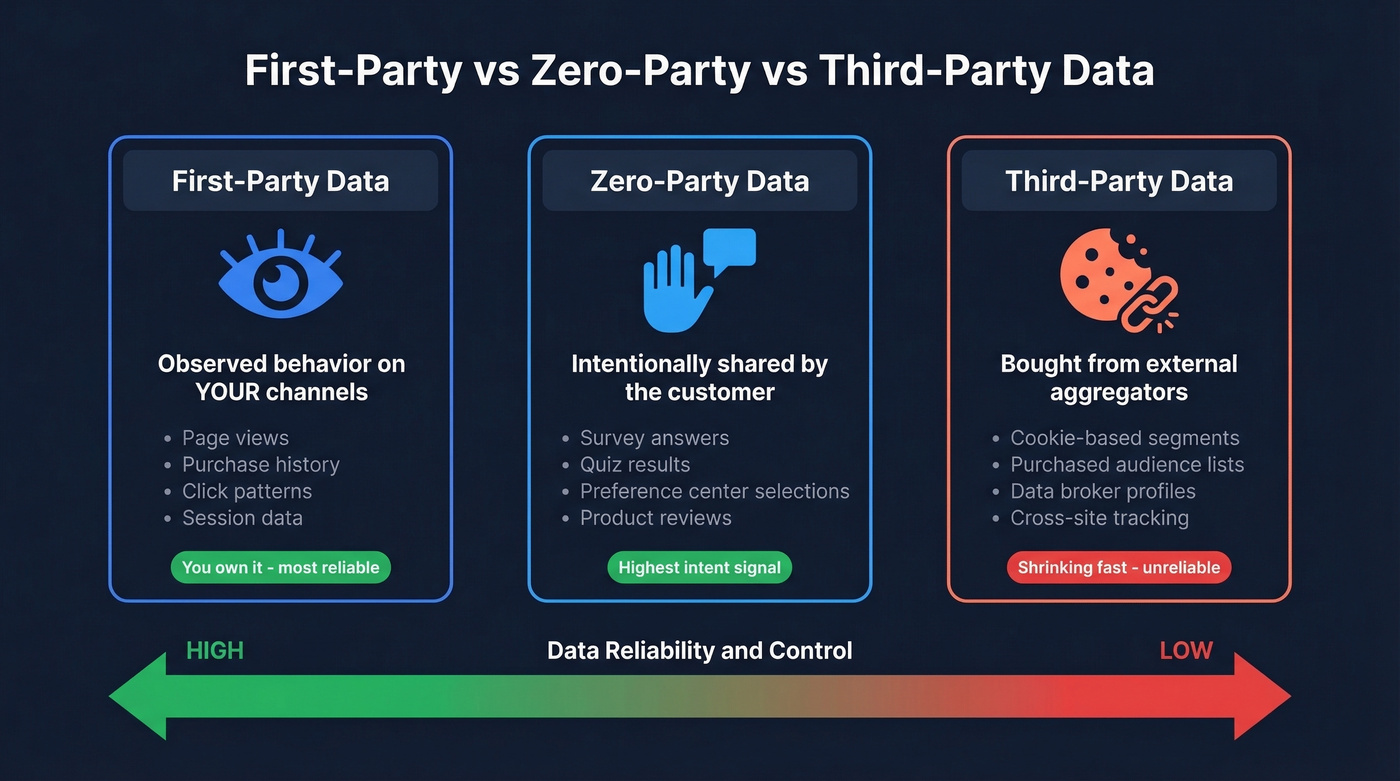
80%+ of consumers are concerned about how companies use their data. Apple's ATT opt-in rate hovers around 35%. When you compare first-party data vs third-party data, the difference is stark: third-party signals aren't just less reliable - they're actively shrinking.
First-party is what you've got.
7 Methods for Collecting First-Party Data
1. Website Behavior Tracking
GA4 with a proper event taxonomy is the foundation. Tag page views, scroll depth, button clicks, and form interactions - not just sessions. The catch: ad blockers and browser restrictions can wipe out a meaningful chunk of client-side data. Build your event plan in GA4 first, then layer server-side tracking on top to close the gap.
If you’re building this out for a revenue team, it helps to map events to your buyer journey touchpoints so “tracking” actually turns into usable segments.
2. Email & Newsletter Capture
Use this if you're running any kind of content or ecommerce operation. Email marketing still returns $36 per $1 spent - nothing else comes close.
Skip this if you don't have an activation plan. Collection without a welcome sequence or segmentation strategy is the number-one waste pattern we see. Teams build a list of 20,000 subscribers, send nothing for three months, then wonder why open rates crater when they finally hit send. (If you need a starting point, use an email blast template and adapt it into a welcome flow.)
Average newsletter signup rates hover around 2%. Optimized popups push that to 5-12%. Gamified campaigns like spin-to-win can hit 20-30%.
3. Progressive Profiling
90%+ of consumers will abandon a cumbersome registration form. So don't ask for everything upfront. Start with email and name. That's it.
Then expand at behavioral triggers: repeat login, high-intent page visit, post-purchase flow. A returning visitor who's hit your pricing page three times is ready for "What's your company size?" A first-time visitor is not. Form analytics show 68% of viewers initiate forms and 66% complete them - the challenge is getting people to start, not finish. Fewer fields at the top of the funnel solves that.
If you want to operationalize this, tie each new field to a specific lead qualification question you’ll actually use downstream.
4. Surveys, Quizzes & Preference Centers
Preference centers are underrated. 42% of customers update their preferences quarterly when a center actually exists - that's zero-party data handed to you on a schedule.
Sephora's Beauty Insider quiz and Stitch Fix's style survey are textbook examples: customers share preferences because they get something useful back. Quiz completion rates typically run 30-60%, with email capture rates of 20-40% when there's an incentive attached. Tools like Typeform and Jebbit make this easy to set up. We've seen B2B teams adapt the same playbook with "tech stack assessment" quizzes that double as lead qualification - the data quality is significantly better than a generic "download our whitepaper" gate.
5. Transaction & CRM Data
Every purchase, support ticket, and renewal event is first-party data you've already collected. The gap isn't collection; it's activation. Connect your transaction data to your email platform and ad audiences. A customer who bought dog food doesn't need cat ads - and that kind of relevancy misfire erodes loyalty fast.
If your CRM is messy or manual, this is where CRM automation software pays for itself.
6. Server-Side Tracking
This is the method most guides skip, and it's the one that matters most for data accuracy in 2026.
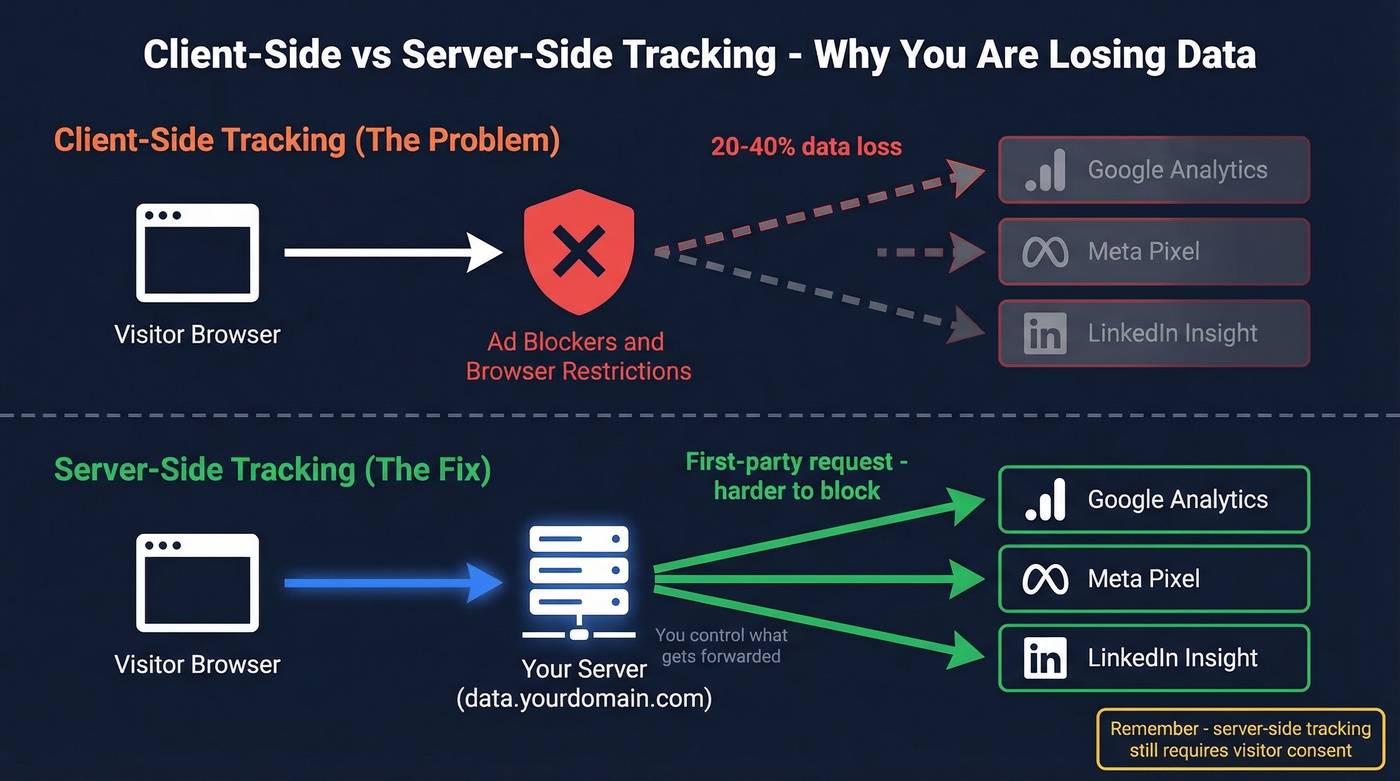
Here's the thing: if you're spending money on paid acquisition but running purely client-side tracking, you're making decisions on incomplete data. That's not analytics - that's guesswork.
The mechanics are straightforward. Instead of your visitor's browser sending data directly to Google, Meta, and every other platform, the browser sends events to your server first. Your server then forwards what you choose to each platform. A common setup is a Node.js server container on a first-party subdomain like data.yourdomain.com, which helps events arrive as first-party requests that are harder for ad blockers to intercept.
The practical approach is a hybrid GTM setup - keep some client-side tags for in-browser interactions, but route key conversion events through a server container. Expect 1-4 weeks to set up a hybrid GTM server container for a typical SMB, plus modest ongoing cloud hosting costs. Hybrid setups often recover a meaningful share of conversion data that client-side tracking alone misses.
One caveat: server-side tracking still requires visitor consent. Moving data collection to your server doesn't change your legal obligations under GDPR or CCPA. It just makes the data you're allowed to collect more complete. (If you’re building a policy + process around this, use a B2B compliance checklist.)
7. B2B Prospecting Data
Every other guide on this topic is B2C-focused. But B2B companies collect first-party data too - by building verified prospect lists through enrichment tools and outbound research. The problem is decay. Email lists lose 20-30% of their validity annually as people change jobs, companies restructure, and domains go stale.
Prospeo handles this with 98% email accuracy on a 7-day refresh cycle, so your prospect data stays current instead of degrading into bounce-rate liability. The free tier gives you 75 verified emails per month - enough to test the workflow before committing. (If you’re comparing sources, start with the best B2B database breakdown.)


You just read that email lists lose 20-30% validity annually. That's not a stat you can ignore - it's a compounding data quality crisis. Prospeo's 7-day refresh cycle and 98% email accuracy mean your first-party prospect data stays clean without manual re-verification. 75 free verified emails/month to start.
Stop collecting first-party data that decays before you use it.
Benchmarks Worth Knowing
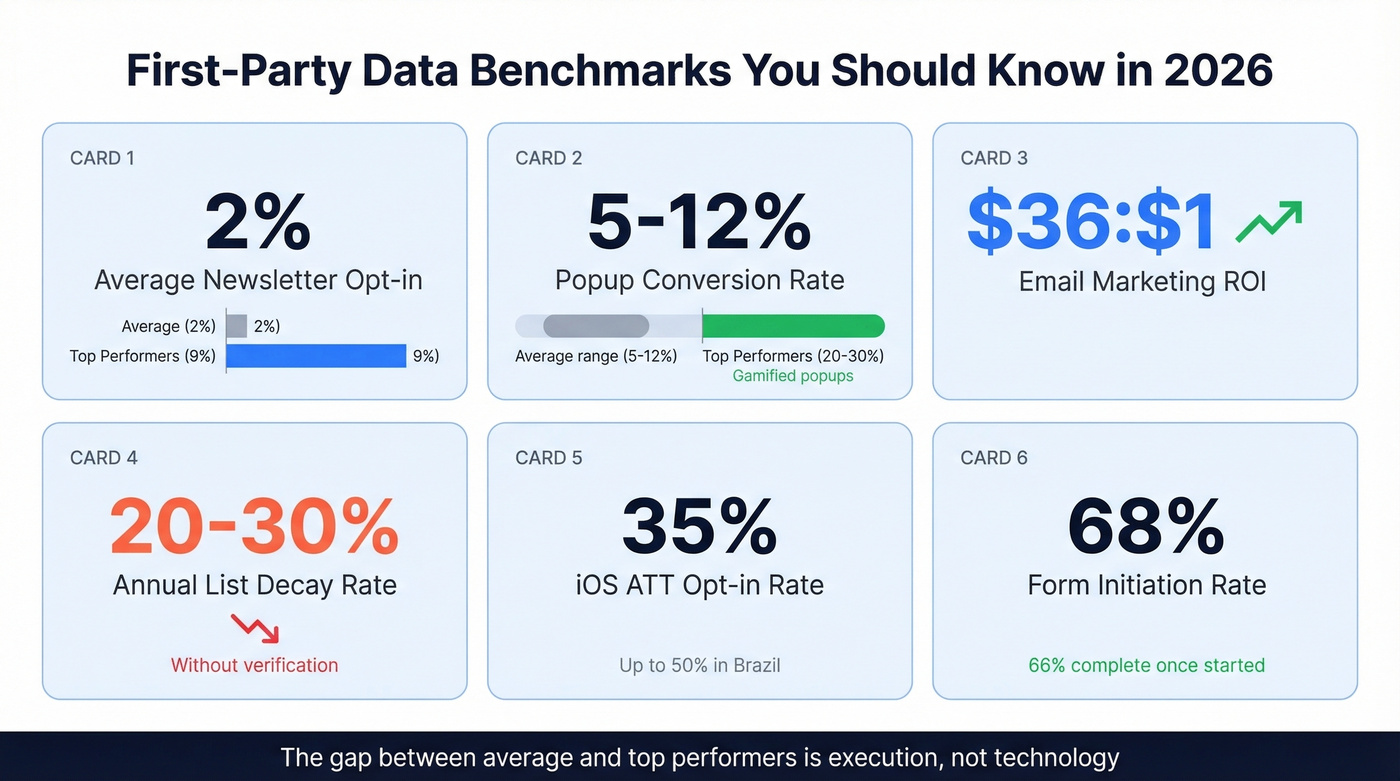
| Metric | Average | Top Performer |
|---|---|---|
| Newsletter opt-in | 2% | ~9% |
| Popup conversion | 5-12% | 20-30% (gamified) |
| Email ROI | $36:$1 | - |
| List decay (annual) | 20-30% | - |
| ATT opt-in (iOS) | 35% | 50% (Brazil) |
| Form initiation rate | 68% | - |
Mistakes That Waste Your Effort
Collecting without activating. 56% of brands rate themselves average or below at using the data they already have. Don't add more inputs to a system that doesn't use what it's got.
If you’re stuck here, it’s usually a workflow problem in your RevOps tech stack, not a “more tools” problem.
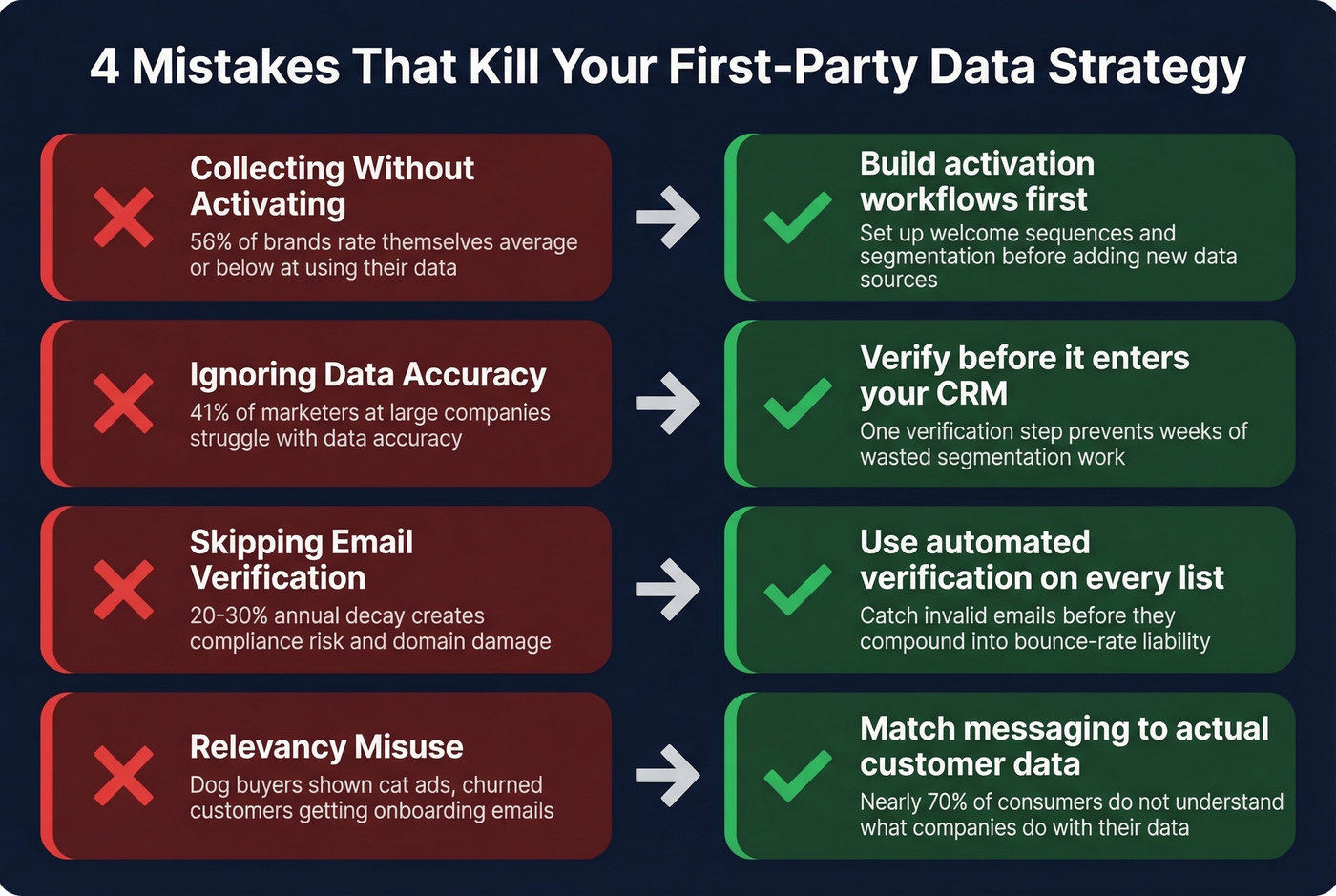
Ignoring data accuracy. 41% of marketers at large companies struggle with data accuracy. Dirty data doesn't just reduce performance - it actively misleads your segmentation. We've watched teams spend weeks building audience segments on top of CRM records that were 30% invalid. The segments looked great in the dashboard. The campaigns bombed. (This is also why data enrichment needs a verification step.)
Skipping verification. With 20-30% annual decay, unverified lists create compliance liability and domain reputation damage. The companies that struggle most aren't missing tools - they're missing a verification step before data enters their system. If you’re troubleshooting deliverability fallout, start with an email reputation check.
Relevancy misuse. A dog buyer shown cat ads. A churned customer getting onboarding emails. Nearly 70% of consumers don't understand what companies do with their data - and when they see irrelevant personalization, it confirms their worst assumptions.
Compliance Essentials
- Deploy a CMP that enforces choices - not just displays a banner
- Implement region-specific consent: EU requires opt-in, most US states default to opt-out
- Honor Global Privacy Control (GPC) signals where legally required
- Maintain auditable consent records for every data subject
- Implement Google Consent Mode v2 across your tag infrastructure
- Know your CCPA thresholds: >$25M revenue, or 100K+ CA records - penalties run up to $7,500 per incident
Building Your Strategy This Quarter
You don't need a CDP to start. You need GA4, a CRM, a form tool, and a verification layer.
The CDP market is projected to surpass $10B - but that doesn't mean you need one yet. A CDP is a year-two investment, once you've got multiple data sources worth unifying. For now, focus on the three priorities from the top of this article: progressive profiling on your forms, server-side tracking through GTM, and email verification on every list before it touches your CRM.
Let's be honest about what separates the companies that win on first-party data collection from everyone else. It isn't the biggest tech stack. It's running a welcome sequence on day one instead of buying a CDP on day one. (If you need a simple cadence, borrow a drip campaign template.)
Progressive profiling and server-side tracking get you better data in. But if the B2B contact data feeding your CRM is already stale, you're enriching garbage. Prospeo returns 50+ data points per contact at a 92% match rate - for roughly $0.01 per email. No contracts, no sales calls.
Clean first-party data starts with verified contacts hitting your CRM.
FAQ
What's the difference between first-party and zero-party data?
First-party data is observed behavior - page views, purchases, clicks on your owned channels. Zero-party data is intentionally shared by the customer, like survey answers or stated preferences. Both come from your properties; the distinction is passive observation versus active disclosure.
Do I need a CDP to collect first-party data?
No. Most companies start effectively with GA4, a CRM like HubSpot, a form tool, and email verification. CDPs like Segment make sense once you have 3+ data sources worth unifying - typically a year-two investment after your collection workflows are stable.
How do I verify the emails I collect?
Use a real-time verification tool before emails enter your CRM. For web form submissions, add double opt-in as a baseline layer. For B2B prospecting lists, tools like Prospeo verify in real time with a 7-day refresh cycle, catching invalid addresses before they damage sender reputation.
Does server-side tracking replace cookie consent?
No. Server-side tracking improves data accuracy by bypassing ad blockers, but it still requires visitor consent under GDPR and CCPA. Moving collection to your server changes where processing happens - not your legal obligations.
What's the highest-impact method for 2026?
Start with progressive form profiling, server-side tracking via GTM, and email verification - these three deliver the fastest quality improvement. Layer in surveys, preference centers, and transaction data activation as your system matures. The key advantage over third-party signals is control: you own the relationship and the consent, which makes your insights more accurate as privacy regulations tighten.