

Virtual Selling Skills: The 2026 Competency Playbook
A RevOps lead on a team we advise ran a pipeline audit last quarter. Close rate had dropped 11 points - not because reps couldn't sell, but because they couldn't sell virtually. Discovery calls felt like interrogations, follow-ups bounced, and half the buying committee never turned cameras on.
Virtual selling skills aren't a nice-to-have anymore. They're just selling. Here's the competency framework that separates reps who hit quota from the 84% who don't.
Quick Self-Check
- You run full discovery without meeting anyone in person
- You have a system for cameras-off engagement
- You send async video or a digital room after every live meeting
- Your prospect data is verified before it hits a sequence
- You use AI for prep and notes - not as a crutch for thinking
80% of B2B interactions happen in digital channels. The reps who win aren't the ones with the best Zoom backgrounds - they're the ones who've made discovery the core of every virtual interaction.
The Competency Framework
A list of tactics gives you a quick win, but it doesn't build repeatable capability. What you need is a competency model - the same structure Alexander Group uses for sales transformations: knowledge, then skills, then observable behaviors assessed across proficiency levels.
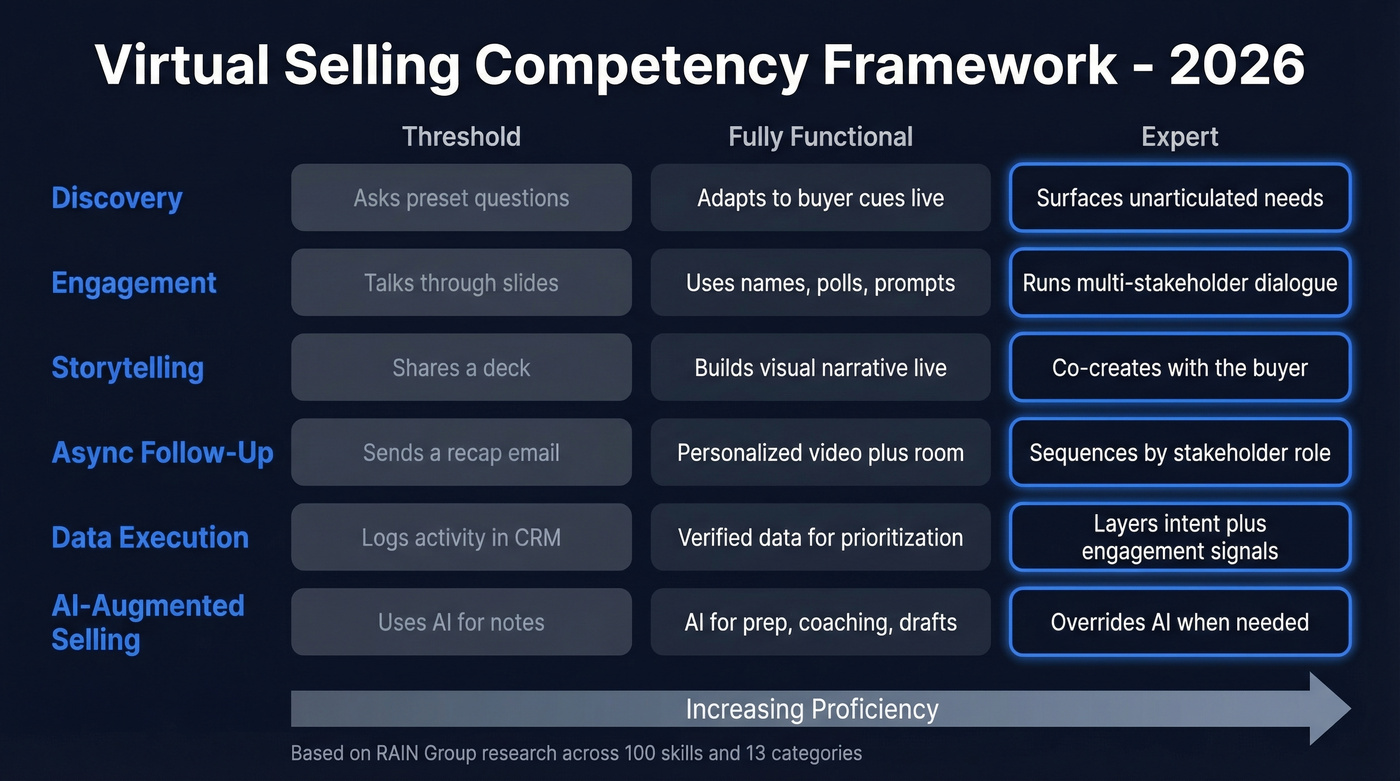
| Competency | Threshold | Fully Functional | Expert |
|---|---|---|---|
| Discovery (virtual) | Asks preset questions | Adapts to buyer cues live | Surfaces unarticulated needs |
| Engagement (cameras-off) | Talks through slides | Uses names, polls, prompts | Runs multi-stakeholder dialogue |
| Storytelling & visuals | Shares a deck | Builds visual narrative live | Co-creates with the buyer |
| Async follow-up | Sends a recap email | Personalized video + room | Sequences by stakeholder role |
| Data-driven execution | Logs activity in CRM | Verified data for prioritization | Layers intent + engagement signals |
| AI-augmented selling | Uses AI for notes | AI for prep, coaching, drafts | Overrides AI when needed |
RAIN Group's research across 100 skills and 13 categories found that top performers separate themselves in relationships, conversations, and productivity. Every row above maps to one of those three.
Why These Skills Matter Now
The shift isn't new. The permanence is.
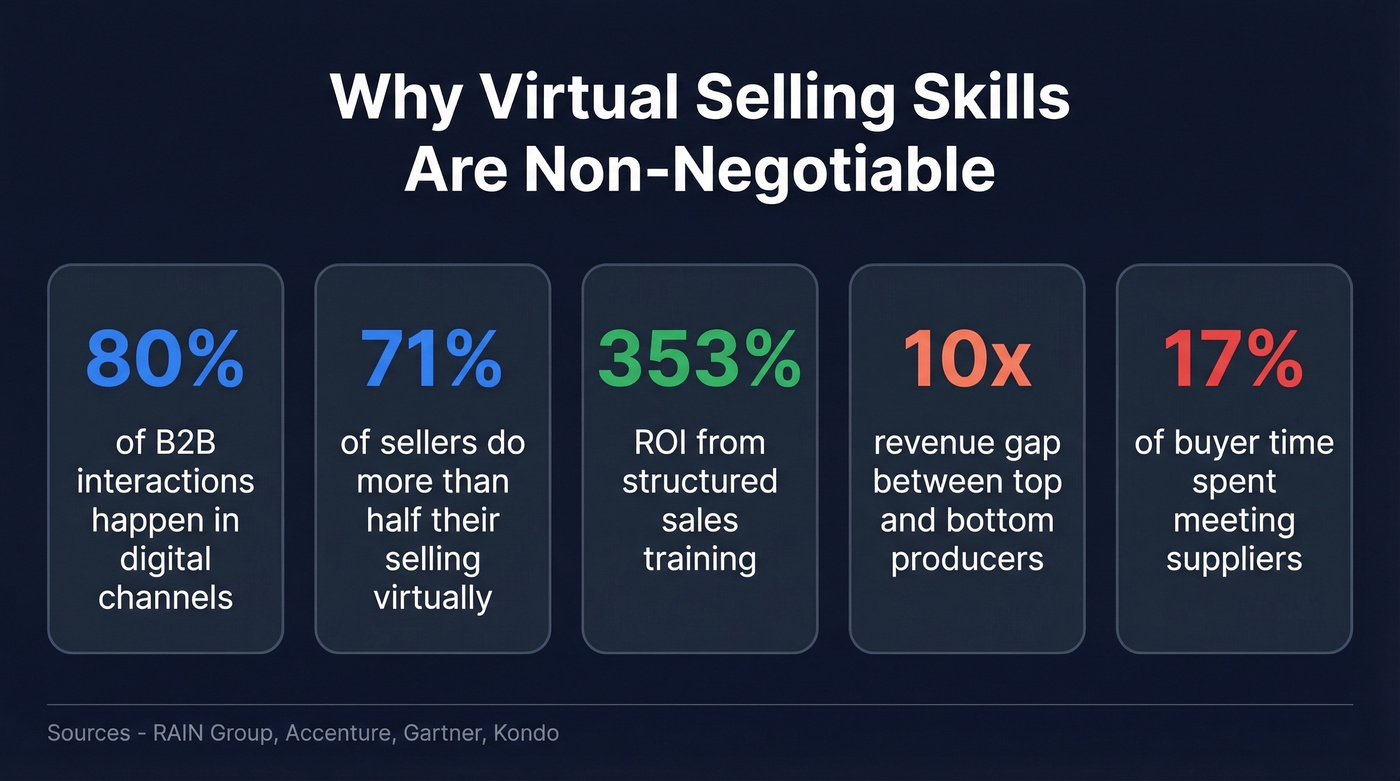
RAIN Group's study of 528 buyers and sellers tracked the acceleration from pre-pandemic to the pandemic: the share doing more than 50% of sales activities virtually jumped from 27% to 71%, and 90% of companies plan to stick with hybrid sales models going forward. Buyers now spend just 17% of their time meeting suppliers, use an average of 10 interaction channels - double what it was in 2016 - and 75% take longer to decide than they did in 2023.
The business case for investing in remote sales competencies is stark. Accenture found that structured sales training delivers 353% ROI, and there's a 10x revenue gap between top and bottom producers. That gap widens in virtual environments where weak skills have nowhere to hide.
Here's the thing: if your average deal size sits below $25k, these digital selling competencies matter more than in-person skills. You'll never justify the travel budget, so your screen presence is your only presence. Invest accordingly.

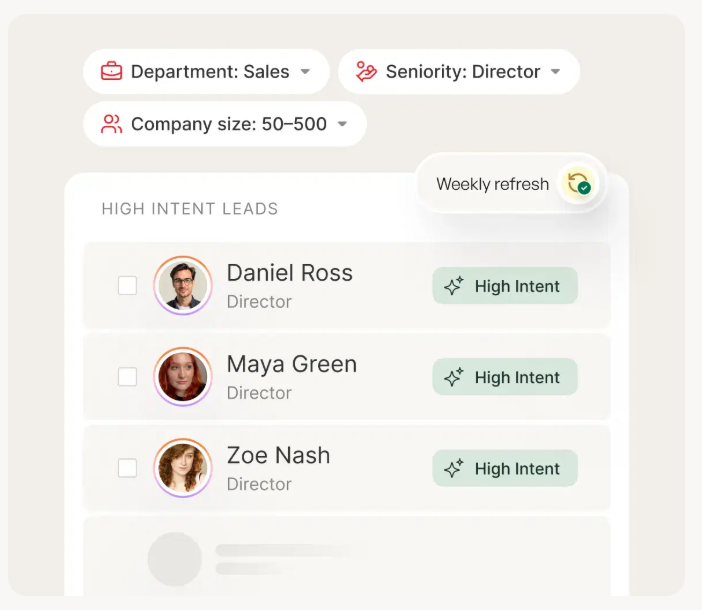
Your virtual selling competencies don't matter if your follow-up bounces. Prospeo delivers 98% email accuracy on a 7-day refresh cycle - so every async video, digital room, and multi-touch sequence actually reaches the buyer. At $0.01 per email, bad data is no longer an excuse.
Stop perfecting your pitch and sending it to dead inboxes.
The 7 Core Skills
1. Run Real Discovery
The buyer is [57% through their decision](https://www.linkedin.com/business/sales/blog/b2b-sales/this-popular-stat-is-wasting-your-time - the-57 - engagement-myth) before they talk to you. Your discovery needs to surface what they've already concluded and where they're still uncertain. Lead with "What's changed that made this a priority now?" - not a feature checklist disguised as curiosity. (If you want a tighter structure, use a discovery call script and a bank of discovery questions.)
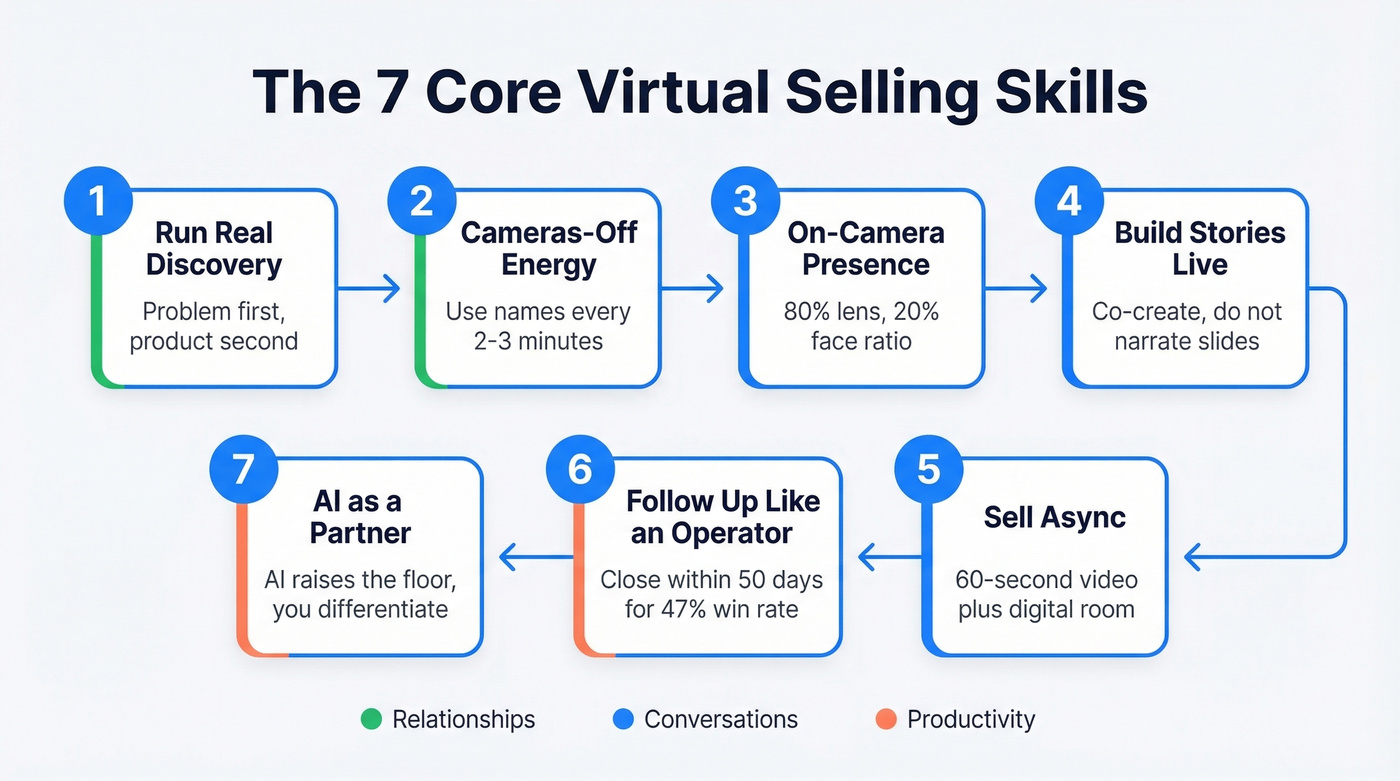
We've seen reps transform their close rates just by flipping the order: problem first, product second. It sounds obvious. Most teams still don't do it.
2. Keep Energy With Cameras Off
Use names every 2-3 minutes. Drop warm prompts: "Sarah, does that match what you're seeing?" Assign roles in multi-stakeholder calls: "James, pressure-test the timeline for us." Virtual group calls become webinars the moment you stop engaging individuals by name.
If you're not the loudest person in the room, virtual can actually be your advantage. Listening, taking notes, and asking deliberate questions plays extremely well on video.
3. On-Camera Presence
Camera at eye level, minimal headroom, light from the front. Look at the lens about 80% of the time and at the other person's face 20% - a ratio that creates the feeling of eye contact without staring. Use pauses before key points instead of rushing through slides.
Your buyer can tell when you're reading from a second monitor.
4. Build Stories Live
| Before (Weak) | After (Strong) |
|---|---|
| Click through 40 pre-built slides | Build the narrative live on screen |
| Narrate features in sequence | Structure around problem, impact, proof, next step |
| Presenter talks, buyer watches | Co-create the story with the buyer |
Screen share is an advantage, not a fallback. If your visuals don't earn their screen time, turn them off and have a conversation instead. (If your deck is the problem, rebuild it with a sales deck storytelling framework.)
5. Sell Async
After every live call, send a 60-second personalized video recap plus a digital room with relevant assets. Buyers use 10 channels now - a single "thanks for your time" email is one channel in a ten-channel world. Vidyard handles the video; the digital room is what separates you from every other rep in their inbox.
Let's be honest: most reps skip this step because it feels like extra work. It is extra work. It's also the highest-leverage 5 minutes you'll spend after a call.
6. Follow Up Like an Operator
Compress your cycle. Outreach's data shows opportunities closed within 50 days hit a 47% win rate - after that, it drops to 20%. End every call with a specific next step, date, and owner. Execute follow-up within 24 hours. (If you need copy you can ship today, use these sales follow-up templates.)
None of this works if your contact data is wrong. A perfectly crafted sequence that bounces is worse than no sequence at all - it wastes your time and trains your domain reputation to look like spam. Verify before you send. Prospeo's 98% email accuracy and 7-day refresh cycle means your outreach actually lands instead of bouncing into the void. (If you're diagnosing deliverability, start with email bounce rate and the email deliverability guide.)
7. Use AI as a Partner
56% of sales professionals now use AI daily - up from 24% in 2023. Sellers who effectively partner with AI are 3.7x more likely to meet quota. (For a practical stack, see our guide to generative AI sales tools.)
Use it for meeting prep, real-time notes, and first-draft follow-ups. Then edit with your own judgment. AI raises the floor; humans differentiate. Sending AI-generated emails without editing them erodes the trust you spent the whole call building.
Mistakes That Kill Deals
From research on common virtual selling mistakes, plus patterns we've seen in pipeline reviews:
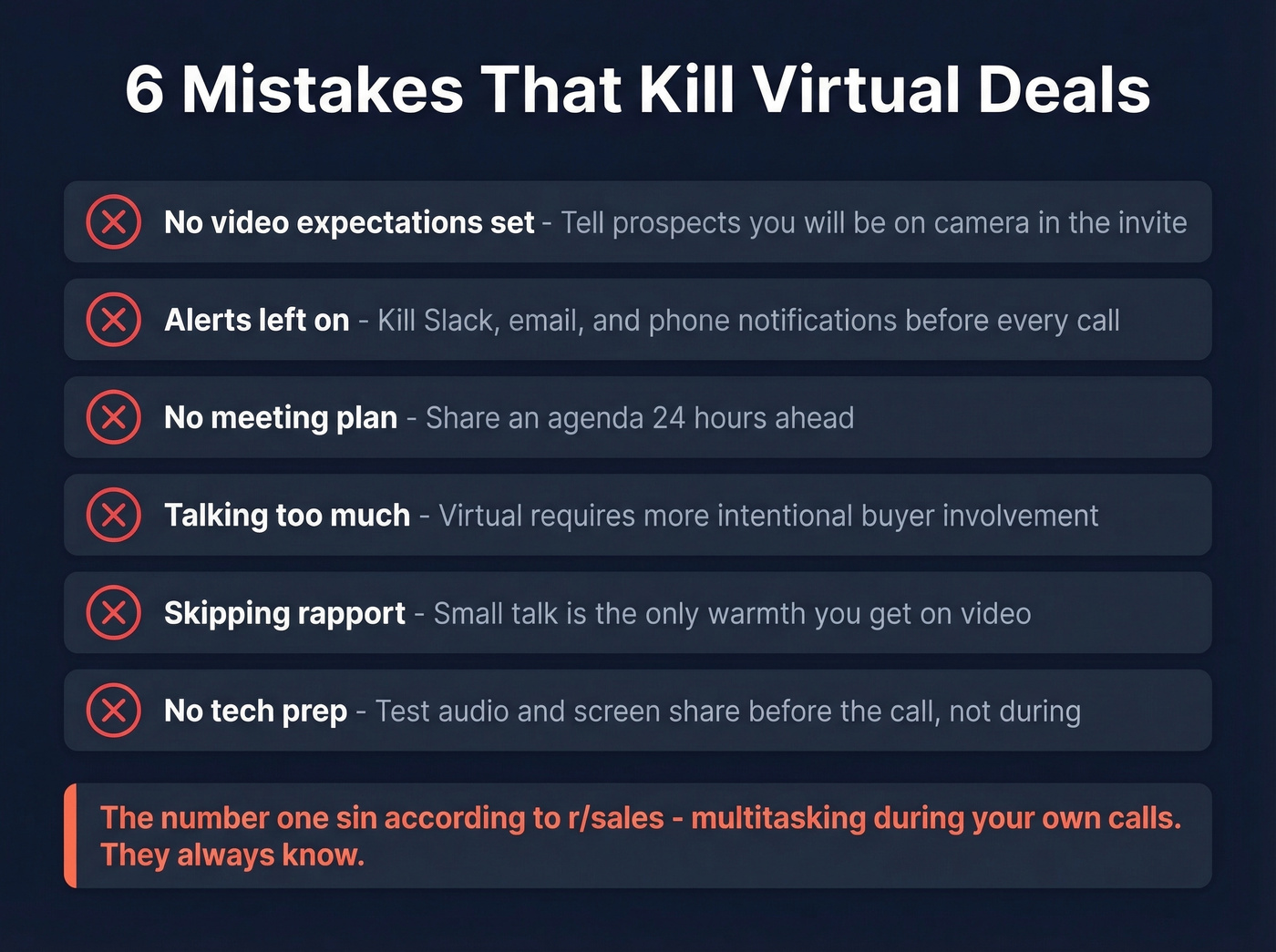
- No video expectations set - tell prospects you'll be on camera in the invite
- Alerts left on - kill Slack, email, and phone notifications before every call
- No meeting plan - share an agenda 24 hours ahead; virtual has zero tolerance for aimlessness
- Talking too much - virtual requires more intentional buyer involvement than in-person
- Skipping rapport - build in deliberate space for it; small talk isn't wasted time on video, it's the only warmth you get
- No tech prep - test audio and screen share before the call, not during
The consensus on r/sales is blunt: the number-one virtual selling sin is multitasking during your own calls. If you're checking Slack while a prospect talks, they know. They always know.
Tool Stack for Digital Selling
You don't need 15 tools. You need six or seven that talk to each other.
| Tool | Category | Starting Price |
|---|---|---|
| Prospeo | Data & verification | Free tier; ~$0.01/email |
| Gong | Conversation intelligence | ~$250-400/user/mo |
| Fathom | AI meeting notes | Free-$25/user/mo |
| Fireflies | AI meeting notes | $10-39/user/mo |
| Vidyard | Async video | ~$19-59/user/mo |
| Outreach | Sales engagement | ~$100-165/user/mo |
| Salesloft | Sales engagement | ~$100-175/user/mo |
| Zoom | Video meetings | $13.33+/user/mo |
Skip Gong if you're a small team - Fathom's free tier covers call recording and AI summaries, and that's enough to start reviewing your own discovery calls. For teams running serious outbound volume, pair a data platform with Outreach or Salesloft for execution and you've got a complete virtual selling engine without enterprise pricing.
You just compressed your sales cycle to 50 days. Now make sure every touchpoint connects. Prospeo gives you verified emails, direct dials with a 30% pickup rate, and intent data across 15,000 topics - so your virtual discovery calls start with the right people already showing buying signals.
Layer intent data on top of your virtual selling workflow today.
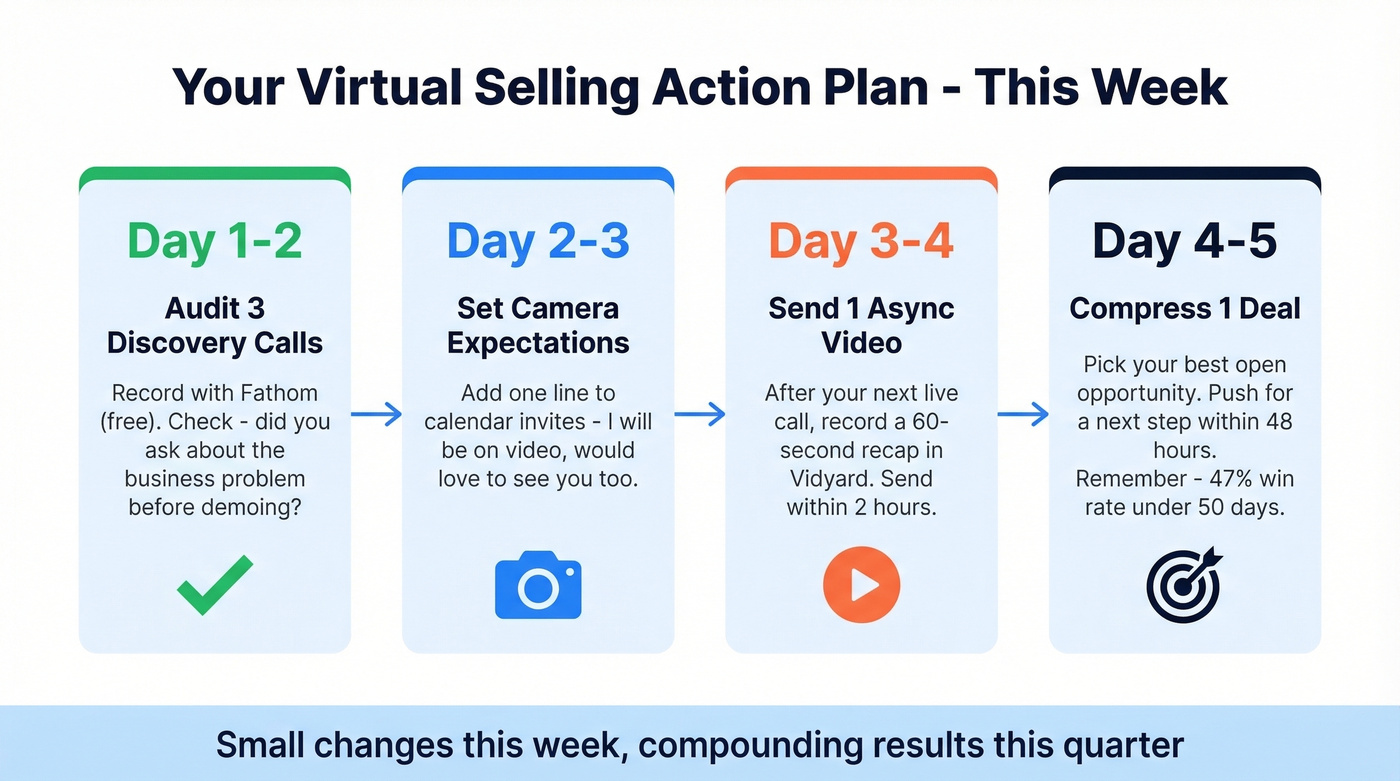
What to Do This Week
- Audit your next 3 discovery calls. Record them (Fathom is free) and check: did you ask about the business problem before demoing?
- Set camera expectations. Add one line to calendar invites: "I'll be on video - would love to see you too."
- Send one async video. After your next live call, record a 60-second recap in Vidyard and send it within 2 hours.
- Compress one deal. Pick your most promising open opportunity and push for a concrete next step within 48 hours. Remember: the 47% win rate threshold is 50 days.
FAQ
What are virtual selling skills?
They're the competencies required to run a full sales cycle - discovery, demo, negotiation, close - through digital channels like video calls, async video, email, and digital rooms. They go beyond Zoom etiquette to include cameras-off facilitation, async follow-up, and AI-augmented execution.
How do you keep buyers engaged with cameras off?
Use names every 2-3 minutes, assign explicit roles to stakeholders, and drop warm prompts that require a response - not just "any questions?" Try "James, does that timeline work for your team?" Silence after a direct question is more powerful than another slide.
What tools do you need for virtual selling in 2026?
At minimum: a video platform (Zoom), conversation intelligence (Gong or Fathom), a sales engagement tool (Outreach or Salesloft), and verified contact data so your outreach reaches real inboxes. Prospeo's free tier covers 75 emails per month - enough for small teams to start without budget approval.
How does digital selling transformation affect quota attainment?
Organizations that retrain reps, rebuild processes, and invest in the right tools see measurably higher win rates - Accenture pegs structured training ROI at 353%. Teams that simply moved their old playbook onto Zoom are the ones watching quota attainment slide year over year.