

Warm Introduction Email Templates: The Forwardable Framework + 7 Ready-to-Send Scripts
You asked a former colleague to introduce you to a VP at a target account. They said yes. Then they asked, "What should I say about you?" - and you froze.
That moment is where most warm introduction email template advice falls apart. The template isn't the hard part. Preparation is.
What You Need (Quick Version)
- Write a forwardable blurb the connector can forward in 10 seconds without editing a word. This is the single highest-leverage thing you can do.
- Use this subject line format:
Name1 (Co) <> Name2 (Co) | Warm Intro. Both parties know exactly what they're opening. - Follow up 2-3 business days after the intro. Most warm intros die from silence, not rejection.
Why Warm Intros Crush Cold Email
Cold email reply rates dipped to around 5.8% in 2024 across 16.5 million emails, per Belkins data cited by Warmer AI. The bottom 50% of senders? Somewhere between 0.8% and 2.1%. Meanwhile, referred leads convert 4x more often and show 37% higher retention. The math isn't close.
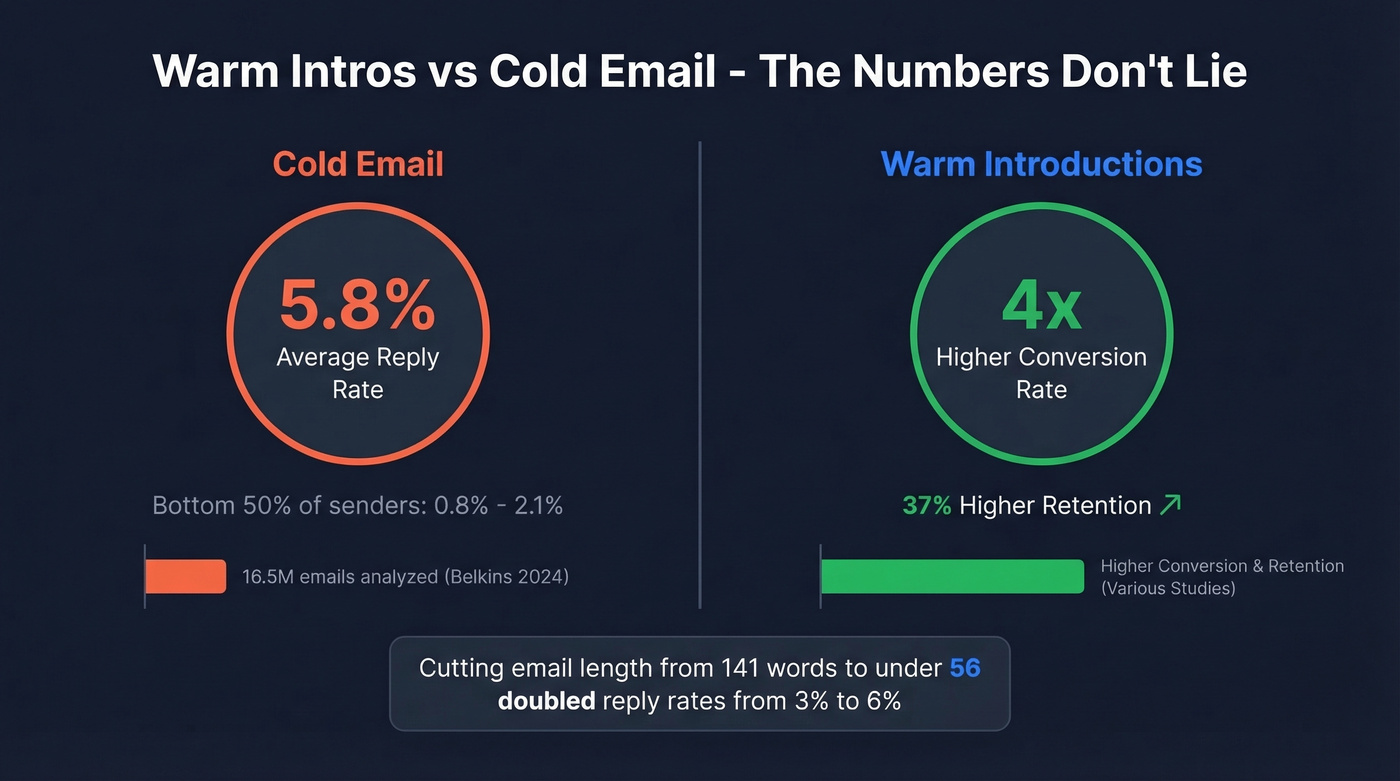
One Reddit operator cut email length from 141 words to under 56 and watched reply rates double from 3% to 6%. Brevity isn't just polite - it moves the numbers.
Everyone knows warm intros work better. The problem isn't awareness. It's execution.
How to Write a Warm Intro Email
Verify Before You Ask
Before you ask for an intro, make sure you’re targeting the right person and the right account. If you’re building lists for specific accounts, account-based selling principles apply here more than “spray and pray” outreach.
Get Permission First
Double opt-in is non-negotiable. Message the connector, explain who you want to meet and why, and offer a graceful out: "Totally fine if this isn't a good fit or the timing's off." Nobody wants to feel cornered into an introduction they're uncomfortable with.
Write the Forwardable Blurb
Here's the thing: this is where 80% of people fail. If the connector has to interpret what you do and frame it for the recipient, you've made it too hard. Write a short, copy-paste blurb they can forward without editing a single word.
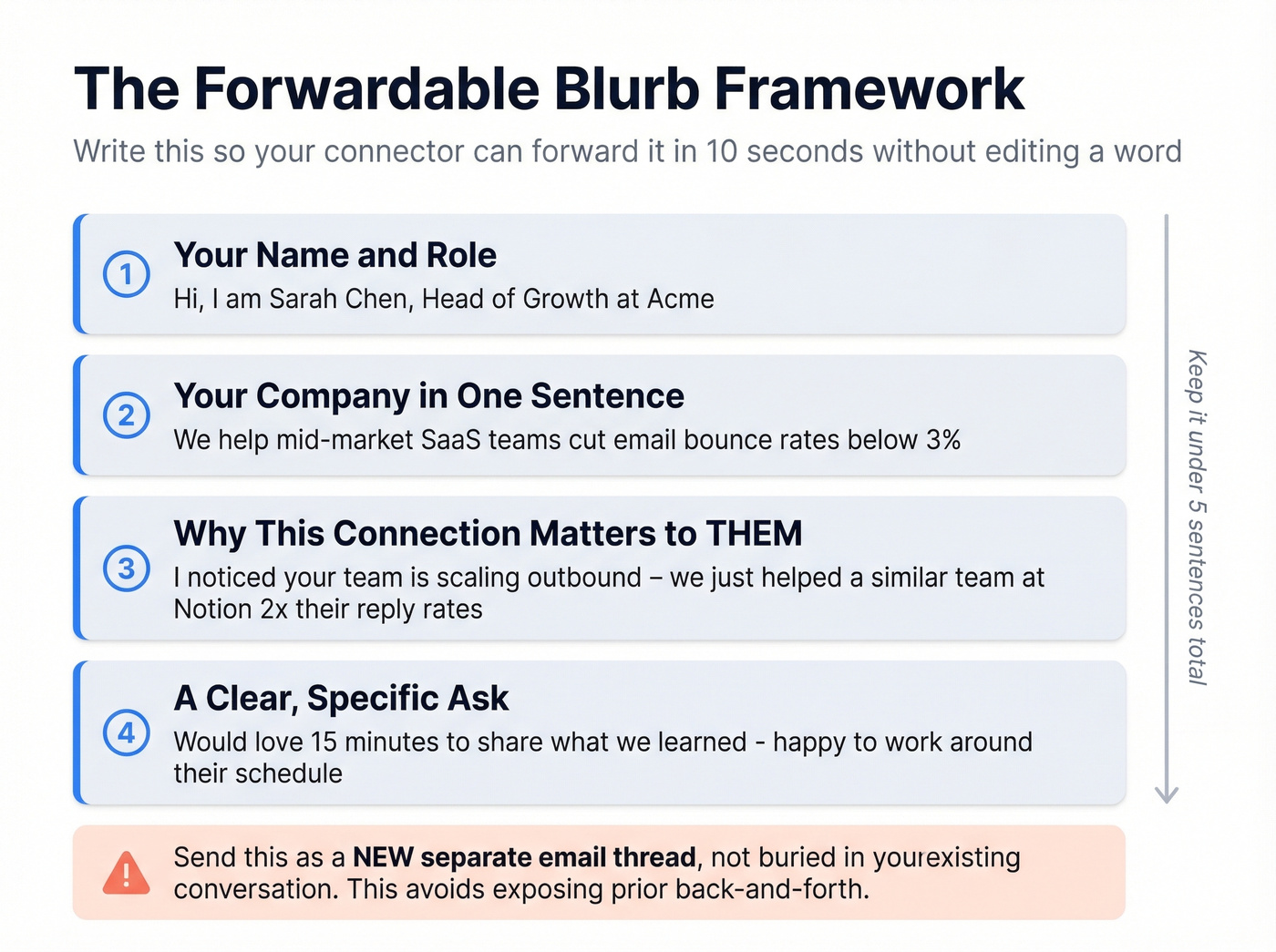
Send it as a new, separate email thread - not buried in your existing conversation. This avoids exposing prior back-and-forth and lets the connector forward cleanly.
Your blurb needs four things: your name and role, your company in one sentence, why the connection matters to the recipient, and a clear ask. That's it. If you're writing more than five sentences, you're overcomplicating it. If you need help tightening that “one sentence,” borrow from these sample elevator pitches.
Nail the Subject Line
The practitioner-tested format from r/Entrepreneur: Name1 (Co) <> Name2 (Co) | Warm Intro. The full format often runs long, so abbreviate company names or drop the pipe label to stay under 50 characters - 46% of email opens happen on mobile, and truncated subjects kill open rates. Personalized subject lines boost opens by 26%. For more options, swipe from these email subject line examples.
Hand Off and Step Out
End with "I'll let you two take it from here." Keep bios to one sentence each. The connector's job ends at the introduction.

Warm intros convert 4x better than cold email - but only if you're reaching verified contacts. Prospeo gives you 98% accurate emails and 125M+ direct dials so the person your connector introduces you to actually gets your follow-up.
Stop wasting warm intros on bounced emails. Verify before you send.
7 Templates You Can Copy Today
Adjust formality based on the connector's relationship with the recipient. These templates default to professional-casual, which works for most B2B contexts.
1. Permission Request
Subject: Quick ask - intro to [Prospect Name]?
Hey [Connector],
I'd love an intro to [Prospect Name] at [Company]. [One sentence on why - e.g., "They're scaling their outbound team and we help with exactly that."]
Totally fine if the timing's off or it's not a good fit. If you're open to it, I'll send you a forwardable blurb so it takes you 10 seconds.
2. Standard Networking Intro
Subject: [Your Name] (Co) <> [Their Name] (Co) | Warm Intro
[Connector's name] here - wanted to connect two people I think should know each other.
[Name 1] - [one sentence bio]. [Name 2] - [one sentence bio]. [One sentence on why they'd benefit from connecting.]
I'll let you two take it from here.
3. Sales Prospect Intro
Subject: [Your Name] (Co) <> [Prospect] (Co) | Introduction
Hey [Prospect], meet [Your Name]. They run [Your Company], which [one sentence framed around what's in it for the prospect - e.g., "helps mid-market SaaS teams cut bounce rates below 3%"].
[Your Name] - [Prospect] leads [team/function] at [Company] and has been [relevant context].
I'll let you two take it from here.
4. Fundraising / Investor Intro
Subject: [Founder] (Startup) <> [Investor] (Fund) | Introduction
[Connector] here. Wanted to introduce [Founder Name], CEO of [Company].
[Company] does [what it does in 1-2 sentences]. [Why it matters - market size or timing]. [Founder] previously [1-2 sentences on background].
Key accomplishments:
- [Traction metric 1]
- [Traction metric 2]
- [Traction metric 3]
[Deck link via DocSend]. I'll let you two take it from here.
Per Chris Neumann's framework, include the deck upfront - the "teaser now, deck later" approach is outdated.
5. Job Referral Intro
Subject: [Candidate] <> [Hiring Manager] | Introduction
Hey [Hiring Manager], meet [Candidate]. They've spent [X years] in [relevant function] at [Company], specifically [one sentence on relevant experience]. I think they'd be a strong fit for the [specific role] on your team.
I'll let you two take it from here.
6. Former Colleague Intro
Subject: [Name 1] <> [Name 2] | Introduction
[Name 1] and I worked together at [Company] on [brief context]. They're now [current role/focus]. [Name 2], you've been [relevant context]. I think you'd have a lot to talk about around [specific topic].
I'll let you two take it from here.
7. Post-Event Intro
Subject: [Name 1] <> [Name 2] | Post-[Event] Introduction
Following up from [Event Name] - [Name 1], meet [Name 2]. [One sentence on why this is relevant now]. Given the conversations at [Event], this is worth a quick chat while the momentum's fresh.
I'll let you two take it from here.
Mistakes That Kill Warm Intros
Three ways to torpedo a mutual introduction email before it starts.
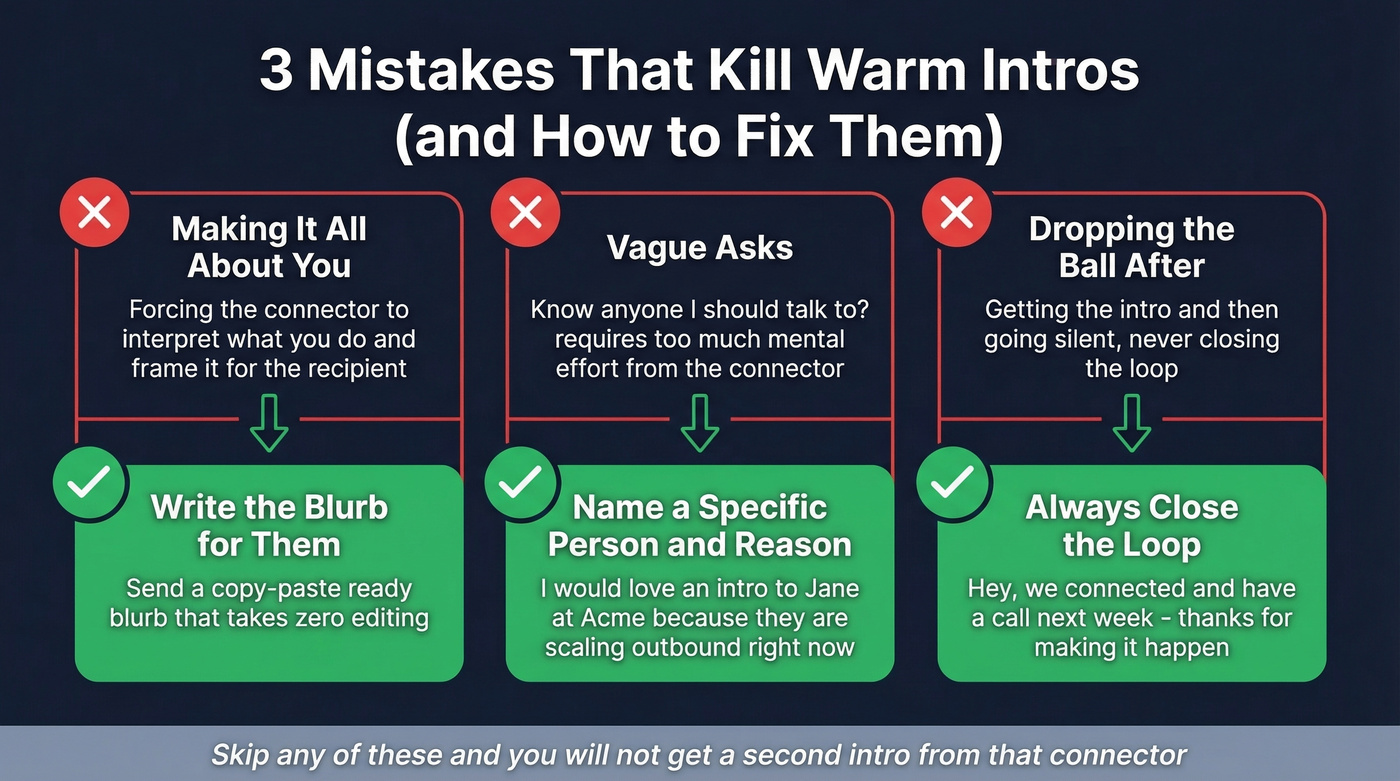
Making it all about you. If the connector has to interpret what you do, frame it for the recipient, and risk their reputation on your behalf, you've made it too hard. Write the blurb for them. We've seen connectors sit on intro requests for weeks simply because they didn't know how to position the person asking - and eventually the window closed. If you want a tighter structure for “what you do + why it matters,” use a simple AIDA style flow.
Vague asks. "Know anyone I should talk to?" is a dead end. Name a specific person and a specific reason. The consensus on r/sales is that vague networking requests get ignored not out of rudeness, but because they require too much mental effort from the connector. If you’re stuck on who to target, start with a clear ideal customer profile.
Dropping the ball after. You got the networking email introduction. Then silence. Always close the loop with the connector - even if it's "they weren't interested." Skip this step and you won't get a second intro from that person.
What to Do After the Intro
Let's be honest: the intro email isn't the bottleneck. The follow-up is. We've seen perfectly crafted warm introductions die because the recipient never heard a second word. The template gets all the attention; the follow-through determines the outcome.
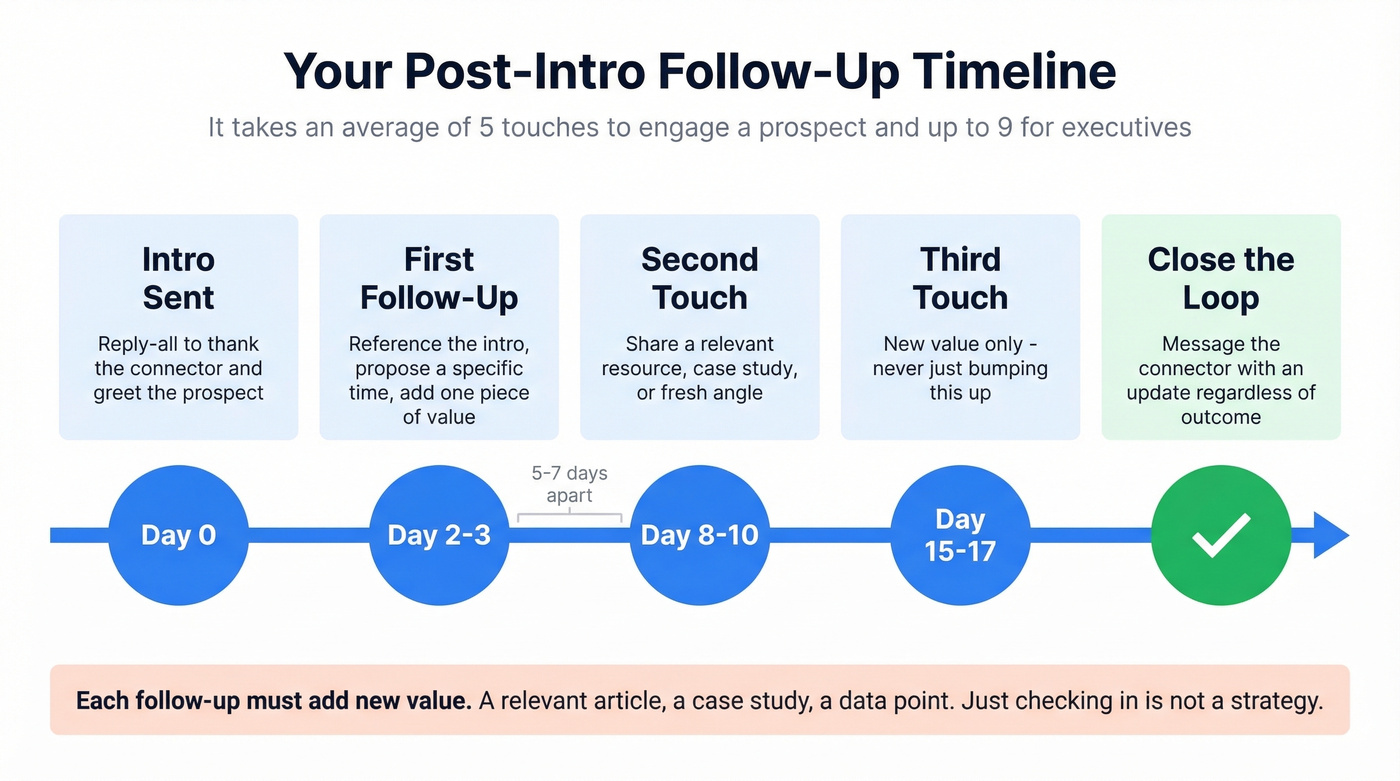
Follow up 2-3 business days after the introduction. If you don't hear back, space subsequent touches 5-7 days apart. Each follow-up should add new value - a relevant resource, a case study, a fresh angle on why the conversation matters. "Just bumping this up" isn't a follow-up strategy. If you need copy, pull from these sales follow-up templates or these cold email follow-up templates.
It takes an average of 5 touches to engage a prospect, and reaching executives often requires around 9, so don't give up after one silence. And always close the loop with the connector. A quick "Hey, we connected and have a call next week - thanks for making it happen" goes a long way toward earning your next intro. That single message is what separates people who get one warm introduction from people who build a referral engine. If you want to systematize this, build a lightweight sequence management process.
You wrote the forwardable blurb, nailed the subject line, and got the intro. Now you need to follow up - and that means having the prospect's direct email, not a generic inbox. Prospeo finds verified emails at $0.01 each with a 7-day refresh cycle.
Turn every warm intro into a real conversation with verified contact data.
FAQ
What's the difference between a warm intro and a cold email?
A warm introduction comes through a mutual connection who vouches for both parties, while cold email targets strangers with no prior relationship. Warm intros convert at roughly 4x the rate of cold outreach - where average reply rates sit around 5.8% - because trust is pre-built through the connector. HubSpot's research on referral selling backs this up consistently.
How long should a warm intro email be?
Under 100 words for the introduction itself. The forwardable blurb you prepare for the connector should be even shorter - your name, role, company in one sentence, why the connection matters, and a clear ask. One Reddit test showed cutting emails below 56 words doubled reply rates. If you're agonizing over word choice past the fifth sentence, you've already gone too long.
How do I ask for a warm introduction without being awkward?
Name a specific person, give a specific reason, and always offer an out like "totally fine if the timing's off." Then send the connector a ready-to-forward blurb so they don't have to write anything. Connectors typically forward these within minutes when zero editing is required. This breakdown from Lenny Rachitsky walks through the psychology well.
How do I make sure the intro email actually reaches the prospect?
Verify the recipient's address before your connector sends anything - a bounced email wastes their social capital. Tools like Prospeo's email finder check deliverability at 98% accuracy across 300M+ profiles, with 75 free verifications per month. That quick step protects both your reputation and the connector's.