

Warm Leads vs Cold Leads: The Numbers, the System, and What Nobody Tells You
A sales rep we know spent two hours a day dialing aged leads from a purchased list. He described it as "getting cussed out every ten dials" - the rest just said they weren't in the market. Meanwhile, inbound leads from the company's website closed at 5x the rate with a fraction of the friction.
The gap between warm leads and cold leads isn't just definitional. It's operational, financial, and - if you're running outbound at scale - it's the difference between a profitable quarter and a wasted one.
Here's the contrarian take nobody wants to hear: stop obsessing over whether a lead is warm or cold. Start obsessing over whether your data is accurate enough to reach them at all.
What You Need (Quick Version)
The difference between cold and warm leads is obvious on paper. What matters is the system you build to score, prioritize, and act on them. Walk away with three things:
- A scoring model that classifies leads automatically - not gut feel, not "they seemed interested." Points, thresholds, decay.
- Speed-to-lead SLAs - respond fast, because almost half of all leads never receive a single follow-up.
- Verified contact data - because the best scoring model in the world is useless if your emails bounce and your phone numbers are dead.
A Decision Framework for Lead Temperature
Definitions are easy. Here's a decision framework instead.
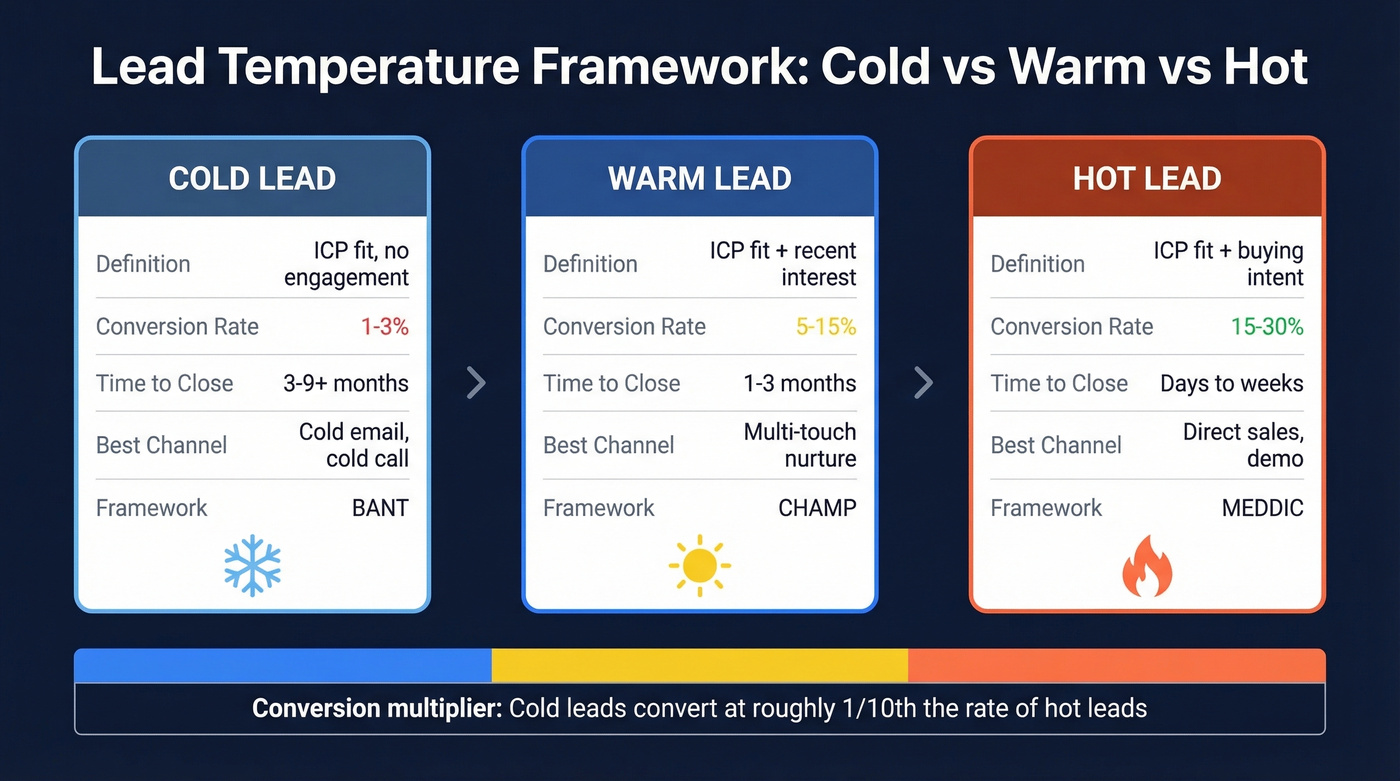
| Cold | Warm | Hot | |
|---|---|---|---|
| Definition | ICP fit, no engagement | ICP fit + recent interest | ICP fit + buying intent |
| Conversion rate | 1-3% | 5-15% | 15-30% |
| Time to close | 3-9+ months | 1-3 months | Days to weeks |
| Best channel | Cold email, cold call | Multi-touch nurture | Direct sales, demo |
| Framework | BANT | CHAMP | MEDDIC |
The conversion ranges come from aggregated B2B benchmarks - they'll vary by deal size, but the ratios hold. Cold leads convert at roughly one-tenth the rate of hot leads. That's not a rounding error.
The framework mapping is worth internalizing. BANT works for cold leads because you're qualifying from scratch - Budget, Authority, Need, Timeline. CHAMP flips the order for warm leads, leading with Challenges first because the prospect has already shown interest. MEDDIC is overkill unless your average deal justifies the rigor; skip it for deals under $15k.
How to Identify Each Lead Type
What Makes a Lead Warm
Two conditions must both be true: the prospect matches your ICP, and they've engaged within the last 30-90 days. Fit alone doesn't make a lead warm - a perfect-profile VP who's never heard of you is still cold. Engagement alone doesn't cut it either - a student downloading your whitepaper for a class project isn't a prospect.
The behavioral signals that matter: pricing page visits, content downloads (especially bottom-of-funnel assets like case studies or ROI calculators), webinar attendance, and repeat site visits. Any of these within a 30-90 day window, combined with ICP match, and you've got a warm lead.
What Makes a Lead Cold
No engagement, or engagement so old it's meaningless. That purchased list from six months ago? Cold. The webinar attendees from Q2 who never opened a follow-up email? Cold again.
A cold lead isn't the same as a suspect. A suspect hasn't been qualified at all - you don't even know if they're ICP. A cold lead fits your profile but hasn't raised their hand. That difference matters because cold leads deserve outreach; suspects deserve research first.
The Economics Behind Lead Temperature
One Reddit operator broke down their cold email economics in detail: $420/month in tooling (domains, sending infrastructure, data), generating 16 qualified leads. That's $26 per qualified lead. Their reply rate had actually declined from 8% to 3% over 18 months before the rebuild - a slow bleed caused by neglecting data quality.
Their bounce rate started at 11%. That's not just wasted sends - it's domain reputation damage. ISPs watch your bounce rate, and once your sending domain gets flagged, even your warm leads stop seeing your emails. After switching to manual verification, they got bounces under 2% and their reply rate doubled.
We've seen teams tank their domain reputation in a single week of bad data. You send 500 cold emails, 47 bounce, your domain reputation drops, and suddenly even your engaged prospects aren't seeing your messages. This is why running lists through a verification tool like Prospeo before every campaign isn't optional - it's insurance against burning your entire outbound channel.

That 11% bounce rate from the article? Prospeo's 5-step verification and 7-day data refresh keep your bounce rate under 2% - so cold outreach actually reaches inboxes instead of torching your domain reputation. 98% email accuracy at $0.01 per lead.
Stop burning your domain on bad data. Verify before you send.
2026 Cold Outreach Benchmarks
Instantly's 2026 benchmark report analyzed billions of cold email interactions:
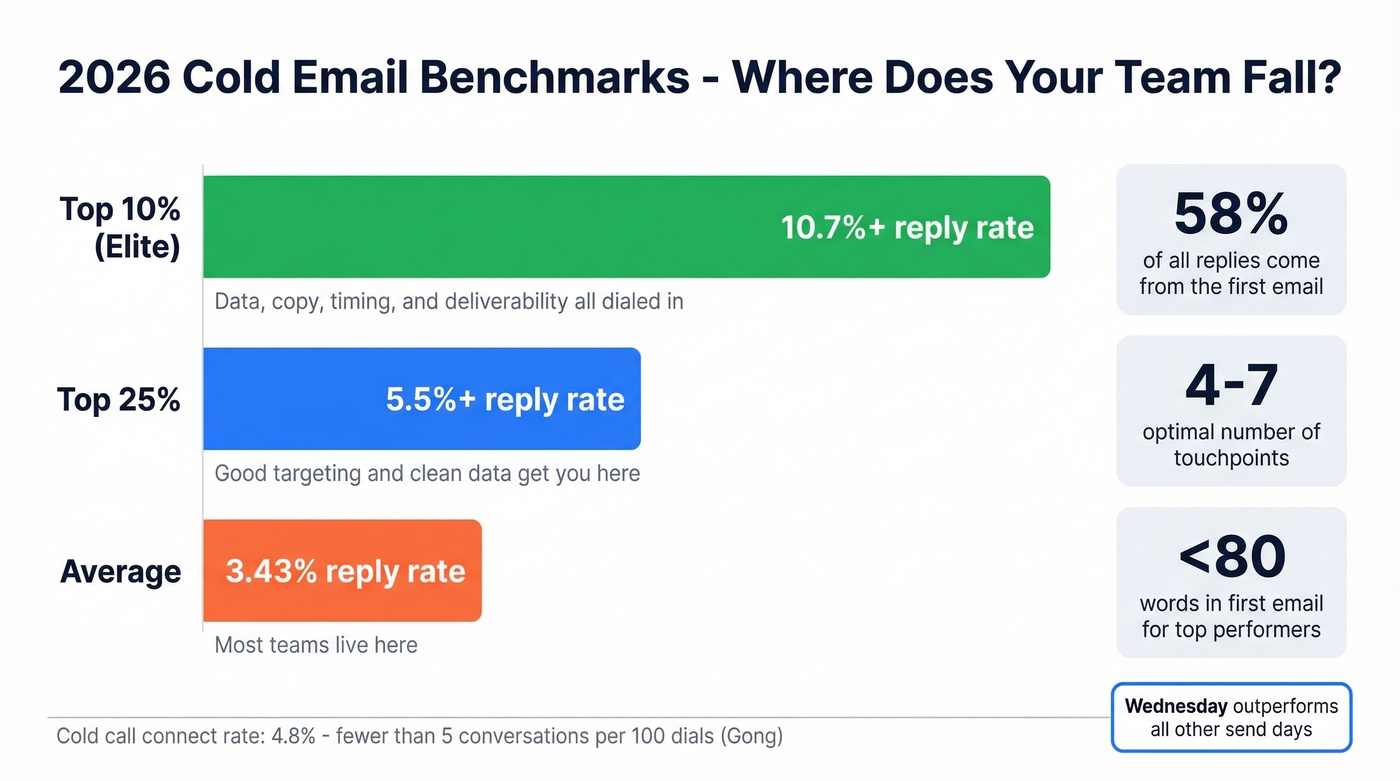
- Average reply rate: 3.43%. Most teams live here.
- Top quartile: 5.5%+. Good targeting and clean data get you here.
- Top 10%: 10.7%+. Everything dialed in - data, copy, timing, deliverability.
What separates the tiers? 58% of all replies come from the first email, so your opening message matters more than your follow-up sequence. The sweet spot is 4-7 touchpoints total. Wednesday consistently outperforms other days. And elite performers keep their first-touch emails under 80 words.
For cold calls, Gong's data puts the connect rate at 4.8%. Fewer than 5 conversations per 100 dials. Cold outreach isn't dead, but you need volume AND quality to make the math work.
Build Your Lead Scoring Model
A scoring model turns subjective "this lead feels warm" into a repeatable system. In our experience, starting with more than seven criteria creates analysis paralysis. Five to seven is the sweet spot.
If you want the deeper version, see our full guide to lead scoring.
Explicit vs Implicit Scoring
Explicit scoring captures who the lead is. Implicit scoring captures what they've done.
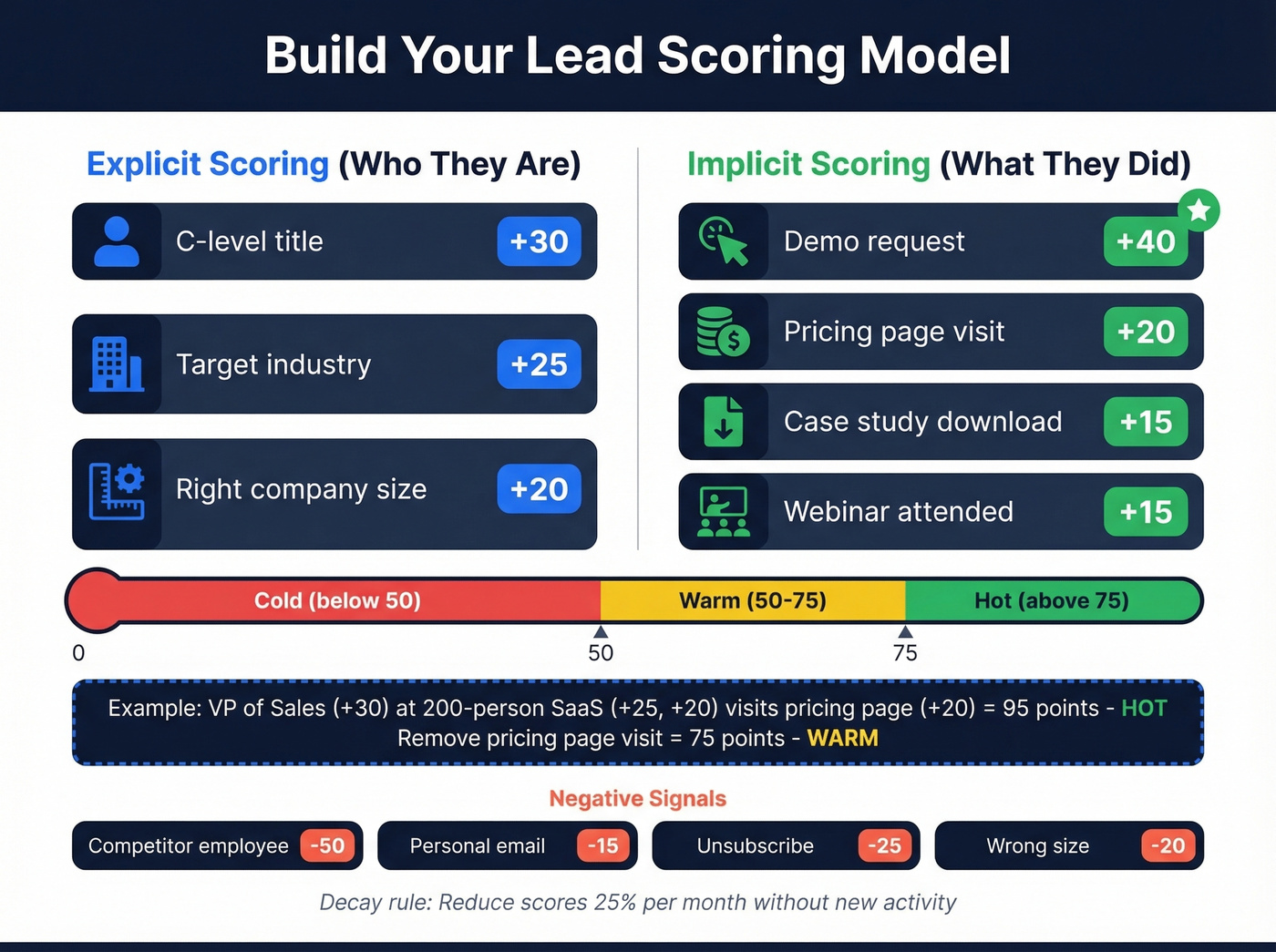
| Type | Signal | Points |
|---|---|---|
| Explicit | C-level title | +30 |
| Explicit | Target industry | +25 |
| Explicit | Right company size | +20 |
| Implicit | Pricing page visit | +20 |
| Implicit | Case study download | +15 |
| Implicit | Demo request | +40 |
| Implicit | Webinar attended | +15 |
Set your thresholds: above 75 is hot, 50-75 is warm, below 50 is cold. The MQL threshold should capture roughly the top 20% of your leads. Teams using this threshold typically see 15-25% conversion from qualified leads to closed deals.
Let's walk through a real example. A VP of Sales (+30) at a 200-person SaaS company (target industry +25, right size +20) who visited your pricing page (+20) scores 95 - hot. Remove the pricing page visit and they're at 75 - warm. That single behavioral signal is the difference between a demo request and a nurture sequence.
Negative Scoring and Decay
This is where most teams get lazy.
| Signal | Points |
|---|---|
| Competitor employee | -50 |
| Personal email (B2B) | -15 |
| Unsubscribe | -25 |
| Wrong company size | -20 |
And here's the rule most teams miss: decay. Reduce scores by 25% per month without new activity. A lead who downloaded your whitepaper six months ago and went silent isn't warm anymore. Decay prevents your pipeline from filling with ghosts.
Your scoring model is only as good as the data feeding it. Job title, company size, technographics - these are the inputs that determine whether a lead starts at 75 or 25. Garbage in, garbage out.
To tighten those inputs, it helps to understand firmographic and technographic data and how to apply firmographic filters.
Warm Outbound - The Third Category
Here's the biggest lie in sales: lead temperature is fixed. It's not. A cold lead with intent signals becomes warm overnight. A warm lead with a stale email becomes invisible.
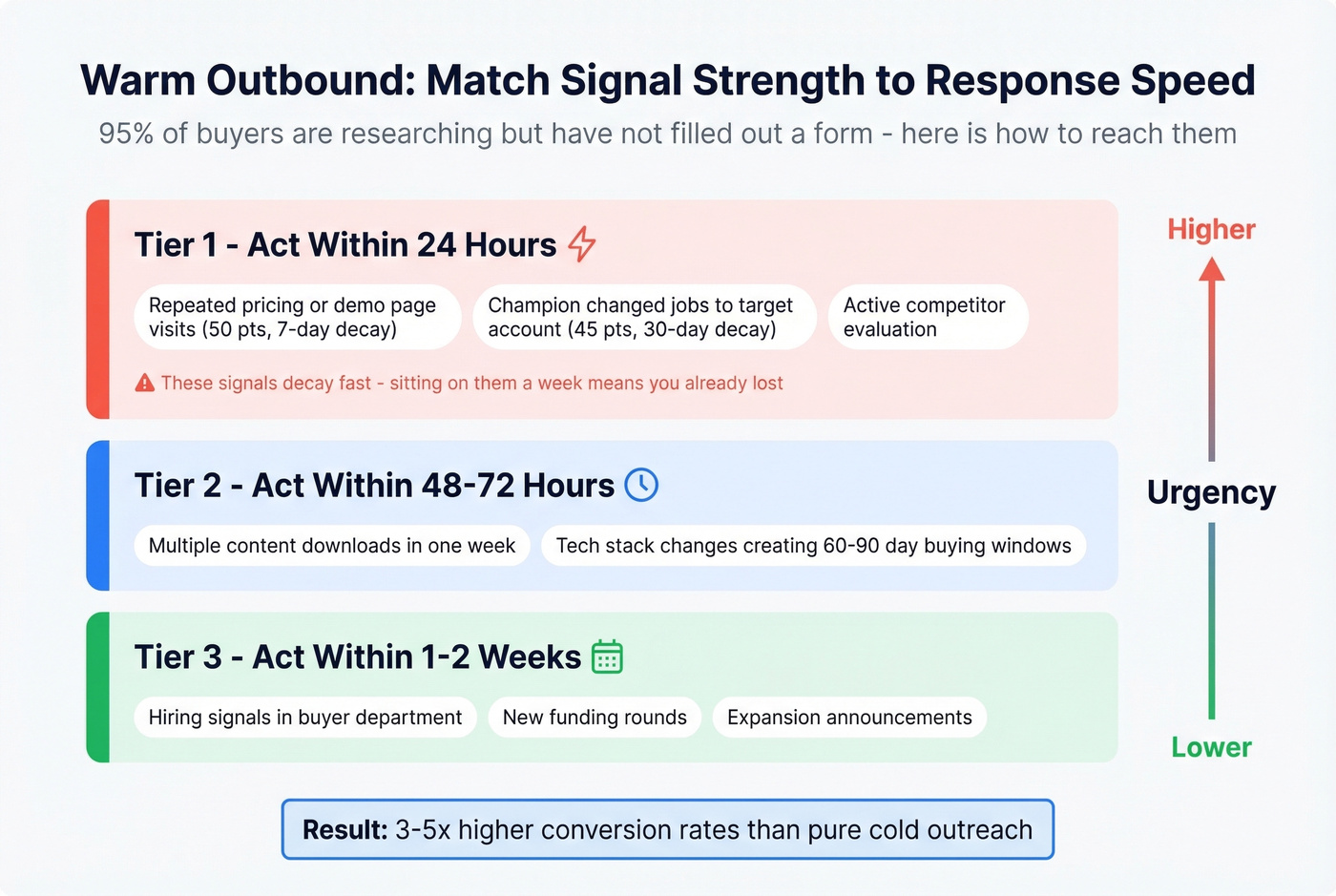
95% of buyers are actively researching but haven't filled out a form. Warm outbound targets them - you're reaching contacts who haven't raised their hand but are showing buying signals that make them behave like warm leads. The result? 3-5x higher conversion rates than pure cold outreach.
Match signal strength to response speed:
Tier 1 - Act within 24 hours: Repeated pricing or demo page visits (score these at 50 points with 7-day decay). A champion changing jobs to a target account (45 points, 30-day decay). Active competitor evaluation. These signals decay fast, so sitting on them for a week means you've already lost.
Tier 2 - Act within 48-72 hours: Content engagement patterns like multiple downloads in a week. Tech stack changes that create 60-90 day adjacent buying windows.
Tier 3 - Act within 1-2 weeks: Hiring signals in your buyer's department. New funding rounds. Expansion announcements.
If you want a practical rubric for these signals, use this guide to identifying buying signals.
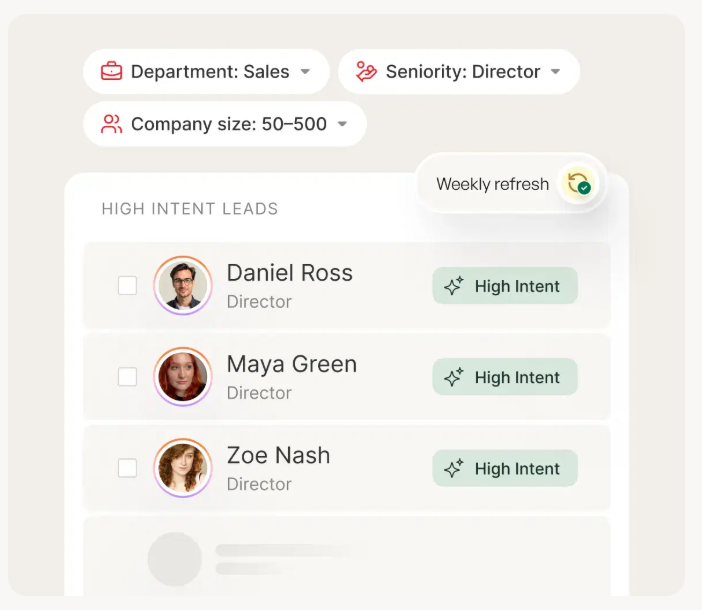
Your lead scoring model is only as good as the data feeding it. Prospeo enriches every contact with 50+ data points - job title, company size, technographics, intent signals across 15,000 topics - so your warm leads actually score correctly and your cold leads get the context they need to convert.
Enrich your leads with 50+ data points and score with confidence.
Nurturing Without Killing Momentum
The Golden Window
You've got 48 hours. Respond within 5 minutes and you're 21x more likely to get a prospect into your funnel than if you wait 30 minutes. Only 16% of companies respond to new leads within 24 hours. Almost 50% of leads never receive a follow-up at all.
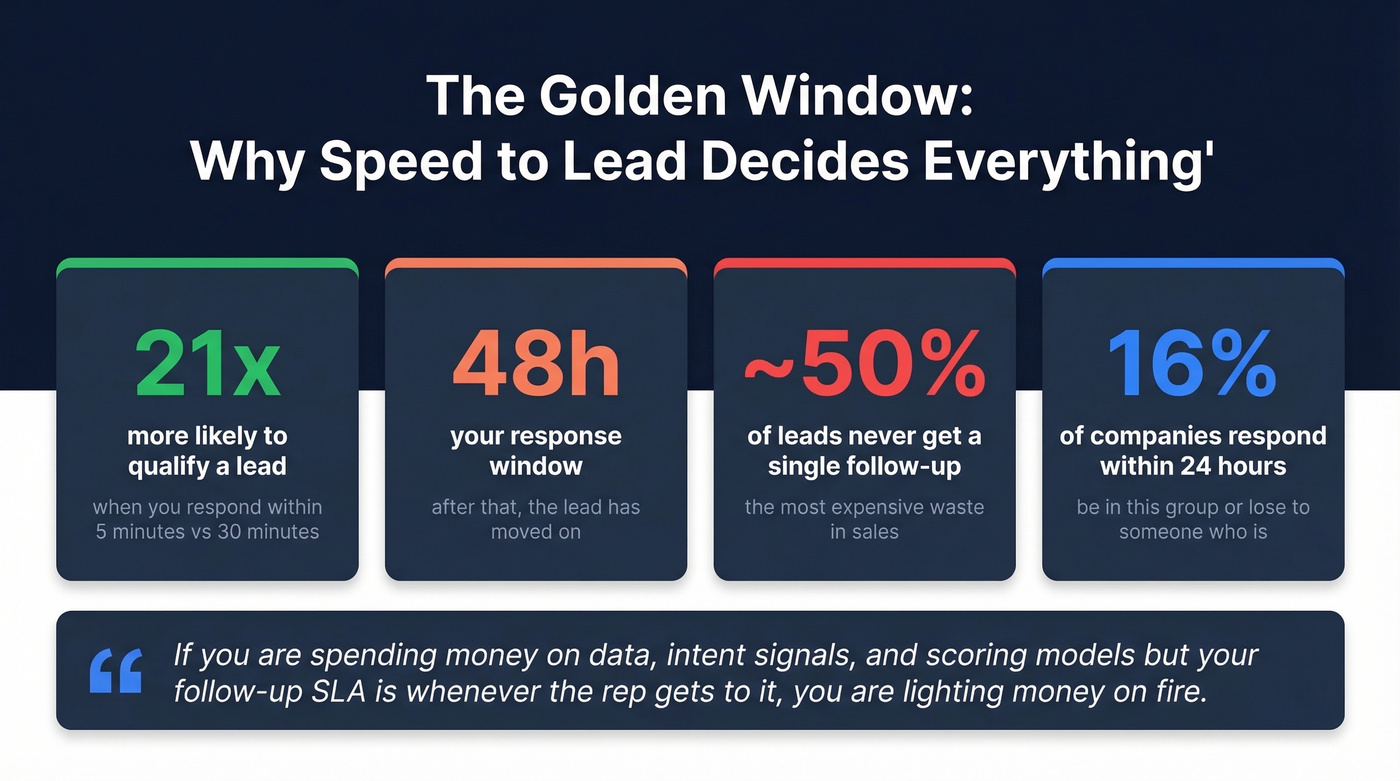
Look - if you're spending money on data, intent signals, and scoring models but your follow-up SLA is "whenever the rep gets to it," you're lighting money on fire.
To operationalize this, build a simple lead status system and standardize your sales activities.
Surround Sound Cadence
One-channel nurture is dead. Here's a cadence we've seen work consistently:
Day 1: Welcome email with a high-value asset - a relevant case study or benchmark report, not a pitch. Personalized subject lines alone drive 11% higher open rates and 27% higher click-through rates.
Day 2: Social nurture - add them to a retargeting audience showing case study ads.
Day 7: If they opened but didn't click, trigger a retargeting ad with a different angle.
Day 14: Optional SMS if you have consent and the lead is high-scoring.
Maintain a 3:1 give-to-get ratio. Deliver value three times before you ask for a meeting. Segmented campaigns built around persona and entry-point content drive 760% more revenue than one-size-fits-all drips. Relevance compounds.
If you need copy you can deploy fast, use these sales follow-up templates and this library of email subject line examples.
FAQ
Can a cold lead become warm?
Yes, and it happens constantly. A cold lead who visits your pricing page three times this week is now warm. Lead scoring with monthly decay tracks this transition automatically. Nurture sequences, retargeting ads, and intent signals all accelerate the shift - temperature is fluid, not fixed.
What's a good cold outreach conversion rate in 2026?
The average cold email reply rate is 3.43%. Top quartile hits 5.5%+, and elite performers exceed 10.7%. If you're below average, check your data quality and email length first - those two variables explain most of the gap.
How do I keep lead data accurate enough to act on?
Run your lists through a verification tool before every campaign. A 7-day refresh cycle means a lead you scored last week still has a valid email this week. Prospeo's free tier gives you 75 email verifications per month - enough to test data quality before committing to a paid plan.