

Warm Email Sign-Offs That Actually Get Replies (Backed by 350K Emails)
You just re-read an email you sent to a new client and realized you signed it "Best" for the 47th time this week. You're not alone - there's an entire thread on r/ExecutiveAssistants dedicated to people trying to escape the "Best" trap. With 376 billion emails sent daily and professionals receiving 121, your warm sign-off is one of the few things that actually registers. But finding the right one - something that sounds human without being weird - is harder than it should be.
Here's what the data says works, not just what sounds nice.
The Quick Version
If you want one warm sign-off that works everywhere: "Thanks." It pulls a 63% response rate across 350,000 email threads - 15.5 points above the baseline.
Your cheat sheet:
- Safest all-purpose pick: Thanks
- Warmth without risk: Warm regards
- Highest response rate: Thanks in advance (65.7%)
- Standing out: With appreciation
That's the short answer. The rest of this article explains why, when each one fits, and the one sign-off that'll start an argument in any office.
Why Your Email Closing Matters
Email strips tone. There's no vocal inflection, no facial expression, no body language. 90% of employees blame workplace misunderstandings on communication that started via email, and a big reason is that neutral language reads as cold on a screen.
Your sign-off is the last thing someone reads before deciding how they feel about your message. It's a warmth marker - a small signal that says "I'm a human being who respects your time." Skip it, and your perfectly reasonable email can land like a demand.
The numbers bear this out. An analysis of 350,000 email threads found that gratitude-based closings produce a 36% relative increase in response rates compared to emails without a thankful closing. That's not a rounding error. That's the difference between getting a reply and getting ghosted.
What 350,000 Emails Tell Us
Boomerang analyzed over 350,000 email threads from mailing list archives across 20+ online communities. They used regular expressions to extract closings and correlated each one with response rates, filtering for sign-offs that appeared at least 1,000 times. To control for bias, they re-ran the analysis on threads where the initial message contained a question mark. The pattern held.
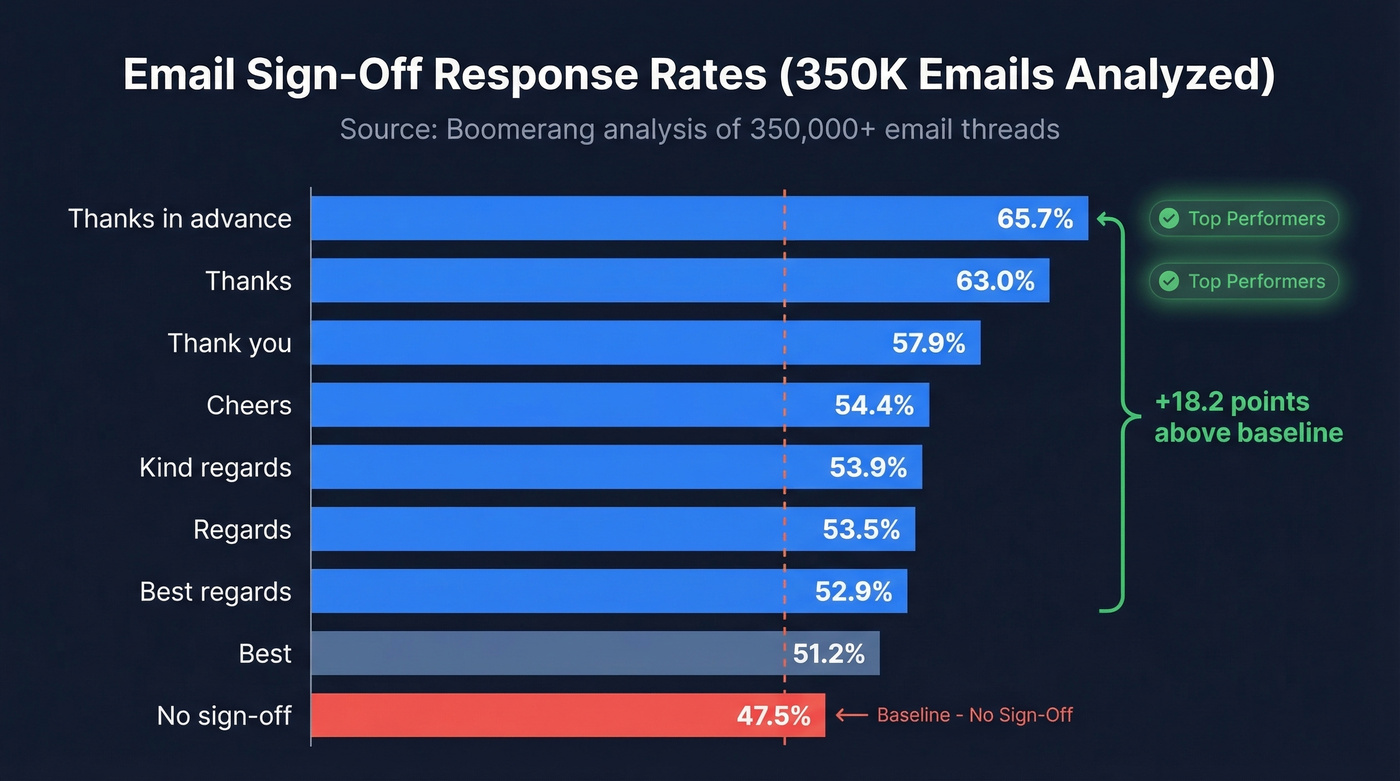
Here's the full ranked table:
| Sign-Off | Response Rate |
|---|---|
| Thanks in advance | 65.7% |
| Thanks | 63.0% |
| Thank you | 57.9% |
| Cheers | 54.4% |
| Kind regards | 53.9% |
| Regards | 53.5% |
| Best regards | 52.9% |
| Best | 51.2% |
| No sign-off | 47.5% |
The takeaway is stark. "Thanks in advance" at 65.7% vs. the 47.5% baseline is an 18.2-point swing. "Best" barely clears the baseline by 3.7 points - as Inc. noted, switching from "regards" to "thanks" produces an 8-10 point lift on its own.
"Best" has become the email equivalent of elevator music. The data confirms what you already felt - it performs like saying almost nothing at all. Gratitude-based closings dominate because they acknowledge the recipient as a person, not just an inbox.
Here's the thing: if you're closing deals under $15K and agonizing over warm regards vs. kind regards, you're optimizing the wrong thing. Pick "Thanks," make it your default, and spend that mental energy on the body of your email instead. The sign-off matters, but not more than what comes before it.
Best Warm Sign-Offs by Category
Most guides give you 89 options. You don't need 89 options. You need 3-4 go-tos that match your voice and context.
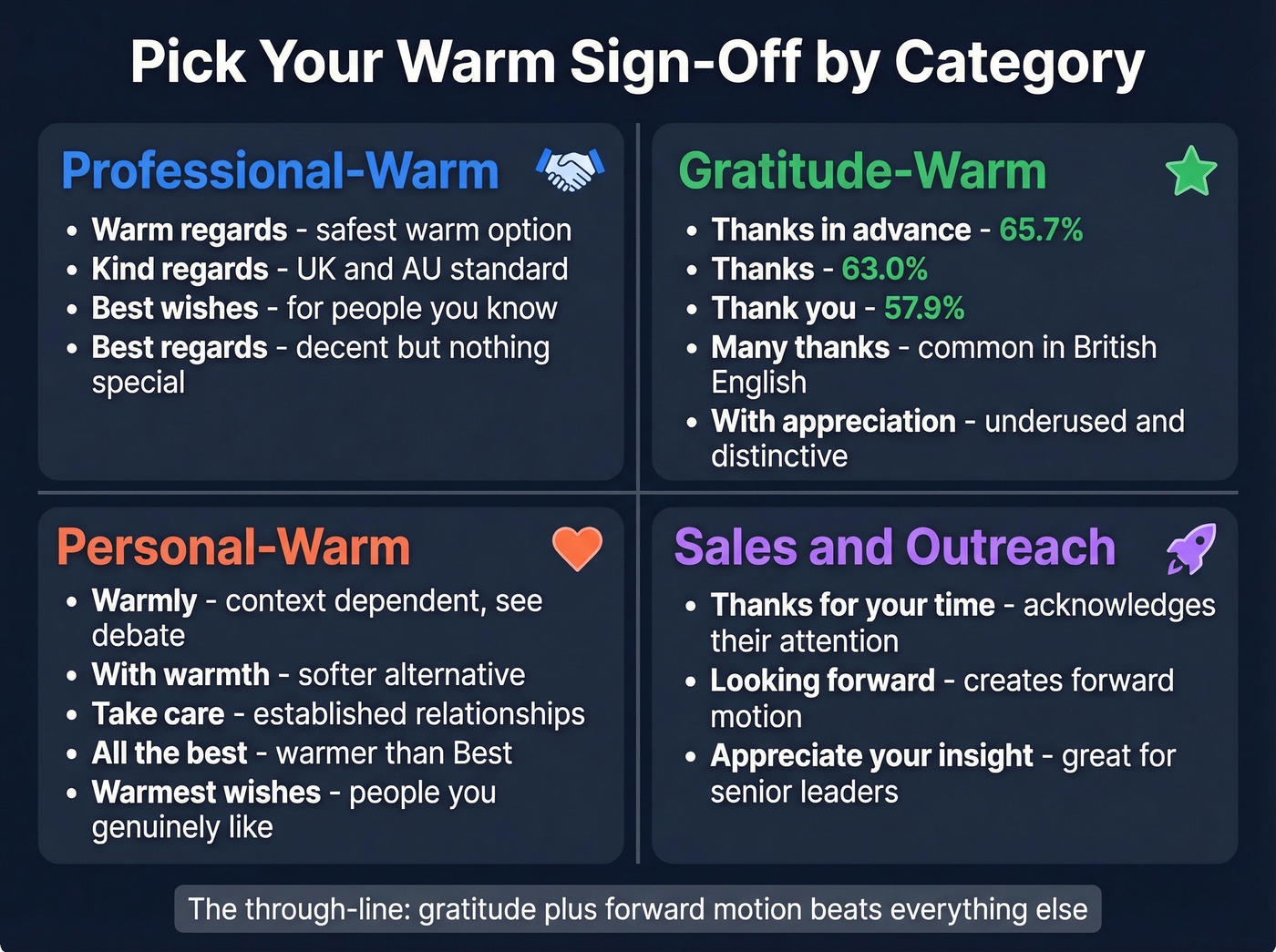
Professional-Warm
"Warm regards" is the safest warm option - professional enough for clients, warm enough to feel human. We've used it as our default for external emails for years, and it's never once landed wrong.
"Kind regards" is standard in UK and Australian business email but can feel stiff in casual US workplaces. One Reddit user on r/workingmoms put it bluntly: "Kind Regards" feels unnatural, "isn't something I would say irl." "Best wishes" works well for people you know but don't email often - slightly more personal than "Best regards," which pulls a 52.9% response rate. Decent, but nothing special.
A quick note on the UK vs. US sincerity split: "Yours sincerely" is standard British English when you know the recipient's name; "Sincerely yours" is the American equivalent. "Yours faithfully" applies when you don't know the recipient's name (a "Dear Sir/Madam" situation). These rules are fading in casual business email, but they still matter in legal correspondence and formal letters.
Gratitude-Warm
These are the data winners, ranked by response rate from the 350K-thread analysis:
- Thanks in advance (65.7%) - The highest performer, but some people find it presumptuous. It implies you're expecting action. Use it when you genuinely are asking for something - it works because it sets a soft expectation of reciprocity.
- Thanks (63.0%) - Short, genuine, universally safe. In our experience, this is the safest default for a reason.
- Thank you (57.9%) - Slightly more formal. Works when you want to acknowledge effort without being casual.
- Many thanks - Common in British English. Carries more weight than a plain "Thanks."
- With appreciation - Underused and distinctive. Great when someone's gone out of their way.
Personal-Warm
- Warmly - We'll get to this one. It's complicated.
- With warmth - A softer alternative to "Warmly" that reads less like a hug and more like a handshake.
- Take care - Best for established relationships. Signals genuine concern without being over-the-top.
- All the best - A warmer "Best" that actually feels like you mean it.
- Warmest wishes - Reserved for people you genuinely like. Too much for a first email.
Sales and Outreach
Cold outreach is where sign-off choice gets tactical. You're writing to someone who didn't ask to hear from you, so every word needs to earn its place.
"Thanks for your time" works because it acknowledges the recipient owes you nothing - that respect lands. "Looking forward" creates forward motion without being pushy and pairs well with a specific next step ("Looking forward to Thursday"). "Appreciate your insight" is complimentary without laying it on thick, which makes it effective for reaching senior leaders. Skip "Talk soon" in cold emails - you haven't talked yet, and it reads as presumptuous.
The through-line across all four categories: gratitude plus forward motion. Avoid anything that sounds like it was auto-generated by a CRM.

A warm sign-off boosts replies by 18 points - but only if your email actually lands. Bad data means bounces, domain damage, and zero replies no matter how perfect your closing line. Prospeo delivers 98% email accuracy with 5-step verification, so every carefully crafted sign-off reaches a real inbox.
Stop perfecting sign-offs for emails that bounce.
The "Warmly" Debate
Let's address the elephant in the inbox. "Warmly" is the most polarizing sign-off in professional email, and the top-ranking Reddit thread on r/office makes the case against it clearly: it "drives me nuts... like wishing me a big hug." The OP describes it as too "touchy feely" for coworkers.
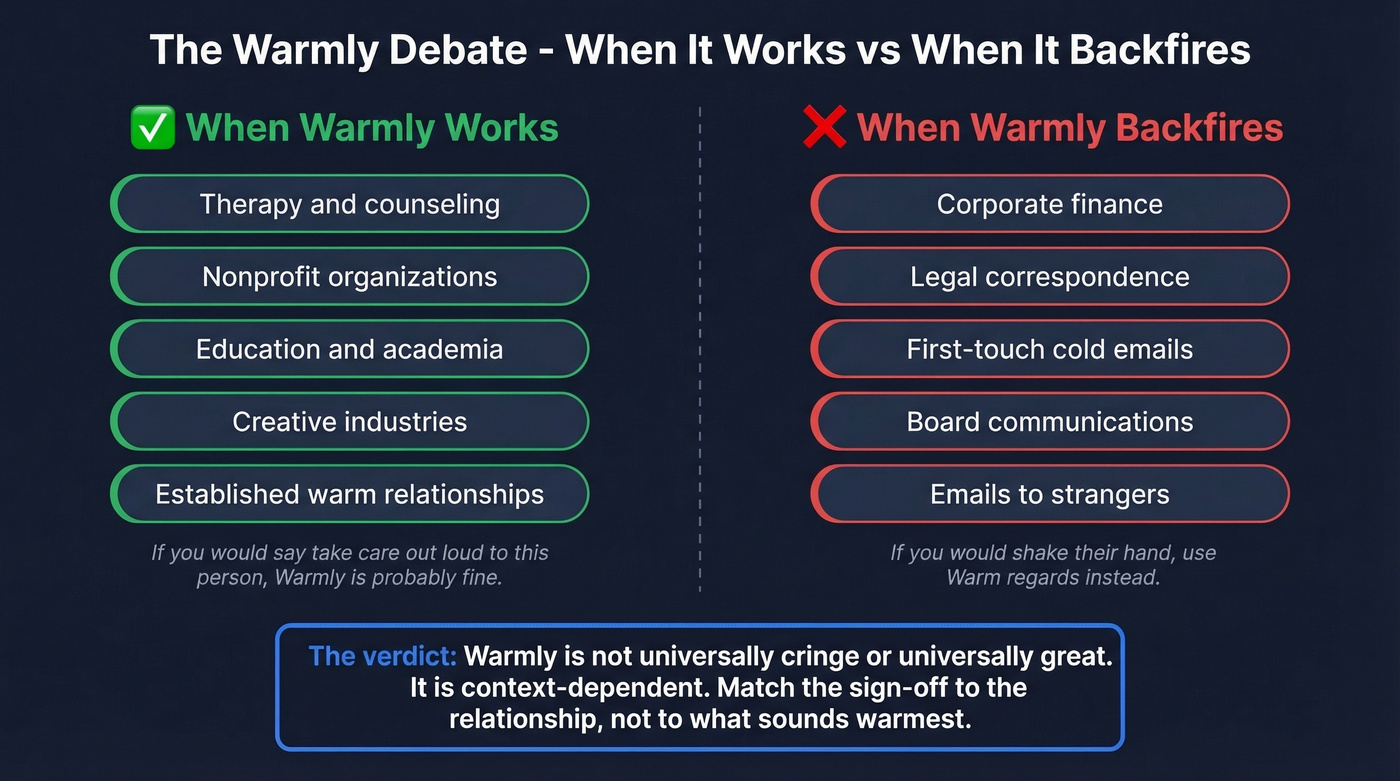
When "Warmly" works: Therapy, counseling, nonprofit, education, and creative industries. In these contexts, it signals empathy and connection. Therapist Brandon Gross writes about "Warmly" as a profession-specific norm, exploring variations like "With warmth" and "Warm regards" as part of the therapeutic relationship.
When it backfires: Corporate finance, legal, first-touch emails to strangers, board communications. It reads as too intimate - like a hug from someone you barely know.
The verdict: "Warmly" isn't universally cringe or universally great. It's context-dependent. If you'd say "take care" out loud to this person, "Warmly" is probably fine. If you'd shake their hand, use "Warm regards" instead. Research from UMD's Smith School reinforces this: the best sign-off is the one that matches the relationship, not the one that sounds warmest in isolation.
Choosing the Right One
Your industry and relationship dictate the sign-off, not your personal taste.
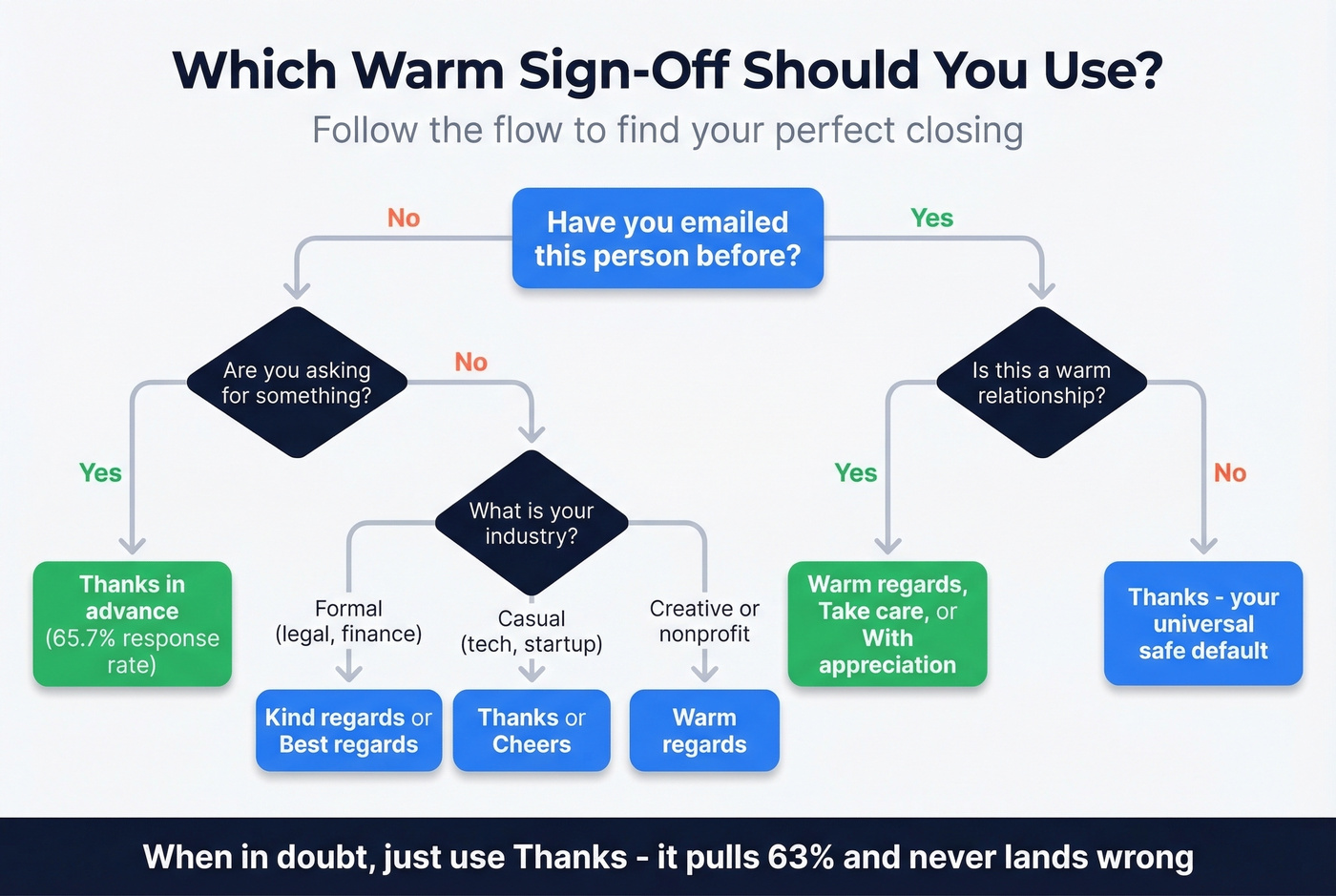
| Situation | Recommended | Avoid |
|---|---|---|
| First email to a stranger | Thanks, Best regards | Warmly, Cheers |
| Ongoing thread, colleague | Thanks, Talk soon | Sincerely, Yours faithfully |
| Warm client relationship | Warm regards, With appreciation | Just your name |
| Formal industry (legal) | Kind regards, Thank you | Warmly, Cheers |
| Creative / startup | Cheers, Thanks | Yours faithfully |
| Asking for something | Thanks in advance | Best (too neutral) |
| Bad news / apology | Sincerely, With appreciation | Thanks in advance, Cheers |
Quick industry guidance:
- Therapy/healthcare: "Warmly" is standard and expected. Lean into it.
- Legal/finance: "Kind regards" or "Best regards." Err formal. Always.
- Tech/startups: "Thanks" or "Cheers." Keep it casual - nobody's impressed by formality.
- Sales/outbound: "Thanks for your time" or "Looking forward." Gratitude plus momentum.
- Academia: "Best wishes" or "Sincerely." Depends on whether you're emailing a peer or a department chair.
Cold Email Sign-Offs
You're writing a cold outreach email to a VP of Sales. You've spent 20 minutes on the subject line and body. Now you're staring at the cursor after your last sentence.
The 350K-thread pattern carries over well to outreach. Gratitude closings still win because they acknowledge the recipient's attention as valuable - and in cold email, that attention is the scarcest resource you're competing for. "Thanks for your time" and "Appreciate your insight" beat neutral closings because they frame the interaction as a favor, not a transaction.
A few rules specific to cold outreach: don't use "Talk soon" (you haven't talked yet). Don't use "Warmly" (you're a stranger). And don't use "Cheers" unless you're emailing someone in the UK or Australia - it can sound odd in the U.S. for professional cold emails.
Of course, your sign-off is irrelevant if the email bounces. Bad contact data means bounced emails and damaged sender reputation. Prospeo verifies emails in real time with 98% accuracy, so your carefully worded closing actually reaches someone. If you're building sequences, pair this with proven cold email follow-up templates and a clear B2B cold email sequence.
You just learned that "Thanks" pulls a 63% response rate in cold outreach. Now imagine pairing that with 300M+ verified contacts and 30+ filters to reach exactly the right decision-makers. Prospeo gives you the data at $0.01 per email - no contracts, no bounced messages torching your domain.
Nail the sign-off and the send list in one platform.
Formatting Quick Reference
The mechanics matter more than people think.
Capitalization: Capitalize only the first word. "Warm regards," not "Warm Regards." Always include a comma after the sign-off, then a line break, then your name.
Emojis and abbreviations: Emojis are fine with close colleagues. For strangers and first-touch client emails, keep it clean and text-only. "Thx" and "Rgds" belong in text messages, not professional email. They save three characters and cost you credibility.
Consistency: Pick 2-3 sign-offs and rotate based on context. Switching between 15 different closings makes you look indecisive, not versatile. If you're also testing subject lines, use a structured set of email subject line examples and a subject line tester so you’re not guessing.
Military convention: If you work with military or government contacts, "V/r" (very respectfully) and "/r" (respectfully) are standard shorthand. Using them signals you understand the culture; ignoring them doesn't offend, but knowing them earns points.
Sign-offs to skip entirely: "Yours truly" (reads as a love letter), "XOXO" (self-explanatory), "Sent from my iPhone" (not a sign-off - delete it), and "Thx" (lazy). If you wouldn't say it to someone's face, don't type it. If you’re getting low replies, it’s usually not the closing - check your email deliverability, email bounce rate, and overall sender reputation.
FAQ
Is "Warmly" professional?
Yes - in people-centered professions like therapy, nonprofit, and education, "Warmly" is standard and expected. In corporate finance or legal settings, it can read as too intimate. "Warm regards" is the safer professional alternative that carries similar warmth without the polarization. Match the sign-off to the industry, not your personal preference.
What's the highest-performing email sign-off?
"Thanks in advance" pulls a 65.7% response rate across 350,000 analyzed email threads - 18.2 points above the 47.5% baseline of no sign-off at all. Plain "Thanks" follows at 63.0%. Both outperform every non-gratitude closing by a wide margin.
Should I use "Warm regards" or "Best regards"?
"Warm regards" signals personal connection - it says "I value this relationship." "Best regards" is politely neutral at a 52.9% response rate. For cold outreach where deliverability matters, pair either with verified contact data so your closing actually reaches the inbox.
Should I use a sign-off in every email?
In first emails and external communication, always. In rapid back-and-forth threads with colleagues, dropping the sign-off after the first reply is normal and expected. The data shows thankful closings outperform non-thankful closings by 36% (62% vs. 46%), so the first message in any thread should include a real closing - "Thanks" is the safest default.