

What Does a Sales Development Representative Actually Do?
It's Monday morning. You've got 47 leads in your queue, half with phone numbers that ring to voicemail and email addresses that bounced last week. Your manager wants 15 meetings booked this month. Welcome to the SDR life.
So what does a sales development representative do, exactly? Here's the short version - and then we'll break down every piece of it.
The Quick Version
SDRs prospect, qualify, and book meetings for closers. They don't close deals - that's the account executive's job. The median OTE sits at $85K, but only 57.3% of reps actually hit quota. The average SDR-to-AE promotion takes 15-16 months, up 28% from pre-pandemic timelines. Despite all that, the SDR role remains the single best entry point into a high-earning sales career - if you treat it as a 12-18 month intensive, not a destination.
What Does an SDR Actually Do?
The SDR role sits at the very top of the revenue funnel. You're the person who turns cold names into warm conversations so an AE can turn those conversations into closed deals. Everything downstream - pipeline, revenue, quota attainment for the whole org - starts with you.
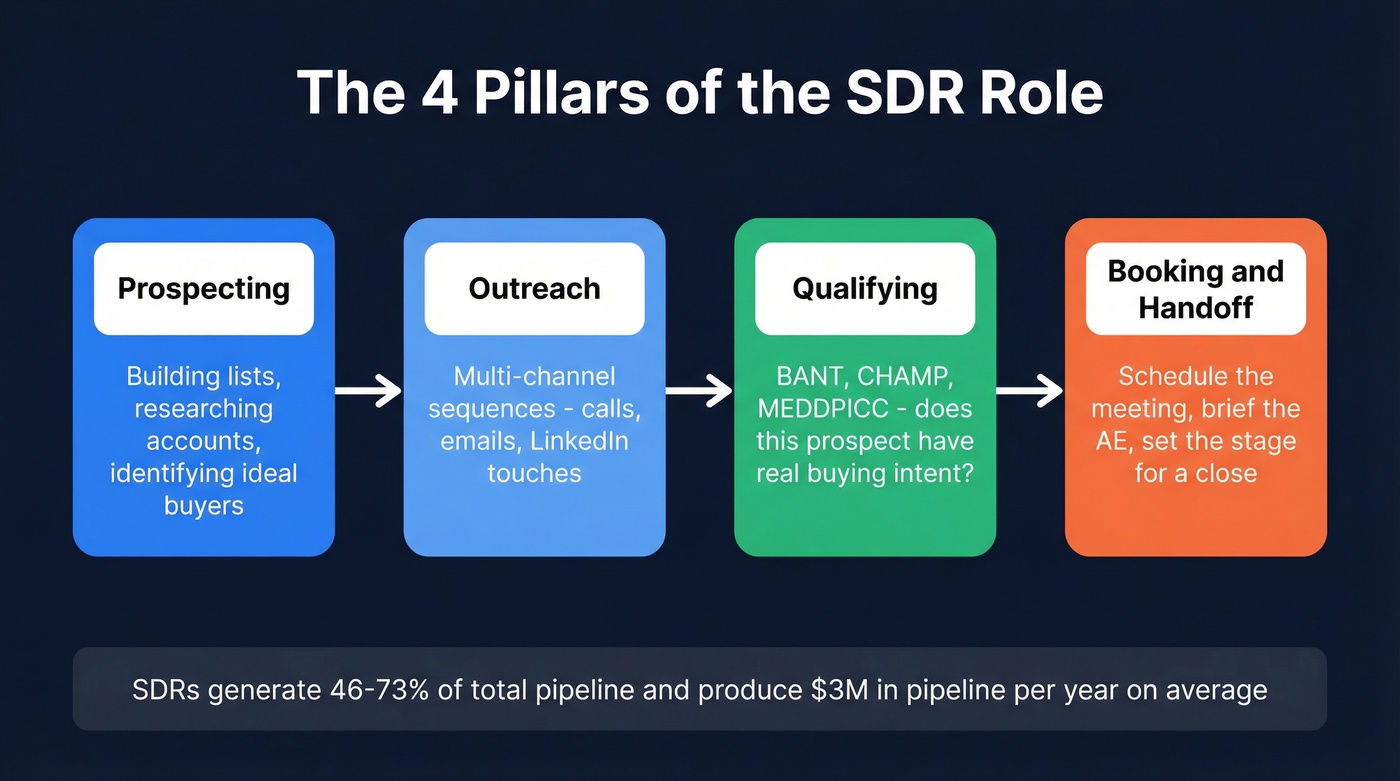
The job breaks down into four pillars:
- Prospecting - finding the right people at the right companies. This means building lists, researching accounts, and identifying who's worth reaching out to (more on sales prospecting if you want a playbook).
- Outreach - multi-channel touches across calls, emails, and social. You're running sequences, not sending one-off messages (see sequence management).
- Qualifying - determining whether a prospect has the budget, authority, need, and timeline to actually buy. Frameworks like BANT and MEDDPICC live here.
- Booking and handing off - scheduling meetings for AEs and providing enough context that the AE walks in prepared, not cold (use a clean handoff email to avoid dropped context).
SDRs generate 46-73% of total pipeline depending on the org, and the median SDR produces $3M in pipeline per year. That's a lot of revenue riding on a role most companies treat as entry-level.
SDR vs BDR - What's the Difference?
| SDR | BDR | |
|---|---|---|
| Primary focus | Inbound qualification | Outbound new business |
| Lead source | Marketing-generated | Self-sourced |
| Key metric | Speed-to-lead | Meetings booked |
Most companies use these titles interchangeably. The traditional distinction is that SDRs work inbound leads from marketing while BDRs do cold outbound prospecting. In practice, plenty of "SDRs" do both. Don't get hung up on the title - focus on whether the role is inbound-heavy, outbound-heavy, or blended. One stat worth remembering: responding to an inbound lead within 5 minutes makes you 9x more likely to convert it. Speed-to-lead is the inbound SDR's superpower.
A Typical Day in the Role
The best SDRs don't wing it. They time-block ruthlessly. Here's what a well-structured day looks like, built around 90-minute focused blocks:
| Time | Activity | Target |
|---|---|---|
| 8:00-8:30 | Data prep & list verification | Clean today's call list |
| 8:30-10:00 | Call block #1 | 20-25 dials |
| 10:00-10:30 | Email follow-ups & responses | 10-15 personalized emails |
| 10:30-12:00 | Call block #2 | 20-25 dials |
| 12:00-1:00 | Lunch + social touches | 10-15 social touchpoints |
| 1:00-2:00 | Research & account prep | Prep tomorrow's targets |
| 2:00-3:30 | Call block #3 (optional) | 10-15 dials |
| 3:30-4:30 | CRM updates & admin | Log all activity |
| 4:30-5:00 | Pipeline review & planning | Set next-day priorities |
Activity benchmarks vary, but the consensus from Bridge Group and Operatix data lands around 40-50 calls per day, 10-40 emails, and 80-100 total activities (here are more sales activities examples if you're building a daily scorecard). That 8:00 AM data prep slot matters more than most people realize - verify your list before your first call block so you're not burning your best energy on dead numbers and bounced addresses.
SDR Metrics That Matter
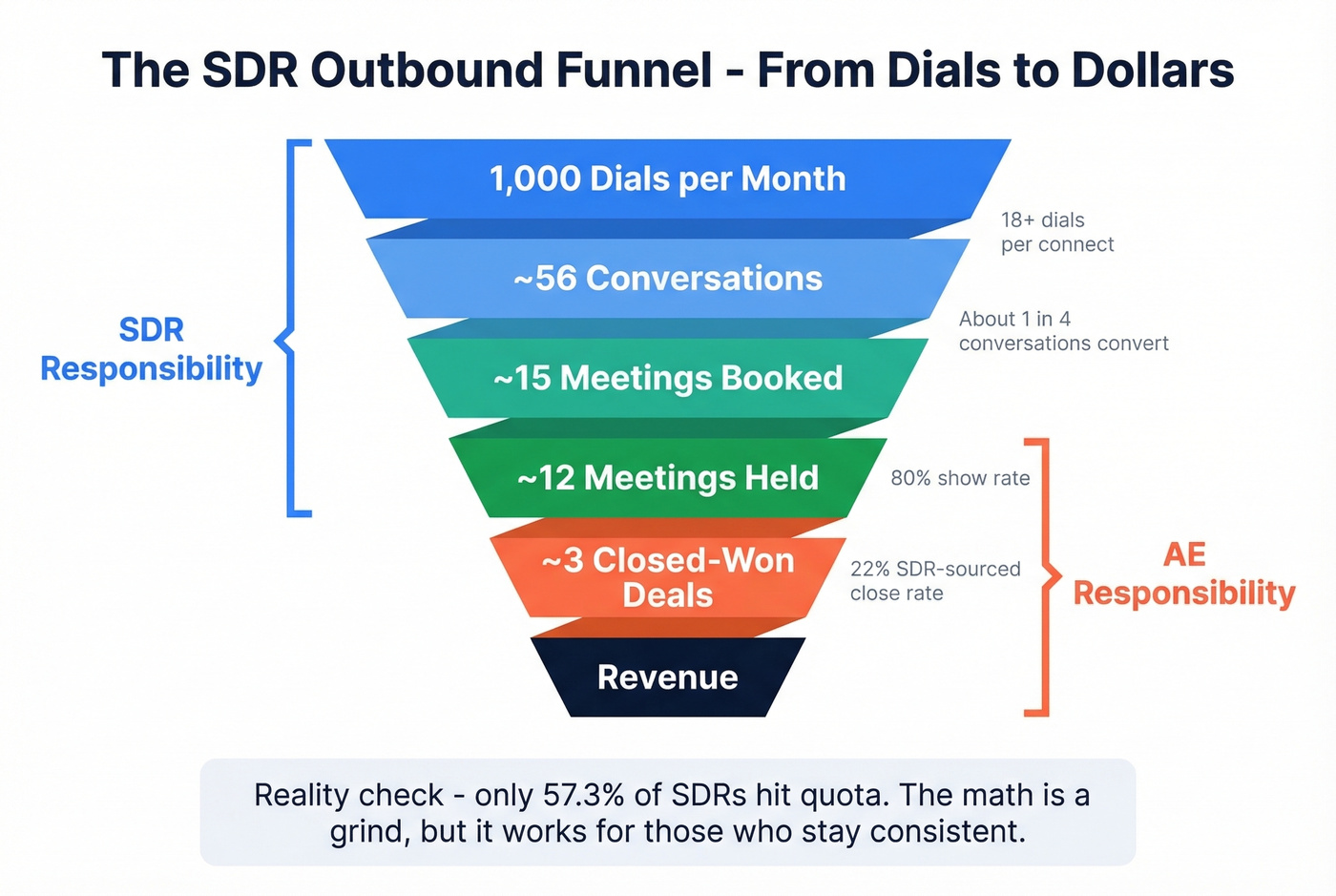
Raw activity numbers don't mean much without conversion context. Here's the full funnel, from dial to dollar:
| Stage | Benchmark | Source |
|---|---|---|
| Dials to connect | 18+ dials per connect | Gartner |
| Connects per 100 touches | 4.4 | Bridge Group |
| Calls to meeting | 1 in 59 | Keller Center |
| Meetings booked/month | 15 (outbound avg) | Operatix |
| Meeting show rate | 80% | Operatix |
| Meetings held/month | ~12 | Operatix |
| SDR-sourced closed-won | 22% | TOPO |
| Cold email reply rate | 1-5% | GMass |
| Accounts per rep | 75-125 | TOPO |
| Touchpoints per account | 16 | TOPO |
Let's walk through the math. You make 50 calls a day, 250 a week. At 18+ dials per connect, that's roughly 14 conversations. Maybe 4-5 of those turn into meetings. Over a month, you're booking 15 meetings, 12 actually happen, and about 2-3 eventually close. That's the reality of outbound - and it's exactly what reps grind through day after day.
Inbound is a different animal. Low-intent leads like whitepaper downloads and webinar attendees convert to meetings at 5-10%. High-intent leads like demo requests convert at 75-80%. The SDR's job is knowing which bucket each lead falls into and acting accordingly (a simple lead scoring model helps a lot here).

That 8 AM data prep block? Prospeo cuts it to minutes. With 98% email accuracy, 125M+ verified mobile numbers, and a 7-day refresh cycle, your call list is clean before you pour your coffee. SDRs using Prospeo see bounce rates drop below 4% - meaning more connects per block, more meetings per month.
Stop burning your best call block on dead numbers.
How SDRs Qualify Leads
Not every meeting is a good meeting. Qualification frameworks exist to separate real opportunities from time-wasters, and mastering this skill is one of the most critical duties because a poorly qualified meeting wastes the AE's time and erodes trust between teams.
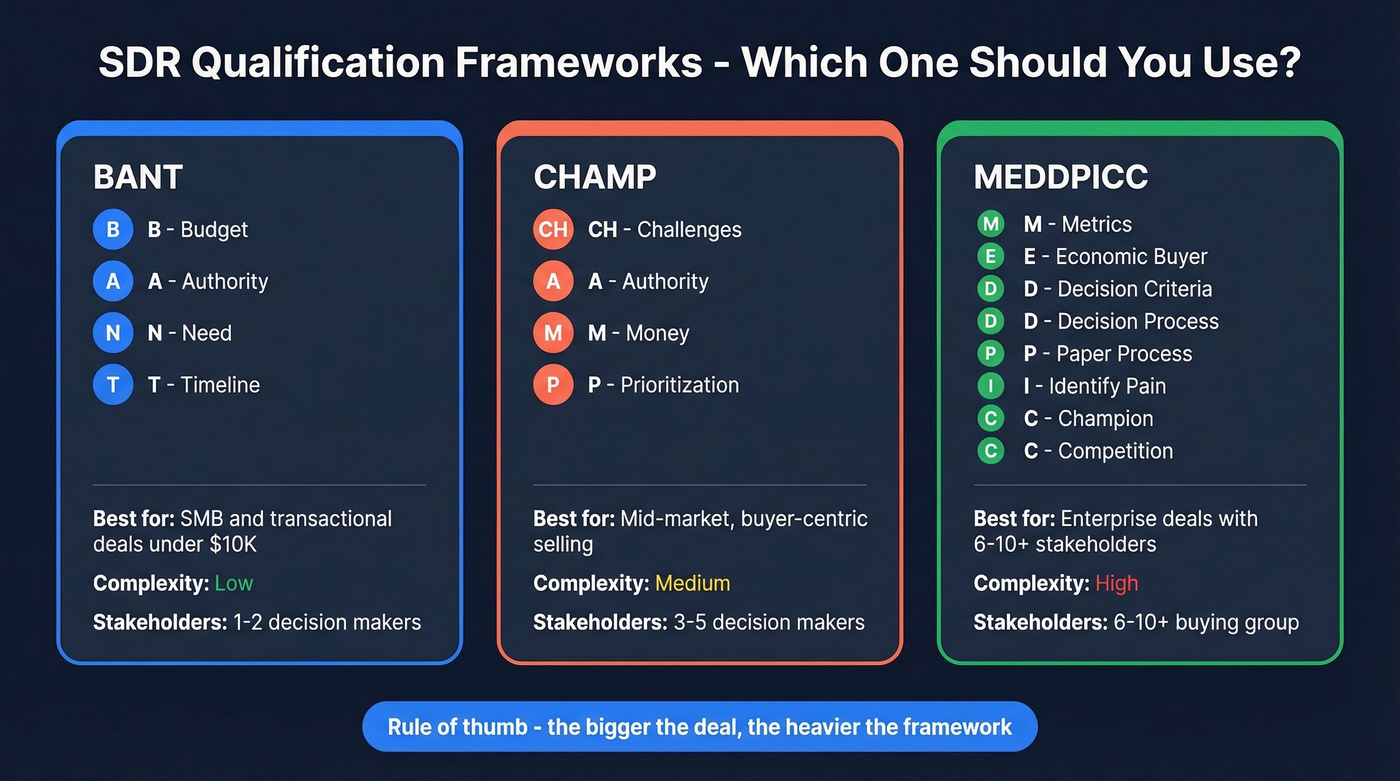
| Framework | Best for | Starts with | Complexity |
|---|---|---|---|
| BANT | SMB / transactional | Budget | Low |
| CHAMP | Mid-market | Challenges | Medium |
| MEDDPICC | Enterprise | Metrics | High |
BANT is fine for deals under $10K. If you're qualifying enterprise opportunities with BANT, you're leaving pipeline on the table - enterprise buying groups include 6-10+ stakeholders, and a simple budget-authority-need-timeline check won't surface the champion, the economic buyer, or the paper process that'll stall your deal for three months.
CHAMP leads with the prospect's challenges - what's actually broken - before asking about budget. It's more buyer-centric and works well in mid-market motions. MEDDPICC is the enterprise heavyweight, adding metrics, decision process, paper process, and competition tracking. Heavier to run, yes. But for six-figure deals with long sales cycles, it's the standard for a reason.
The SDR Tech Stack
The average SDR team uses 12-15 tools daily, costing $2,000-$5,000 per SDR per month. Here's how the stack breaks down:
| Category | Example Tools | Cost/User/Mo |
|---|---|---|
| CRM | Salesforce, HubSpot | $25-$300 |
| Prospecting/Data | Prospeo, ZoomInfo, Apollo | $50-$500 |
| Sales Engagement | Outreach, SalesLoft | $75-$150 |
| Dialer | Orum, Nooks | $200-$350 |
| Enrichment | Clearbit, ZoomInfo | $30-$200 |
| Scheduling | Calendly, Chili Piper | $10-$30 |
| Intent/Signals | Bombora, 6sense | $500-$5,000 |
| Conversation Intel | Gong, Chorus | $100-$200 |
For context: ZoomInfo starts at roughly $14,995/year, Apollo offers a free tier up to $79/user/month, and Prospeo starts free at about $0.01/email with no contracts. We've seen teams cut their bounce rates from 35% to under 4% just by switching to a data source with a 7-day refresh cycle - fewer bounces during those morning call blocks directly translates to more conversations per hour (if you're troubleshooting, start with email bounce rate basics).
If we were building an SDR stack from scratch, we'd start with three things: a CRM (HubSpot's free tier works), a data platform with verified emails and direct dials, and a sales engagement tool like Outreach or SalesLoft. Everything else is a nice-to-have until you're booking 15+ meetings a month consistently (a fuller list of SDR tools is helpful when you're comparing stacks).

SDR Salary Benchmarks in 2026
| Level | OTE | Base/Variable Split | Quota-to-OTE Ratio |
|---|---|---|---|
| Entry (0-1 yr) | $70-75K | 70/30 | 4:1-6:1 |
| Mid (1-3 yrs) | $80-90K | 65/35 | 4:1-6:1 |
| Senior (3-5 yrs) | $90-100K+ | 60/40 | 4:1-6:1 |
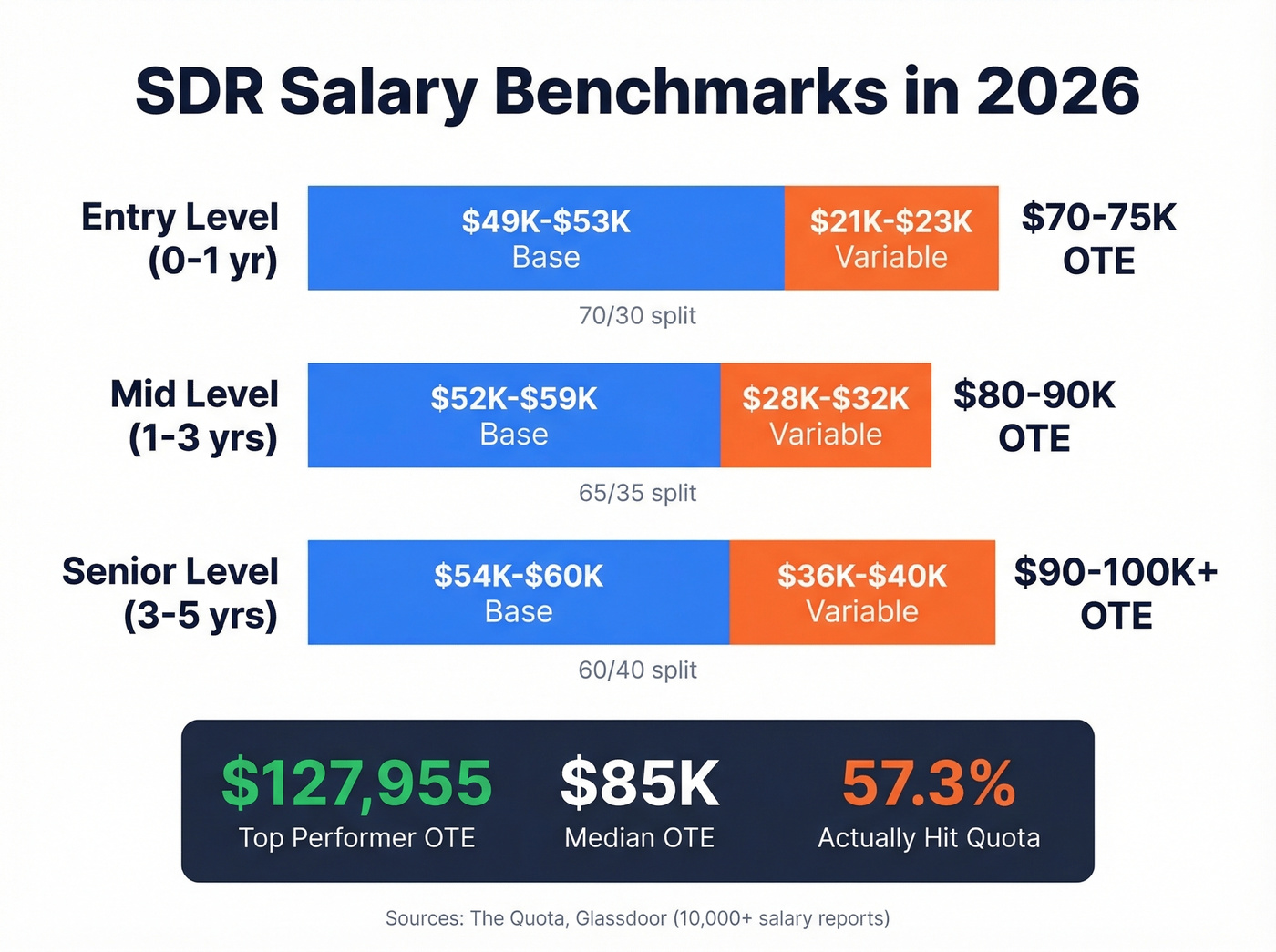
The median OTE across all levels is $85K (median base: $60K), with top performers hitting $127,955. Glassdoor's dataset of 10,000+ salaries shows a median total pay of $102K, with base pay ranging $53K-$71K and additional comp adding $30K-$57K (if you want the math behind OTE, see OTE in sales).
A hybrid commission plan works like this. Say your variable target is $30K. Under the "gold standard" hybrid model, 60% ($18K) is tied to qualified meetings held - roughly $100 per meeting at 15 meetings/month. The remaining 40% ($12K) is tied to closed-won revenue sourced, working out to about 2.4% commission on $500K in sourced revenue.
Most job postings say "OTE: $85K" without mentioning only 57% of reps hit quota. Before accepting an offer, ask about the base/variable split, what percentage of the team hits OTE, and whether commission is paid on meetings booked or meetings held. The difference matters enormously.
Career Paths After SDR
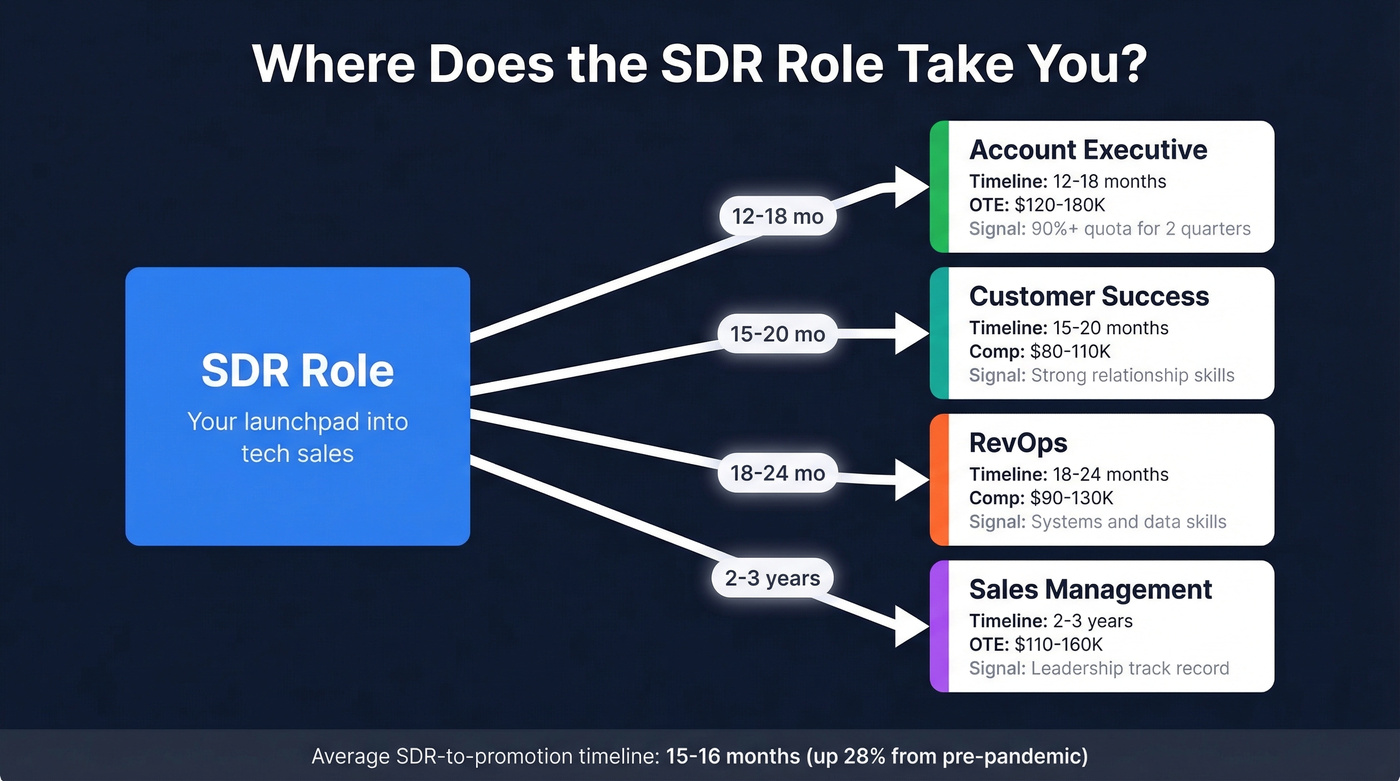
The promotion timeline has shifted. Post-pandemic, the average SDR-to-promotion path increased 28%, from 12 months to 15-16 months. Here's where SDRs branch out:
| Role | Timeline | Readiness Signal | Comp Range |
|---|---|---|---|
| Account Executive | 12-18 mo | 90%+ quota, 2 qtrs | $120-180K OTE |
| Customer Success | 15-20 mo | Strong relationships | $80-110K total |
| RevOps | 18-24 mo | Systems + data skills | $90-130K total |
| Sales Management | 2-3 yrs | Leadership track record | $110-160K OTE |
SDR to Account Executive
This is the most common path. Top performers make the jump in 10-12 months; the average is 12-18. The readiness bar is clear: hit 90%+ quota for two consecutive quarters, demonstrate you can run a full discovery call, and show you understand the buyer's decision process. AE base salaries start at $60K-$80K, with mid-market OTE reaching $120K-$180K.
SDR to Customer Success
If you love the relationship side of sales but hate the cold outreach grind, CSM is a natural fit. Typical transition takes 15-20 months. Base pay runs $55K-$75K, with total comp of $80K-$110K.
SDR to RevOps
RevOps is the most underrated SDR exit. Demand is exploding, pay is strong ($65K-$85K base, $90K-$130K total), and there's no quota. If you're the SDR who geeks out over Salesforce reports and pipeline analytics, this path is worth exploring seriously (here's a deeper look at the RevOps manager role).
SDR to Sales Management
This usually happens after 2-3 years and requires a demonstrated leadership track record - mentoring new reps, running team standups, contributing to process improvements. Skip this if you don't genuinely enjoy coaching people; managing a team of SDRs while carrying your own number is a fast track to burnout.
Is the SDR Role Worth It?
Here's the thing: only 54-57% of SDRs hit quota. Average tenure hovers around 12-18 months. Burnout is real - and it's not hard to see why when you combine high activity expectations with inconsistent data quality that forces reps to spend hours researching instead of actually talking to prospects.
Every article tells you the SDR role is about volume. That's 2019 thinking. In 2026, the SDRs who promote fastest obsess over data quality and targeting precision. Fifty calls to verified direct dials beat 200 calls to switchboards. Ten hyper-personalized emails to in-market buyers beat 100 templated blasts to a stale list. We've watched SDRs make the AE jump in under a year because they stopped chasing activity metrics and started building genuine pipeline from clean data - the r/sales community echoes this constantly, with threads full of reps saying their close rates jumped the moment they prioritized list quality over list size (if you're building that system, start with an ideal customer profile).
The career upside is real. An SDR who promotes to mid-market AE in 14 months goes from $85K OTE to $150K+ OTE. That's a near-double in just over a year. No other entry-level role in tech offers that kind of trajectory. Treat the SDR seat as an intensive - learn the craft, master the tools, hit your numbers - and the math works out.
At 18+ dials per connect, every dead number kills your momentum. Prospeo's verified mobiles hit a 30% pickup rate - nearly 3x the industry average. That means more conversations per 90-minute call block, more qualified meetings for your AEs, and a faster path to that AE promotion.
Turn 50 daily dials into actual conversations.
FAQ
Do you need a degree to become an SDR?
No. Most companies prioritize coachability, communication skills, and resilience over formal education. Many top SDRs come from hospitality, retail, or other customer-facing backgrounds. The barrier to entry is lower than almost any other tech role - performance matters far more than credentials.
How many calls does an SDR make per day?
Typically 40-50 outbound calls, plus 10-40 emails and social touches. It takes an average of 18+ dials to reach a single prospect, which is why volume still matters even in a quality-first approach.
What's the difference between an SDR and an Account Executive?
SDRs prospect and qualify leads, then book meetings. AEs take those meetings and close deals. The SDR role is purely top-of-funnel - generating and nurturing pipeline - while the AE owns the deal from discovery through close. Most SDRs promote to AE within 12-18 months of consistently hitting quota.
What tools do SDRs use most?
A CRM (Salesforce or HubSpot), a sales engagement platform (Outreach or SalesLoft), and a prospecting data tool for verified emails and direct dials. Prospeo's free tier with 75 emails/month is a strong starting point for new reps, while ZoomInfo and Apollo serve larger teams with bigger budgets.
How much do SDRs really earn?
Median OTE is $85K, with base salaries around $53K-$71K. Top performers earn $127K+. Only 57% hit full quota, so ask about the base/variable split and what percentage of the team hits their number before accepting an offer.