

What Does an SDR Actually Do? The Complete 2026 Guide
Only 57.3% of SDRs hit quota. That means nearly half the people in this role grind through constant rejection without clearing the bar - and most don't understand why. The gap between top performers and everyone else isn't talent or hustle. It's process, data quality, and knowing exactly what the job demands.
So what does an SDR do, and why do so many struggle? Here's the practitioner's breakdown.
Quick Summary
An SDR (Sales Development Representative) finds prospects, gets them to respond, and books meetings that actually happen. They don't close deals - that's the AE's job. Median OTE is $85K, 57.3% hit quota, and the best SDRs generate roughly $3M in pipeline per year. No degree required. Most companies hire on potential, not pedigree. It's the most common entry point into B2B tech sales, and many SDRs promote to AE within 12-18 months.
What Is an SDR?
SDR stands for Sales Development Representative. The function is specific: find the right people, get them to respond, and book a meeting that actually happens. They don't run demos, negotiate contracts, or close.
The median sales development representative generates about $3M in pipeline per year. That's pipeline an AE would never have touched without someone doing the unglamorous work of cold calling, emailing, and following up across multiple channels for weeks.
Here's what most people miss: the best reps aren't the ones sending the most emails. They research well enough to earn a reply, qualify sharply enough to avoid wasting AE time, and follow up consistently enough that prospects don't slip through the cracks. Volume is table stakes, not a differentiator.
SDR vs BDR - What's the Difference?
Most companies use these titles interchangeably. When there is a distinction:
| SDR | BDR | |
|---|---|---|
| Focus | inbound lead qualification | Outbound prospecting |
| Input | MQLs from marketing | Cold accounts, target lists |
| Reports to | Marketing (2.1x more likely) | Head of sales |
| Output | SQLs from warm leads | New opportunities from cold |
About 68% of sales development teams report to the head of sales. In orgs that split the roles, there are typically 2.3 BDRs for every SDR because outbound simply requires more headcount. The median team ratio is 1 sales development rep to 2.6 AEs. Whether your badge says SDR or BDR matters far less than whether you're working inbound leads, outbound accounts, or both.
A Typical SDR Day
Ask any sales development rep what their day actually looks like, and the answer is always the same: 80% rejection, 20% adrenaline. The best ones don't wing it. They time-block in 90-minute segments and protect those blocks like meetings with their VP.
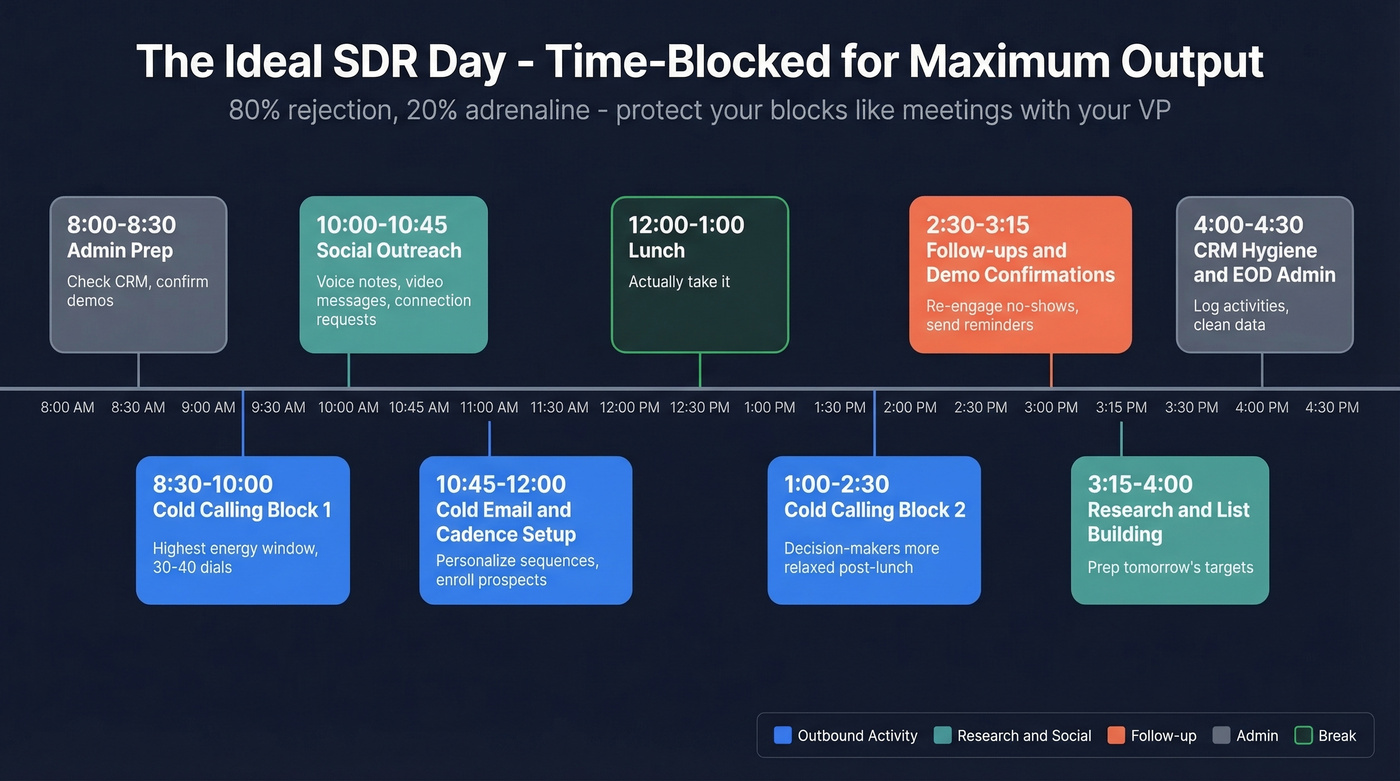
- 8:00-8:30 - Admin prep. Check CRM for overnight inbound leads, confirm today's demos. The average company takes 42 hours to respond to an inbound lead. Only 7% respond within 5 minutes, but doing so lifts conversion by 400%.
- 8:30-10:00 - Cold calling block #1. Highest-energy window. Aim for 30-40 dials.
- 10:00-10:45 - Social outreach. Voice notes, video messages, connection requests. Most reps skip this; top performers protect it.
- 10:45-12:00 - Cold email and cadence setup. Personalize sequences, enroll new prospects, respond to replies.
- 12:00-1:00 - Lunch. Actually take it.
- 1:00-2:30 - Cold calling block #2. Decision-makers are often more relaxed post-lunch.
- 2:30-3:15 - Follow-ups and demo confirmations. Re-engage no-shows, send calendar reminders.
- 3:15-4:00 - Research and list building for tomorrow.
- 4:00-4:30 - CRM hygiene and EOD admin.
Context-switching kills productivity. Every time you bounce between calling and emailing, you lose momentum. Finish each block before moving on.
Core SDR Responsibilities
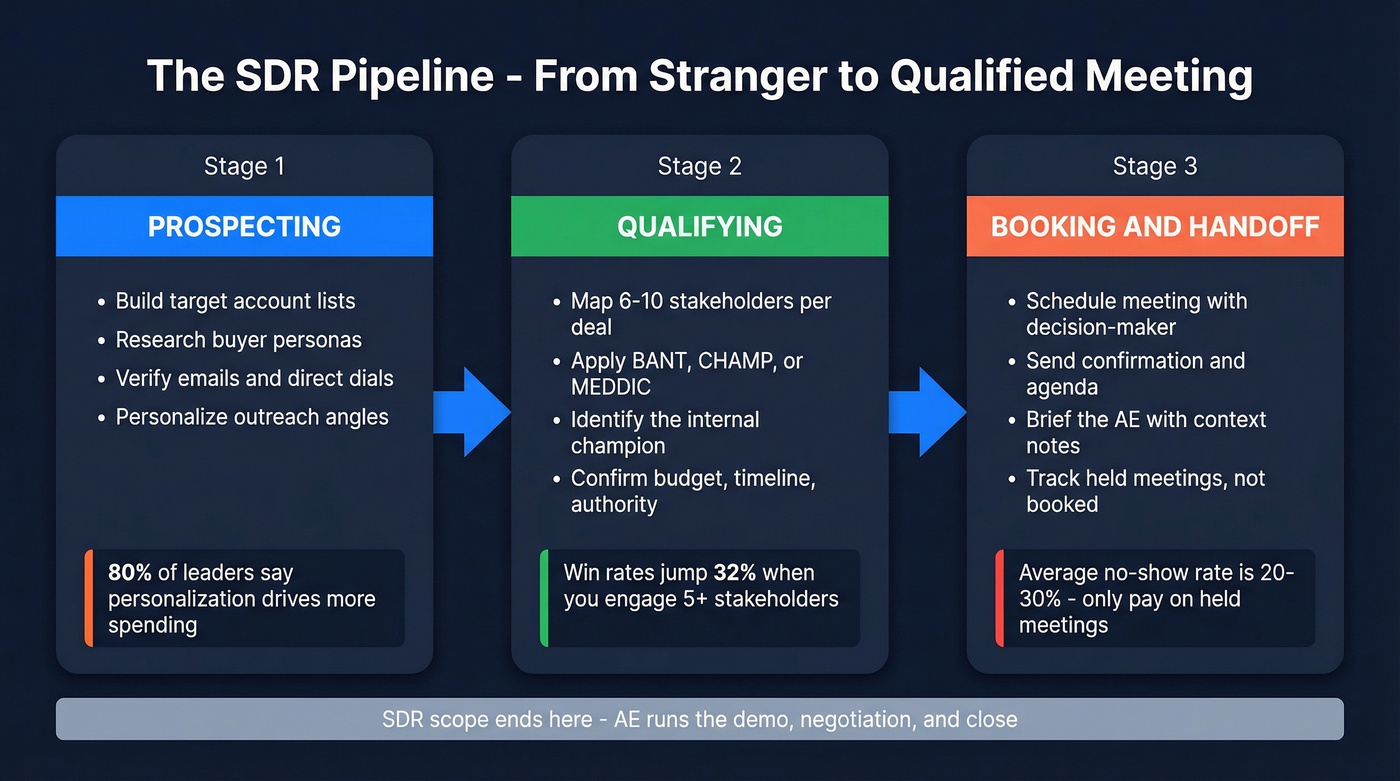
The job boils down to three things: prospecting, qualifying, and booking meetings with a clean handoff.
Prospecting
This means building a list of people worth talking to. Before any outreach, run through a quick checklist: Does this person match the buyer persona? Are they a decision-maker or an influencer? What tools does their company use? Skipping this step is how you end up sending 200 emails a day with a 0.3% reply rate.
Personalization matters. Almost 80% of business leaders say consumers spend more when their experience is personalized. We've seen this play out firsthand - a well-researched three-sentence email outperforms a generic five-paragraph pitch every single time. (If you want a system, start with these sales prospecting techniques.)
Qualifying
This is where frameworks earn their keep. Modern buying groups include 6-10+ stakeholders, so one of the most critical duties is mapping the decision landscape - not just asking "does this person have budget?" Win rates jump 32% when you engage five or more stakeholders.
| Framework | Best For |
|---|---|
| BANT (Budget, Authority, Need, Timeline) | SMB, inbound triage |
| CHAMP (Challenges, Authority, Money, Prioritization) | Consultative, mid-market |
| MEDDIC (Metrics, Economic Buyer, Decision Criteria/Process, Identify Pain, Champion) | Enterprise, high-ACV |
Start with BANT. Graduate to MEDDIC when your average deal crosses $50K. The "Champion" element is political - you need someone inside the account who'll fight for your deal when you're not in the room. (For deeper enterprise qualification, use MEDDIC sales qualification.)
Booking and Handoff
A meeting that no-shows isn't a meeting. The best teams pay on held meetings confirmed by the AE in the CRM. If your org pays on "meetings booked" regardless of whether they happen, push back. That incentive structure rewards calendar spam, not pipeline.

Bad data is why 43% of SDRs miss quota. When your connect rate drops below 5%, the problem isn't your script - it's your list. Prospeo delivers 98% email accuracy on a 7-day refresh cycle, so every dial and every send reaches a real person. At $0.01 per email, your list-building block shrinks from hours to minutes.
Stop burning call blocks on dead contacts. Build verified lists in minutes.
SDR KPIs and Benchmarks
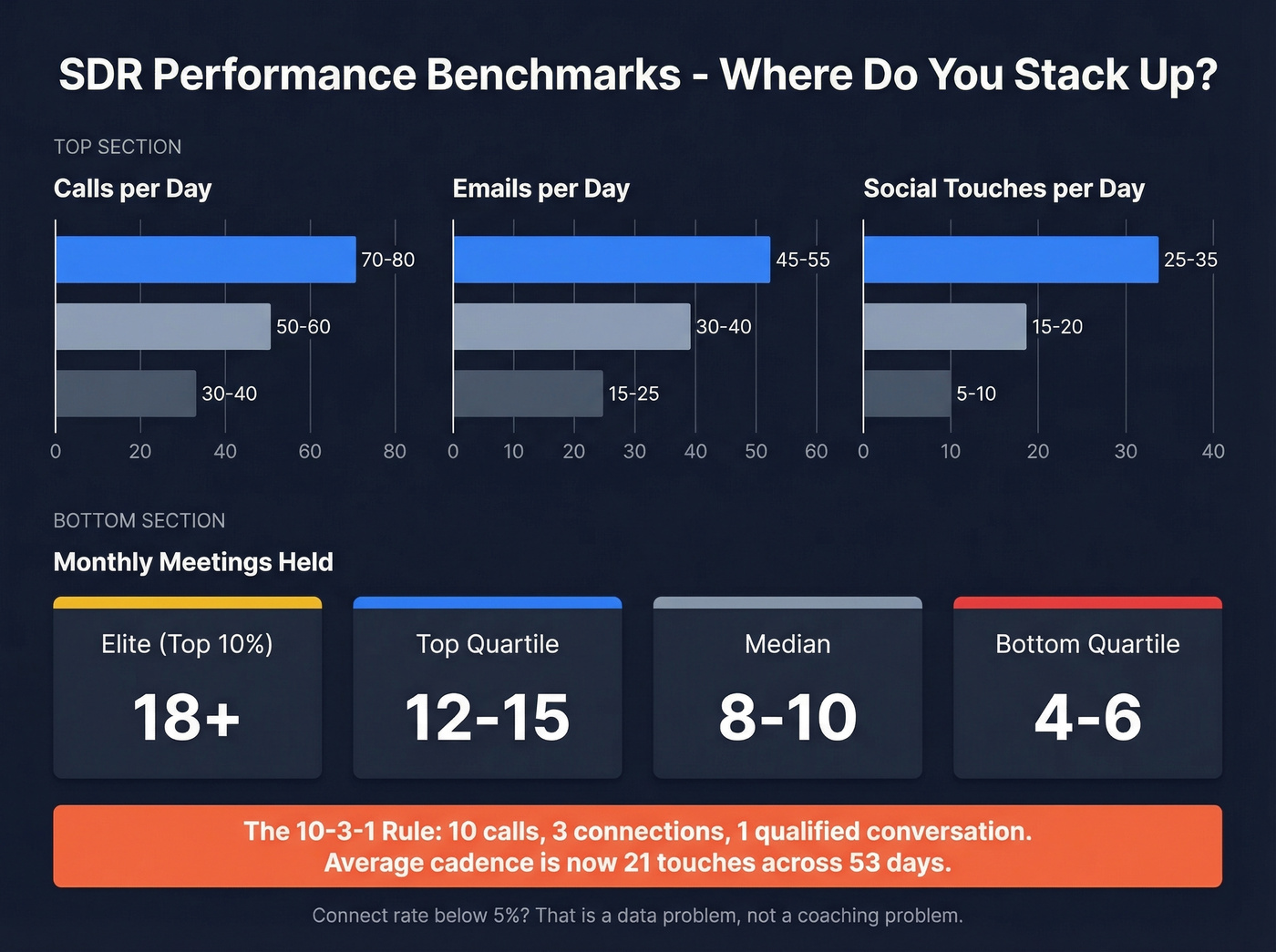
Here are the activity benchmarks by performance quartile:
| Metric | Top Quartile | Median | Bottom Quartile |
|---|---|---|---|
| Calls/day | 70-80 | 50-60 | 30-40 |
| Emails/day | 45-55 | 30-40 | 15-25 |
| Social touches/day | 25-35 | 15-20 | 5-10 |
The average cadence now runs 21 touches across 53 days - up from 17 - hitting roughly 9 contacts per account. Multi-touch converts 2-3x higher than single-channel. The 10-3-1 rule for phone prospecting still holds: 10 calls, 3 connections, 1 qualified conversation.
Monthly meeting tiers:
- Elite (top 10%): 18+
- Top quartile: 12-15
- Median: 8-10
- Bottom quartile: 4-6
The average no-show rate is 20-30%. If yours exceeds 15%, your meeting count is lying to you. Only 28% of sales teams have full visibility from prospecting to revenue, which is why most orgs over-index on activity metrics and miss what actually matters. (To track the right numbers, use these funnel metrics.)

Connect rate is the canary in the coal mine. Healthy: 8-12%. Below 5%, you don't have a coaching problem - you have a data problem. Before blaming your script, audit your data. Prospeo delivers 98% email accuracy on a 7-day refresh cycle, which directly impacts whether your dials and sends actually reach someone. (If you're seeing bounces, start with email bounce rate.)
Ramp expectations: Month 1 is 20-30% of quota. Month 2: 40-60%. Month 3: 70-90%. Full productivity by month 4. If your org expects 100% in month two, the quota is wrong, not the rep. (A practical onboarding template: 30-60-90 day plan for sales reps.)
Salary and Compensation
Median SDR base salary is $60,000. Median OTE is $85,000. Top performers pull $127,955. Remember: only 57.3% hit quota, so OTE is aspirational for nearly half the people in this role.
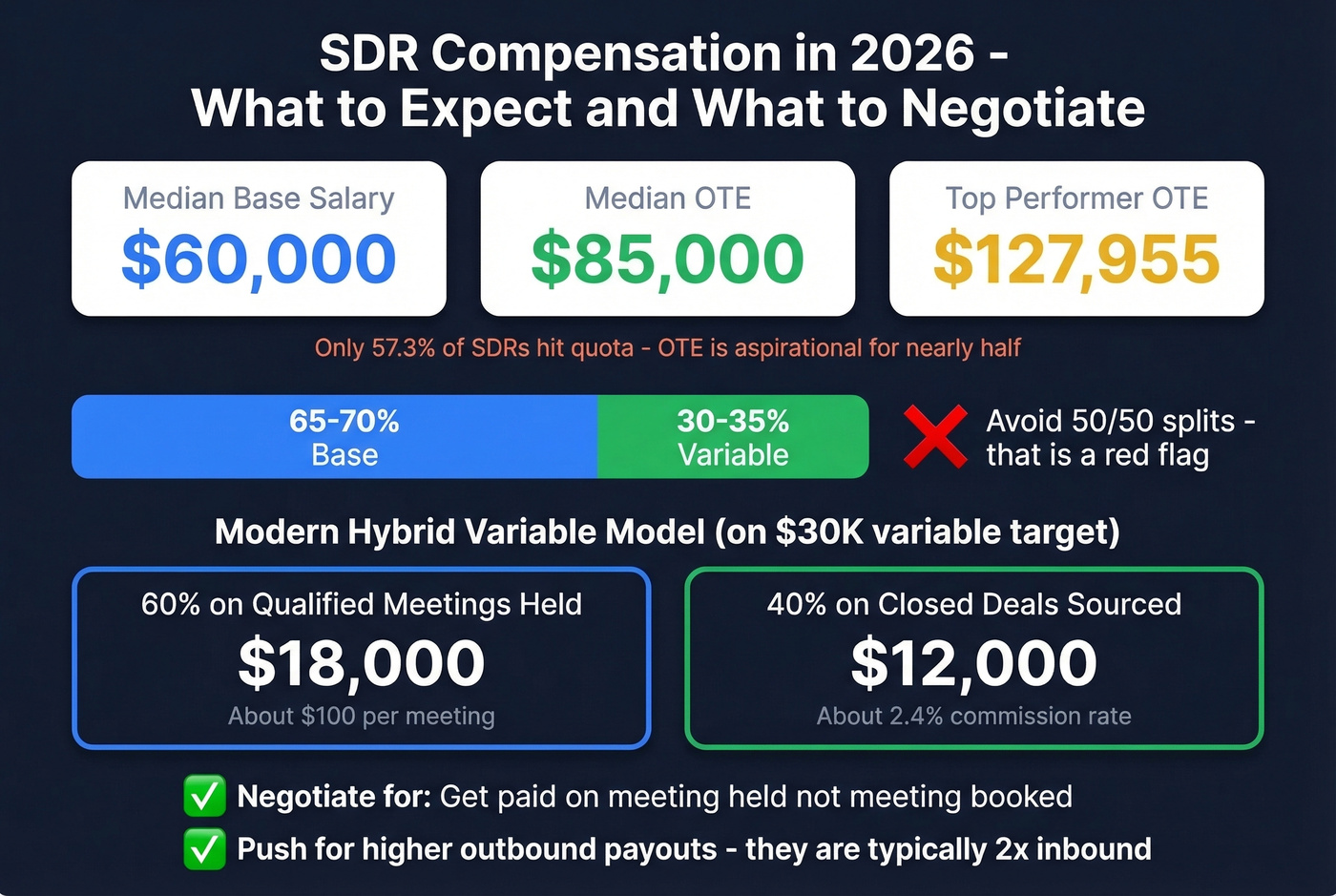
The standard pay split is 65/35 or 70/30 (base/variable). Skip any company offering 50/50 - that's a red flag for an org that doesn't understand sales development economics. You're not closing deals; your variable shouldn't swing like an AE's. (If you want the math, see OTE in sales.)
The modern hybrid model on a $30K variable target looks like this: 60% ($18K) pays on qualified meetings held at roughly $100 per meeting, and 40% ($12K) pays on closed deals you sourced at about a 2.4% commission rate. Two things to negotiate before you sign: get paid on "meeting held," not "meeting booked," and push for higher payouts on outbound meetings. They typically command 2x the payout of inbound because the effort is dramatically higher.
The SDR Tech Stack
The average sales development team uses 12-15 tools at $2,000-$5,000 per rep per month. That's why the consolidation trend is real - teams are choosing platforms that cover multiple categories instead of stitching together a dozen point solutions.
| Category | Example Tools | Price Range |
|---|---|---|
| CRM | HubSpot, Salesforce, Pipedrive | $25-$300/user/mo |
| Prospecting & Data | Prospeo, Apollo, ZoomInfo | $50-$500/user/mo |
| Sales Engagement | Lemlist, Instantly, Outreach | $30-$150/user/mo |
| Dialer | Orum, Aircall, Dialpad | $50-$200/user/mo |
| Scheduling | Calendly, Chili Piper | $10-$30/user/mo |
| Intent & Signals | Bombora, 6sense | $500-$5,000/mo |
| Conversation Intel | Gong, Chorus | $100-$200/user/mo |
If I were building a stack from scratch, I'd start with three tools: CRM (HubSpot's free plan works fine), a data provider for verified emails and direct dials, and a sequencer like Instantly or Lemlist. Everything else is optional until you're past five reps. (More options here: SDR tools.)
Let's be honest: if your average contract value is under $15K, you don't need a $30K/year data platform. Self-serve tools with transparent pricing will get you 90% of the way there at a fraction of the cost. Quotas also get set unrealistically when leadership hasn't lived the day-to-day of cold outreach - don't compound that problem by blowing your tool budget on enterprise software you'll never fully use.
The article says top SDRs spend 3:15-4:00 PM on research and list building. Prospeo's 30+ filters - buyer intent, technographics, headcount growth, job changes - let you build tomorrow's call list in 15 minutes instead of 45. That's 125M+ verified mobiles with a 30% pickup rate and 300M+ profiles ready to search.
Cut your research time by 70% and triple your connect rate.
AI and the SDR Role in 2026
AI agents can handle 3-5x more conversations than a human rep. On technical questions, AI answers immediately 87% of the time versus 15% for humans. Time to technical qualification drops from 8.3 days to 2.1 days.
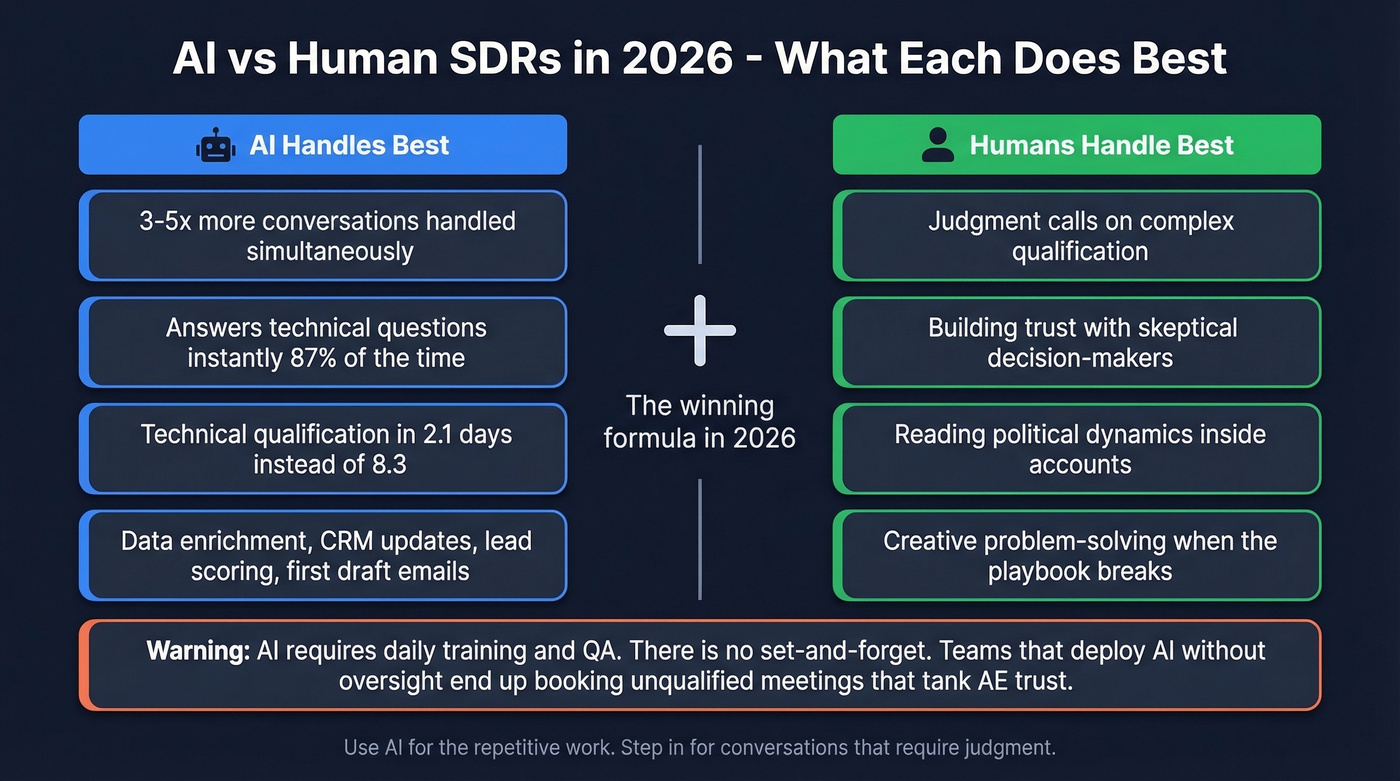
But here's what the hype cycle misses: AI requires daily training and QA. There's no set-and-forget. We've watched teams deploy AI agents, celebrate the volume spike for two weeks, then realize the "meetings" being booked are unqualified garbage that wastes AE time and tanks AE trust in the SDR function.
The reps who survive use AI to handle the repetitive work - research, first drafts, initial replies - and step in for the conversations that require judgment. Non-selling tasks like data enrichment, CRM updates, and lead scoring are exactly where automation delivers the biggest time savings. The role isn't disappearing, but the floor for what "good" looks like is rising fast. (If you're building workflows, start with generative AI lead generation.)
Career Path After SDR
The sales development representative role is a launchpad, not a destination. Experience required at hire has dropped to about 1 year, down from 2.5 in 2010.
| Path | Timeline | What It Takes | OTE |
|---|---|---|---|
| SDR to AE | 12-18 months | 90%+ quota, 2 straight quarters | $120K-$180K |
| SDR to CSM | 15-20 months | Relationship skills, retention mindset | $80K-$110K |
| SDR to RevOps | 18-24 months | Analytical bent, CRM/data fluency | $90K-$130K |
The AE path is the default, but not the only one. If you love building sequences, optimizing cadences, and analyzing conversion data, RevOps is a better fit than carrying a quota for the next decade. CSM works if you're energized by long-term relationships rather than net-new hunting. (If you're considering the ops track, start with RevOps manager.)
One scenario we see often: an SDR who's great at process but average at cold calling pivots to RevOps and immediately becomes the most valuable person on the team. The consensus on r/sales is that RevOps is the most underrated exit from the SDR seat, and we'd agree.
FAQ
What does an SDR do all day?
Time-blocked prospecting: 2-3 hours of cold calls, 1-2 hours of email and social outreach, plus research, CRM updates, and follow-ups. Top quartile reps make 70-80 dials and send 45-55 emails daily. See the daily schedule above for a full breakdown.
How are SDRs different from AEs?
SDRs own the top of the funnel - prospecting, qualifying, and booking meetings. AEs take over from there, running demos, handling objections, and closing deals. The handoff point is the held meeting; everything before it is the SDR's domain.
Is being an SDR stressful?
Yes. Rejection is constant and only 57.3% hit quota. But clear KPIs and a 12-18 month promotion timeline make it a short-term grind with a defined exit. Time-blocking and strong data quality reduce wasted effort significantly.
Do SDRs make good money?
Median OTE is $85K, top performers earn $127,955+. The 65/35 base/variable split means a significant chunk depends on hitting targets. It's solid entry-level tech comp with a clear path to six figures as an AE.