

What Is a B2B Marketing Funnel? Stages, Benchmarks, and Realities Nobody Else Covers
86% of B2B purchases stall. Not "face challenges." They stall - and 81% of buyers end up dissatisfied with the vendor they chose anyway. If you're asking what a B2B marketing funnel actually is and whether yours reflects how buyers behave in 2026, you're asking the right question.
Here's how to build one grounded in real numbers.
Quick version: A B2B marketing funnel maps how companies move from stranger to customer across three core stages - top of funnel (TOFU), middle of funnel (MOFU), and bottom of funnel (BOFU) - but modern buyers don't move through them linearly. 75% prefer rep-free research. They loop, skip stages, and consume content in channels your attribution can't see. Jump to the benchmark section for industry-specific conversion rates, or head to the dark funnel section if your attribution dashboard already looks suspicious.
B2B Marketing Funnel Defined
A B2B marketing funnel is a framework that maps the journey a business buyer takes from first hearing about your company to becoming a qualified lead your sales team can close. It aligns your messaging, content, and channels to each stage of that journey so you're not pitching a demo to someone who doesn't know they have a problem yet.
The concept traces back to E. St. Elmo Lewis in 1898 with the AIDA model: Attention, Interest, Desire, Action). Over a century later, the core logic hasn't changed much. What's changed is the complexity of the buying process and the sheer number of channels involved.
The marketing funnel specifically covers awareness through lead capture. Once a prospect raises their hand - fills out a form, requests pricing, books a demo - they enter the sales funnel. The marketing funnel's job is to get them to that hand-raise moment with the right context and intent.
B2B vs. B2C: Structural Differences
If you've only worked in B2C, B2B funnels will feel painfully slow. The differences aren't subtle.
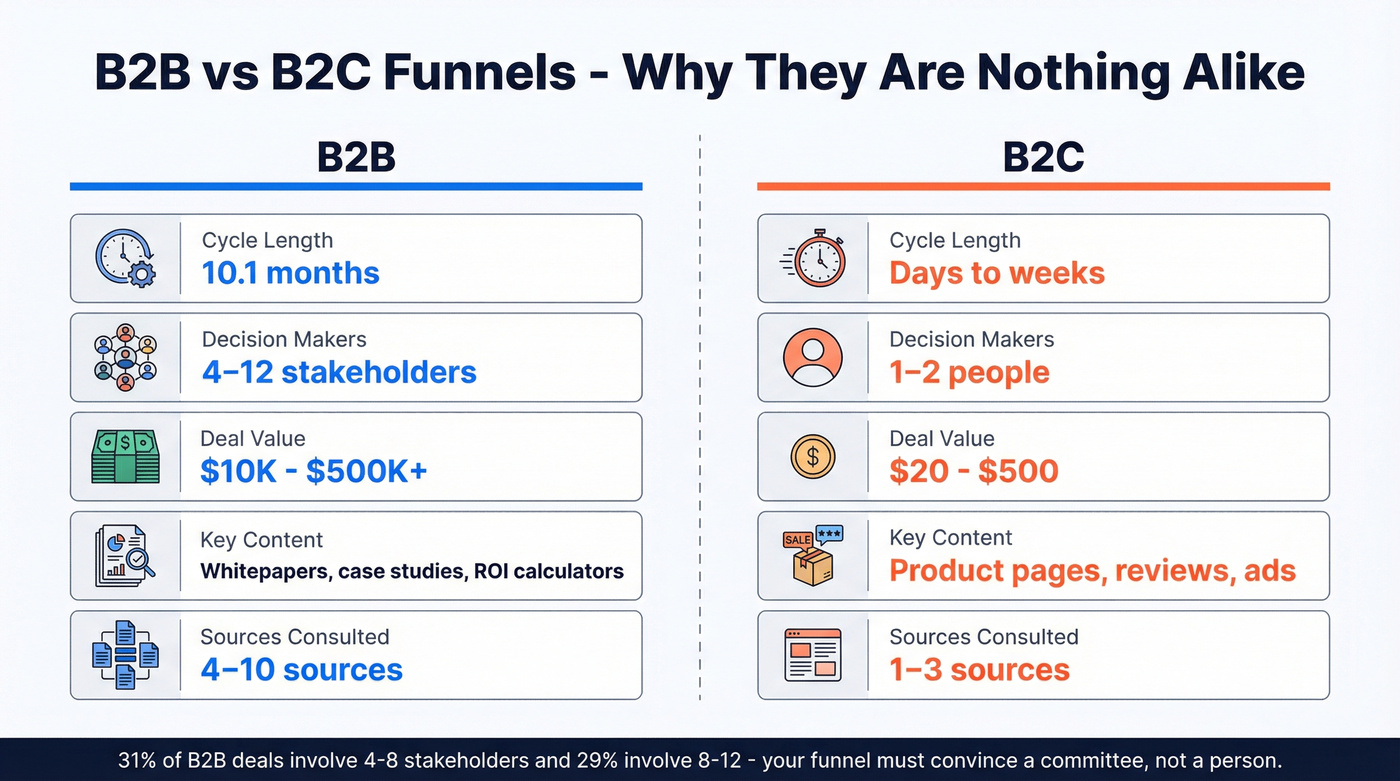
| Dimension | B2B | B2C |
|---|---|---|
| Avg cycle length | 10.1 months | Days to weeks |
| Decision-makers | 4-12 stakeholders | 1-2 people |
| Avg deal value | $10K-$500K+ | $20-$500 |
| Primary content | Whitepapers, case studies, ROI calculators | Product pages, reviews, ads |
| Research behavior | 4-10 sources consulted | 1-3 sources |
The committee dynamic alone changes everything. 31% of B2B purchases involve 4-8 stakeholders, and 29% involve 8-12. Your funnel isn't convincing one person - it's convincing a group where 42% consult 4-6 sources and 35% review 7-10.
Each stakeholder plays a different role. The champion pushes the deal internally. The economic buyer controls budget. The technical evaluator stress-tests your product against requirements. And the blocker - often someone in procurement or legal - looks for reasons to say no. Your content needs to serve all four simultaneously, which is why single-persona funnels fail in B2B. A case study that wins over your champion is irrelevant to the economic buyer who needs an ROI model. This is also why the B2B customer acquisition funnel looks nothing like a B2C checkout flow - you're managing consensus, not impulse.
Why the Funnel Is a Useful Lie
Nobody actually moves through a funnel in a straight line. Gartner's research shows buyers engage in "looping" across six buying jobs, revisiting stages they've supposedly completed. They read your case study, go dark for three weeks, show up on a competitor's webinar, then come back and request a demo.
Let's be honest: ask any B2B marketer on r/sales or r/marketing whether their funnel works as designed and you'll get a chorus of "not really."
The numbers tell the story. 75% of B2B buyers prefer a rep-free experience. Buyers define purchase requirements 83% of the time before talking to sales. First contact has moved from 69% to 61% of the journey - roughly six to seven weeks earlier in the buying process. And 49% of buyers say economic pressures have shortened their cycles, with 62% engaging sellers earlier than they would have a year ago.
But here's the counterpoint: buyers who use supplier digital tools in partnership with a sales rep are 1.8x more likely to complete a high-quality deal. The funnel isn't dead. It just isn't a pipeline anymore. It's a living system that adapts to every account in real time.
So why keep using it? Because you need an operational framework to measure what's working. The funnel is imperfect, but it's the best mental model we have for allocating budget, creating content, and diagnosing where pipeline leaks. Don't mistake the map for the territory.
B2B Marketing Funnel Stages
The 3-Stage Model (TOFU / MOFU / BOFU)
Start here. Three stages is enough for most teams to organize their content and measure what matters.
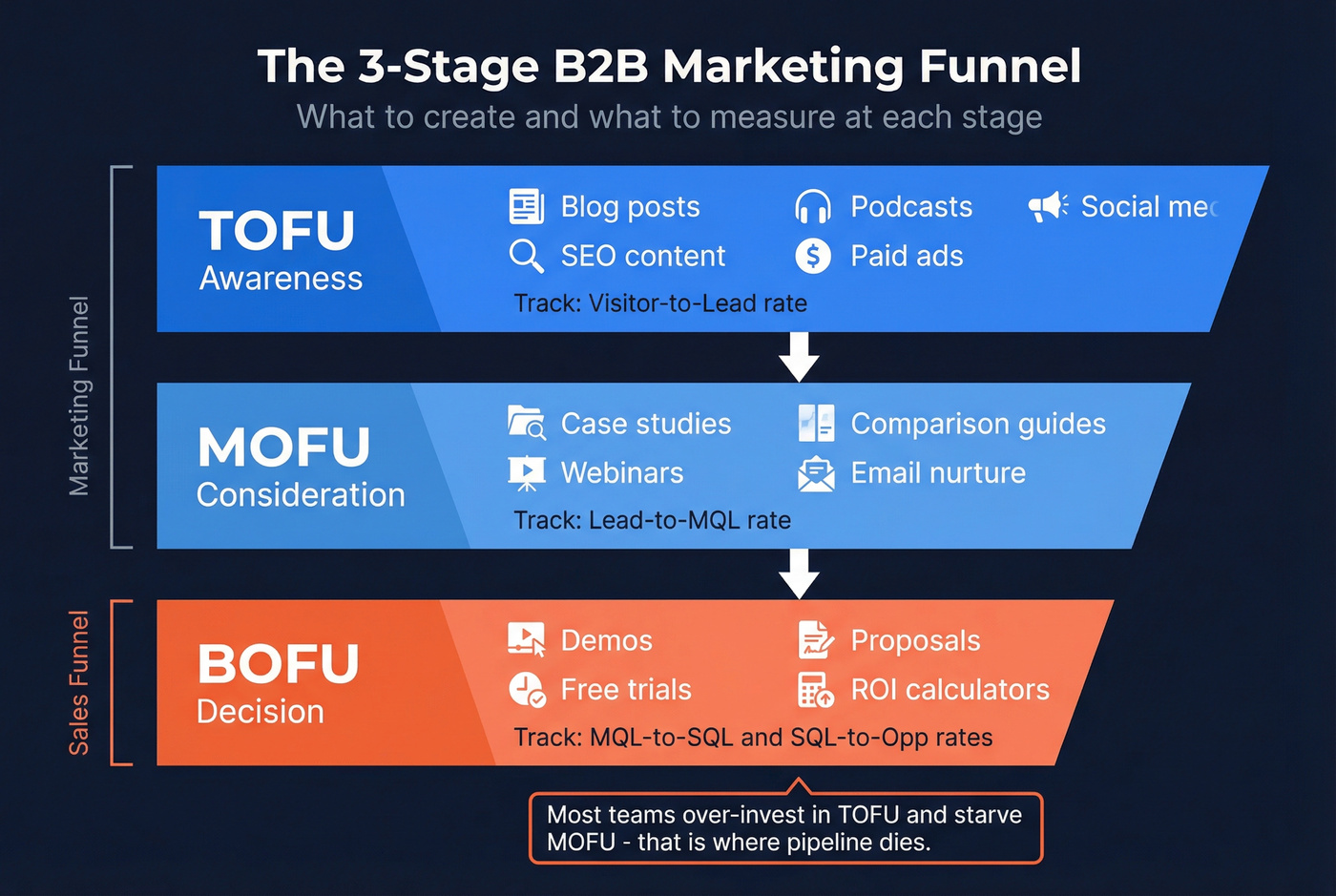
Top of Funnel (TOFU) - Awareness. Blog posts, SEO content, social media, podcasts, and paid ads. The goal is getting on the buyer's radar. Track your visitor-to-lead conversion rate.
Middle of Funnel (MOFU) - Consideration. Case studies, webinars, comparison guides, and email nurture sequences. The goal is building trust and educating on your solution. Track your lead-to-MQL rate.
Bottom of Funnel (BOFU) - Decision. Demos, free trials, proposals, ROI calculators, and customer references. The goal is converting qualified leads into pipeline. Track MQL-to-SQL and SQL-to-opportunity rates.
The mistake most teams make is over-investing in TOFU content and starving MOFU. You end up with traffic that never converts because there's nothing bridging "I've heard of you" to "I trust you enough to talk to sales." We've seen this pattern kill pipeline at companies with 100K+ monthly visitors - tons of awareness, zero middle-funnel content, and a sales team complaining about lead quality.
The 7-Stage Progressive Model
Once you're generating consistent pipeline, expand to seven stages. This adds post-purchase stages that matter for retention and expansion revenue:
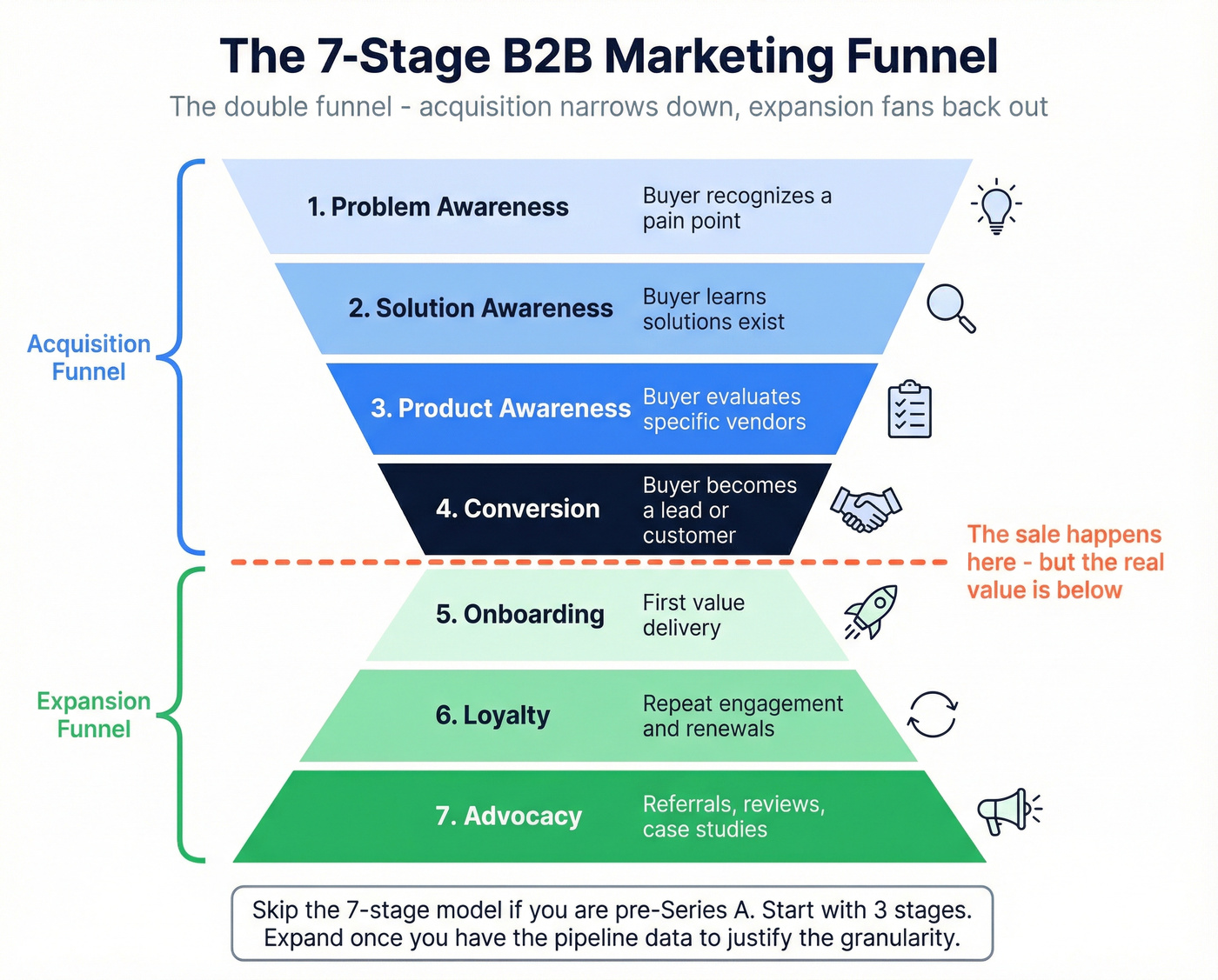
- Problem Awareness - buyer recognizes a pain point
- Solution Awareness - buyer learns solutions exist
- Product Awareness - buyer evaluates specific vendors
- Conversion - buyer becomes a lead or customer
- Onboarding - first-value delivery
- Loyalty - repeat engagement and renewals
- Advocacy - referrals, reviews, case studies
In SaaS, the sale happens in the middle - retention is the real bottom of the funnel. Expansion revenue from existing customers is cheaper than new logos, and the companies winning in 2026 spend as much energy on stages 5-7 as they do on 1-3. That's the logic behind the double funnel approach: one funnel drives acquisition, a mirrored funnel drives expansion and advocacy.
Skip the 7-stage model if you're pre-Series A. You don't have enough volume to optimize that many stages meaningfully. Start with three. Expand once you have the pipeline data to justify the granularity.
Marketing Funnel vs. Sales Funnel
Use "marketing funnel" when you're talking about awareness through lead capture - the journey from stranger to hand-raiser. Your marketing team owns this.
Use "sales funnel" when the prospect has raised their hand and provided information. Sales owns qualification, proposals, and close.
The handoff happens at the MQL-to-SQL transition. Three tactics make this cleaner: custom form questions that reveal budget and timeline, analyzing whether the lead came from branded vs. non-branded keywords, and dual-CTA landing pages that let prospects self-select ("Talk to sales" vs. "Download the guide").

Your MOFU is starving because your contact data is wrong. 86% of B2B deals stall - bad emails and dead phone numbers make it worse. Prospeo delivers 98% verified emails and 125M+ direct dials so your nurture sequences actually reach the 4-12 stakeholders killing your deals.
Stop losing pipeline to bounced emails. Fix your funnel's data layer today.
Funnel Benchmarks You Can Actually Use
Every funnel guide tells you to "track conversion rates." None tell you what those rates should be.
Visitor-to-Lead Rates by Industry
These come from First Page Sage's dataset, based on client data collected January 2022 through August 2025 across 25 industries.
| Industry | Avg Conversion Rate |
|---|---|
| B2B SaaS | 1.1% |
| Financial Services | 1.9% |
| Business Consulting | 1.4% |
| Commercial Insurance | 1.7% |
| IT & Managed Services | 1.5% |
| Legal Services | 7.4% |
| Manufacturing | 2.1% |
| Medical Device | 1.5% |
| Cybersecurity | 1.5% |
| Real Estate | 2.8% |
Typical visitor-to-lead rates run 0.8-2.5%, with top performers hitting 3-5%. If you're a B2B SaaS company at 1.1%, you're average. Below 0.8%? Something's broken - likely your offer, your targeting, or your page speed.
Stage-to-Stage Conversion Rates
This is where it gets operational. First Page Sage defines the stages clearly: a Lead is any non-spam contact without clear buying intent. An MQL has expressed buying interest and can afford your product. An SQL has received pricing and wants to continue. Closed Won means a signed contract.
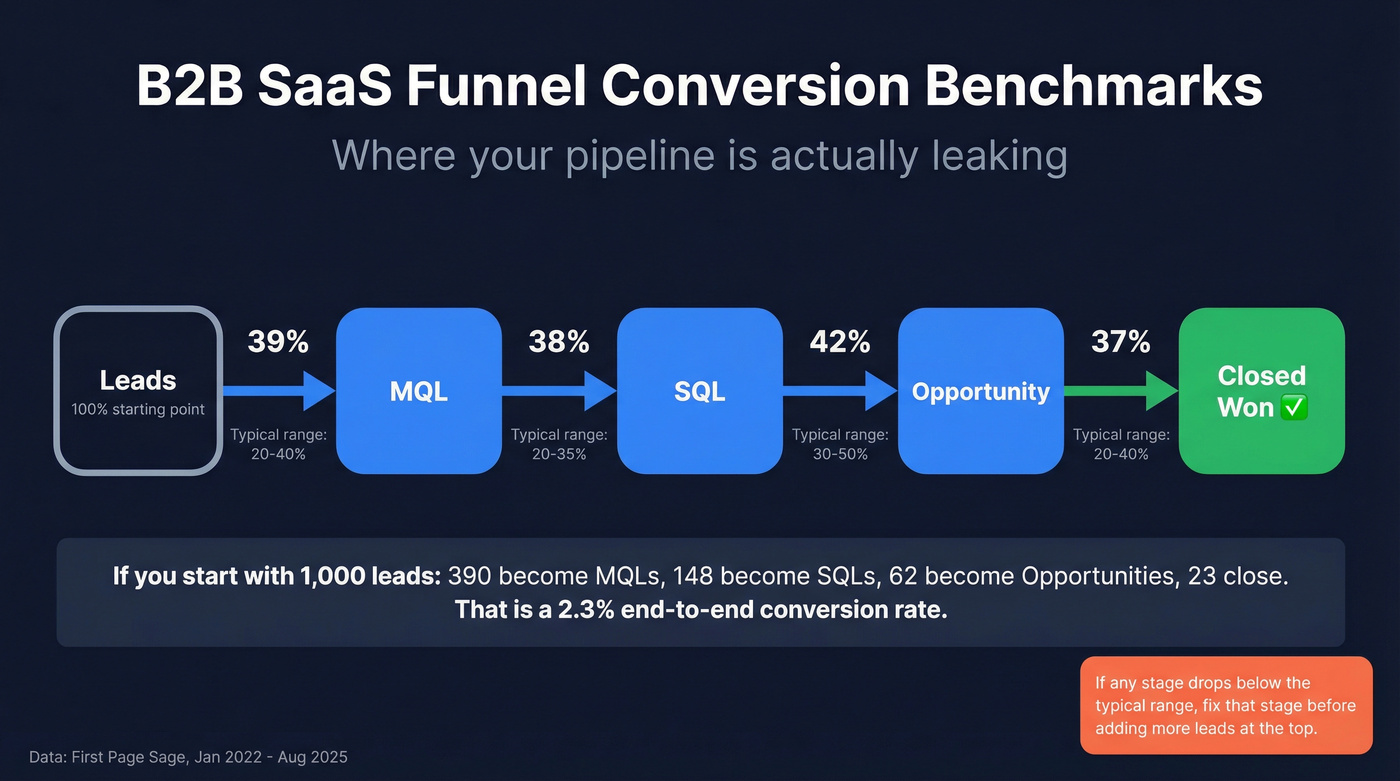
| Stage Transition | B2B SaaS Benchmark | Typical Range |
|---|---|---|
| Lead to MQL | 39% | 20-40% |
| MQL to SQL | 38% | 20-35% |
| SQL to Opportunity | 42% | 30-50% |
| SQL to Closed Won | 37% | 20-40% |
We've seen teams obsess over top-of-funnel volume when their real problem is a 15% MQL-to-SQL rate. If your numbers fall significantly below these ranges at any stage, that's where to focus - not on generating more leads that'll leak out at the same broken point. For a deeper KPI list, use this funnel metrics breakdown.
The Dark Funnel: Why Your Attribution Is Lying
You're staring at your attribution dashboard and 73% of closed-won deals show "direct traffic" as the source. Opportunities appear from nowhere. Your CEO asks which channel is working and you don't have a real answer.
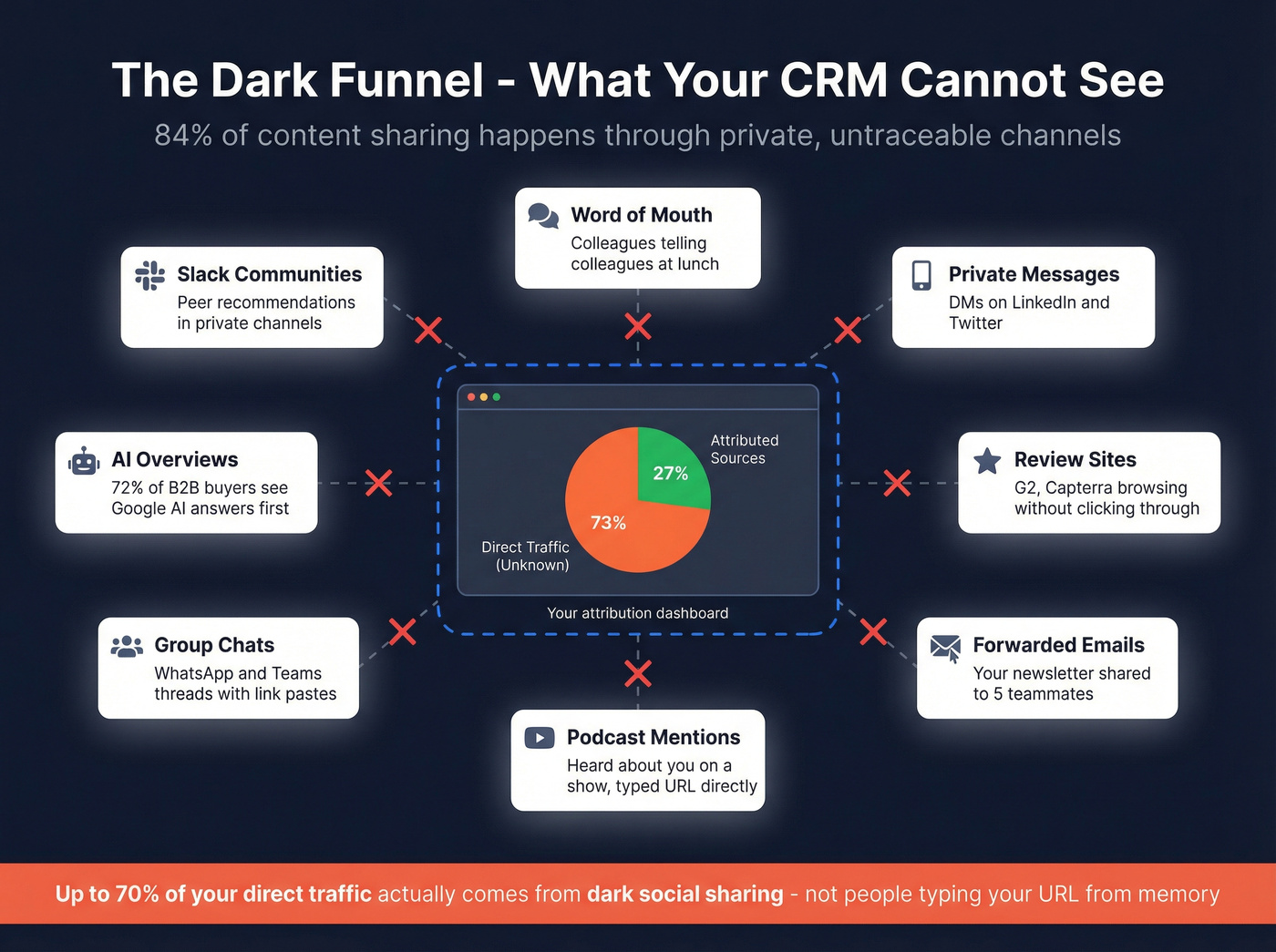
That's the dark funnel - buyer activities your CRM can't capture: private messaging, Slack communities, word-of-mouth, third-party review research, passive content consumption. About 84% of content sharing happens via private, untraceable channels. Parse.ly found that up to 70% of "direct" traffic actually originates from dark social sharing - people copying links, forwarding in email, sharing in group chats. And with 72% of B2B buyers encountering Google AI Overviews in search results, attribution is getting murkier, not clearer.
Four symptoms you have a dark funnel problem:
- 80%+ of deals attributed to "direct traffic"
- Opportunities that appear with no prior marketing touches
- Prospects who seem "already educated" on the first sales call
- Pipeline that doesn't correlate with campaign spend
The fix isn't better tracking - it's hybrid attribution. Multi-touch models surface 2.7x more touchpoints per conversion than last-click approaches. Combine quantitative tracking with qualitative self-reported data ("How did you hear about us?" on every form), account-level intelligence from intent data, and honest acceptance that you'll never see the full picture. In our experience, the self-reported field alone has been the single most valuable attribution input for teams that actually use it.
How to Build Your Funnel
Pick the Right Model for Your Stage
Early-stage (pre-PMF to Series A): Use the simple 3-stage model. Focus on acquisition and product-market fit. You don't have enough volume to optimize mid-funnel stages meaningfully.
Growth-stage (Series B+): Add mid-funnel qualification and lead scoring. This is where MQL/SQL definitions and handoff processes start mattering - you've got enough data to see where the funnel leaks. Teams at this stage often benefit from configuring lifecycle stages and automated workflows in HubSpot, where lead scoring can be set up without custom development.
Mature (established revenue, expansion focus): Shift emphasis toward retention, loyalty, and advocacy. Your funnel should extend through onboarding and renewal because expansion revenue is significantly cheaper than acquiring new logos.
Fill the Top with Accurate Data
Here's the thing: your funnel is only as good as the data feeding it. The #1 reason funnels leak at the top isn't bad content or weak offers - it's stale, inaccurate contact data that bounces, wastes rep time, and poisons your deliverability.
Prospeo addresses this with a database of 300M+ professional profiles, 30+ search filters including buyer intent signals across 15,000 topics powered by Bombora, and email accuracy at 98% on a 7-day refresh cycle versus the 6-week industry average. That freshness gap matters more than most teams realize. Snyk's 50-person AE team switched and dropped their bounce rate from 35-40% to under 5%, with AE-sourced pipeline jumping 180% and generating 200+ new opportunities per month. When your top-of-funnel data is clean, every downstream conversion rate improves. If you're evaluating vendors, compare options in these data enrichment services and B2B company data providers roundups.

Set Up Tracking and Templates
You don't need a $50K BI stack to track your funnel. Start with a spreadsheet. Salesflare offers a free funnel template with customizable stages, deal fields, and an auto-updating insights tab that shows forecasts and conversion rates. For teams ready for dashboards, ZebraBi's Power BI template tracks web sessions through leads, opportunities, and revenue with actuals vs. forecast comparison.
At minimum, track five metrics weekly: visitor-to-lead rate, lead-to-MQL, MQL-to-SQL, SQL-to-opportunity, and opportunity-to-close. Pipeline velocity - average days per stage - is the sixth metric that separates good RevOps from guesswork. If you're seeing leakage, this guide on sales pipeline challenges helps you diagnose the usual failure points.
Strategies That Move Pipeline
You don't need ten tools. You need the right ones in three categories and the right strategies connecting them.
CRM: HubSpot offers a free CRM that works well for early-stage teams. Salesforce (typically ~$25-$330/user/month depending on edition) is the default once you need more customization and reporting depth. If you're standardizing your stack, start with this list of examples of a CRM.
Data and enrichment: Bad data is the #1 funnel killer at the awareness-to-lead stage. Prospeo verifies emails in real time at 98% accuracy, includes Bombora intent data across 15,000 topics layered with job role and company growth signals, and starts free with 75 verified emails per month. You're not just building lists - you're building lists of accounts already researching your category. To improve deliverability while scaling outbound, use these email reputation tools.
Attribution: Don't buy a $40K attribution platform before you've added "How did you hear about us?" to every form. Hybrid attribution - quantitative tracking plus qualitative self-reported data plus account-level intent - is the only approach that accounts for the dark funnel.
Building a funnel that converts committees of 4-12 stakeholders? You need every decision-maker's real contact info - not generic role@ addresses. Prospeo's 30+ filters let you target by buyer intent, job changes, and department headcount so your BOFU content hits the right people.
Find every stakeholder in the buying committee for $0.01 per email.
FAQ
How many stages should a B2B marketing funnel have?
Start with three: TOFU (awareness), MOFU (consideration), BOFU (decision). Expand to seven - adding onboarding, loyalty, and advocacy - once you have consistent pipeline and need to optimize retention. Most teams under $5M ARR don't need more than three.
What's a good B2B conversion rate?
Visitor-to-lead averages 0.8-2.5% across B2B industries, with top performers hitting 3-5%. Lead-to-MQL runs 20-40%, and MQL-to-SQL sits around 20-35%. Check the benchmark tables above for industry-specific numbers.
Is the B2B marketing funnel dead?
No - but it's an imperfect model. Buyers loop, skip stages, and research in channels your attribution can't see. The funnel remains the best operational framework for measuring and improving pipeline. The map isn't the territory, but you still need a map.
How do I fill the top of my funnel with quality leads?
Combine inbound content (SEO, webinars, social) with outbound using verified contact data. Layer intent signals on firmographic criteria to prioritize accounts actively researching your category, then feed those contacts into nurture sequences matched to their funnel stage.