

What Is a Company Identifier? Every Type Explained
Someone from HR sends you a "company ID number" and you have no idea which number they mean. So what is a company identifier, exactly? It's any standardized code used to uniquely recognize a legal entity - or, in finance, the entity behind a security - across a specific system.
The confusion is real, and it's worse than you think. CDQ's managed reference dataset catalogs 522 distinct business identifier types across global jurisdictions. In our experience, most mix-ups happen because people lump tax IDs, registration numbers, and vendor IDs into one bucket. They're not interchangeable, and using the wrong one wastes days.
The Five You Actually Need (U.S.)
If you're a U.S.-based business, these five identifiers cover most of what you'll encounter:
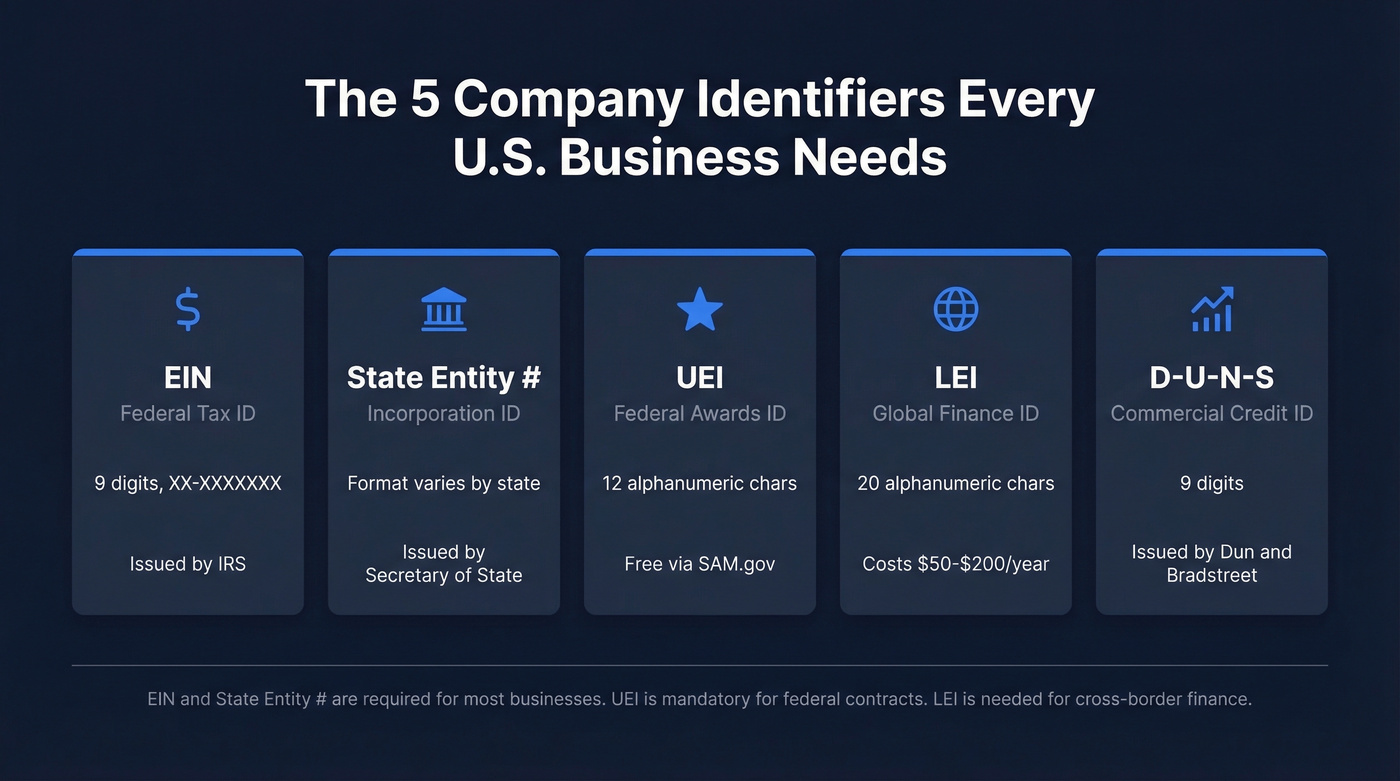
- EIN - Your federal tax ID. Used for payroll and most federal tax filings, and commonly required for business bank accounts.
- State Entity Number - Assigned at incorporation by your Secretary of State. Proves you legally exist in that jurisdiction.
- UEI - Required for federal grants and contracts. Replaced D-U-N-S in April 2022. Free via SAM.gov.
- LEI - Used for cross-border financial transactions and regulatory filings. Renewed annually, typically ~$50-$200/year depending on the LOU.
- D-U-N-S - Still used for commercial credit reports and some private-sector vendor onboarding. Assigned by Dun & Bradstreet.
Master Reference Table
Here's a quick-reference table for the identifiers you're most likely to encounter - worth bookmarking if you deal with onboarding, compliance, finance, or vendor management.
| Identifier | Format | Issuing Authority | Where to Look It Up |
|---|---|---|---|
| EIN | 9 digits (XX-XXXXXXX) | IRS | IRS.gov (EIN application / confirmation via 147C) |
| LEI | 20 alphanumeric | GLEIF-accredited LOUs | gleif.org |
| UEI | 12 alphanumeric | SAM.gov | sam.gov |
| D-U-N-S | 9 digits | Dun & Bradstreet | dnb.com |
| CIK | Up to 10 digits (leading zeros) | SEC | EDGAR (sec.gov) |
| CUSIP | 9 characters | CUSIP Global Services | Financial data vendors |
| ISIN | 12 chars (2-letter prefix) | National numbering agencies | Financial data vendors |
| SEDOL | 7 characters | London Stock Exchange | Financial data vendors |
| State Entity # | Varies by state | Secretary of State | State SOS website |
Types of Company Identifiers
Government & Tax Identifiers
Think of your EIN as your business's Social Security number. It's a unique 9-digit number formatted XX-XXXXXXX, assigned by the IRS, and you'll use it for tax reporting, opening business bank accounts, and running payroll. The IRS online application is free and usually issues the number immediately.
EIN falls under the broader "TIN" (Taxpayer Identification Number) umbrella, which also includes SSNs for sole proprietors and ITINs for non-residents. Not every business must have an EIN - a sole proprietor with no employees can use their SSN - but most businesses with employees, partnerships, or corporate structures need one. Even sole proprietors often get an EIN just to keep their SSN off business documents.
State entity numbers are a separate animal entirely. Your Secretary of State assigns one when you incorporate or register a foreign entity. The format varies by jurisdiction, and you'll need it for annual reports, amendments, and state-level filings. Don't confuse it with your EIN: they live in different systems and solve different problems.
UEI - The Federal Awards Identifier
On April 4, 2022, the federal government stopped using D-U-N-S numbers to identify entities for awards. The replacement is the Unique Entity Identifier, a 12-character alphanumeric code created and managed through SAM.gov.
UEI registration is completely free. The identifier itself doesn't expire, even if your SAM registration goes inactive. You need a physical address (no P.O. Boxes), and you must be a separate legal entity. If you're pursuing federal grants, contracts, or subcontracting opportunities, UEI is non-negotiable.
One warning that saves people real money: GSA doesn't contact organizations directly to "help" with UEI registration. If you get unsolicited calls or emails about your UEI, treat them as scams and go straight to SAM.gov.
Global & International Identifiers
The Legal Entity Identifier functions as a global business ID used across financial markets. It's a 20-character alphanumeric code governed by ISO 17442, used for cross-border financial transactions, derivatives reporting, and regulatory filings. LEIs aren't free to maintain - expect ~$50-$200/year for renewal, depending on your Local Operating Unit.
Regulators are pushing harder on identifier consistency. The SEC has explored expanding LEI usage in U.S. markets, and in the EU, CSRD reporting is forcing companies and data providers to map entities cleanly across registrations, subsidiaries, and group structures. If you work in finance, risk, or ESG reporting, getting your LEI house in order now pays off later. Reliable B2B identity data - knowing exactly which legal entity sits behind every record - is what makes that mapping possible at scale.
Outside the LEI, every country has its own naming convention for business tax identifiers. Here are the ones you'll run into most often:
| Country | Identifier Name | Notes |
|---|---|---|
| UK | UTR + VAT Number | UTR for corp tax; VAT for returns |
| France | SIREN -> VAT | "FR" prefix + control key |
| Germany | USt-IdNr | Starts with "DE" |
| Denmark | CVR | Prefixed "DK" for VAT |
| Norway | Organisasjonsnummer | Suffixed "MVA" for VAT |
| Switzerland | UID | Unified across cantons |
| Poland | NIP | Used for VAT and tax |
The UK's Companies House company number is another common one - it's the registration number assigned at incorporation, separate from the tax identifiers above.
Financial Market Identifiers
Here's the thing: stock tickers are terrible identifiers. They change, they get reused, and companies can have multiple tickers across exchanges. We've seen analysts burn hours trying to match entities across datasets with tickers, only to end up with duplicate companies and broken joins. If you're doing serious financial data work, use a proper security identifier.
CUSIP is the standard for U.S. and Canadian securities - 9 characters, where the first 6 identify the issuing company. SEDOL covers UK securities with 7 characters. ISIN wraps both into a global 12-character format that starts with a two-letter country code: a U.S. ISIN embeds the CUSIP, a UK ISIN embeds the SEDOL.
For SEC filings, CIK is one of the cleanest anchors. It's stable, searchable, and built for tracking an issuer across EDGAR over time. If you do academic or market research, you'll also run into PERMNO (CRSP's 5-digit security identifier) and GVKEY (Compustat's 6-digit company key), both designed for longitudinal analysis where stability matters more than anything else.
Proprietary & Commercial Identifiers
D-U-N-S numbers still matter for commercial credit and private-sector vendor qualification, even though they've been replaced by UEI for federal awards. Beyond D-U-N-S, you'll encounter vendor-specific identifiers like Crunchbase IDs, Bloomberg IDs, Orbis IDs, and PitchBook IDs. These are proprietary, assigned by each platform, and not interchangeable.
One practical nuance: many platforms also use "soft identifiers" for matching - industry codes like NAICS/SIC, headcount bands, revenue ranges, and HQ location. They're not true IDs, but they're often the glue that helps resolve messy records when a hard identifier is missing. If you work with products and supply chains, you'll also see GS1 identifiers like GLNs. They aren't "company IDs" in the tax or corporate-registration sense, but they matter in procurement and logistics.
If you're trying to standardize records across tools, this is where data enrichment and lead enrichment workflows usually pay for themselves.

Matching company identifiers to the right legal entities is step one. Step two is reaching the people inside them. Prospeo maps 300M+ professionals across companies worldwide - with 30+ filters including technographics, headcount growth, and funding - so you go from entity ID to verified contact in seconds, not days.
Turn any company identifier into a pipeline of verified decision-maker contacts.
FinCEN Identifier & BOI Reporting (2026 Update)
If you've read anything about Beneficial Ownership Information reporting from 2024, most of it is outdated now. On March 21, 2025, FinCEN issued an interim final rule that removed BOI reporting requirements for U.S. companies and U.S. persons entirely.
The revised scope now only applies to foreign entities registered to do business in a U.S. state or tribal jurisdiction. Those foreign reporting companies must file within 30 days of the rule's publication date if registered before it, or within 30 calendar days of registration becoming effective if registered after.
The legal landscape is still shifting. On December 19, 2025, an Eleventh Circuit panel reversed a 2024 district court decision that had held the CTA unconstitutional, remanding for further proceedings. FinCEN intended to finalize the rule in 2025 but cited a lapse in appropriations as the reason for delay. As of early 2026, the final rule is still pending. If you're a domestic U.S. company, you don't need to file BOI. If you're a foreign entity registered in a U.S. state, check the current deadlines on FinCEN's site.
How to Find Any Company Identifier
Bookmark these and you'll stop losing time to "where do I find the ___ number?" searches:
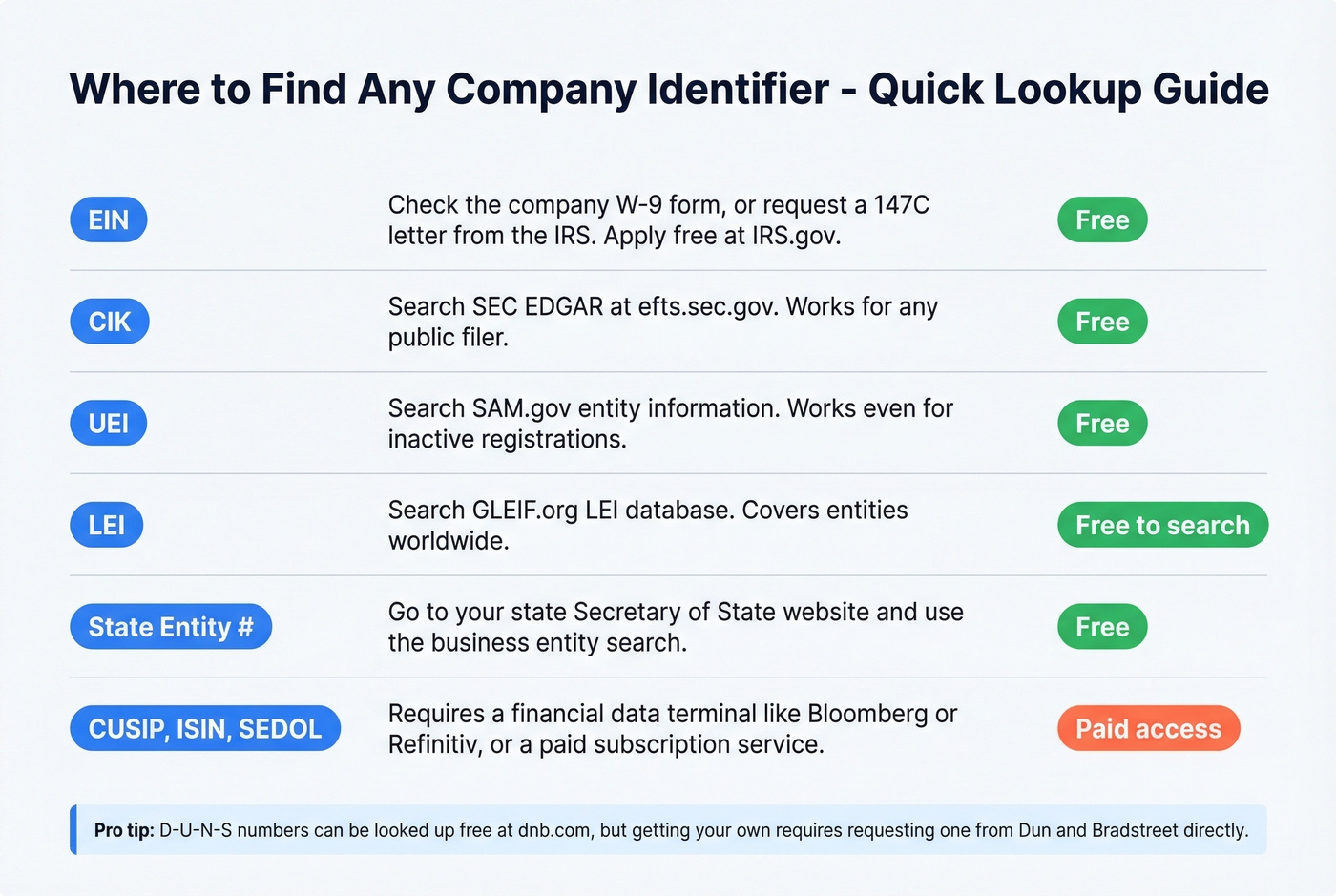
- EIN - The company's W-9, or the IRS EIN pages: IRS EIN application
- CIK - SEC EDGAR search: SEC EDGAR
- UEI - SAM.gov entity search (works even for inactive registrations)
- LEI - GLEIF LEI search (free, global)
- State Entity Number - Your state's Secretary of State business search (example: Delaware entity search)
- D-U-N-S - Dun & Bradstreet's lookup tool at dnb.com
For financial identifiers like CUSIP, ISIN, and SEDOL, you typically need a financial data terminal or a subscription service. CIK is the exception - free and searchable by anyone.
If you're doing this for onboarding, compliance, or outbound, it helps to document the process inside your CRM and keep a consistent lead status so identifiers don't get lost between teams.
From Company IDs to Verified Contacts
Company identifiers solve one problem: knowing exactly which entity you're dealing with. In B2B sales and outreach, the harder part is reaching the right person inside that entity. Strong data connections between a verified company record and the people who work there are what turn a clean entity match into a real pipeline opportunity.
Prospeo bridges that gap with 300M+ professional profiles, 143M+ verified emails, and 125M+ verified mobile numbers. Search by company, filter by role and seniority, and export verified emails with 98% accuracy and direct dials - all refreshed every 7 days so you're not building campaigns on stale data.
If you're building lists at scale, pair this with an Ideal Customer Profile and a repeatable lead generation workflow.
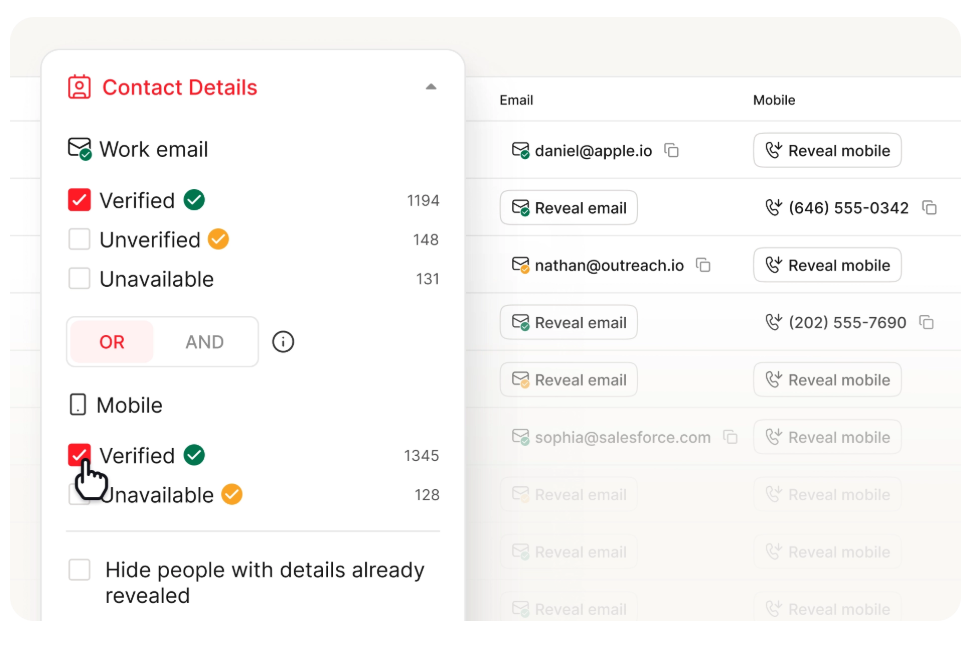
Clean entity mapping matters because bad data wastes time. That's exactly why Prospeo refreshes every record on a 7-day cycle and runs 5-step email verification - delivering 98% accuracy at $0.01 per email. When you need to go from a LEI, EIN, or D-U-N-S to an actual conversation, the data has to be right.
Stop mapping entities manually. Start reaching buyers with verified data.
FAQ
Is an E-Verify Number the Same as a Company ID?
No. An E-Verify Company ID is a separate identifier assigned when an employer enrolls in the E-Verify system - it's not your EIN, D-U-N-S, or state entity number. If your company uses a third-party I-9 vendor like HireRight, the E-Verify Company ID is typically accessible through that vendor's admin panel or your E-Verify employer account directly.
Do U.S. Companies Still Need to File BOI Reports?
No. FinCEN's March 2025 interim final rule removed BOI reporting requirements for U.S. companies and U.S. persons under the Corporate Transparency Act. Only foreign entities registered in a U.S. state or tribal jurisdiction must file. The final rule is still pending as of early 2026, but domestic companies have no current filing obligation.
Which Identifier Works Best for B2B Prospecting?
For entity resolution and deduplication across databases, LEI or D-U-N-S are the most reliable because they're globally unique and stable. For turning identified companies into actionable outreach, tools like Prospeo let you search by company name or domain and pull verified emails and phone numbers for decision-makers - so you go from "right entity" to "right person" without stitching together five different tools.