

What Is a Good Email Conversion Rate? (It Depends on Three Things)
You just ran a campaign and saw 2.3%. Is that good? Bad? Somewhere in between?
The post-privacy baseline across industries sits at roughly 2.4-2.6%, synthesized from 109 industry reports. But that single number hides enormous variation depending on what you're sending, who you're sending to, and whether your emails actually reach the inbox. Let's break down what "good" actually looks like for your specific situation.
Why Conversion Rate Benchmarks Are Confusing
The biggest problem with any email conversion rate benchmark isn't the data - it's the denominator. A "3% conversion rate" means something completely different depending on whether you're dividing by emails sent, delivered, opened, or clicked.
Mailchimp makes this worse by using "click rate" and "click-through rate" almost interchangeably. When comparing your numbers to a benchmark, make sure you're comparing the same math. Most published benchmarks use conversions / delivered emails x 100.
Conversion Rate by Email Type
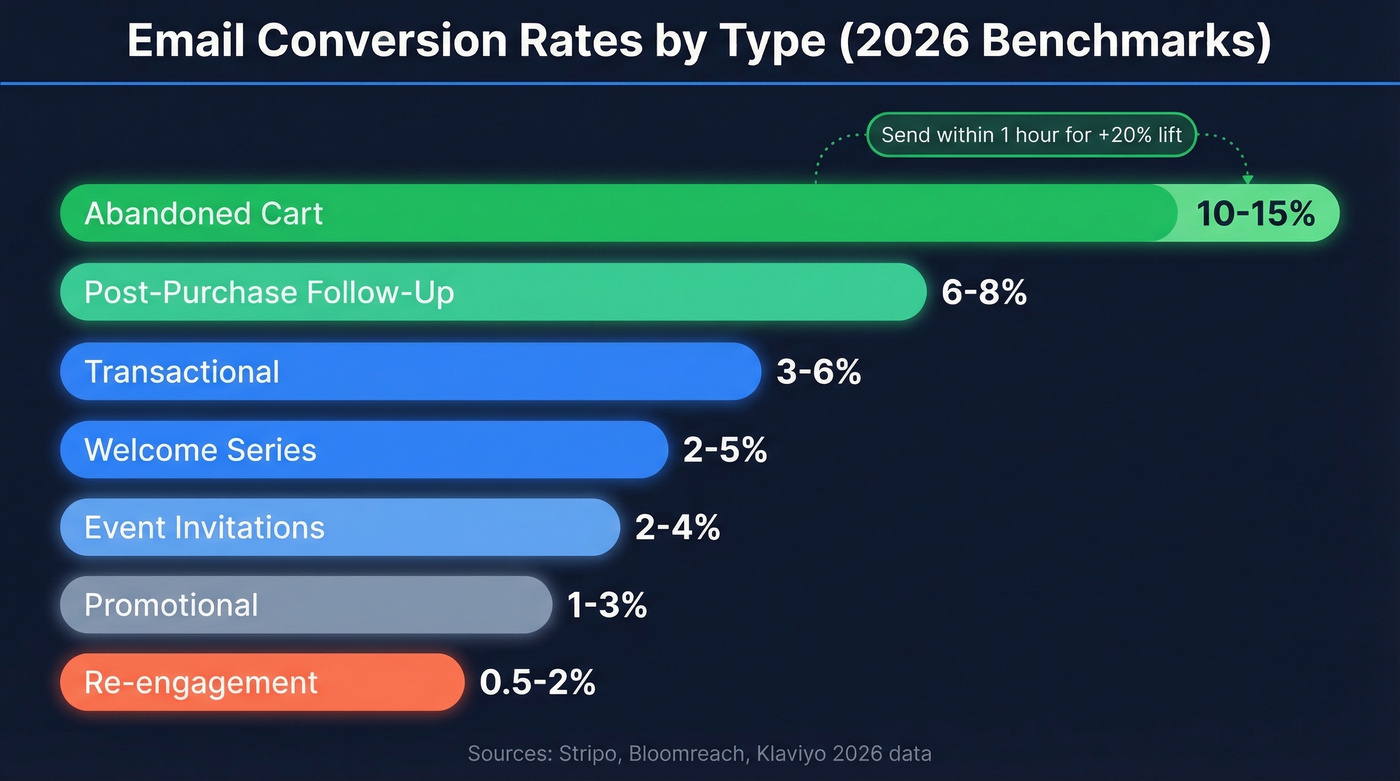
Abandoned cart sequences routinely outperform everything else because the intent is already there - someone literally had your product in their cart.
| Email Type | Conversion Rate |
|---|---|
| [Abandoned cart | 10-15%](https://www.campaignmonitor.com/resources/knowledge-base/what-is-the-average-conversion-rate-for-cart-abandonment/) |
| Post-purchase follow-up | ~6.8% |
| Transactional | 3-6% |
| Welcome series | 2-5% |
| Event invitations | 2-4% |
| Promotional | 1-3% |
| Re-engagement | 0.5-2% |
Abandoned cart emails benefit from 45-50% open rates and roughly 21% CTR. Sending within one hour of abandonment boosts conversions by about 20%, and that timing detail alone makes cart recovery the single highest-leverage fix available to any ecommerce team that hasn't already optimized it. If you're waiting 24 hours, you're leaving real money behind.
Benchmarks by Industry
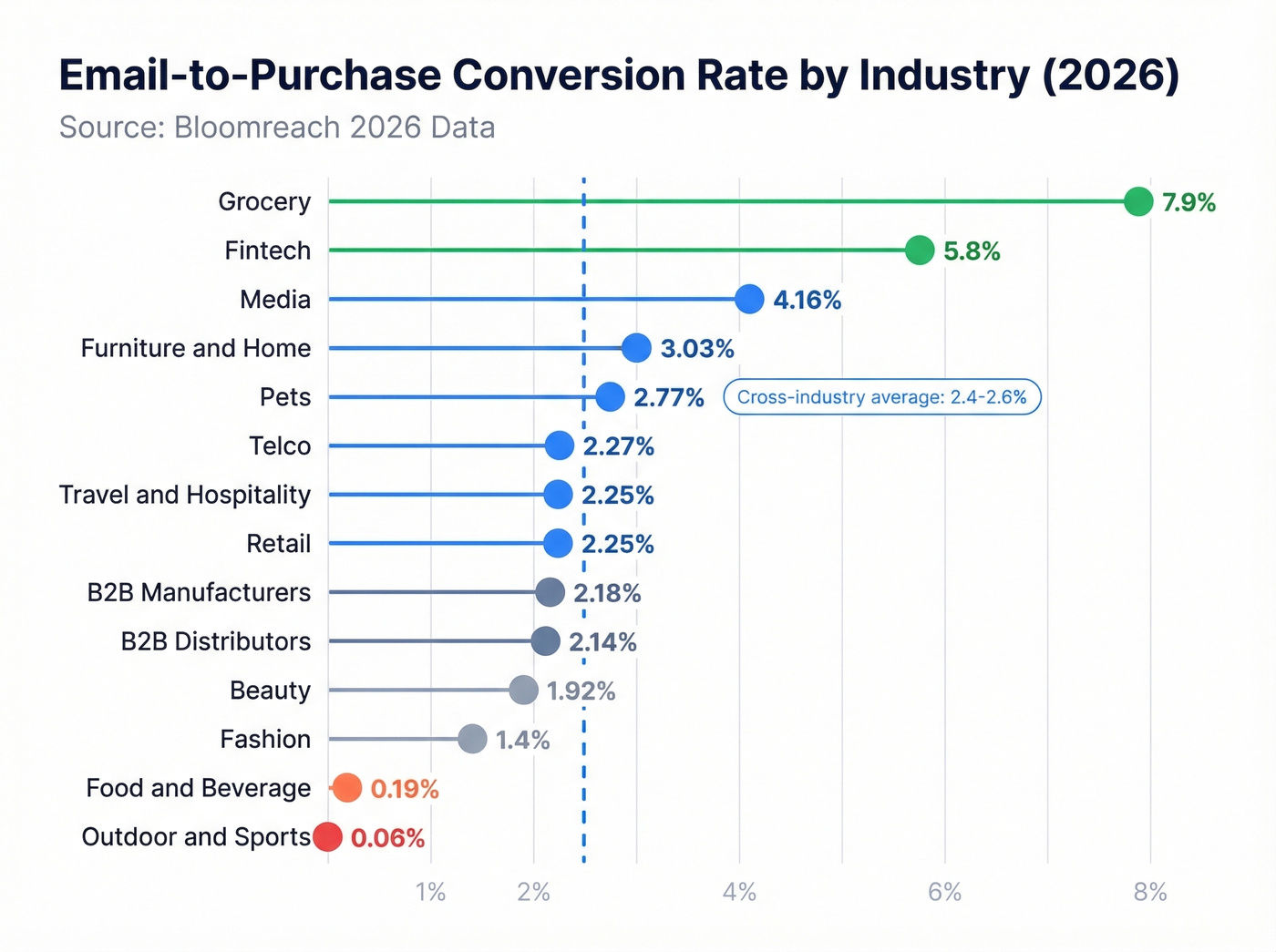
These are email-to-purchase conversion rates from Bloomreach's 2026 data. The spread is massive.
| Industry | Conversion Rate |
|---|---|
| Grocery | 7.9% |
| Fintech | 5.8% |
| Media | 4.16% |
| Furniture & home | 3.03% |
| Pets | 2.77% |
| Telco | 2.27% |
| Travel & hospitality | 2.25% |
| Retail | 2.25% |
| B2B manufacturers | 2.18% |
| B2B distributors | 2.14% |
| Beauty | 1.92% |
| Fashion | 1.4% |
| Food & beverage | 0.19% |
| Outdoor equipment & sports | 0.06% |
If you're in grocery at 3%, you're underperforming badly. If you're in fashion at 1.4%, you're right on the money. Context kills averages.
B2B directional ranges
For B2B teams, these ranges serve as directional targets:
| B2B Industry | Conversion Rate |
|---|---|
| SaaS/software | 1.5-3% |
| Manufacturing | 0.8-1.5% |
| Professional services | 1-2% |

You just read that bounce rates above 2.5% actively damage your sender reputation and cap your conversion rate. Prospeo's 5-step email verification - with catch-all handling, spam-trap removal, and honeypot filtering - keeps bounce rates under 3% consistently. At $0.01 per email with a 7-day data refresh cycle, cleaning your list costs less than one lost conversion.
Stop optimizing subject lines on top of broken data.
Campaigns vs. Automated Flows
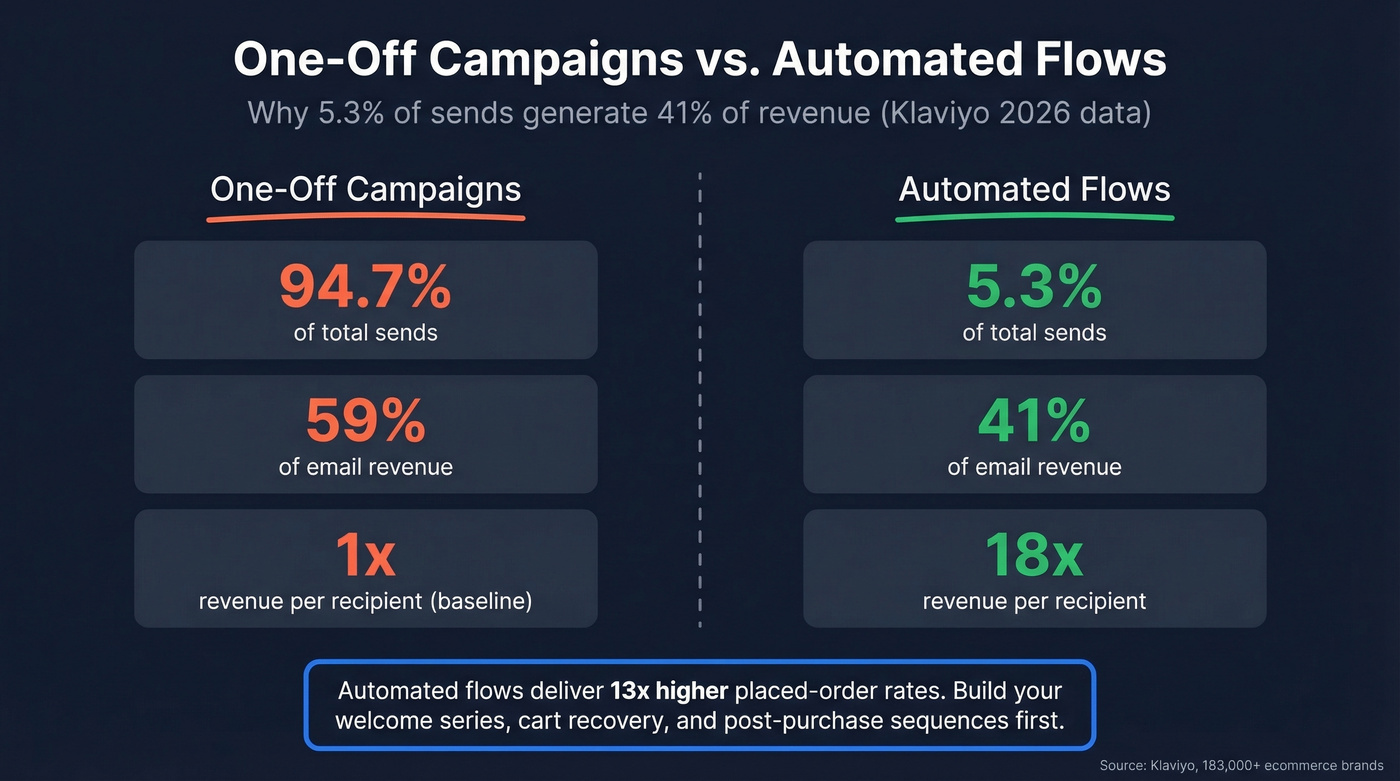
This is the insight most guides bury. Klaviyo's 2026 data across 183,000+ ecommerce customers shows automated flows account for just 5.3% of total email sends - but generate roughly 41% of total email revenue. Flows deliver 13x higher placed-order rates, and revenue per recipient runs nearly 18x higher than one-off campaigns.
Track revenue per email alongside conversion rate. A 1% conversion rate on a $500 ACV product beats a 5% rate on a $10 item every time. Conversion rate alone doesn't tell you if your emails are making money.
Here's the practical takeaway: if you're spending 90% of your email effort on one-off blasts and 10% on automation, you've got the ratio backwards. Build your welcome series, cart recovery, and post-purchase sequences before you send another promotional blast.
Cold Email Conversion Rates
Cold email plays by different rules entirely. Average reply rates have dropped from 5.1% in 2024 to 3.43% in 2025-2026, and deal conversion from cold outreach sits at 0.2-2%.
One practitioner on r/coldemail sent 147,000 cold emails and reported a 1.2% positive reply rate - 1,764 conversations that produced 40 calls. That same person found warm, intent-led conversations pushed reply rates to 34%, a 28x improvement over cold. On the other end, a smaller test of 908 trigger-based emails hit a 3.1% email-to-close rate. Follow-ups generate 42% of all cold email replies, so sending one email and moving on leaves almost half your results on the table.
Look, if your average deal size is under five figures, you probably don't need a 2% cold email conversion rate to build a real pipeline. You need volume, clean data, and relentless follow-up. We've seen teams triple their pipeline just by fixing bounce rates and adding two follow-up steps - no fancy copywriting required. (If you want plug-and-play sequences, start with these follow-up templates.)
Deliverability Is Your Conversion Ceiling
No amount of optimization matters if your emails land in spam. Average inbox placement is 84%, meaning roughly 16.9% of emails never reach the inbox. If your bounce rate exceeds 2.5-3%, you've got a data quality problem actively damaging your sender reputation.

This is where list hygiene becomes a conversion rate lever. Bad addresses cause bounces, bounces tank your sender score, and a damaged sender score pushes future emails to spam - a cascading failure that compounds with every send. In our experience, teams that clean their lists before optimizing subject lines or CTAs see the biggest jumps in conversion rate, because they're removing the upstream bottleneck that caps everything downstream. (If you need a full framework, use this email deliverability guide and then focus on how to improve sender reputation.)
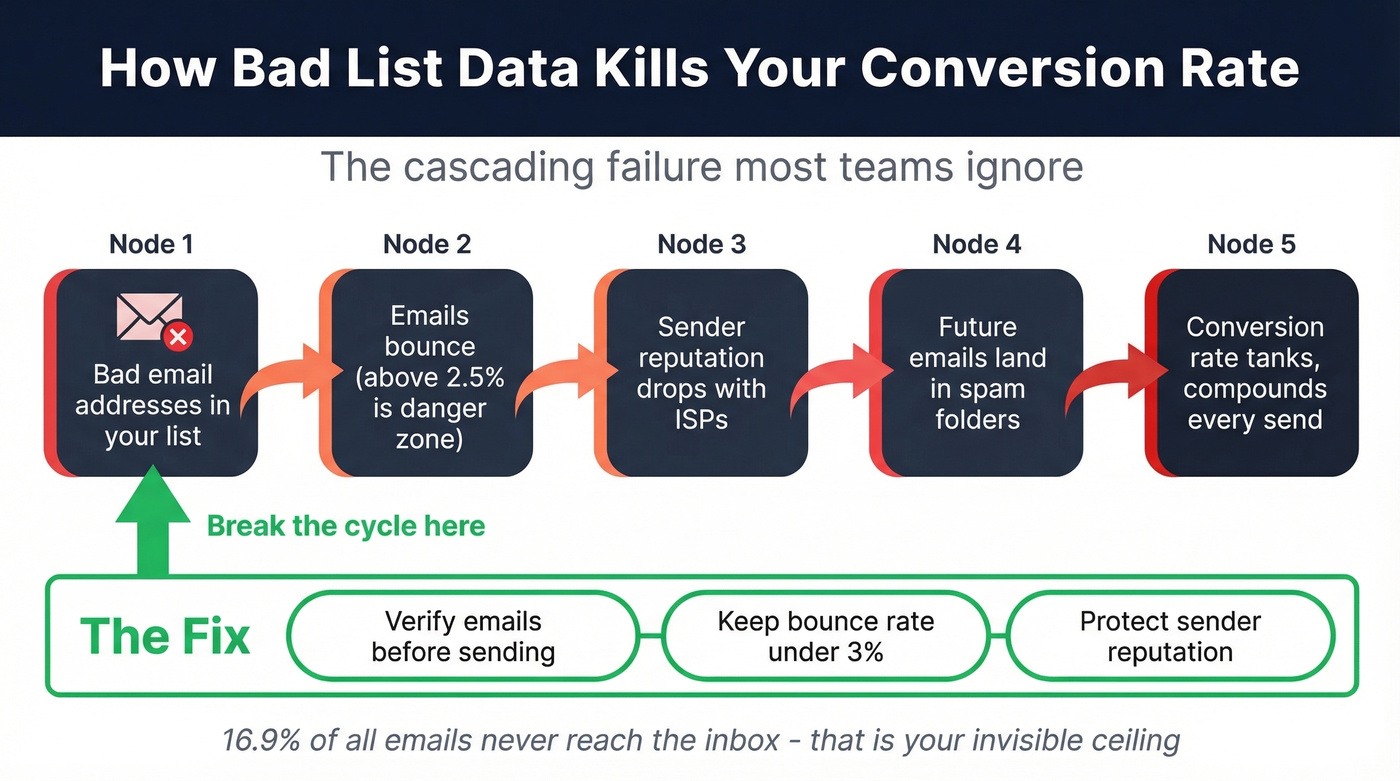
Prospeo's email verification catches bad addresses before they do damage, using a 5-step process that includes catch-all handling, spam-trap removal, and honeypot filtering on a 7-day refresh cycle. That kind of infrastructure keeps bounce rates under 3% consistently.
How to Improve Your Rate
Five moves that actually move the needle:
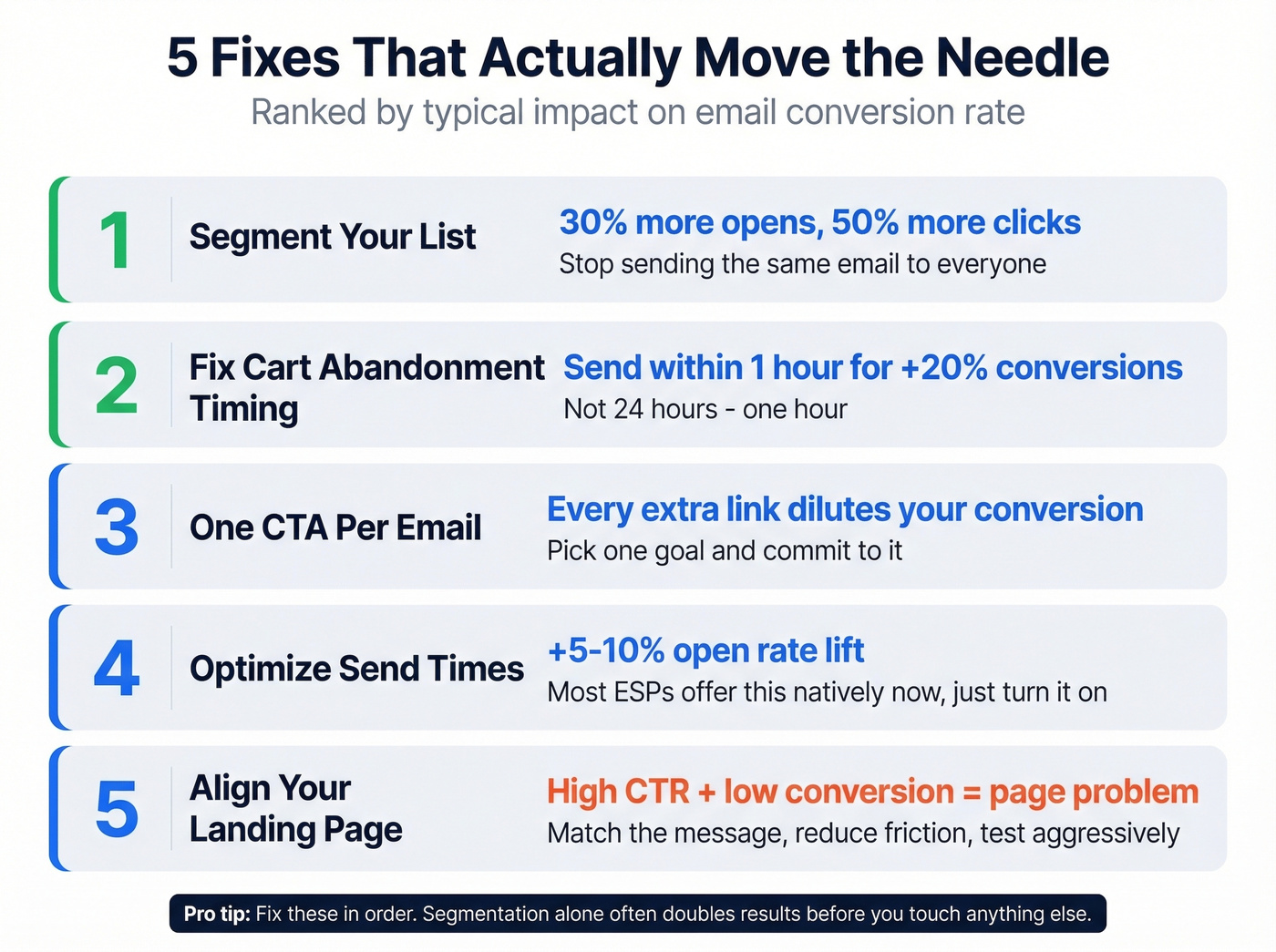
- Segment everything. Segmented campaigns deliver up to 30% more opens and 50% more clicks versus batch-and-blast. If you're still sending the same email to your entire list, skip every other tip and fix this first. (For a practical framework, see targeted email campaigns.)
- Optimize send times. Send-time optimization lifts open rates 5-10%. Most ESPs offer this natively now - turn it on. (For outbound, use this best time to send cold emails playbook.)
- Fix cart abandonment timing. Within one hour. Not 24 hours. One hour = +20% conversions.
- One CTA per email. Every additional link dilutes the action you want. Pick one goal per message and commit to it. (More examples: email call to action.)
- Align your landing page. A high CTR with a low conversion rate means your email gets clicks but your landing page isn't closing. Match the message, reduce friction, and test the page as aggressively as you test the email itself.
Cold email conversion rates are dropping - 3.43% reply rates in 2025-2026. The teams still winning are the ones sending to verified contacts with intent signals. Prospeo gives you 300M+ profiles with 98% email accuracy, buyer intent data across 15,000 topics, and 30+ filters to target exactly who's in-market right now.
Turn cold outreach into warm conversations with data that actually connects.
FAQ
What's the difference between email CTR and conversion rate?
CTR measures clicks divided by delivered emails. Conversion rate measures goal completions - purchases, signups, demo requests - divided by delivered emails. A high CTR with low conversions almost always points to a landing page or offer mismatch, not an email problem.
Is 1% a bad email conversion rate?
For abandoned cart emails where benchmarks run 10-15%, yes, 1% signals a serious problem. For cold outreach deal conversion or re-engagement campaigns, 1% is perfectly normal. Always compare against the benchmark for your specific email type and industry before making changes.
How does list quality affect conversions?
Bad addresses cause bounces, which damage sender reputation, which pushes future emails to spam - a cascading failure that gets worse with every send. Cleaning your list and verifying addresses before each campaign is the fastest way to lift inbox placement, and you'll typically see measurable improvement within one send cycle.
What's a good email conversion rate for cold outreach?
Expect 0.2-2% deal conversion from cold email in 2026, with average reply rates around 3.4%. Trigger-based sends targeting in-market buyers can push email-to-close rates above 3%, but that requires intent data and tight segmentation - not just bigger lists.