

What Is a Sales Goal - and Why Do Most Reps Miss Theirs?
A rep hits $2.1M against a $1.95M target. The reward? A $2.75M number next year with no new accounts. That's not goal-setting - that's punishment math. And it's far more common than sales leaders want to admit.
So what is a sales goal, really, and why do so many fall apart? Only 43.5% of reps actually hit quota, which means the problem usually isn't effort. It's the goal itself.
The Short Answer
A sales goal is a specific performance outcome assigned to a rep or team within a set timeframe - quantitative ($500K in ARR) or qualitative (improve win rate by 15%). That definition is the easy part. The gap between setting a goal and hitting one comes down to understanding the types, choosing the right frameworks, and avoiding a handful of mistakes that kill attainment before Q2 starts.
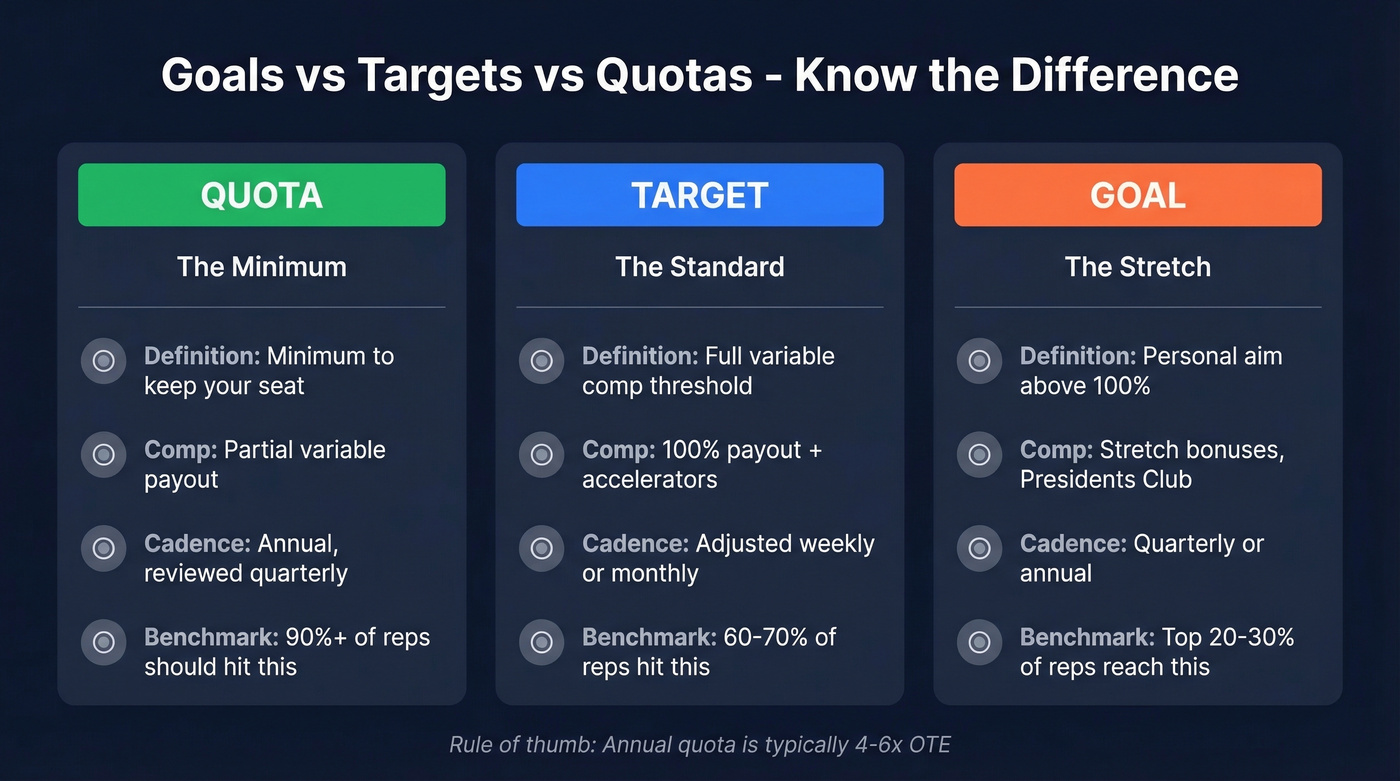
Goals, Targets, and Quotas Explained
These three terms get used interchangeably, and that's where comp disputes and demotivation start.
| Term | What It Means | Comp Implication | Typical Cadence |
|---|---|---|---|
| Quota | Minimum to keep your seat | Partial variable comp | Annual, reviewed quarterly |
| Target | Full variable comp threshold | 100% payout + accelerators | Often adjusted weekly/monthly |
| Goal | Personal aim above 100% | Stretch bonuses, President's Club | Quarterly or annual |
In a well-calibrated org, 90%+ of reps should hit quota. If your company says "60% hit quota," they're mislabeling targets as quotas - or the numbers are genuinely broken. Rule of thumb: annual quota is typically 4-6x OTE, depending on role, segment, and deal cycle.
Why Sales Goals Matter
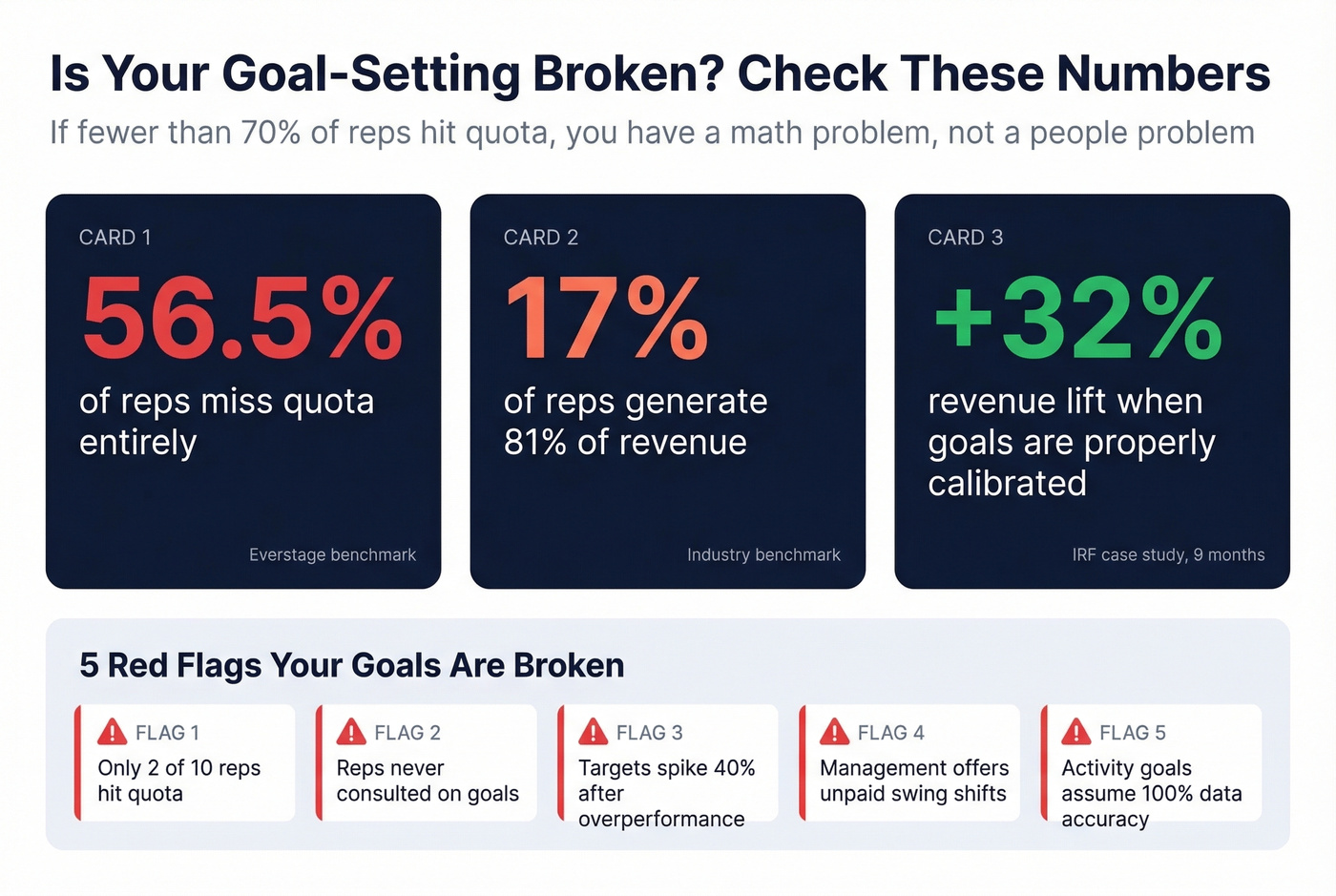
U.S. companies spend over $900 billion annually on their sales forces - roughly 3x what they spend on all advertising combined. Yet those same companies deliver only 50-60% of the financial performance their strategies promise. The concentration is stark: benchmarks show 17% of reps generate 81% of revenue.
Here's the thing: 56% of executives say their biggest challenge is ensuring daily decisions align with strategy, and misaligned objectives are a primary driver. Ebsta and Pavilion's benchmarks show 69% of reps falling short. But when goals and incentives are properly calibrated, the results flip dramatically - one case study showed +32% revenue and $747,800 in ROI over just nine months. That's the difference between a revenue target on paper and one that actually changes behavior.

Activity goals only work when the data behind them is real. If 20% of your emails bounce, that 50-call target is actually a 40-call target - and your reps know it. Prospeo delivers 98% email accuracy and 125M+ verified mobiles with a 30% pickup rate, so every dial and send counts toward quota.
Stop setting goals your data can't support. Start with contacts that connect.
Types of Sales Goals
Five categories matter, but reps should carry two to three maximum. Every goal beyond three dilutes focus and makes prioritization impossible.
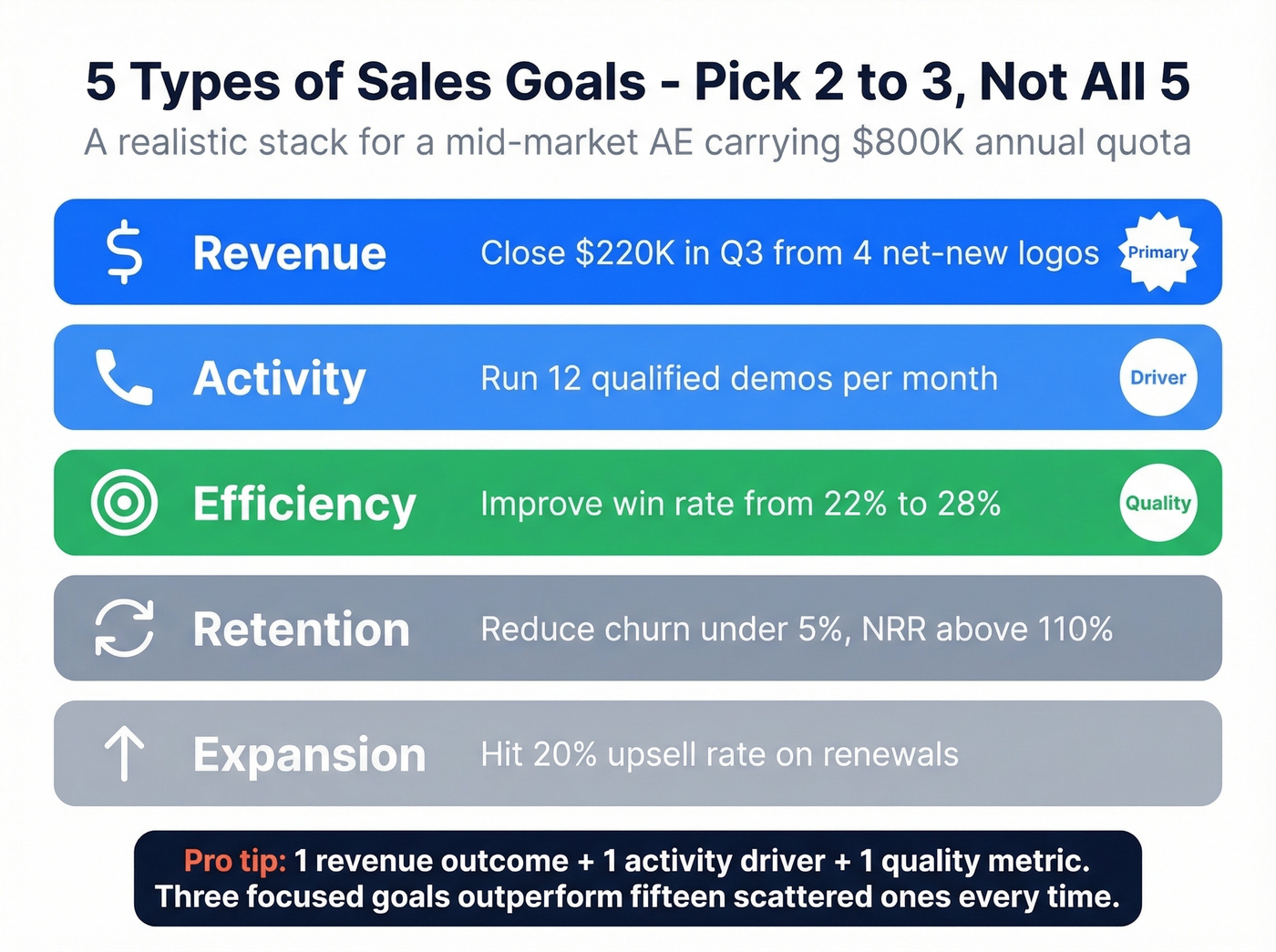
Here's what a realistic stack looks like for a mid-market AE carrying an $800K annual quota:
- Revenue - Close $220K in Q3 new business from 4 net-new logos
- Activity - Run 12 qualified demos per month
- Efficiency - Improve win rate from 22% to 28%
- Retention - Reduce churn to under 5%, maintain NRR above 110% (track it with churn analysis)
- Expansion - Hit a 20% upsell rate on renewals
Pick one revenue outcome, one activity driver, and one quality metric. That's it. We've seen teams assign fifteen KPIs and wonder why nothing moves - three focused goals will outperform fifteen scattered ones every single time.
How to Set Achievable Sales Goals
The SMART Framework
Specific, Measurable, Achievable, Relevant, Time-bound. The framework is well-known, but most sales applications of it are too vague.
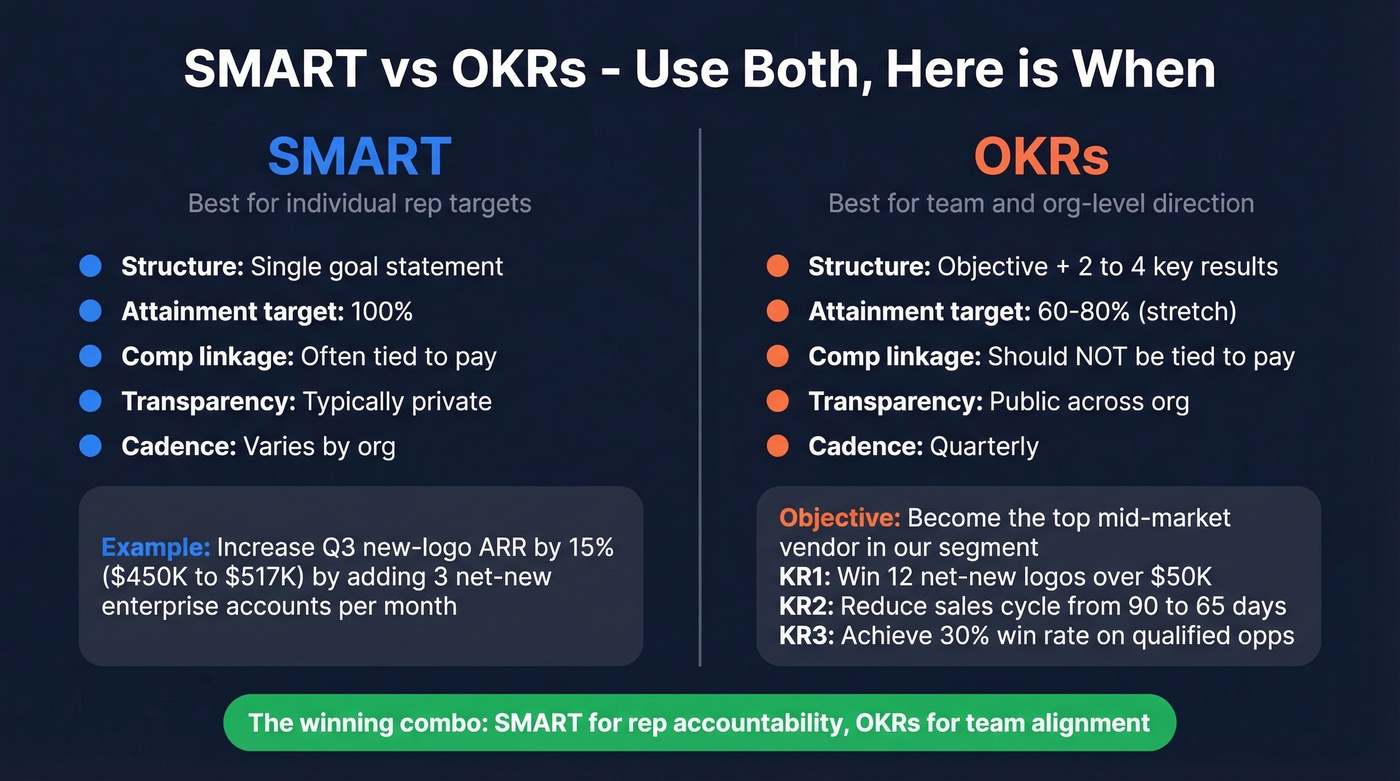
A real SMART sales goal looks like this: "Increase Q3 new-logo ARR by 15% ($450K to $517K) by adding 3 net-new enterprise accounts per month." Compare that to "grow revenue." One is a goal. The other is a wish.
SMART is necessary but not sufficient. It gives you structure without ambition or organizational alignment. Teams looking to set smarter objectives need a second layer.
Beyond SMART - OKRs
OKRs solve what SMART misses. Locke and Latham's goal-setting research shows goals work best when they're specific, challenging, and when people participate in defining them. In our experience, the teams that hit quota consistently are the ones where reps helped shape the key results - not just received them in a spreadsheet.
| Dimension | SMART | OKRs |
|---|---|---|
| Structure | Single goal statement | Objective + 2-4 key results |
| Attainment target | 100% | 60-80% (stretch) |
| Comp linkage | Often tied | Should not be tied |
| Transparency | Typically private | Public across org |
| Cadence | Varies | Quarterly |
SMART goals work for individual rep targets. OKRs work for team and org-level direction. Use both.
How to Measure Progress
Two formulas you need:
Target Attainment (%) = (Actual Sales / Sales Target) x 100
Conversion Rate (%) = (Closed Deals / Qualified Leads) x 100 (see sales conversion rate)
The real distinction is leading vs. lagging indicators. Lagging indicators like revenue and churn tell you what already happened. Leading indicators - calls made, meetings booked, pipeline created - tell you what's about to happen. Rolling forecasts that update monthly based on pipeline reality keep goals grounded instead of locked to January assumptions (more on pipeline health).
Activity metrics are only trustworthy when the underlying contact data is verified, though. If a meaningful chunk of your phone numbers are disconnected, a "50 calls/day" goal turns into a lot of wasted dials. Tools like Prospeo verify emails at 98% accuracy and support mobile verification, so activity goals reflect actual selling time rather than busywork against dead numbers (compare options in data enrichment services).

Mistakes That Kill Attainment
The most common complaint on r/sales about goal-setting? Punishment quotas. A rep hits $2.1M against a $1.95M target, and management hands them $2.75M the next year - a 40% hike with no additional accounts or territory expansion. The result is a number that's no longer attainable, and everyone knows it.
If you want a clean way to separate planning from performance expectations, align your sales forecast vs sales goal definitions before comp season.
As Zoltners, Sinha, and Lorimer wrote in HBR: "When a majority of salespeople miss a goal, it's often because the management team set the goal too high." Unrealistic goals dampen sales and push top performers out the door.
My hot take: if fewer than 70% of your reps hit quota, you don't have a hiring problem or a coaching problem. You have a math problem. Fix the goals before you fix the people (and audit the factors affecting sales performance while you're at it).
Red flags your goals are broken:
- Only 2 out of 10 reps hit quota per quarter
- Reps aren't consulted during the goal-setting process
- Targets spike after overperformance with no territory changes
- Management offers unpaid "swing shifts" to help reps hit number - a sign the goals, not the effort, are broken
- Activity goals assume 100% data accuracy when they shouldn't
Skip the goal-setting exercise entirely if you haven't audited your data quality first. The best framework in the world can't fix a pipeline built on bounced emails and disconnected numbers (start with email bounce rate).
When 69% of reps miss quota, the problem isn't always the goal - it's the pipeline feeding it. Prospeo's 300M+ profiles with 30+ filters (buyer intent, job changes, funding, headcount growth) let your team build pipeline against the exact ICP your goals require. At $0.01 per email, fixing your data costs less than one missed deal.
Hit quota by reaching real buyers, not dead leads.
FAQ
What's the difference between a sales goal and a quota?
A sales goal is a broader performance objective - revenue growth, efficiency improvement, market expansion. A quota is the minimum a rep must hit to earn variable comp. Goals inspire direction; quotas enforce accountability. Most orgs need both working together.
What are good sales goals for a new rep?
Start with activity-based targets - 15 meetings booked or 8 demos run per month - before layering in revenue outcomes. Ramp-period objectives should reflect a realistic 3-6 month schedule, not the same number a tenured rep carries from day one.
How many sales goals should a rep carry?
Two to three maximum. One revenue outcome, one activity driver, and one quality metric like win rate or average deal size. Let's be honest - anything beyond three just creates noise that makes it harder to prioritize.
What tools help reps hit activity-based goals?
CRMs track progress, but the data feeding them matters more. Contact verification platforms ensure activity metrics reflect real selling effort, and sales engagement tools then automate sequences against that clean data. The combination of accurate contacts and consistent outreach cadence is what actually moves the needle on activity goals.