

What Is a Sales Prospecting Tool - and Which Type Do You Actually Need?
Sales reps spend just 30% of their time actually selling. The rest vanishes into research, data entry, and chasing contacts who left their company six months ago. That's not a productivity problem - it's a pipeline problem. And 42% of salespeople say prospecting is the single hardest part of the job, which means the software you use to find and reach buyers isn't a nice-to-have. It's the thing that determines whether your quarter ends with a full pipeline or a painful forecast call.
The Short Answer
A sales prospecting tool is software that helps you identify, qualify, and engage potential buyers. Four categories exist: CRMs, sales intelligence platforms, sales engagement platforms, and email outreach tools. Starting from zero? Get a data tool with verified emails, a sequencing tool, and your CRM. That's the whole stack.
Definition and Core Workflow
A sales prospecting tool helps you find and engage potential customers who match your ideal customer profile. The core workflow runs three steps: identify prospects who fit your ICP, qualify them against criteria like budget, authority, need, and timeline, then engage through the right channel at the right time.
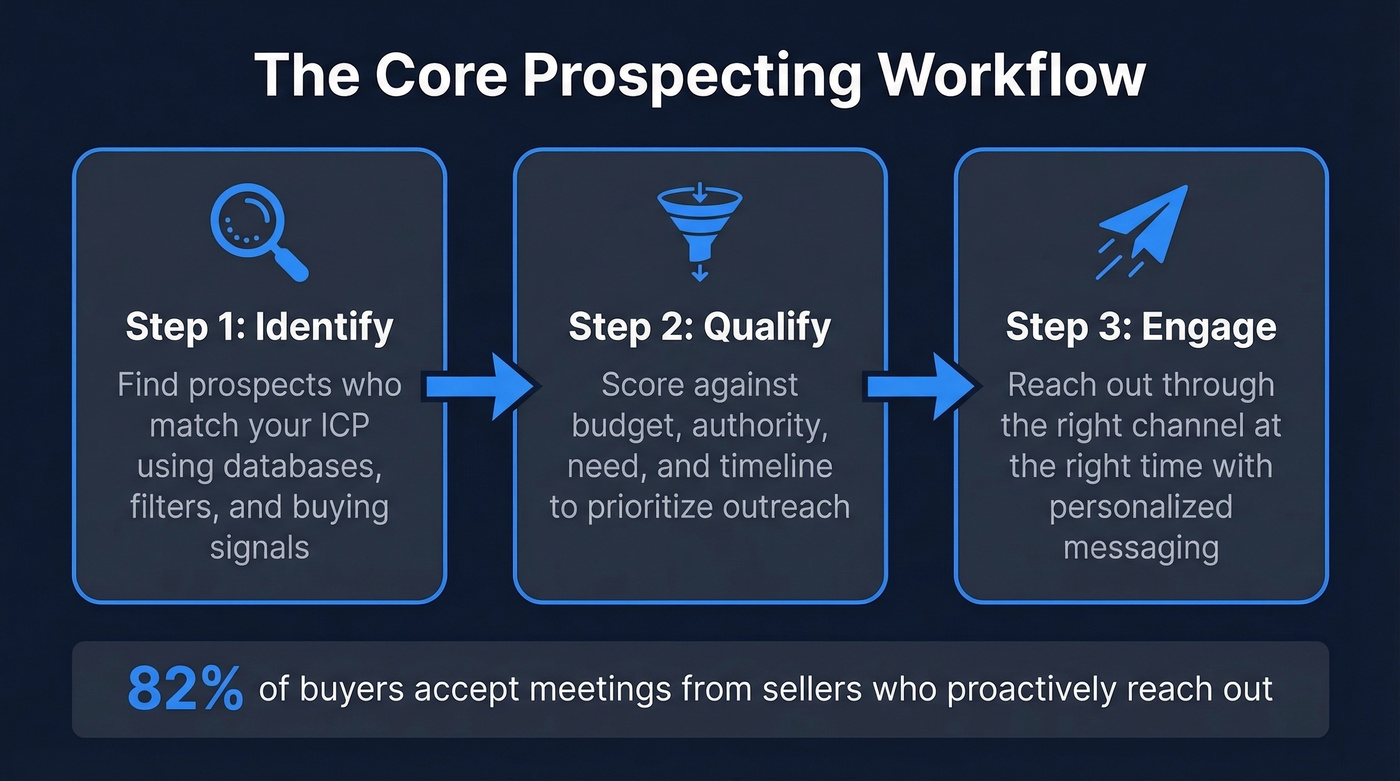
These tools cut the manual grind of spreadsheet research, email guessing, and profile browsing. They pull from databases, enrich contact records, track buying signals, and either automate outreach sequences or plug into the sequencer you already use. Here's the thing: 82% of buyers accept meetings from sellers who proactively reach out. The tool you use to find and reach those buyers directly shapes your pipeline.
Prospecting vs. Lead Generation
These terms get swapped constantly, but they're different motions with different owners.
| Dimension | Prospecting | Lead Generation |
|---|---|---|
| Ownership | Sales-led | Marketing-led |
| Motion | One-to-one outreach | One-to-many campaigns |
| Time horizon | Short-term pipeline | Long-term demand |
| Tooling | Data platforms, dialers | Landing pages, ads, content |
Prospecting is a rep sending a targeted cold email. Lead gen is marketing running a webinar funnel. Both feed the pipeline, but prospecting gives you direct control over who enters it.
75% of B2B buyers prefer a rep-free buying experience, and 85% have already set purchase requirements before they ever contact a vendor. The data you use to target them is everything.

You just read that bad data at the top makes every downstream number worse. Prospeo's 5-step verification delivers 98% email accuracy on 300M+ profiles - refreshed every 7 days, not 6 weeks. Snyk's 50 AEs dropped bounce rates from 35% to under 5% and grew pipeline 180%.
Get the prospecting data that actually connects you to real buyers.
Four Types of Prospecting Tools
89.9% of companies use two or more data tools to research prospects. That's not tool sprawl - no single category covers the full workflow.
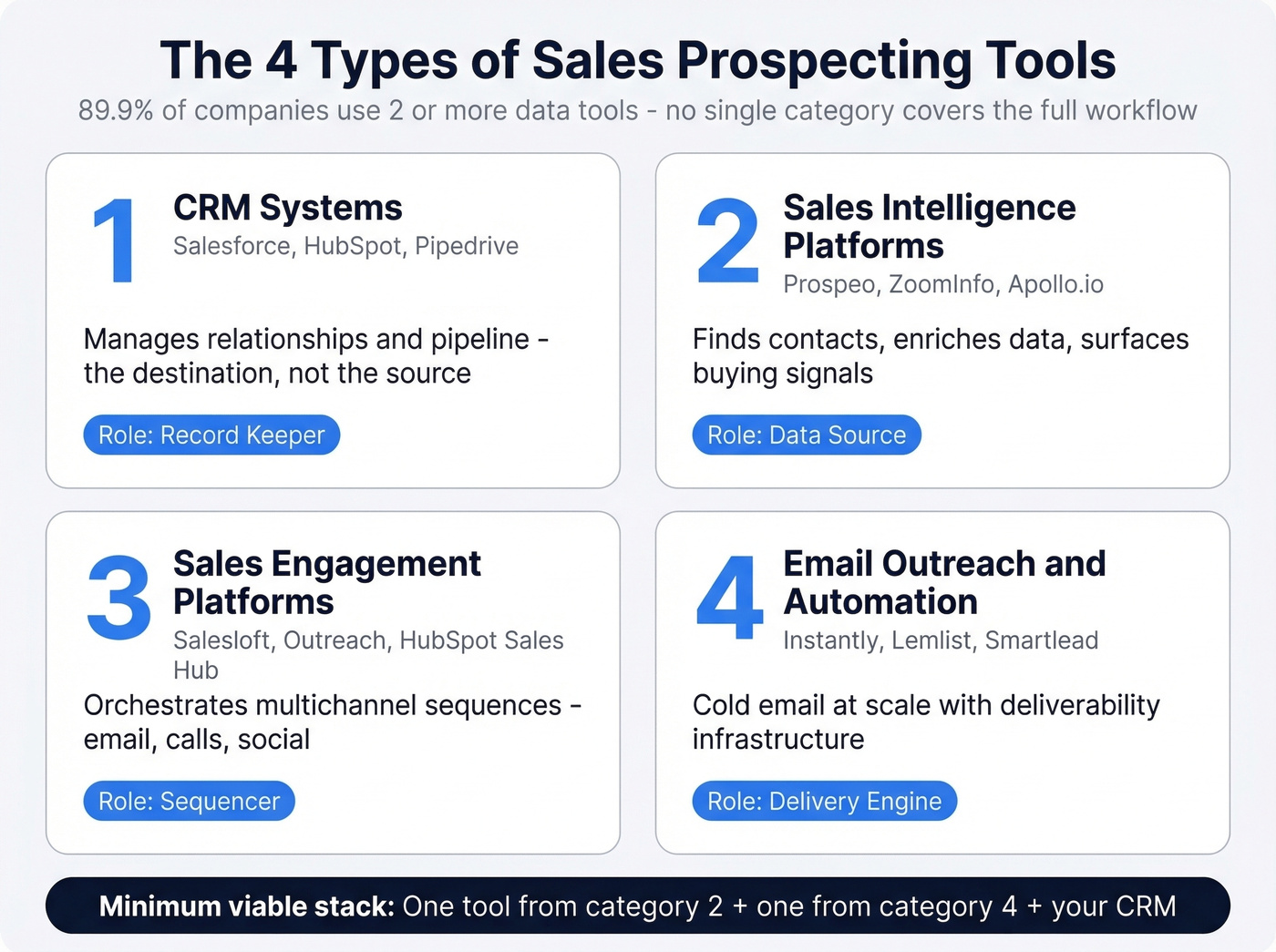
1. CRM Systems - Salesforce, HubSpot, Pipedrive. These manage relationships and pipeline but don't find new prospects. The destination, not the source.
3. Sales Engagement Platforms - Salesloft, Outreach, HubSpot Sales Hub. These orchestrate multichannel sequences: email cadences, call tasks, social touches. They sit between your data source and your CRM.
4. Email Outreach & Automation - Instantly, Lemlist, Smartlead. Purpose-built for cold email at scale, with deliverability infrastructure that engagement platforms often lack.
Most teams need at least one tool from categories 2 and 4, plus their CRM.
Features Worth Paying For
Five criteria separate good tools from expensive noise.
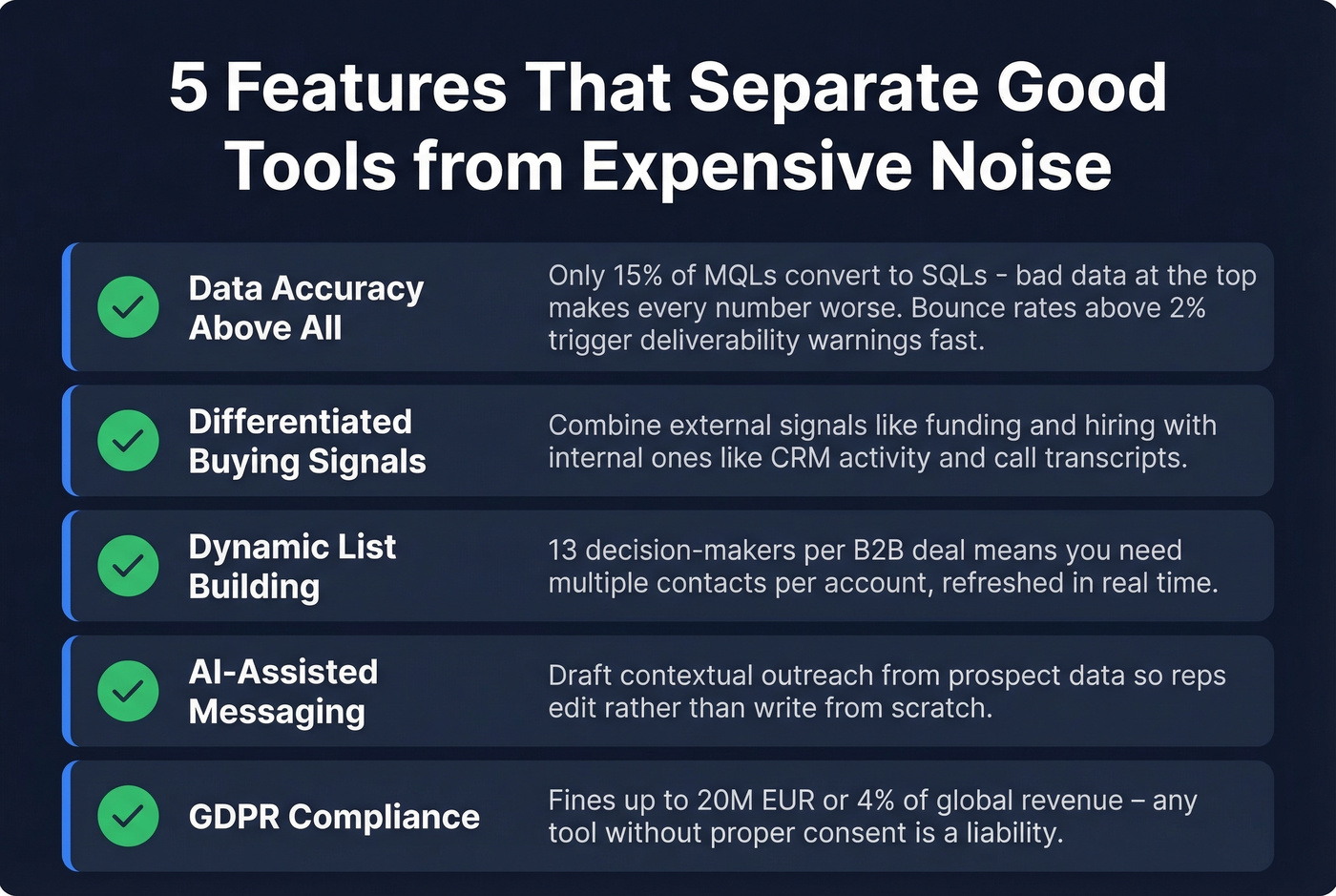
Data accuracy above all. Only about 15% of MQLs convert to SQLs - bad data at the top makes every downstream number worse. In our testing, bounce rates above 2% triggered deliverability warnings fast. Once email providers flag you, recovery takes weeks. Data quality isn't a feature checkbox; it's the foundation everything else sits on. (If you want benchmarks and fixes, see bounce rates and the full email deliverability breakdown.)
Differentiated buying signals. Commoditized intent data doesn't help. Look for tools that combine external signals (funding, hiring, tech installs) with internal ones (CRM activity, call transcripts) to surface genuinely in-market accounts. For a practical scoring approach, use a framework for identifying buying signals.
Dynamic list building. Static CSV exports go stale fast. The best tools reprioritize prospects in real time as signals change - and with 13 decision-makers involved in the average B2B deal, you need multiple contacts per account, not just one.
AI-assisted messaging. Tools that draft contextual outreach from prospect data let the rep edit rather than write from scratch. That compresses the gap between finding a contact and reaching them. (If you're building this into your workflow, start with AI cold email outreach.)
GDPR compliance. Fines run up to EUR 20M or 4% of global revenue. Any tool handling EU data without proper consent mechanisms is a liability, not an asset.
Best Prospecting Tools in 2026
Prospeo
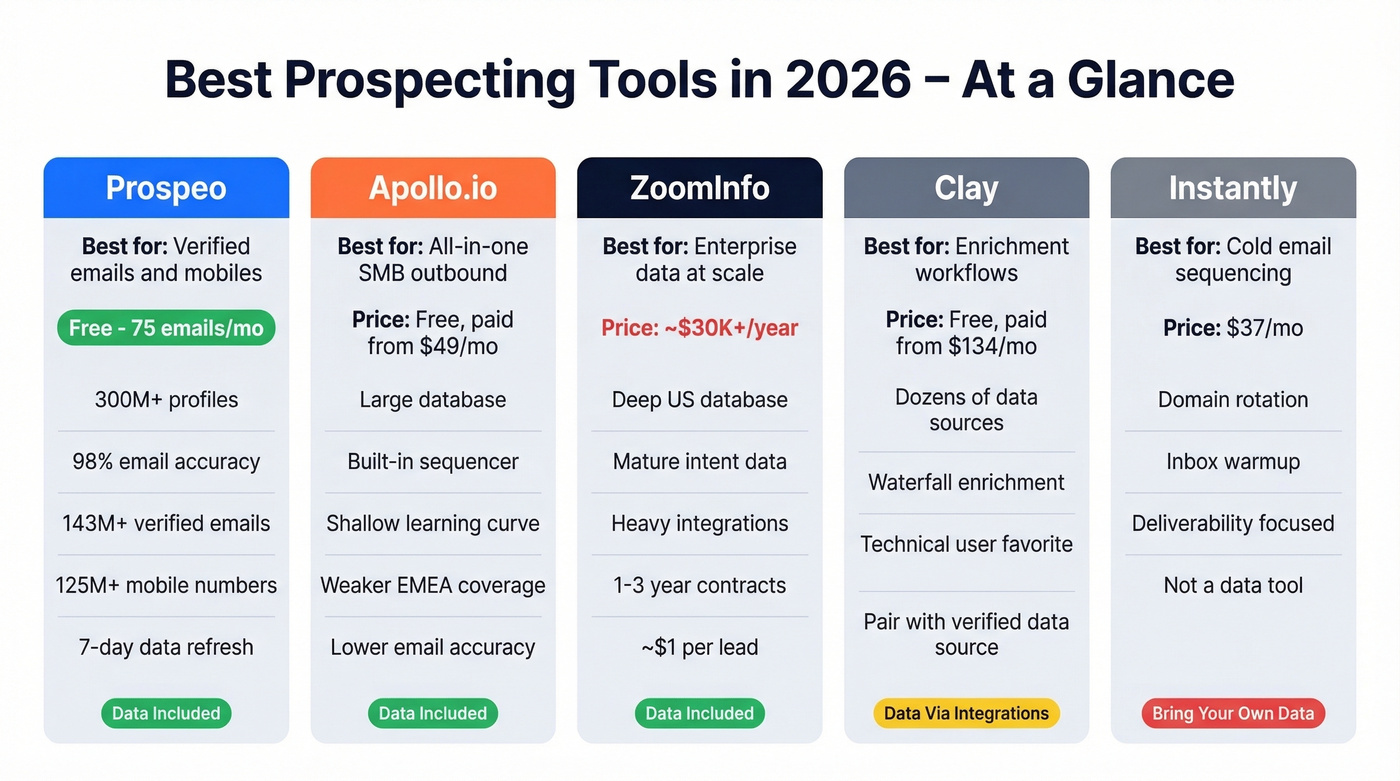
Prospeo's database covers 300M+ professional profiles with 98% email accuracy, 143M+ verified emails, and 125M+ verified mobile numbers hitting a 30% pickup rate. Data refreshes every 7 days - the industry average is 6 weeks, which means most competitors serve you contacts who've already changed jobs by the time you hit send.

The search interface gives you 30+ filters including buyer intent powered by 15,000 Bombora topics, technographics, job changes, headcount growth, and funding signals. The Chrome extension (40K+ users) pulls verified contact data from any website or professional profile page in one click. (If you're comparing providers, see our roundup of sales prospecting databases.)
Real results: Snyk's team of 50 AEs dropped their bounce rate from 35-40% to under 5%, grew AE-sourced pipeline by 180%, and now generates 200+ new opportunities per month. At roughly $0.01 per email with a free tier (75 emails/month), the cost comparison to enterprise alternatives is stark.
Best for: Teams that want enterprise-grade data accuracy without enterprise pricing or annual contracts.
Apollo.io
Use this if you're an SMB team that wants data and sequencing in one platform. Apollo's free tier is genuinely useful, and paid plans run $49-$79/user/month. The database is large, the sequencer is competent, and the learning curve is shallow.
Skip this if you need high-accuracy mobile numbers or you're selling into EMEA where Apollo's coverage thins out. We've seen email accuracy run noticeably lower than dedicated data platforms - fine for volume plays, less fine when you're targeting C-suite.
ZoomInfo
ZoomInfo is the enterprise default: the US database depth is unmatched, the intent data is mature, and the workflow integrations run deep. It's also the tool most teams realize they're overpaying for. Mid-market contracts often land around $30K/year with 1-3 year commitments.
Let's be honest: at roughly $1 per lead versus $0.01 from a self-serve platform, the math only works if you're running 50+ reps and need the full GTM suite. For everyone else, it's an expensive database with features gathering dust.
Clay
Clay pulls from dozens of data sources and lets you build complex prospecting workflows with waterfall enrichment logic. Free tier gives 1,200 credits/year; paid plans start at $134/mo. It's a practitioner favorite on r/sales - the kind of tool that rewards technical users with outsized results. Pair it with a verified data source for the best output. (If you're using Clay specifically, this Clay list building guide will save you time.)
Instantly
Cold email sequencing and deliverability infrastructure, not a data tool. Growth plan at $37/mo, Hypergrowth at $97/mo. Bring your own contacts, let Instantly handle domain rotation, warmup, and inbox management.
| Tool | Best For | Starting Price | Data Included? |
|---|---|---|---|
| Prospeo | Verified emails & mobiles | Free (75 emails/mo) | Yes - 300M+ profiles |
| Apollo.io | All-in-one SMB outbound | Free; paid from $49/mo | Yes |
| ZoomInfo | Enterprise data at scale | ~$30K+/year | Yes |
| Clay | Enrichment workflows | Free; paid from $134/mo | Via integrations |
| Instantly | Cold email sequencing | $37/mo | No - bring your own |
The article shows you need a data tool with verified emails, a sequencer, and your CRM. Prospeo covers the hardest part: 143M+ verified emails at $0.01 each, 125M+ mobile numbers with 30% pickup rates, and native integrations with Salesforce, HubSpot, Instantly, Lemlist, and Smartlead. No contracts, no sales calls.
Build your entire prospecting stack starting at zero dollars today.
Mistakes That Kill Your Prospecting
Sending to unverified lists. A bounce rate above 2% damages your domain reputation, and once email providers flag you, recovery takes weeks. Every dollar spent on sequencing tools is wasted if the underlying data is dirty. The consensus on r/sales is brutal on this - one bad list can tank deliverability for months, and reps who've been through it never skip verification again.

Mass impersonal blasts. Untargeted lists get 67% fewer replies than smaller, segmented sends. Segmented campaigns see 14.31% higher open rates. Fewer, better-targeted emails outperform spray-and-pray every time. (For a tighter approach, use these sales prospecting techniques.)
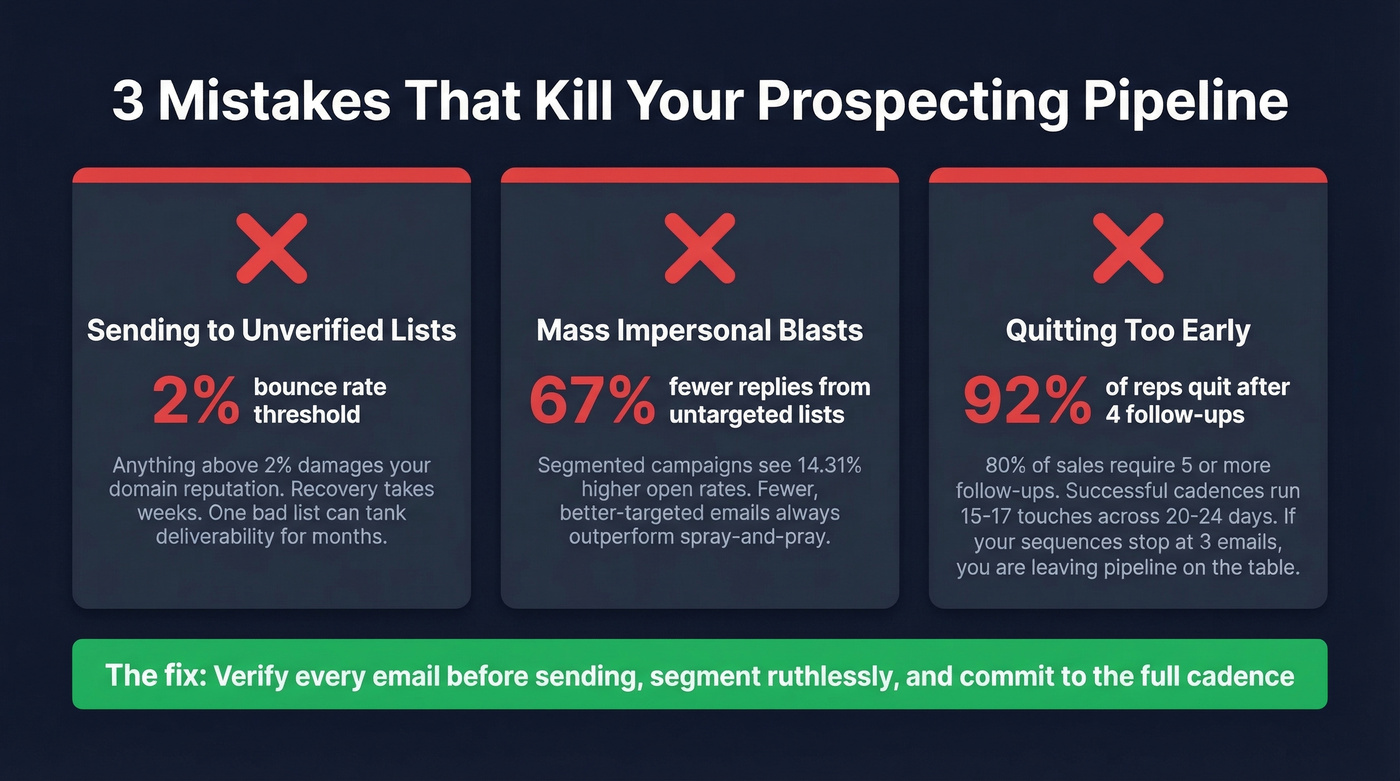
Quitting too early. 80% of sales require 5+ follow-ups, but 92% of reps quit after 4. Successful cadences often run 15-17 touches across 20-24 days. If your sequences stop at three emails, you're leaving pipeline on the table.
FAQ
Is a CRM the same as a prospecting tool?
No. A CRM like HubSpot or Salesforce manages existing relationships and pipeline stages - it doesn't discover new contacts. Most teams pair their CRM with a dedicated data platform for contact discovery and a sequencer for outreach.
How much do prospecting tools cost?
Self-serve platforms start free - Prospeo offers 75 verified emails/month at no cost, Apollo has a limited free tier. Mid-market tools run $100-$700/month per seat. Enterprise databases like ZoomInfo start around $30K/year with annual commitments.
Do I need more than one tool?
Almost certainly. 89.9% of companies use two or more. A proven stack: one tool for verified contact data, one for email sequencing, and your CRM. Three tools cover the full workflow without forcing you into an overpriced all-in-one.
What's the best free option for small teams?
Prospeo's free tier includes 75 verified emails and 100 Chrome extension credits per month with full enrichment - enough to run real outbound campaigns. Apollo also offers a free plan, though email accuracy is lower. For sequencing, Instantly's entry plan starts at $37/month.