

What Is an Email Subject Line - and How to Write One That Gets Opened
You spend 45 minutes crafting the perfect cold email. The prospect never sees it because the subject line didn't earn the open. That tiny strip of text before the preview pane? It's the highest-leverage sentence in your entire outreach workflow. Here's what makes it work, backed by real numbers.
Email Subject Line Definition
An email subject line is the single line of text a recipient sees in their inbox before deciding whether to open, ignore, or delete your message. It sits between the "From" name and the preheader - that preview snippet shown next to or under the subject in most inboxes.
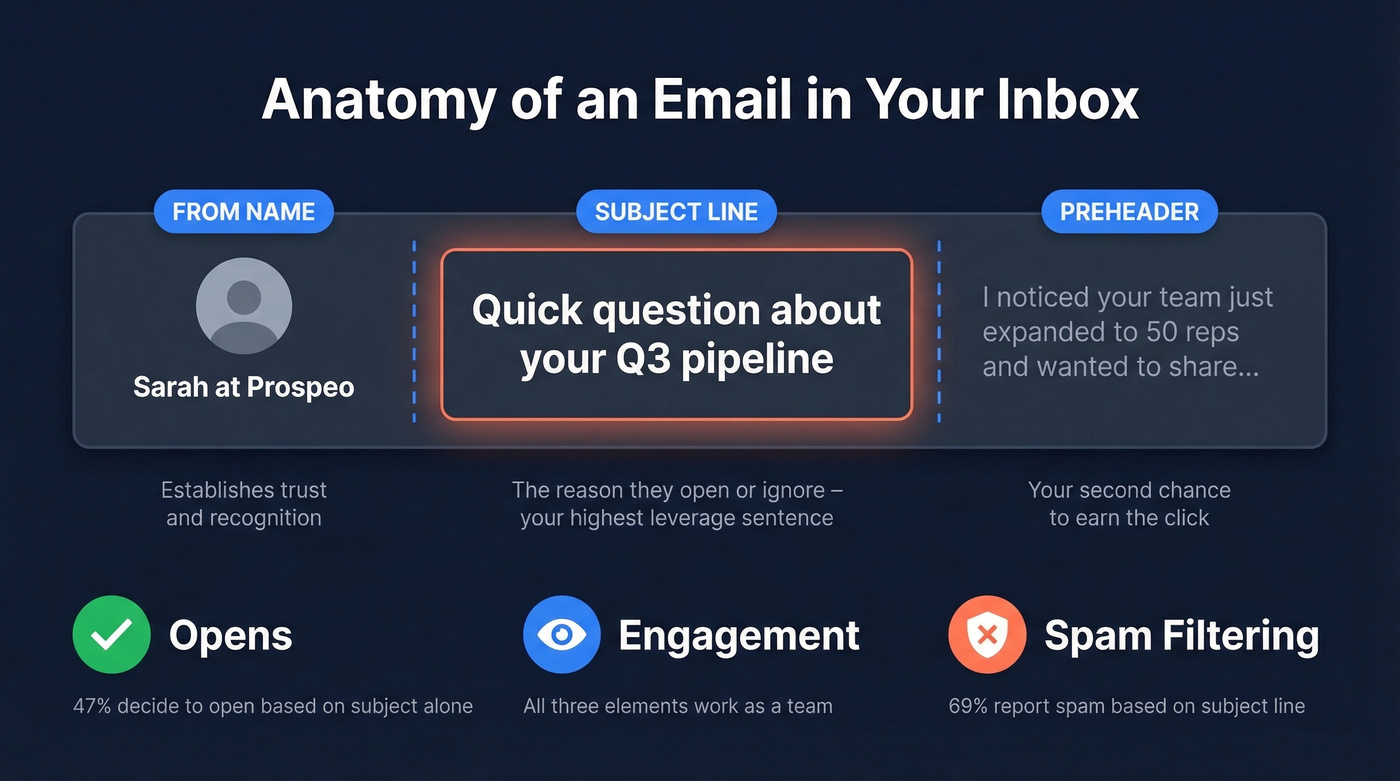
Think of these three elements as a team. The "From" name establishes who you are. The subject line tells the recipient why they should care. The preheader gives them one more reason to click. Most people obsess over the email body and treat the subject as an afterthought, which is exactly why so many emails die unopened.
The subject line is also one of the first things spam filters evaluate. It's not just a creative exercise - it's a deliverability decision.
Quick version:
- Keep subject lines to 2-4 words, around 40-50 characters for mobile safety.
- Add the recipient's first name - personalization lifts opens.
- A perfect subject line is worthless if the email bounces. Verify your list first.
Why Subject Lines Matter
The data is stark. 47% of recipients decide whether to open an email based solely on the subject line. Even more alarming: 69% report emails as spam based on the subject line alone. Your subject line is simultaneously your best shot at engagement and your biggest spam risk.
Then there's the mobile factor. 81% of emails are now opened on mobile devices. Your carefully crafted 80-character subject line gets chopped in half on an iPhone screen. The recipient sees a fragment, makes a snap judgment, and moves on.
The ROI math is simple. Email marketing returns $36-$40 for every dollar spent according to industry benchmarks from DMA and Litmus. But that return only materializes if people open the email. And opens start with the subject line.
Ideal Length by Device
"Keep it short" isn't actionable when Gmail shows ~70 characters and an iPhone shows 33-41. Let's get specific.
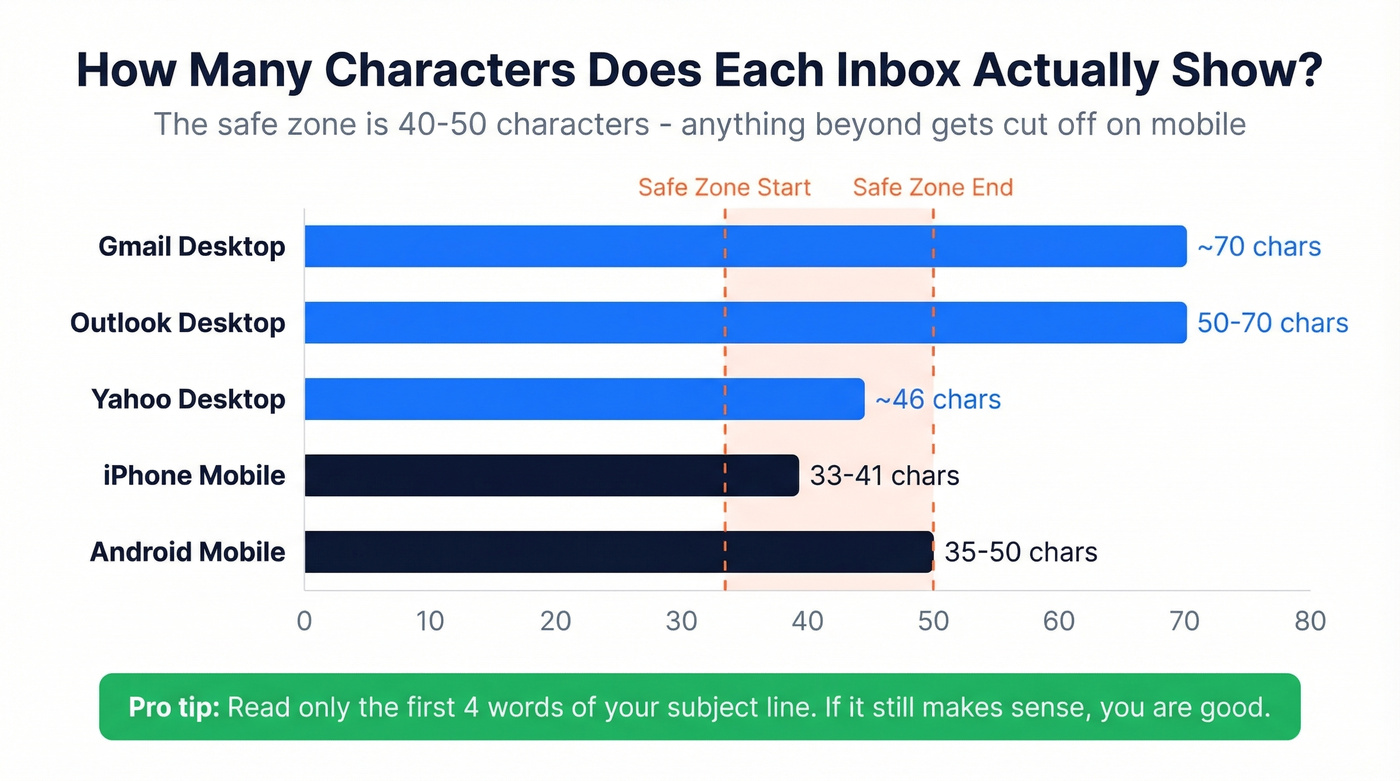
Twilio SendGrid's Cyber Week data found the average subject line ran 6 words, but the best-performing ones were just 2-4 words. Shorter consistently wins.
| Client | Platform | Characters Shown |
|---|---|---|
| Gmail | Desktop | ~70 |
| Outlook | Desktop | 50-70 |
| Yahoo | Desktop | ~46 |
| iPhone | Mobile | 33-41 |
| Android | Mobile | 35-50 |
The safe zone is 40-50 characters. That renders fully on every major mobile client and gives you enough room on desktop to be descriptive. Front-load the important words - if your subject line gets truncated, the first three words need to carry the message on their own.
A practical test: write your subject line, then read only the first four words. Does it still make sense? If not, restructure.
Subject Line Best Practices
Personalize It
Personalized subject lines hit 46% open rates vs. 35% without. That gap should bother you, because personalization is still underused in most campaigns - meaning it's a competitive advantage sitting right there.
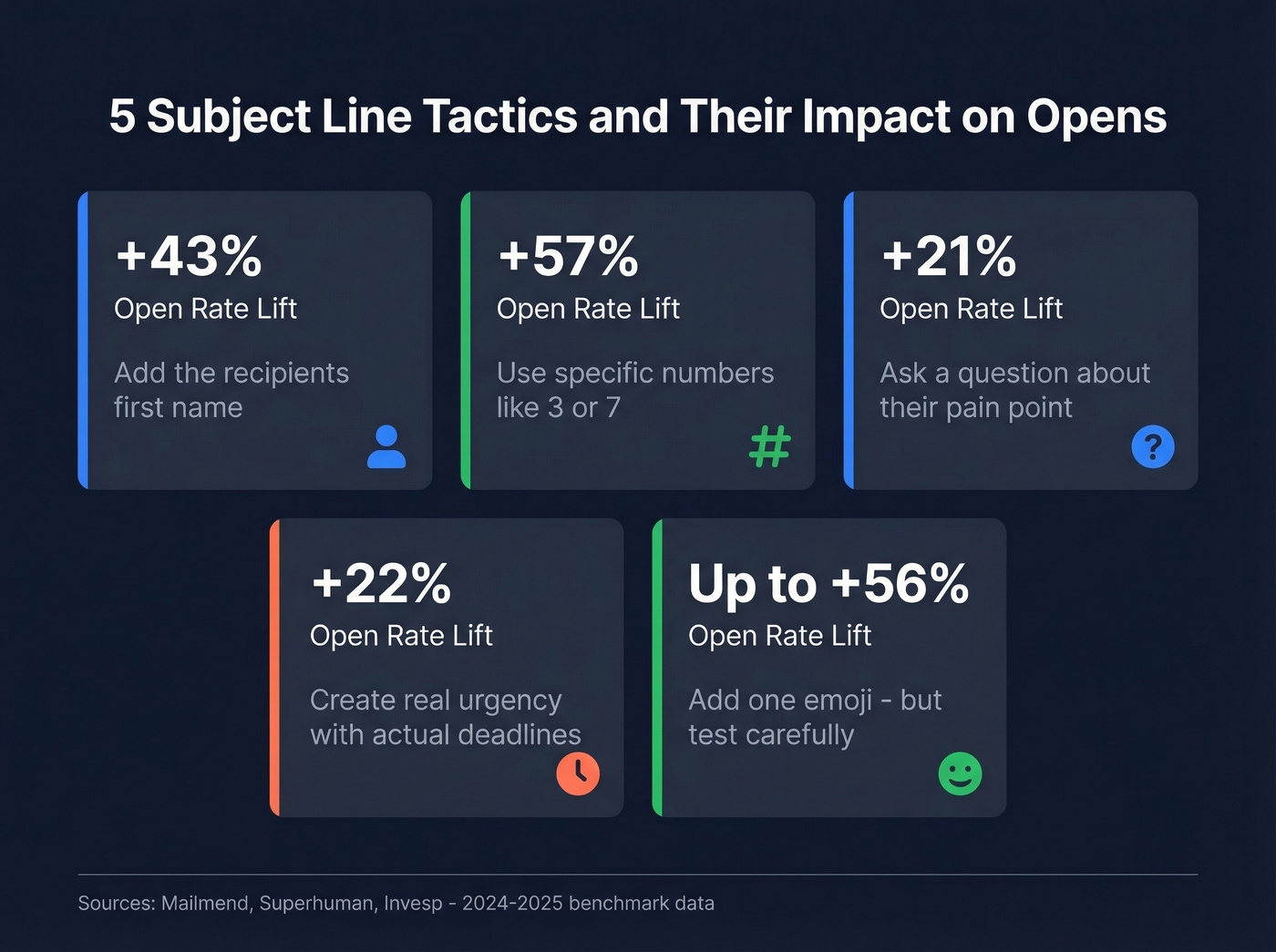
Including a recipient's first name boosts open rates by 43.41% and can lift response rates by 30.5%. But this doesn't mean every email needs "Hey {first_name}" - that's become its own cliche. Try the recipient's company name, their city, or a reference to a recent event. The goal is relevance, not just a merge tag.
Use Numbers
Consider two subject lines:
- "Ways to reduce customer churn"
- "3 ways to cut churn"
Subject lines with numbers see 57% higher open rates. Numbers create specificity and set expectations - the reader knows exactly what they're getting. Odd numbers tend to outperform even ones.
If you're writing cold outreach, it also helps to keep the rest of the message tight - especially your email copywriting.
Ask a Question
"Still using spreadsheets for pipeline tracking?"
That subject line works because the brain wants to close the open loop. The recipient feels compelled to answer, even if just mentally. Question-based subject lines achieve 21% higher open rates compared to statements, but the best questions reference a specific pain point the recipient actually has, which means you need to know your audience before you write.
Create Real Urgency
"ACT NOW!!!" - that's spam.
"Offer expires Friday at midnight" - that's urgency.
The difference matters. Urgency lifts opens by 22%, but modern recipients - especially B2B buyers - smell manufactured pressure instantly. It damages trust more than it drives clicks. Use real deadlines, real scarcity, or real consequences. If the urgency isn't genuine, skip it entirely.
Test Emojis Carefully
Emojis can boost open rates by up to 56%, but the caveats are real. Not all emojis render the same across devices and inboxes - check Emojipedia before committing. Stick to a single emoji at the beginning or end. Overuse increases spam risk, and multiple emojis in a row look unprofessional in B2B contexts.
Don't Forget the Preheader
The preheader is your second subject line. Most email clients display a short preview snippet right after the subject, and too many senders waste it by letting their email client auto-pull "View in browser" or an image alt tag. Write a deliberate preheader that reinforces or expands on your subject line's promise.
If you want to test this systematically, run an email preview text A/B testing experiment alongside your subject line tests.
Words That Boost and Kill Opens
Not all words are created equal.
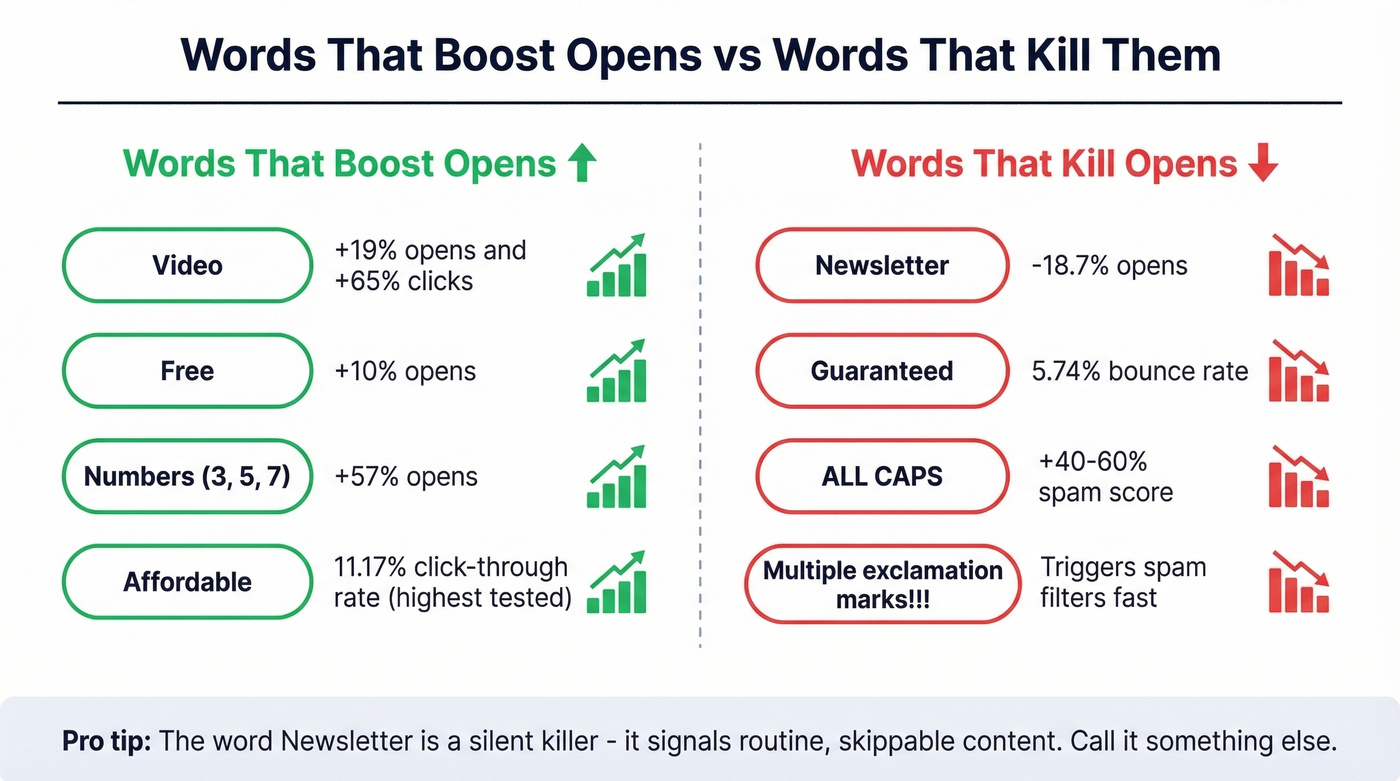
| Words That Help | Impact |
|---|---|
| "Video" | +19% opens, +65% clicks |
| "Free" | +10% opens |
| "Affordable" | 11.17% CTR (highest) |
| Numbers | +57% opens |
| Words That Hurt | Impact |
|---|---|
| "Newsletter" | -18.7% opens |
| "Guaranteed" | 5.74% bounce rate |
| ALL CAPS + excessive punctuation | +40-60% spam score |
The "Video" stat is worth highlighting. Even if you don't have a video, linking to a short Loom walkthrough and flagging it in the subject line will lift engagement. "Free" still works despite years of spam association - context matters more than the word itself.
And "Newsletter" is a silent killer. It signals routine, skippable content. If you're sending a newsletter, call it something else.
If you need more inspiration, pull from a swipe file of email subject line examples and adapt them to your audience.

Personalized subject lines lift opens by 43%, but personalization requires accurate data. Prospeo gives you verified emails, job titles, company names, and 50+ data points per contact - so every merge tag actually works.
Stop personalizing emails to addresses that bounce.
Spam Trigger Words to Avoid
160 billion spam emails hit inboxes every day. While modern filters evaluate patterns, tone, and sender context rather than just keywords, stacking multiple trigger words in a single subject line is still a fast path to the junk folder.
| Instead of This | Write This |
|---|---|
| "100% free" | "Complimentary" or "Included" |
| "Limited time only" | "Available through [date]" |
| "Guaranteed success" | "Proven results" |
| "Act now" | "Worth a look this week" |
| "Click here" | Descriptive link text |
ALL CAPS combined with excessive punctuation increases spam scores by 40-60%. Writing "FREE OFFER!!!" is essentially asking to be filtered. One exclamation mark is fine. Three is a spam signal.
We've seen teams rewrite subject lines obsessively while ignoring the fact that their sender reputation was already damaged. The words matter, but they're one layer in a system that includes authentication (SPF/DKIM/DMARC), engagement history, and list quality.
If you want a deeper checklist, run your copy through an email spam checker before you send.
Open Rate Benchmarks for 2026
HubSpot's benchmark data puts the average open rate across industries at 42.35%.
| Industry | Open Rate | CTR | Bounce |
|---|---|---|---|
| Retail | 38.58% | 1.34% | 0.62% |
| B2B Services | 39.48% | 2.21% | 0.50% |
| Nonprofit | 46.49% | 2.66% | 0.80% |
| SaaS | 38.14% | 1.19% | 0.50% |
Mailchimp's most recent public benchmark: All Users 35.63% open rate and 2.62% click rate.
General guidance: above 30% is solid, 45-50% is strong, 50%+ is exceptional. Here's the catch, though.
Apple Mail Privacy Protection has inflated open rates across the board. A study of 80,000+ accounts found open rates rose 18 points after MPP rolled out, and Apple Mail accounts for 46% of email clients. That means nearly half your "opens" are phantom opens triggered by Apple's proxy servers, not actual humans reading your email.
Let's be honest: open rates are a vanity metric in 2026. Click-through rate and reply rate are far more reliable indicators of whether your subject line actually resonated. Track opens for directional trends, but make decisions based on clicks and replies.
To go deeper on what “good” looks like, compare against a standard email open rate by segment and list source.
How to A/B Test Subject Lines
- Write two variants that differ on one variable - length, personalization, emoji, or question vs. statement. Don't change three things at once.
- Send to ~20% of your list, split evenly between the two versions.
- Wait 1-2 hours before selecting the winner.
- Send the winner to the remaining 80%.
- Time it right. Open rates peak between 8-11 AM in the recipient's time zone.
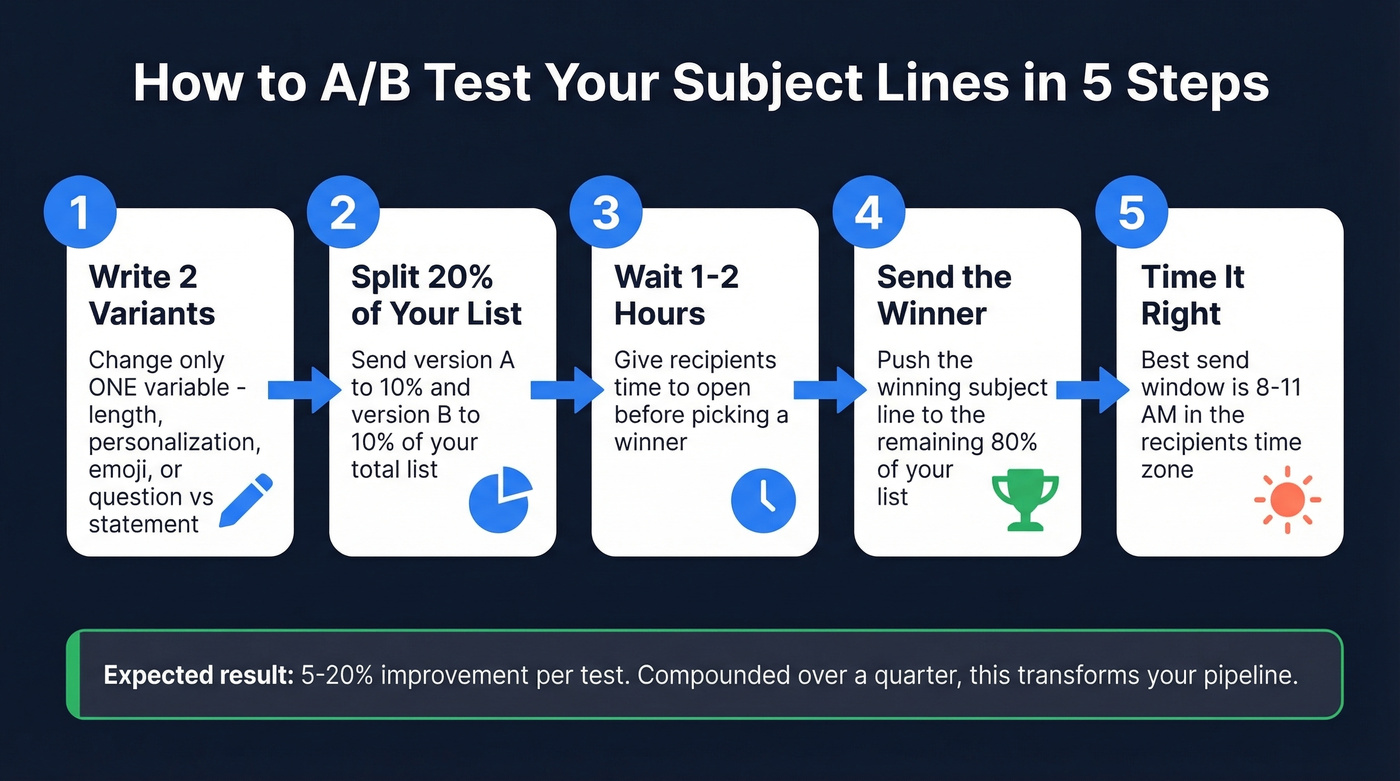
A well-designed test often delivers 5-20% improvement. That sounds modest, but compounded over dozens of campaigns, it's the difference between a mediocre pipeline and a strong one. In one well-known test, Teleflora saw a 3X open rate lift just by adding the recipient's first name to the subject line. We've watched teams improve reply rates by double digits over a quarter through systematic testing alone - no magic, just discipline.
If you're testing cold outreach specifically, align your subject tests with your cold email sequence so you don't optimize one email in isolation.
The Part Nobody Talks About: Your Data
Here's the thing about subject line guides: none of this matters if your emails don't reach the inbox.
Bad email data leads to bounces, which damage sender reputation, which pushes future emails to spam - and your subject line never gets seen. If your bounce rate is above 3-5%, stop rewriting subject lines and fix your data first. A great subject line on a blacklisted domain is like a billboard in an empty field.
Prospeo's 5-step verification catches spam traps, honeypots, and catch-all domains before you hit send, with 98% email accuracy. One customer, Meritt, saw their bounce rate drop from 35% to under 4% after switching to verified data, and their pipeline tripled from $100K to $300K per week. Skip this step if your list is already clean and your bounce rate is under 2% - but for everyone else, verification should come before copywriting.
If you’re diagnosing issues, start with your email bounce rate and work backward to list source and sending practices.
You just learned how to write subject lines that earn opens. Now make sure those emails actually land. Prospeo's 98% email accuracy and 5-step verification keep your bounce rate under control - because a perfect subject line is worthless in the spam folder.
Protect your domain reputation at $0.01 per verified email.
Email Subject Line FAQ
How long should an email subject line be?
Aim for 2-4 words or 40-50 characters. iPhone displays cut off at 33-41 characters, so front-load your key message to survive truncation on every device.
Do emojis help email subject lines?
They can boost opens by up to 56%, but overuse increases spam risk. Test a single emoji against a plain-text version and verify rendering across Gmail, Outlook, and Apple Mail before scaling.
What's a good email open rate in 2026?
Above 30% is solid, 50%+ is exceptional. Apple MPP inflates numbers by ~18 points, so prioritize click-through and reply rates - they reflect genuine engagement more accurately.
Should I use "Re:" or "Fwd:" in cold emails?
No. Fake threading prefixes violate CAN-SPAM, destroy trust instantly, and are universally despised in cold email communities on Reddit and elsewhere. Write a genuine, specific subject line instead.
Does data quality affect subject line performance?
Absolutely. Bounced emails damage sender reputation, pushing future messages to spam regardless of how good your subject line is. Verify your list before optimizing copy - it's the foundation everything else sits on.