

What Is Cold Email Marketing - and Does It Still Work in 2026?
Your first cold email campaign looked perfect on paper. Fifty prospects, personalized subject lines, a clear CTA. Then 47 emails bounced, your domain got throttled, and the only reply was an auto-responder. As HBR noted, cold email is uniquely hard because you have no relationship with the recipient and zero real-time feedback to course-correct. Most cold emails fail - but the ones that don't can build pipeline from scratch.
The Short Answer
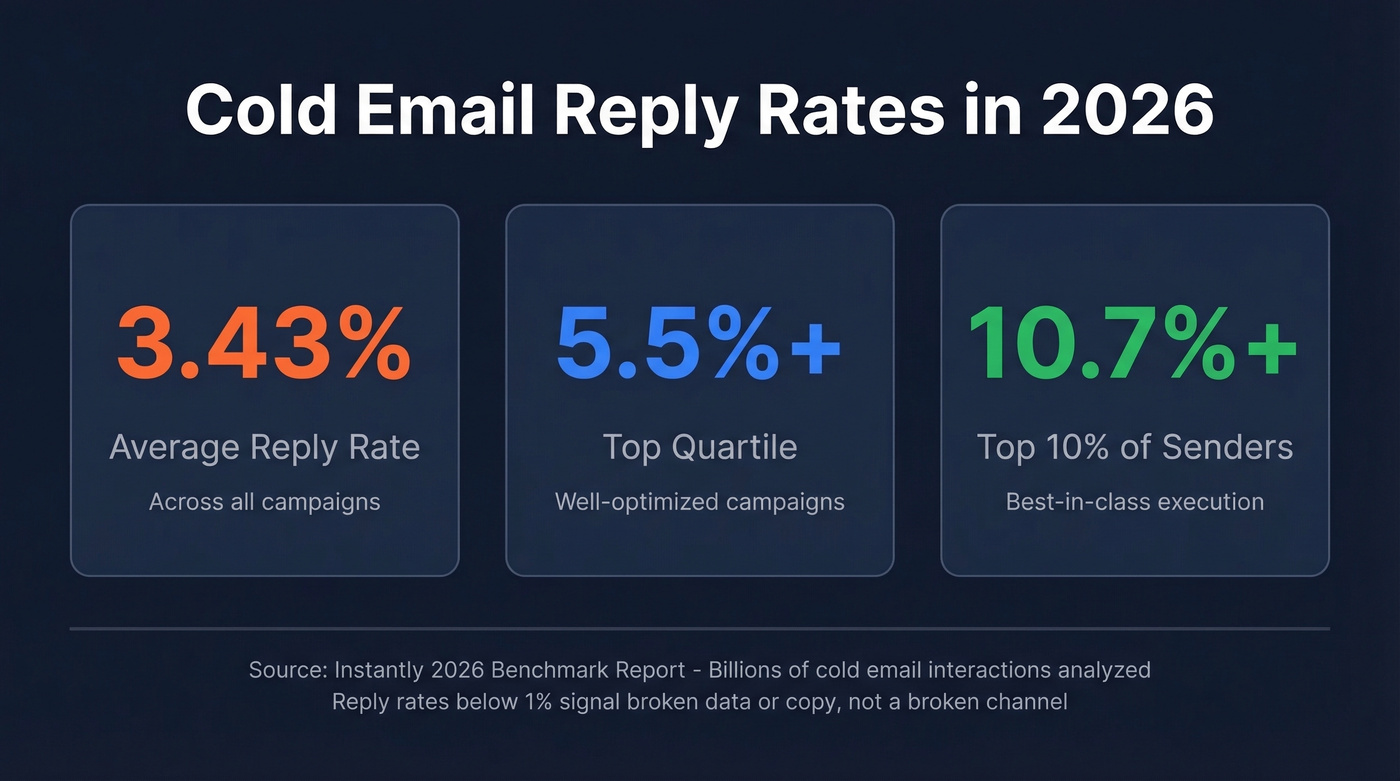
Cold email marketing is sending targeted, one-to-one emails to prospects who haven't opted in. It works in 2026 - the average reply rate is 3.43%, and top performers hit 10.7%+ - but only if you nail three things: verified data, warmed infrastructure, and legal compliance. Most campaigns fail before the first send because the setup is broken.
Cold Email Marketing Defined
Cold email marketing means reaching out to a specific person at a specific company with a relevant message, even though they haven't heard from you before. You're starting a conversation, not blasting a newsletter.
The confusion usually starts when people lump it in with email marketing or, worse, spam. They're different activities with different legal frameworks, different goals, and different infrastructure.
| Cold Email | Email Marketing | Spam | |
|---|---|---|---|
| Consent | No prior opt-in | Opted-in list | None |
| Targeting | ICP-matched | Segmented subscribers | Untargeted mass |
| Personalization | 1-to-1, role-specific | Segment-level | Generic or deceptive |
| Goal | Start a conversation | Nurture or convert | Sell/scam at volume |
| Legal basis | Opt-out / legitimate interest | Consent-based | Violates most laws |
The GMass framework breaks the distinction into five dimensions: intent (you're solving a real problem), targeting (you researched this person), buyer-centricity (the email is about them, not you), honesty (no deceptive headers or misleading subjects), and data sourcing (you found their email through legitimate research, not a scraped dump).
A cold email becomes spam the moment you stop caring about relevance. Send the same template to 10,000 unresearched contacts and you're a spammer, regardless of what you call it. Cold outreach scales better than cold calling for enterprise prospecting, while calling works better for high-value mid-market accounts where a personal touch matters. But for top-of-funnel pipeline generation, nothing beats a well-executed cold email program.
Does It Still Work in 2026?
Yes. The bar is just higher than it was two years ago.
The Instantly 2026 benchmark report analyzed billions of cold email interactions across thousands of active workspaces. Average reply rate: 3.43%. Top quartile campaigns hit 5.5%+. The top 10% of senders clear 10.7%. SoPro's dataset of 151 million outreach points puts the average response rate at 5.1%, with most campaigns landing between 1-5%.
The trend line matters, though. Belkins reported a 15% drop in reply rates between 2023 and 2024, driven by inbox fatigue and tighter spam filtering. Teams that adapted moved to multichannel sequences - cold email plus calls plus social touches - and saw 20% higher close rates and 25% shorter sales cycles.
Here's the thing: single-channel, low-effort outreach is dying. If you're willing to invest in infrastructure, data quality, and genuine personalization, the channel still converts better than almost anything else at the top of the funnel.
Benchmarks to Know
Before you launch anything, you need to know what "good" looks like. Open rates used to be the default metric, but Apple Mail Privacy Protection and bot pre-fetching have made them unreliable. Reply rate is the metric that matters now.
| Metric | Average | Top Quartile | Red Flag |
|---|---|---|---|
| Reply rate | 1-3.4% | 5.5%+ | <1% |
| Positive reply rate | 0.5-1.5% | 2-4% | <0.3% |
| Meeting booked rate | 0.3-0.8% | 1-2% | <0.2% |
| Bounce rate | 2-5% | <2% | >5% |
| Unsubscribe rate | 0.3-1% | <0.3% | >1% |
These ranges pull from Instantly's dataset and SaaS-specific benchmarks.
Let's do the funnel math. If you send 1,000 cold emails at the average 3.43% reply rate, expect about 34 replies. At a typical 30% positive reply rate, that's roughly 10 interested prospects. Convert 30-40% to meetings and you're looking at 3-4 booked calls per 1,000 sends. Work backward from your pipeline target to figure out how many emails you need to send each week.
If your bounce rate is above 5%, stop sending immediately. That's a stop signal for deliverability and domain reputation. Below 1% reply rate? The problem is almost always data quality or copy, not the channel itself.
Infrastructure That Makes or Breaks You
Most campaigns fail before a single prospect reads a word. Spam accounts for roughly 47% of global email traffic, so inbox providers are aggressive with filtering. Authentication and warm-up aren't optional - they're the foundation everything else sits on.
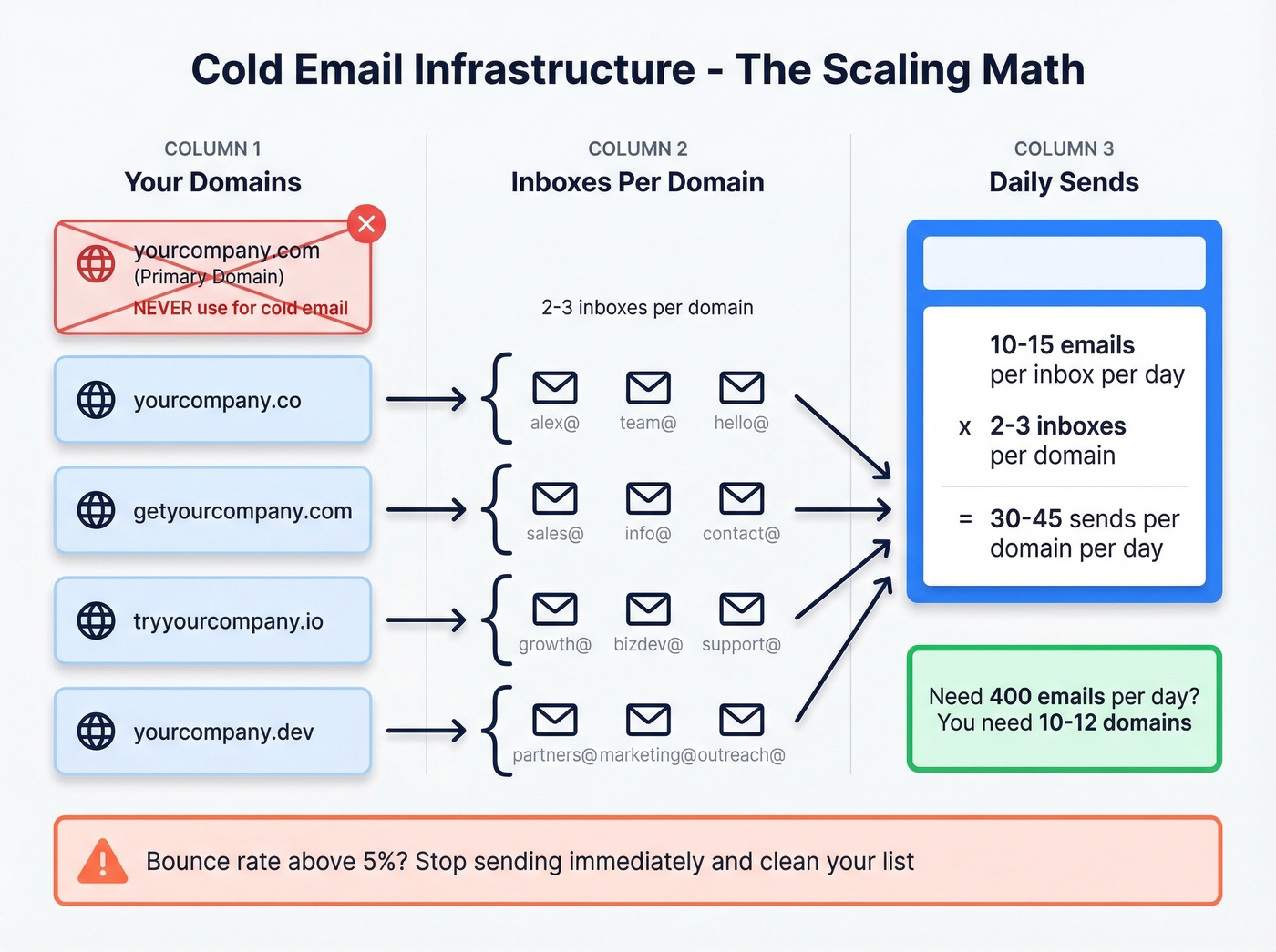
Never send cold email from your primary domain. Buy secondary domains - variations like yourcompany.co or getyourcompany.com - and dedicate them to outbound. If a sending domain gets flagged, your main domain stays clean.
The scaling math is straightforward: 10-15 emails per day per inbox, 2-3 inboxes per domain, which gives you roughly 30-45 sends per domain per day. Targeting 400 emails per day? You need 10-12 domains. This isn't optional.
Every domain needs SPF, DKIM, and DMARC configured before you send anything. These authentication records tell inbox providers you're legitimate. Skip them and Gmail will bury you. (If you want to go deeper on the technical side, start with email deliverability and DMARC alignment.)
Then comes warm-up:
| Week | Daily Volume | Activity |
|---|---|---|
| Week 1 | 5 to 25 | Warm-up emails only |
| Week 2 | 25 to 50 | Continue warm-up |
| Week 3 | 75-100 | Mix in cold sends |
| Week 4 | Stabilize 50-100 | Full cold volume |
Minimum warm-up period is 14 days. 21 is safer. Keep warm-up running even after you start sending cold emails. And if your bounce rate crosses 5% in the first week, stop everything and clean your list.
One practitioner on r/coldemail shared that they burned 145 email accounts in a single week by skipping warm-up and launching at full volume. That's not an edge case - it's what happens when you treat infrastructure as optional.

You just read that 28% of B2B emails go invalid every year and bounces above 5% kill your domain. Prospeo's 7-day data refresh cycle and 98% verified email accuracy keep your cold email infrastructure clean - so you never burn a sending domain over bad data again.
Stop burning domains. Start with emails that actually land.
Build and Verify Your Prospect List
About 28% of B2B email addresses become invalid every year due to job changes, company restructuring, and role shifts. Nearly a third of any list you built six months ago is already decaying.
Start with your ICP. Define the job titles, industries, company sizes, and geographies you're targeting before you touch a data tool. Sourcing contacts without a clear ICP is how you end up emailing 5,000 people who'll never buy.
Then verify everything before you send. We've seen teams go from 35-40% bounce rates to under 5% simply by running their lists through proper verification. That's the difference between a campaign that builds pipeline and one that destroys your domain.

Write Emails That Get Replies
The best infrastructure in the world won't save a bad email.
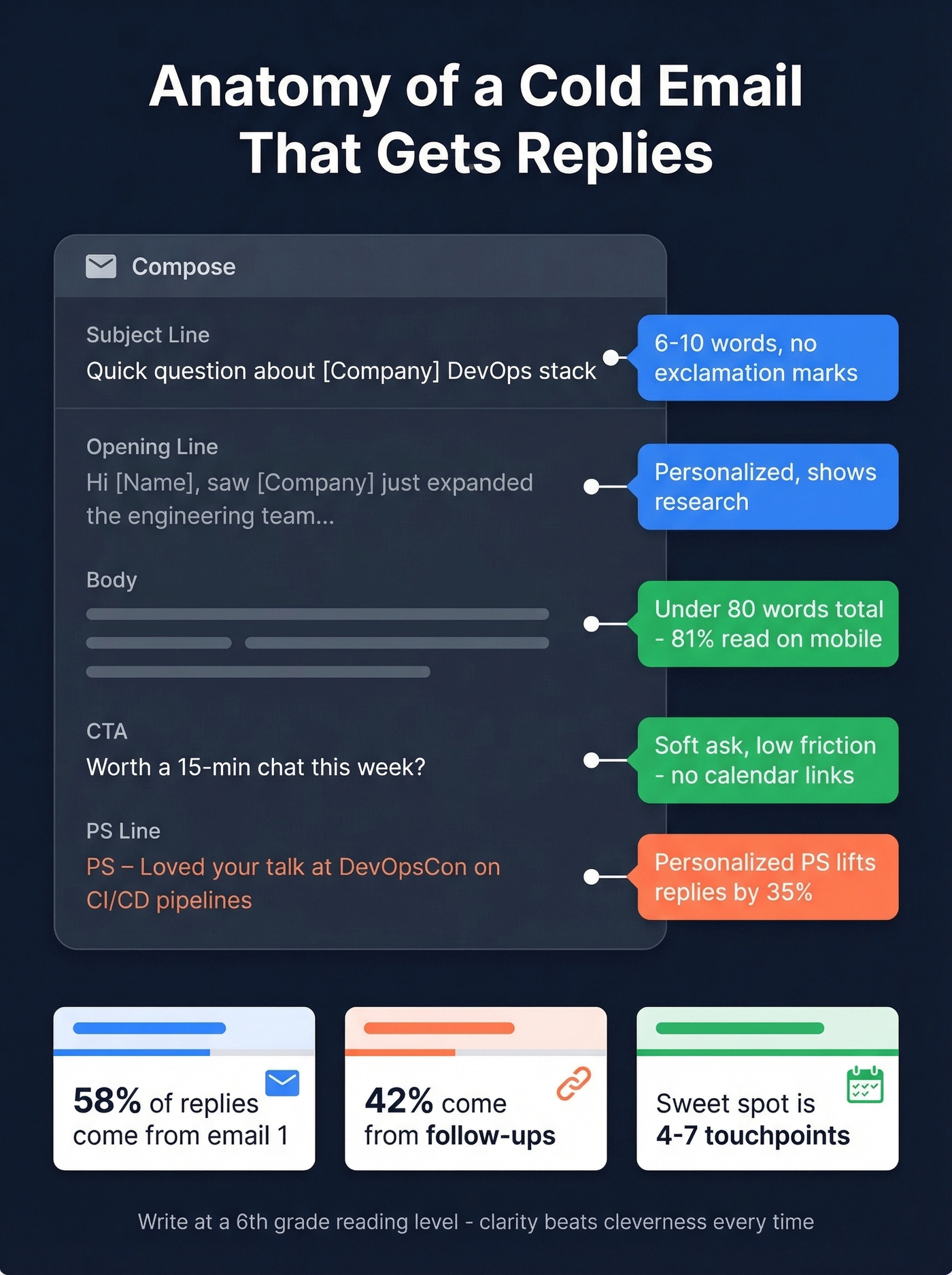
The best-performing campaigns in 2026 keep emails under 80 words. 81% of emails are opened on mobile, so brevity isn't a preference - it's a format constraint. Subject lines should land between 6-10 words. Skip the exclamation marks. (If you need ideas, pull from proven subject lines.)
Write at a 6th-grade reading level. This isn't about dumbing things down - it's about clarity. Simpler language drives significantly higher engagement because busy executives scan, they don't study. Pair that with a single, soft CTA. "Worth a 15-minute chat?" beats "Book a 30-minute demo on my calendar." Lower friction, higher conversion. If you're stuck, use a simple email call to action framework.
Personalize the PS line. Adding a personalized postscript lifts reply rates by roughly 35%. It's the last thing they read and the easiest place to show you did your homework.
Follow up - and know where the replies come from. In Instantly's 2026 data, 58% of replies come from step 1 of a sequence, and follow-ups drive the remaining 42%. The sweet spot is 4-7 touchpoints. Beyond that, you hit diminishing returns unless you're adding new value. Tuesday and Wednesday are peak send days, with Wednesday performing best. (For ready-to-use copy, see cold email follow-up templates.)
Our hot take: if your average deal size is under $10K, you probably don't need a 7-touch sequence with custom video and handwritten notes. Three well-timed, well-written emails will outperform a bloated sequence that takes your reps 20 minutes per prospect. Complexity is the enemy of volume at lower deal sizes.
Legal Compliance
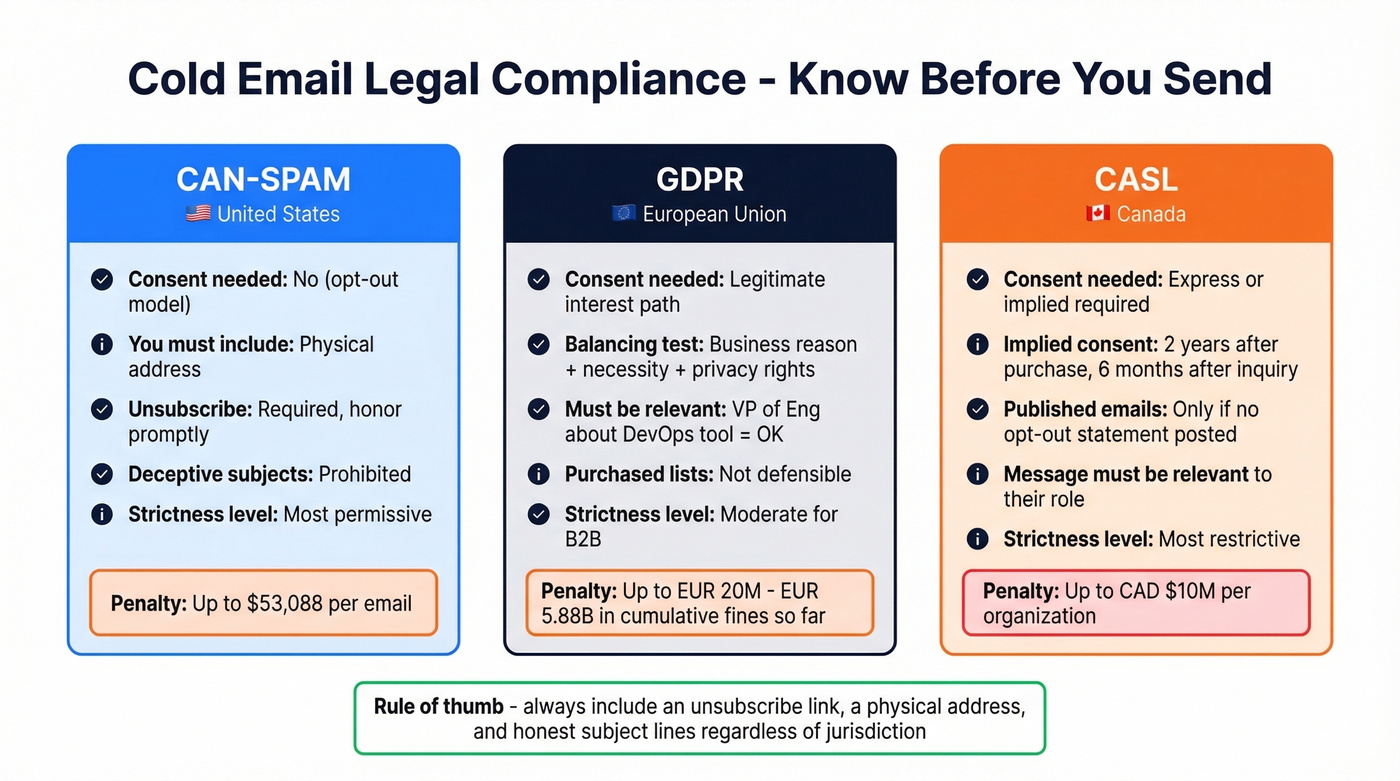
CAN-SPAM penalties run up to $53,088 per email. GDPR fines reach EUR 20M. CASL can hit CAD $10M per organization. These aren't theoretical - the Spam Reporting Centre logged 152,603 complaints in six months of 2025, alongside 153 Notices to Produce and 123 Warning Letters.
CAN-SPAM (United States)
CAN-SPAM is an opt-out framework. You don't need prior consent to send a cold email, but you must include a physical mailing address, a working unsubscribe mechanism, and accurate header information. No deceptive subject lines. Honor opt-outs promptly. It's the most permissive of the three frameworks.
GDPR (European Union)
GDPR doesn't ban cold email outright. The path most B2B senders use is "legitimate interest," which requires a three-part balancing test: you have a genuine business reason to reach out, the processing is necessary, and the recipient's privacy rights don't override your interest. Emailing a VP of Engineering about a DevOps tool their company likely needs? Defensible. Blasting a purchased list? Not even close. Cumulative GDPR fines have exceeded EUR 5.88B, with roughly 35% tied to consent violations.
CASL (Canada)
CASL is the strictest. You need either express or implied consent before sending. Implied consent covers existing business relationships (2 years after a purchase, 6 months after an inquiry) and conspicuously published email addresses - but only if the email is publicly posted, there's no "no unsolicited messages" statement, and your message is relevant to the recipient's role. Unsubscribe requests must be processed within 10 business days.
Beyond jurisdiction-specific rules, Gmail and Yahoo's 2024 enforcement changes apply to everyone: SPF/DKIM/DMARC are mandatory, one-click unsubscribe is required for bulk senders, and your spam complaint rate must stay below 0.3%.
Mistakes That Kill Campaigns
These are the errors we see over and over. Most are preventable in under an hour.
- Not warming up domains. Launching at full volume on a fresh domain is the fastest way to land in spam permanently.
- Sending from your primary domain. One bad campaign and your company email reputation is toast.
- Skipping list verification. A 10% bounce rate will tank your sender reputation in days.
- Missing the unsubscribe link. It's required under CAN-SPAM and CASL, and it's the practical standard for GDPR-friendly cold outreach.
- Multiple CTAs. One ask per email. Period.
- Too many links or HTML. Plain text outperforms designed emails in cold outreach. Spam filters flag link-heavy messages.
- No SPF/DKIM/DMARC. If you haven't configured authentication, nothing else matters.
- No follow-up plan. Follow-ups drive 42% of replies - skipping them leaves results on the table.
- Emailing your own customers. One Reddit user shared the horror of sending a prospect their own case study as a "success example." Set up CRM exclusion lists before you launch.
- Broken merge tags. Nothing screams "mass email" like "Hi
{first_name}, I noticed your company{company_name}..."
Tools You Need
You don't need a 12-tool stack. Three categories, covered well.
Data & Verification: Prospeo is the strongest option here - 98% email accuracy at roughly $0.01 per lead, with native integrations into Instantly, Smartlead, and Lemlist so verified contacts flow straight into your sequences. Apollo is another solid choice, especially if you want a free-tier database to start with. Paid plans run from $59/mo per user, though you'll want to verify emails separately since their accuracy sits around 79%. (If you're comparing options, start with data enrichment services or a sales prospecting database.)
Sending Platform: Instantly (~$30-97/mo) is the most popular for dedicated cold email. Smartlead (~$39-94/mo) handles multi-inbox rotation well. Lemlist (~$39-99/mo) adds multichannel sequences. Saleshandy starts at $25/mo and works fine for smaller volumes. Skip this category if you're already running outbound through Salesloft or Outreach - no need to double up.
Warm-Up: Use your sending platform's built-in warm-up tool. Instantly and Smartlead both include it. The warm-up schedule matters more than the specific tool - follow the ramp table above and don't rush it.
The math is simple: 1,000 cold emails at 3.43% reply rate = 34 replies. But only if those emails reach real inboxes. Prospeo gives you 143M+ verified emails with 5-step verification, catch-all handling, and spam-trap removal - at $0.01 per email. No contracts, no sales calls.
Send 1,000 cold emails that actually arrive for under $10.
FAQ
Is cold email marketing legal?
Yes, in most jurisdictions. CAN-SPAM (US) requires an opt-out mechanism and physical address. GDPR (EU) requires legitimate interest. CASL (Canada) requires implied or express consent. Penalties reach $53,088 per email under CAN-SPAM and EUR 20M under GDPR, so compliance isn't negotiable.
What's a good cold email reply rate?
The average is 3.43% based on Instantly's 2026 benchmark data. Top quartile campaigns hit 5.5%+, and above 10% puts you in the top 10% of senders. Below 1% usually signals a data quality or messaging problem - not a broken channel.
How many follow-ups should I send?
Four to seven touchpoints is the sweet spot. Step 1 generates 58% of replies, but follow-ups contribute the remaining 42%. Beyond seven touches, returns diminish sharply unless each message adds genuinely new value.
How do I keep cold emails out of spam?
Use secondary domains, authenticate with SPF/DKIM/DMARC, warm up for 2-3 weeks, and verify your list to keep bounces under 2%. Stay below a 0.3% spam complaint rate. Plain text emails with limited links outperform HTML-heavy designs in cold outreach.
What's a good free tool for cold email list building?
Prospeo's free tier includes 75 email credits per month with full verification - enough to test a small campaign with 98% accuracy. Apollo also offers a free database tier, though its email accuracy (around 79%) means higher bounce risk without additional verification.