

What Is Drip Email? Definition, Benchmarks, and How to Build One That Converts
Automated email sequences generate 3.3x higher click rates and 13.2x higher order rates than one-off campaigns. That's not a marginal improvement - it's a different category of performance entirely. Yet most teams still send one-off blasts and wonder why conversions stay flat.
If you've ever asked "what is drip email?" the short answer: it's the fix.
Drip Email Meaning Explained
A drip email campaign is a sequence of automated emails sent on a predetermined schedule, triggered by a specific action - a signup, a purchase, an abandoned cart, a form fill. Instead of blasting your entire list with one message and hoping for the best, you deliver the right message at the right time, automatically.
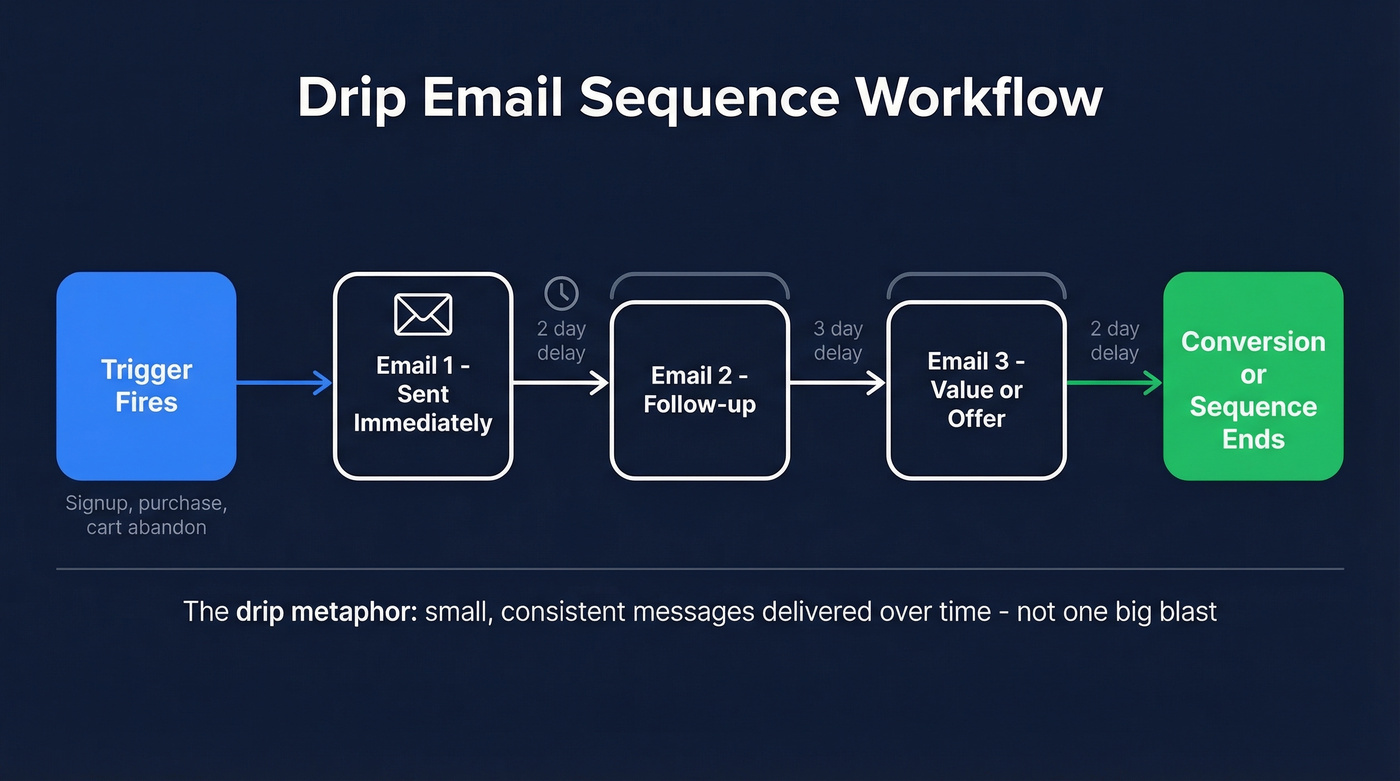
The concept is simple. A trigger fires, email one goes out immediately, a delay passes, email two follows, another delay, email three, and so on until the sequence ends or the recipient converts.
You'll hear drip campaigns called automated email sequences, lifecycle emails, autoresponders, or marketing automation flows depending on the platform. The terminology shifts, but the underlying logic is identical: time-based, automated, sequential. The "drip" metaphor comes from drip irrigation - small, consistent amounts of water delivered over time instead of flooding a field. You're nurturing contacts with steady, relevant touchpoints rather than drowning them in a single blast.
Does It Actually Work?
Yes. Across 183,000+ brands, automated flows average a 5.58% click rate and 2.11% order rate, compared to 1.69% clicks and 0.16% orders for one-off campaigns. That's not subtle.
Here's a quick shortlist if you want to skip ahead to tools:
- Klaviyo - killer Shopify/WooCommerce integration, flow builder purpose-built for cart abandonment and post-purchase.
- ActiveCampaign - deep behavioral triggers, built-in CRM, serious automation logic.
- Brevo - starts at $9/mo, solid deliverability, generous free tier at 300 emails/day.
2026 Benchmarks: Drip vs. One-Off
These numbers come from Klaviyo's benchmark dataset of 183,000+ brands.
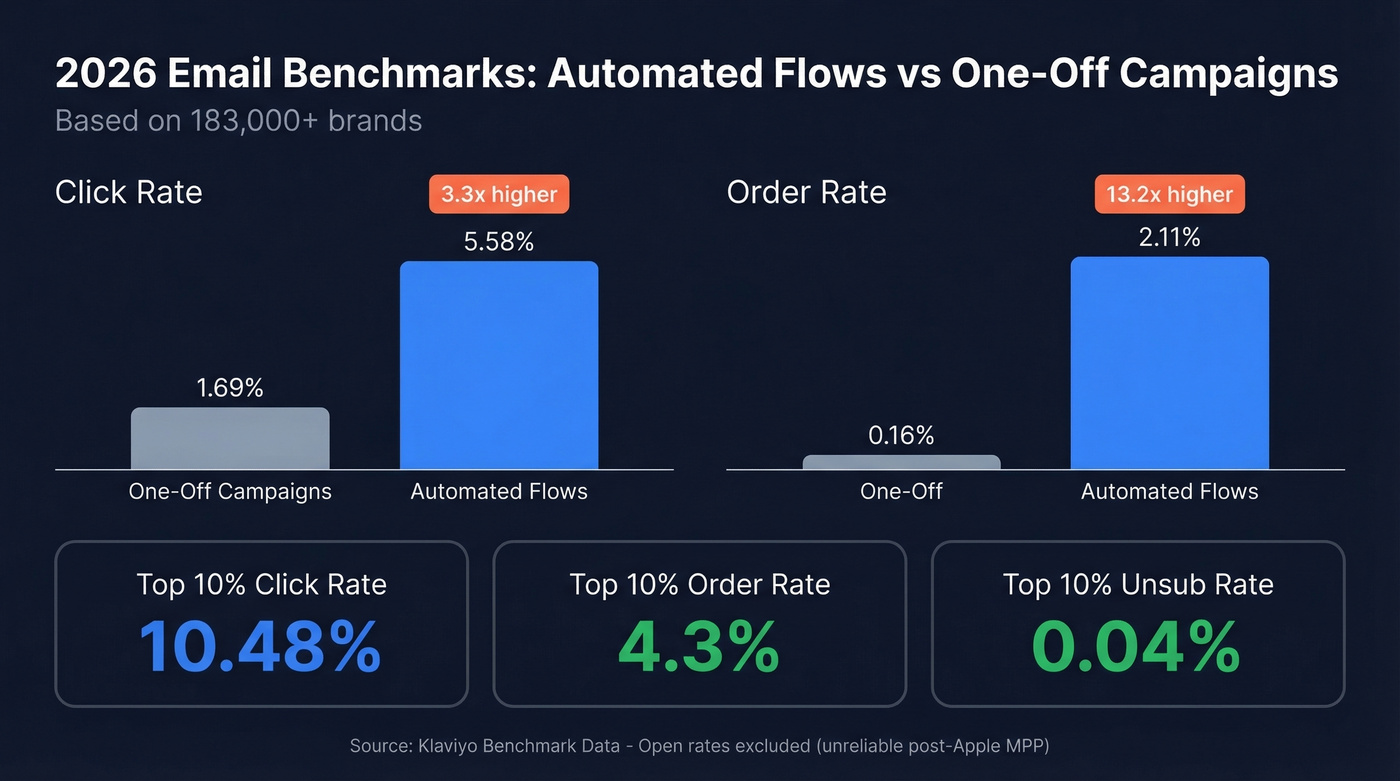
| Metric | One-Off Campaigns | Automated Flows | Flow Advantage |
|---|---|---|---|
| Click Rate | 1.69% | 5.58% | 3.3x higher |
| Order Rate | 0.16% | 2.11% | 13.2x higher |
| Top 10% Click | 3.38% | 10.48% | 3.1x higher |
| Top 10% Order | 0.36% | 4.3% | 11.9x higher |
Open rates are less meaningful post-Apple MPP, so they're excluded here. Clicks and conversions are the metrics that actually move revenue.
And here's what "good" looks like for automated flows specifically:
| Metric | Average | Top 10% |
|---|---|---|
| Open Rate | 48.57% | 65.74% |
| Click Rate | 4.67% | 12.22% |
| Order Rate | 1.42% | 4.93% |
| Unsub Rate | 0.81% | 0.04% |
If your automated sequences hit below 40% opens or under 3% clicks, there's room to improve. Notice the unsubscribe gap: top performers run 0.04% unsubs versus 0.81% average. That 20x difference comes down to segmentation and list hygiene - the top 10% aren't just writing better emails, they're sending to cleaner, more targeted lists.
Drip vs. Nurture vs. Blast
These three terms get used interchangeably, and they shouldn't.
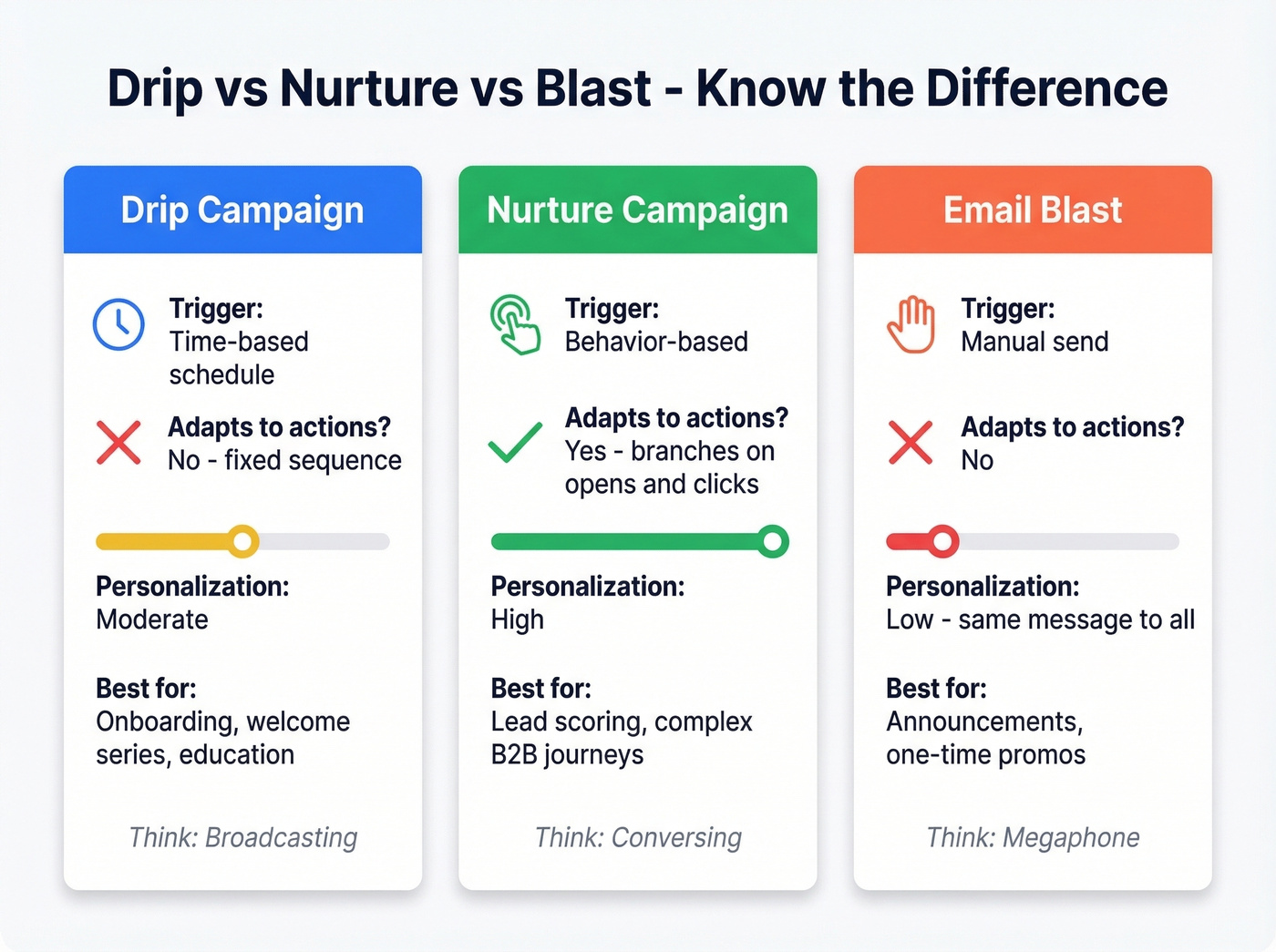
| Drip Campaign | Nurture Campaign | Email Blast | |
|---|---|---|---|
| Trigger | Time-based schedule | Behavior-based | Manual send |
| Adapts to actions? | No - fixed sequence | Yes - branches on opens/clicks | No |
| Personalization | Moderate (segment-level) | High (individual behavior) | Low (same message to all) |
| Best for | Onboarding, welcome, education | Lead scoring, complex B2B | Announcements, promos |
The clearest way to think about it: drip is broadcasting, nurture is conversing. A drip sequence delivers the same emails on the same schedule regardless of what the recipient does. A nurture campaign watches behavior - opens, clicks, page visits - and adapts the next message accordingly.
In practice, most mature teams use both. Drips handle the structured stuff like welcome series, onboarding, and renewal reminders. Nurture handles the adaptive stuff like lead scoring, intent-based follow-ups, and multi-stakeholder B2B journeys.

You saw the data: top-performing drip campaigns run 0.04% unsub rates because they send to clean, verified lists. Prospeo's 5-step email verification and 7-day data refresh give your sequences the foundation they need - 98% accuracy, zero spam traps, no bounces torching your sender reputation.
Fix your list before you fix your copy. Start at $0.01 per verified email.
Types of Drip Campaigns
Welcome Series
The highest-performing drip type, period. Three to four emails over the first week - day 0, day 2, day 5, day 7. First email confirms the signup and sets expectations. Subsequent emails introduce your product, share social proof, and drive a first conversion.
Onboarding Sequence
Triggered by account creation or first purchase. The goal is activation, not selling. Walk users through setup, highlight key features, and reduce time-to-value. SaaS companies live and die by these sequences.
Abandoned Cart
The money sequence for ecommerce. Typically three emails: a reminder at 1 hour, a second nudge at 24 hours, and a final push with urgency or a discount at 48-72 hours.
One practical tip: don't recommend the exact abandoned item in your subject line. It feels surveillance-y and tanks trust. Reference the category or use a general "you left something behind" approach instead.
Lead Nurture
B2B buying cycles involve multiple stakeholders and longer timelines, so lead nurture drips run longer - six to ten emails over four to eight weeks, spaced five to seven days apart. Each email should move the prospect closer to a conversation, not just dump content on them.
Re-engagement
Targets subscribers who've gone cold - no opens or clicks in 60-90 days. Two to three emails that ask if they still want to hear from you. If they don't engage, suppress them. Your deliverability will thank you.
Renewal and Upsell
Triggered by contract dates or usage milestones. Start 30-60 days before renewal with value recaps, then layer in upgrade options or cross-sell recommendations. Timing matters more than copy here.
How to Build a Drip Campaign Step by Step
1. Define a single goal. Every drip sequence needs one clear objective - convert a trial user, recover an abandoned cart, book a demo. If you can't state the goal in one sentence, the sequence will be unfocused.
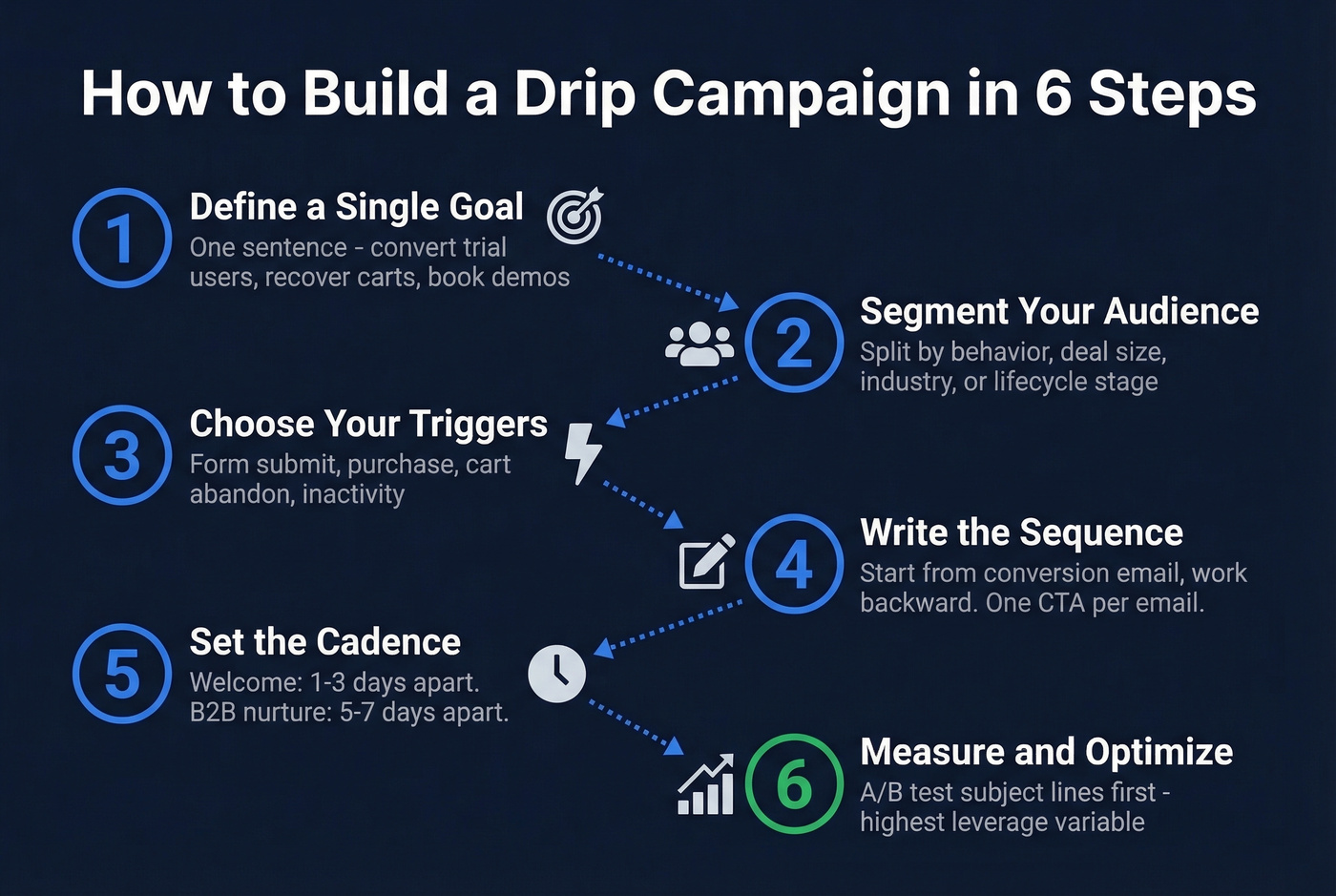
2. Segment your audience. Don't send the same welcome sequence to a $50/mo self-serve signup and a six-figure enterprise lead. Segment by behavior, deal size, industry, or lifecycle stage. Even basic segmentation dramatically improves performance.
3. Choose your triggers. Common triggers include form submission, purchase, cart abandonment, event registration, and inactivity thresholds. Match the trigger to the goal. Understanding how automated sequences work at this trigger level is what separates a high-performing campaign from a glorified newsletter.
4. Write the sequence. Start with the email closest to conversion and work backward. Each email should have one CTA, not three. Subject lines matter more than body copy - if they don't open, nothing else matters. Write each email so it stands alone, too, because subscribers can enter a drip midstream through re-segmentation or delayed triggers, and every message needs enough context to make sense independently. (If you need ideas, steal from these subject lines.)
5. Set the cadence. For welcome sequences, one to three days between emails works well. For longer B2B nurture drips, five to seven days. Test cadence against unsubscribe rates - if unsubs spike, you're sending too frequently.
6. Measure and optimize. Track open rate, click rate, conversion rate, and unsubscribe rate per email in the sequence. In our experience, the biggest ROI comes from optimizing email three onward - that's where most sequences lose people. A/B test subject lines first; they're the highest-leverage variable. Modern tools now use AI to optimize send times and personalize content blocks based on recipient behavior, which can lift performance without rewriting every email.
One note on list building: if you're using popups to capture emails feeding your drip sequences, mean conversion rates sit around 3.2%, with exit-intent popups at 3.8% and fullscreen overlays hitting 4.7%. Below 2%? Your offer or placement needs work.
Common Drip Campaign Mistakes
These are the patterns we see kill campaigns repeatedly.
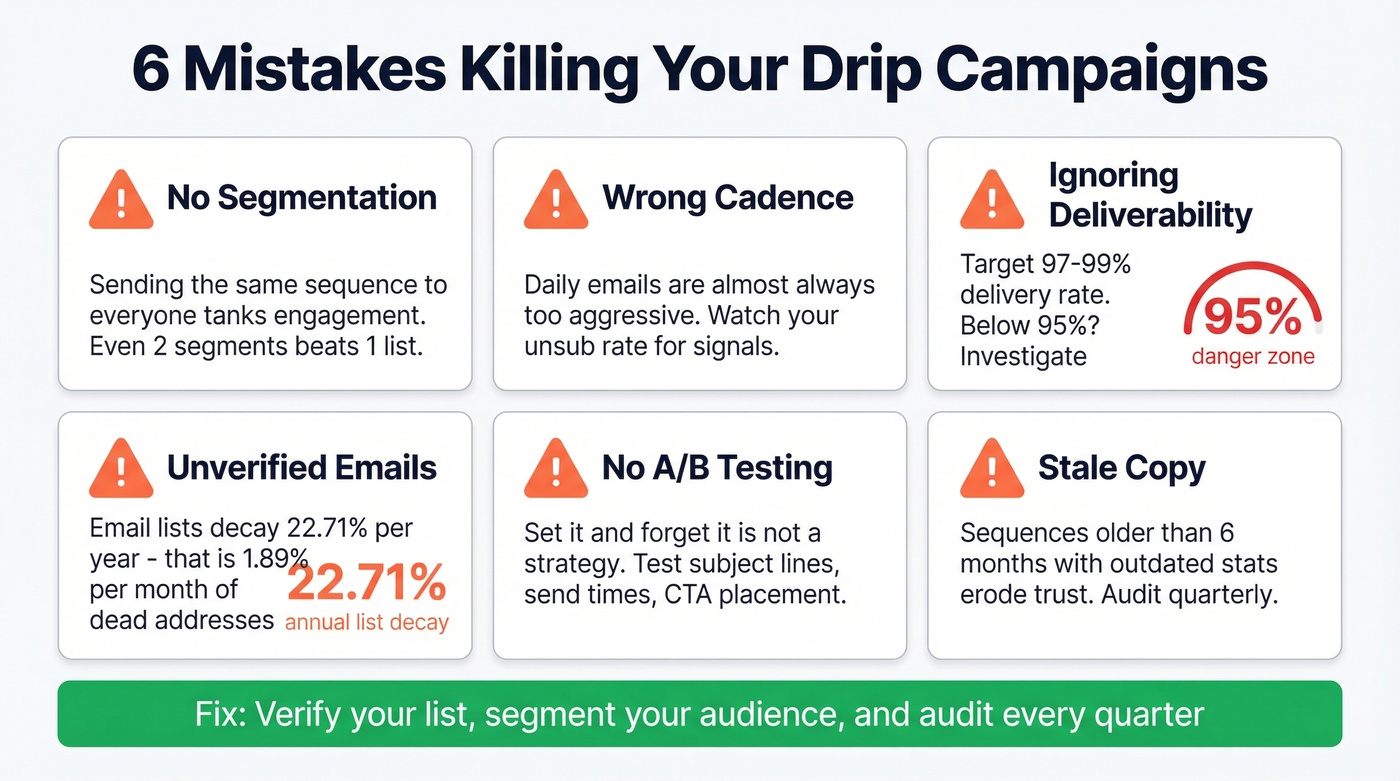
No segmentation. Sending the same sequence to every subscriber is the fastest way to tank engagement. Even two segments - new vs. returning - beats a single list.
Wrong cadence. Too frequent and you'll spike unsubscribes. Too slow and you lose momentum. Daily emails in a drip sequence is almost always too aggressive outside of a time-limited launch.
Ignoring deliverability. Your campaign doesn't matter if emails land in spam. Target a 97-99% delivery rate; investigate anything below 95%. Authenticate your domain with SPF, DKIM, and DMARC, and warm up new sending domains gradually. Mailtrap's deliverability guide is worth bookmarking. (More: email deliverability and DMARC alignment.)
Sending to unverified emails. Here's the thing - email lists decay at roughly 22.71% per year. That's 1.89% per month. If you're not verifying addresses before they enter a sequence, you're sending to dead inboxes and tanking your sender reputation. Prospeo's 5-step verification catches invalid addresses, spam traps, and catch-all domains at about $0.01 per check, which is cheap insurance against bouncing your way into spam folders. (If bounces are creeping up, start with bounce rate benchmarks and sender reputation.)
No A/B testing. Most teams set up a sequence and never touch it again. Test subject lines, send times, and CTA placement. Small improvements compound across thousands of sends.
Stale copy. A drip sequence written 18 months ago with outdated stats and irrelevant offers erodes trust. Audit your sequences quarterly.
For cold outbound specifically, plan for six to ten emails in a sequence. It typically takes seven to eleven touchpoints before a prospect engages, and most reps give up after three. (If you're building outbound drips, use a proven B2B cold email sequence structure.)
Best Drip Email Tools in 2026
| Tool | Starting Price | Free Tier | Best For |
|---|---|---|---|
| Klaviyo | $20/mo | Yes (limited) | Ecommerce flows |
| ActiveCampaign | $15/mo | No | B2B automation |
| Brevo | $9/mo | 300 emails/day | Budget teams |
| Omnisend | $16/mo | Yes | Ecomm + SMS |
| MailerLite | $10/mo | 500 contacts | Simplicity |
| Kit | $39/mo | 10K contacts | Creators |
| Mailchimp | $13/mo | 500 contacts | General use |
| Freshmarketer | $18/mo | Yes | Freshworks users |
Klaviyo is the obvious pick for ecommerce. Its Shopify and WooCommerce integrations are best-in-class, the flow builder is purpose-built for cart abandonment and post-purchase sequences, and the segmentation engine is strong. The catch? It's overpriced outside pure ecommerce, and the free tier is weak. If you're running a B2B SaaS, look elsewhere.
ActiveCampaign is the B2B automation workhorse. Deep behavioral triggers, built-in CRM, conditional logic that can handle complex multi-step sequences. The consensus on r/sales and r/emailmarketing is that setup is "brutal" - but once it's running, it's the most powerful mid-market automation platform available. We've tested dozens of tools, and the learning curve gap between MailerLite and ActiveCampaign is night and day. Pricing ramps fast with contact count, so watch your list size.
Brevo is the budget winner. Starting at $9/mo with a free tier that gives you 300 emails per day, it's hard to beat on value. Deliverability is solid, the automation builder handles standard sequences well, and it won't punish you for growing your list. It lacks ActiveCampaign's behavioral depth, but for straightforward automated campaigns, it gets the job done.
Omnisend pairs email with SMS in a single flow builder - useful for ecommerce teams that want multi-channel sequences without stitching together separate tools. MailerLite is the simplest option on this list, ideal if you want clean automated sequences with a low learning curve. Kit (formerly ConvertKit) remains the go-to for creators and course builders, though $39/mo for paid plans is steep compared to alternatives. Skip Freshmarketer unless you're already deep in the Freshworks ecosystem.
Let's be honest about something most tool comparisons ignore: teams obsess over which platform to pick and completely ignore data quality. Every tool on this list assumes the emails you're sending to are valid. They don't verify them. Bad data will undermine even the best-designed campaign, and we've seen teams blame their copy or cadence when the real problem was a 15% bounce rate from stale addresses. (If you're cleaning and enriching lists at scale, look at data enrichment services.)
B2B lead nurture drips fail when 20-35% of your emails bounce. Prospeo's 143M+ verified emails and catch-all domain handling mean your 6-10 email sequences actually reach decision-makers - not dead inboxes that destroy your domain reputation.
Every bounced drip email is a wasted touchpoint. Eliminate them.
Drip Email FAQ
How many emails should a drip campaign have?
Most sequences run three to seven emails. Welcome series typically need three to four. Cold outbound works best at six to ten emails over four to eight weeks. Match the length to your sales cycle - shorter for ecommerce, longer for B2B.
What's a good open rate for automated email sequences?
The average automated flow open rate is 48.57%. Top 10% performers hit 65.74%. If you're below 40%, check your subject lines, sender reputation, and list quality.
How is a drip campaign different from a nurture campaign?
Drip campaigns are time-based - emails send on a fixed schedule regardless of recipient behavior. Nurture campaigns adapt based on opens, clicks, and actions. Think broadcasting versus conversing. Most mature teams use both for different stages of the funnel.
Why are my drip emails bouncing?
Email lists decay at roughly 22.71% per year. If you're not verifying addresses before they enter your sequences, you're sending to dead inboxes. Run your list through a verification tool before launching - catching invalid addresses, spam traps, and catch-all domains before they hit your sender reputation is far cheaper than recovering from a blacklist.
How often should you send drip emails?
Space emails one to three days apart for welcome sequences and five to seven days for longer B2B nurture drips. Test cadence against unsubscribe rates - if unsubs spike after a specific email, you're either sending too frequently or the content missed the mark.