

What Is Email Outreach - and Why Do Most People Get It Wrong?
The average cold email reply rate is 3.43%. That means roughly 97 out of 100 people you email won't respond. Yet the top 10% of senders hit reply rates above 10.7% - three times the average, using the exact same channel. The gap isn't talent or copywriting wizardry. It's almost always list quality and deliverability.
Email outreach means targeted, one-to-one emails to people who haven't opted in, with the goal of starting a conversation rather than blasting a newsletter. Before you write a single email, you need to authenticate your domain (SPF/DKIM/DMARC), verify every address, and keep emails under 80 words. Get those three things right and you're already ahead of most senders.
Email Outreach Defined
Email outreach is sending targeted emails to people you don't have a prior relationship with - prospects, journalists, potential partners, recruiters' candidates - to start a conversation. It's not email marketing, which goes to people who've already opted in. And it's not spam, which is mass, irrelevant, and usually deceptive.
| Email Outreach | Email Marketing | |
|---|---|---|
| Audience | No prior opt-in | Subscribers who opted in |
| Goal | Start a conversation | Nurture over time |
| Volume | Small, targeted batches | Large lists |
| Compliance | CAN-SPAM + GDPR (stricter operationally) | CAN-SPAM + GDPR (permission-based, simpler operationally) |
| Typical use | Sales, PR, link building, recruiting | Newsletters, promotions, onboarding |
Most people think cold outreach means sales emails, but it's broader than that. PR teams pitch journalists. SEO teams request backlinks. Agencies recruit affiliates. Partnership teams open co-marketing conversations. The mechanics are the same: find the right person, write something relevant, make it easy to say yes.
Does It Still Work? (2026 Benchmarks)
Yes, but the bar is higher than it was two years ago. Inboxes are saturated, prospects are drowning in pitches, and a lot of what used to work is getting ignored now.
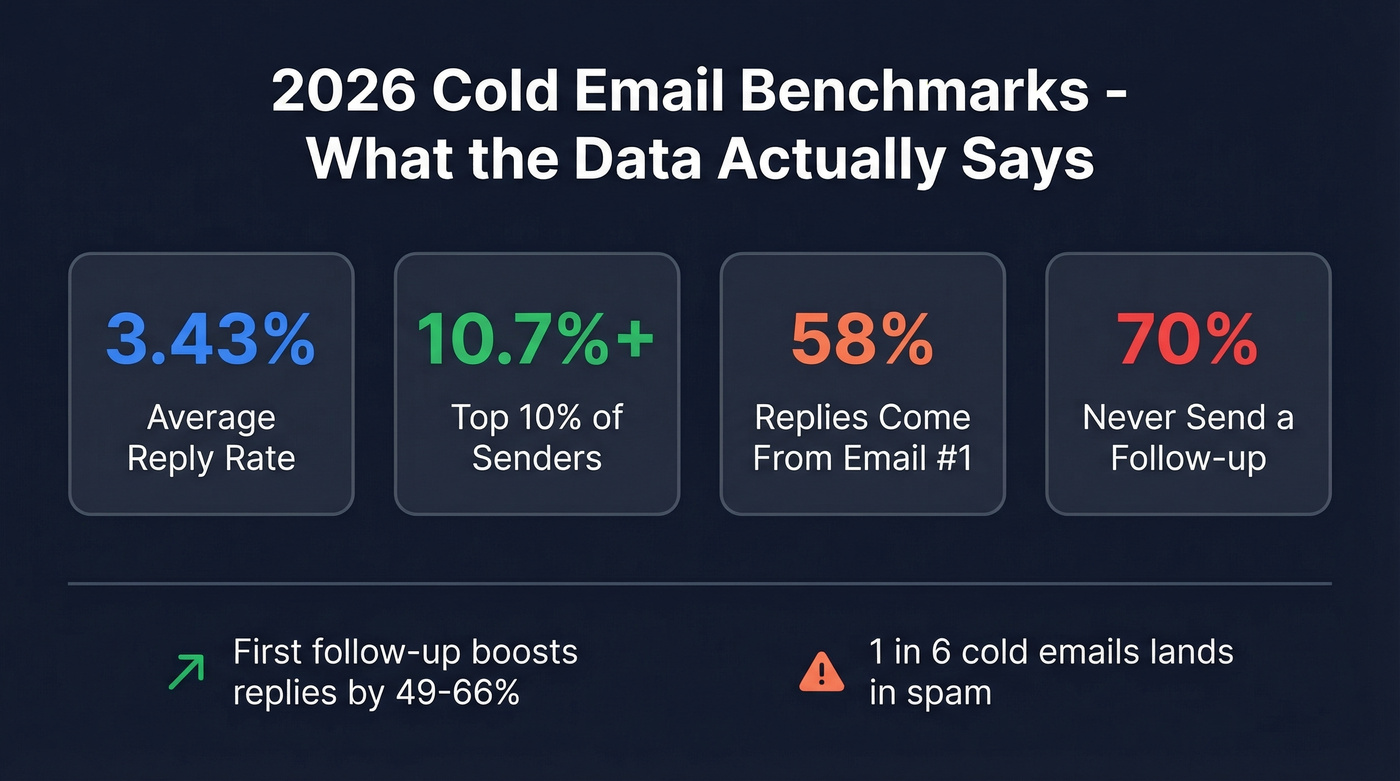
That sounds dramatic, but the data tells a more nuanced story. Instantly's 2026 benchmark report analyzed billions of cold email interactions across thousands of active workspaces: 3.43% average reply rate, 5.5%+ for top-quartile campaigns, and 10.7%+ for the elite tier. Other analyses put the typical range at 1-5%, with personalized emails pulling more than twice the replies of generic ones.

Here's what else the data shows. 58% of all replies come from the first email. One in six cold emails lands in spam. And 70% of senders never send a single follow-up - which is wild, because the first follow-up alone boosts replies by 49-66%. We've watched teams obsess over A/B testing subject lines while ignoring the fact that they never sent email number two. That's like optimizing your landing page headline when the page itself is 404ing.

This article shows that list quality is the single biggest lever in email outreach. Prospeo delivers 98% email accuracy across 143M+ verified addresses, refreshed every 7 days - not every 6 weeks. Start with 75 free verified emails and see what clean data does to your reply rates.
Stop rewriting copy when the real problem is your list.
Is Cold Email Legal?
Yes - with rules. In the US, CAN-SPAM doesn't require prior consent for commercial emails. But it does require:
- Accurate "From," "To," and routing information
- Non-deceptive subject lines
- Clear identification that the message is an ad
- A valid physical postal address
- An easy, obvious opt-out mechanism honored within 10 business days
There's no B2B exception. Violate any of these and the FTC can hit you with penalties up to $53,088 per email. Per email.
In the EU, it's stricter. You generally need explicit consent or a legitimate interest basis under GDPR, and you also need to account for ePrivacy and country-specific rules. For B2B cold outreach, that usually means relevance to the recipient's job role, transparency about who you are and how you got their info, and an easy opt-out. If you're sending into Europe, consult counsel - the rules vary by country.
How to Set Up Email Outreach
Authenticate Your Domain
Domain authentication isn't optional anymore. Gmail has required SPF, DKIM, and DMARC for bulk senders since February 2024. Outlook followed suit for high-volume senders in mid-2025. Skip authentication and your emails are far more likely to get blocked or routed to spam before anyone sees them.
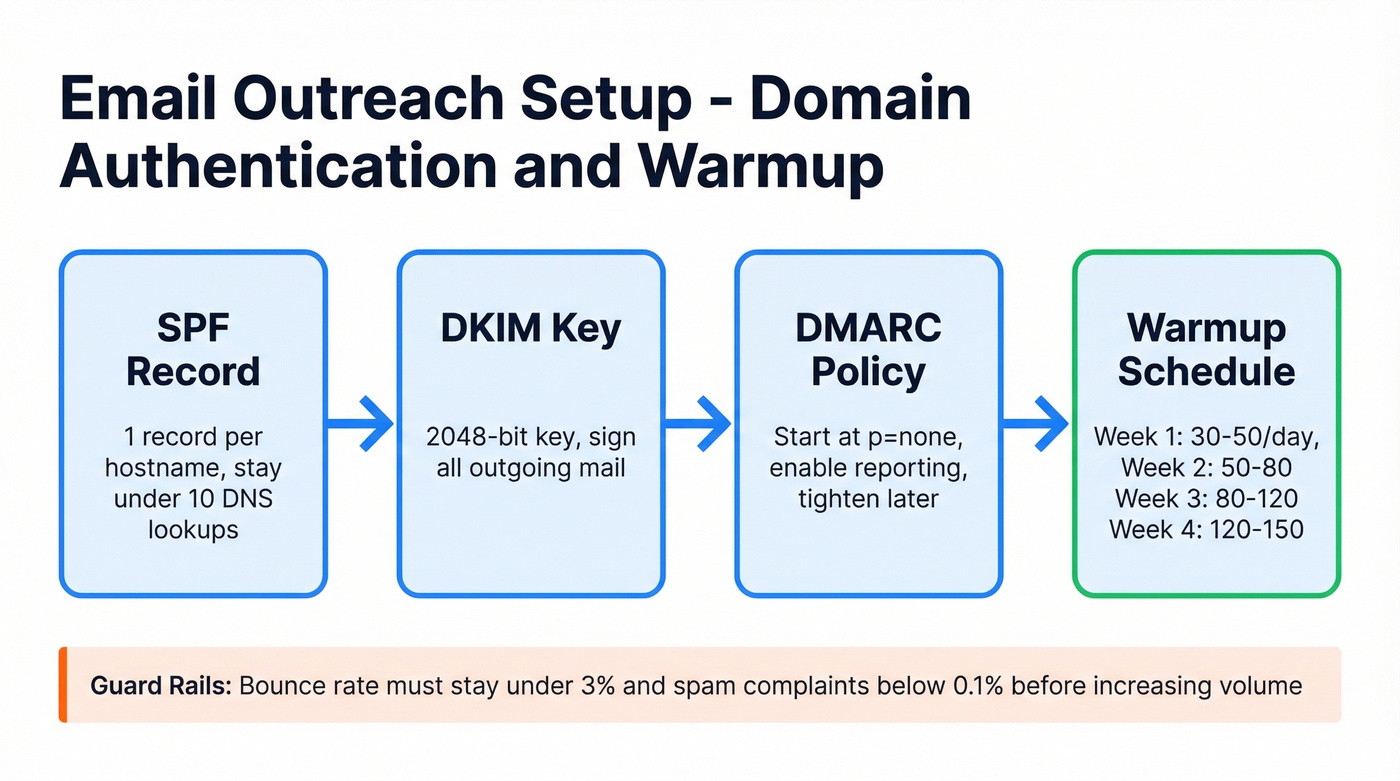
Publish one SPF record per hostname (stay under the 10 DNS lookup limit), set up DKIM with a 2048-bit key when supported, and start DMARC at p=none with reporting enabled. Then warm up your mailbox gradually: 30-50 emails/day in week one, ramping to 50-80, then 80-120, then 120-150 by week four. Only increase if your bounce rate stays under 3% and spam complaints stay below 0.1%.
Build a Clean Prospect List
Look, list quality is the single biggest lever in any outreach campaign. Bad data means bounces. Bounces mean domain reputation damage. And once your domain reputation tanks, even your best emails land in spam.
We've seen teams rewrite their copy five times before realizing the problem was never the message - it was the list. One agency we spoke with burned through three sending domains in two months because they were pulling contacts from a database that hadn't been refreshed in over a year. They switched to verified data, kept bounce rates under 3%, and haven't flagged a domain since.
Prospeo runs a 5-step verification process with catch-all handling, spam-trap removal, and honeypot filtering - delivering 98% email accuracy across 143M+ verified addresses. Every record refreshes on a 7-day cycle, so you're not emailing someone who changed jobs six weeks ago. The free tier gives you 75 verified emails per month, enough to test whether cleaner data actually moves your reply rates before you commit. If you’re comparing providers, start with email list providers and data enrichment services.

Write Short, Specific Emails
Best-performing campaigns use emails under 80 words. A popular format right now is 40-60 words: context trigger, specific outcome, quick proof, soft CTA. Here's what that looks like:
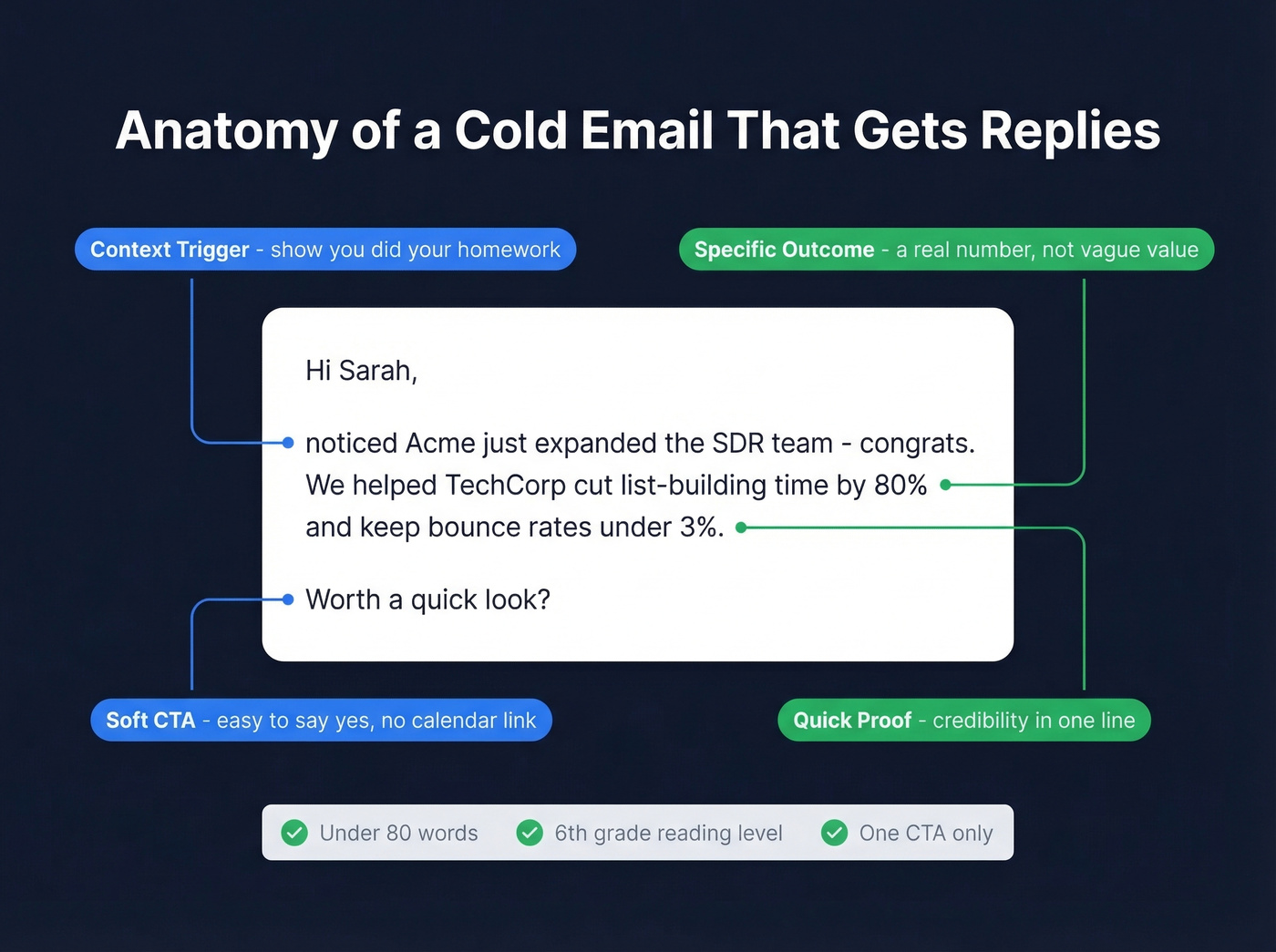
Hi [Name], noticed [Company] just expanded the SDR team - congrats. We helped [Similar Company] cut list-building time by 80% and keep bounce rates under 3%. Worth a quick look?
No fluff, no "hope this finds you well," no calendar link. Write at a 6th-grade reading level with one CTA, not three. For more structure, borrow from proven emails that get responses and tighten your ask with clear email call to action patterns.
Wednesday is the peak send day, with the 9:30-11:30 AM window in your recipient's time zone performing best. Build a sequence of 4-7 touchpoints spaced 3-4 days apart, and make your second email feel like a reply rather than a formal follow-up - that approach outperforms structured follow-ups by about 30%. Add a personalized P.S. line; it can lift performance by 35%. If you want a deeper breakdown, see our best time to send cold emails guide and a practical B2B cold email sequence framework.
Let's be honest: if your deal size is under five figures, you probably don't need a $30k/year sales intelligence platform. You need 75 verified emails, a tight 40-word template, and the discipline to follow up four times. The tooling arms race is mostly a distraction from the basics.
The top 10% of cold emailers hit 10.7%+ reply rates because they nail deliverability first. Prospeo's 5-step verification with catch-all handling, spam-trap removal, and honeypot filtering keeps your bounce rate under 3% - so your emails actually reach inboxes. At $0.01 per email, you don't need a $30K platform to send like the elite tier.
Verify every address before you hit send. Start free today.
Mistakes That Kill Reply Rates
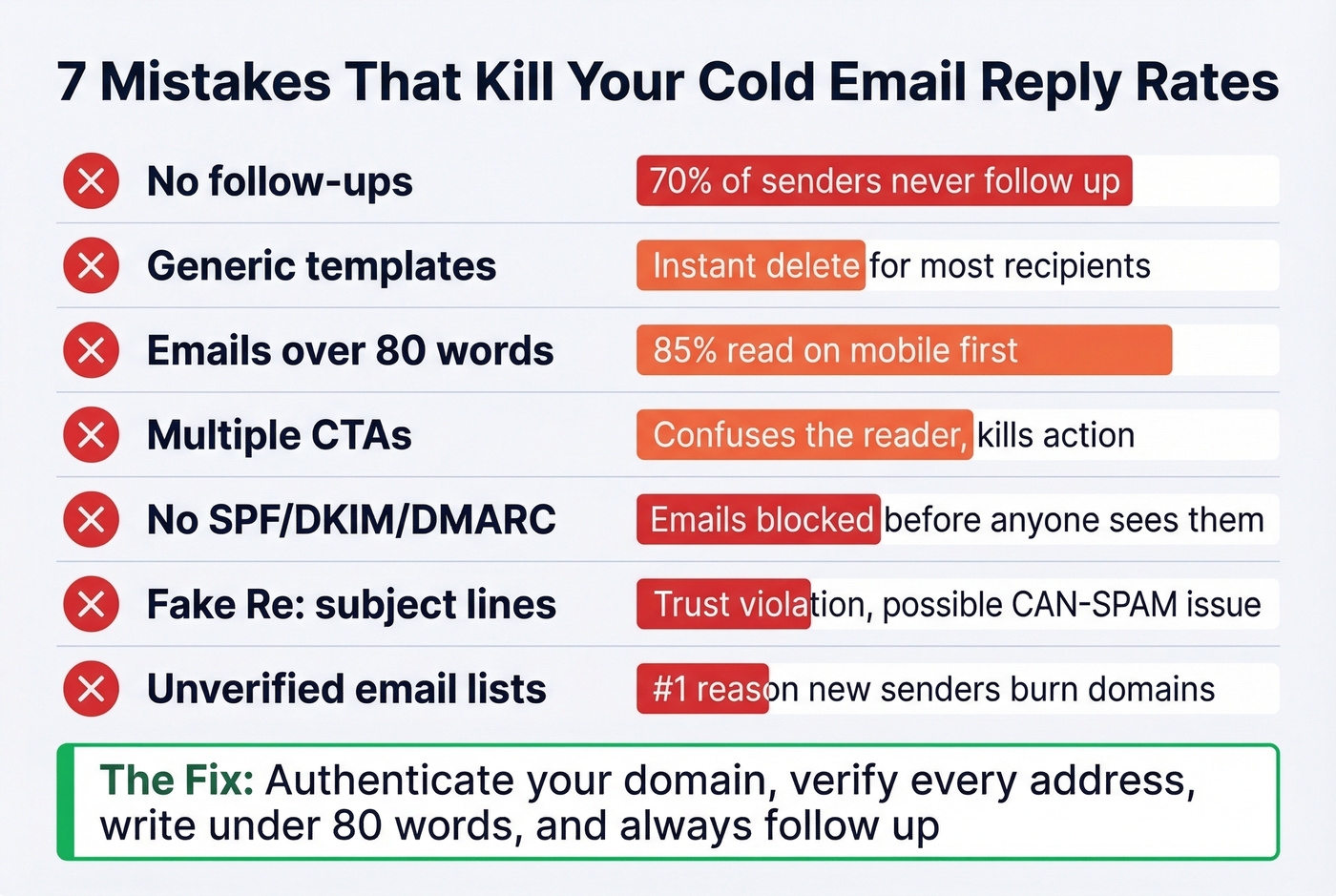
- No follow-ups. 70% of senders never follow up. The first follow-up alone lifts replies by up to 66%. This is the easiest win in outreach. (If you need copy, use these cold email follow-up templates.)
- Generic templates. "Hope this email finds you well" is an instant delete. Lead with something specific to the recipient. If you’re stuck, pull from cold email subject line examples and prospecting email subject lines.
- Too-long emails. If it's over 80 words, cut it. Around 85% of emails get read on phones first.
- Multiple CTAs. One ask per email. "Want to chat?" is enough.
- Skipping authentication. No SPF/DKIM/DMARC means your emails get blocked or filtered before anyone sees them.
- Fake "Re:" subject lines. They trigger trust violations and can violate CAN-SPAM's deceptive subject line rule. Don't do it.
- Unverified lists. Verify every email before sending. Invalid addresses, spam traps, and honeypots spike your bounce rate and torch your domain reputation overnight. The consensus on r/coldemail is that bad data is the number one reason new senders burn domains - and we'd agree. If you’re troubleshooting, start with email bounce rate and spam trap removal.
FAQ
What's a good cold email reply rate?
The average is 3.43%, top-performing campaigns exceed 5.5%, and the elite 10% of senders hit 10.7%+. If you're below 3%, investigate your list quality and deliverability before rewriting copy - bad data is the most common culprit.
How many follow-ups should I send?
Four to seven touchpoints spaced 3-4 days apart is the sweet spot. The first follow-up alone boosts replies by 49-66%, yet 70% of senders never send one. Don't be in that 70%.
Do I need permission to send cold emails?
In the US, CAN-SPAM doesn't require prior consent - but you must include an opt-out, a physical address, and accurate sender info. In the EU, GDPR generally requires explicit consent or legitimate interest. Consult counsel for jurisdiction specifics.
What's the best free tool for verifying outreach lists?
Prospeo's free tier includes 75 verified emails per month with full 5-step verification, spam-trap removal, and catch-all handling - enough for small teams running real campaigns. Hunter offers 25 free searches monthly but caps enrichment features. Skip this category entirely if you're sending fewer than 50 emails a month - manual verification through a tool like NeverBounce works fine at that scale.