

Lead Response Time: What It Is, Why It Matters, and How to Fix It
A practitioner on r/GrowthHacking cut their average lead response time from 3.8 hours to 4 minutes. Their inquiry-to-client conversion rate jumped from 11.5% to 27.5%. The only variable that changed was speed.
So what is lead response time, exactly, and why does it have this much impact on pipeline?
What Is Lead Response Time?
Lead response time measures the gap between a prospect's first inbound action - form fill, demo request, chat message - and your team's first meaningful contact. Not an auto-confirmation email. Actual human engagement.
LeanData breaks it into two components: Lead Processing Time (enrichment, routing, assignment) plus Rep Response Time (how long the rep takes after getting the lead). Most teams obsess over the second while ignoring the first, which is where the real delays live.
Here's a concrete example. A prospect submits a demo request at 2:00 PM. Your routing logic takes 42 minutes to enrich, match, and assign the lead. The rep calls at 2:47 PM. Your response time is 47 minutes - and 42 of those had nothing to do with the rep.
Why Speed to Lead Matters
The study everyone cites but nobody links to: James B. Oldroyd, Kristina McElheran, and David Elkington, Harvard Business Review, March 2011. Their conclusion was blunt - most companies respond far too slowly, and the cost is enormous.
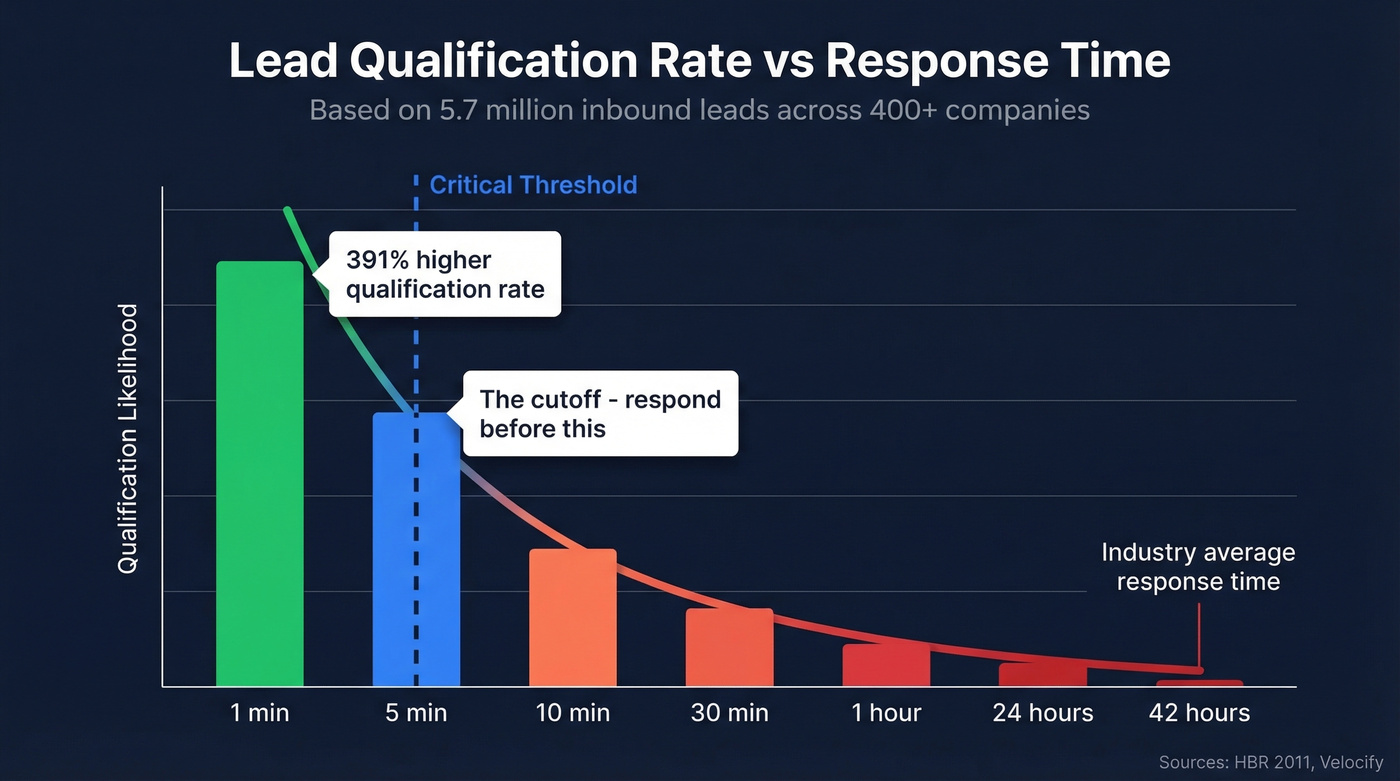
Across 55 million sales activities and 5.7 million inbound leads at 400+ companies, the odds of qualifying and connecting with leads are dramatically higher when reps respond in the first 5 minutes. Velocify's research puts the lift at 391% when response time is under one minute. After 10 minutes, the window closes fast. After 30, you're fighting gravity.
Real-world proof: That Reddit practitioner saw a 64% inquiry-to-call booking rate at a 4-minute response vs. 28% at 3.8 hours. The call-to-client rate barely changed (41% vs. 43%) - speed didn't improve sales skill, it just got more people on the phone.

Speed to lead only works when your contact data is real. Teams that respond in under 5 minutes still lose deals to bounced emails and disconnected numbers. Prospeo's 7-day data refresh and 98% email accuracy ensure your fast response actually reaches the prospect.
Stop racing to contact dead inboxes. Verify your leads first.
Lead Response Time Benchmarks
Knowing 5 minutes matters doesn't help if you don't know where your industry sits. The benchmarks are grim.
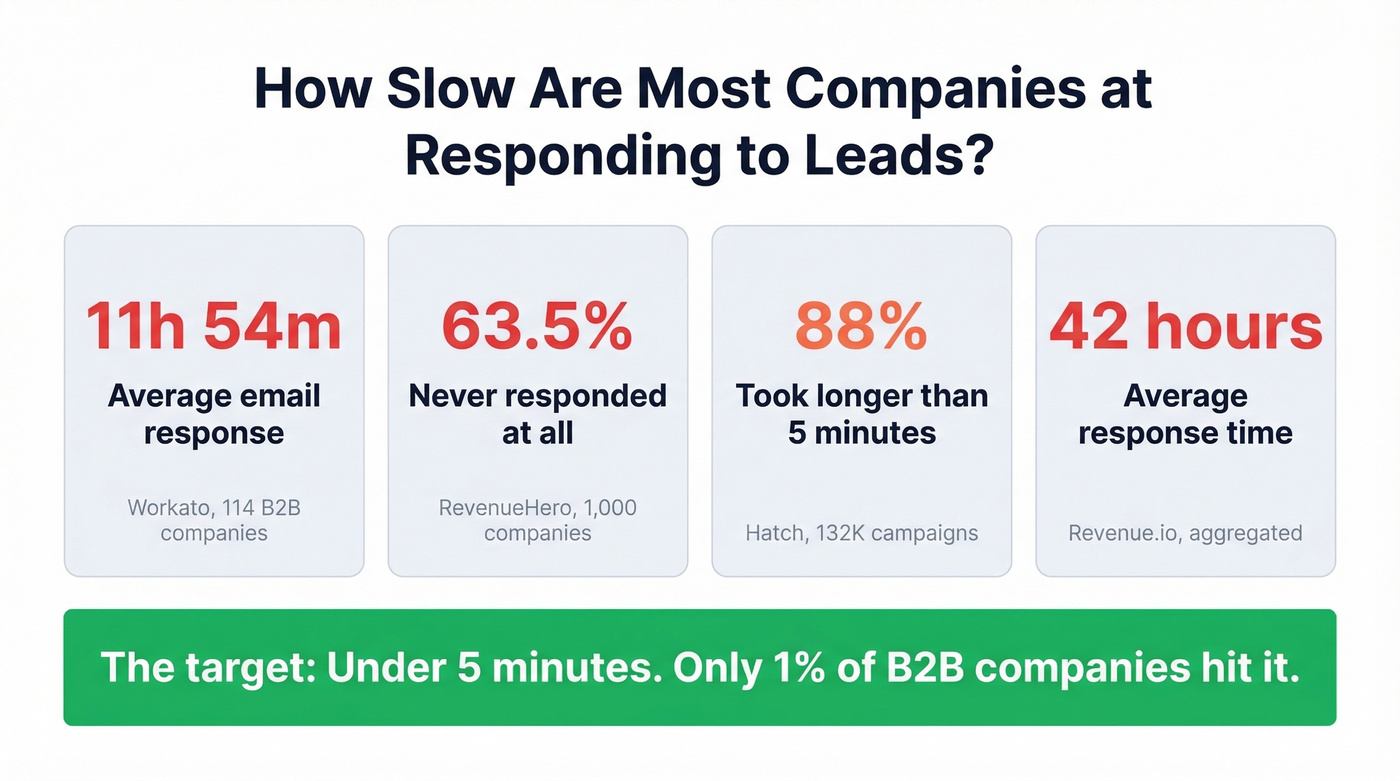
| Study | Sample | Key Finding |
|---|---|---|
| Workato | 114 B2B companies | >99% failed the 5-min test (avg 11h 54m email, 14h 29m phone) |
| RevenueHero | 1,000 companies | 63.5% never responded at all |
| Hatch | 132,188 campaigns | 88% took >5 min; 37% took a full day |
| Revenue.io | Aggregated | Average response: 42 hours |
Legal services is one outlier: Hennessey Digital's study of 1,333 law firms found a median response time of 13 minutes. But 26% never responded at all, and only 25% hit the 5-minute mark.
Track median response time, not average. A few 48-hour outliers will skew your average into looking terrible even if most reps respond in 20 minutes. Segment by lead source and channel for anything actionable.
Where the Real Delays Hide
Most teams blame reps. The actual bottleneck is usually upstream.
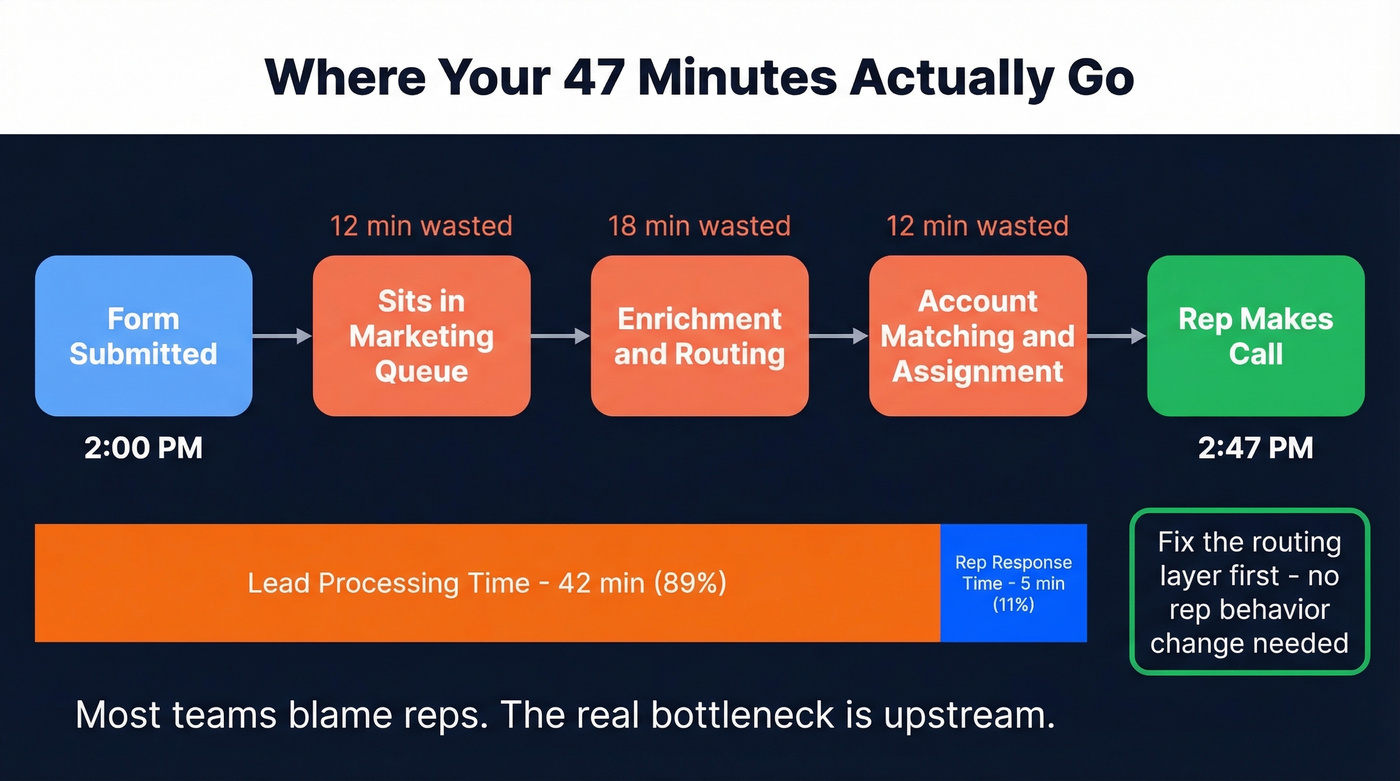
We've seen teams cut inbound follow-up time in half just by fixing the routing layer - no rep behavior change needed. Common failure modes, adapted from Flawless Inbound's CRM audit framework:
- Leads created too late - form fills sit in a marketing queue before hitting the CRM.
- Unclear ownership - nobody's assigned, so nobody follows up.
- Sales doesn't trust marketing leads - reps cherry-pick and ignore the rest.
- No post-assignment tracking - leads get assigned but nobody monitors whether contact actually happened.
- The after-hours gap - a large share of inbound leads come in evenings and weekends (40%+ is a common benchmark). That Friday night demo request sits untouched until Monday. By then, the prospect's already talking to your competitor.
Let's be honest: most of these aren't technology problems. They're process problems wearing a technology disguise.
How to Improve Your Lead Response Time
Here's the speed-to-lead checklist that actually works:
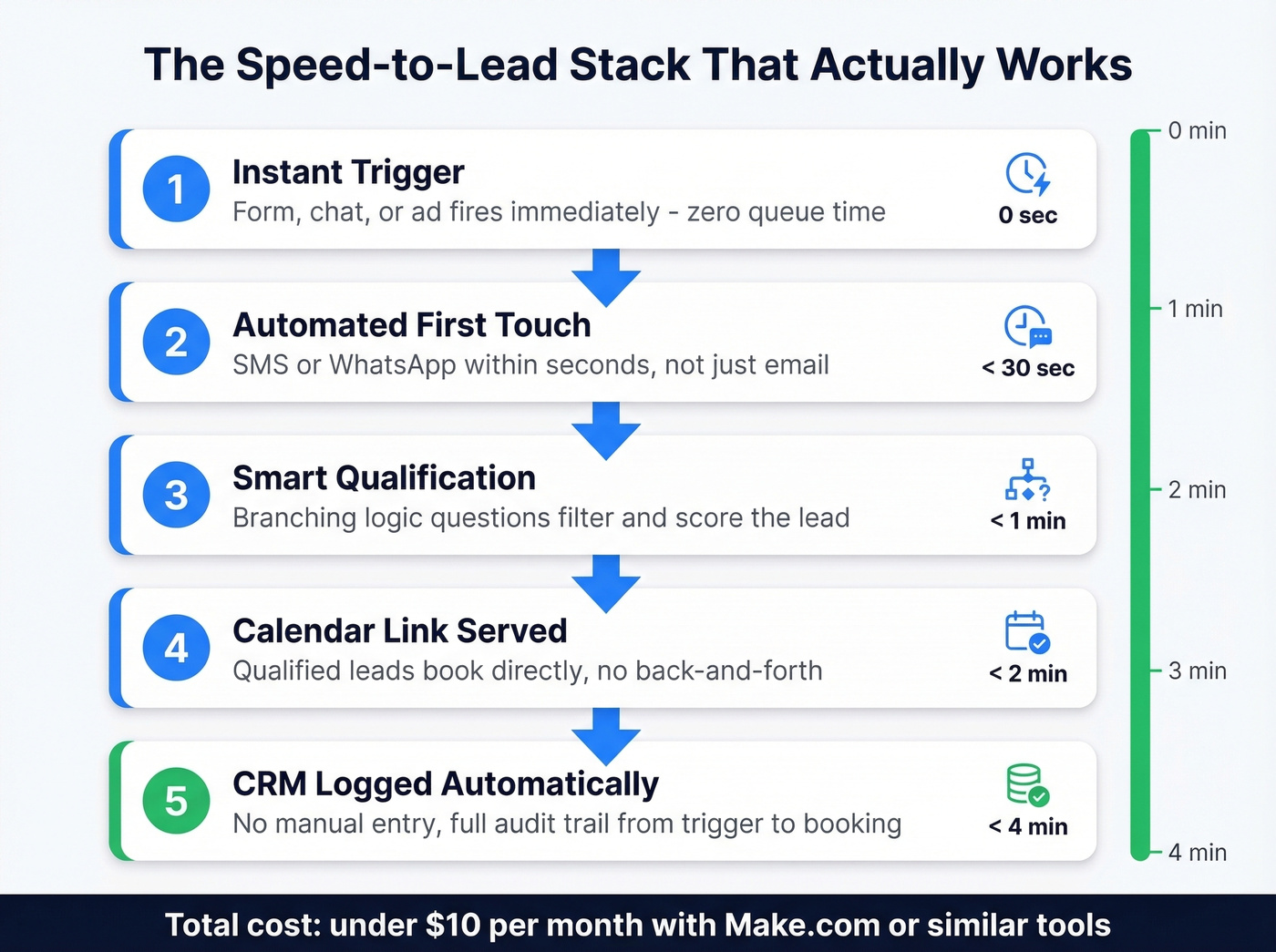
- Trigger fires instantly from form, chat, or ad
- Automated first-touch message within seconds - WhatsApp or SMS, not just email
- Structured qualification questions with branching logic based on responses
- Calendar booking link served immediately to qualified leads
- CRM logging happens automatically, no manual entry
You don't need enterprise tooling for this. A Make.com scenario can handle trigger-to-response automation for under ~$10/month. Teams on r/MarketingAutomation are layering in AI voice qualification calls for leads that don't self-book - that's a genuine edge nobody talks about yet.
In our experience, the after-hours gap is the single biggest source of lost leads. Revenue.io recommends a dedicated inbound response rep once you hit 300-400 unique marketing leads per month. Below that threshold, automation plus mobile alerts covers you.
What to measure: median response time by rep, conversion rate by response-time bucket, and follow-up rate after first contact (use sales activities to standardize what “contact” means).
Bad Data Breaks Everything
Most speed-to-lead advice stops at routing. But you can build the fastest automation in the world, and if your emails bounce and phone numbers are disconnected, your 4-minute response time is a vanity metric.
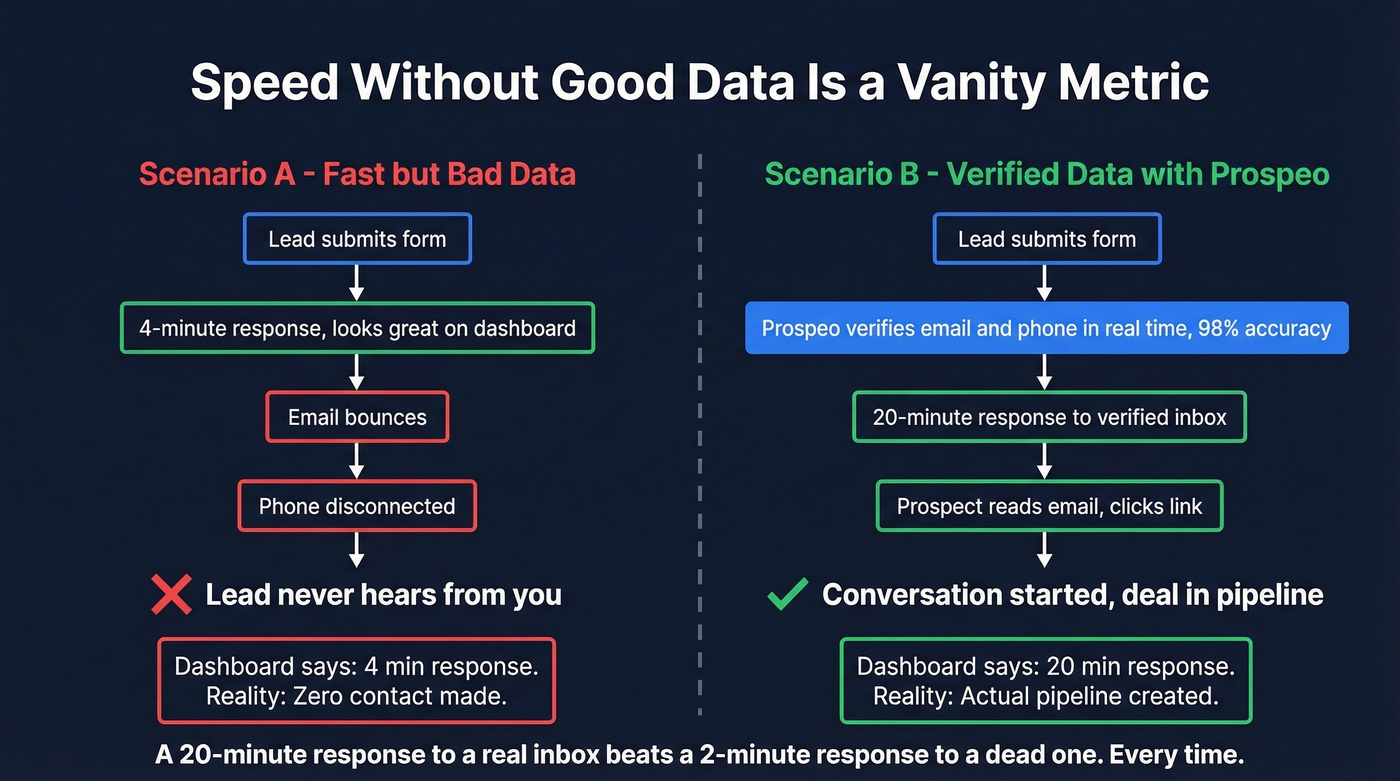
Think about it: you respond in 4 minutes. The email bounces. The lead never hears from you. Your dashboard says you're fast. Your pipeline says otherwise.
Pair your speed-to-lead stack with verified contact data. Prospeo verifies emails at 98% accuracy on a 7-day refresh cycle, so your automated outreach actually reaches someone (see data enrichment and lead enrichment options if you’re building a full pipeline). That matters more than shaving seconds off your routing logic.
Here's the thing - if your bounce rate is above 5%, don't spend another dollar on speed-to-lead tooling. Fix the data first (start with email bounce rate and an email deliverability audit). A 20-minute response to a valid email beats a 2-minute response to a dead inbox every single time.

Bad data is the silent killer of your speed-to-lead investment. If your bounce rate tops 5%, every dollar on routing automation is wasted. Prospeo gives you 143M+ verified emails at $0.01 each - so your 4-minute response time converts instead of vanishing into the void.
A 20-minute response to a real inbox beats a 2-minute response to a dead one.
FAQ
What is a good lead response time?
Under 5 minutes for inbound leads. Velocify's research shows a 391% lift in qualification rates when reps respond within 60 seconds. The best teams use automated first-touches to bridge the gap while a human rep follows up.
How do you measure lead response time?
Subtract the timestamp of the lead's action (form fill, chat, demo request) from the timestamp of first meaningful rep contact. Track median, not average - averages hide 48-hour outliers that distort the picture. Segment by source and channel for actionable data.
Does contact data quality affect response effectiveness?
Directly. If your emails bounce or phone numbers are disconnected, a fast response never translates into an actual conversation. Verified data with a short refresh cycle - weekly rather than the typical 6-week industry average - ensures your automated outreach reaches real inboxes, turning speed-to-lead from a dashboard metric into pipeline.