

What Is Relationship Intelligence (And Do You Actually Need It)?
Your team just lost a deal because nobody knew your CEO went to college with the prospect's CFO. That connection was sitting in someone's email history, invisible to everyone else. That's the problem relationship intelligence is designed to solve.
Most guides on this topic are vendor pages redefining the concept as whatever their product does. This one isn't. We've seen teams spend six figures on RI platforms only to discover their underlying contact data was stale - so here's the honest version.
Three things to know upfront:
- RI maps connections, influence paths, and relationship strength across your organization's network - not just who's in your CRM.
- It depends entirely on clean contact data. Bad emails and stale titles in, bad insights out.
- If your team is under 50 people, you probably don't need dedicated RI software yet. A well-maintained CRM plus verified contact data gets you most of the value at a fraction of the cost.
Relationship Intelligence Defined
In psychology, relationship intelligence is an interpersonal skill - how well you read and navigate human connections. In B2B sales and dealmaking, it's a technology category: software that automatically captures, analyzes, and visualizes professional relationships across your organization. We're focused on the second meaning here, the technology that makes your org's hidden network visible and actionable.
RI answers questions your CRM can't. Who on our team has the strongest connection to the CFO at Target Account? Which board member overlaps with our investor? How warm is this intro path, really?
| Concept | Focus |
|---|---|
| Emotional Intelligence (EI) | Managing emotions (self + others) |
| Social Intelligence (SI) | Navigating social interactions |
| Relationship Intelligence (RI) | Mapping connection networks at scale in a business context |
Why It Matters in 2026
Gartner puts B2B buying committees at 5 to 20 stakeholders per deal, up dramatically over the last decade. The average deal involves 6-10 decision-makers, and 44% of millennial buyers prefer minimal contact with a sales rep altogether. Sellers get roughly 5% of a prospect's time to establish a connection.
Cold outreach alone doesn't cut it. Buyers are 5x more likely to engage when approached through a warm introduction, and speed compounds the advantage - deals closed within 50 days carry a 47% win rate, compared to under 20% after that threshold.
Here's the thing: every company already has relationship data. It's just trapped in people's heads, scattered across inboxes, and invisible to the CRM.
How RI Platforms Work
RI platforms follow a consistent five-step process, and understanding each step helps you evaluate whether you actually need one or whether your real problem is upstream.
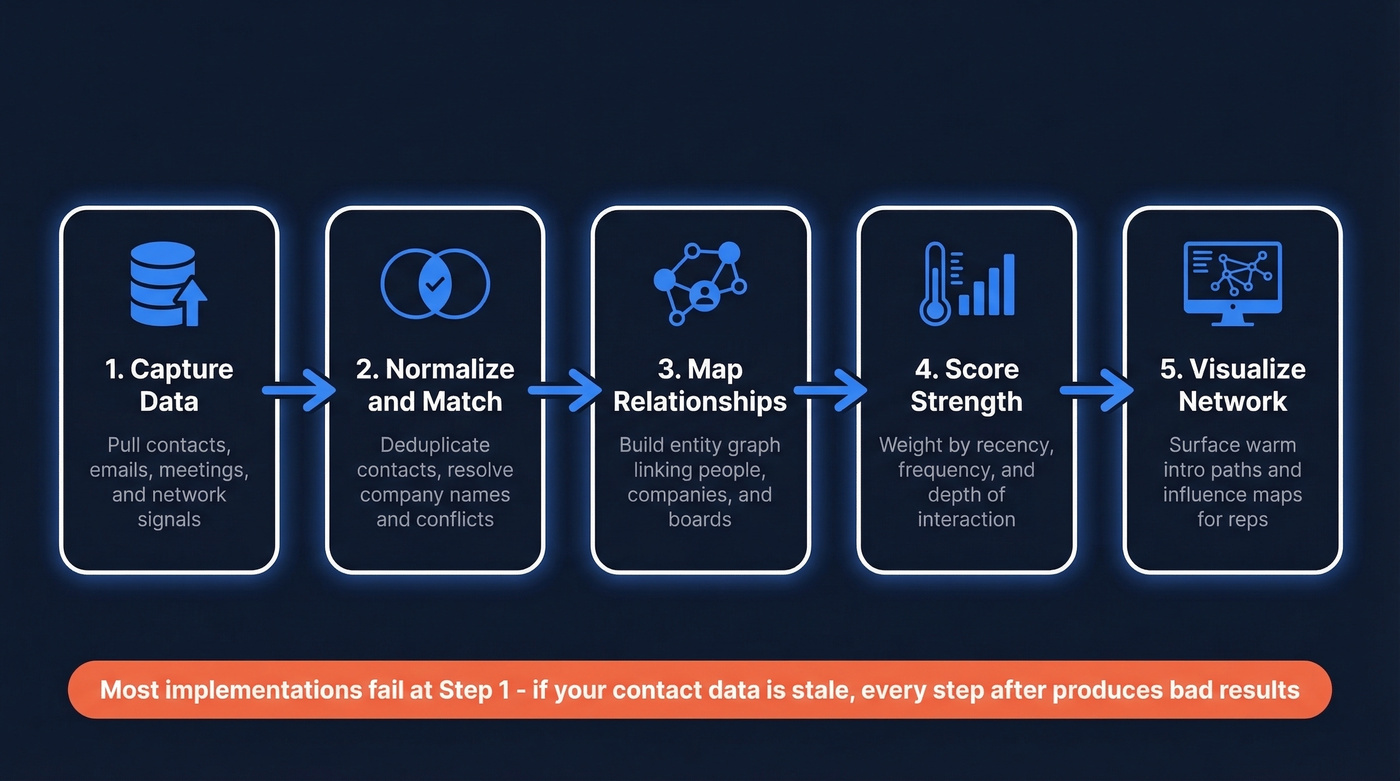
Capture data. The platform pulls contact records, communication metadata, meeting history, and professional network signals into one system. This is where most implementations quietly fail - RI tools are only as good as the contact data feeding them, and garbage contacts produce garbage relationship maps.
Normalize and match entities. The system disambiguates "Accel" from "Accel Partners," merges duplicate contacts, and resolves name conflicts. This sounds simple until you're dealing with 50,000 contacts across three CRM instances and a dozen email domains.
Map relationship links. It builds an entity graph connecting people to companies, investors, board seats, and shared work history.
Score connection strength. Relationships get weighted by recency, frequency, and depth - not just whether two people exchanged an email once three years ago.
Visualize the network. The platform surfaces relationship maps, warm intro paths, and influence diagrams where reps can actually act on them.
There's an important distinction between "inbox mining" RI, which scans email and calendar data, and "people graph" RI, which builds maps from public professional data. Most enterprise platforms blend both approaches.

Every RI platform fails when the contact data underneath is stale. Prospeo refreshes 300M+ profiles every 7 days - not every 6 weeks - so your relationship maps are built on verified emails (98% accuracy) and current job titles, not ghosts.
Clean data in, real relationship insights out. Start free today.
Benefits of Relationship Intelligence
The benefits compound as your team and deal complexity grow. At a basic level, RI eliminates blind spots - no more discovering after a lost deal that someone on your team had a direct line to the decision-maker.
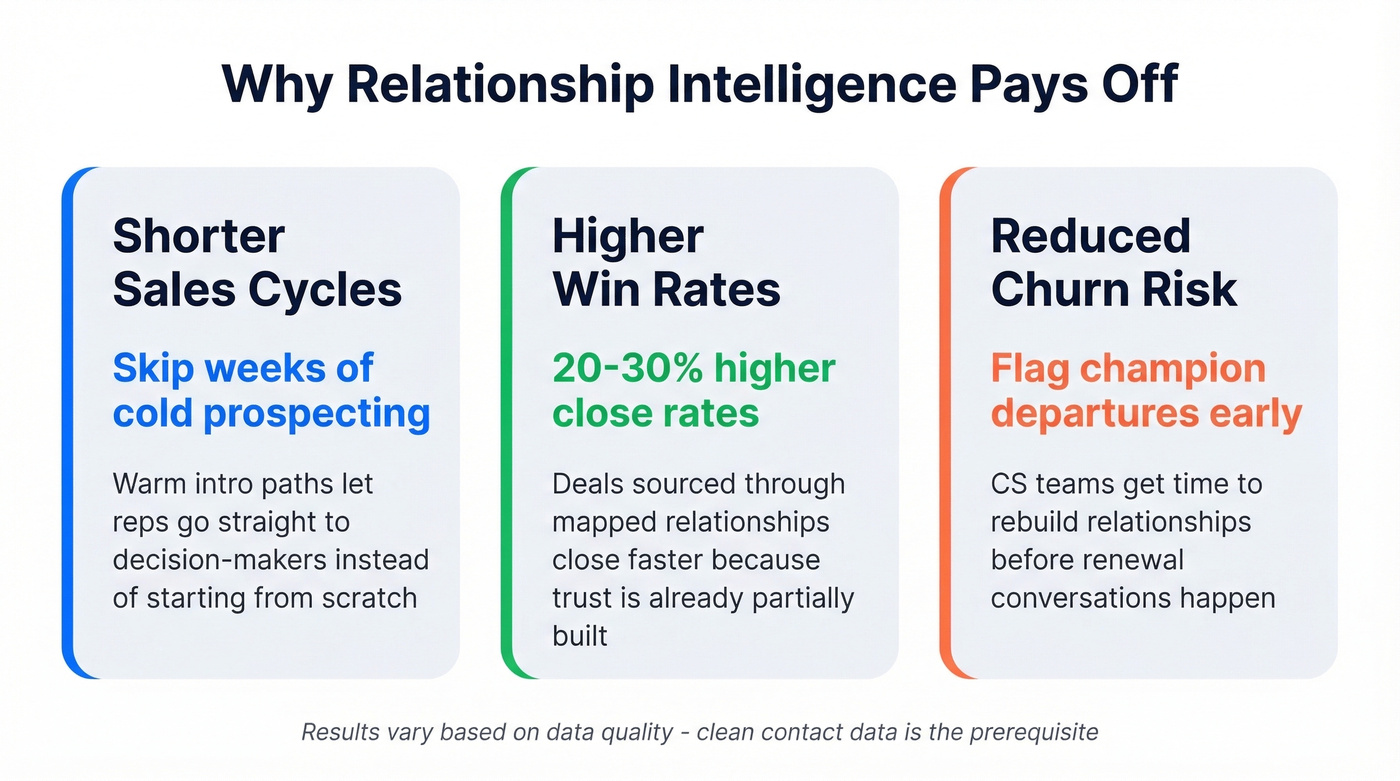
But the real value shows up in three areas:
Shorter sales cycles. Warm intro paths reduce the time from first touch to closed deal. When reps can see the fastest route to a stakeholder, they skip weeks of cold prospecting entirely. This is also where sales prospecting techniques matter most: RI amplifies what already works.
Higher win rates. Deals sourced through mapped relationships close at significantly higher rates than cold outbound because trust is already partially established. We've talked to teams that saw win rates jump 20-30% after implementing relationship mapping - though the gains varied widely based on data quality going in.
Reduced churn risk. RI flags when key champion contacts leave an account, giving CS teams time to rebuild relationships before renewal conversations. This alone can justify the investment for companies with high-ACV accounts and long sales cycles. (If you're measuring this, pair it with a real churn analysis process.)
Where RI Data Actually Lives
A SalesOps practitioner on r/SalesOperations framed it well: relationship intelligence is what lives beyond contacts and activity logs. It's the context - who knows whom, how strong the connection is, what history exists.
That context is scattered across email threads, Slack DMs, personal spreadsheets, and tribal knowledge that walks out the door when someone leaves. CRMs capture activity, but teams routinely revert to spreadsheets because CRM workflows are too rigid. In our experience, the teams that get the most from RI are the ones that fix their contact data first, before buying any platform. If you're still evaluating your stack, start with contact management software and a clear lead generation workflow.
Privacy and Compliance
Let's be honest - this is the elephant in the room that most RI vendor pages skip entirely. If a tool is scanning your team's emails and calendars to build relationship graphs, you've got real compliance exposure.
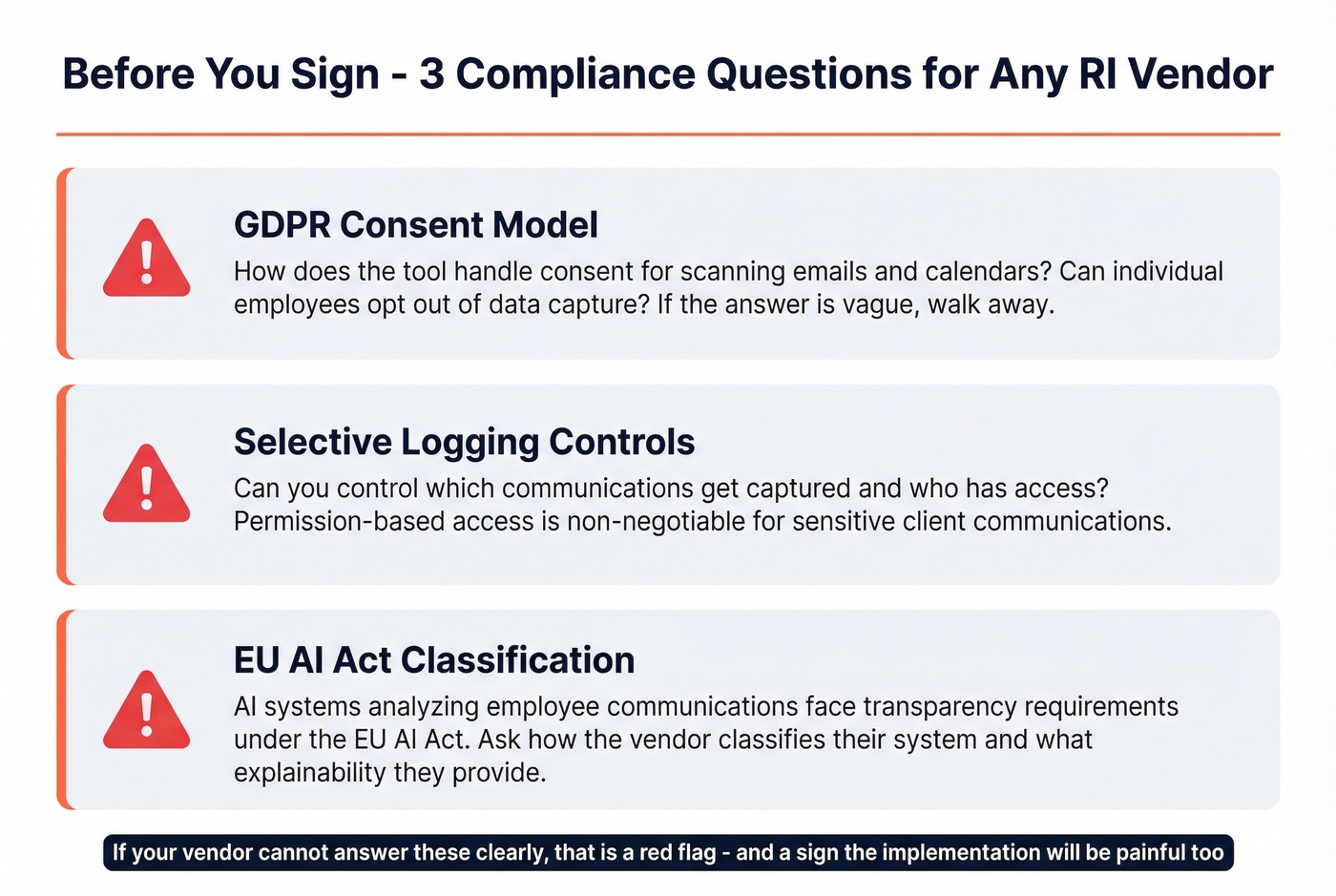
Three questions to ask any RI vendor before signing:
- GDPR consent model: How do they handle consent for email and calendar scanning? Can individuals opt out?
- Selective logging: Can you control which communications get captured? Is access permission-based?
- EU AI Act classification: Under the EU AI Act, AI systems analyzing employee communications face transparency and explainability requirements. Ask how the vendor classifies their system.
If your vendor can't answer these questions clearly, that's a red flag - and a sign the implementation will be painful too.
RI Tools Worth Knowing
Relationship intelligence isn't a software category. It's a discipline. The software just makes it scalable. Here are the tools worth understanding, with honest takes on who they're actually built for.
Affinity
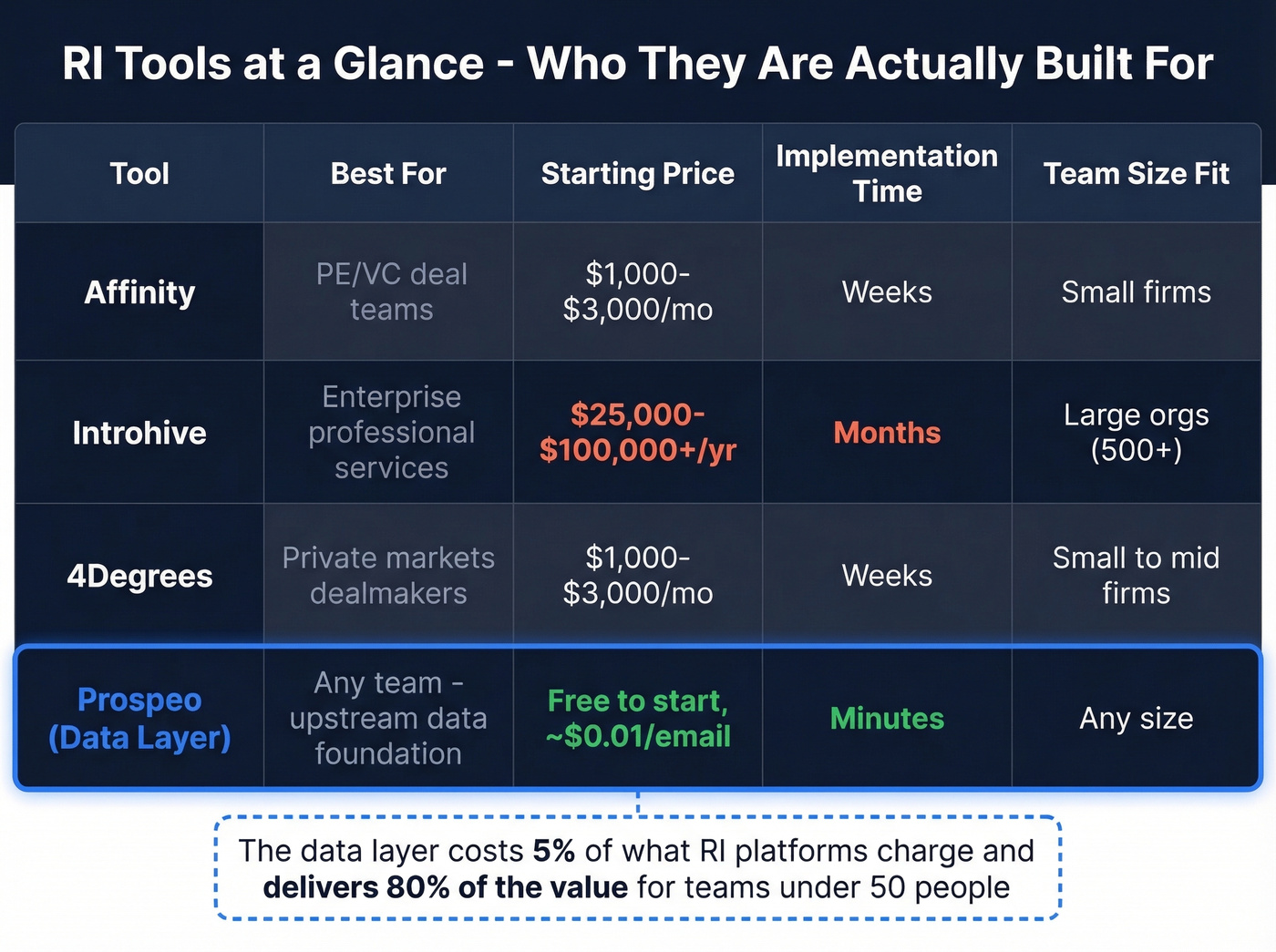
The go-to for PE/VC deal teams. Affinity is a relationship CRM with automated activity capture that maps your firm's collective network. It's strong at what it does, but it's purpose-built for investment workflows - if you're running a SaaS sales team, the fit is awkward. Pricing typically runs $1,000-$3,000+/month for small teams, with enterprise pricing scaling from there. If you're comparing stacks, see Affinity vs HubSpot CRM.
Introhive
Targets enterprise professional services firms and typically runs $25,000-$100,000+/year. Unless you're a large law firm or consulting practice with thousands of client relationships to track, skip this one. The implementation alone takes months, and the ROI math only works at scale.
4Degrees
Positions itself around connection quality rather than just activity-frequency scoring - a meaningful differentiator for private markets dealmakers who care about who you know, not how often you emailed them. Typically $1,000-$3,000/month for small teams.
The Data Foundation That Makes All of This Work
Before investing in any RI platform, make sure the contact data feeding it is accurate. This is where we see the most wasted spend - teams drop $50K+ on relationship mapping software, then wonder why the maps are full of people who left their companies two years ago.
Prospeo handles this upstream layer with 300M+ professional profiles, 98% email accuracy, and a 7-day data refresh cycle. CRM enrichment returns 50+ data points per contact, which means your RI platform is actually working with current, verified records instead of stale CRM ghosts. If you're shopping options, start with a shortlist of data enrichment services and sanity-check deliverability with an email deliverability guide.

The pricing gap tells the story: RI platforms require five-figure annual contracts, while verified contact data starts free with paid plans from roughly $0.01 per email. For teams under 50 people, clean data in a well-maintained CRM gets you 80% of the relationship intelligence value at 5% of the cost. (If you're building outbound, pair this with the right SDR tools.)
Before spending six figures on an RI platform, fix what's actually broken: your contact data. Prospeo's CRM enrichment returns 50+ data points per contact at a 92% match rate - giving your team accurate titles, verified emails, and direct dials to map relationships that actually close deals.
Enrich your CRM for $0.01 per email. No contracts, no sales calls.
FAQ
Is relationship intelligence the same as a CRM?
No. A CRM stores contacts and activity logs. Relationship intelligence analyzes the context around those contacts - connection strength, influence paths, who knows whom - and surfaces insights a CRM alone can't provide. Think of RI as a layer that sits on top of your CRM data, not a replacement for it.
Do I need dedicated RI software?
For teams under 50 people, usually not. A well-maintained CRM with verified contact data and disciplined note-taking covers most of what RI platforms do. The software becomes essential when relationship context is too distributed for any one person to track - typically once you're managing hundreds of accounts across multiple teams.
What data does relationship intelligence need to work?
Clean contact records - verified emails, correct titles, current companies - plus communication metadata like email and calendar signals. Enrichment data like org charts and intent signals adds another layer. Get the contact foundation right first, then layer RI on top.
How much does relationship intelligence software cost?
Most RI platforms start at $1,000-$3,000/month for small teams and scale to $25,000-$100,000+/year for enterprise deployments. The upstream data layer is far cheaper - verified contact data starts free with paid plans at roughly $0.01 per email, making it a practical first step before committing to a full RI platform.