

What Is Sales Management? Benchmarks, Frameworks, and Mistakes That Matter
You got promoted because you were the best rep on the floor. Six months later, your team misses the number and you're wondering what went wrong. That's the sales management gap - and it's where most first-time managers stall out.
So what is sales management, exactly? It's the practice of building, coaching, and directing a sales team to hit revenue targets consistently. It covers hiring, pipeline oversight, forecasting, methodology enforcement, and rep development. McKinsey research shows these best practices lift productivity by up to 20%. The fix for most underperforming teams comes down to three things: a coaching cadence, a sales methodology, and clean data.
If you remember nothing else: 69% of reps missed quota last year. Everything below gives you the numbers and frameworks to close that gap.
Why Sales Management Matters
An OMG analysis of 318 sales teams found that 30% relied on a single salesperson for more than half of their revenue. That's not a sales team. That's a single point of failure.
Top producers generate 10x more revenue than bottom producers, and the manager's job is to compress that gap through systems, coaching, and accountability rather than hoping the next hire is a unicorn. Accenture pegs corporate training ROI at 353%. The math is clear: investing in management systems pays back faster than hiring another rep.
On r/sales, the most common question from new managers isn't about methodology - it's about earning respect from former peers. That's a coaching problem, not a process problem. And it's the reason the best sales leadership managers spend the majority of their time developing people, not reviewing dashboards.
Core Responsibilities of a Sales Manager
A sales manager's job breaks into six areas, each with a concrete benchmark. Understanding these responsibilities is what separates managers who hit quota from those who scramble every quarter.
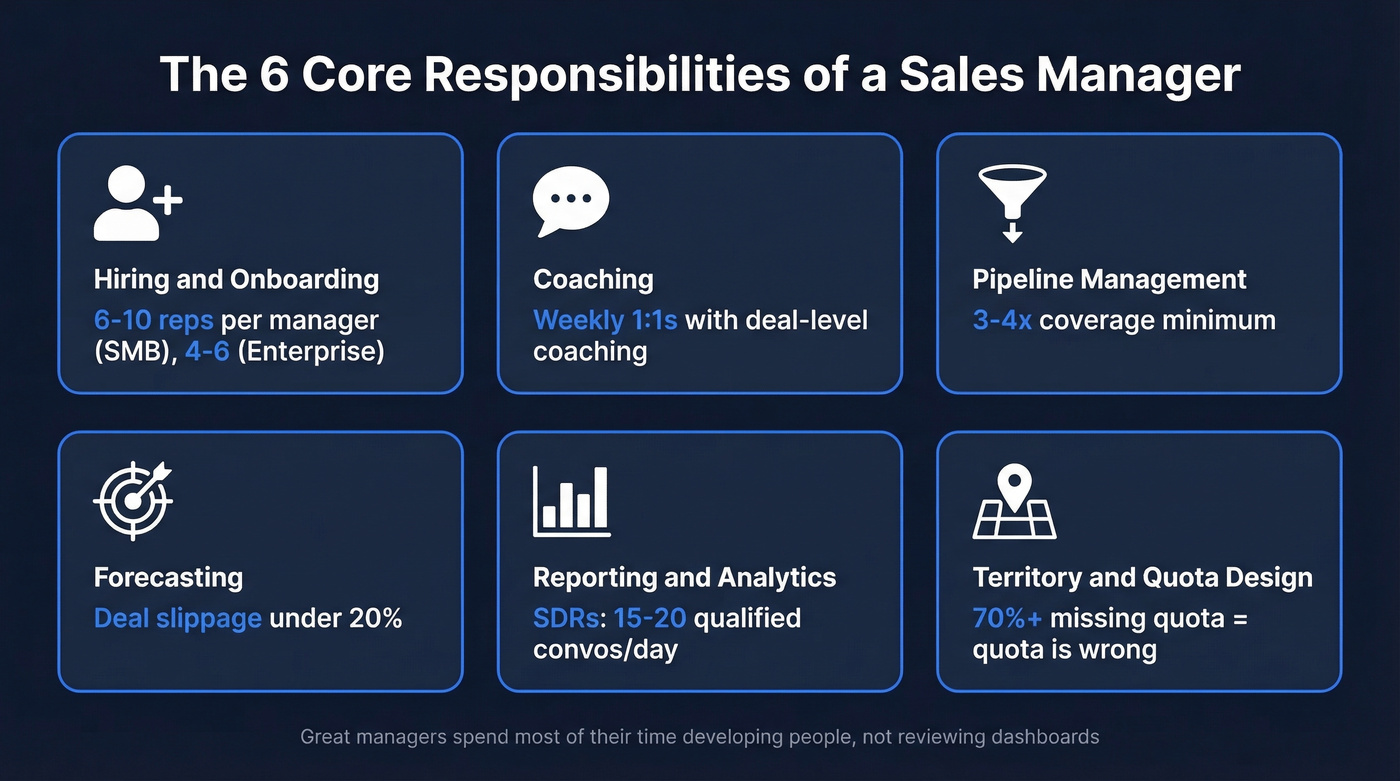
- Hiring and onboarding. A common operating range is a rep-to-manager ratio of 6-10 for SMB/mid-market, 4-6 for enterprise.
- Coaching. Weekly 1:1s with deal-level coaching, not status updates. This is the highest-ROI activity on your calendar.
- Pipeline management. Run weekly reviews with 3-4x coverage minimum. Below ~25-30% win rate? Push to 4-5x.
- Forecasting. Accurate forecasts require deal-level inspection, not rep self-reporting. Keep deal slippage under 20%.
- Reporting and analytics. SDRs should hit 15-20 qualified conversations per day, AEs 8-12 depending on ACV and segment. Activity without outcomes is noise - use sales activities that map to pipeline movement.
- Territory and quota design. If more than 70% of the team is missing quota, the quota is wrong - not the team.
These duties overlap daily, which is why time management is the silent skill that separates great managers from overwhelmed ones.
KPIs and Benchmarks
Every guide tells you to "track KPIs." Here are the actual numbers we've seen matter most.
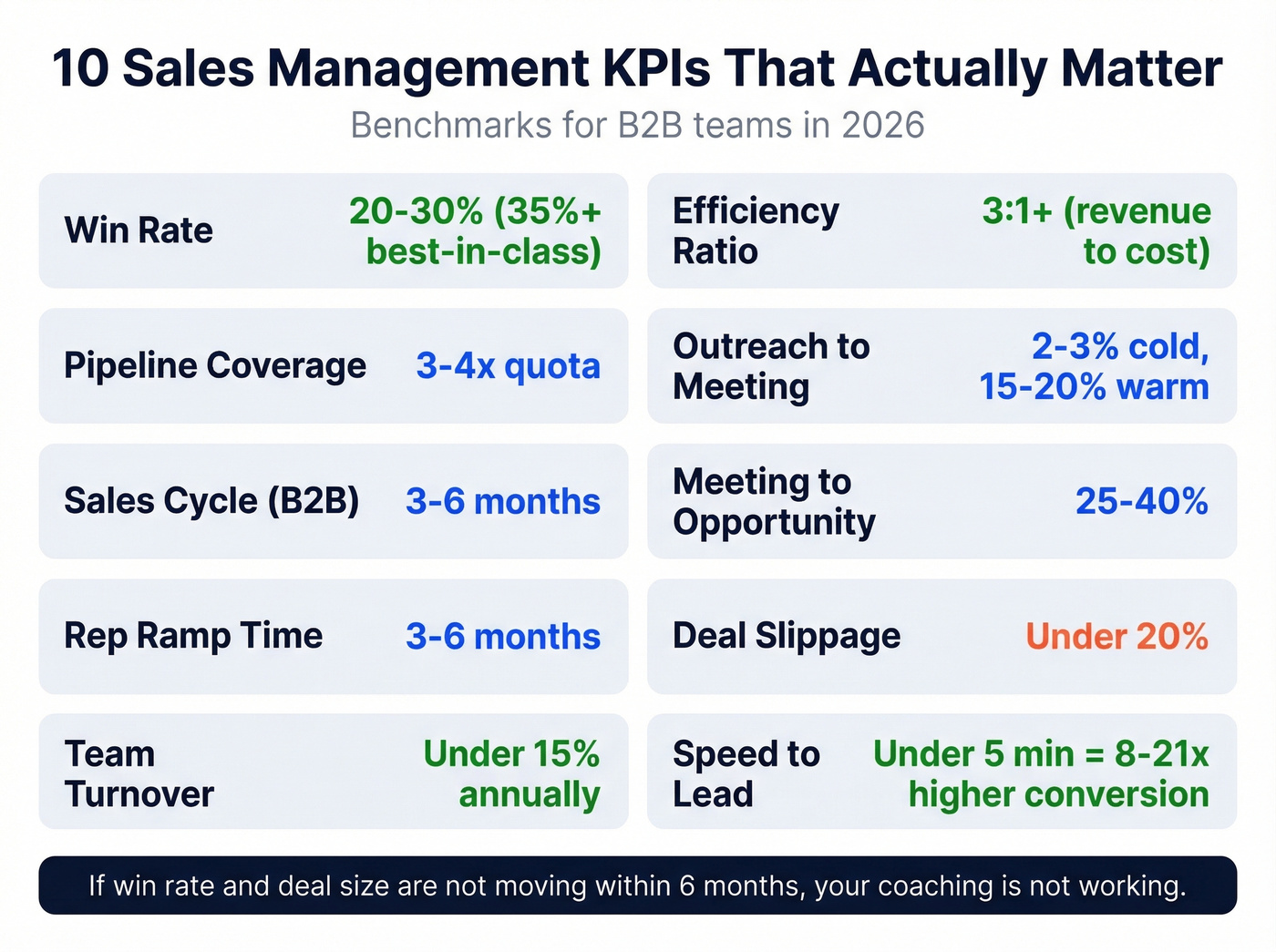
| KPI | Benchmark | Why It Matters |
|---|---|---|
| Win rate | 20-30% (35%+ best-in-class) | Core health metric |
| Pipeline coverage | 3-4x quota | Below 3x = forecast risk |
| Sales cycle | 3-6 months (B2B) | Longer = higher CAC |
| Rep ramp time | 3-6 months | Faster ramp = faster ROI |
| Team turnover | <15% annually | High churn kills momentum |
| Efficiency ratio | 3:1+ (revenue / cost) | Below 3:1 = unprofitable |
| Outreach-to-meeting | 2-3% cold, 15-20% warm | Prospecting efficiency |
| Meeting-to-opportunity | 25-40% | Funnel conversion signal |
| Deal slippage | <20% | Forecast accuracy proxy |
| Speed-to-lead | <5 min = 8-21x higher conversion | First responder wins 35-50% |
Measure coaching ROI by tracking win rate and deal size changes within six months of implementing a new cadence. If those numbers aren't moving, the coaching isn't working. If you want a tighter view of leading indicators, track funnel metrics alongside lagging revenue.

Pipeline coverage means nothing if your reps are emailing dead addresses. Prospeo delivers 98% email accuracy and 125M+ verified mobile numbers - refreshed every 7 days, not every 6 weeks. Teams using Prospeo book 26% more meetings than ZoomInfo users.
Stop managing around bad data. Start managing with clean pipeline.
Methodologies and Frameworks
A sales methodology isn't optional. Korn Ferry research shows adopting one leads to a 15% win rate lift and 21% increase in quota attainment.
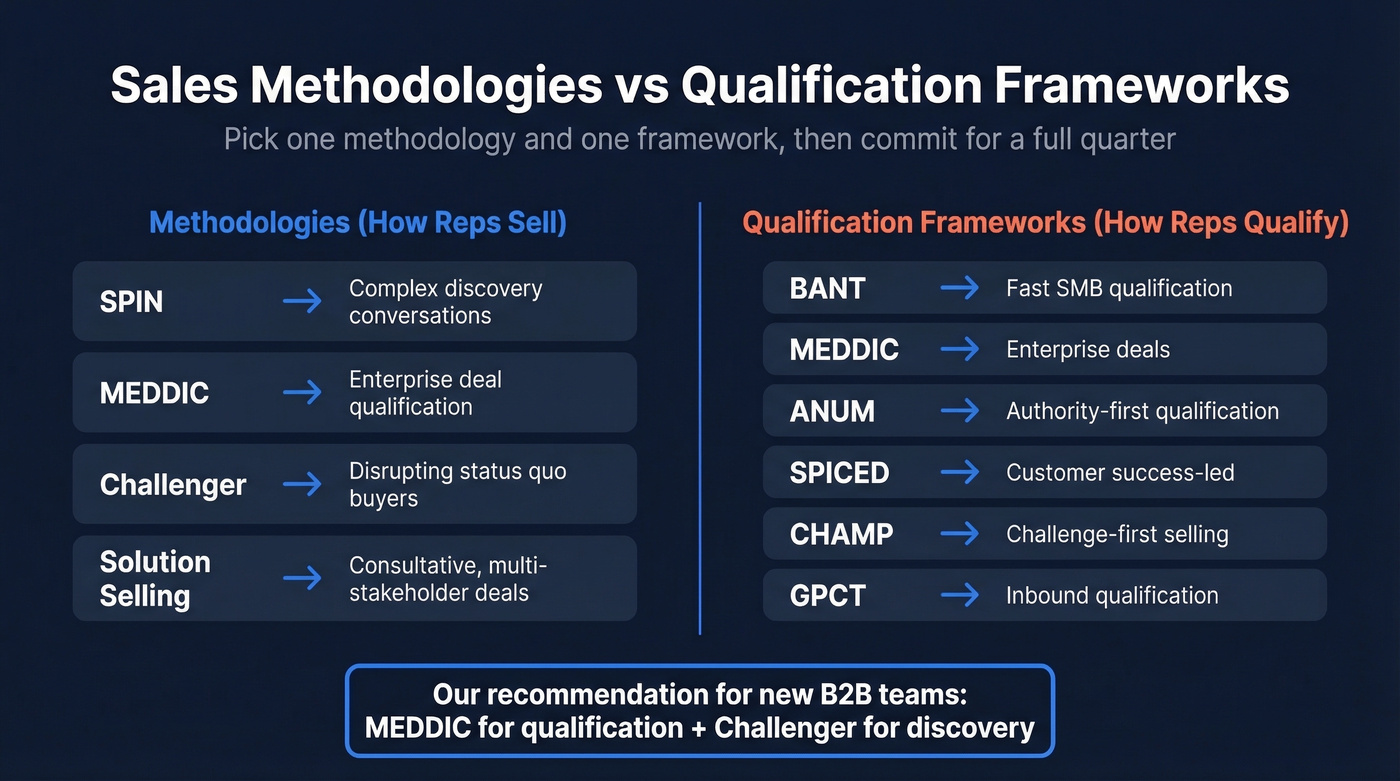
| Methodology | Best For |
|---|---|
| SPIN | Complex discovery conversations |
| MEDDIC | Enterprise deal qualification |
| Challenger | Disrupting status quo buyers |
| Solution Selling | Consultative, multi-stakeholder |
Here's the thing: most teams agonize over methodology selection for months. Building a B2B team from scratch? Start with MEDDIC for qualification and Challenger for discovery. Commit for a full quarter, then iterate. Indecision costs more than an imperfect choice. If you're standardizing execution, pair this with sales process optimization so stages and behaviors match.
Qualification Frameworks at a Glance
| Framework | Stands For | Use When |
|---|---|---|
| BANT | Budget, Authority, Need, Timeline | Fast SMB qualification |
| MEDDIC | Metrics, Economic Buyer, Decision Criteria, Decision Process, Identify Pain, Champion | Enterprise deals |
| ANUM | Authority, Need, Urgency, Money | Authority-first qualification |
| SPICED | Solution, Pain, Impact, Competition, Economic Buyer, Decision Criteria | Customer success-led |
| CHAMP | Challenges, Authority, Money, Prioritization | Challenge-first selling |
| GPCT | Goals, Plans, Challenges, Timeline | Inbound qualification |
A sales process defines the stages a deal moves through. A methodology defines how reps execute each stage. Don't confuse the two - you need both, and process without methodology produces wildly inconsistent results across your team.
How AI Is Changing the Role in 2026
56% of sales professionals now use AI daily, and adoption jumped from 24% to 43% in a single year per HubSpot's tracking. Sellers who effectively partner with AI tools are 3.7x more likely to meet quota according to Gartner.
AI agents handle meeting prep, account research, email drafting, and report generation. Bain found early AI deployments boosted win rates by more than 30%. The manager's job is shifting from admin oversight to strategic coaching - reviewing AI-generated call summaries instead of sitting on every call, using AI forecasting instead of spreadsheet math. For a deeper stack view, see generative AI sales tools.
Routine tasks like data entry, follow-up scheduling, and lead scoring are increasingly automated. That frees managers to focus on the human side of the role: deal strategy, rep development, and cross-functional alignment. The manager who understands AI tooling will outperform the one who doesn't. That gap is only widening.
Mistakes That Kill Pipeline
We've watched five patterns destroy pipeline repeatedly across teams we've worked with.
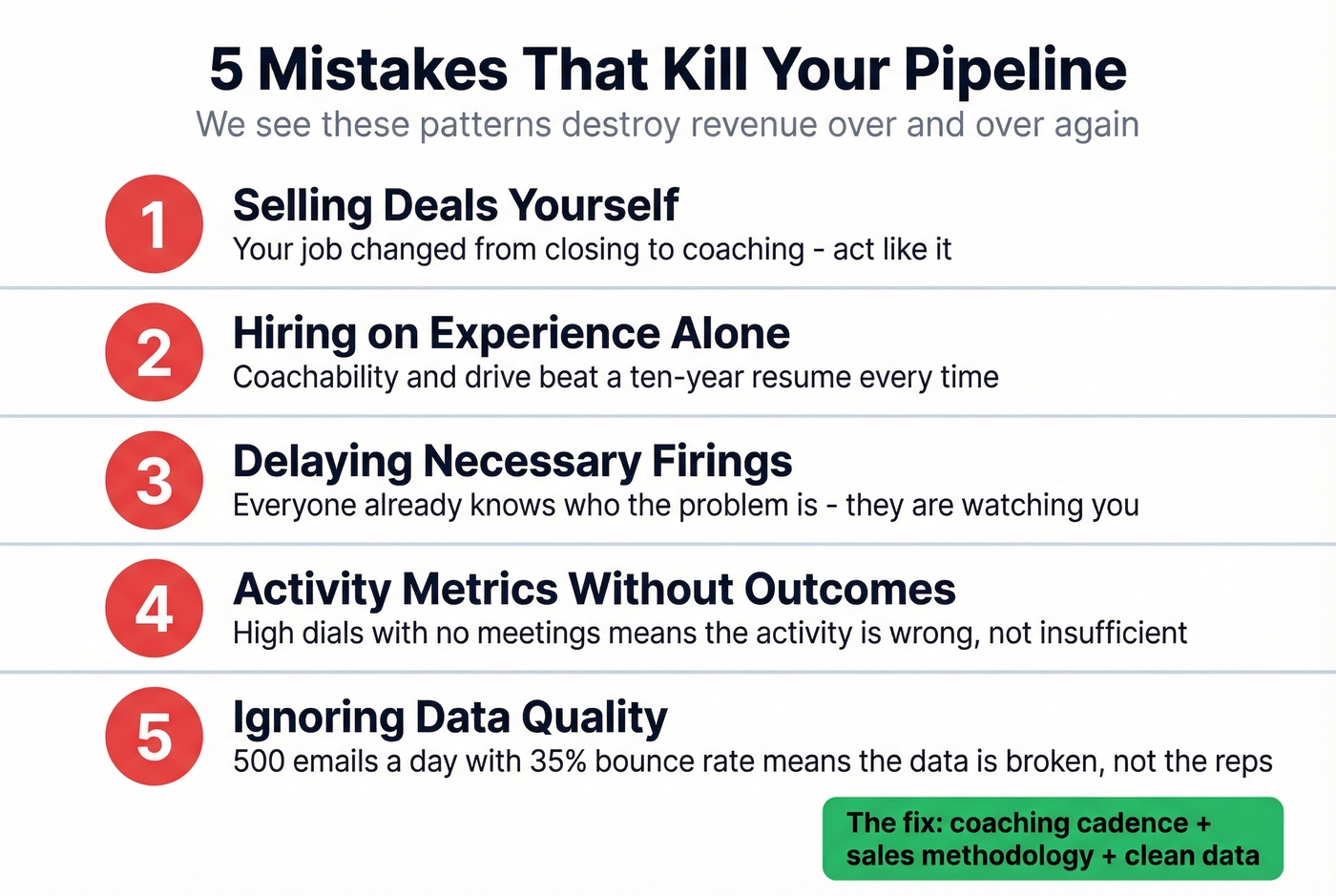
1. Selling deals yourself instead of managing pipeline. You closed the biggest deal last quarter. Meanwhile, three reps stalled out because nobody reviewed their pipeline. Your job changed - act like it. If you're seeing recurring stalls, map them against common sales pipeline challenges.
2. Hiring on experience alone. Hire for coachability and work ethic. Skills can be taught; drive can't. We've seen reps with zero SaaS experience outperform ten-year veterans within two quarters because they were genuinely coachable and hungry to improve.
3. Delaying necessary firings. Keeping a non-producer for six months poisons team dynamics. One negative rep can undo a quarter of coaching work. Let's be honest - everyone on the team already knows who the problem is. They're watching to see if you'll act.
4. Relying on activity metrics without outcome tracking. High activity with no meetings means the activity is wrong, not insufficient. Track conversations-to-meetings, not just dials.
5. Ignoring data quality. Your SDR team sends 500 emails a day with a 35% bounce rate. The problem isn't the reps - it's the data. Verify your list before you blame effort. Tools like Prospeo catch bad emails before they hit send, which is the difference between a productive outbound motion and a burned domain. If bounces are creeping up, use email bounce rate benchmarks to diagnose the root cause.
Essential Tools for Sales Leaders
You don't need 15 tools. You need a CRM, clean prospect data, and call recording. Everything else is optional until you've nailed those three.
CRM: HubSpot's free tier works well for small teams. Salesforce plans start around $25/user/month and scale with you. Skip this if your team is under three reps and you're bootstrapping - a well-maintained spreadsheet beats a CRM nobody updates. If you're comparing options, start with examples of a CRM.
Conversation intelligence: Gong typically costs around $100-150/user/month. Expensive, but it transforms coaching from guesswork to data. In our experience, the ROI shows up within one quarter if managers actually review the call insights.
Data quality and enrichment: Your pipeline is only as good as the data feeding it. Prospeo gives you 300M+ profiles with 98% email accuracy and a 7-day data refresh cycle - free tier available, no contracts. If you're evaluating vendors, compare data enrichment services before you commit.

You're tracking outreach-to-meeting rates and speed-to-lead, but your reps waste hours on bounced emails and wrong numbers. Prospeo's 30+ search filters - including buyer intent, job changes, and headcount growth - put the right prospects in front of your team at $0.01 per email.
Give your sales team data that actually connects them to real buyers.
FAQ
What does a sales manager do day-to-day?
A sales manager spends most of their day on pipeline reviews, coaching 1:1s, forecast updates, and cross-functional alignment with marketing and CS. Coaching is the highest-leverage activity. The daily mix varies by team size, but these four tasks remain constant whether you manage five reps or fifty.
What's the difference between a sales process and a methodology?
A process defines the stages a deal moves through - discovery, demo, proposal, close. A methodology defines how reps execute within each stage, like using MEDDIC qualification questions during discovery. You need both. Process without methodology produces inconsistent results.
What tools does a new sales manager need first?
Start with three: a CRM for pipeline visibility, a verified data provider for clean prospect lists, and a call recording tool for coaching. Get those right before adding anything else. You can always layer on intent data, sequencing tools, and analytics platforms later.
What are the core functions of sales management?
The six primary functions are hiring, coaching, pipeline management, forecasting, reporting, and territory design. Each maps to specific KPIs - pipeline coverage should sit at 3-4x quota, and team turnover should stay below 15% annually. Neglecting any one creates a bottleneck that drags down the entire team.