

What Is an SDR in Sales? The Definitive 2026 Guide
It's your first week as an SDR. You've got a headset, a list of 500 accounts, and a quota number that feels like it was pulled from thin air. Nobody told you that 57.3% of SDRs miss their targets - or that the ones who hit them can earn six figures early in their careers. So what is an SDR in sales, exactly? And is the grind actually worth it?
The Quick Answer
An SDR - Sales Development Representative - is the person who fills the top of the B2B sales pipeline. You prospect, qualify, and book meetings so Account Executives can close deals. You don't close anything yourself. Median OTE sits between $85K and $102K depending on the dataset, with top performers clearing $128K. It's the fastest path to a six-figure sales career if you treat it like a 12-18 month apprenticeship - and the fastest path to burnout if you don't.
Quick distinction: an SDR books meetings. A BDR often does the same thing (titles are used interchangeably at a lot of companies). An AE takes those meetings and closes the deal.
What Does an SDR Actually Do?
The sales development role splits into two flavors. Inbound SDRs work leads that marketing generates - demo requests, content downloads, webinar attendees. Outbound SDRs start from scratch, building target lists and cold-contacting prospects who've never heard of the company. Outbound is harder, builds stronger prospecting skills, and forces you to get good at research, messaging, and objection handling fast.
Regardless of model, the daily workflow follows a predictable rhythm:
| Time Block | Activity | Duration |
|---|---|---|
| 8:00-8:30 | Pipeline review, prep | 30 min |
| 8:30-10:30 | Cold calling block | 2 hrs |
| 10:30-11:30 | Email sequences + follow-ups | 1 hr |
| 11:30-12:00 | Account research | 30 min |
| 12:00-1:00 | Lunch | 1 hr |
| 1:00-3:00 | Cold calling block #2 | 2 hrs |
| 3:00-3:30 | Social touches + video | 30 min |
| 3:30-4:30 | Admin, CRM updates, prep | 1 hr |
The benchmark is 80-100 total activities per day - a mix of calls, emails, and social touches. That translates to roughly 40-50 dials and 10-40 personalized emails daily.
The core loop is simple: prospect, connect, qualify, book meeting, hand off to AE, get feedback on meeting quality. That feedback loop is where most reps either level up or stagnate. The best SDRs obsess over what happens after the handoff, not just the booking itself. And the best-performing orgs recognize this, treating the role as a specialist function rather than just a stepping stone to carrying a bag.
SDR vs BDR vs AE
Let's clear this up, because the internet makes it more confusing than it needs to be.
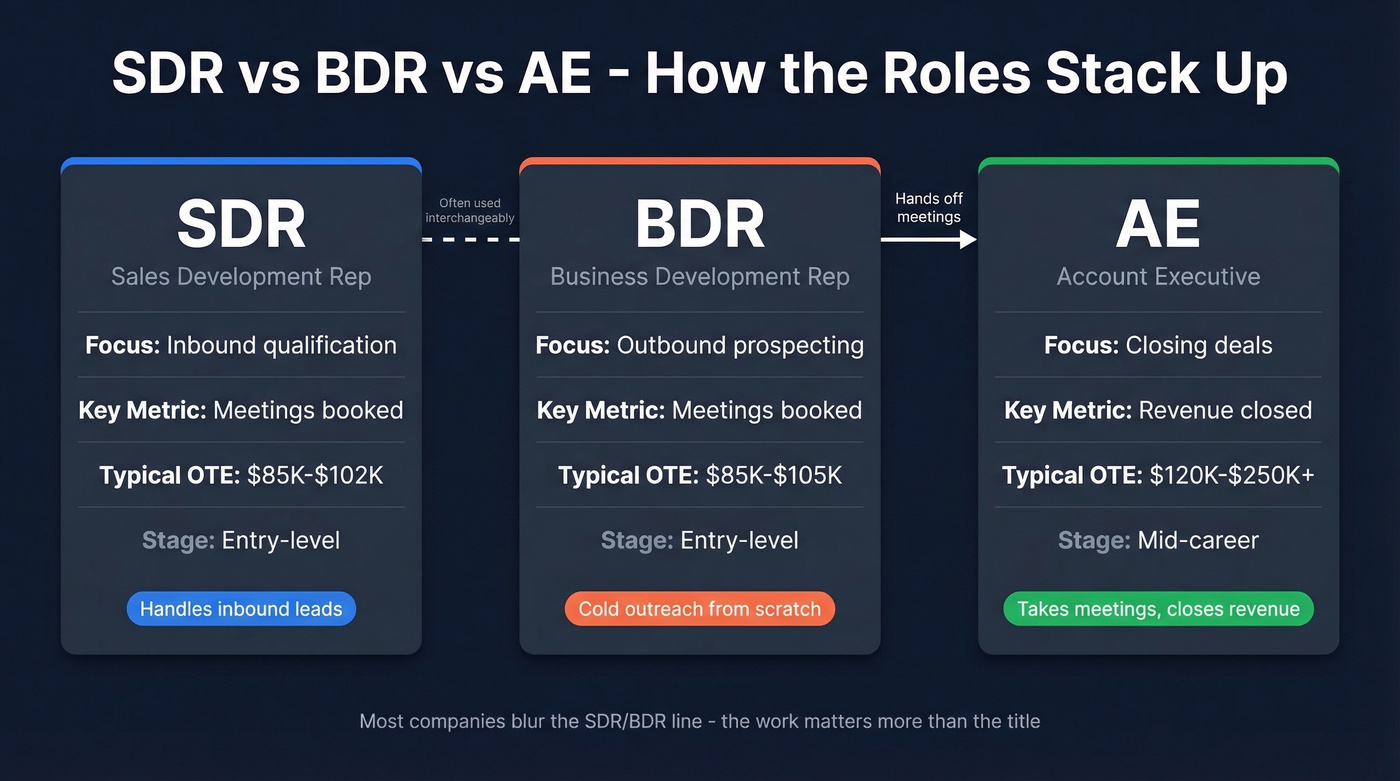
| Role | Focus | Key Metric | Typical OTE | Career Stage |
|---|---|---|---|---|
| SDR | Inbound qualification | Meetings booked | $85K-$102K | Entry-level |
| BDR | Outbound prospecting | Meetings booked | $85K-$105K | Entry-level |
| AE | Closing deals | Revenue closed | $120K-$250K+ | Mid-career |
Here's the thing: most companies use SDR and BDR interchangeably. When there's a distinction, it's usually that SDRs handle inbound leads while BDRs do outbound - or the split is by market segment (SMB vs. mid-market). Don't overthink the title. The work is what matters, and the work is almost always some mix of outbound prospecting, qualifying, and booking meetings.
Metrics That Actually Matter
Activity Benchmarks
These numbers come from compiled data across Bridge Group, Operatix, and Tenbound research - they represent what "good" looks like for an outbound rep.
| Metric | Benchmark |
|---|---|
| Calls/day | 40-50 |
| Emails/day | 10-40 |
| Total activities/day | 80-100 |
| Meetings booked/month | 15 |
| Meeting show rate | ~80% |
Fifteen meetings a month with an 80% show rate gives you roughly 12 held meetings. That's the number your AE team actually cares about.
The Conversion Funnel Math
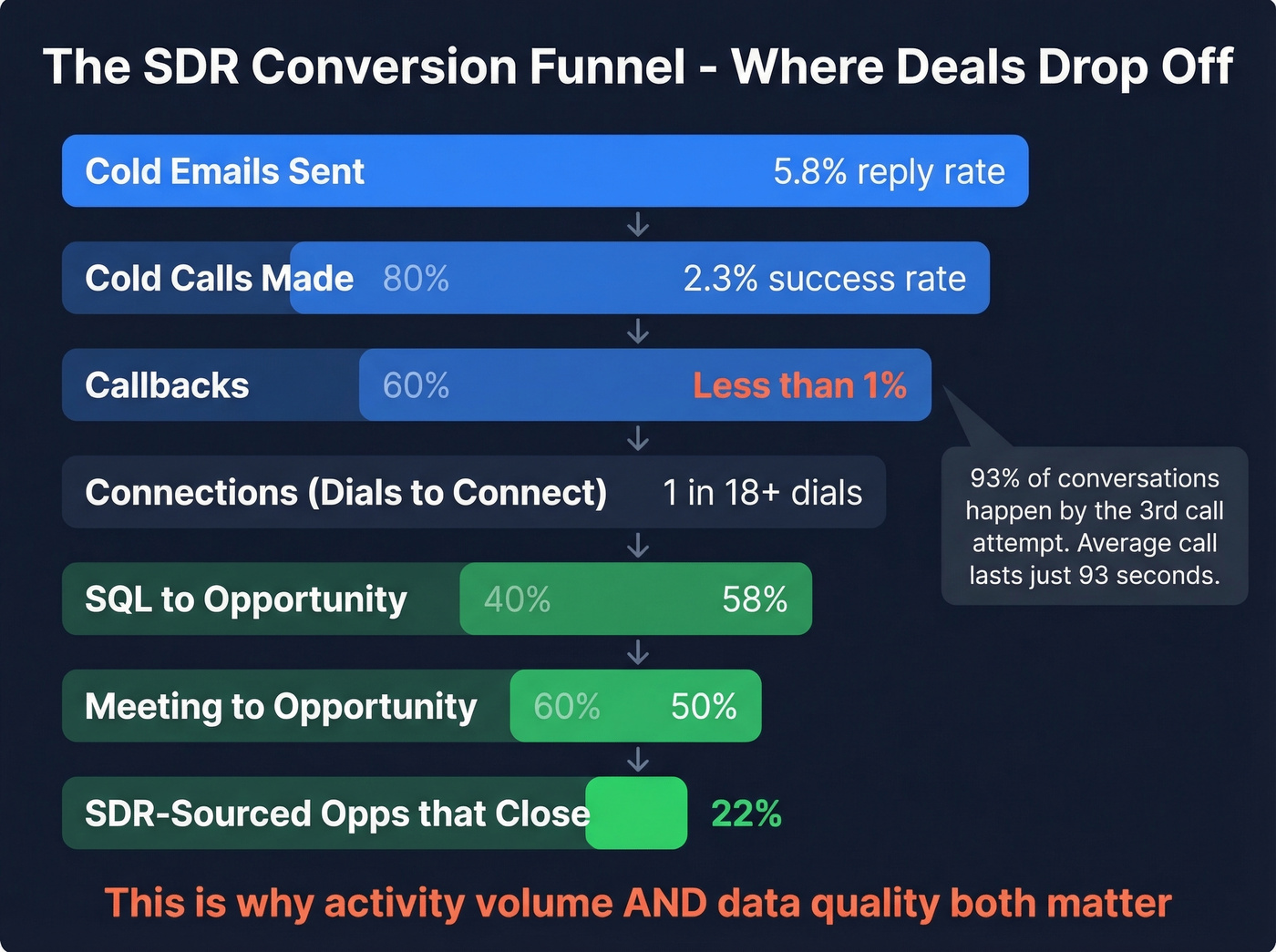
This is where reality hits. Benchmark data compiled from 16.5M cold emails and 204K+ cold calls paints a clear picture of the dropoff at every stage:
| Stage | Conversion Rate |
|---|---|
| Cold email reply rate | 5.8% |
| Cold call success rate | 2.3% |
| Callback rate | <1% |
| Dials to connect | 18+ |
| SDR-qualified lead to opportunity | ~58% |
| Meeting to opportunity | ~50% |
| SDR-sourced opps close rate | 22% |
93% of conversations happen by the third call attempt. The average call lasts just 93 seconds - barely enough time to deliver a value prop and ask a qualifying question.
The math is unforgiving. If you're sending 40 emails a day at a 5.8% reply rate, that's about 2.3 replies. Most won't convert to meetings. This is why activity volume matters - and why data quality is the upstream variable that makes or breaks everything else. We've seen it firsthand: the reps who obsess over data quality outperform those who just dial harder. If a quarter of your emails bounce, you're burning domain reputation and wasting dials on dead numbers.
SDRs typically manage 75-125 accounts at a time, and the average org runs a 2.6 AE-to-1 SDR ratio.
How SDRs Qualify Leads
BANT vs MEDDIC vs CHAMP
Picking a qualification framework matters less than using one consistently. That said, using BANT for six-figure enterprise contracts is a bad time - it's too shallow for multi-stakeholder deals.
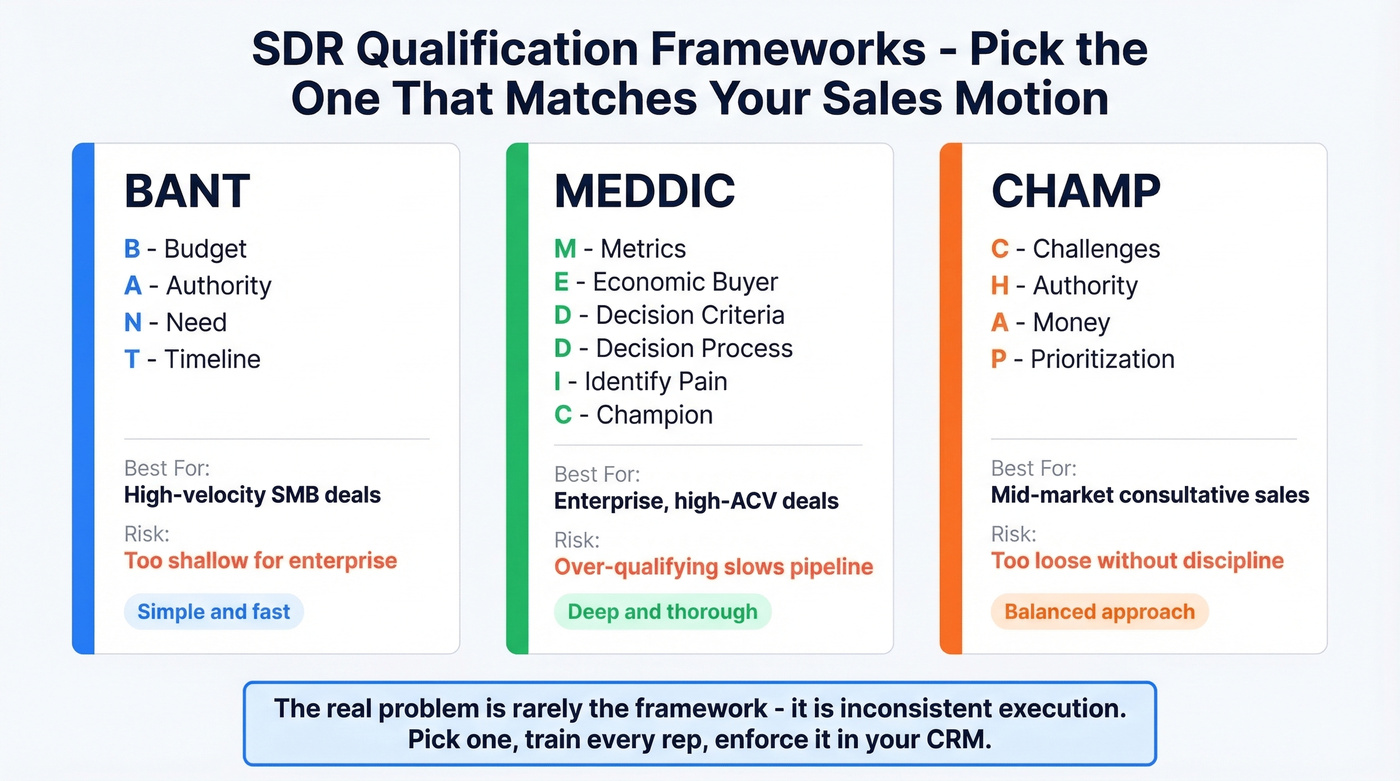
| Framework | Stands For | Best For | Risk |
|---|---|---|---|
| BANT | Budget, Authority, Need, Timeline | High-velocity SMB | Too shallow for enterprise |
| MEDDIC | Metrics, Economic Buyer, Decision Criteria, Decision Process, Identify Pain, Champion | Enterprise, high-ACV | Over-qualifying slows deals |
| CHAMP | Challenges, Authority, Money, Prioritization | Mid-market consultative | Too loose without discipline |
The real failure modes aren't about picking the wrong framework. They're about over-qualifying (which stalls pipeline velocity) or under-qualifying (which inflates your pipeline with deals that'll never close and wrecks forecast accuracy). We've seen teams switch frameworks three times in a year when the actual problem was inconsistent execution of the one they had.
Pick the framework that matches your sales motion, train every rep on it, and enforce it in your CRM fields. Consistency beats sophistication every time.

The article says 57.3% of SDRs miss quota. Bad data is the silent killer - bounced emails torch your domain reputation, and dead phone numbers waste your 40-50 daily dials. Prospeo gives SDRs 98% verified emails and 125M+ direct dials, refreshed every 7 days. That means more connects per activity block and fewer wasted reps.
Stop dialing dead numbers. Start hitting quota.
SDR Compensation in 2026
Two datasets tell slightly different stories, and both are useful:
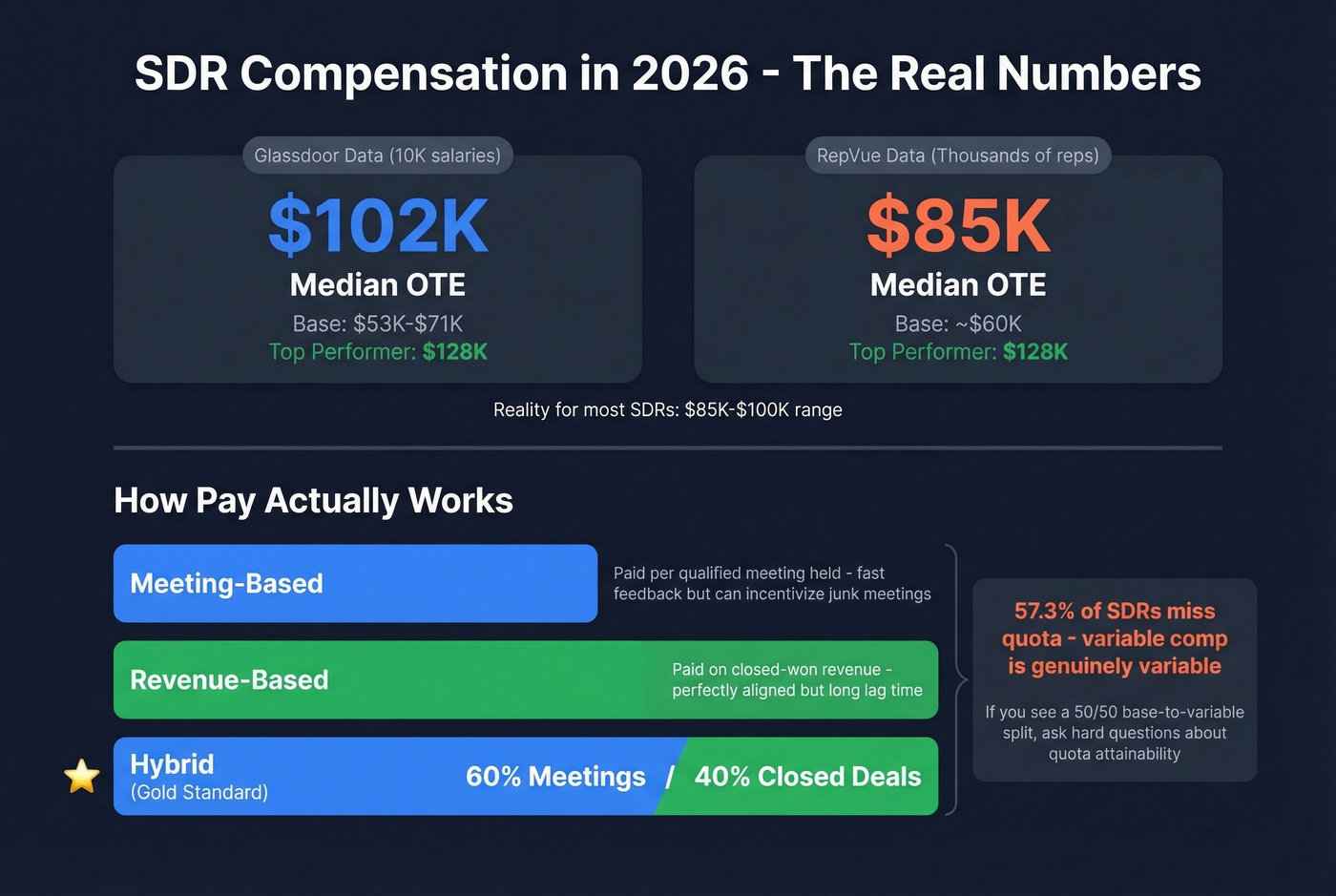
| Source | Median OTE | Base Range | Top Performer | Sample Size |
|---|---|---|---|---|
| Glassdoor | $102K | $53K-$71K | $128K | 10K salaries |
| RepVue | $85K | ~$60K | $127,955 | Thousands |
The gap reflects methodology differences. Glassdoor skews toward self-reported data from higher-cost markets; RepVue aggregates across a broader set of companies. Other industry benchmarks cluster around $75K-$95K. For most sales development reps, the truth lands somewhere in the $85K-$100K range, with significant variance based on geography, industry, and company stage.
The 57.3% quota attainment stat is the reality check. About 43% of SDRs don't hit their number in a given period. That doesn't mean they're all failing - quota-setting is notoriously aggressive - but it means variable comp is genuinely variable.
How Pay Actually Works
The standard pay mix is 65/35 base to variable. Some companies push 50/50, but that's too risky for junior reps still learning the craft. If you're evaluating offers and see a 50/50 split, ask hard questions about quota attainability.
Three common payout models:
Meeting-based comp pays per qualified meeting held. Fast feedback, but it can incentivize junk meetings. Revenue-based comp pays on closed-won sourced revenue - perfectly aligned but with painful lag time for a junior rep. Hybrid splits variable pay 60% meetings / 40% closed deals, and it's the gold standard for most orgs.
Run the math on a hybrid plan: $30,000 in variable comp, 15 qualified meetings per month as the target. The meeting bucket (60% = $18K) works out to roughly $100 per meeting. The revenue bucket (40% = $12K) against $500K in sourced revenue per year implies about a 2.4% commission on closed deals.
The SDR Tech Stack in 2026
McKinsey found that B2B companies adopting advanced sales technology grow revenue 2-3x faster. The average team uses 12-15 tools daily, and the total stack cost runs $2,000-$5,000 per rep per month. The 2026 trend is consolidation - platforms covering multiple categories to bring that number down.
If you're building your stack from scratch, start with a short list of SDR tools and add categories only when you can prove ROI.
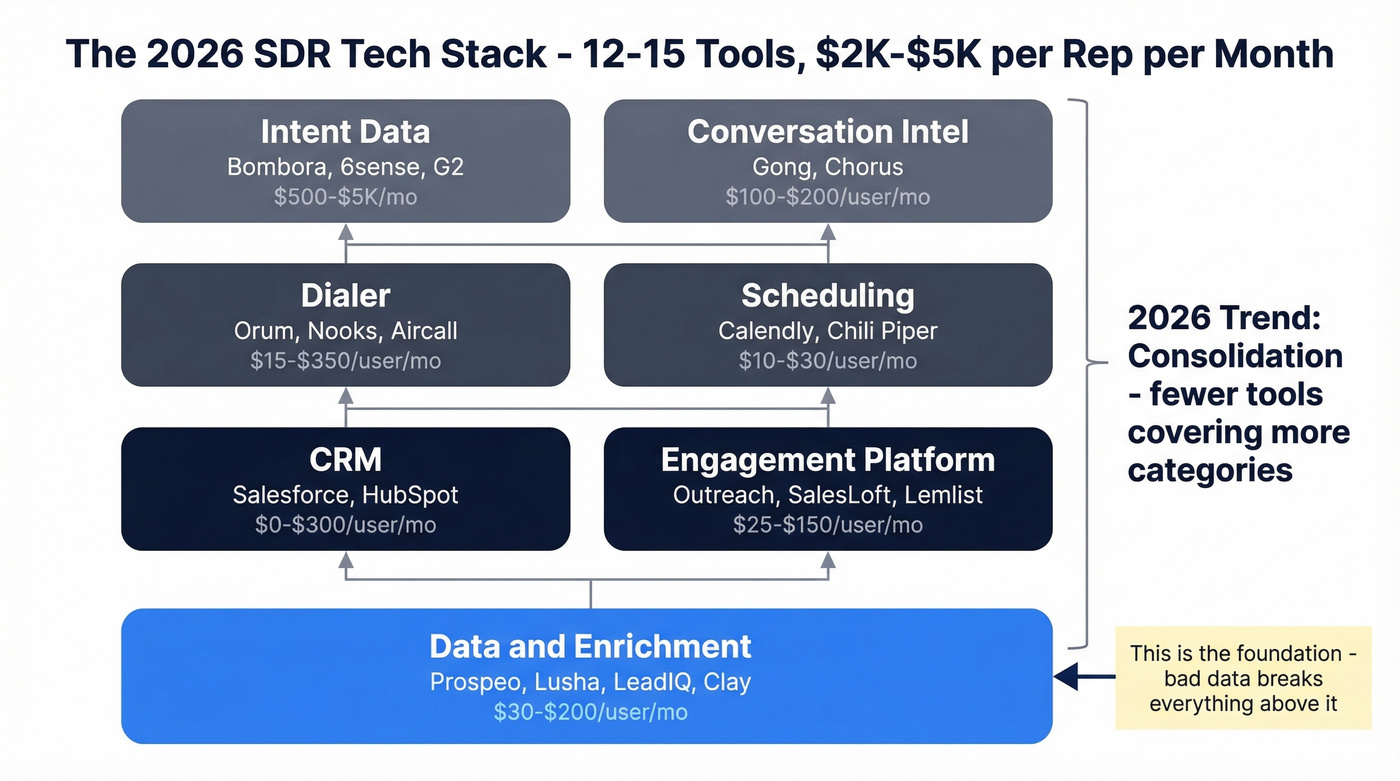
| Category | Example Tools | Price Range |
|---|---|---|
| CRM | Salesforce, HubSpot (free tier available) | $0-$300/user/mo |
| Engagement | Outreach, SalesLoft, Lemlist | $25-$150/user/mo |
| Dialer | Orum, Nooks, Aircall, Dialpad | $15-$350/user/mo |
| Enrichment | Lusha, LeadIQ, Clay | $30-$200/user/mo |
| Scheduling | Calendly, Chili Piper | $10-$30/user/mo |
| Intent Data | Bombora, 6sense, G2 | $500-$5,000/mo |
| Conversation Intel | Gong, Chorus | $100-$200/user/mo |
The data layer is the foundation of everything a sales development rep does. In our experience testing dozens of stacks, data quality is always the bottleneck. If half your emails bounce and your phone numbers are dead, no amount of activity will save your pipeline.
Prospeo refreshes its 300M+ contact database every 7 days - compared to the 6-week industry average - and verifies emails at 98% accuracy. With 125M+ verified mobile numbers delivering a 30% pickup rate, reps spend time selling instead of chasing dead leads. The free tier starts at 75 verified emails per month plus 100 Chrome extension credits, enough to test whether better data actually moves your numbers.

Skip the enterprise data platform if your average deal size is under $10K. Start with a self-serve tool, prove the ROI, then scale up. The reps who waste budget on enterprise tooling before they've nailed their ICP are the same ones who blame the tools when they miss quota.
SDR Career Path
The Typical Path to AE
You've been in the role for 14 months. You're consistently hitting 110% of quota, you've shadowed a dozen AE discovery calls, and the mid-market AE manager knows your name. This is the moment where career trajectory either accelerates or stalls.
The typical SDR-to-AE promotion takes 12-18 months. But "typical" hides a lot of variance - I've seen reps promoted in 8 months and others stuck for 2+ years because they never built relationships with the AE leadership team. Promotion strategy matters more than raw tenure. Proactively align with your manager on a written promotion plan. Shadow AE meetings not just to learn, but to build relationships with the AE team manager who'll eventually approve your move.
If you're new, a structured 30-60-90 day plan can keep you from thrashing in month one.
Alternative Paths
Not every sales development rep wants to carry a quota forever. Customer Success suits relationship-oriented reps who thrive on long-term account management. RevOps appeals to the analytical types who love systems and process optimization. Sales Engineering is the natural move for technically minded reps, while Enablement draws the natural teachers who'd rather coach a team than carry a number.
One piece of advice from a 7-year sales veteran on Reddit: avoid startups for your first AE role. The learning curve is brutal, support is minimal, and the territory is usually unproven. Take your first closing role at a company with established playbooks, ramped territories, and a real enablement function.
If you're still trying to break into the role, don't just submit applications online. Call the hiring manager directly. It's the most SDR thing you can do, and it immediately demonstrates the skill they're hiring for.
AI and the Future of SDRs
"Are SDRs about to be cooked by AI?" That's the exact question bouncing around r/salesdevelopment right now. The honest answer is nuanced.
AI SDRs are genuinely better at certain tasks. Here's what comparative data from SaaStr shows:
| Metric | Human SDR | AI SDR |
|---|---|---|
| Technical questions answered | 15% | 87% |
| Time to technical qualification | 8.3 days | 2.1 days |
| Technical buyer satisfaction | 6.2/10 | 8.4/10 |
| Calls needing technical follow-up | 73% | 22% |
Those numbers are striking. But AI SDRs require daily QA - they aren't set-and-forget. They hallucinate product capabilities, miss emotional cues, and can't navigate the political dynamics of a buying committee. The role isn't disappearing. It's evolving. The reps who thrive in 2026 and beyond will use AI to handle research, personalization, and initial qualification at scale, while focusing their human time on conversations that require trust, judgment, and nuance.
If you're leaning into automation, start with AI sales follow-up workflows before you try to replace the whole top-of-funnel.
The Honest Truth About Being an SDR
Look, the role is stressful. Quota pressure is relentless, job security is shaky (that same Reddit veteran reports being fired or laid off three times across a 7-year career), and the anxiety of constant rejection takes a real toll. If you're prone to tying your self-worth to your performance metrics, this job will test you.
The counterbalance is equally real. No other entry-level role builds phone confidence, business acumen, and outbound skills this fast. The earning potential is legitimate - $100K+ OTE before you're 25 is achievable. And the career velocity is unmatched: 12-18 months of strong performance opens doors to AE roles, leadership tracks, and adjacent functions that would take years to reach through other paths.
Understanding what an SDR in sales truly is - an apprenticeship in pipeline generation - helps you approach the role with the right mindset from day one. Exercise, take your PTO, and don't be afraid to seek help if the anxiety gets heavy. The skills you're building are durable. The quota number resets every quarter.
If rejection is the part that breaks you, build a system for cold call rejection so it stops feeling personal.
At a 5.8% cold email reply rate, every bounce destroys your math. SDRs using Prospeo's 5-step verified data keep bounce rates under 4% and connect rates 3x higher than industry average - turning 80-100 daily activities into actual pipeline instead of noise. Starting at $0.01 per email, no contracts.
Fix your data quality and the conversion funnel fixes itself.
FAQ
What does SDR stand for?
SDR stands for Sales Development Representative - an entry-level B2B role focused on prospecting, qualifying leads, and booking meetings for Account Executives. They're the person responsible for filling the top of the pipeline so closers can focus on closing.
How much do SDRs earn in 2026?
Median OTE ranges from $85K to $102K, with top performers earning up to $128K. Base pay typically runs $53K-$71K on a 65/35 base-to-variable split. Geography and company stage create significant variance.
What's the difference between an SDR and a BDR?
Most companies use the titles interchangeably. When they differ, SDRs typically handle inbound leads while BDRs focus on outbound prospecting. Don't choose a job based on the title - evaluate the actual work and comp plan.
Is SDR a good entry-level sales job?
Yes - if you treat it as a 12-18 month apprenticeship. It builds outbound prospecting, objection handling, and business acumen faster than almost any other role. Resilience matters more than raw talent.
What tools do SDRs need to get started?
At minimum: a CRM, a data provider with verified contacts, and a sales engagement platform. The average stack costs $2,000-$5,000/month per rep, though free tiers can get a small team started for much less.