

Inbound vs Outbound Marketing: What Actually Works in 2026
A CEO we know asked her marketing lead a simple question last quarter: "We spent $15,000 a month on content and got 12 leads. The SDRs booked 40 meetings from cold outreach, but half the emails bounced. What are we doing wrong?" The answer wasn't that inbound failed or outbound won. The real difference between inbound and outbound marketing isn't which one is "better" - it's which ratio fits your business right now, and whether the data underneath both channels is any good.
Quick Version
- Inbound earns attention over months (SEO, content, email nurture) at roughly $135 per lead
- Outbound pushes messages now (cold email, ads, direct outreach) at roughly $346 per lead
- Neither wins universally - the right mix depends on your sales cycle, company stage, and data quality
- B2B with under 50 employees? Start with outbound for immediate pipeline. Put 20-30% of budget into inbound that compounds.
- B2C? Email marketing is the top ROI channel. Full stop.
- B2B scale-up (50-200)? Go hybrid, shifting toward inbound as content assets mature.
The rest of this piece gives you the numbers to decide.
Key Differences Between Inbound and Outbound
What Is Inbound Marketing?
Inbound is pull marketing. You create something valuable - a blog post, a webinar, an email course - and let buyers find you when they're already looking for answers. The core tactics: SEO, content marketing, email nurture, organic social, and webinars. Think Airbnb's neighborhood guides or HubSpot's blog empire - content that ranks, builds trust, and generates leads without a single cold call.
The catch? Inbound channels are shifting. About 30% of marketers reported decreased search traffic as consumers turn to AI tools for answers. That doesn't mean inbound is dying - it means the format is evolving. Answer Engine Optimization (AEO) is the new frontier: 51% of teams plan to increase AEO investment vs just 14% for traditional SEO. If your inbound strategy is still "publish 4 blog posts a month and pray for rankings," you're optimizing for a search engine that's already changed.
What Is Outbound Marketing?
Outbound is push marketing. You identify who you want to reach and put your message in front of them - whether they asked for it or not. Forget the old image of TV ads and cold calling. Modern outbound is data-driven and personalized: cold email sequences triggered by intent signals, multi-channel cadences across email and phone, paid ads targeting specific accounts, even strategic direct mail.
The transformation comes from enriched B2B data enabling personalized outreach at scale, combined with real-time tracking and sales automation that lets reps act on warm signals within minutes. Talk to any outbound agency running 50+ client campaigns and they'll tell you the same thing: list quality is the #1 variable. Outbound isn't spray-and-pray anymore. When it's done right, it's surgical.
Inbound vs Outbound B2B Marketing: Side-by-Side
| Dimension | Inbound | Outbound |
|---|---|---|
| Cost per lead | ~$135 | ~$346 |
| Time to results | 3-12 months | Days to weeks |
| Conversion benchmark | 14.6% (organic search) | 1-2% (cold); 12-18% (multi-channel) |
| ROI range | SEO: 748%; Email: 261% | PPC: 36%; Direct mail: 29-35% |
| Scalability | Compounds over time | Linear (more spend = more reach) |
| Best for | Category-aware buyers | Market entry, launches, immediate pipeline |
| Key risk | Months before payoff | Bad data kills deliverability |
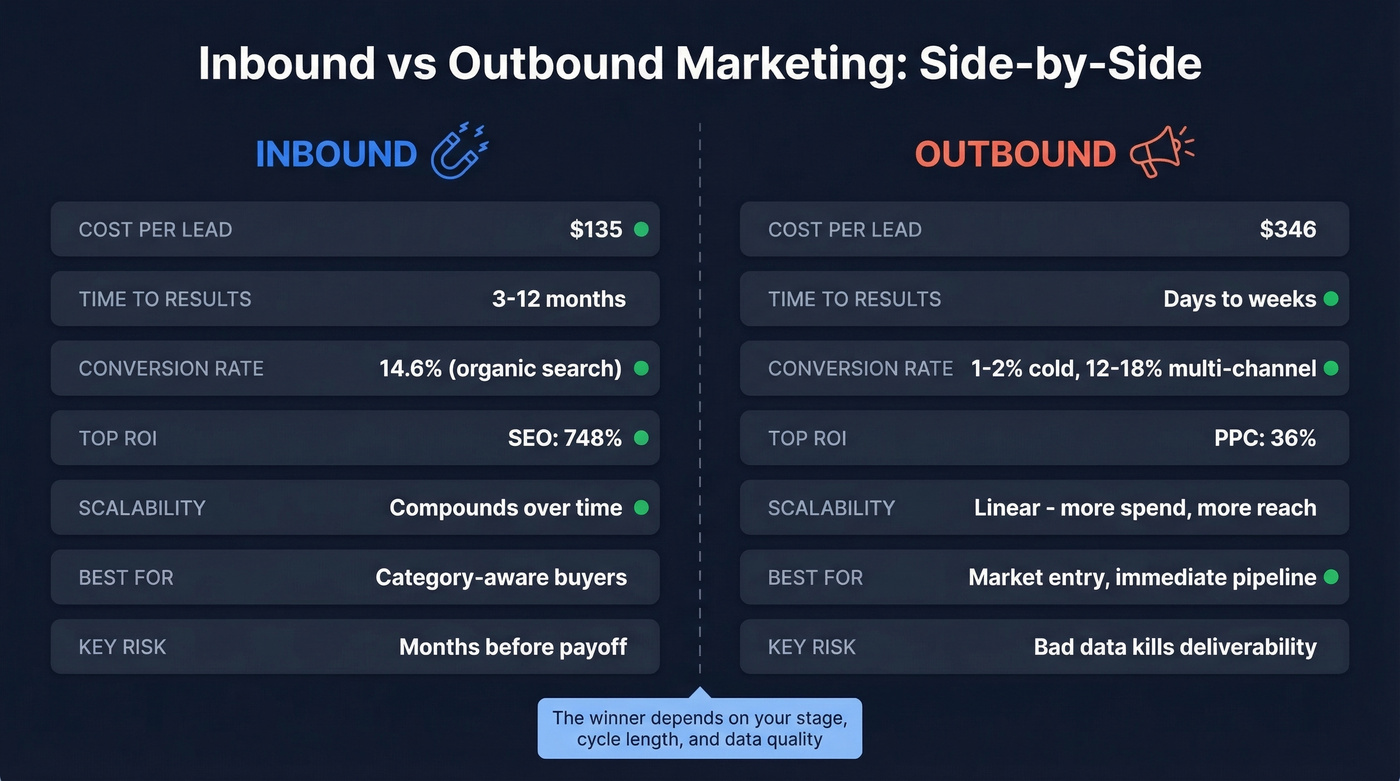
The conversion gap is the number everyone fixates on - 14.6% vs 1-2%. But that comparison is misleading. Modern multi-channel outbound (email + phone + social touches) converts at 12-18%, which closes the gap dramatically. The real differentiator isn't the channel. It's whether you're reaching the right person with the right message at the right time.
2026 Channel ROI Benchmarks
B2B Channel ROI
| Channel | ROI | Break-Even | Key Metric |
|---|---|---|---|
| SEO | 748% | ~9 months | 9.1 ROAS over 3 years |
| 261% | ~7 months | 2.4% conversion rate | |
| Webinars | 213% (430% in SaaS) | ~30 days | Highest B2B SaaS ROI |
| LinkedIn (paid) | 229% | Varies | 2.74% visitor-to-lead |
| LinkedIn (organic) | 192% | Ongoing | vs 0.69% Twitter, 0.77% Facebook |
| PPC | 36% | ~4 months | Immediate traffic |
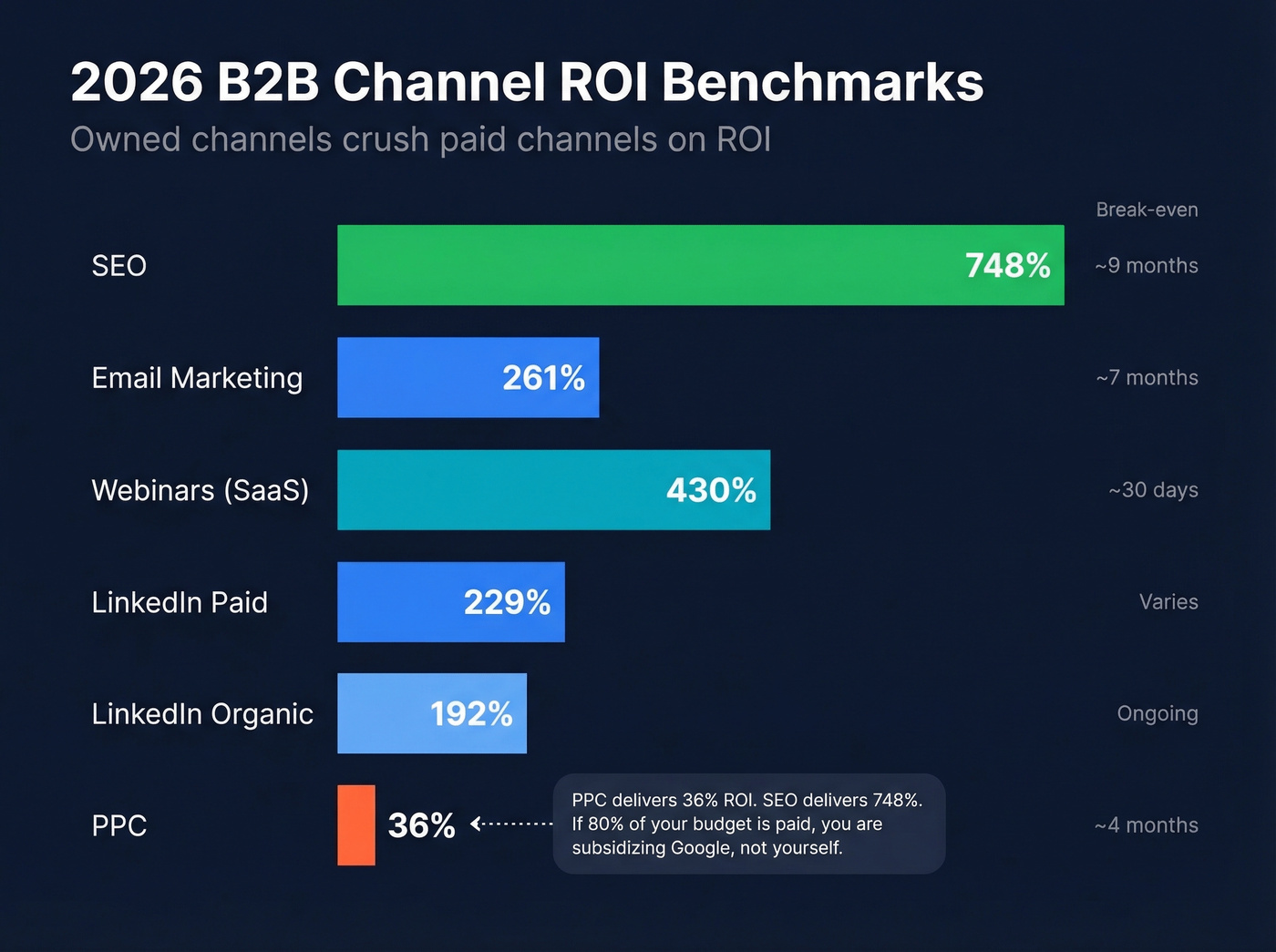
The pattern is clear: owned channels crush paid channels on ROI. SEO at 748% vs PPC at 36% isn't even close. LinkedIn's visitor-to-lead rate of 2.74% makes Twitter and Facebook look like rounding errors for B2B.
Webinars are the sleeper hit. At 430% ROI for B2B SaaS, they outperform almost everything except SEO - and they hit break-even in about 30 days instead of 9 months.
B2C Channel ROI
For B2C brands, the hierarchy is different. The top ROI channels are email marketing (#1), paid social (#2), and content marketing (#3). Email conversion rates actually run higher in B2C (2.8%) than B2B (2.4%).
Here's the thing: if your average deal size is under $10K, you probably don't need a complex multi-channel tech stack. Email alone will outperform everything else in your budget. Every dollar you divert from email nurture to chase TikTok trends is a dollar working harder for the platform than for you.
PPC delivers 36% ROI. SEO delivers 748%. If you're spending 80% of your budget on paid and 20% on organic, you're subsidizing Google's revenue, not yours.

Half the emails bouncing kills your outbound ROI faster than any strategy mistake. Prospeo's 98% email accuracy and 7-day data refresh cycle mean your cold outreach actually lands - turning that 1-2% cold conversion rate into the 12-18% multi-channel benchmark.
Stop subsidizing your bounce rate. Start reaching real buyers at $0.01 per verified email.
Modern Outbound in 2026
Intent Data Changes Everything
Not all outbound is created equal. The gap between a 2% reply rate and a 15% reply rate often comes down to timing - and intent data is how you get timing right.
First-party intent (someone visits your pricing page or attends your webinar) deserves a response within 5 minutes. Second-party intent (a prospect reviews your category on G2 or Capterra) signals active evaluation. Third-party intent (Bombora-type networks tracking content consumption across thousands of sites) gives you the broadest signal of in-market behavior. Tools like Prospeo track 15,000 intent topics via Bombora, letting you layer buyer intent with job role and company growth signals to build hyper-targeted lists.
Before you launch any outbound sequence, verify your list. At roughly $0.01 per verified email, email verification is the cheapest insurance in your entire outbound stack - and the one most teams skip.
Cold Email Benchmarks
A Mailshake survey of 508 outbound professionals paints a sobering picture: average reply rates sit at 1-4%. Only 5% of senders personalize every email. Those who do see 2-3x better reply rates. Nearly half don't even track bounce rates - which is like running a restaurant and never checking if the food reaches the table.
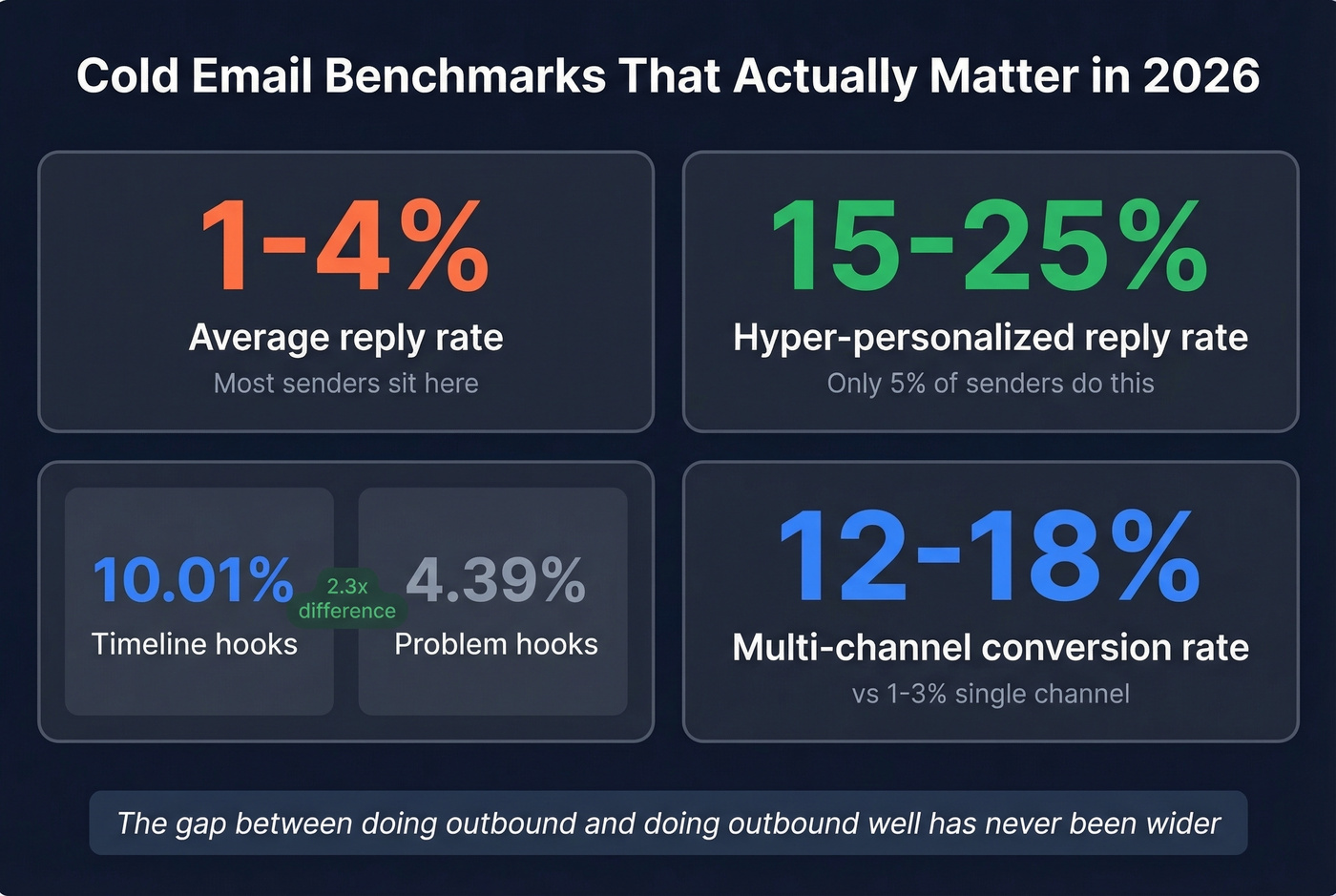
Messaging matters more than most teams realize. Timeline-based hooks pull a 10.01% reply rate vs 4.39% for problem-statement hooks - a 2.3x difference. Meeting rates tell the same story: 2.34% for timeline hooks vs 0.69% for problem hooks. Average reply rates have been declining steadily, and the bar keeps rising in 2026. Predictive send-time optimization alone lifts engagement 40% over fixed scheduling, yet most teams still blast at 9 AM Tuesday like it's 2019.
Hyper-personalized emails hit 15-25% reply rates. Multi-channel sequences convert at 12-18% vs 1-3% for single-channel. The gap between "doing outbound" and "doing outbound well" has never been wider.
How Long Each Approach Takes
SEO is the slowest channel. Expect 1-3 months for technical fixes and local SEO wins to take hold, 3-6 months for content to start ranking on less competitive terms, and 6-12+ months for competitive keywords. Site authority, competition, keyword difficulty, and content consistency all extend timelines.
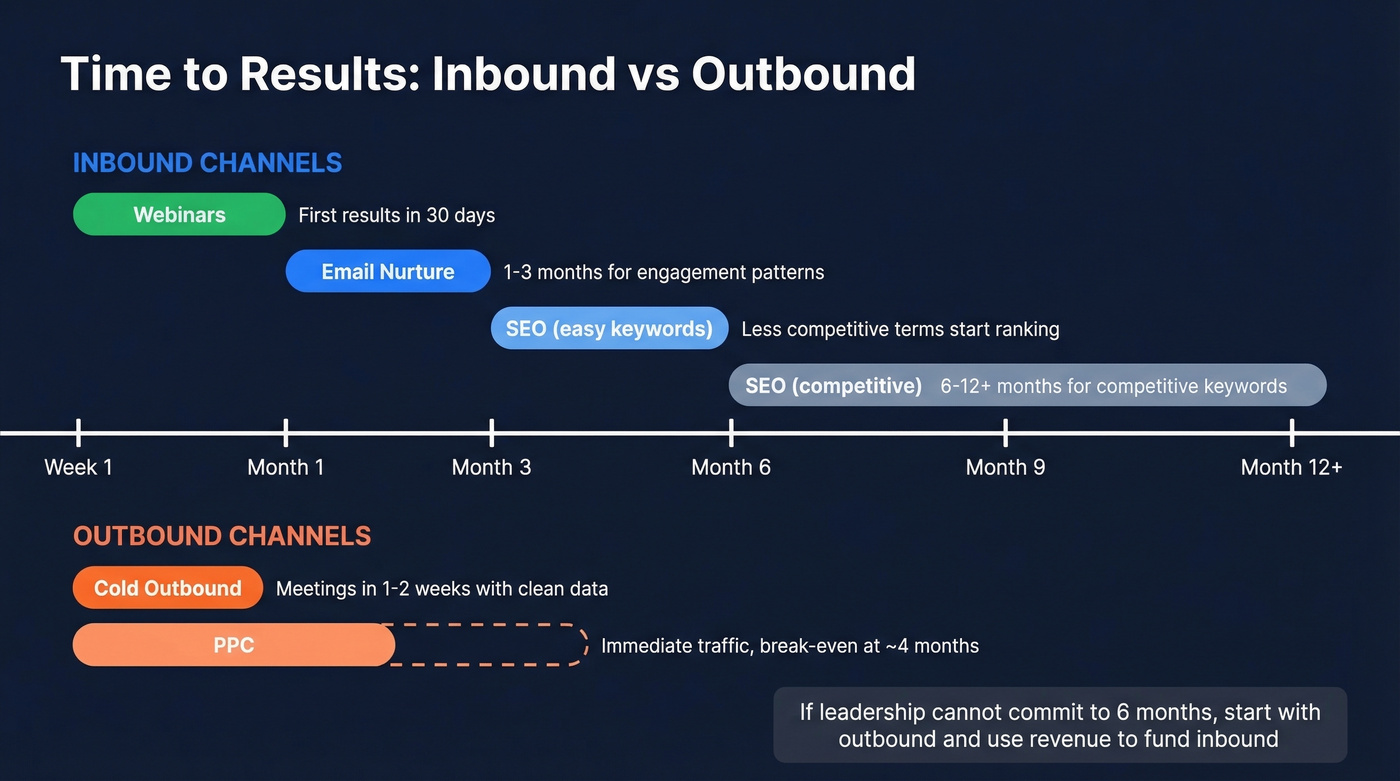
Email nurture shows meaningful engagement patterns within 1-3 months of building sequences. Webinars are the fastest inbound channel - first results within 30 days. Cold outbound, assuming clean data, books meetings within 1-2 weeks of launch. PPC delivers immediate traffic but breaks even around 4 months.
Most inbound content fails because teams expect SEO results in 60 days. If your leadership can't commit to 6 months, start with outbound and use the revenue to fund inbound. We've seen this pattern repeatedly - companies that try to go inbound-first without the patience end up abandoning content programs that were 3 months from inflecting.
How to Choose the Right Mix
By Company Stage
Startup (under 50 employees): Go outbound-first. You need pipeline now, not in 9 months. Put 20-30% of your marketing budget into inbound assets that'll compound - a few high-quality blog posts, an email nurture sequence, basic SEO hygiene. But don't pretend you can out-content HubSpot on day one.
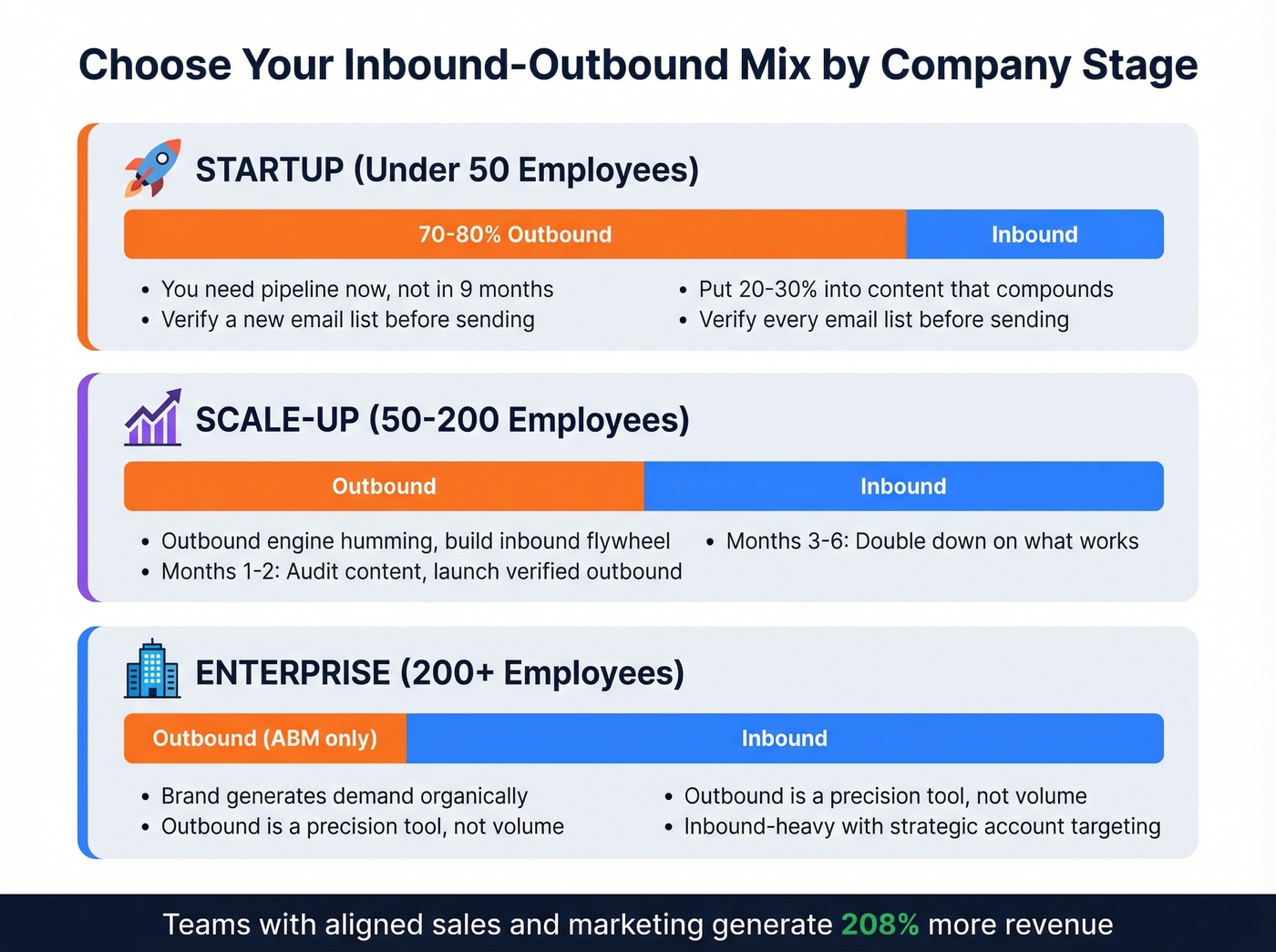
Scale-up (50-200): Hybrid. Your outbound engine should be humming, and now you're building the inbound flywheel alongside it. Gradually shift budget toward content, SEO, and webinars as those channels start producing. Here's a rough month-by-month: Months 1-2, audit your existing content and launch outbound sequences on verified lists. Months 3-4, publish bottom-of-funnel content (comparison pages, cost pages) while optimizing outbound messaging based on reply data. Months 5-6, double down on what's working - by now you'll have enough data to see which inbound assets generate pipeline and which outbound sequences deserve more budget. This is where combining inbound and outbound lead generation starts to pay compounding dividends.
Enterprise (200+): Inbound-heavy with outbound reserved for ABM and strategic accounts. At this stage, your brand should be generating demand organically. Outbound becomes a precision tool, not a volume play.
By Business Model
PLG companies spend a median of 13% of revenue on marketing - heavier on programs, lighter on people. PLG teams allocate 52% of marketing budget to programs vs 44% for sales-led, and invest more in tech (16% vs 13%). Sales-led companies spend about 9% of revenue. Hybrid models land around 10%.
The average software company runs 10.5 simultaneous GTM efforts - 5 core and 5.5 experimental. Let's be honest: if you're spreading budget across that many channels, none of them will work. Pick 2-3 and go deep.
Budget Alignment
The traditional wisdom puts combined Sales + Marketing spend at 30-50% of revenue, with a historical split of roughly 30% Marketing and 70% Sales. But here's the number that should change how you think about alignment: teams with aligned sales and marketing generate 208% more revenue and 67% higher close rates.
CPC is increasing about 15% year-over-year across major platforms. Every dollar you put into SEO and email builds an asset you control, while paid channels get more expensive every quarter.
Mistakes That Kill Campaigns
Inbound Mistakes
Chasing volume over intent. Ranking for a 10,000-search keyword that attracts tire-kickers is worse than ranking for a 200-search keyword where every visitor has a credit card ready. Search intent beats search volume every time.
Leaving sales out of content creation. Your SDRs hear the same objections every day. Your content team is writing about topics they found in a keyword tool. Get SMEs and sales reps involved - they know the real questions prospects ask. Strong sales communication between these teams is what separates mediocre content from content that actually converts.
Ignoring bottom-of-funnel content. Cost pages, comparison posts, "problems with X" articles - these convert at 3-5x the rate of top-of-funnel educational content. Most teams under-invest here.
Treating AI as a silver bullet. Automation without oversight produces generic, off-brand output that readers scroll past. AI is a drafting tool, not a publishing tool.
Outbound Mistakes
Using unverified contact data. About 17% of marketing emails never reach the inbox. If you're not verifying before you send, you're burning your domain reputation with every campaign. Prospeo's 5-step verification process - with catch-all handling, spam-trap removal, and honeypot filtering - exists specifically because this problem is so pervasive.
Not tracking bounce rates. Nearly half of senders don't monitor this. That's negligence, not strategy. (If you want the benchmarks and fixes, start with bounce rates.)
Generic messaging at scale. Only 5% of outbound teams personalize every email. The other 95% wonder why their reply rates are stuck at 1-2%. If you're rebuilding your sequences, start with proven sales follow-up templates.
Single-channel outreach. Email-only sequences convert at 1-3%. Multi-channel sequences hit 12-18%. The math isn't complicated.
Ignoring first-party data. As third-party cookies phase out, your own behavioral data - site visits, email engagement, webinar attendance - becomes your most valuable targeting signal. Skip this at your own risk.
The Missing Variable: Data Quality
Every strategy in this article - inbound nurture, outbound sequences, ABM, intent-driven targeting - depends on whether your data is accurate. The biggest ROI killer in outbound isn't your messaging. It's your data. A perfectly crafted cold email sent to a dead inbox is worth exactly zero. And inbound nurture sequences that bounce 20% of the time will tank your sender reputation just as fast.
When Meritt switched to Prospeo, their bounce rate dropped from 35% to under 4% and pipeline tripled from $100K to $300K per week. That's not a marginal improvement - that's the difference between a broken outbound program and a working one. (If you're evaluating vendors, compare data enrichment services before you commit.)
Intent data without accurate contact data is a wasted signal. Prospeo layers 15,000 Bombora intent topics with 30+ filters - buyer intent, technographics, job changes, headcount growth - so your outbound hits the right person at the right time with a verified email or direct dial.
Combine intent signals with 300M+ verified profiles and watch reply rates climb.
FAQ
What is the difference between inbound and outbound marketing?
Inbound marketing pulls buyers to you through content, SEO, and email nurture - they find you when they're ready. Outbound pushes your message to prospects through cold email, ads, and direct outreach. Inbound compounds over months at ~$135/lead; outbound generates pipeline in days at ~$346/lead.
Is inbound or outbound more effective for B2B?
Neither universally wins. Organic search leads convert at 14.6% vs 1-2% for cold outreach, but modern multi-channel outbound hits 12-18%. Effectiveness depends on your sales cycle, audience, and data quality. Most successful B2B companies run both simultaneously.
How much does inbound cost compared to outbound?
Inbound leads cost about $135 each - roughly 61% less than outbound leads at $346. Content marketing costs 62% less and generates about 3x more leads than traditional outbound. The tradeoff is time: inbound takes 3-12 months to compound, while outbound books meetings within weeks.
Can you combine inbound and outbound strategies?
Yes - and most high-growth B2B companies do. Use outbound for immediate pipeline and inbound to build compounding assets. Aligned sales and marketing teams generate 208% more revenue. Start outbound on verified lists to keep bounce rates under control, then reinvest revenue into content and SEO that compounds over time.
How long before inbound marketing generates results?
SEO takes 3-6 months for initial ranking lifts and 6-12+ months for competitive terms. Email nurture shows engagement patterns within 1-3 months. Webinars can produce results within 30 days - the fastest inbound channel. PPC delivers immediate traffic but breaks even around month four.