

When to Send a Follow-Up Email (2026 Data Guide)
Your cursor's hovering over "Send" on that follow-up, and the same question hits you every time: too soon, or too late? Knowing when to send a follow-up email is the difference between a reply and radio silence.
A Belkins study of 16.5 million cold emails gives us real numbers to work with. And across cold email benchmarks, one pattern is consistent: most replies come from follow-ups, not the initial send. Instantly's analysis puts that number at 55%. If you're only emailing once, you're leaving more than half your pipeline on the table.
Quick-Reference Timing
Cold outreach: First follow-up on Day 2-3. Then graduated spacing - Day 6-8, Day 13-15, Day 27-29. Cap at 4 follow-ups.
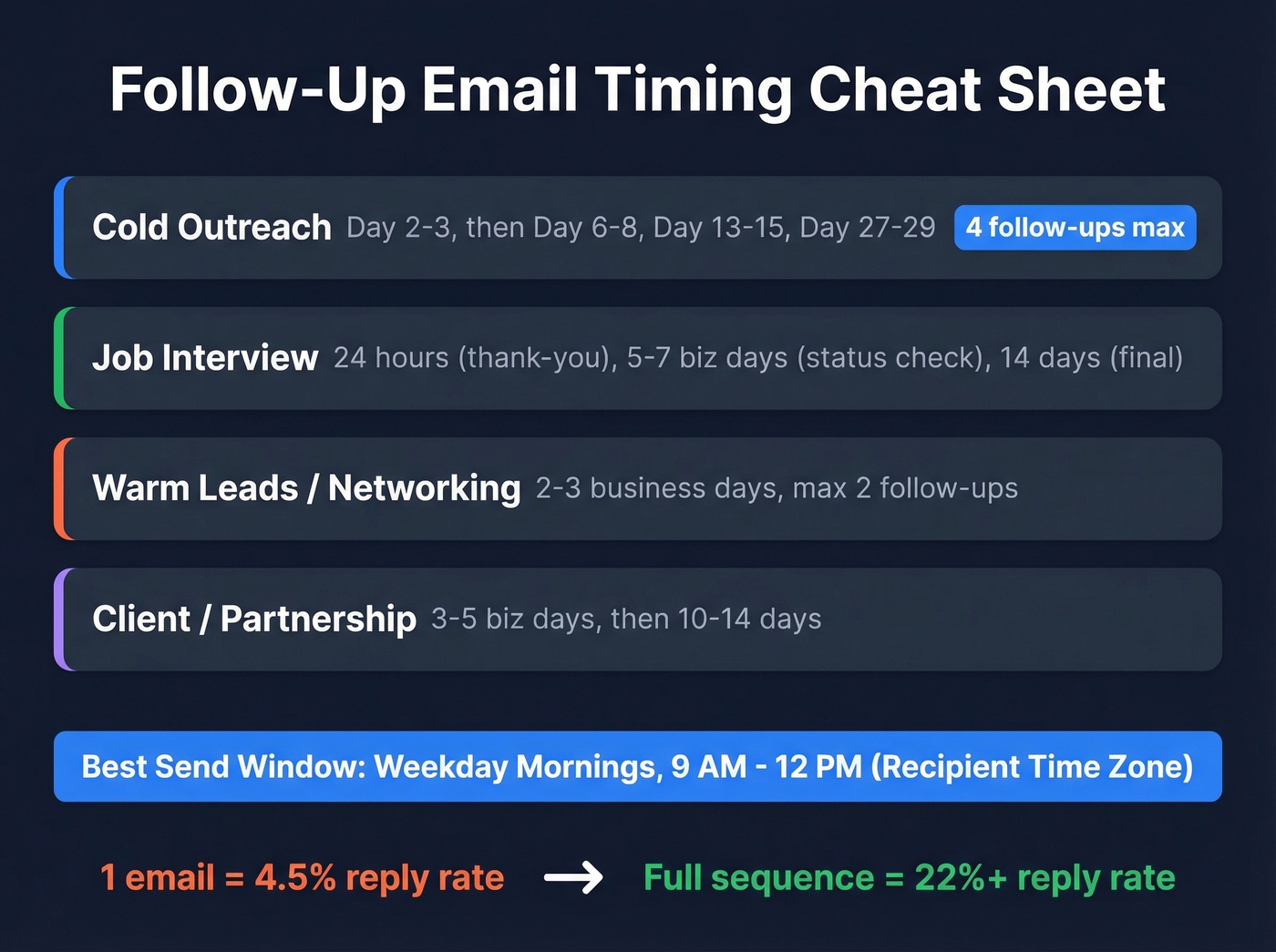
Job interview: Thank-you email within 24 hours. Status check at 5-7 business days. Final follow-up at 14 days.
Warm leads / networking: 2-3 business days.
Best send window: Weekday mornings, 9 AM-12 PM in the recipient's time zone.
The number that matters: A single cold email averages a 4.5% reply rate. A full sequence pushes cumulative replies past 22%. Timing isn't optional - it's where the pipeline lives.
The General Rule: 2-3 Business Days
Wait 2-3 business days before your first follow-up. That window gives the recipient enough time to see your email and respond without feeling pressured, but it's short enough that your original message is still fresh. Anything under 24 hours feels pushy.
The data backs this up. Belkins found a single cold email pulls an 8.4% reply rate with a 45.37% open rate - solid, but 91.6% of people didn't respond. Lemlist's broader campaign analysis shows 4.5% on one email, climbing to 22.37% across a full sequence. The gap between those two single-email numbers reflects different methodologies, but both confirm the same thing: one email isn't enough.
Lemlist also found there's a 90% chance a reply happens within the first two days of sending. If someone hasn't responded by day three, they haven't ignored you - they've moved on. That's your cue.
Follow-Up Timing by Scenario
Not every follow-up lives on the same clock. A cold prospect and a hiring manager operate on completely different timelines, and matching your cadence to the context is what separates effective outreach from noise.
| Scenario | First Follow-Up | Second Follow-Up | When to Stop |
|---|---|---|---|
| Cold sales outreach | Day 2-3 | Day 6-8 | After 3-4 emails |
| Job interview | 24 hours (thank-you) | 5-7 business days | After 2-3 emails |
| Warm intro / networking | 2-3 business days | 7-10 days | After 2 emails |
| Client / partnership | 3-5 business days | 10-14 days | After 2-3 emails |
Cold Sales Outreach
Your first follow-up lands on Day 2-3. After that, stretch the intervals - Day 6-8 for a value-add, Day 13-15 for a new angle, Day 27-29 for a breakup email.
Seniority matters. For C-suite executives, timetoreply recommends waiting about 7-10 business days before following up. For mid-level managers, a 3-5 business day window works better. We've found this tracks with our own outbound - VPs and above need more breathing room, while directors and managers are used to faster-paced email exchanges.
Company size plays a role too. The Belkins dataset shows enterprise contacts at 1,000+ employees are far less tolerant of long multi-email sequences compared to SMBs.
Founders are an interesting exception. Reply rates in Belkins' founder segment rise through the second follow-up (6.64% to 6.66% to 6.94%) before dropping on later touches (5.75% on the third, 3.01% on the fourth). For founder outreach, the data peaks early - don't overstay your welcome.
For cold leads specifically, timetoreply suggests waiting 5-7 days before the first follow-up. That's too conservative for most B2B outbound. By day 5, your email is buried under dozens of others. The Day 2-3 window consistently performs better in modern outbound sequences.
Job Interview
Send a thank-you email within 24 hours of the interview. No exceptions.
If you haven't heard back and no timeline was given, send a status check at 5-7 business days. If they said "we'll decide by Friday" and Friday passes, wait 1-2 business days, then follow up. Your final follow-up comes at 14 days - after that, the silence is your answer.
Here's the thing: Superhuman cites that 80% of hiring managers say thank-you notes influence their decisions, yet only 24-57% of candidates send them. That's a huge edge for minimal effort.
Networking and Warm Intros
Warm intros move faster. Someone introduced you to a VP at a conference? Follow up within 2-3 business days while the interaction is still fresh. Reference the specific conversation. One follow-up is usually enough - two at most. Networking follow-ups that feel like sales sequences kill the relationship.
Client or Partnership Follow-Ups
Existing relationships get more patience. Wait 3-5 business days for the first follow-up, 10-14 days for the second. These people know you - pushing too hard signals desperation. If a hot lead has a time-sensitive offer on the table, tighten to 28-48 hours before the deadline.
One thing most timing guides ignore: adjust for calendar context. Follow-ups sent during holiday weeks, fiscal year-end, or major conference seasons need extra buffer. A follow-up that lands on December 26 isn't persistent - it's invisible.
Best Day and Time to Send
A Siege Media study of 85,000+ outreach emails found Monday pulls the strongest numbers: roughly 20% open rate, 4.3% click rate, and 2.8% reply rate. Wednesday comes in close behind at 17.2% opens and 2.6% replies.
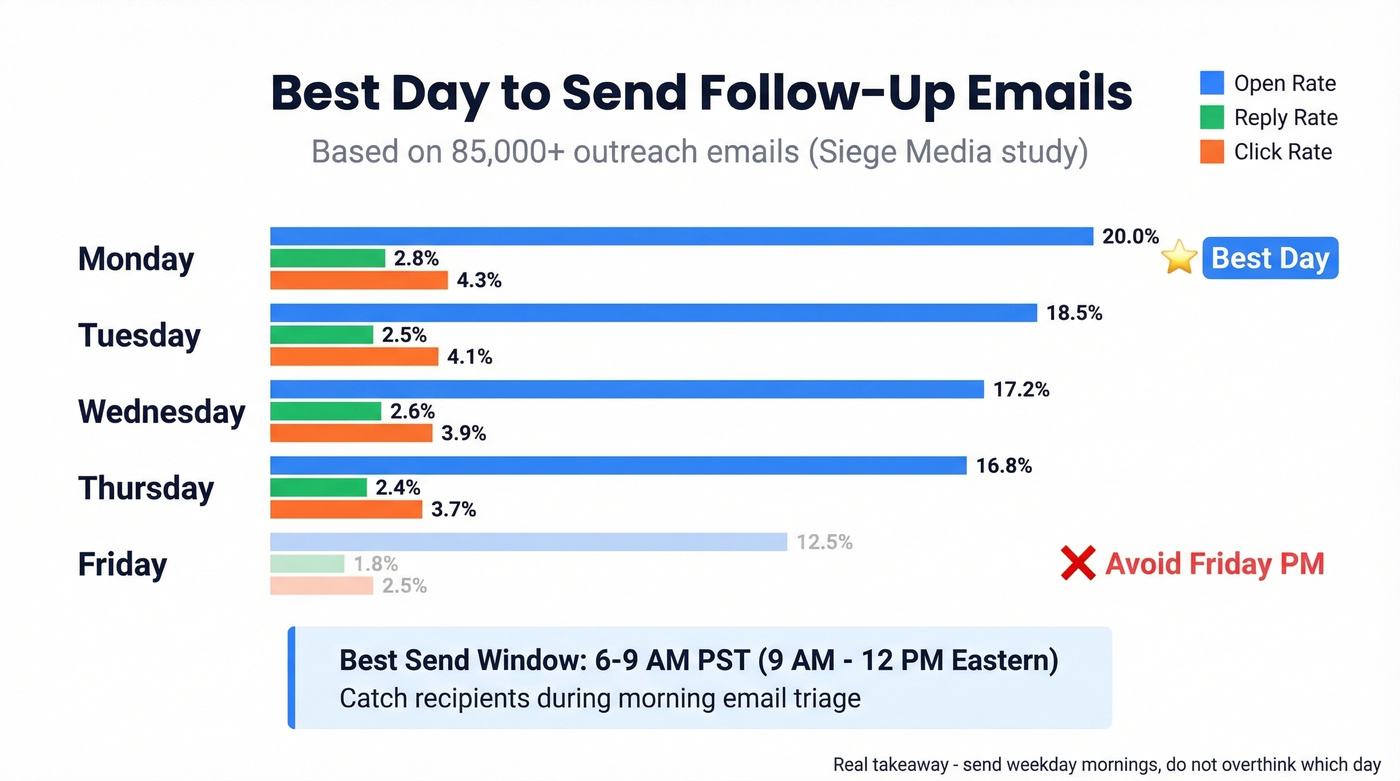
The best send window is 6-9 AM PST, which translates to 9 AM-12 PM Eastern. That catches recipients during their morning email triage - the window where they're most likely to actually read and respond.
Let's dismiss the Tuesday-vs-Monday debate that dominates every other article on this topic. Monday through Thursday mornings all perform well. Friday afternoon and weekends are the only clear losers. Instantly's guidance also points to Tuesday-Thursday as a strong window, which aligns closely enough.
The real takeaway: send your follow-ups in the morning, recipient's time zone, on a weekday that isn't Friday. Don't overthink which specific morning.

A perfectly timed follow-up means nothing if it bounces. Prospeo's 98% email accuracy and 7-day data refresh ensure every follow-up in your cadence reaches a real inbox - not a dead address that tanks your domain reputation.
Stop perfecting your timing on emails that never arrive.
The Ideal Follow-Up Cadence
The graduated spacing model works better than fixed intervals. Instead of following up every two days like clockwork - which feels robotic and triggers spam filters - stretch the gaps as you go.
This approach is easiest to manage with solid sequence management and a clear B2B cold email sequence structure.
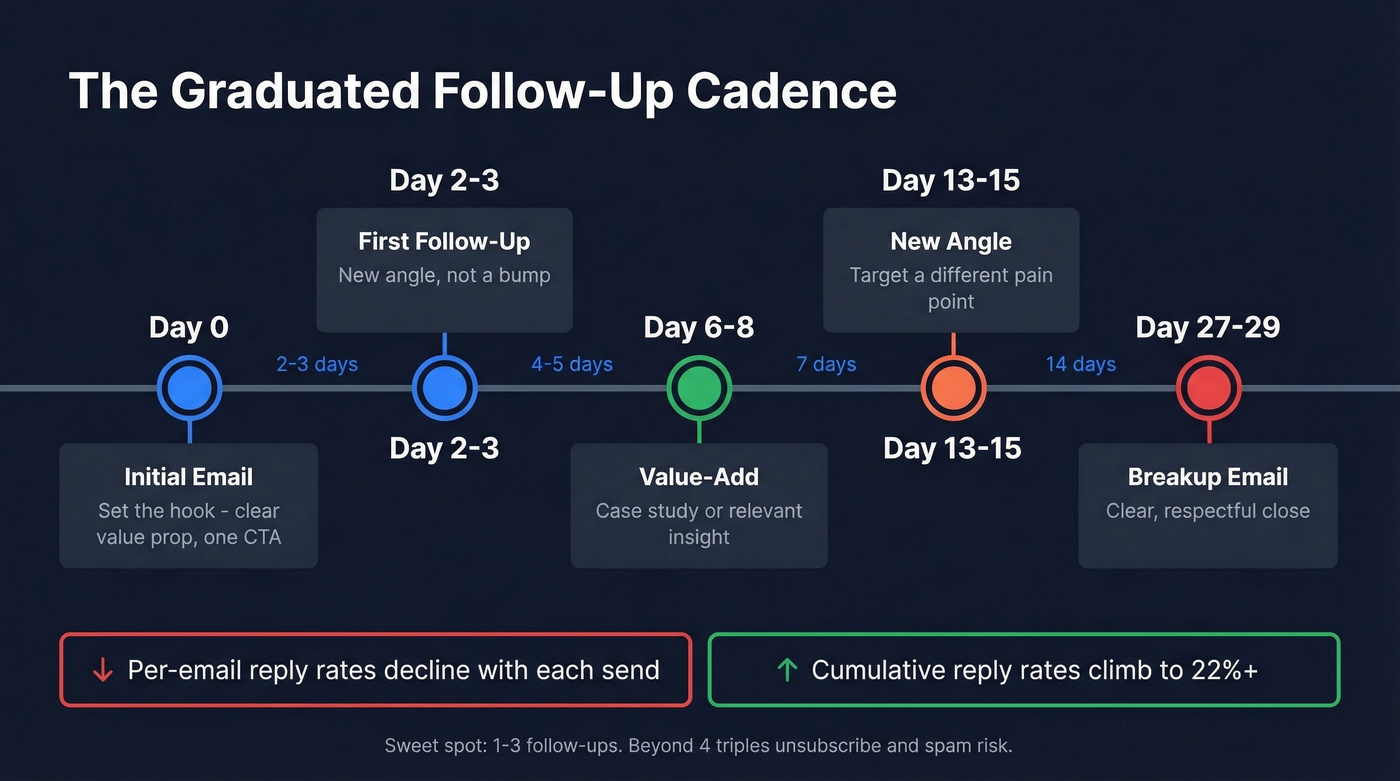
Here's the cadence we recommend, based on Instantly's framework:
- Day 0 - Initial email
- Day 2-3 - First follow-up with a new angle, not a bump
- Day 6-8 - Value-add like a case study or relevant insight
- Day 13-15 - New angle targeting a different pain point
- Day 27-29 - Breakup email with a clear, respectful close
Now here's where the data gets interesting - and where most advice falls apart. The Belkins dataset shows that per-email reply rates decline with each follow-up. The first email pulls 8.4%, and it drops from there. Lemlist's data shows the opposite trend at the sequence level: cumulative reply rates climb from 4.5% to 22.37% across 10 emails.
Both datasets are right. Per-email rates decline, but cumulative replies increase. The question is when the costs - sender reputation damage, unsubscribes, spam complaints - outweigh the marginal gains from one more email.
For most teams, 1-3 follow-ups is the sweet spot. A fourth is fine if you have a strong reason like a new trigger event or genuinely relevant content. Beyond four, you're playing with fire. Belkins found 4+ emails in a sequence triples unsubscribe rate and more than triples spam-complaint risk.
Hot take: If your average deal closes under $5K, you probably don't need more than two follow-ups. The math doesn't work - the time spent crafting touches four and five for a $3K deal is better spent finding new prospects who actually want to talk.
Five Mistakes That Kill Replies
Bumping With No New Value
The most common anxiety on r/sales and r/coldemail boils down to: "Am I being annoying?" The answer is yes - but only if you're sending empty follow-ups. "Just checking if you saw my last email" is the fastest way to get ignored.
If you need examples that add value (instead of bumping), use these sales follow-up templates and cold email follow-up templates.
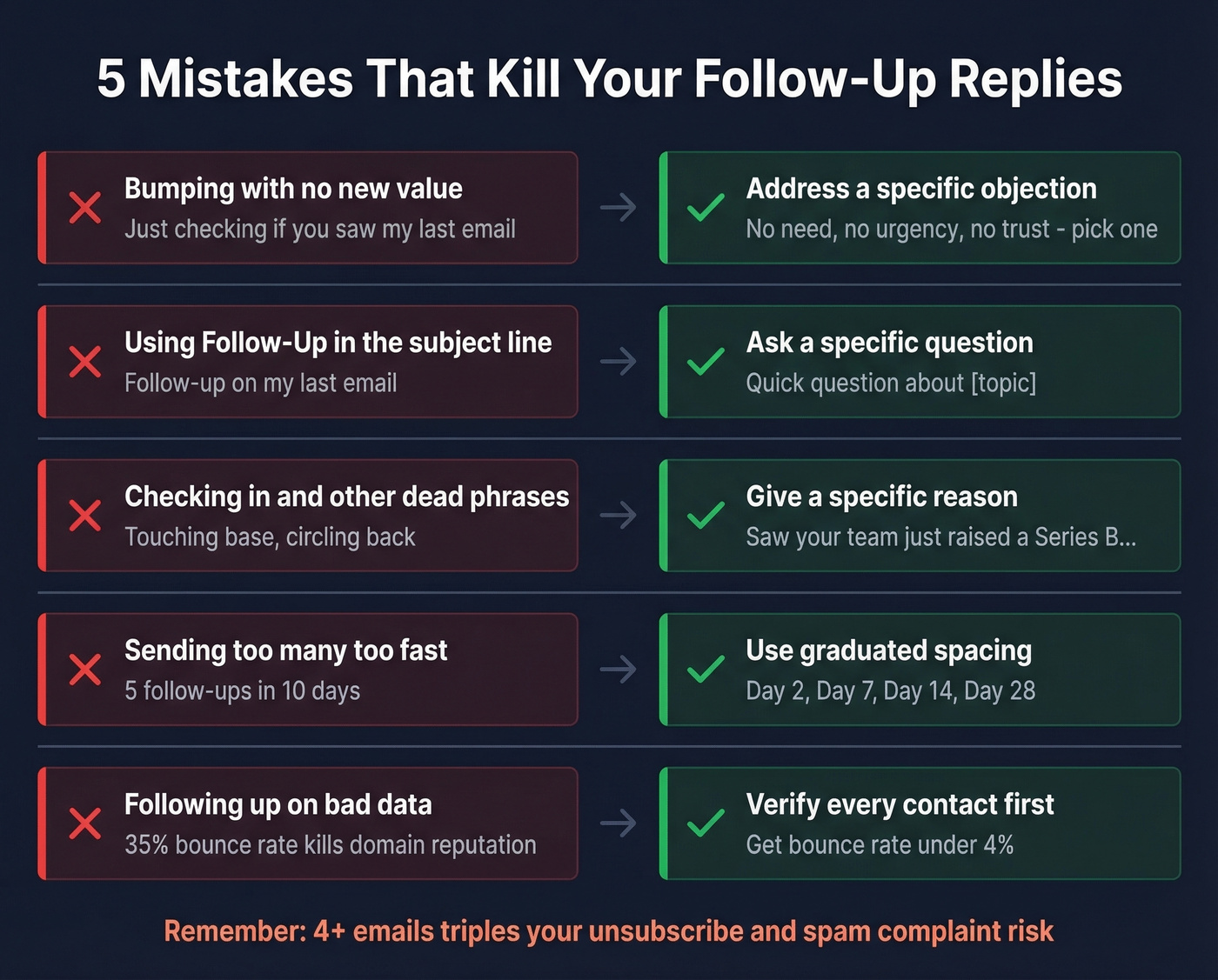
Every follow-up needs to earn its inbox space. GMass frames this well: each touchpoint should address a different objection - no need, value not worth cost, no urgency, don't want it, or don't trust you. If your follow-up doesn't tackle one of those, it's a bump, not a message.
Using "Follow-Up" in the Subject Line
Never put the word "follow-up" in your subject line. It signals "you ignored me and I'm trying again," which is exactly the frame you want to avoid. "Quick question about [specific topic]" beats "Follow-up on my last email" every time.
If you're stuck, borrow proven email subject line examples and refine your prospecting email subject lines.
"Checking In" and Other Dead Phrases
"Touching base," "circling back," "just checking in" - these phrases are the corporate equivalent of dead air. They communicate nothing except that you have nothing to communicate.
Replace them with a specific reason for the email. "Saw your team just raised a Series B - here's how [company] handled [specific challenge] at that stage" gives the recipient a reason to respond.
If you want alternatives that still sound human, see how to say just checking in professionally.
Sending Too Many Too Fast
We've seen teams blast five follow-ups in ten days and wonder why their domain reputation tanked. The data is unambiguous: 4+ emails triples your unsubscribe rate. Graduated spacing isn't just a best practice - it's domain protection.
If you're scaling volume, it helps to understand email velocity and how to improve sender reputation.
Following Up on Bad Data
Everyone obsesses over timing. But the real question is whether your email even arrived. Bounces damage your sender reputation, pushing future messages toward spam. One of our agency clients was running a solid cadence but seeing abysmal reply rates - turned out 35% of their list was bouncing. After cleaning the list with Prospeo's 5-step verification, their bounce rate dropped under 4% and replies jumped within two weeks.
Verify every contact before your first send. Skip this step and your perfectly timed follow-up sequence hits a dead inbox.
The data is clear: a full sequence pushes reply rates past 22%. But scaling that cadence across hundreds of prospects requires verified contact data you can trust. Prospeo gives you 300M+ profiles with 98% email accuracy at $0.01 per lead - so your graduated spacing strategy actually converts.
Build the prospect list your follow-up cadence deserves.
Follow-Up Email Templates
Keep every follow-up under 150 words.
First Cold Follow-Up
Subject: Quick question, [Name]
Hi [Name],
I sent a note last [day] about [specific topic]. Wanted to share one thing I missed - [one-sentence value add or relevant insight]. Worth a 15-minute call this week?
[Your name]
After No Response
Subject: One more thought, [Name]
Hi [Name],
[One sentence referencing a new angle - a case study, a stat, or a specific pain point relevant to their role]. Thought this might resonate given [specific detail about their company or situation].
Happy to walk through it if useful. If not, no worries at all.
[Your name]
The Breakup Email
Subject: Should I close your file?
Hi [Name],
I've reached out a few times about [topic] and haven't heard back - totally understand if the timing's off. I'll assume this isn't a priority right now and close the loop on my end. If anything changes, I'm here.
[Your name]
Breakup emails often perform well because they surface the thread one last time without pressure. The consensus on r/sales is that these pull disproportionately high reply rates - people respond when they feel the window closing.
Interview Thank-You
Subject: Great speaking with you today
Hi [Name],
Thank you for taking the time to discuss the [role] today. I especially enjoyed our conversation about [specific topic from the interview]. It reinforced my excitement about [specific aspect of the company or team].
Looking forward to next steps.
[Your name]
Send this within 24 hours. No exceptions.
When to Stop Following Up
There's a point where persistence becomes spam. For cold outreach, stop at 3-4 emails total. For interviews, cap at 2-3. Beyond four emails, you're tripling your spam risk for diminishing returns.
Most non-responses aren't rejection. They're backlog. The prospect saw your email, meant to respond, and got buried. That's why the breakup email works - it surfaces your thread one last time without pressure.
If email isn't working after 3-4 touches, switch channels. The Belkins dataset shows a LinkedIn message paired with a profile visit pulling an 11.87% reply rate - worth trying when email follow-ups plateau. A phone call works too. The goal is to start a conversation, not to win the email-volume contest.
55% of replies come from follow-ups. The other 45% come from knowing when to stop.
FAQ
How long should I wait to follow up after no response?
Wait 2-3 business days for sales outreach, 5-7 business days after a job interview. Lemlist data shows a 90% chance a reply happens within two days - if they haven't responded by day three, it's time for your first follow-up.
Is it rude to send a follow-up email?
No - 55% of cold email replies come from follow-ups, and recipients expect them. The only rude follow-up is one that adds no value or arrives too frequently. Lead with a new insight, case study, or specific question every time.
How many follow-up emails is too many?
For cold outreach, cap at 3-4 emails total. The 16.5M-email study found that 4+ emails triples your unsubscribe rate. For interviews, 2-3 is the limit before you risk damaging the relationship.
What's the best time to send follow-up emails?
Weekday mornings between 9 AM and 12 PM in the recipient's time zone consistently produce the highest open and reply rates. Monday and Wednesday perform best by the numbers, but any Tuesday-through-Thursday morning is strong. Avoid Friday afternoons and weekends entirely.
Does email accuracy affect follow-up deliverability?
Absolutely. Bounced emails damage your sender reputation, pushing every future message closer to spam. Verify addresses before your first send - tools like Prospeo catch spam traps, invalid domains, and honeypots before they hurt deliverability.