

Where to Get Email Addresses in 2026 (5 Methods)
You send 500 cold emails. 40 bounce. Your ESP flags the domain, deliverability tanks across every sequence, and now even your warm leads aren't seeing your messages. That's not a hypothetical - it's the most common failure mode when teams source emails from the wrong places.
The real question isn't just where to get email addresses. It's where to get emails that don't bounce, don't land in spam, and don't get your domain blacklisted.
Here are five methods, ranked by reliability, with real pricing and accuracy data.
The Short Answer
- Need a free all-in-one platform - Apollo. Huge database, generous free tier, but credits expire monthly and older contacts bounce more than you'd expect.
- Need EU/UK data with compliance baked in - Cognism. Enterprise pricing, but the GDPR coverage is best-in-class.
- No budget at all? Skip straight to the Google search operators section below.
Legal Rules Before You Start
CAN-SPAM (US)
Every commercial email you send falls under CAN-SPAM. There's no B2B exemption - a common misconception that gets companies fined. The FTC's compliance guide spells it out: penalties run up to $53,088 per violating email.
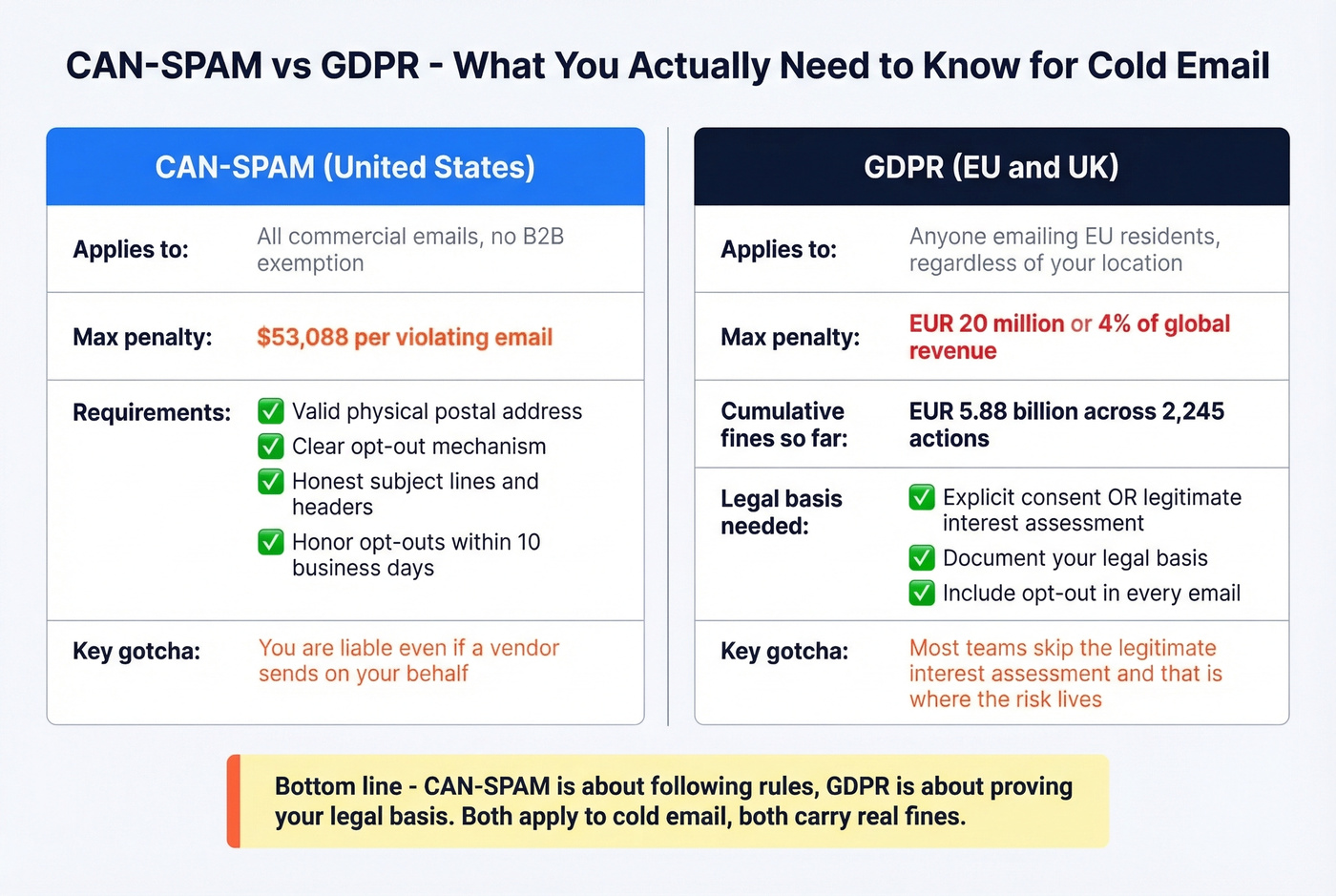
Every outbound email needs a valid physical postal address, a clear opt-out mechanism, and honest headers and subject lines. Once someone opts out, you've got 10 business days to honor it, and you can't sell or transfer that address afterward. You're also on the hook if a third-party vendor sends on your behalf.
GDPR (EU/UK)
If you're emailing anyone in the EU, GDPR applies regardless of where your company is based. That extraterritorial reach catches a lot of US-based teams off guard. Cumulative GDPR fines have surpassed EUR 5.88 billion across 2,245 enforcement actions, and the number keeps climbing. Maximum penalties reach EUR 20 million or 4% of global annual turnover, whichever is higher.
Email addresses are personal data under GDPR. You need either explicit consent or a defensible "legitimate interest" basis for B2B outreach. The safest approach: always include an opt-out, document your legal basis, and don't email EU residents from purchased lists unless you've done a legitimate interest assessment. Most teams haven't, and that's where the risk lives.

You just read the accuracy spread: 79% to 98%. Every percentage point below 98% means more bounces, more domain damage, and more money spent fixing deliverability. Prospeo's 5-step verification and 7-day refresh cycle exist to keep you at the top of that range - 143M+ verified emails at ~$0.01 each, no contracts.
Get emails that actually land. Start with 75 free verified contacts.
Five Ways to Find Email Addresses
Email Finder Tools
This is the primary method for most outbound teams, and the tool you pick matters more than you'd think. A 100-contact accuracy benchmark by Saleshandy tested 15 tools against the same verified list. The spread was massive - from 79% to 98% accuracy. That's the difference between 2 bounces per 100 emails and 21.
If you're comparing platforms, it helps to separate finders from enrichment and verification - see data enrichment options too.
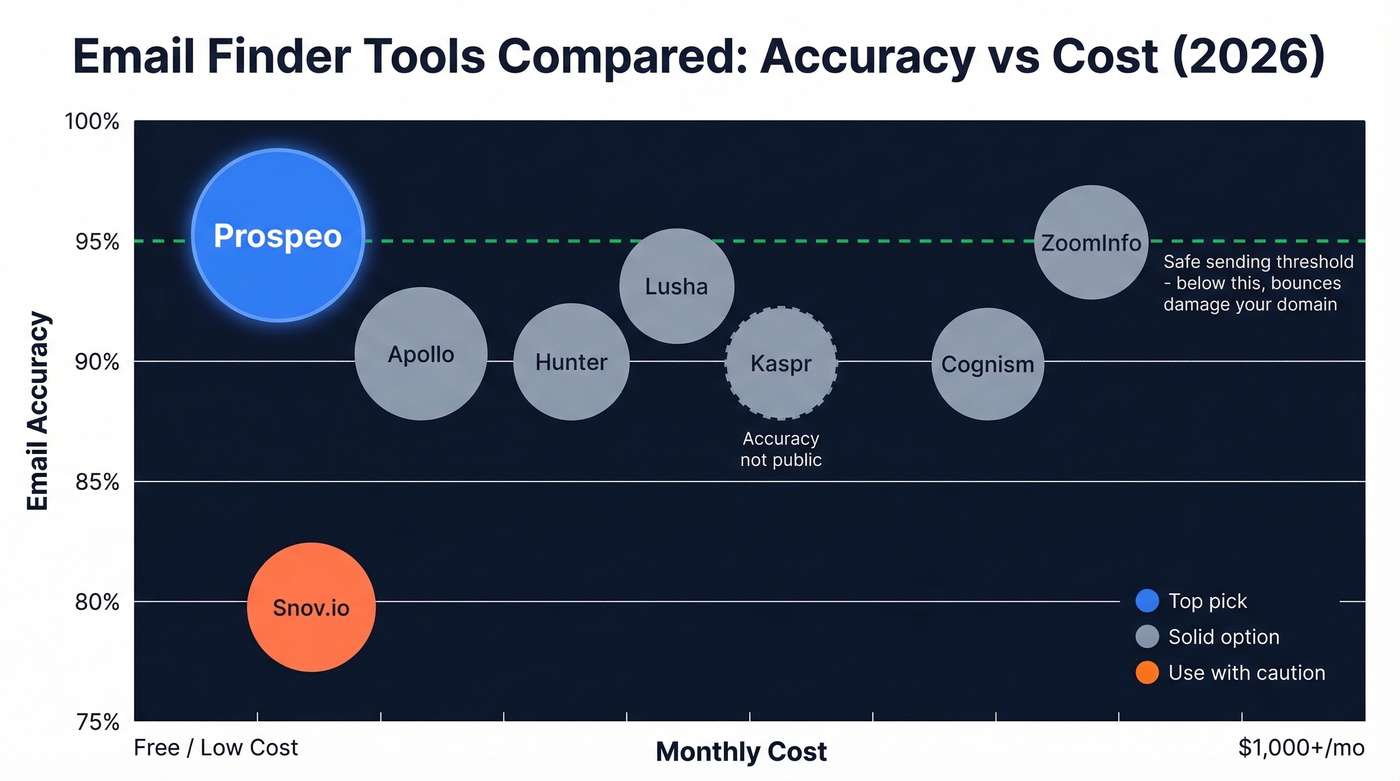
One caveat: Saleshandy ranked itself #1 in that test, so vendor benchmarks always deserve a raised eyebrow. But the relative rankings track with what practitioners report in cold email communities on Reddit, so the data is directionally useful.
Here's what most accuracy discussions miss: the dollar cost of bad data. At Apollo's ~91% accuracy, roughly 9 out of every 100 emails are dead. That's not just wasted credits - it's domain reputation damage that compounds across every campaign. We've seen teams spend more recovering from a blacklisted domain than they would have spent on accurate data in the first place.
If you're running outbound at any volume, treat this as a deliverability problem first - use an email deliverability checklist, not just a tool list.
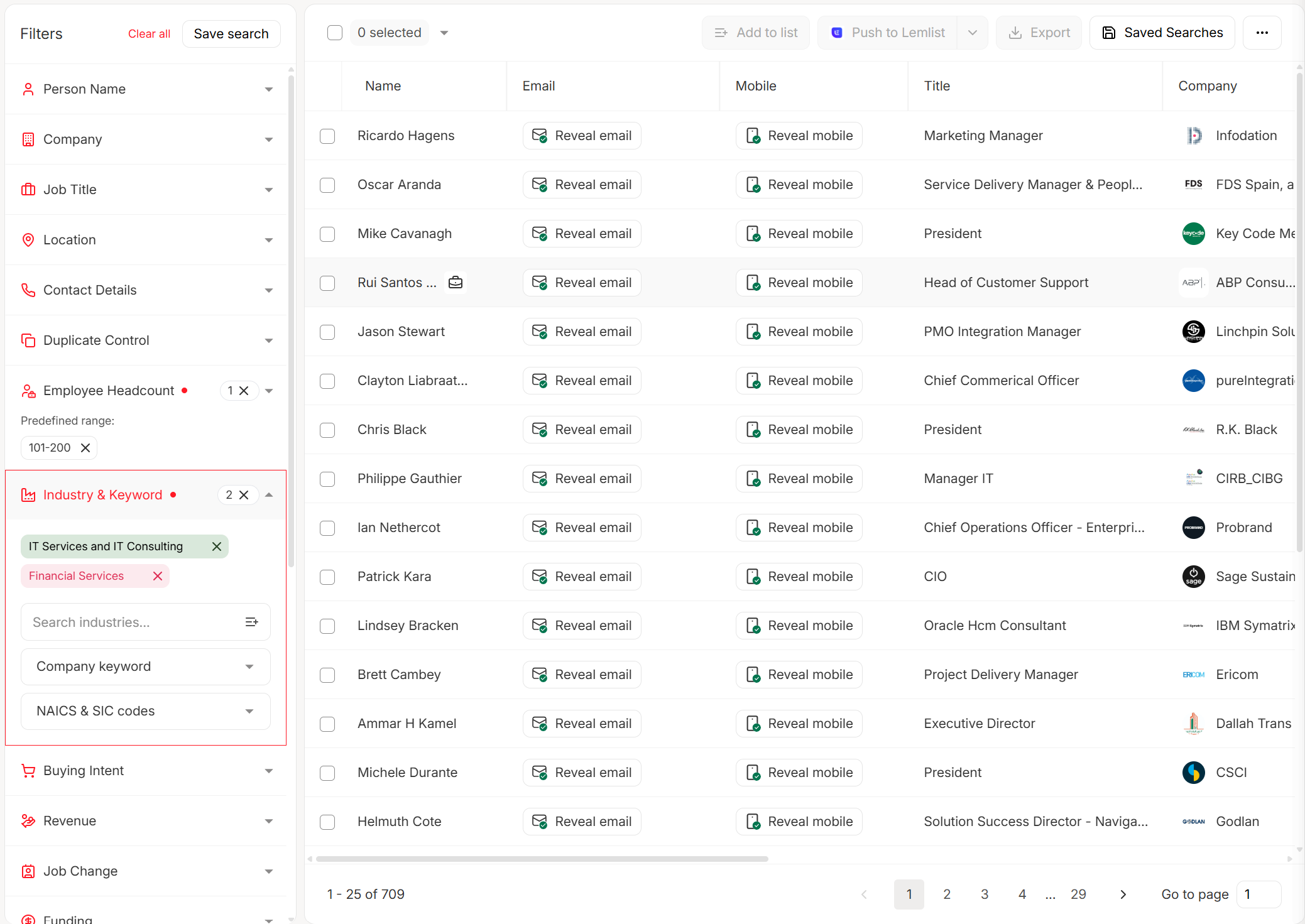
Prospeo is where we'd start if email accuracy is the priority - and it should be. The platform runs 300M+ professional profiles through a proprietary 5-step verification process with catch-all handling, spam-trap removal, and honeypot filtering. The result is 98% email accuracy on 143M+ verified addresses, refreshed on a 7-day cycle. For context, the industry average refresh is six weeks. That gap matters when you're emailing people who change roles and companies frequently.
The proof is in the deliverability numbers. Meritt, an outbound agency, saw bounce rates drop from 35% to under 4% after switching, and their pipeline tripled from $100K to $300K per week. At ~$0.01 per email with a free tier of 75 verified emails per month, the economics speak for themselves. No annual contracts, no sales calls required.
Apollo is the obvious starting point for teams that want everything in one place. The database covers 275M+ contacts, the free tier is generous, and you get a built-in sequencer. But credits expire monthly and don't roll over. Paid plans run $49/user/month for Basic, $79 for Professional, and $119 for Organization with a minimum of 3 seats. The accuracy benchmark put Apollo at ~91%, and the consensus on r/sales backs that up - "data feels bad sometimes" and "lots of bounces on older contacts" are recurring complaints. Apollo is great for getting started fast. Just verify everything before you send.
If you're evaluating alternatives, compare against other sales prospecting databases before you commit.

Who should skip Hunter? Anyone who needs a primary database for prospecting at scale. Hunter scored ~90% accuracy in the benchmark and has a loyal following, but practitioners still describe its database as "pretty small" compared to the biggest all-in-one platforms. Where Hunter shines is as a verification layer - find emails elsewhere, verify through Hunter. The free tier gives you 50 searches per month, and paid plans start at $49/mo.
If you're shopping around, here's a deeper list of Hunter alternatives.
Cognism is the tool we'd recommend without hesitation for EU/UK outbound. The consensus in cold email communities is clear: "great for EU/UK data," but "pricing seems enterprise-level." Cognism uses custom pricing with a flat platform access fee, typically landing around $1,000-$3,000/mo depending on seats and package. It scored ~90% in accuracy benchmarks. If you're selling into EMEA and compliance is a board-level concern, Cognism earns its price. For US-only outbound, you're overpaying.
Snov.io scored 79% accuracy - the lowest in the benchmark - but it's affordable at $39/mo for 1,000 credits and includes built-in automation. Reddit users call it "good for international leads." Use it as a supplementary source, not your primary one, and always run results through a verifier.
Lusha offers quick lookups with a free tier and paid plans from $37/mo per user, scoring 93% accuracy. Solid for one-off research, less practical for bulk prospecting. ZoomInfo hit 95% accuracy but typically costs $15K-$40K+/year - enterprise-grade and priced accordingly. Kaspr offers unlimited B2B email credits starting at EUR 45/user/month, which is interesting for high-volume teams, though independent accuracy data is thin.
| Tool | Accuracy | Free Tier | Paid From | Best For |
|---|---|---|---|---|
| Prospeo | 98% | 75 emails/mo | ~$0.01/email | Verified accuracy, no contracts |
| Apollo | ~91% | Yes (limited) | $49/user/mo | All-in-one free start |
| Hunter | ~90% | 50 searches/mo | $49/mo | Verification layer |
| Cognism | ~90% | No | Custom ($1K-$3K/mo) | EU/UK compliance |
| Snov.io | ~79% | Yes | $39/mo | International leads |
| Lusha | ~93% | Yes | $37/mo | Quick lookups |
| ZoomInfo | ~95% | No | $15K-$40K+/yr | Enterprise teams |
| Kaspr | Not public | Yes | EUR 45/user/mo | Unlimited email credits |
Google Search Operators (Free)
You don't need a paid tool to find business emails. Google's advanced search operators are surprisingly powerful if you know the right queries, and they're the best free method when you're building a list of email addresses without spending a dime. Here are five you can copy and run right now:
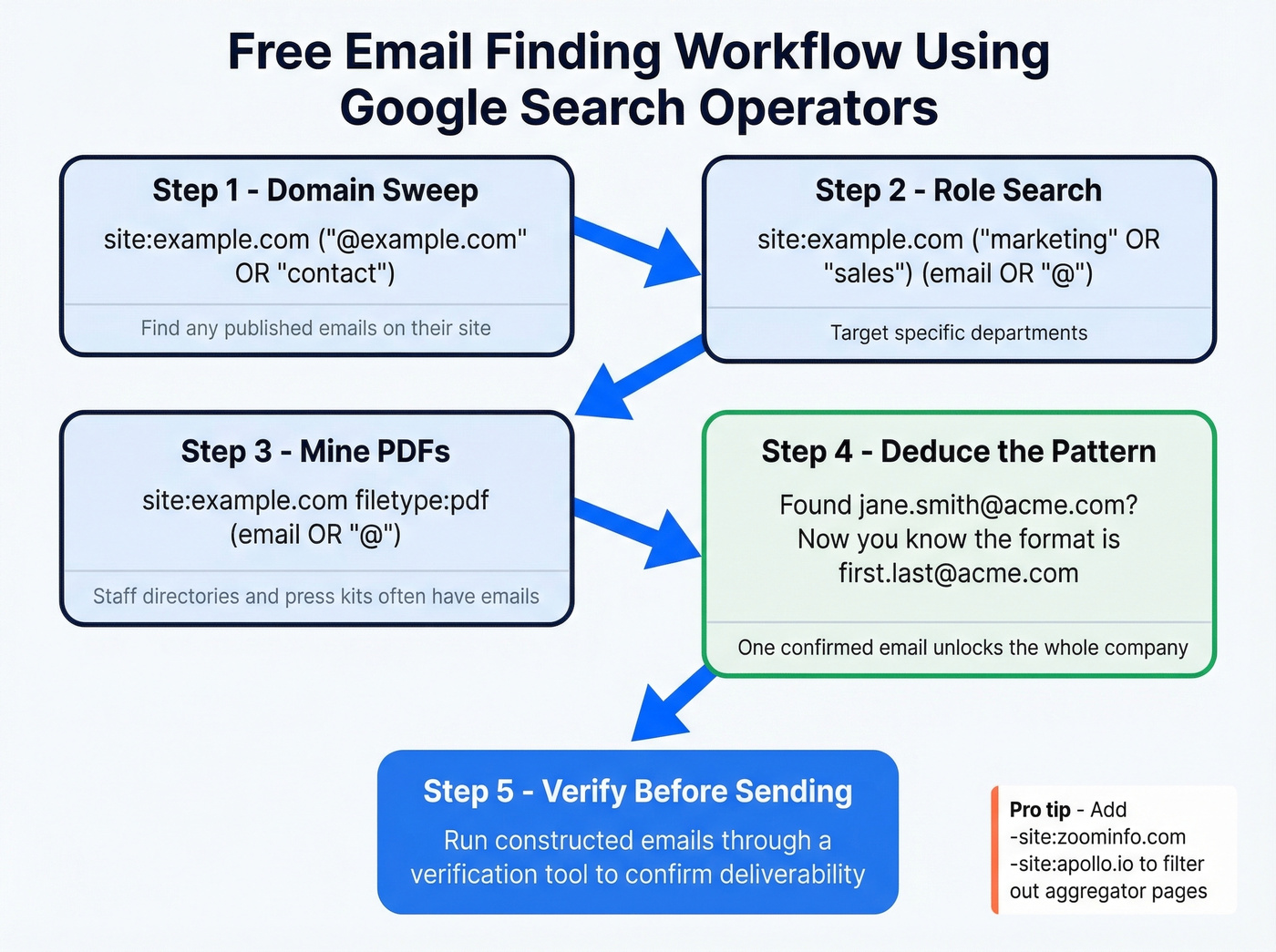
Company domain sweep:
site:example.com ("@example.com" OR "contact" OR "team" OR "email")
Role-based search:
site:example.com ("marketing" OR "PR" OR "sales") (contact OR email OR "@")
PDF mining - staff directories, org charts, and press kits often contain emails:
site:example.com filetype:pdf (email OR "@")
Industry team pages:
intitle:"team" ("email" OR "contact") "fintech"
Press contacts:
site:example.com (press OR "media") ("contact" OR "email")
Add -site:zoominfo.com -site:apollo.io to your queries. This filters out aggregator sites and surfaces original company pages where the emails are more likely to be current.
In our experience, the Google operator method works best for companies with 50-500 employees - large enough to have a web presence, small enough that they haven't scrubbed every email from public pages. The real goal isn't to find 500 emails. It's to find one or two confirmed addresses and deduce the company's email format. If you find jane.smith@acme.com and john.doe@acme.com, you now know the pattern is first.last@acme.com and you can construct emails for anyone at that company. Pair this with a verification tool and you've got a free prospecting workflow that actually works.
If you want more ways to do this at scale, see sales prospecting techniques that pair well with operators.
Company Websites and Social Profiles
Check About pages, team pages, press/media pages, and author bios on company blogs. Many companies still publish direct contact emails for their leadership team, especially in the mid-market.
This doesn't scale, but it's free and the data is current. For a targeted ABM approach where you're going after 20-30 accounts, spending five minutes per company website often yields better results than a database pull.
Buy a B2B Email Database
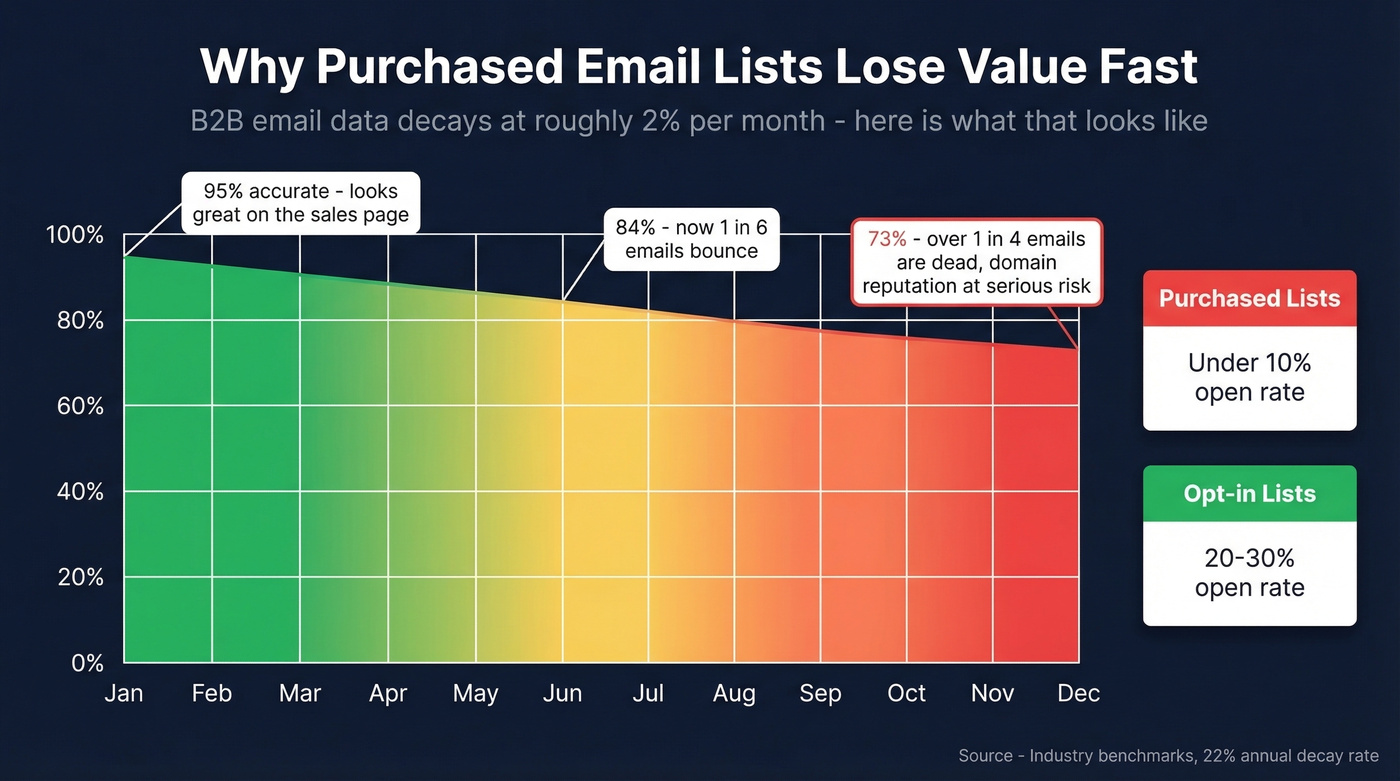
Let's be honest: purchased lists are usually a bad investment. Business email data decays at roughly 22% per year - about 2% per month. A list that's 95% accurate in January is down to ~73% by December. And that's before you account for the engagement gap: purchased lists typically see open rates below 10%, while opt-in lists regularly hit 20-30%.
If you're considering it anyway, start with a breakdown of email list providers and the tradeoffs.
Here's the thing most vendors won't tell you: "verified" on a purchased list means the email was technically deliverable at the time of verification. It doesn't mean the person still works there, consented to being contacted, or that the data is CAN-SPAM or GDPR compliant.
When does buying make sense? Enterprise ABM teams with budget, a clear ICP, and the infrastructure to clean and verify before sending. For most teams - especially startups and agencies - you're better off building lists through finder tools or inbound methods and verifying in real time.
Build Your Own List (Inbound)
The long game is building an opt-in list. It's slower, but the engagement metrics are incomparable. Email marketing delivers a 261% ROI according to FirstPageSage research, and 73% of marketers rank webinars as their top-converting lead magnet.
If you need a step-by-step system, this pairs well with a guide on how to generate an email list.
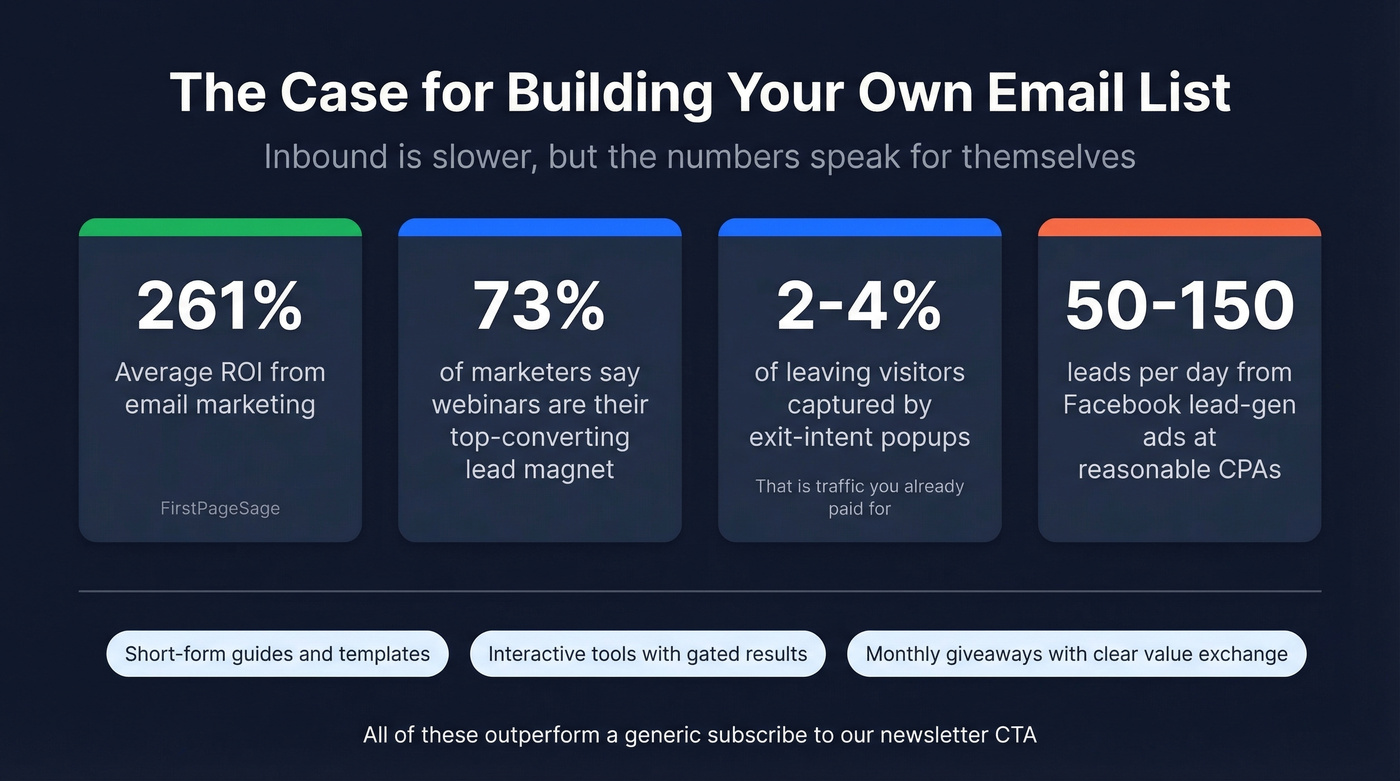
Exit-intent popups convert an additional 2-4% of website traffic. Facebook lead-gen ads can capture 50-150 leads per day at reasonable CPAs. Monthly giveaways with a clear value exchange generate 100+ signups per day for some teams. Short-form guides, templates, and interactive tools with gated deeper results consistently outperform generic "subscribe to our newsletter" CTAs.
If you're focused on collecting email addresses for marketing campaigns specifically, inbound is the channel that delivers the highest long-term engagement and the cleanest compliance posture.
One more thing: if your average deal size is under $10K, you probably don't need ZoomInfo-level data or a purchased list. A free-tier finder tool paired with Google operators and a solid inbound funnel will get you 80% of the way there at 5% of the cost.
The Step Everyone Skips
It takes about three months to warm up a sending domain. It takes three seconds to burn it.
A single campaign with a 7% bounce rate can tank your deliverability for weeks. One cautionary example from r/coldemail: a sender launched their first campaign with 256 emails, hit a 7% bounce rate, 10.55% open rate, and roughly 1% replies - mostly out-of-office. Six sending accounts, domains warmed for a month, sending 50-60 per day. The list quality still killed the campaign before it started.
Keep total bounces under 2%, and target hard bounces below 1%. Above 5%, stop sending immediately and clean your list. For reference, software companies average 0.93% bounce rates and e-commerce sits at 0.29%.
If you want the deeper benchmarks and fixes, see email bounce rate and how to improve sender reputation.
Standalone verification tools like ZeroBounce (~$10 per 1,000 emails) and NeverBounce (~$8 per 1,000) work fine, but they add a separate cost and step to every workflow. Prospeo builds verification into the finding step - the 5-step process includes catch-all handling, spam-trap removal, and honeypot filtering before you ever export a contact. You're not paying twice, and you're not adding manual verification steps that slow down your team.
Finding email addresses is the easy part. Finding ones that don't bounce, don't trigger spam traps, and don't torch your sender reputation - that's the real problem. Prospeo refreshes every record every 7 days (not the 6-week industry average), runs catch-all handling and honeypot filtering, and delivers 98% accuracy across 300M+ profiles.
One bad list costs more than a year of accurate data. See the difference.
FAQ
Is it legal to cold email someone whose address you found online?
Yes, under CAN-SPAM in the US - include a valid physical address, a clear opt-out, and honest headers. For EU residents, GDPR requires either legitimate interest or explicit consent. B2B outreach typically qualifies under legitimate interest, but you must provide an easy opt-out and document your legal basis.
What's a safe email bounce rate?
Under 2% total bounces is the safe zone, with hard bounces below 1%. Cross 5% and stop sending immediately - your domain reputation is actively degrading. Software companies average 0.93%; e-commerce averages 0.29%.
Are free email finder tools accurate enough?
Free tiers work for testing, but accuracy ranges from 79% to 98% in benchmarks. Prospeo's free tier (75 verified emails/month) delivers the same 98% accuracy as its paid plans. Always verify every email before sending, regardless of source.
How fast does email data decay?
About 22% per year, or roughly 2% per month. A list that's 95% accurate in January drops to approximately 73% by December. Tools with weekly refresh cycles keep data usable far longer than the six-week industry average.
What's the cheapest way to find verified business emails?
Google search operators cost nothing and work well for targeted research. For tool-assisted prospecting at scale, a free-tier finder tool gives you enough verified emails per month to test workflows and validate accuracy before committing budget. Combine operators with a finder tool and you can build targeted prospect lists without spending anything upfront.