

The Worst Time to Send an Email (2026 Data)
Weekends and the middle of the night are where emails go to die. With 4.73 billion email users worldwide and 40% of them sitting on unread inboxes, getting the timing wrong means your message lands, gets buried, and never gets opened. Period.
Understanding the worst time to send an email - and what actually works - can save your campaigns from silent failure. Here's the full breakdown.
Quick Answer
| Worst Factor | Specifics |
|---|---|
| Worst days | Saturday, Sunday |
| Risky days | Monday (catch-up), Friday (wind-down) |
| Dead zone | 3-4 AM recipient local time |
| Low engagement window | Evening + overnight (recipient local time) |
| Why it matters | 23% of opens happen in hour one - miss it and you're buried |
That table covers the basics. Let's dig into why these windows are so brutal and where the exceptions hide.
Worst Days to Send Emails
Saturday and Sunday are the clear losers. Brevo's benchmark synthesis, built on an analysis of 44+ billion emails, shows that Saturday and Sunday have the lowest open and click-through rates across industries. Not close, either - the gap is wide enough that it's rarely worth fighting.
To anchor what "good" looks like: MailerLite's 2025 benchmarks (median across 3.6M campaigns) put the overall median open rate at 43.46%. Weekend sends consistently fall short of that number.
Monday and Friday aren't much better for B2B. Mondays are inbox-clearing days where your carefully crafted email competes with 50+ messages that piled up over the weekend. Fridays? People mentally check out by 2 PM. The engagement drop-off is real, and we've seen it repeatedly in our own outbound campaigns. One thing worth noting: Apple Mail Privacy Protection inflates open rates by pre-loading tracking pixels, so click rates are the more honest metric to watch.
Dead Hours: Time of Day
The dead zone is 3-4 AM in the recipient's local time. Mailchimp's send-time guidance explicitly warns against sending too early in recipients' time zones, and for obvious reasons - engagement is near zero.
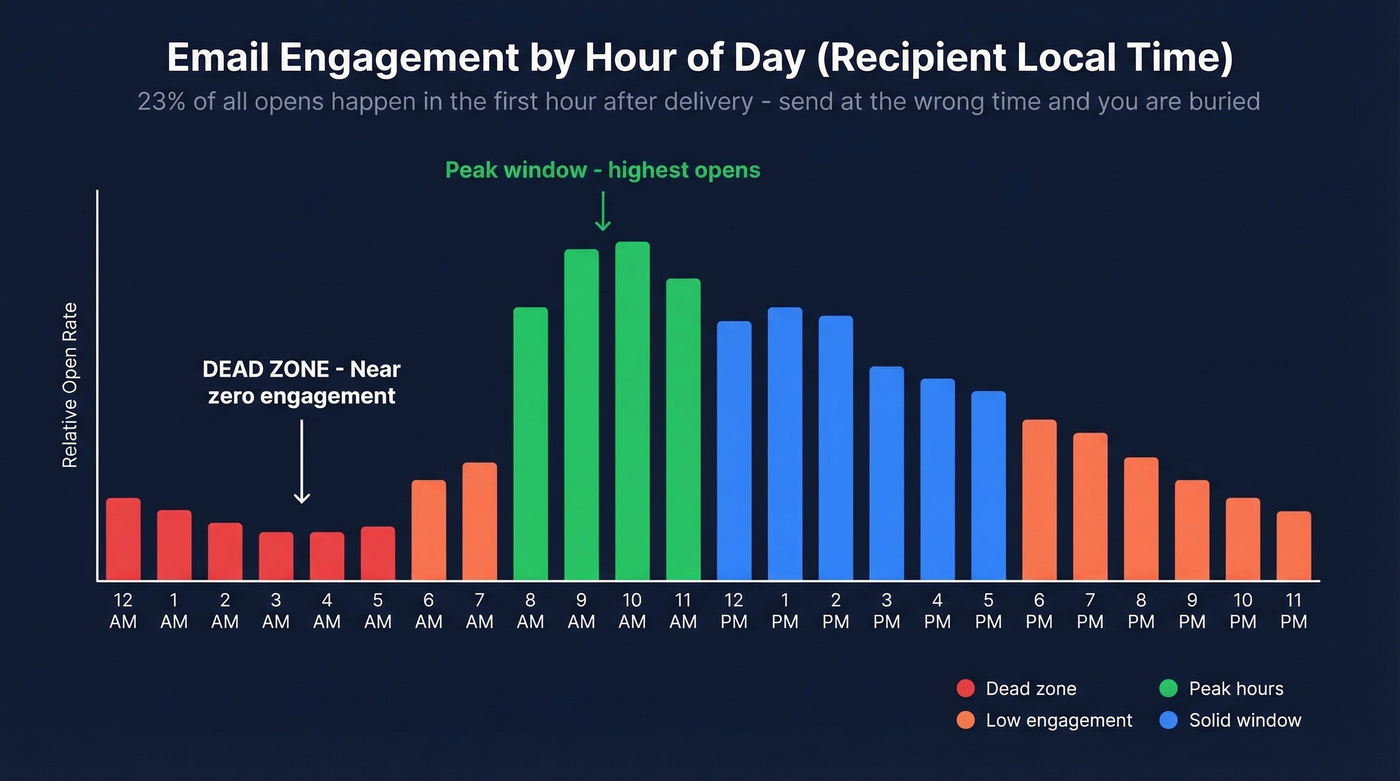
Here's the thing: 23% of all opens happen within the first hour after delivery, and in the second hour, opens drop by half. Send at 10 PM and your email sits untouched for 8-10 hours. By the time someone opens their inbox in the morning, it's buried under overnight newsletters, shipping notifications, and calendar reminders. You've already lost.

23% of opens happen in the first hour - but only if the email reaches a real inbox. Bad data turns perfect timing into wasted effort. Prospeo's 5-step verification catches dead addresses, spam traps, and catch-all domains before they tank your sender reputation.
Fix your list before you fix your send time. 75 free verifications, no card required.
B2B vs B2C: Opposite Patterns
This is where the question gets interesting, because B2B and B2C behave very differently outside work hours.
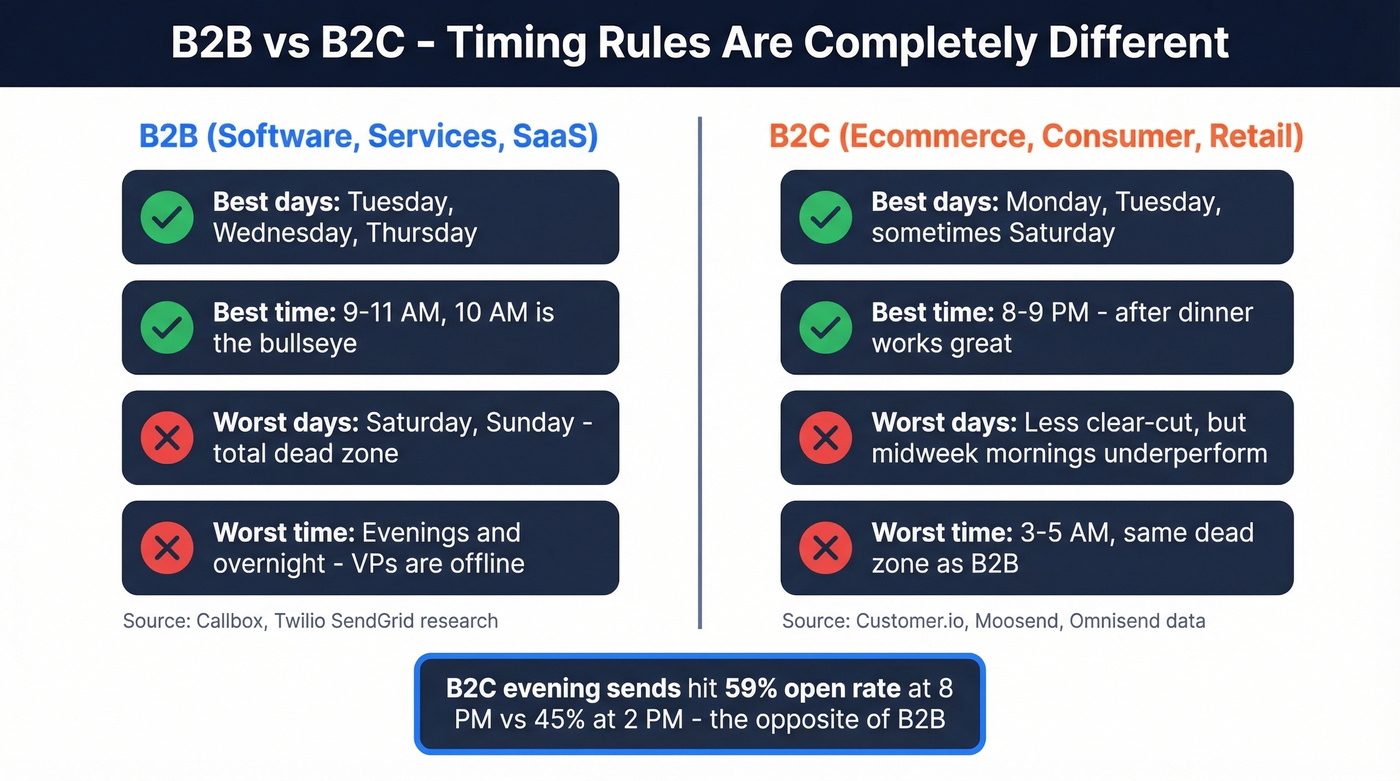
B2B: Weekends are a dead zone. Twilio SendGrid's research frames it plainly - B2B software buyers don't engage on weekends. Callbox pins the sweet spot at Tuesday through Thursday, 9-11 AM, with 10 AM as a reliable bullseye. Anything outside that window carries a measurable penalty. If you're selling to VPs and directors, respect their work schedule or get ignored. If you're building sequences, use a B2B cold email sequence structure that matches those windows.
B2C: Evenings can actually work. Aggregated data from Customer.io (pulling from Moosend and Omnisend) shows CTR peaks at 8-9 PM, with Monday at 9 PM hitting a 9.01% CTR and 8 PM sends reaching a 59% open rate versus 45% at 2 PM. For ecommerce and consumer brands, the "bad timing" rules flip after dinner. Customer.io also highlights that AI send-time optimization can lift open rates by 23% versus static scheduling - worth exploring if your ESP supports it.
The takeaway: if you're selling software to VPs, evenings and weekends are dead. If you're selling shoes to consumers, Saturday evening can outperform Tuesday morning.
The Time Zone Trap
Here's the hidden timing disaster nobody talks about enough: you think you're sending at 10 AM, but half your list receives it at 4 AM.
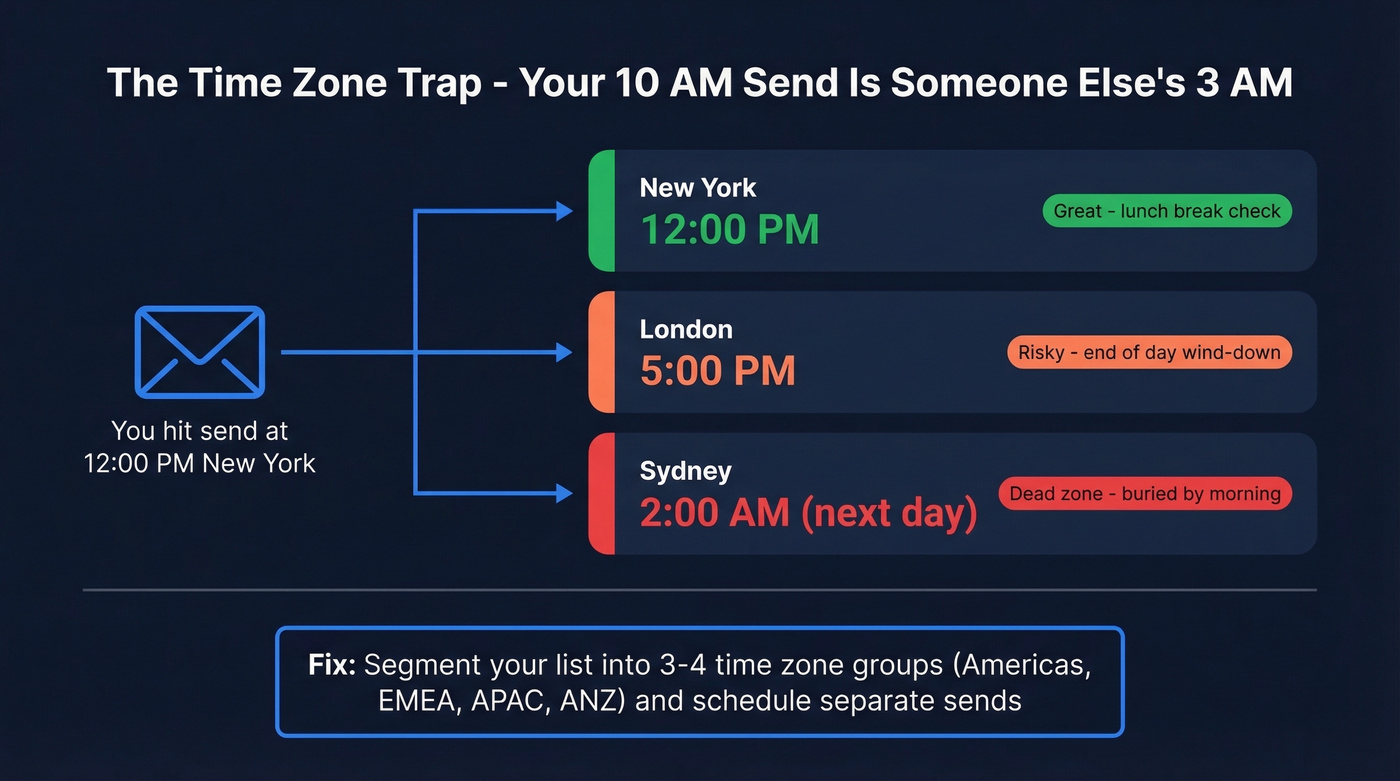
An email sent at noon in New York arrives around 2-4 AM in Sydney, depending on daylight savings. That's not a timing optimization problem - it's a deliverability disaster. Mailchimp built Timewarp specifically for this, and Litmus recommends either prioritizing your most important time zone or segmenting your list by geography. If you're running a global list from a single send, you're guaranteeing a chunk of your audience gets your email at the worst possible hour. If you're seeing inbox placement issues, start with an email deliverability guide before you tweak scheduling.
What to Do Instead
Four things to fix right now:
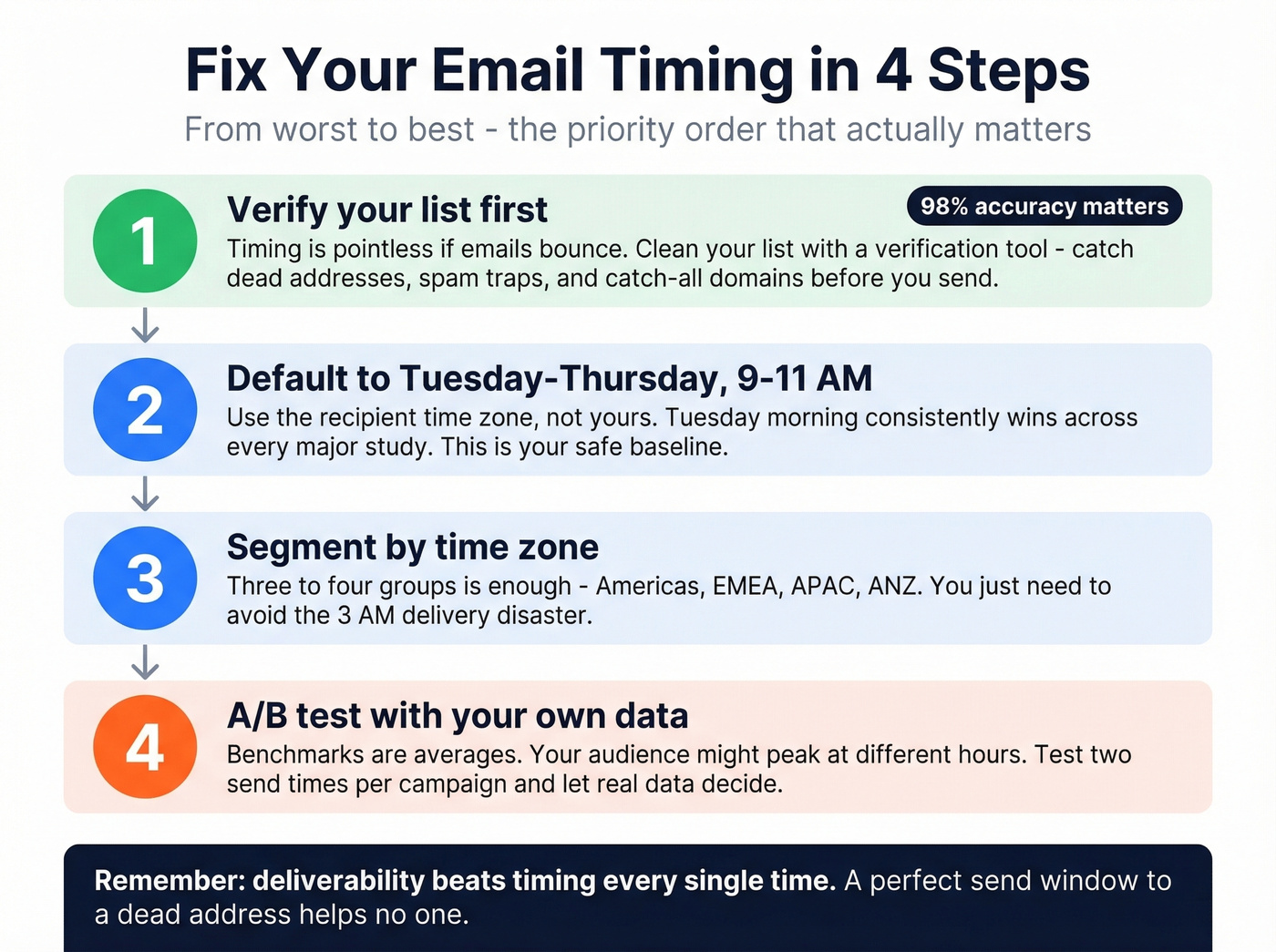
Default to Tuesday-Thursday, 9-11 AM in the recipient's time zone. Not yours - theirs. In our testing, Tuesday morning consistently outperforms every other slot. This is the safest baseline across major studies. If you're doing outreach, compare this with the best time to send cold emails playbook.
A/B test send times with your own list. Benchmarks are averages. Your audience might be different. Twilio SendGrid's data scientists found no statistically significant peak open time during Memorial Day weekend - proof that defaults break during holidays and unusual periods. If you want to measure beyond opens, use a clean click rate formula in email marketing and track replies.
Segment by time zone if you have a global audience. Three to four segments (Americas, EMEA, APAC, ANZ) is enough. You don't need 24 segments - you just need to avoid the 3 AM delivery problem. If you're automating this, automated cold email scheduling can help you avoid accidental overnight sends.
Verify your list before scheduling anything. Timing only matters if the email reaches a real person. Run your list through a verification tool like Prospeo before you hit send - with 98% email accuracy and a 7-day data refresh cycle, it catches dead addresses that would otherwise bounce and tank your sender reputation. If you're diagnosing issues, start with email bounce rate benchmarks and fixes, then work on how to improve sender reputation.
Look, I'll be direct: timing is the second-most-overrated topic in email marketing. The first is subject lines. Both matter far less than whether your email reaches a valid inbox. If you want a faster win than timing tweaks, steal from proven email subject line examples. We've seen bounce rates destroy sender reputation faster than any timing mistake ever could - one client came to us after a 35% bounce rate torched their domain, and no amount of Tuesday-at-10-AM scheduling was going to fix that. Fix deliverability first, then obsess over send windows. Knowing the worst time to send an email helps, but sending to a dead address at the perfect time helps no one.
One client came to us with a 35% bounce rate - no send-time trick was saving that domain. Prospeo's 98% email accuracy and 7-day data refresh cycle keep your list clean so your Tuesday 10 AM send actually lands. At $0.01 per email, it costs less than one wasted campaign.
Stop optimizing timing on a list full of dead addresses.
FAQ
Is Friday a bad day to send emails?
For B2B cold outreach, yes - engagement drops measurably as people wind down after lunch. For B2C newsletters, Friday performs fine and sometimes outperforms midweek, especially for weekend promotions sent after 5 PM. Skip Friday for sales emails; test it for consumer campaigns.
Does send time matter more than subject lines?
Both matter less than whether the email reaches a valid inbox. A perfectly timed email to a dead address does nothing except hurt your domain reputation. Fix deliverability first, then optimize timing.
What's the single worst hour to send an email?
3-4 AM in the recipient's local time zone. Engagement is near zero during this window. Even automated sequences should respect local time to avoid landing in the overnight burial pile.