

ZOPA: Zone of Potential Agreement Explained
Most people treat negotiation like haggling - throw out a number, hope for the best, split the difference. That's how you leave money on the table or walk away from deals that should've closed.
Understanding the ZOPA, or zone of potential agreement, gives you a framework to know - before you open your mouth - whether a deal is even possible and where the sweet spot sits.
What Is ZOPA?
ZOPA stands for zone of potential agreement: the overlap between what each side in a negotiation will accept. If a seller won't go below $250K and a buyer won't go above $265K, the ZOPA is $250K-$265K. Any deal in that range works for both parties. No overlap? No deal. Period.
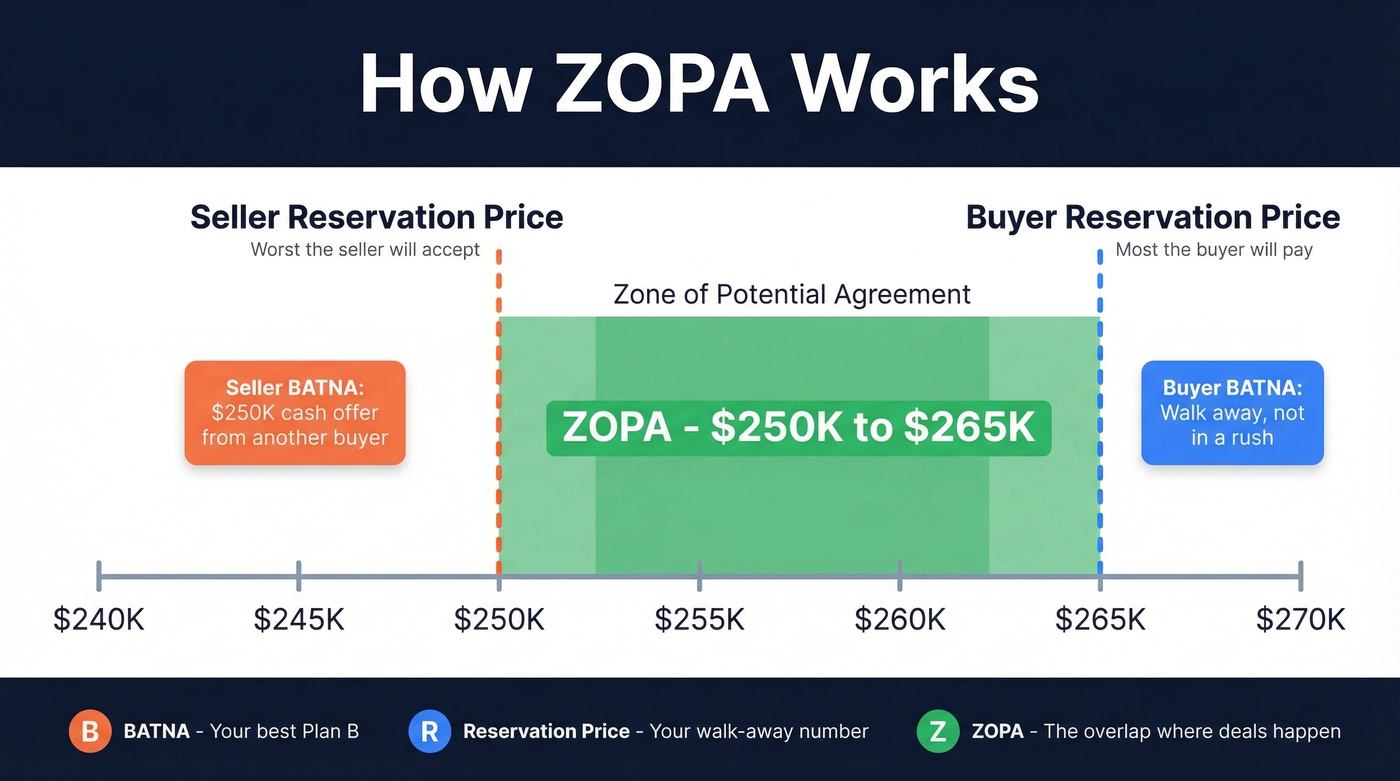
You'll also see it called the "zone of possible agreement," the "bargaining range," or the "bargaining zone." Harvard's Program on Negotiation even glosses "Zone of Potential Agreement" as "zone of possible agreement" - don't get hung up on the wording. The concepts that make this framework useful are your BATNA (best alternative to a negotiated agreement), your reservation price - the worst deal you'd still accept - and your target price, what you're actually aiming for.
What You Need Before You Sit Down
Three things, in order of importance:
Know your reservation price. This is the dollar value of your BATNA - the point where you're better off walking away. If you haven't calculated it, you're negotiating blind.
Estimate the other side's reservation price. Here's the thing: this is both the hardest and highest-leverage part of any negotiation. What separates a great negotiator from an average one isn't knowing their own limits. It's the hours spent estimating the other party's.
Expand beyond price. Real negotiation isn't a single number line. It's a zone of acceptable packages - payment terms, timelines, scope, warranties. That's where deals actually get made.
Positive vs. Negative ZOPA
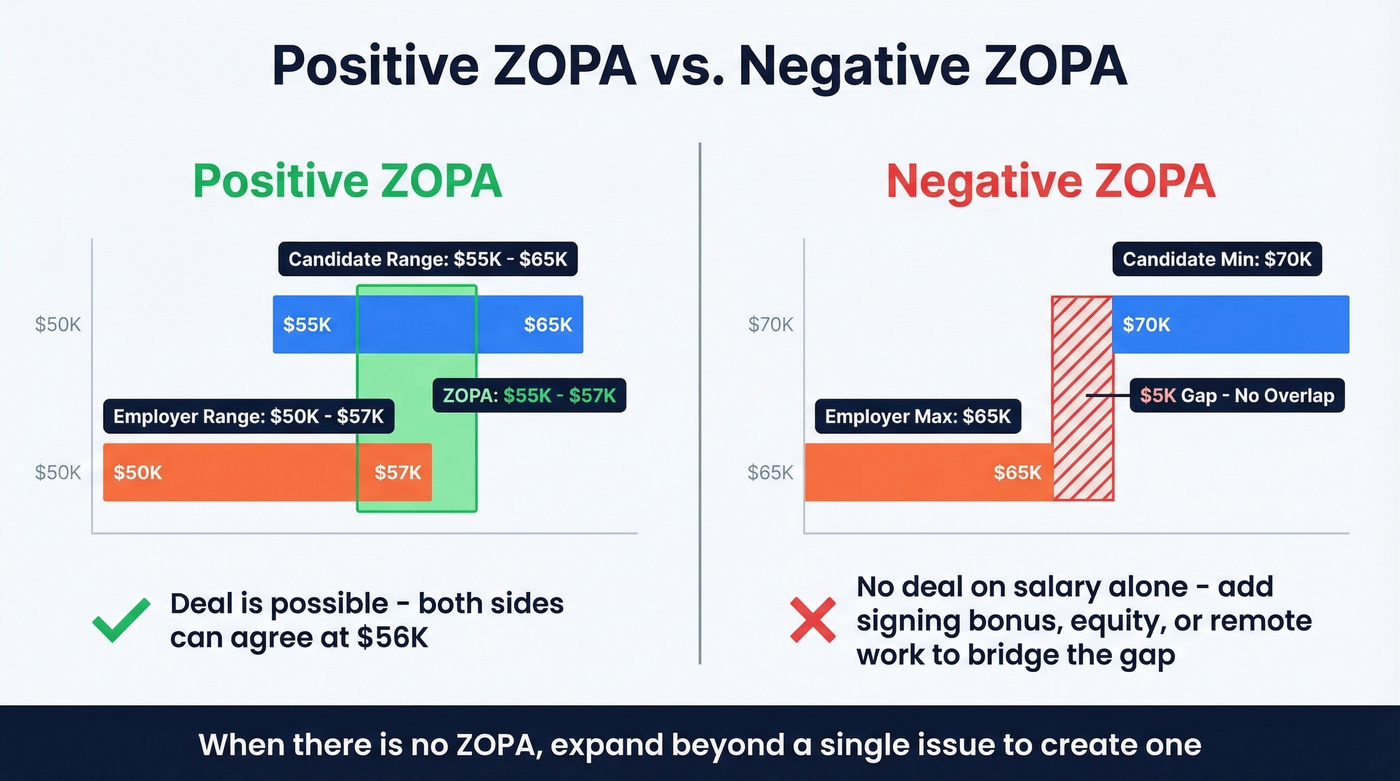
A positive ZOPA means the ranges overlap. A negative ZOPA means they don't - and unless you can change the terms, there's nothing to negotiate.
| Scenario | Party A Range | Party B Range | ZOPA |
|---|---|---|---|
| Salary (positive) | Candidate: $55K-$65K | Employer: $50K-$57K | $55K-$57K |
| Salary (negative) | Candidate min: $70K | Employer max: $65K | None |
In the positive example, the candidate's floor falls within what the employer can pay. Settlement at $56K works for everyone. In the negative example, there's a $5K gap that pure salary negotiation can't bridge - both sides pursue their BATNAs, or they get creative and add other terms like signing bonuses, remote work, or equity.

Estimating the other side's reservation price starts with reaching the right person. Prospeo gives you direct access to 300M+ professional profiles with 98% verified email accuracy - so your pre-negotiation outreach lands with the decision-maker, not a gatekeeper.
Stop negotiating blind. Start with the right contact.
How to Calculate ZOPA Step by Step
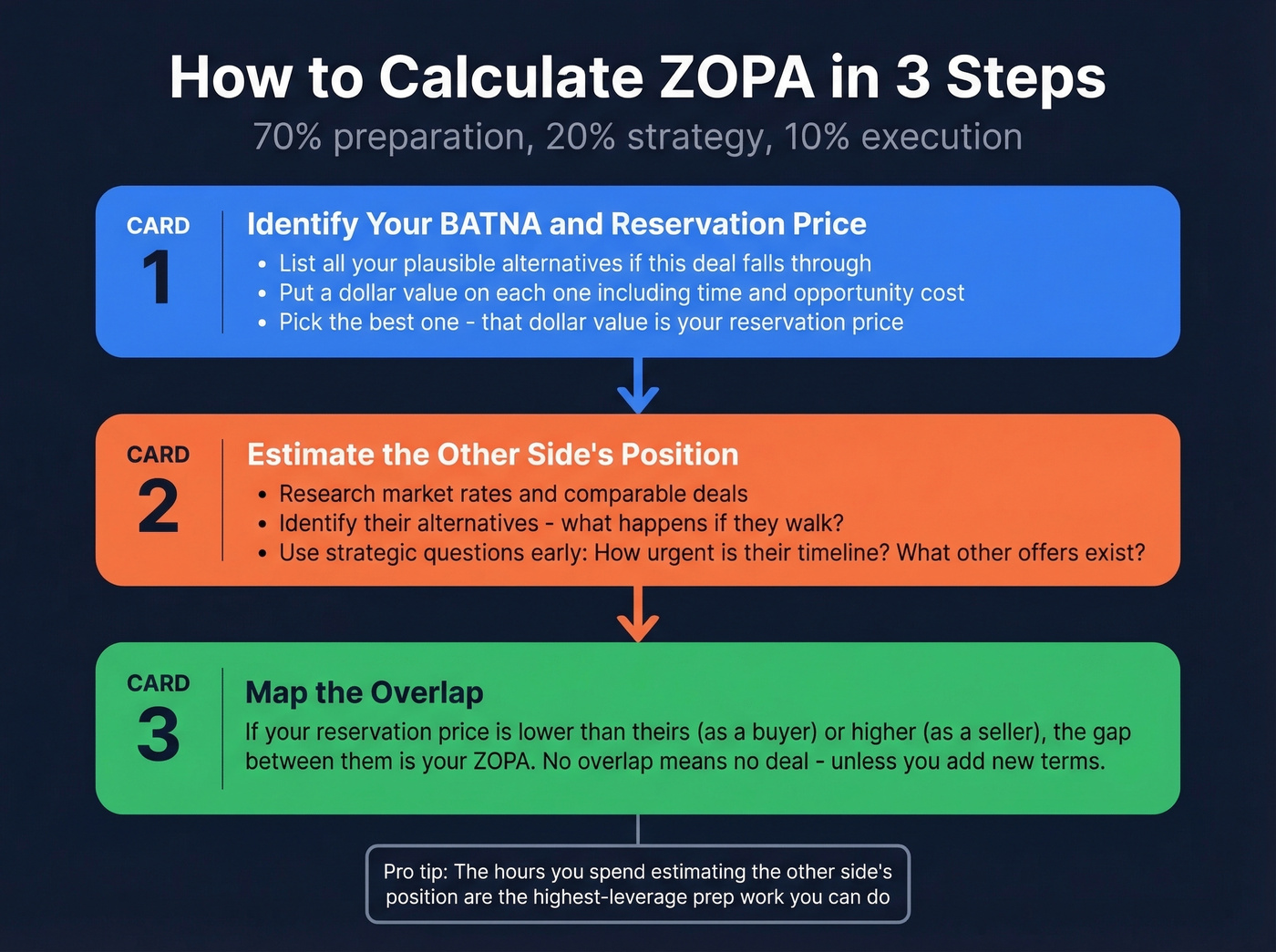
A common practitioner framework puts negotiation at 70% preparation, 20% strategy, 10% execution. The calculation itself is straightforward. The real work is in the inputs.
Step 1: Identify Your BATNA and Reservation Price
Harvard PON breaks BATNA assessment into three steps:
- List your plausible alternatives. What happens if this deal falls through? Another vendor? Another candidate? Doing nothing?
- Estimate the value of each alternative. Put a number on it - dollars, time, opportunity cost.
- Select the best one. That's your BATNA. Its dollar value becomes your reservation price.
If you're not actually willing to take your BATNA, it's not really your BATNA. Be honest with yourself before you sit down at the table.
Step 2: Estimate the Other Side's Position
This is where average negotiators and great ones diverge. Research market rates, identify their alternatives, and use strategic questioning early in the conversation to narrow the bargaining range. What other offers do they have? How urgently do they need to close? What's their cost of delay?
Part of that research means reaching the right people directly - not gatekeepers. Tools like Prospeo help here, covering 300M+ professional profiles with 98% email accuracy so your pre-negotiation outreach actually lands with someone who can make the call. If you're doing this in a revenue context, it also helps to sharpen your discovery questions before you get on the call.
Worked Example: Land Deal
A parcel is listed at $275K. The seller has a cash offer of $250K from another buyer - that's the seller's BATNA, making their reservation price $250K. The buyer's reservation price is $265K, and they're not in a rush.
The bargaining zone sits at $250K-$265K. If the buyer knew the seller's walk-away point, they'd offer $251K. If the seller knew the buyer's, they'd counter at $264K. That information asymmetry is the entire game. If you want a tighter framework for setting that walk-away number, see walk-away point.
Beyond Price: Multi-Issue Negotiation
Most real negotiations aren't about a single number. A Future of Sourcing analysis argues that the traditional one-dimensional ZOPA - a line - is incomplete. In practice, it's an oval: a range of acceptable packages where many combinations of terms satisfy both sides.
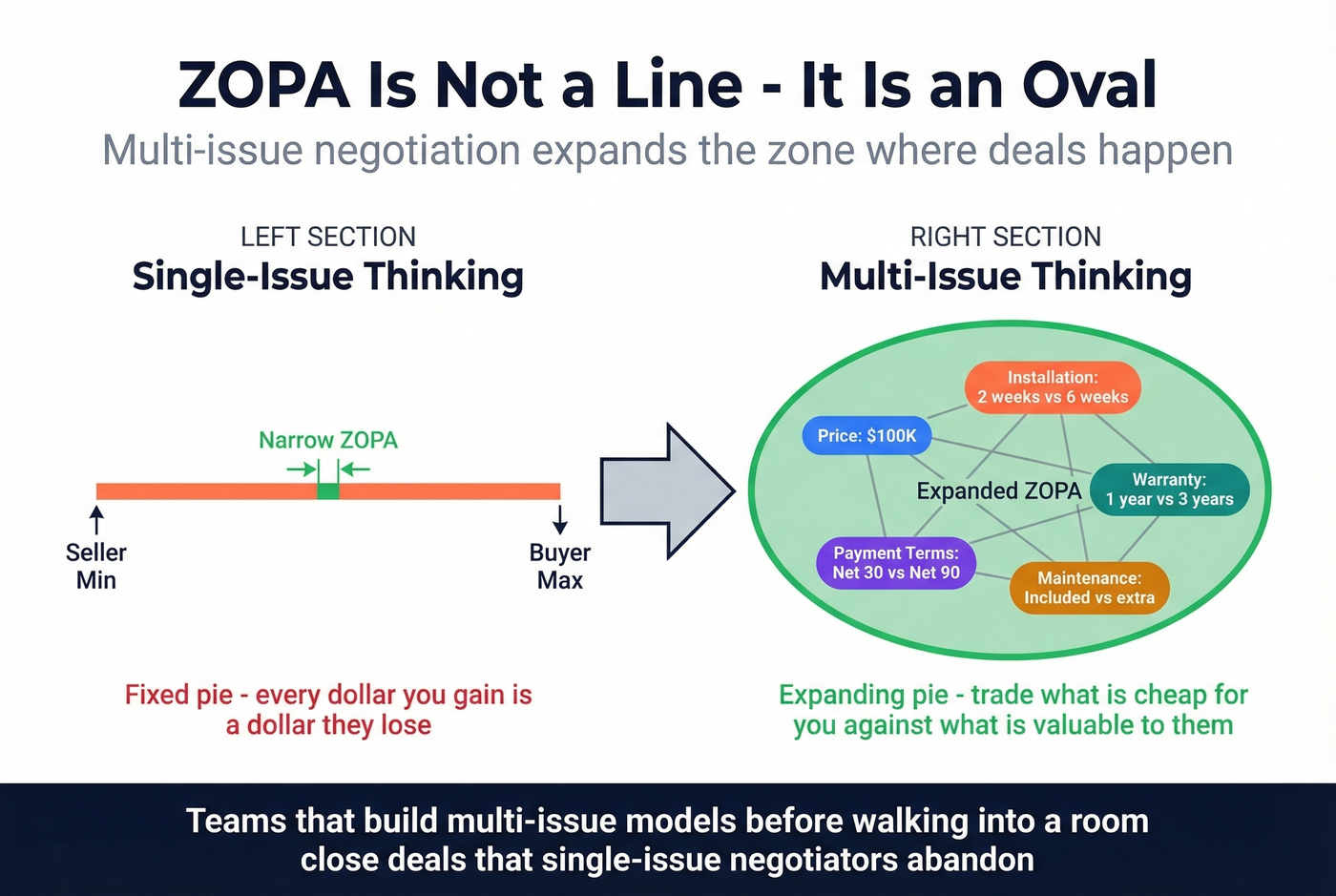
Consider a $100K replacement part deal. Price is one variable, but installation timing, warranty length, and ongoing maintenance all create dimensions where tradeoffs happen. You accept a higher price for faster installation or a longer warranty. In M&A, the same logic applies - earn-out structures, equity splits, and retention packages can create agreement where headline price alone couldn't.
This is the core difference between distributive negotiation (splitting a fixed pie) and integrative negotiation (expanding the pie). Distributive thinking treats every dollar you gain as a dollar they lose. Integrative thinking asks what each side values differently and trades accordingly. In our experience, the teams that build multi-issue models before walking into a room close deals that single-issue negotiators abandon. This is also where sales communication and clean internal alignment matter more than most teams admit.
Anchoring, Hidden ZOPAs, and Time Pressure
Sometimes a zone of potential agreement exists but neither side can see it. Parties exaggerate their alternatives to gain bargaining power, creating an apparent absence of overlap. We see this constantly in B2B sales: a prospect claims three competing proposals when they have one, and the seller walks from a winnable deal. Deception and uncertainty kill negotiations that would've benefited both sides. If you're running outbound, this is why competitive intelligence strategy belongs in your prep.
The first number spoken also has outsized influence. In Ariely, Loewenstein, and Prelec's well-known 2003 anchoring experiment, participants who wrote down higher arbitrary numbers placed bids up to 2x higher than those who wrote lower numbers. The anchor reshapes what feels "reasonable." For a deeper breakdown of how this works in practice, see anchoring.
Speak first when you've done your homework and have a solid estimate of the other side's range. Let them go first when you're flying blind - their opening gives you information you don't have.
A 2020 study in Frontiers in Psychology found that time pressure can be as influential as BATNA in determining outcomes. Deadlines and calendar pressure shift bargaining power just as much as having a strong Plan B. If you're negotiating against a quarter-end deadline, that's a lever - use it. This is also why teams that track pipeline health tend to negotiate with more leverage.
Let's be honest: most negotiation advice obsesses over BATNA as the only source of power. It's not. A mediocre BATNA combined with zero time pressure and good information about the other side's constraints will outperform a strong BATNA wielded blindly. Power in negotiation is situational, not structural.
Common ZOPA Mistakes
The agreement trap. Accepting a deal that's worse than your BATNA because you got caught up in the momentum of negotiating. Always compare the final offer to your walk-away number, not to where the conversation started.
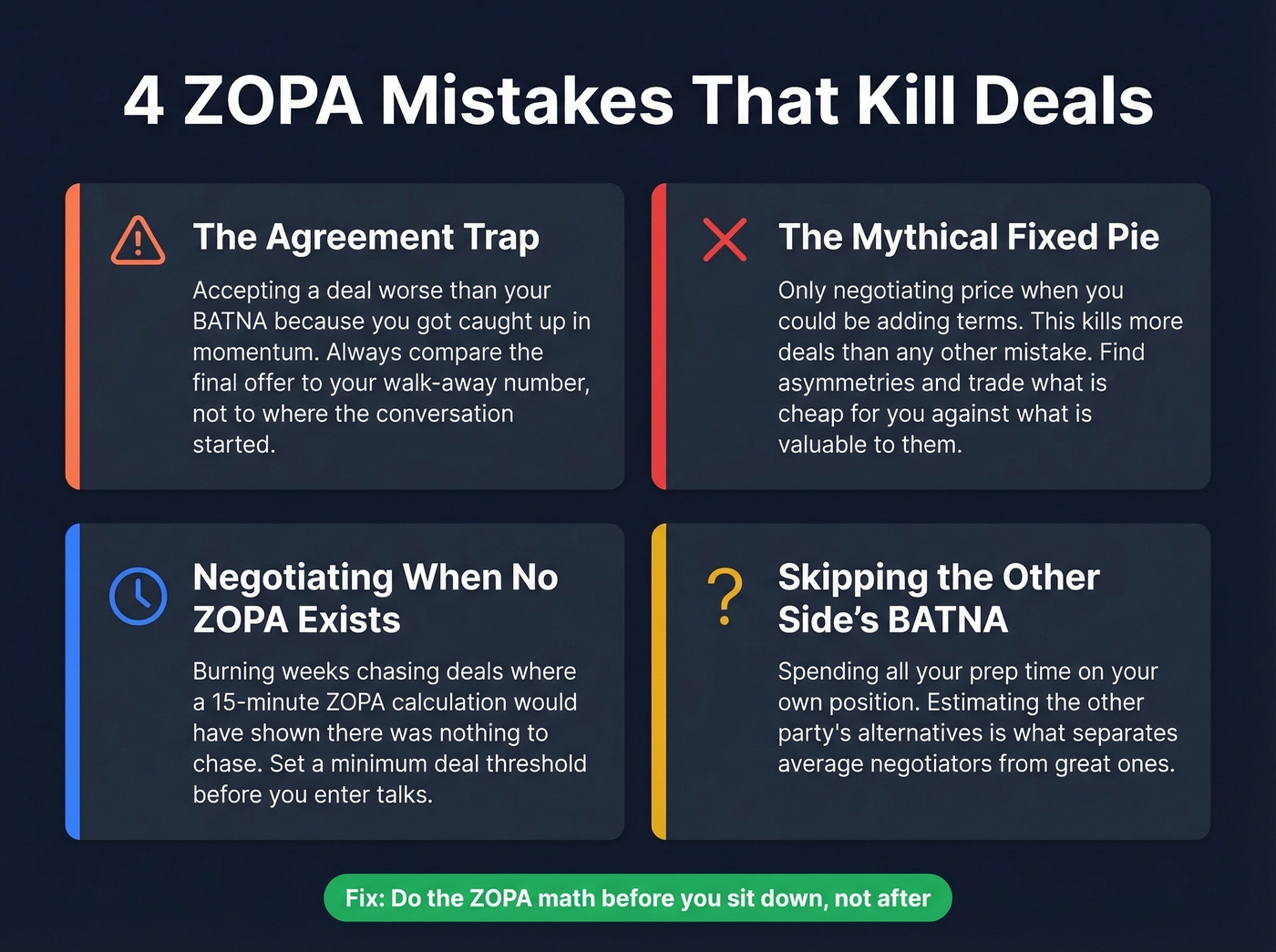
The mythical fixed pie. In our experience, this assumption kills more deals than any other mistake on this list. If you're only negotiating price, you're almost certainly leaving value on the table. Add terms. Find asymmetries. Trade what's cheap for you against what's valuable to them.
Negotiating when no ZOPA exists. If the ranges don't overlap and neither side can add terms to create overlap, stop. Set a minimum deal threshold before you enter talks, and walk away when the math doesn't work. We've watched teams burn weeks chasing deals where a 15-minute ZOPA calculation would've shown there was nothing to chase. If this is happening in your org, it’s usually a sales process optimization problem, not a rep problem.
Skipping the other side's BATNA. Most people spend all their prep time on their own position. The consensus on r/negotiation and r/sales is clear: estimating the other party's alternatives is what separates average from great. Skip this step and you're guessing where the zone sits. If you need a repeatable way to operationalize that research, start with sales prospecting techniques.
The best BATNA in the world won't help if you can't get to the table. Prospeo's 125M+ verified mobile numbers and 30% pickup rate mean you connect directly with buyers - no gatekeepers, no dead ends, no wasted prep.
Every closed deal starts with a real conversation. Get direct dials at $0.01/lead.
FAQ
What's the difference between ZOPA and BATNA?
BATNA is your best alternative if the deal falls through - your Plan B. ZOPA is the overlap between both sides' acceptable terms. Your BATNA determines your reservation price, which defines one edge of the ZOPA. They're connected but distinct: BATNA is individual, ZOPA is relational.
Can you create a ZOPA when there isn't one?
Yes, by expanding beyond a single issue. Adding terms like delivery timing, payment structure, warranty, or scope can create overlap where price alone couldn't. Reaching the actual decision-maker early helps too - you don't want to negotiate with someone who can't say yes.
How do you calculate the zone of potential agreement?
Identify your BATNA and convert it to a reservation price - the worst deal you'd still accept. Then estimate the other side's reservation price through market research and strategic questioning. If your reservation price is lower than theirs (as a buyer) or higher (as a seller), the gap between them is your ZOPA. No overlap means no deal unless you add new terms to the table.