

How to Build ABM Campaigns That Actually Move Pipeline
You launched the ads. You built the account list. You ran the plays for a quarter. Then your VP of Sales walks over and asks, "So what did this actually influence?" If you don't have a clear answer, your ABM campaigns have a measurement problem - not a strategy problem.
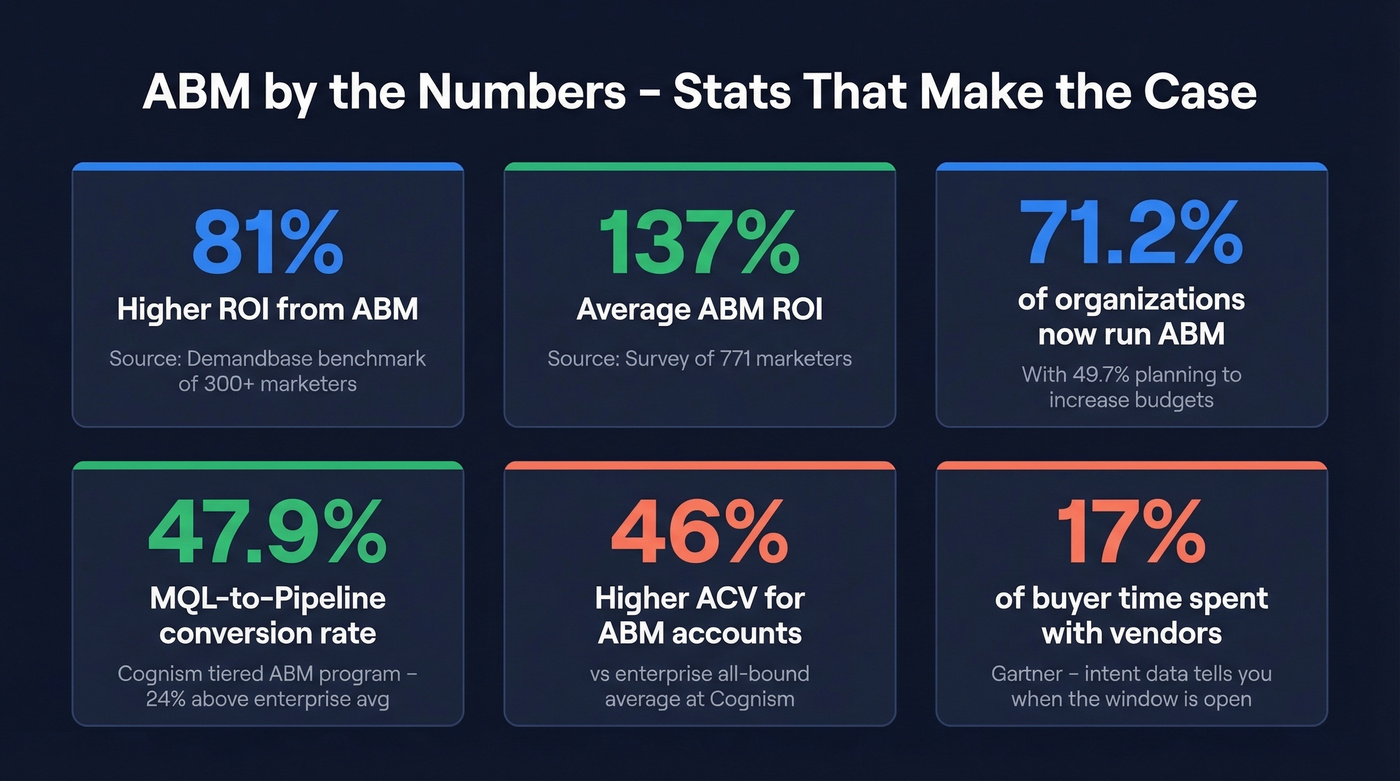
Account-based marketing delivers 81% higher ROI according to a Demandbase benchmark of 300+ marketers. A separate survey of 771 marketers found 71.2% of organizations now run ABM, with an average ROI of 137% - and 49.7% plan to increase budgets this year. The strategy works. Execution is where most teams stall: buying a platform before proving the motion, measuring MQLs instead of pipeline, and running single-threaded outreach into buying committees of 12.
Here's how to build ABM campaigns that Sales actually trusts, starting with the minimum viable system and scaling from there.
What You Need to Run ABM Campaigns
You don't need a $100K platform to start. We've watched companies spend six figures annually on platforms that promised the world and delivered what one newsletter called "expensive lead scoring 2.0." At their core, account-based marketing campaigns are coordinated, multi-channel plays aimed at a defined set of high-value accounts - not broad-net demand gen. You need five things:
- A tight account list. 50-500 accounts max for your first motion. Not your entire TAM.
- Verified buying-group contacts. Stale emails and wrong numbers kill ABM before it launches. Prospeo's 98% email accuracy and 7-day refresh cycle mean you're working with current data, not last quarter's org chart.
- Three campaign plays. Not twelve. Three plays you can execute well and measure clearly.
- An engagement scoring model. Define what "engaged account" means before you spend a dollar on ads. (If you need a baseline, start with a simple lead scoring model and adapt it to accounts.)
- A weekly Sales report. One page. Which accounts are active, what they're doing, and what Sales should do next.
That's it. Everything else is optimization.
Types of ABM Campaigns and When to Use Each
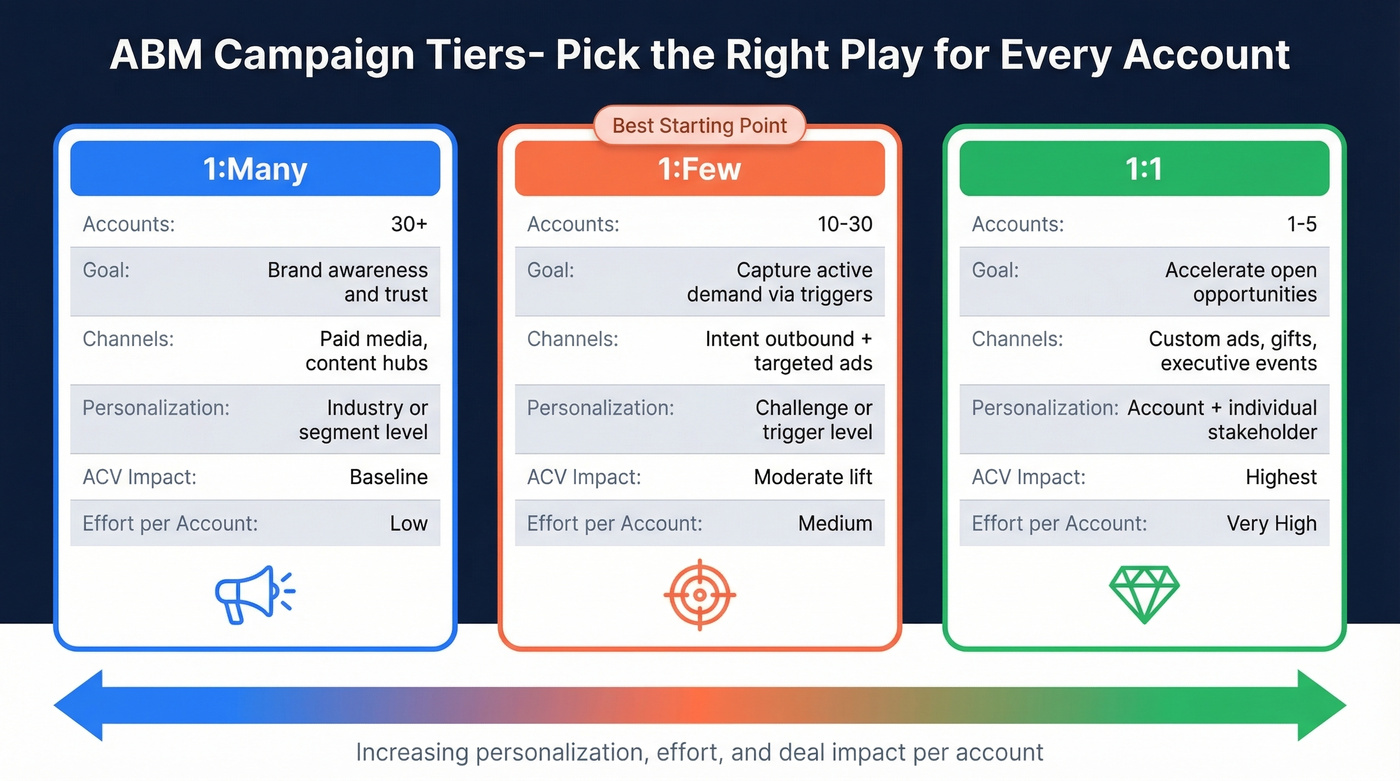
Not every account deserves the same treatment. The tiering model from Dreamdata frames it well: 1:many builds trust, 1:few captures active demand through triggers, and 1:1 accelerates open opportunities.
| 1:Many | 1:Few | 1:1 | |
|---|---|---|---|
| Accounts | 30+ | 10-30 | 1-5 |
| Objective | Brand + awareness | Capture active demand | Accelerate open deals |
| Channels | Paid media, content hubs | Intent outbound + ads | Custom ads, gifts, events |
| Personalization | Industry/segment | Challenge/trigger level | Account + stakeholder |
| ACV impact | Baseline | Moderate lift | Highest |
One note on ad audience sizes: 1-5 accounts in a 1:1 tier might translate to 500 or fewer people across those accounts for ad targeting. Don't confuse account count with audience size when setting up campaigns.
Internal data from Cognism's tiered ABM program drove a 47.9% MQL-to-pipeline conversion rate - 24% higher than their enterprise average. ABM accounts carried a 46% higher ACV than their enterprise all-bound average. Tiering directly impacts deal size and conversion.
For your first campaign, start with 1:few. It's the sweet spot: enough accounts to generate signal, enough personalization to outperform generic demand gen, and enough volume that Sales won't dismiss it as a one-off.
Select Target Accounts
The biggest ABM mistake is starting with too many accounts. Your list should be tight enough that Sales recognizes every name on it.
Foundry's FIRE method gives you a solid framework: Firmographic fit (right size, industry, tech stack), Intent (active research behavior), Recency (signals from the last 30-90 days, not last year), and Engagement (already interacting with your content or site). (If your list-building is still manual, it’s worth standardizing how you automate target account lists.)
The Intent Taxonomy That Matters
Not all intent signals carry equal weight.
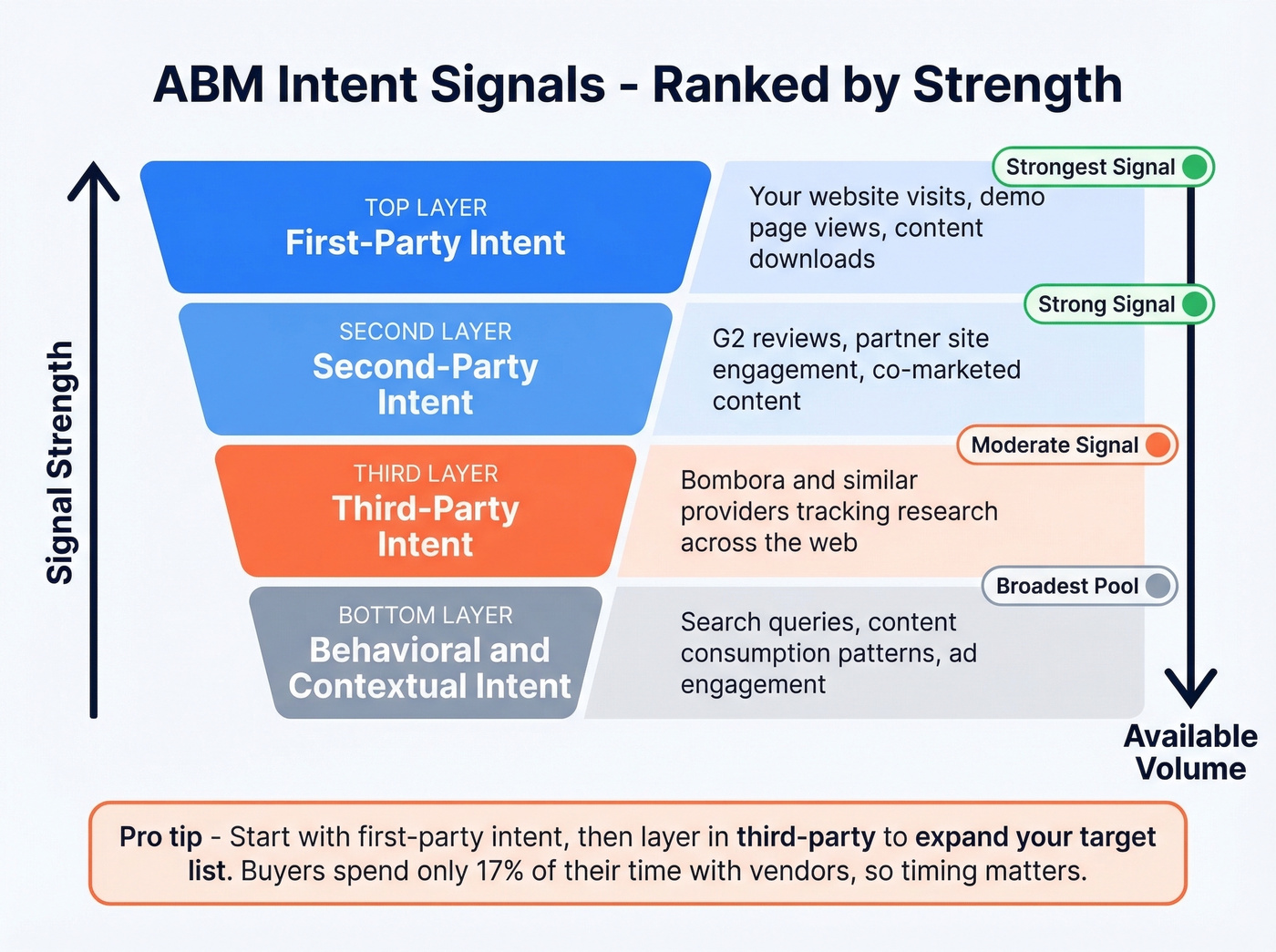
- First-party intent - your own website visits, content downloads, demo page views. The strongest signal, but the smallest pool.
- Second-party intent - engagement on partner sites, review platforms like G2 or TrustRadius, or co-marketed content.
- Third-party intent - research behavior across the broader web, typically aggregated by providers like Bombora.
- Behavioral and contextual intent - search queries, content consumption patterns, and ad engagement that indicate active buying research.
Start with intent signals to identify which accounts are actively researching your category, then filter by job role, headcount growth, and technographics to narrow from your full TAM to accounts worth pursuing right now. (If you need a clean definition of what to track, use an intent based segmentation approach.)
Here's why timing matters: Gartner reports B2B buyers spend only 17% of their time meeting with potential suppliers. Intent data tells you when the research window is open. Miss it, and you're fighting for a sliver of attention.
Build the list with marketing data, then validate it with Sales. Account selection should be a joint exercise. If your AEs don't believe in the list, they won't work it.
Map the Buying Group
Single-threaded outreach is the silent killer of account-based marketing. You reach the VP of Marketing, get a meeting, and then the deal stalls because the CTO, CFO, and Head of IT were never in the conversation. Enterprise buying committees run [upwards of 12 people](https://www.inverta.com/resources/the-power-of-precision - building-effective-abm-campaigns-a-case-study). You need to reach at least 3-5 of them.
An Inverta case study makes this concrete: a cloud services provider targeted 50 enterprise accounts with personalized outreach across the full buying group. The result was a 70% engagement rate, a 190% increase in successful contacts, and $1.3M in pipeline. That doesn't happen when you're emailing one person per account. (This is also where account-based selling best practices matter as much as marketing.)

Use full committee mapping if you're running 1:few or 1:1 campaigns where deal size justifies the effort. Skip it if you're running 1:many awareness plays - at that tier, target by persona, not by individual.

ABM dies when you can't reach the buying committee. Prospeo gives you 300M+ profiles with 30+ filters - job title, department, technographics, headcount growth - so you can map every stakeholder across your target accounts. 98% email accuracy means your multi-threaded outreach actually lands.
Stop single-threading into 12-person buying committees with stale data.
Budget Math and Channel Reality
Let's talk real numbers. A practitioner on r/b2bmarketing shared their LinkedIn ABM budget: $12K/month, roughly $18 average CPC. At that rate, you're getting about 3 clicks per day.
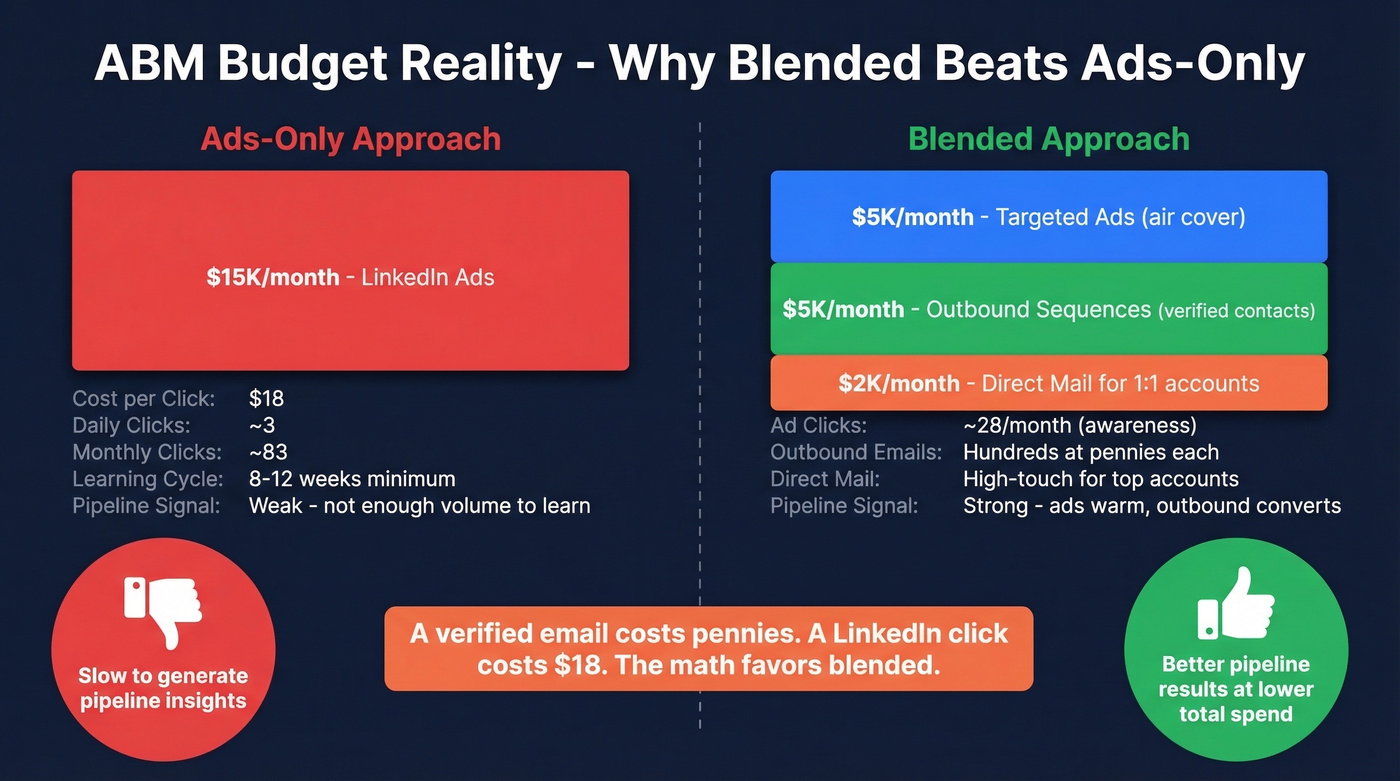
Three clicks a day isn't a test. You don't have enough volume to learn anything meaningful for weeks. Most teams underestimate how long ABM ad campaigns need to run before you can draw conclusions - design for 8-12 week learning cycles, not 2-week sprints.
The fix isn't more ad budget. It's more channels. Campaigns that work are multi-channel: paid ads for air cover, outbound email for direct engagement, direct mail for high-value 1:1 accounts, and website personalization (tools like Mutiny let you tailor landing pages by account or segment) to convert the traffic you're already getting. Foundry's research consistently emphasizes this multi-channel imperative. (If you’re adding direct mail, use a dedicated direct mail for lead generation workflow so it’s measurable.)
Budget reality check: If you're spending $12K/month on ads alone, consider reallocating 30-40% to outbound sequences targeting the same accounts. A verified email costs pennies. A LinkedIn click costs $18. The math favors a blended approach.
We've seen teams get better pipeline results from a $5K ad budget paired with disciplined outbound than from a $15K ads-only approach. The ads warm the account; the outbound converts it. When you're A/B testing creative or messaging, change one variable at a time and give each variant at least 2 weeks of data before drawing conclusions. (If your outbound is inconsistent, tighten up sequence management first.)
Three Plays to Run First
Play 1: Intent-Surge Intercept (1:Few)
Trigger: Multiple stakeholders at the same account spike on intent topics related to your category within a 7-day window.
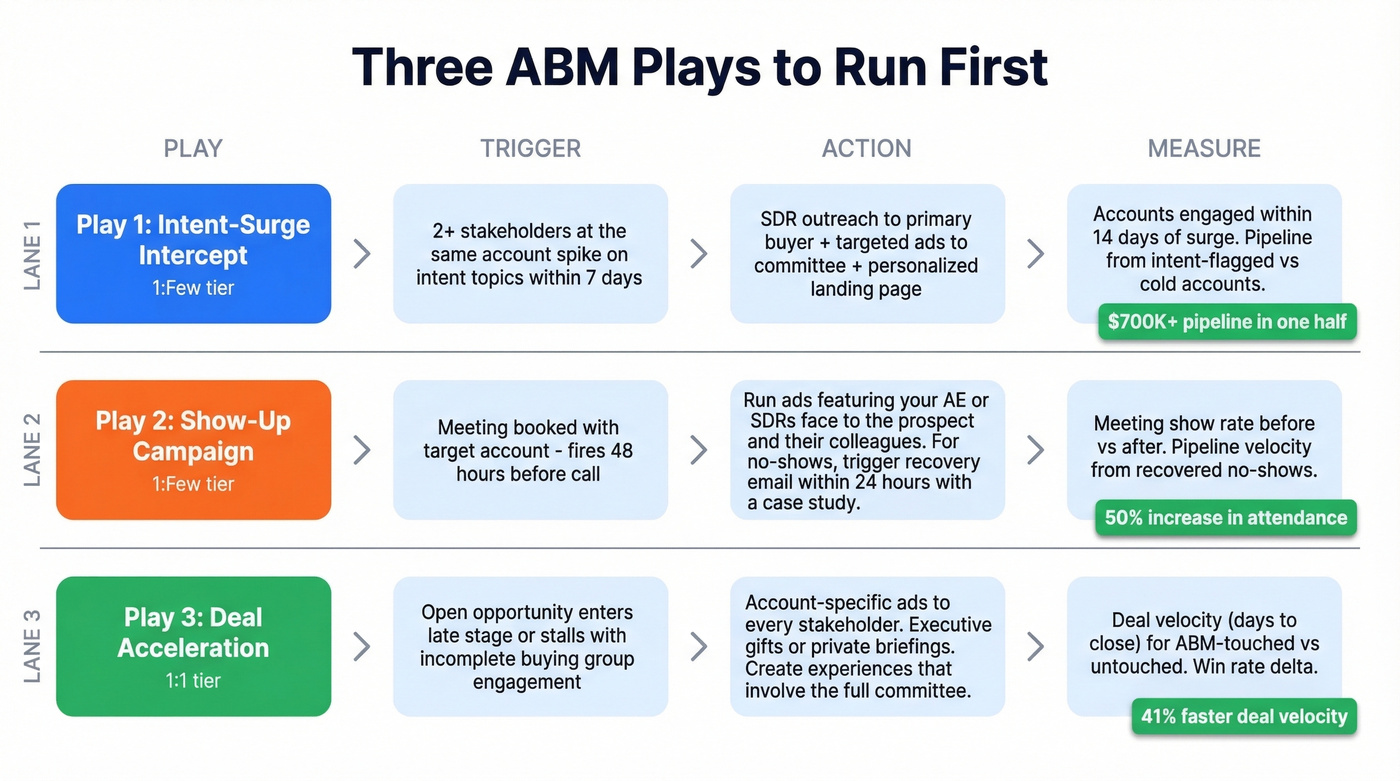
Action: Build a weekly "hot accounts" list. When an account shows intent surges from 2+ stakeholders, trigger a coordinated play - SDR outreach to the primary buyer, targeted ads to the broader committee, and a personalized landing page addressing their likely challenge. This motion generated $700K+ in pipeline in a single half at one B2B company.
Measure: Accounts engaged within 14 days of intent surge. Pipeline created from intent-flagged accounts vs. cold accounts.
Play 2: The Show-Up Campaign
We ran into this problem ourselves: booked meetings with target accounts that never showed. The fix was surprisingly simple.
Run ads to the prospect and their colleagues 48 hours before the meeting - reinforce your value prop and reduce no-shows. Influ2 reports this approach increased meeting attendance by 50%. One tactic that works especially well: use your SDR's or AE's actual face in the ad creative. When the prospect sees the same person in the ad and on the Zoom call, it builds familiarity before the conversation starts.
For no-shows, trigger a recovery sequence within 24 hours - a short, empathetic email with a relevant case study, not a guilt trip. Pair it with a retargeting ad that keeps your brand visible. Track show rate before vs. after, and pipeline velocity from recovered no-shows. (If you need copy, keep a set of sales follow-up templates ready for the recovery sequence.)
Play 3: Deal Acceleration (1:1)
This is where account-based marketing gets creative. One xGrowth case study sent target accounts a physical safe with a valuable gift inside, then mailed the combination code to a different stakeholder at the same company. The two had to collaborate to open it, forcing a conversation about the vendor and getting multiple decision-makers engaged simultaneously.
You don't need to ship safes. But the principle holds: 1:1 plays should create experiences that involve the full buying committee. Account-specific ads targeting every stakeholder, executive gifts, private briefings tailored to their use case. BioCatch ran this approach and saw 100% of late-stage deals had an engaged contact from their ABM program, with 41% faster deal velocity. The highest-impact plays are the ones that multi-thread into the buying group, not the ones with the flashiest creative.
Measure deal velocity (days to close) for ABM-touched vs. untouched opportunities, and win rate delta.
Measuring ABM So Sales Believes You
If you're reporting MQLs to Sales leadership, you've already lost the room.
Set definitions before you launch. An engaged account means 3+ contacts from the same account interacting with your campaigns within 30 days - not one person clicking one ad. A sales-ready account is engaged, showing an intent surge, and fits ICP criteria. That's the handoff trigger. Deliver a weekly report to Sales leadership: which accounts moved, what they did, and the recommended next action. (If you want a tighter view of impact, track pipeline health alongside engagement.)
The proof points are there. CipherHealth generated $122.70 in revenue for every $1 spent on ABM. Bonterra saw 2x win rates and 2.5x deal value. StarTree drove a 3.17x conversion rate increase versus cold outreach.
MQL-only measurement actively undermines ABM. An engaged account that hasn't filled out a form is still valuable - build your scoring model around account-level engagement patterns, not individual lead actions. And with 78.7% of organizations now incorporating AI into their ABM programs, predictive scoring models are getting sharper at identifying which engagement patterns actually predict pipeline. Worth exploring once you're past the basics. (If you go that route, start with B2B predictive analytics fundamentals.)
Hot take: If your average deal size is under $10K, you probably don't need ABM at all. The ROI comes from concentrating resources on high-value accounts. Spreading that same effort across hundreds of small deals is just demand gen with extra steps.
Do You Need a Dedicated Platform?
The consensus on r/b2bmarketing is blunt: most ABM platforms are overbuilt and overpriced for teams that aren't running enterprise-scale programs. One practitioner called them "incredibly expensive" and noted they just use manual account lists plus a visitor identification tool to prove reach.
Platforms like 6sense, Demandbase, Terminus, and RollWorks typically run $30K-$150K+/year depending on modules and ad spend commitments. That's a big bet before you've proven the motion works.
Prove reach and pipeline with a simple stack first. Your minimum viable setup: an ad platform (LinkedIn, Google), an outbound tool (Instantly from ~$30/mo, Smartlead from ~$39/mo, or Outreach for enterprise), your CRM, and Prospeo for verified contacts and intent signals. That's enough to run all three plays above and measure results. We've watched teams burn six months negotiating platform contracts when they could have been running campaigns with this stack from day one. If you outgrow it, evaluate platforms - with data to back the business case. (If you’re still choosing tools, compare options in our guide to the best SDR tools.)
Intent data tells you which accounts are in-market. Prospeo layers Bombora intent signals across 15,000 topics with verified contact data refreshed every 7 days - so your 1:few ABM plays hit the right people at the right time, not last quarter's org chart.
Reach active buyers before the 17% supplier window closes.
FAQ
How long before ABM campaigns show results?
Expect 12 weeks minimum for meaningful engagement signals and early pipeline. Full maturity - where you can confidently attribute revenue to specific plays - typically takes 6-9 months. Don't judge the strategy by a 30-day sprint.
What's the minimum budget to start?
$5K-$10K/month blending ads with outbound is a realistic floor. A LinkedIn-only budget at $18 CPC gives you limited volume - pair even modest ad spend with outbound sequences using verified contacts to stretch further.
How many accounts should I target?
Match your tier: 1-5 for 1:1, 10-30 for 1:few, 30+ for 1:many. Start smaller than you think. A tight list of 20 accounts you can actually work beats a sprawling list of 500 you can't.
Is ABM only for enterprise companies?
No. The framework scales down even if the platform spend doesn't. Mid-market teams from Seed through Series C run effective 1:few campaigns without a six-figure platform - you just need verified contacts, an outbound tool, and disciplined execution.
Where can I find strong ABM campaign examples?
The case studies referenced throughout this guide - Cognism ($700K+ pipeline), CipherHealth ($122.70 revenue per $1 spent), BioCatch (41% faster deal velocity), and Bonterra (2x win rates) - are strong starting points. Look for examples that share specific pipeline numbers, not just engagement metrics.