

How to Build ABM Landing Pages That Actually Convert
Your VP of Marketing just came back from a conference fired up about 1:1 ABM landing pages. "We need personalized pages for every target account by next quarter." Meanwhile, your CRM has 40% stale titles, your enrichment data hasn't been refreshed in two months, and nobody's agreed on the target account list. Sound familiar?
Personalized ABM landing pages convert 2-3x better than generic ones. But here's the thing most guides won't tell you: the landing page is the least important part of an ABM program. Strategy, data quality, and sales alignment determine whether it works. The page just captures the outcome.
What You Need Before Building a Single Page
Before you touch a page builder or personalization overlay, nail these three things:
- Clean account data first. Enrichment and verification before you build anything. A misspelled name on a "personalized" page is worse than no personalization at all. (If you’re evaluating vendors, start with data enrichment services.)
- Start with 1:few templates, not 1:1 custom builds. You don't need 200 bespoke pages. You need 5-10 smart templates that flex by industry, pain point, or buying stage.
- You don't need a $40K platform. Clay + Webflow or a basic builder with clean CRM data gets you 80% of the way there.
What Account-Based Marketing Pages Actually Are
An ABM landing page is a web page tailored to a specific account, industry segment, or buying committee - not a generic "request a demo" page with your logo on it. The difference isn't cosmetic. It's structural: the headline speaks to the visitor's actual problem, the case studies match their industry, and the CTA reflects where they are in the buying process.
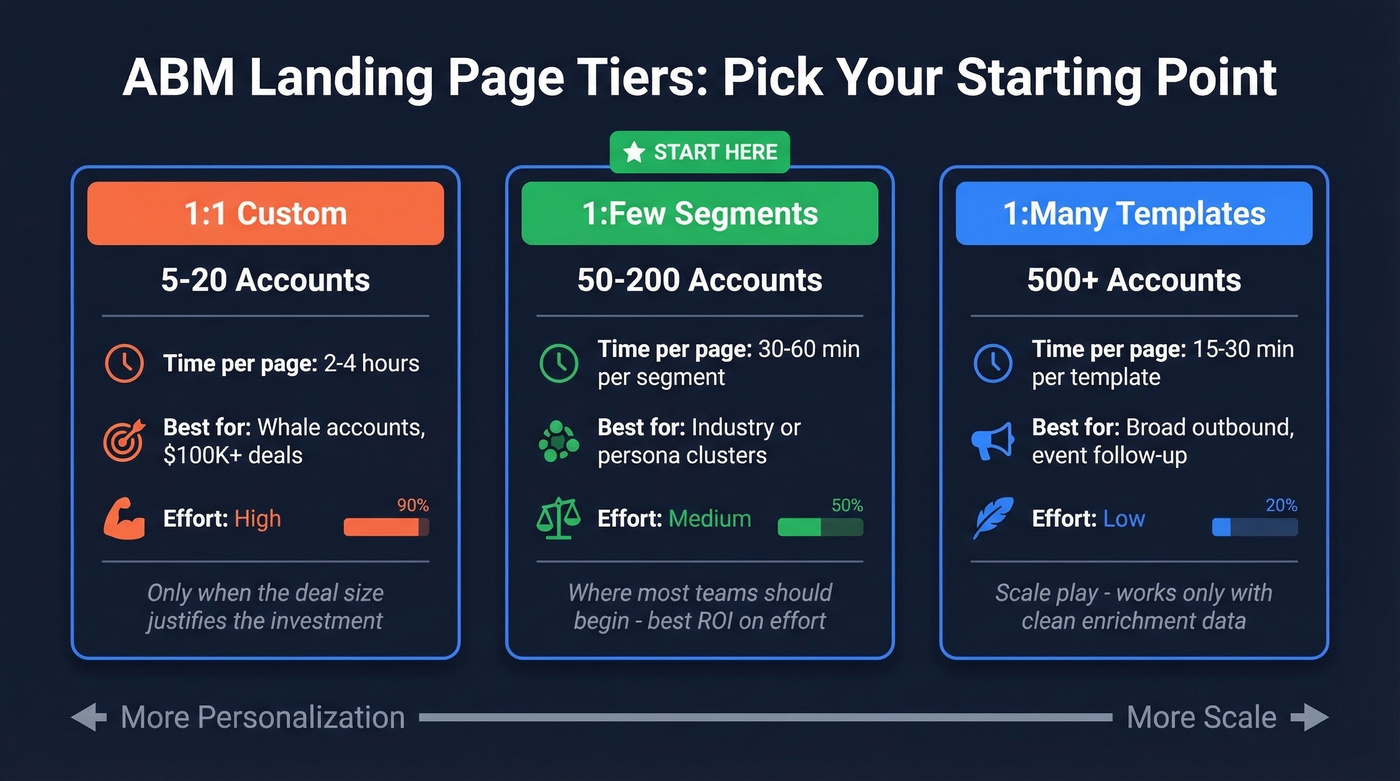
The operating model breaks into three tiers:
| Tier | Accounts | Time per Page | When to Use |
|---|---|---|---|
| 1:1 | 5-20 | 2-4 hrs/page | Whale accounts, $100K+ deals |
| 1:few | 50-200 | 30-60 min/segment | Industry or persona clusters |
| 1:many | 500+ | 15-30 min/template | Broad outbound, event follow-up |
Most teams should start at 1:few. The consensus on r/b2bmarketing is blunt - landing page platforms don't move the needle much without a full play behind them. Strategy and sales alignment matter more than the page itself.
Why Personalized Pages Convert Better
Snowflake's personalized pages converted at 34% versus 11% for generic pages. That's not a marginal improvement - it's a fundamentally different outcome.
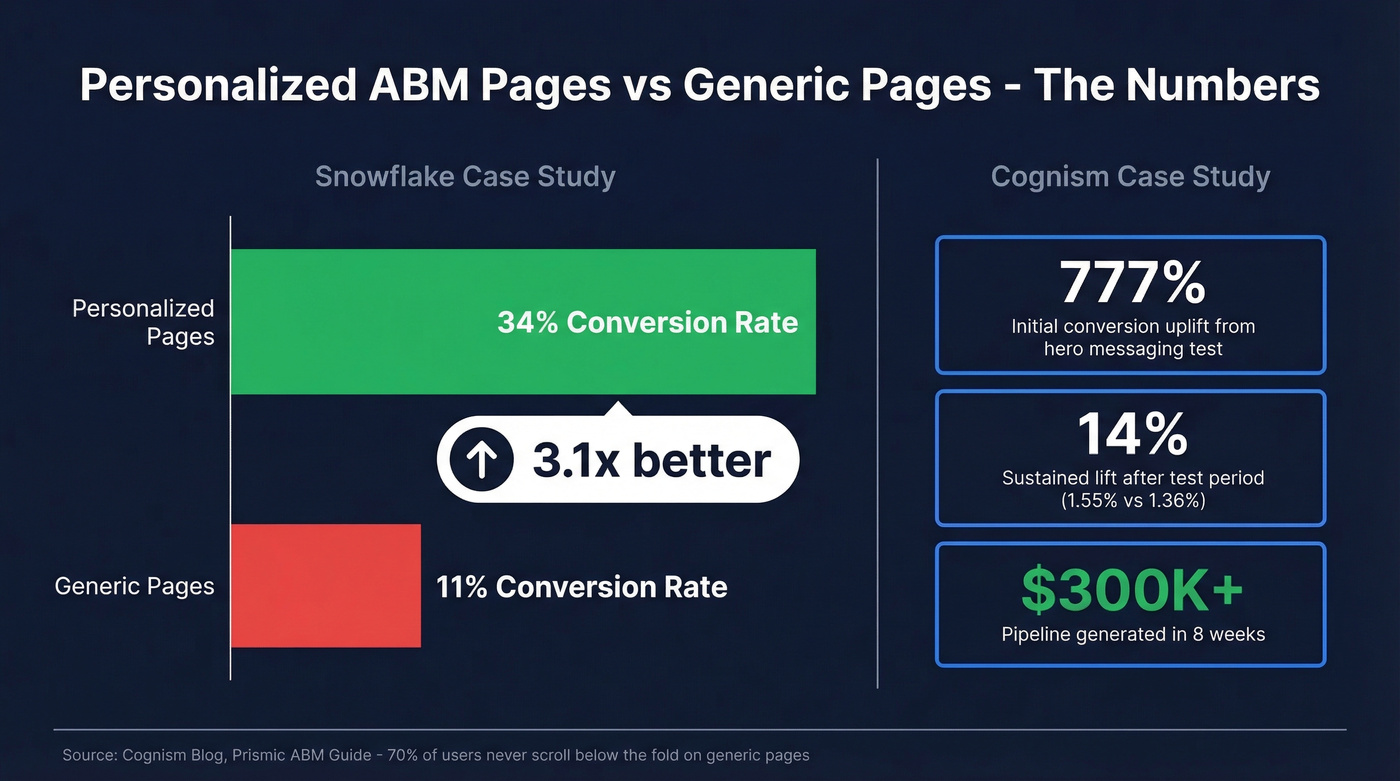
Cognism ran a homepage hero messaging test and saw a 777% initial conversion uplift, settling into a sustained 14% lift by the end of the test period (1.55% vs 1.36%). Session length increased 12-58% depending on the segment. That same ABM program generated $300K+ in pipeline within eight weeks.
Why does this work? Microsoft Clarity data shows 70% of users never reach the bottom of a page. If your value proposition is buried below the fold behind generic copy, most visitors leave before they see it. Account-targeted pages front-load relevance - the visitor immediately sees their problem, their industry, their use case. That recognition creates the conversion lift, not fancy design.
The Data Foundation Most Guides Skip
Most personalized pages fail because of bad data, not bad design. We've seen teams spend weeks building beautiful experiences only to discover their CRM had the wrong job titles for half their target accounts. A page that says "Hi Sarah, VP of Engineering" when Sarah became CTO six months ago doesn't feel personalized - it feels lazy.
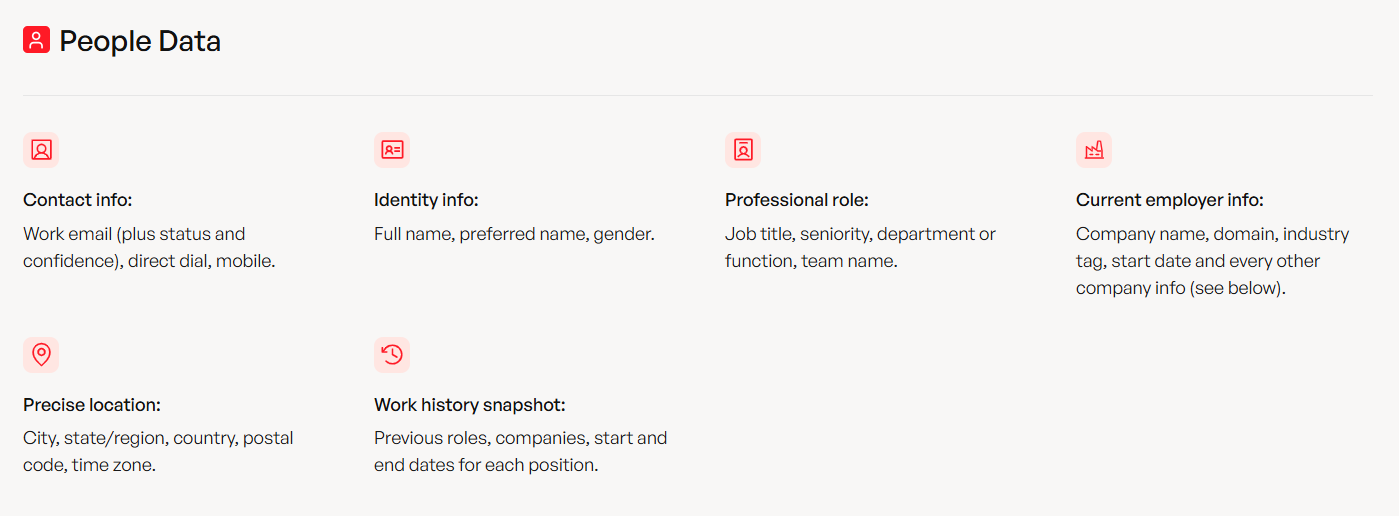
Before you build anything, you need verified contact data (names, titles, emails that actually work), firmographics (company size, revenue, industry), technographics (what tools they're running - critical for "we integrate with your stack" messaging), and intent signals that tell you whether they're actually in-market or you're just guessing. (If you’re building your scoring model, use a simple lead scoring framework.)
Third-party data degrades fast. The industry-average refresh cycle is six weeks, which means by the time you build your page, the data powering it is already going stale. Prospeo's 7-day refresh cycle and 98% email accuracy across 300M+ professional profiles solve this upstream - you're enriching with 50+ data points per contact before you ever open a page builder. The intent data layer tracks 15,000 topics via Bombora, so you're personalizing for accounts that are actually showing buying signals.
Fix the data first. Everything downstream gets easier.
How to Structure Effective Pages
Think of your page as modular blocks, not a monolithic design. The order and content of each block changes per account or segment, but the framework stays consistent. In our experience, 80% of your conversion lift comes from three elements: headline, value proposition, and social proof.
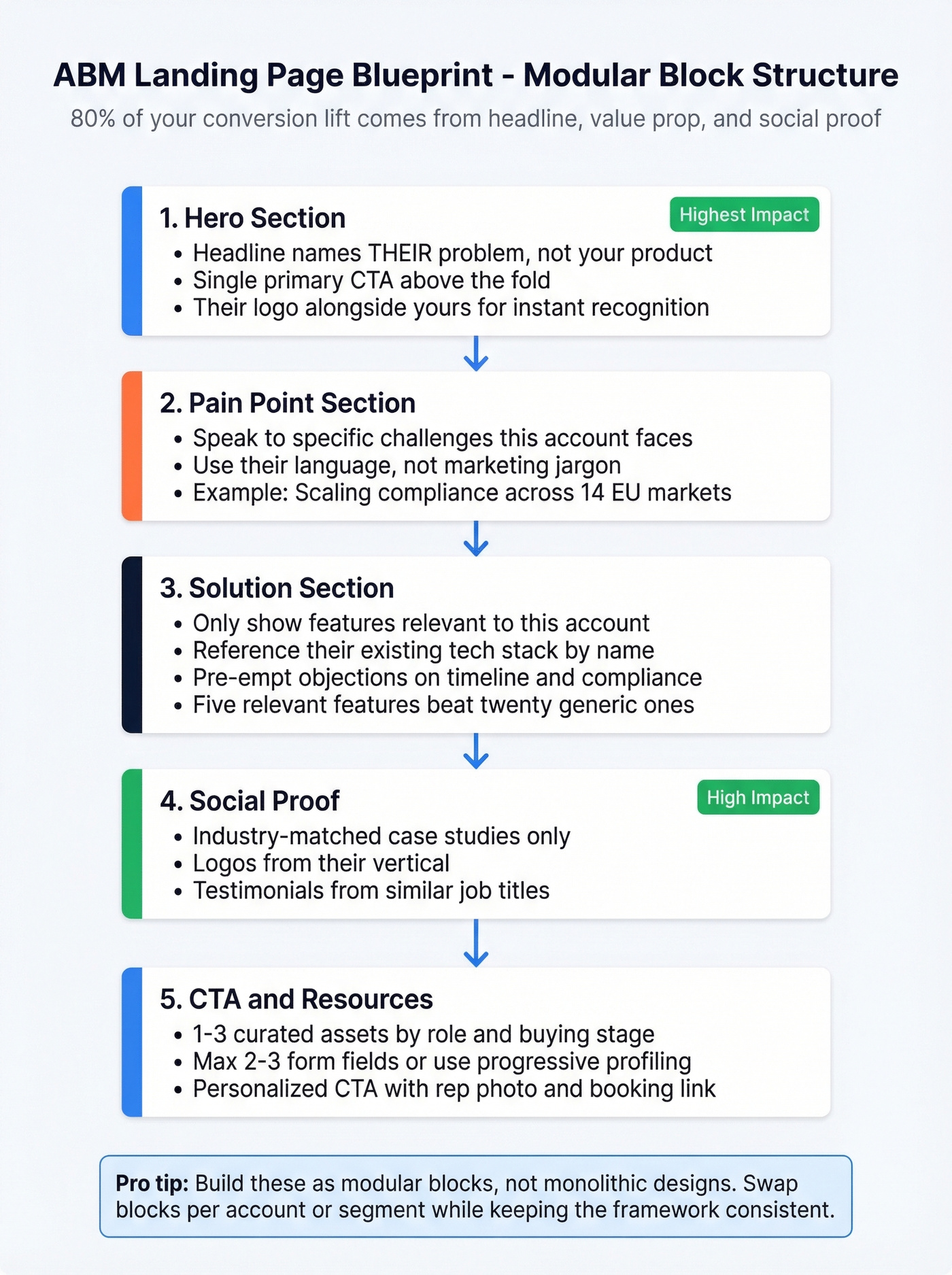
Hero section. Your headline should name the visitor's problem, not your product. Include a clear value prop, a single primary CTA, and a personalized visual - their logo alongside yours, or an industry-relevant image.
Pain point section. Speak to the specific challenges this account or segment faces. "Scaling compliance across 14 EU markets" hits harder than "enterprise compliance solutions."
Solution section. Only show features relevant to this account. Tailor the "How it Works" walkthrough to reference their existing tech stack - if they run Salesforce, show the Salesforce integration, not a generic API diagram. Pre-empt likely objections around implementation timeline and compliance. A page that shows five relevant features converts better than one showing twenty.
Social proof. Industry-matched case studies, recognizable logos from their vertical, testimonials from similar roles. A fintech prospect doesn't care about your manufacturing case study.
Resources and CTA. Curate 1-3 assets by role and buying stage. Keep forms short - two to three fields max, or use progressive profiling to reduce friction. For enterprise deals, a personalized CTA like "See how [Company] can cut onboarding time by 40%" with a rep photo and direct booking link outperforms generic "Request a demo" buttons every time.

ABM landing pages fail when your CRM has stale titles and dead emails. Prospeo enriches every contact with 50+ data points on a 7-day refresh cycle - so your personalized pages never greet a VP who became CTO two months ago. 98% email accuracy across 300M+ profiles.
Stop personalizing pages with bad data. Fix the foundation first.
How to Identify Visitors
Personalization only works if you know who's on the page. Three identification methods, each with a clear use case.
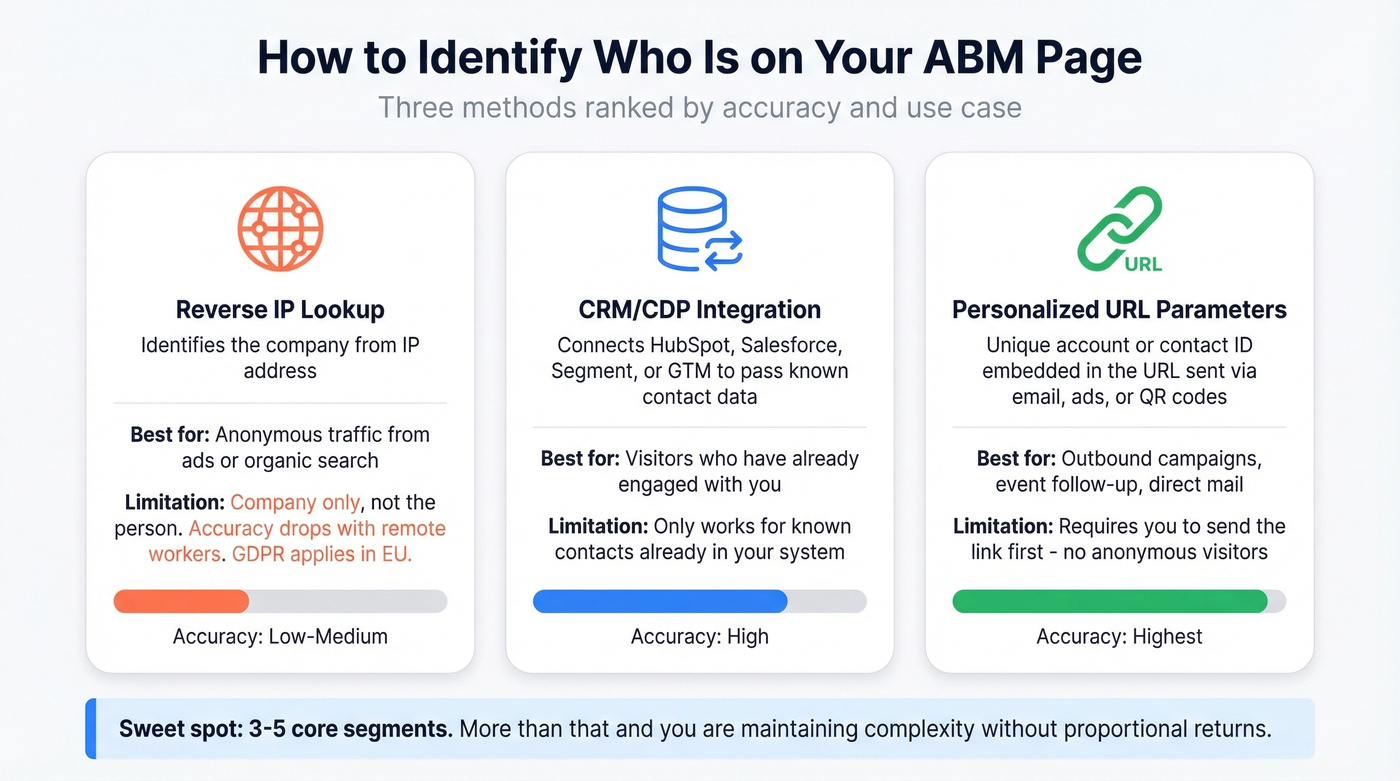
Reverse IP lookup identifies the visitor's company from their IP address. Best for anonymous traffic from ad campaigns or organic search. The limitation: it tells you the company, not the person, and accuracy drops with remote workers on home networks. GDPR implications apply in the EU.
CRM/CDP integrations connect HubSpot, Salesforce, Segment, or Google Tag Manager to pass known contact data to your page. This is the most reliable method for visitors who've already engaged with you. (If you’re standardizing your stack, start with examples of a CRM.)
Personalized URL parameters embed a unique account or contact ID in the URL you send via email, ads, or QR codes at events. Simplest approach, highest accuracy - you're explicitly telling the page who's visiting.
Keep your segments manageable. Three to five core segments is the sweet spot. More than that and you're maintaining complexity without proportional returns. (For a tighter definition, use an Ideal Customer Profile template.)
Scaling From 5 Pages to 500
Building five 1:1 pages manually is fine. Building fifty is painful. Building five hundred without automation? Impossible.
This is where the work shifts from a design exercise to a data operations challenge. The fastest scaling approach right now is the Clay + Webflow stack. One marketer on Reddit documented building 171 personalized landing pages in under 30 minutes using Clay's Webflow integration - pulling pain signals from social media posts, then generating personalized pages and AI-written emails from that data. VITRONIC, a manufacturing company, launched a 60-page personalized campaign in roughly 90 minutes using a similar template-based approach. (If you want the workflow math, see Clay list building.)
The pattern is the same regardless of tooling: build a blueprint template with dynamic fields, populate a database with account-specific content, then generate pages programmatically. The manual work shifts from page building to data preparation - which is exactly why clean enrichment data matters so much upstream.
ABM Landing Page Tools and Pricing
| Tool | Category | Best For | Pricing | Dev Required? |
|---|---|---|---|---|
| Prospeo | Data enrichment layer | Clean data for any builder | Free tier; ~$0.01/email | No |
| Clay + Webflow | DIY automation stack | Scaling fast, budget teams | ~$149/mo + $14/mo | Optional |
| Mutiny | Personalization overlay | Modifying existing site | ~$37,800/yr median | No |
| Prismic | Dedicated ABM builder | Dev teams, headless CMS | $1K-$2.5K/mo | Yes |
| Userled | AI microsite generator | Quick 1:1 microsites | Free trial; ~$500-2K/mo | No |
| Folloze | Enterprise journey platform | Multi-asset ABM journeys | ~$30K+/yr | No |
| Demandbase | Enterprise ABM suite | Full-stack ABM programs | Custom; typically $30K+/yr | No |
| Unbounce | General landing page builder | CRO, paid campaigns | $99-$649/mo | No |
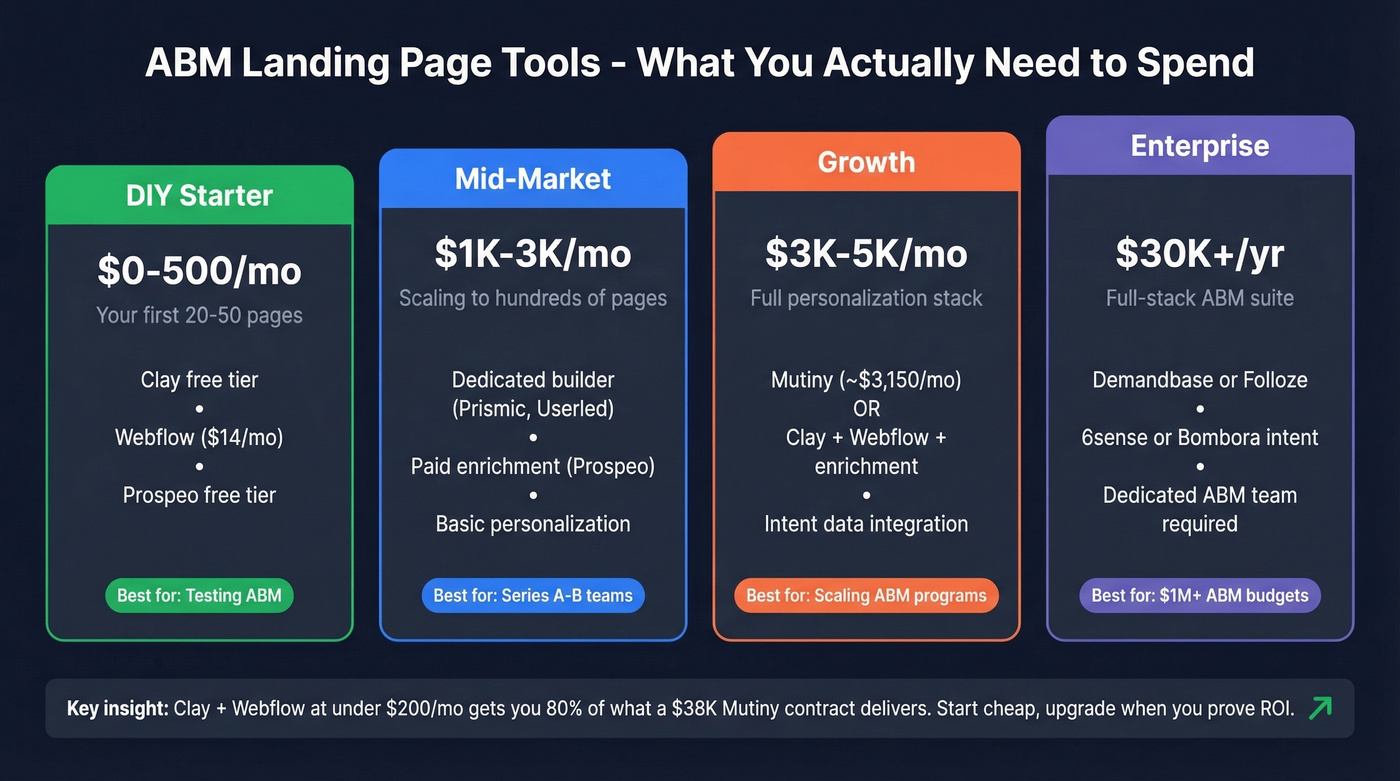
Mutiny is the go-to for personalizing your existing website without rebuilding anything. It overlays dynamic content based on visitor attributes. The median buyer pays $37,800/year across 53 purchases tracked by Vendr, with a range of $25K-$60K. Powerful, but expensive for what's essentially a personalization layer, not a page builder.
Clay + Webflow is the scrappy alternative eating into enterprise tools' market share. Clay handles data orchestration and enrichment; Webflow handles page generation. Total cost stays under $200/month, making it accessible for Series A teams that can't justify a $38K Mutiny contract.
The remaining tools fill specific niches. Prismic is purpose-built for ABM but requires developer resources. Userled generates AI-powered microsites quickly. Folloze and Demandbase are enterprise plays for organizations with dedicated ABM teams. Skip Unbounce if you need native ABM features - it's a solid general-purpose builder, but you'll be duct-taping personalization onto it. (If you’re comparing ABM ad + landing stacks, see Metadata.io alternatives.)
Let's break down the budget tiers:
DIY/Starter ($0-500/mo): Clay free tier + Webflow + free enrichment. Good enough for your first 20-50 pages. (If you’re bootstrapping the stack, start with free lead generation tools.)
Mid-Market ($1K-3K/mo): Dedicated builder + paid enrichment. Handles 1:few at scale.
Enterprise ($30K-325K/yr): Full ABM suite like Demandbase or 6sense. Justified when you've got 10+ people running ABM programs.
Don't forget hidden costs: implementation runs $1K-$5K for most platforms, and premium support adds $500+/month.
Intent data turns ABM pages from educated guesses into precision plays. Prospeo tracks 15,000 Bombora topics layered with firmographics, technographics, and verified contact data - so you personalize pages for accounts actually showing buying signals, not just accounts on a wish list.
Build ABM pages for accounts that are actually in-market right now.
How to Measure Performance
If you can't measure at the account level, you're not doing ABM - you're doing marketing with extra steps.
Account Penetration Rate = (Engaged accounts / Total target accounts) x 100. A 20-30% penetration rate is strong for enterprise programs.
Pipeline Velocity = (Opportunities x Avg deal size x Win rate) / Sales cycle length. This tells you whether your personalized pages are accelerating deals, not just generating vanity engagement. (To pressure-test your funnel, track funnel metrics alongside pipeline.)
Engagement Score = weighted sum of activities across contacts within an account - page visits, asset downloads, time on page, CTA clicks - weighted by intent signal strength. (If you need a system for this, use identifying buying signals.)
ABM sales cycles run 6-18 months. You won't see pipeline impact from your landing pages in week two. Set expectations with leadership early. Use GA4 for conversion tracking, Microsoft Clarity or Hotjar for heatmaps, and Dreamdata or HockeyStack for account-level attribution.
Common Mistakes
Personalization without strategy. A beautiful 1:1 page means nothing without sales alignment, a focused account list, and multi-touch orchestration behind it. This is the most common ABM failure mode we see. (If you’re aligning sales + marketing plays, borrow from account-based selling best practices.)
Token-level personalization is dead. Swapping in a company name isn't ABM. If the headline, value prop, and proof points don't change, you've built a mail merge, not a personalized experience.
Legacy CMS bottlenecks. If launching a new page requires a dev sprint and a two-week QA cycle, you'll never scale. MACH architecture (microservices, API-first, cloud-native, headless) removes this friction.
Siloed data, no single source of truth. Marketing has one account list, sales has another, and neither matches the CRM. Integrate your stack, define data standards, and assign clear ownership.
Not testing. Priority order for A/B tests: hero copy, then CTA, then module order, then page length. Most teams never test because they're too busy building new pages instead of optimizing existing ones. That's backwards.
FAQ
How do 1:1, 1:few, and 1:many tiers differ?
1:1 pages are fully custom for your top 5-20 whale accounts ($100K+ deal size). 1:few use segment templates for 50-200 accounts grouped by industry or persona. 1:many are lightly personalized templates scaled to 500+ accounts using dynamic fields like company name and pain point.
What conversion rate should I expect?
Personalized account-based pages typically convert at 15-35%, roughly 2-3x better than generic pages. Snowflake reported 34% vs. 11%. Results depend on tier, audience match, and data accuracy.
Do I need a dedicated ABM platform?
No. Clay + Webflow paired with clean enrichment data handles most use cases under $500/month - no $30K+ annual commitment required. Dedicated platforms like Mutiny or Demandbase make sense once you have 10+ people running coordinated programs.
How do I get clean data for personalization?
Start with a B2B enrichment tool that refreshes records frequently. A 7-day refresh cycle and 98%+ email accuracy prevent the stale-title problem that kills personalization credibility. Enrich your target account list before building any pages, then re-verify quarterly at minimum.
How long before I see pipeline impact?
Enterprise ABM sales cycles run 6-18 months, so expect meaningful pipeline data 8-12 weeks after launch at the earliest. Track leading indicators - account penetration rate, engagement score, session duration - weekly to confirm your pages are working while pipeline matures.