

ABM Lead Generation: From Strategy to Pipeline in 2026
You build your first ABM list, send 500 emails, and 180 bounce. Your domain reputation tanks before the first play even runs. Every ABM guide tells you to "personalize at scale" and "align sales and marketing." None of them tell you what to do Monday morning.
Here's the thing: ABM lead generation works - 81% higher ROI according to Demandbase's benchmark of 300+ marketers - but only if you stop treating it like lead gen with a fancier label. We've spent the last two years watching teams succeed and fail at this, and the difference almost always comes down to execution, not tooling. Below is the playbook that actually generates pipeline, including the framework, the plays, and the exact tools with real pricing.
What You Need (Quick Version)
Account-based marketing lead generation boils down to four things:
- A tiered target account list. Not your entire TAM. A curated list of 1,000-5,000 accounts segmented by effort level.
- 3-5 signal-based plays. Triggers that tell you when to reach out and what to say. Not batch-and-blast.
- Verified contact data for the buying committee. Bad emails kill ABM before it starts.
- Shared sales/marketing KPIs. Account engagement, pipeline velocity, deal size - not MQL count.
You don't need a $100K platform. You need the discipline to start small and prove pipeline impact first.
ABM vs Lead Gen vs Demand Gen
These three terms get used interchangeably, and it causes real confusion.
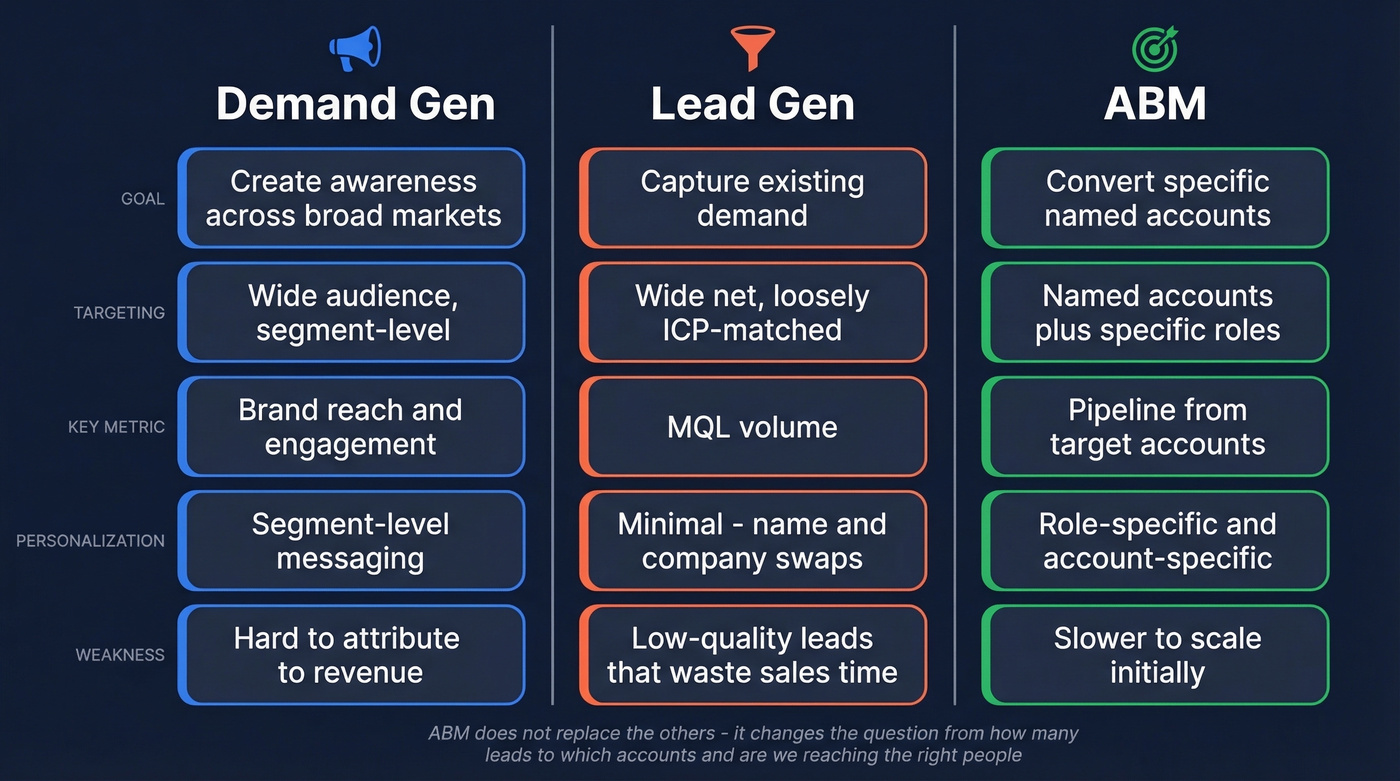
| Demand Gen | Lead Gen | ABM | |
|---|---|---|---|
| Goal | Create awareness | Capture demand | Convert named accounts |
| Targeting | Broad audience | Wide net, ICP-ish | Specific accounts + roles |
| Primary metric | Brand reach, engagement | MQL volume | Pipeline from target accounts |
| Sales cycle | Long, indirect | Medium | Shorter per account |
| Personalization | Segment-level | Minimal | Role- and account-specific |
| Typical weakness | Hard to attribute | Low-quality leads | Slow to scale |
The useful framing from ABM Agency is "create demand vs capture demand" - you can't do one without the other. ABM doesn't replace lead gen or demand gen. It changes the question from "how many leads?" to "which accounts, and are we reaching the right people inside them?"
Why Account-Based Marketing Works
A survey of 771 marketers found 71.2% of organizations now run ABM strategies, with an estimated average ROI of 137%. Nearly half plan to increase ABM budgets this year. N.Rich recommends ABM should influence roughly 50% of total revenue - new and expansion combined - with 30-50% of marketing resources allocated when revenue targets are ambitious.
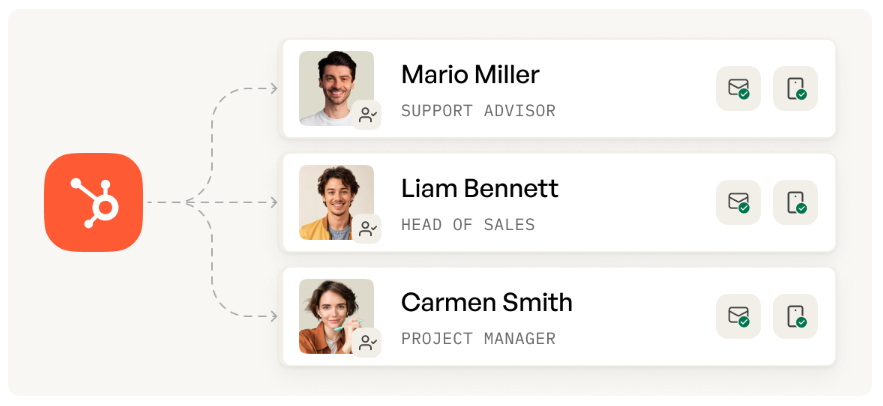
B2B deals involve roughly 7 decision-makers. Traditional lead gen captures one name and hopes that person has buying authority. Account-based lead generation maps the entire committee and orchestrates touches across all of them. That's why 78.7% of ABM practitioners now incorporate AI into their workflows - the multi-threading complexity demands it.
Let's be honest about the question every team asks during an ABM rollout: "Has anyone actually generated pipeline from this, or is it just vendor hype?" The answer depends entirely on execution quality. ABM measured by MQL volume is just lead gen with extra steps. The teams seeing 137% ROI are measuring account engagement, pipeline velocity, and deal size.
The ABM Lead Generation Framework
Define Your ICP and Build the List
Start by separating your Total Addressable Market from your Target Account List. Your TAM might be 50,000 companies. Your TAL should be 1,000-5,000 - the accounts where you have a realistic shot at winning based on firmographics, technographics, and historical win patterns.
The mistake most teams make is skipping this step and calling their entire CRM an "ABM list." That's not ABM. That's email marketing with a rebrand. Build the TAL from your best closed-won deals backward: what did those companies look like before they bought?
Tier Accounts and Map the Committee
Not every account deserves the same effort.
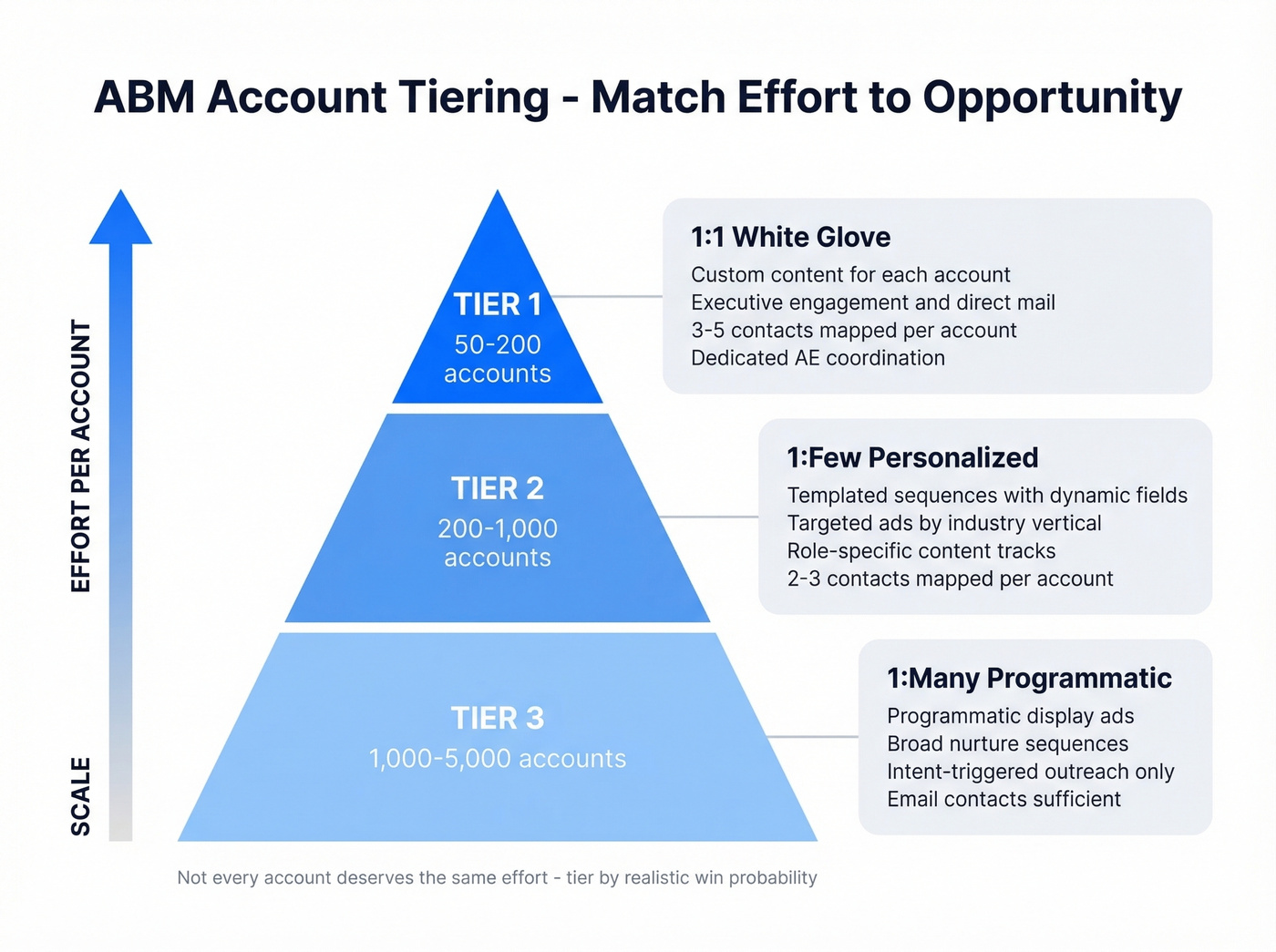
Tier 1 (50-200 accounts): White-glove. Custom content, 1:1 outreach, executive engagement. These are your dream logos.
Tier 2 (200-1,000 accounts): Automated but personalized. Templated sequences with dynamic fields, targeted ads, role-specific content.
Tier 3 (1,000-5,000 accounts): Mostly automated. Programmatic ads, broad nurture sequences, intent-triggered outreach only.
Within each account, map the buying committee by persona: decision-makers, champions, and end users. With ~7 people involved in the average B2B deal, you can't just email the VP and hope for the best. We've found the sweet spot is identifying 3-5 contacts per Tier 1 account and 2-3 per Tier 2 - enough to multi-thread without drowning in data.
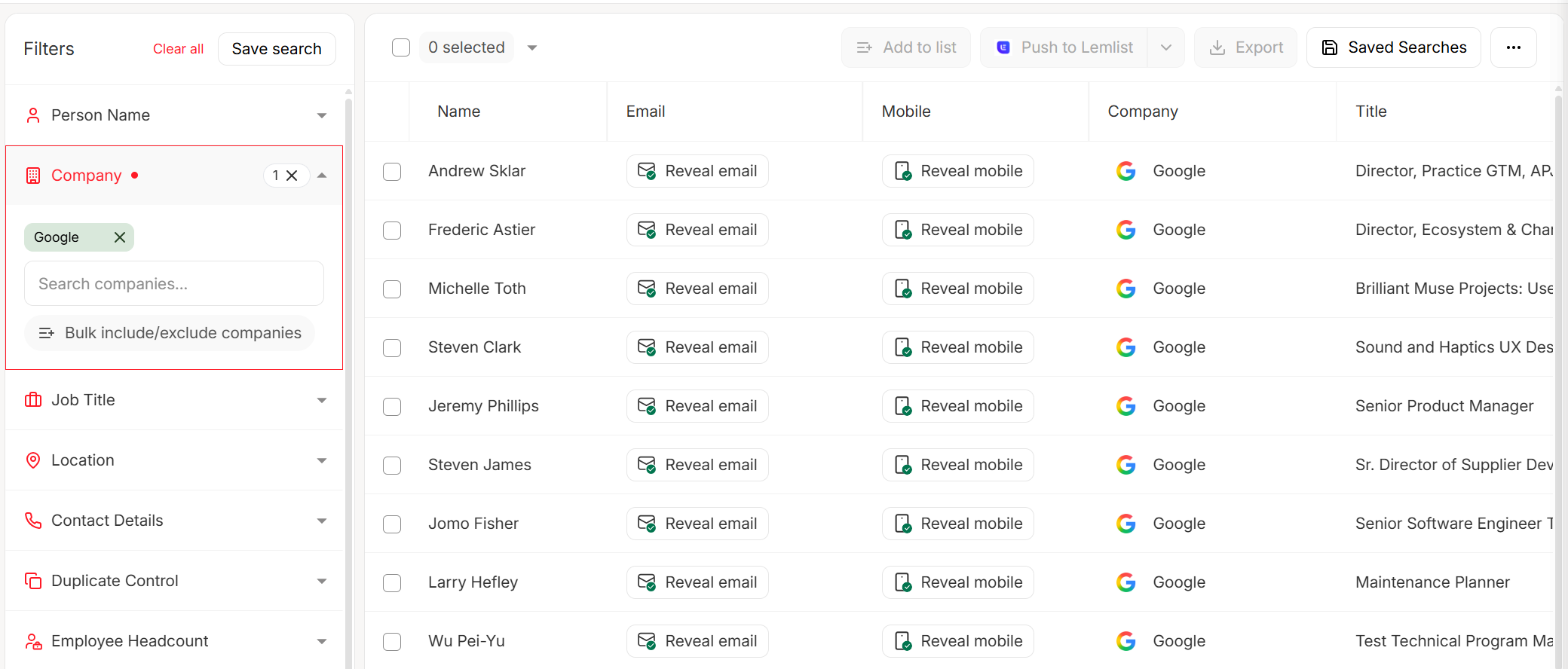
This is where data quality becomes the bottleneck. Paste a company URL into Prospeo and you get verified emails and direct dials for the buying committee - 98% email accuracy, refreshed every 7 days. For Tier 1 accounts, enrich phone numbers for decision-makers. For Tier 3, emails are enough. Match enrichment depth to account tier and you'll control data costs without sacrificing coverage.
Layer Intent Signals
Intent data tells you when an account is actively researching your category.
First-party intent covers behavior on your own properties - pricing page visits, demo video views, email clicks. Second-party intent comes from partner or review site data, like comparison page visits. Third-party intent is aggregated web behavior from providers like Bombora, tracking what topics accounts research across the open web.
Don't mirror every raw intent topic into your CRM - a lesson practitioners learn the hard way in the HubSpot community. Define 3-5 intent clusters and score at the cluster level. Otherwise you'll drown in field sprawl and noisy scoring models.
If your average deal size is under $15K, you probably don't need a $50K intent data platform. Start with first-party signals and a good enrichment tool. Layer third-party intent after you've proven the model works.
One more thing: ignoring compliance isn't just a legal risk - it's a data quality issue. GDPR and CCPA violations erode trust with the exact accounts you're trying to win. Use providers that enforce opt-out globally and offer DPAs.
Track Progression with AIDA, Not MQLs
Ditch the MQL/SQL handoff. Replace it with AIDA stages at the account level: Unaware, Attention, Interest, Desire, Action. Each stage maps to observable behaviors - not arbitrary lead scores. (If you want the deeper breakdown, use the AIDA stages as your measurement backbone.)
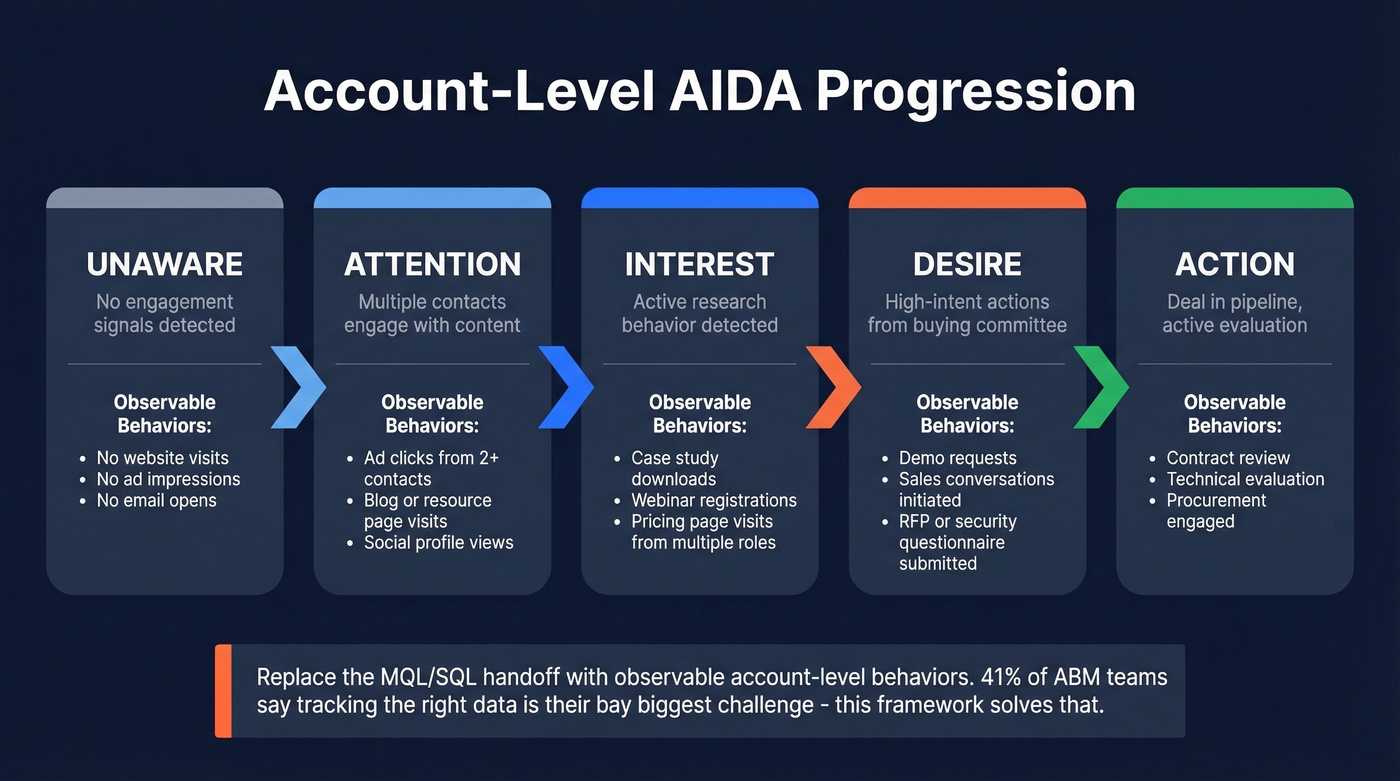
An account moves from "Unaware" to "Attention" when multiple contacts engage with your content. From "Interest" to "Desire" when they request a demo or attend a webinar. 41% of ABM practitioners cite inability to track the right data as their biggest challenge, which is exactly why the framework matters more than the platform.

180 bounced emails out of 500 kills your domain and your ABM program. Prospeo delivers 98% email accuracy with a 7-day refresh cycle, so your buying committee data is current when your plays run - not stale from last quarter.
Stop killing ABM campaigns with bad data. Start with verified contacts.
Three Plays That Generate Pipeline
These aren't theoretical. They're the plays that generate 8-25% reply rates versus the 1% you get from generic outbound.
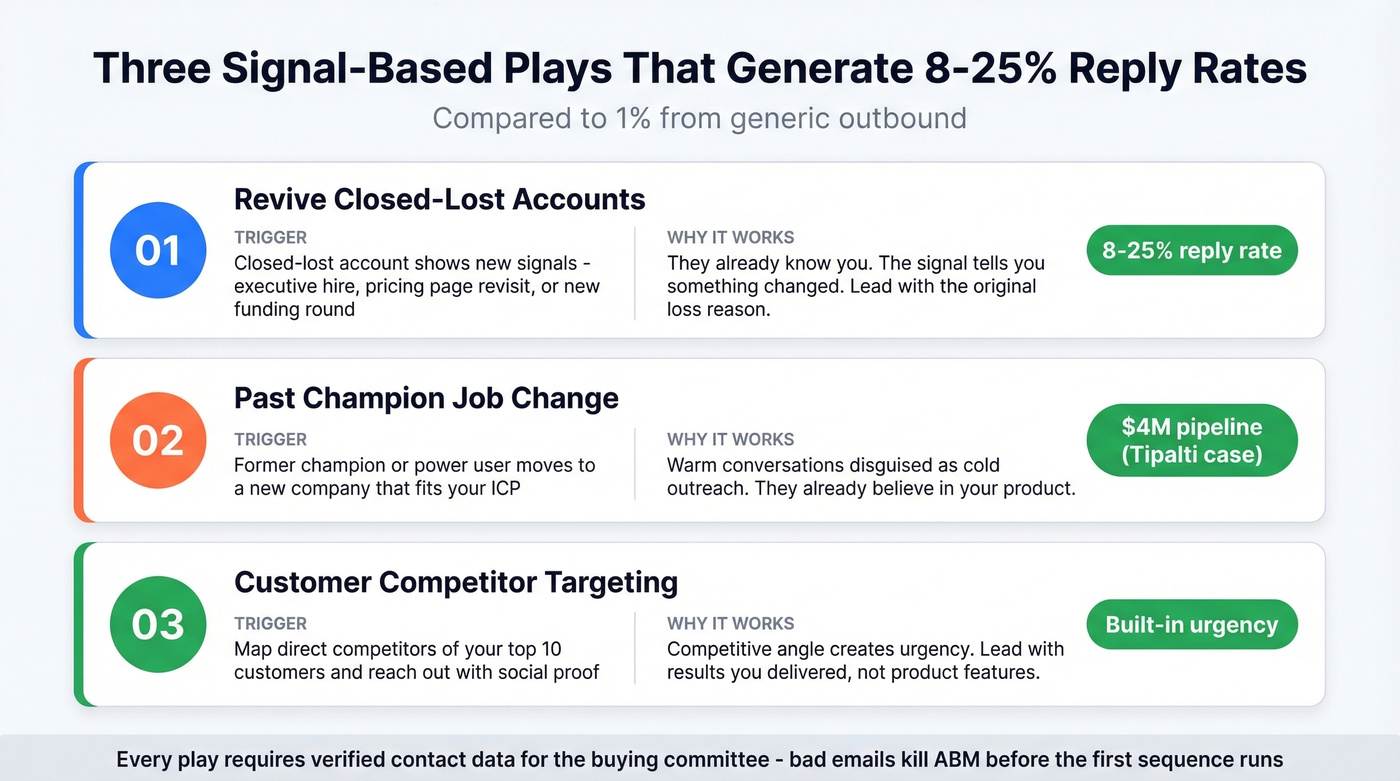
Revive Closed-Lost Accounts
Trigger: A closed-lost account shows new signals - executive hire, pricing page revisit, new funding round.
Action: Draft a contextual email tied to the original loss reason. If they churned on price, reference the new funding. If they chose a competitor, reference the competitor's recent struggles. The specificity is what makes this work - generic "just checking in" emails get ignored.
Expected outcome: 8-25% reply rates. These accounts already know you. The signal tells you something changed.
Past Champion Job Change
Trigger: A former champion or power user moves to a new company that fits your ICP.
Action: Run a "welcome wagon" sequence within the first 30 days. Alert, personalized email referencing their past success with your product, then human follow-up from an AE. Tipalti generated $4M in pipeline using this exact play.
Expected outcome: Warm conversations disguised as cold outreach. The champion already believes in your product. You're making it easy for them to bring you along.
Customer's Competitor
Your top 10 customers each have direct competitors. Map them.
Lead with credibility and social proof - "We help [their competitor] do X. Here's how." The competitive angle creates urgency that generic outreach can't match. The key is leading with results you've delivered, not with your product features. This play is where account-based outreach shines because you're reaching specific people at specific companies with a message only they would care about. Skip this play if your customer base is too small to provide meaningful social proof, or if your customers have strict confidentiality agreements that prevent you from naming them.
Real ABM Results
DocuSign tailored content by industry vertical instead of sending generic nurture campaigns. The results: 60% increase in engagement, 300% rise in page views, and 22% growth in sales pipeline. The lesson isn't "personalize your content" - it's "personalize by industry, not by first name."
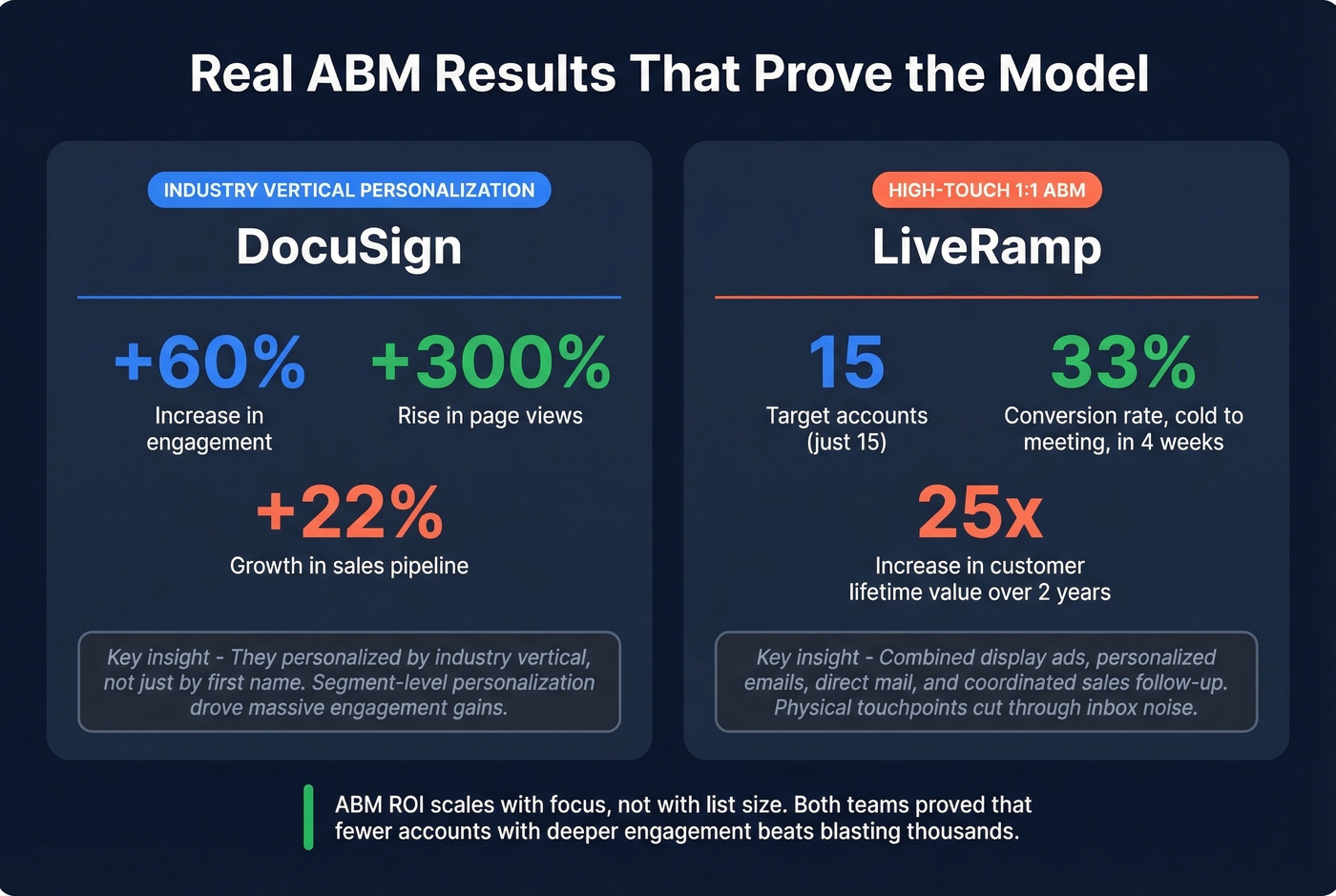
LiveRamp ran high-touch 1:1 ABM targeting just 15 accounts with custom display ads, personalized emails, direct mail, and coordinated sales follow-up. Within four weeks: 33% conversion rate from cold leads to meetings. Over two years, customer lifetime value increased 25x.
Both cases prove the same principle: ABM ROI scales with focus, not with list size. And don't ignore offline channels - LiveRamp's 33% conversion rate included direct mail. Physical touchpoints cut through inbox noise in ways that another Marketo drip never will.
ABM Mistakes That Kill Pipeline
No clear ICP. If you can't describe your ideal customer in two sentences, you're not ready for ABM. You're ready for research. (Use an ideal customer scoring rubric before you build lists.)
Measuring MQLs instead of engagement. The moment you report ABM success by lead volume, you've turned it back into lead gen. Track account-level engagement, pipeline created, and deal velocity.
Generic "personalized" content. Swapping a first name and company name into a template isn't personalization. Role-specific, industry-specific, challenge-specific content is. Everything else is a mail merge.
Sales/marketing misalignment. When sales and marketing run separate playbooks against the same accounts, you get duplicate outreach, conflicting messaging, and confused buyers. Joint account planning and shared KPIs aren't optional - they're the foundation of any successful account-based strategy. In our experience, the teams that hold weekly 30-minute account review meetings between sales and marketing outperform those that rely on async Slack updates by a wide margin.
Stale contact data. We've seen teams build beautiful ABM programs and then watch 20%+ of their emails bounce on the first sequence. If your bounce rate is above 5%, your data provider is the problem. Prospeo refreshes 300M+ profiles every 7 days - the industry average is 6 weeks. That gap is the difference between pipeline and spam folders. (If you’re diagnosing deliverability, start with bounce rate benchmarks and fixes.)

The ABM Tech Stack
A functional ABM stack for a 5-person team runs $1,500-$5,000/month. Enterprise with full orchestration: $50,000-$200,000+/year.
| Category | Tool | Pricing | Best For |
|---|---|---|---|
| ABM Platform | Demandbase | $30K-$150K+/yr | Enterprise orchestration |
| ABM Platform | 6sense | Free tier + enterprise custom | Mid-market ABM testing |
| ABM Platform | Terminus | $30K-$80K+/yr | ABM advertising |
| Enrichment | Prospeo | Free tier, then ~$0.01/email | Emails, dials, intent data |
| Enrichment | Apollo.io | Free + from $49/mo | Budget-friendly enrichment |
| Enrichment | ZoomInfo | $15K-$40K+/yr | Enterprise data needs |
| Marketing Automation | HubSpot Marketing Hub | From $800/mo | CRM-native ABM |
| Marketing Automation | Marketo | Typically $1,000+/mo | Enterprise automation |
| Intent Data | Bombora | $20K-$60K+/yr | Standalone intent |
| Sales Engagement | Outreach / Salesloft | $100-$200/user/mo | Sequence orchestration |
You don't need all of this on day one. Start with enrichment and engagement - that's where the crawl-walk-run approach pays off. Pick a data provider, connect it to your CRM and sequencing tool, and run your first play. The platform investment comes after you've validated the model, not before. (If you’re evaluating options, compare outbound lead generation tools by workflow fit, not feature checklists.)
Multi-threading 3-5 contacts per Tier 1 account means you need verified emails and direct dials - fast. Prospeo maps the buying committee with 30+ filters, 125M+ verified mobiles, and intent data across 15,000 topics. At $0.01 per email, you scale ABM without the $100K platform.
Reach every decision-maker in your target accounts for a fraction of ZoomInfo's cost.
FAQ
How is ABM lead generation different from traditional lead gen?
ABM targets named accounts and maps the full buying committee, then orchestrates personalized touches across multiple stakeholders simultaneously. Traditional lead gen casts a wide net optimized for volume. The shift is from "how many leads?" to "are we penetrating the right accounts with the right message?"
How many accounts should I target?
Start with 50-200 accounts for Tier 1 white-glove treatment, with your full target account list across all tiers reaching 1,000-5,000. Going broader than that usually means you're doing segmented marketing, not ABM. Most teams see the best pipeline-per-account ratio at 100-500 active accounts.
What's a realistic ABM budget?
A functional stack runs $1,500-$5,000/month for a small team. Start with free tiers - 6sense offers 50 credits/month, and there are enrichment tools with generous free plans - then scale after proving pipeline impact. Platform investment comes after validation, not before.
How long before ABM generates pipeline?
Expect 3-6 months for measurable pipeline impact with a new program. LiveRamp saw 33% cold-to-meeting conversion within 4 weeks, but they ran high-touch 1:1 ABM against just 15 accounts with significant resources. Most teams need a full quarter to build the list, test plays, and see deals progress.
Do I need an ABM platform to start?
No. You need a clean target account list, verified contact data for the buying committee, 3-5 repeatable signal-based plays, and genuine sales/marketing alignment. We've seen teams generate more pipeline with a spreadsheet and good data than with a six-figure platform and bad execution.