

ABM Orchestration: What It Actually Takes (Not What Vendors Tell You)
Your CMO just came back from a conference and announced you're "doing ABM." Now you need to figure out what ABM orchestration actually means - and whether it requires a $30K platform or a shared spreadsheet. One practitioner on r/b2bmarketing put it bluntly: most ABM platforms feel "incredibly expensive" and "not useful" for teams with a niche TAM. They're not wrong.
What You Need (Quick Version)
Account-based marketing orchestration coordinates sales and marketing touches across channels for target accounts. Here's the shortcut by budget:
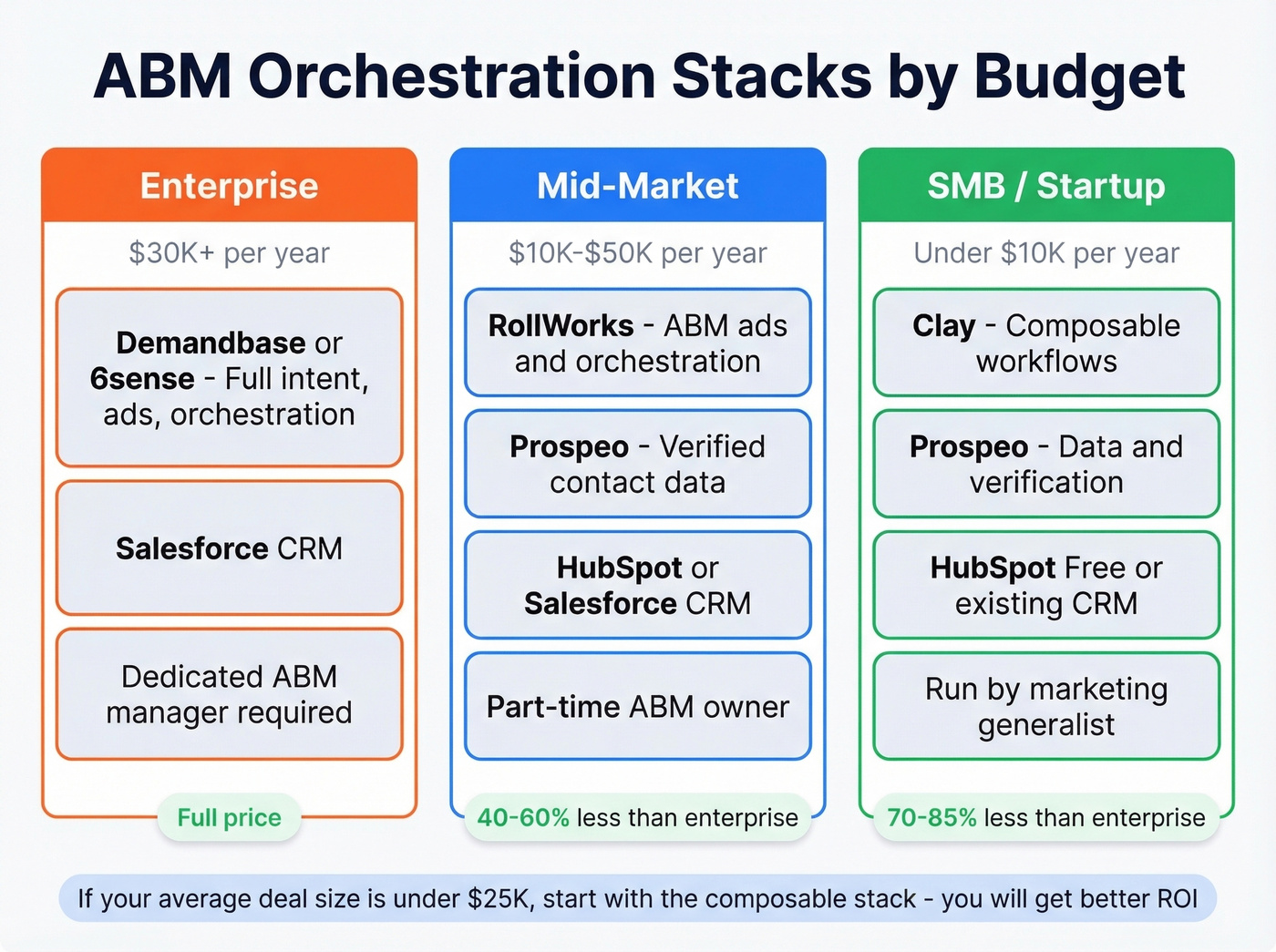
- Enterprise ($30K+/yr): Demandbase or 6sense. Full intent, ads, orchestration.
- Mid-market ($10K-$50K/yr stack total): RollWorks + a data layer like Prospeo + your CRM.
- SMB (under $10K/yr): Composable stack - Clay + your data provider + HubSpot or existing CRM.
The #1 thing that breaks orchestration isn't strategy. It's bad contact data. Fix that first.
What It Actually Means
ABM is the strategy. Orchestration is the operational engine. It's the difference between saying "we target enterprise accounts" and actually coordinating every email, ad impression, sales call, and direct mail piece so those accounts experience a coherent journey instead of disconnected campaigns. Some teams now call this ABX (Account-Based Experience) - same core idea, but with more emphasis on post-sale expansion and lifecycle-wide coordination.
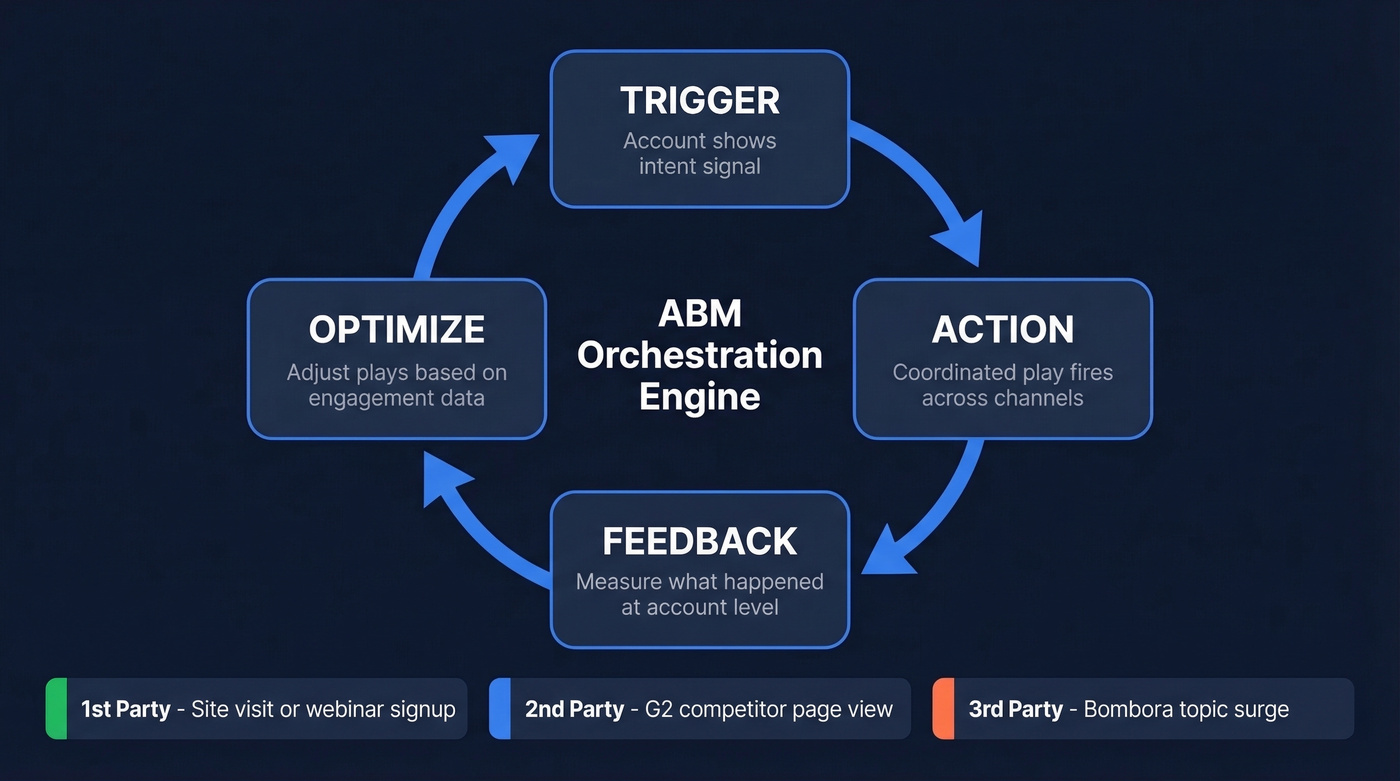
The core loop: Trigger -> Action -> Feedback -> Optimize. An account shows intent. You fire a coordinated play across channels. You measure what happened. You adjust.
A survey of 771 marketers found 71.2% of organizations now implement ABM strategies. The question isn't whether to do it - it's whether you need a six-figure platform to do it well.
Why It Matters More in 2026
That same survey pegged average ABM ROI at 137%, with 49.2% of respondents saying ABM delivers the highest ROI of any initiative they run. Nearly half plan to increase ABM budgets this year.
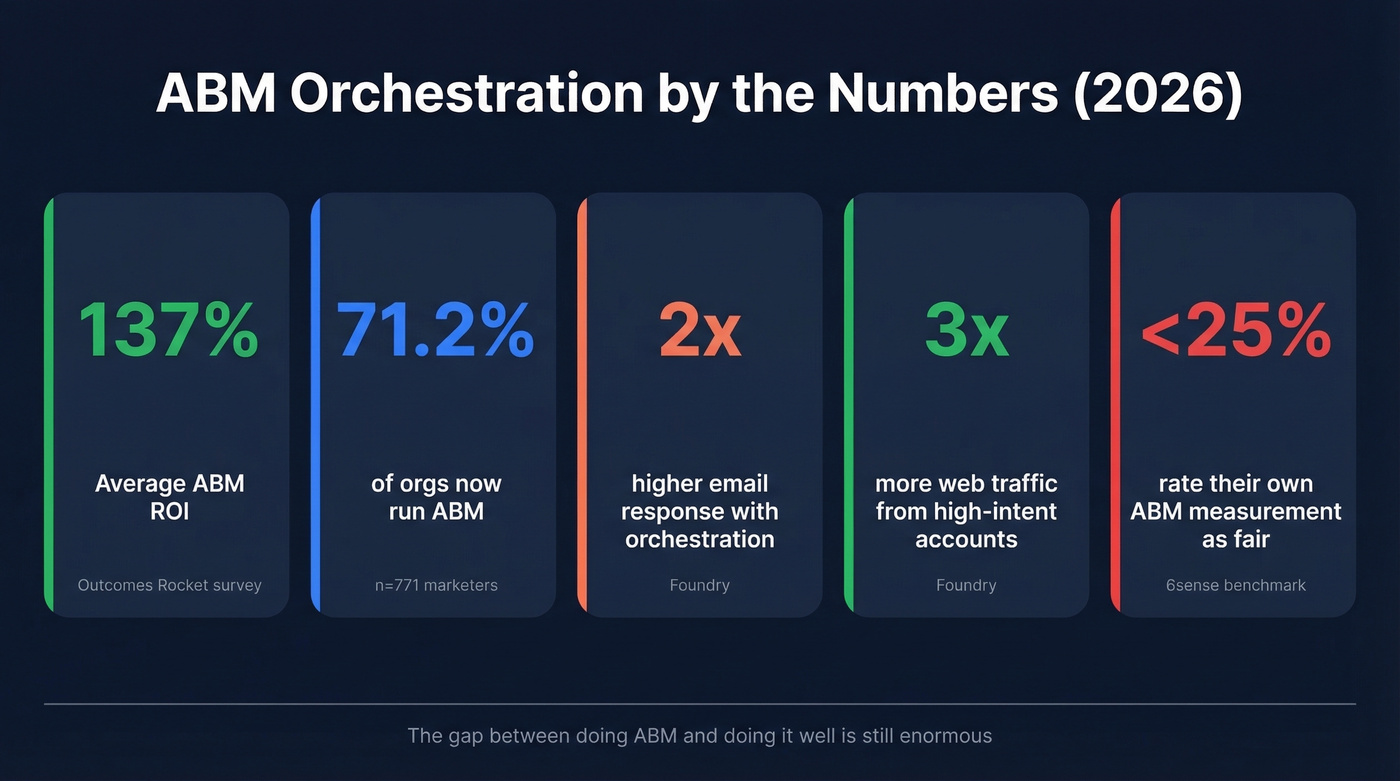
The performance gap between orchestrated and non-orchestrated campaigns is stark. Foundry reports that orchestrated campaigns deliver 2x higher email response rates, 3x more web traffic from high-intent accounts, and 20% more form fills compared to non-orchestrated efforts. That's not marginal. That's a different league.
Buyers now initiate 79% of engagements, which means your coordinated plays need to respond to signals, not blast sequences on a calendar. And 78.7% of ABM teams have already incorporated AI into their workflows. If you're still running this manually, you're competing against teams that aren't.
How to Build the Motion
Define Your ICP and Accounts
Start with firmographic and technographic criteria, then layer in intent signals to prioritize. AI agents have compressed this - building a 200-account target list that used to take 2-3 days now takes 2-4 hours including human review. Don't skip the human review. Algorithms are great at pattern matching but terrible at knowing your market's weird edge cases.
If you need a tighter starting point, use an Ideal Customer Profile scoring rubric before you add intent.
Find the Buying Committee
This is where most orchestration efforts quietly die.
You identify 200 target accounts but only have one contact per account - usually the wrong one. You need the full buying group: the economic buyer, the champion, the technical evaluator, the end user. Tools that tell you an account is "surging" are useless if you can't reach the actual humans behind the research.
Use a data platform like Prospeo to find verified emails and direct dials for each buying committee member. With 300M+ professional profiles, 98% email accuracy, and a 7-day data refresh cycle versus the 6-week industry average, you're working with contacts that actually connect. Snyk's sales team was bouncing 35-40% of emails before switching providers - that kind of data rot kills an entire account-based motion before it starts.
If you're struggling to source the right people fast, a name to email workflow is often the simplest way to fill gaps.
Map Intent to Triggers
Not all intent is equal. First-party intent - your own site visits, webinar attendance, form fills - is the strongest signal. Second-party intent comes from review sites like G2; someone researching your competitor's page is a trigger worth acting on. Third-party intent from providers like Bombora tracks broader web research across 15,000+ topics via a cooperative model spanning 4,000+ premium sites.
Only about 21% of marketers currently use intent data for ABM. That means doing this well is still a genuine competitive edge. The key is mapping each signal type to a specific action - a G2 competitor comparison visit triggers a different play than a pricing page visit on your own site.
To operationalize this, build a simple system for identifying buying signals and scoring them consistently.
Design Multichannel Playbooks
59% of B2B buyers expect personalized content while researching, and 71% expect it once they engage directly. Your playbooks need to coordinate ads, email sequences, sales outreach, and content - timed to intent signals, not arbitrary cadences.
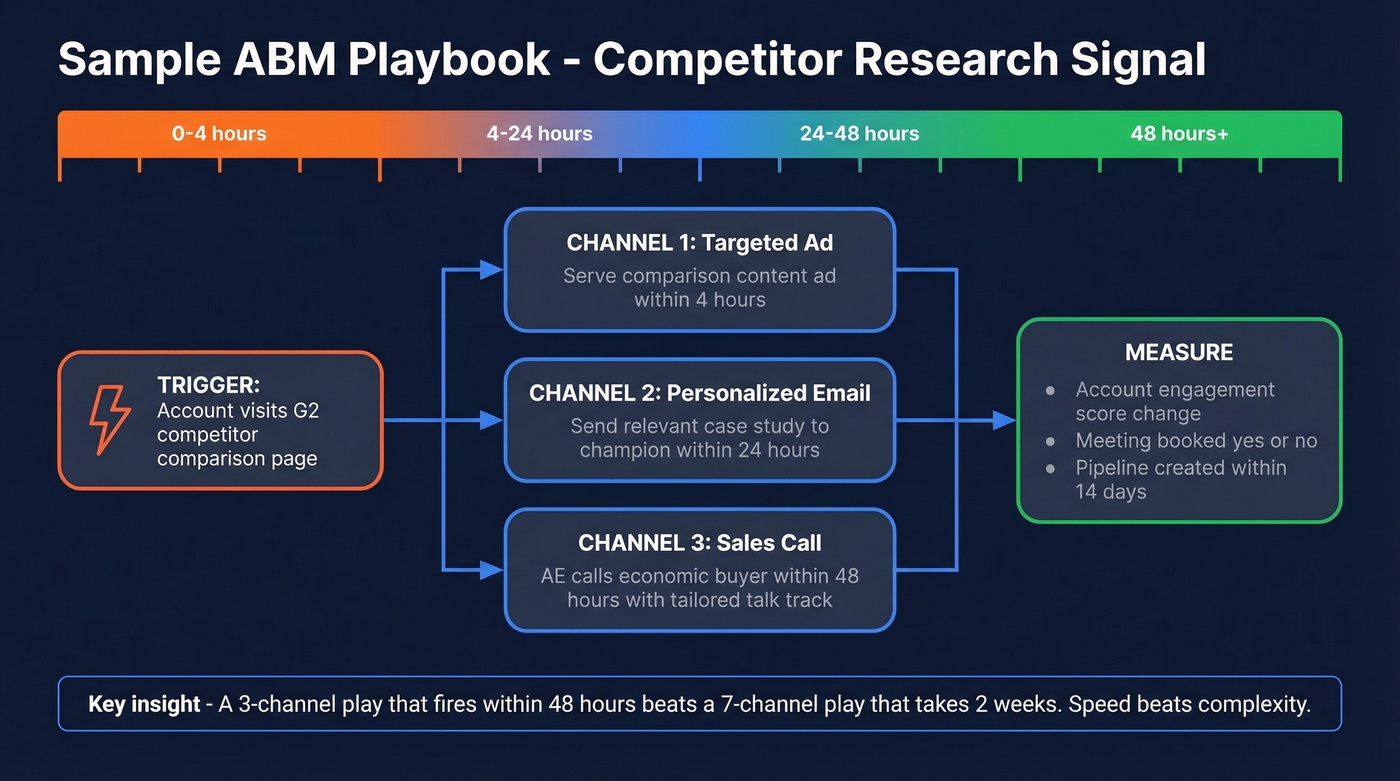
Here's the thing: a three-channel play (targeted ad + personalized email + sales call) that fires within 48 hours of an intent signal will outperform a seven-channel play that takes two weeks to execute. Speed beats complexity every time. The goal is a unified narrative across every touchpoint, not a patchwork of disconnected messages that confuse the buying committee.
If email is a core channel, keep a set of proven sales follow-up templates so reps don’t reinvent copy mid-play.
Measure and Iterate
Track account-level metrics: pipeline velocity, engagement depth across the buying group, and influenced revenue. Do not default to MQLs. According to 6sense's benchmark report, 82% of teams have adopted ABM, but fewer than 25% rate their own measurement practices as fair. The gap is always the same - teams reporting lead-level metrics for an account-level strategy.
If you need a clean baseline, start with a short list of funnel metrics that map to account progression.

Your orchestration engine is only as good as your contact data. Prospeo gives you 300M+ profiles with 98% email accuracy and 125M+ verified mobiles - refreshed every 7 days, not every 6 weeks. Snyk cut bounce rates from 35% to under 5% and added 200+ opportunities per month.
Stop orchestrating plays to email addresses that bounce.
What It Actually Costs
This is the section nobody else publishes.
| Tool | Category | Starting Price |
|---|---|---|
| Demandbase One | All-in-one ABM | ~$18K-$65K/yr (varies by size) |
| 6sense | All-in-one ABM | ~$30K-$60K/yr |
| Terminus | ABM ads + orchestration | ~$2K/mo |
| RollWorks | Mid-market ABM | $850-$1,200/mo |
| HubSpot Marketing Hub | Marketing automation | Starts around $800/mo |
| Clay | Composable orchestration | $149-$349/mo |
| Apollo | Data + outreach | Free / $49/mo |
| Prospeo | Data + verification + intent | Free tier / ~$0.01/email |
| Warmly | Visitor identification | $499/mo |
| Leadfeeder (Dealfront) | Visitor identification | $99/mo |
Let's be honest: if your average deal size is under $25K, you almost certainly don't need Demandbase or 6sense. The composable stack approach can cut costs by 60-70% compared to an all-in-one platform. In our experience, teams under $10M ARR get better results from a composable stack than from an enterprise platform they'll only use 30% of. Demandbase and 6sense are powerful, but they're built for organizations with dedicated ABM managers and six-figure marketing budgets. If that's not you, skip them.
If you’re evaluating vendors, it helps to compare categories like data enrichment services before you commit to a platform.
Why ABM Orchestration Fails
Three failure patterns show up repeatedly:
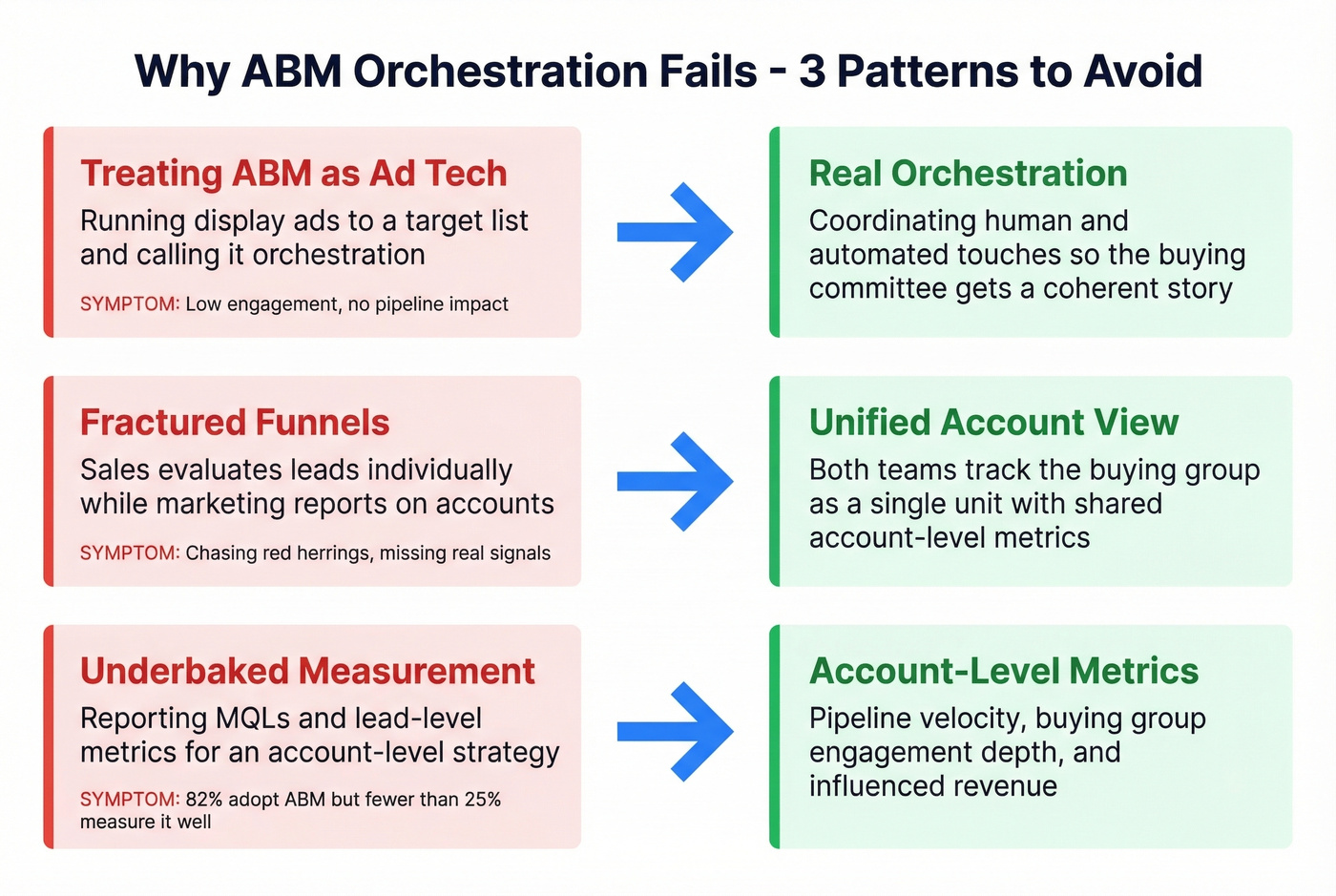
Treating ABM as ad tech. Teams buy a platform, run display ads to a target account list, and call it orchestration. That's programmatic advertising with a fancier label. Real orchestration means coordinating human and automated touches across channels so the buying committee experiences a coherent story - not just retargeted banner ads.
Fractured funnels. Sales evaluates leads individually while marketing reports on accounts. Nobody's looking at the buying group as a unit, so you chase red herrings and miss real signals. Without proper account-level coordination, the two teams end up working against each other instead of reinforcing the same message.
Underbaked measurement. We've found this is the hardest to fix because it requires org-level buy-in, not just a tool purchase. 82% of teams adopt ABM, but fewer than 25% rate their measurement as fair - most still report 2-3 metrics to the board, and only 1-2 align to modern marketing principles.
When this breaks down, it’s usually a process issue as much as a tooling issue - tighten sales execution before you add more channels.
Data Quality: The Part Everyone Skips
We've seen teams come to us with 35%+ bounce rates, and it's always the same story: their ads fire, their intent signals trigger, their playbook runs - and then the email bounces and the phone number's disconnected. All that orchestration effort, wasted at the last mile.
Orchestration is only as good as the data feeding it. Waterfall enrichment - running contacts through multiple providers sequentially - can push coverage from ~40% to 85% at roughly $0.06-$0.10 per lead via direct API. That's the economics that make composable ABM viable for mid-market teams. If you're building a composable stack, pair a verification-first data provider with your orchestration layer and you'll avoid the garbage-in-garbage-out problem that kills most motions before they produce a single meeting.
If you’re seeing deliverability issues, start by benchmarking and fixing your email bounce rate before scaling volume.

Building a composable ABM stack? Prospeo plugs directly into HubSpot, Salesforce, Clay, and Zapier - so your intent signals trigger outreach to contacts that actually connect. At ~$0.01 per email, you spend on orchestration tools, not overpriced data.
Layer real buying committee data into every account play you run.
ABM Orchestration FAQ
What's the difference between ABM and ABM orchestration?
ABM is the strategy of targeting specific accounts; orchestration is the operational process of coordinating every touch across channels, timing, and personas so those accounts experience a coherent journey. Think of ABM as the "what" and orchestration as the "how" - without the latter, you're just running disconnected campaigns at a named list.
Do I need an ABM platform to orchestrate effectively?
No. You can coordinate account-based plays with a CRM, a solid data provider, and a shared workflow between sales and marketing. Platforms like Demandbase or 6sense automate the process at scale, but teams under $10M ARR often get better results from a composable stack at 60-70% lower cost.
How do I measure success?
Track account-level metrics: pipeline velocity, buying group engagement depth, and influenced revenue. Avoid defaulting to MQLs - fewer than 25% of ABM teams rate their own measurement as fair, usually because they're still reporting lead-level metrics for an account-level strategy.
What's the biggest reason orchestration fails?
Bad contact data. If 30-40% of your emails bounce and phone numbers are disconnected, every playbook you build breaks at the last mile. Fix data quality first - verified emails with 98%+ accuracy and fresh mobile numbers - then layer on intent signals and multichannel plays.