

Account-Based Engagement: The Operational Guide for B2B Teams
Most ABM programs fail. BCG's research across 21 companies found the root cause usually isn't strategy - it's that "account-based marketing" was always a misnomer for what's actually a cross-functional operating model. Forrester figured this out in June 2018 and coined a better term: account-based engagement.
You don't need a $60K platform to start. A CRM, verified contact data, and shared SLAs between marketing, sales, and CS often outperform a six-figure Demandbase contract with no process behind it. Here's the thing: we've watched teams burn through entire fiscal quarters trying to configure platforms they didn't need yet. Below is the framework, a concrete scoring model with point values, and the tech stack to run it.
What Is Account-Based Engagement?
BCG defines ABE as aligning marketing, sales, and service to win accounts, retain customers, and grow revenue through targeted, personalized omnichannel engagement. The term originated in Forrester's June 2018 report titled "Not Yet the New Normal: ABM Must Evolve to Account-Based Engagement."
The distinction matters. Calling it "account-based marketing" implies marketing owns it. ABM programs that stay siloed in marketing become what one Reddit user aptly called "expensive reminders to sell to your ICP." ABE reframes the motion as cross-functional - marketing generates engagement, sales acts on it with defined SLAs, and CS extends it post-sale.
BCG interviewed 34 senior executives at 21 companies across technology, manufacturing, and business services. The pattern was clear: successful ABE programs produce faster pipeline growth, higher close rates, larger deals, and better retention. Two models have emerged - strategic ABE for high-touch, 1:1 engagement with top-tier accounts, and scaled ABE for programmatic 1:many coverage across broader tiers.
ABE vs ABM vs ABX
| Dimension | ABM | ABE | ABX |
|---|---|---|---|
| Scope | Marketing-led | Cross-functional | Full lifecycle |
| Focus unit | Account | Buying group / contacts | Customer experience |
| Core metric | MQLs / pipeline | Engagement depth + coverage | CLV + retention |
| Typical failure | Sales ignores it | Misaligned SLAs | Over-engineered |
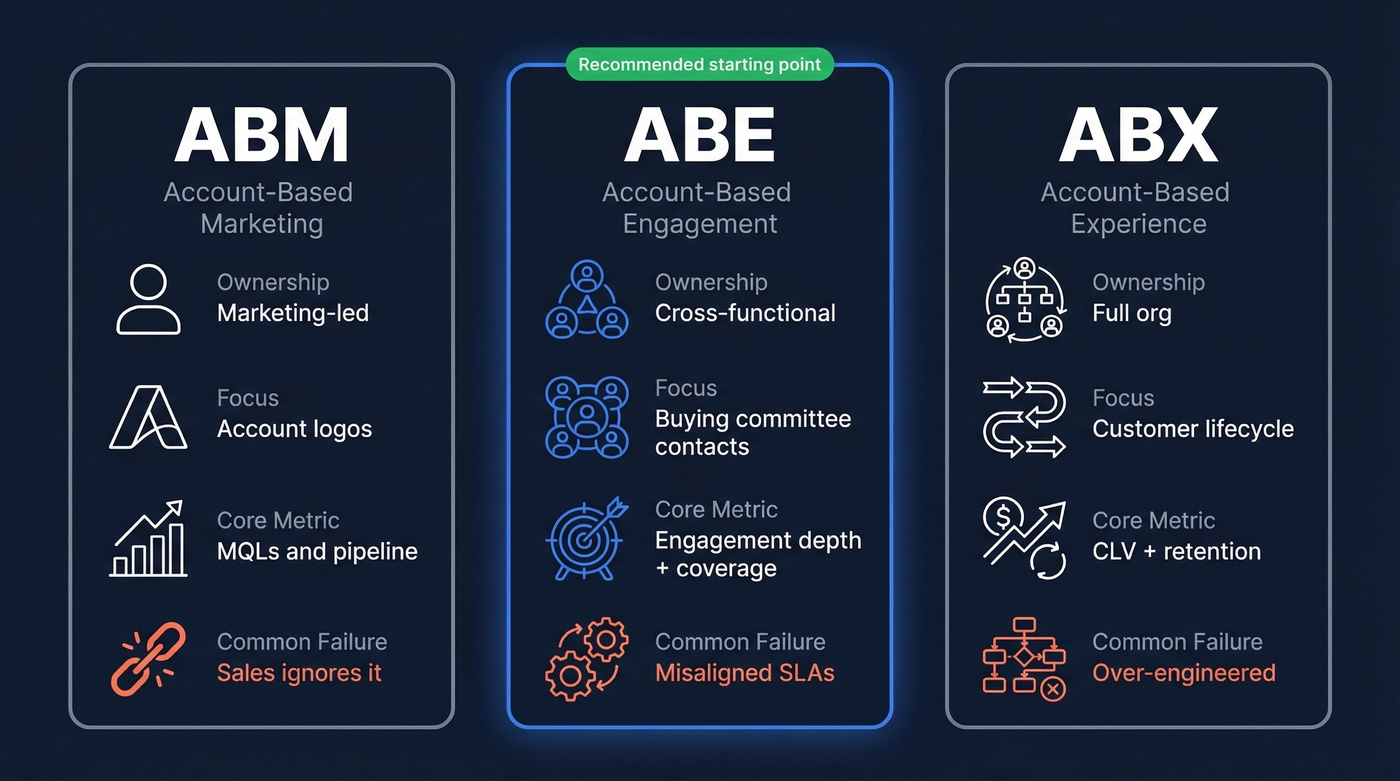
ABM is a targeting and acquisition strategy. ABE adds operational rigor - shared SLAs, buying-group coverage targets, contact-level measurement. ABX extends everything post-sale into retention and expansion, with lifecycle approaches delivering up to 1.6x higher CLV.
The common Reddit objection - "ABM is just good demand gen" - isn't wrong about bad ABM. It's wrong about ABE. The difference is operational discipline, not a rebrand.

You can't run account-based engagement on bad data. If 37% of touchpoints go unattributed and half your buying committee emails bounce, your scoring model is fiction. Prospeo delivers 98% email accuracy, 125M+ verified mobiles, and a 7-day data refresh cycle - so your engagement scores reflect reality.
Map the full buying committee with contacts you can actually reach.
Why ABE Programs Fail
More than half of all ABE programs fail the first time around, and 58% of marketers have at best moderate ability to drive engagement from key accounts. We've seen the same five failure modes over and over:
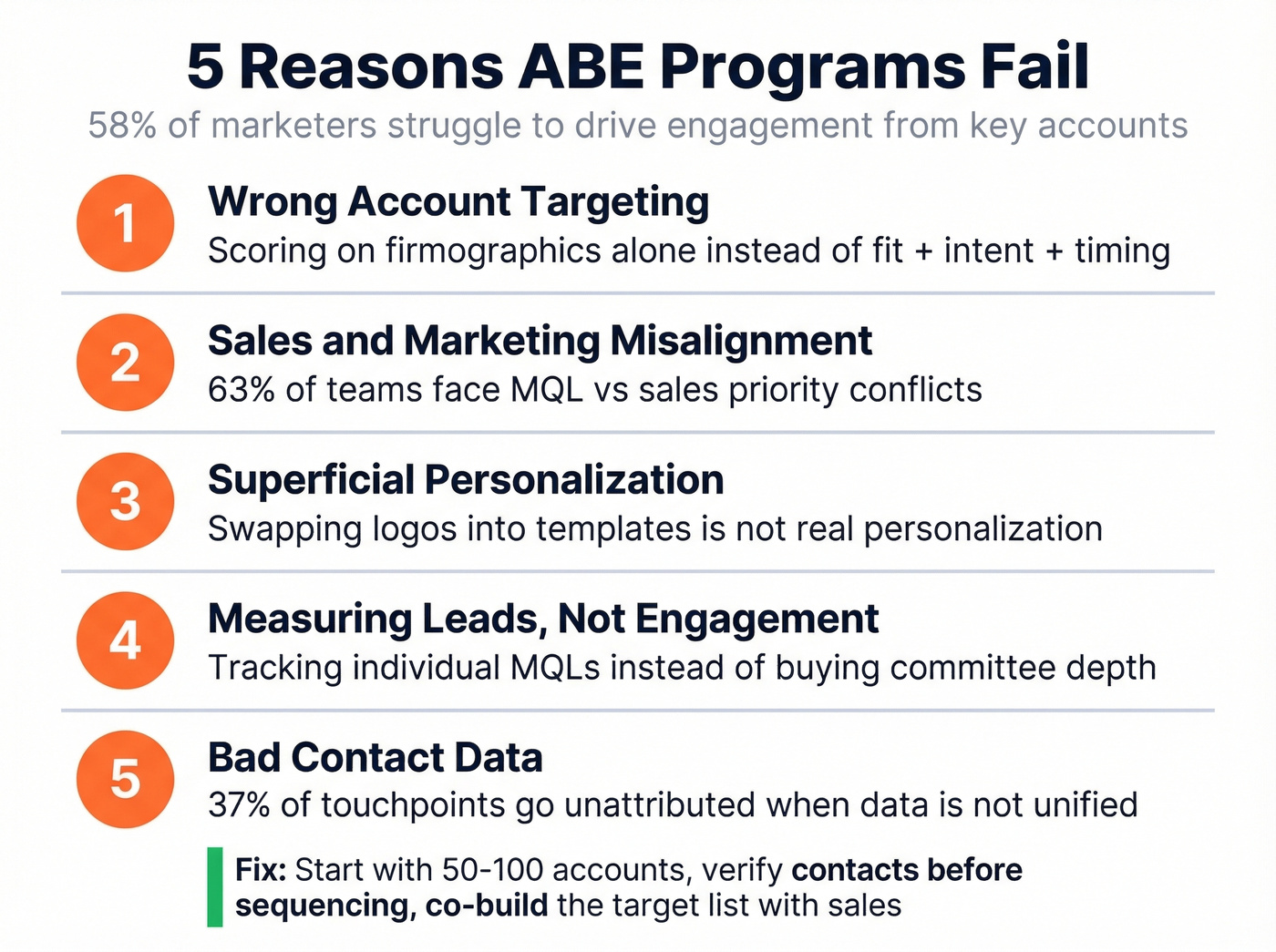
Targeting wrong accounts. Score on fit x intent x timing, not just firmographics. Start with 50-100 accounts, not 500. Use an Ideal Customer Profile rubric so sales and marketing score fit the same way.
Sales/marketing misalignment. 63% of teams face MQL-vs-sales-priority misalignment. Co-build the target account list. Shared ownership kills finger-pointing.
Superficial personalization. Swapping a logo into a template isn't personalization. Use account context: recent funding, tech stack changes, hiring signals. (If you need a system, start with personalized outreach principles.)
Measuring leads instead of engagement. Track engagement depth across the buying committee, not individual MQLs. If you're still using legacy models, compare this to modern lead scoring approaches.
Bad data. You can't engage a buying committee if half your emails bounce. Verify contacts before they enter any sequence. (See email bounce rate benchmarks and fixes.)
One subtle failure worth flagging: misreading intent signals. A Bombora keyword surge is top-of-funnel awareness. A G2 competitor comparison is bottom-of-funnel evaluation. Treating them the same distorts scoring and wastes sales capacity - and it's a mistake we see even at companies spending six figures on intent data.
How to Build an ABE Plan
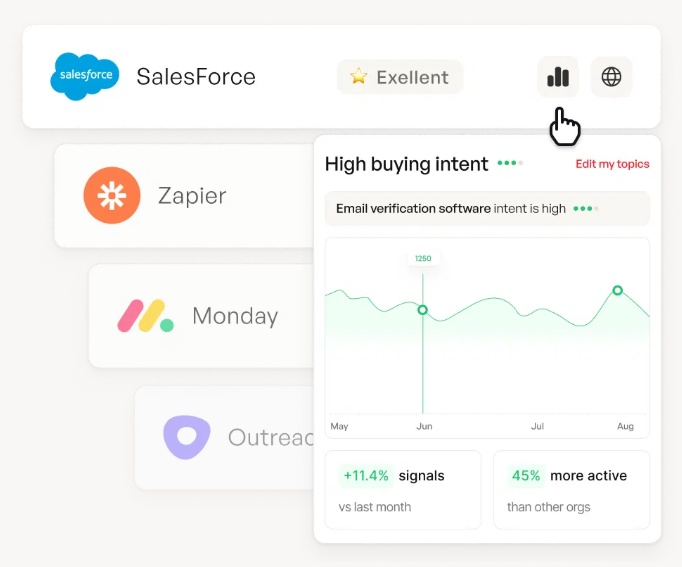
Select Accounts With Fit + Intent + Timing
Your ICP scoring model needs three dimensions: firmographic fit, intent signal recency, and timing window. A company that matches your ICP and surged on relevant intent topics in the last 14 days is a fundamentally different prospect than one that hit a threshold 30 days ago. If you want a cleaner way to operationalize this, use intent based segmentation.
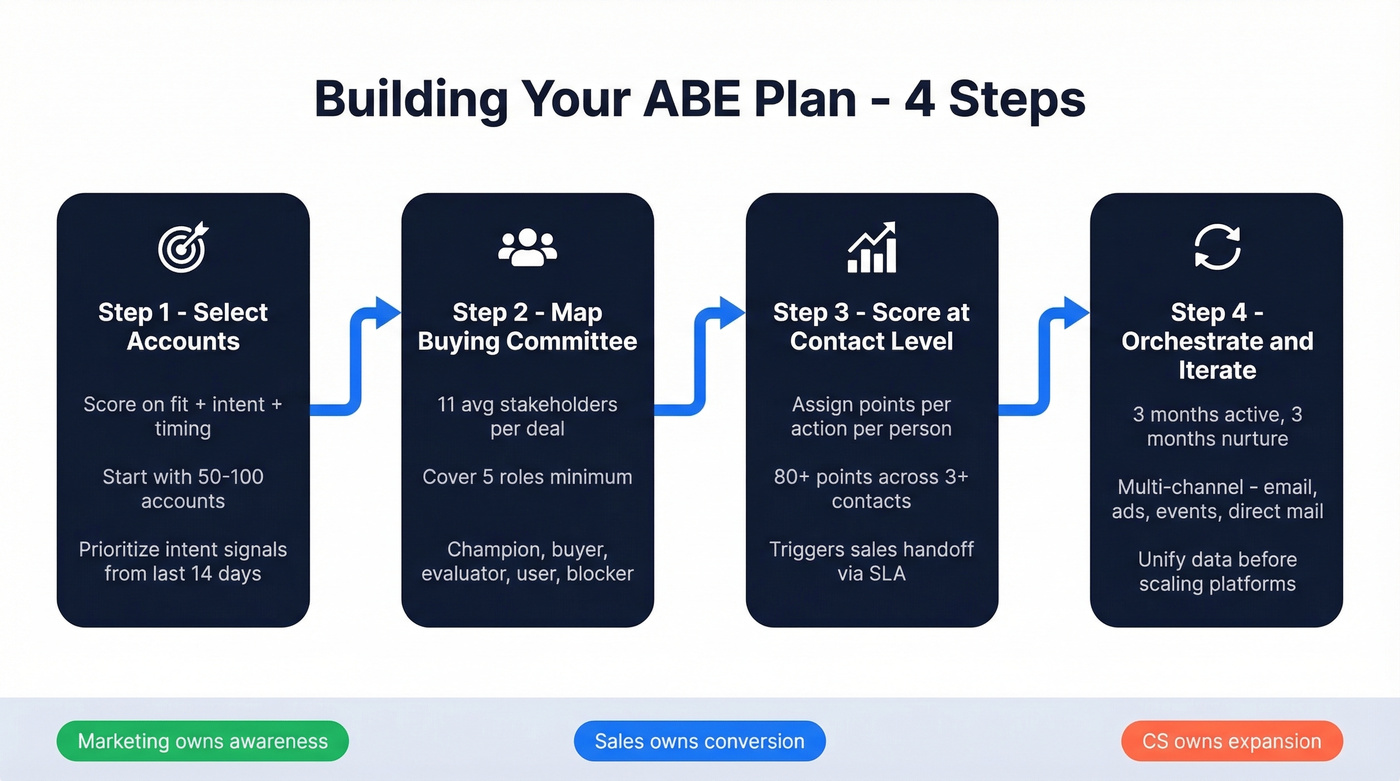
42% of marketers say identifying the right buyers is their biggest challenge. The fix is counterintuitive - go narrower. Start with 50-100 accounts where you have strong fit and real intent signals. Prove the model before scaling.
Map and Engage the Buying Committee
The average B2B deal involves 11 stakeholders, each consuming 5-7 assets before engaging sales. Your coverage target for Tier 1 accounts should be at least five identified roles: champion, economic buyer, technical evaluator, end user, and blocker.
Build concrete SLAs around engagement triggers. If three decision-makers from a target account visit your pricing page within 48 hours, sales outreach should happen within 24 hours. Multi-channel matters - email, ads, events, direct mail. The inbox alone is increasingly broken for cold outreach. If you're adding offline touches, direct mail for lead generation can work well in Tier 1.
When marketing targets the same people sales is pursuing, teams convert 65% more prospects into pipeline. That's not a nice-to-have. That's the mechanism.
Plan for engagement cycles: three months of active outreach followed by three months of nurture to avoid account fatigue. Document these cadences so every team operates from the same playbook. Skip this step and you'll burn through your best accounts in a single quarter with nothing to show for it.
Score Engagement at the Contact Level
Most ABE programs score at the account level. That's a mistake. You need contact-level engagement scoring to understand buying committee dynamics:
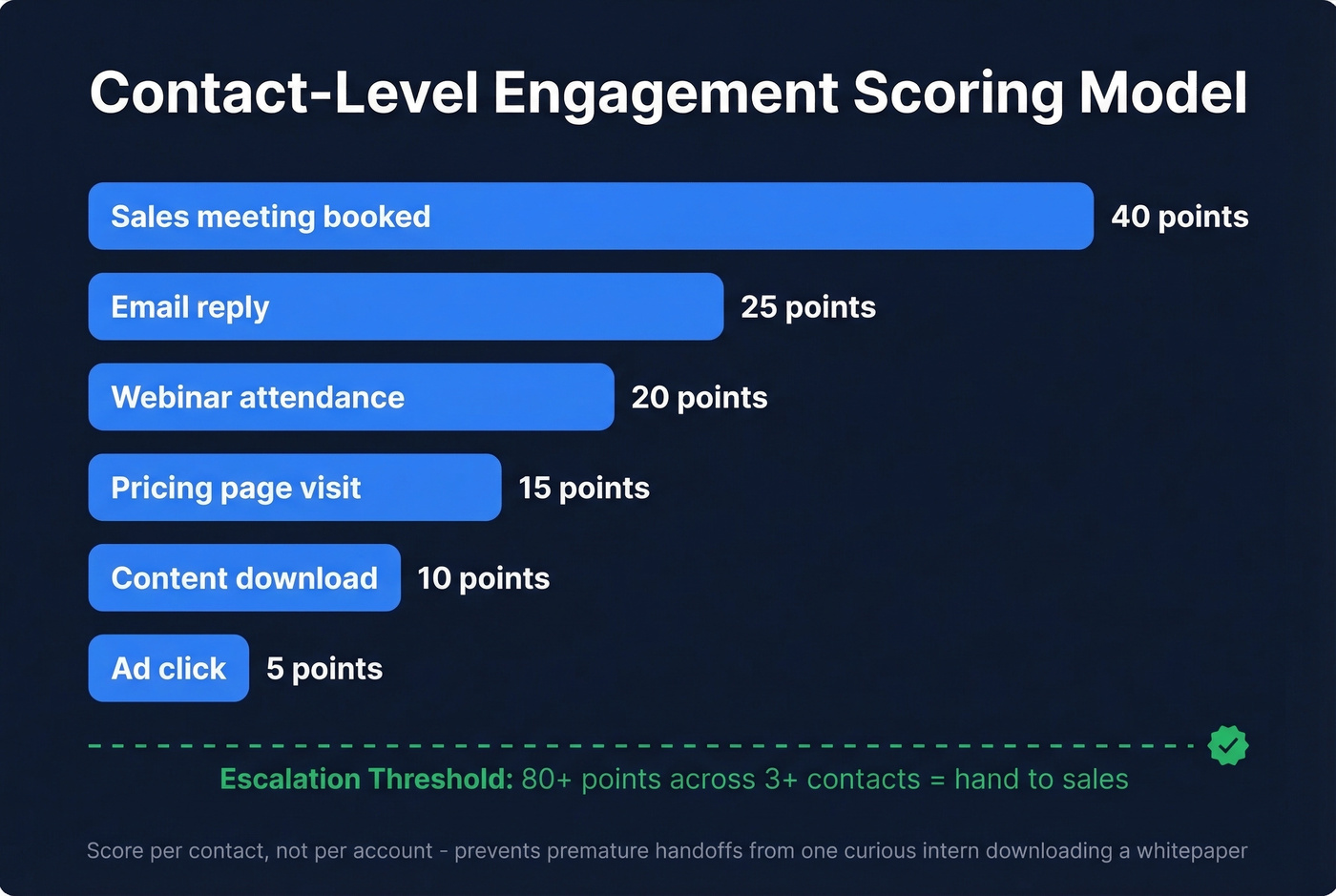
- Pricing page visit: +15 points
- Content download: +10
- Webinar attendance: +20
- Email reply: +25
- Ad click: +5
- Sales meeting booked: +40
- Escalation threshold: 80+ points across 3+ contacts = hand to sales
This threshold approach prevents premature handoffs and ensures you're seeing real committee-level interest, not one curious intern downloading a whitepaper.
Let's be honest about the data problem here: 37% of touchpoints go unattributed when data isn't unified. If your CRM, marketing automation, and intent data live in separate silos, your engagement scores are fiction. Unify first, score second. Most teams would get more ROI from spending a week cleaning their CRM than from buying another platform. If you're doing this at scale, data enrichment services can help keep records current.
The ABE Tech Stack
You don't need a dedicated ABE platform to run this motion. Start with three layers: a CRM for orchestration, a verified data source for buying-group contacts, and intent signals to prioritize timing. The platform comes after you've proven the model.

| Layer | Tool | Starting Price | Notes |
|---|---|---|---|
| CRM | HubSpot (Pro) | ~$800/mo | Automation + reporting workflows |
| CRM | Salesforce | ~$75-$300/user/mo | Most common foundation |
| Verified Data | Prospeo | Free tier; ~$0.01/email | 98% accuracy, 7-day refresh |
| ABE Platform | Demandbase | $18K-$300K/yr | Complex; long implementation |
| ABE Platform | 6sense | $15K-$100K+/yr | Strong intent; 3+ month setup |
| ABE Platform | RollWorks | ~$850/mo | Lighter; account-level only |
A 10-person team can run effective account-based engagement with HubSpot Pro and Prospeo for around $1,000/month. That's a fraction of what Demandbase or 6sense costs - and it forces you to build the process discipline that platforms can't buy for you. If you're evaluating options, start with a shortlist of examples of a CRM to match your workflow.
ABE lives or dies on buying-committee coverage. In our experience, the teams that struggle most aren't the ones with bad strategy - they're the ones working off stale contact lists where half the emails bounce and the other half hit the wrong person. Prospeo's 300M+ professional profiles with 30+ search filters, including buyer intent, technographics, and headcount growth, paired with a 7-day data refresh cycle, solve that specific problem. The 92% API match rate means CRM enrichment actually works at scale, which is critical when you're tracking engagement across dozens of contacts per account. (Related: lead enrichment workflows.)
The article above recommends starting ABE with 50-100 accounts and at least 5 stakeholders per account. That's 250-500 verified contacts minimum. Prospeo's 30+ search filters - including buyer intent powered by Bombora, technographics, and job changes - let you build that list in minutes at $0.01 per email. No contracts, no sales calls.
Stop configuring platforms you don't need. Start with accurate data.
FAQ
Is ABE just ABM with a different name?
No. ABM is typically a marketing-led targeting strategy focused on acquisition. Account-based engagement is a cross-functional operating model with shared SLAs between marketing, sales, and customer success, plus buying-group coverage targets and contact-level scoring. Forrester coined the distinction in 2018 because most ABM programs failed by staying siloed in marketing.
Do I need Demandbase or 6sense to start?
No - start with a CRM, verified contact data, and cross-functional SLAs. Most ABE programs fail from bad process, not missing software. Prove the model with 50 Tier 1 accounts using affordable tools before committing $50K+/year to a platform that takes three or more months to implement.
Why does contact-level data matter for ABE?
ABE targets specific people in buying committees, not just company logos. If your emails bounce or phone numbers are disconnected, engagement scores are fiction and SLAs are meaningless. 72% of practitioners say contact-level targeting is a core differentiator, yet most teams still operate on stale account-level data that hasn't been verified in months.
How many accounts should I start with?
Start with 50-100 accounts where you have strong ICP fit and active intent signals. This lets you build repeatable playbooks, calibrate scoring thresholds, and prove ROI before scaling. Teams that launch with 500+ accounts almost always dilute their effort and produce mediocre results across the board.