

Best Account Based Selling Tools in 2026 (With Real Pricing)
Your VP of Sales just announced the team is "going account-based." Everyone nods. Nobody knows what tools to buy. So someone searches for account based selling tools and gets back 40 ABM platforms that cost six figures and take two months to implement.
Here's the thing: most ABS tool lists are actually ABM lists - heavy on marketing orchestration and light on what salespeople need. Verified contact data for every stakeholder on a buying committee, plus a way to sequence multi-threaded outreach. Gartner research puts the average enterprise buying group at 5-11 stakeholders across five business functions. You don't close that deal with a single-threaded email cadence and a prayer.
This list focuses on sales execution tools, organized by what they do in an ABS workflow. We've evaluated 30+ tools in this space, and we include real pricing for every single one. If you want the process layer behind the tools, see our account-based selling best practices.
Our Picks (TL;DR)
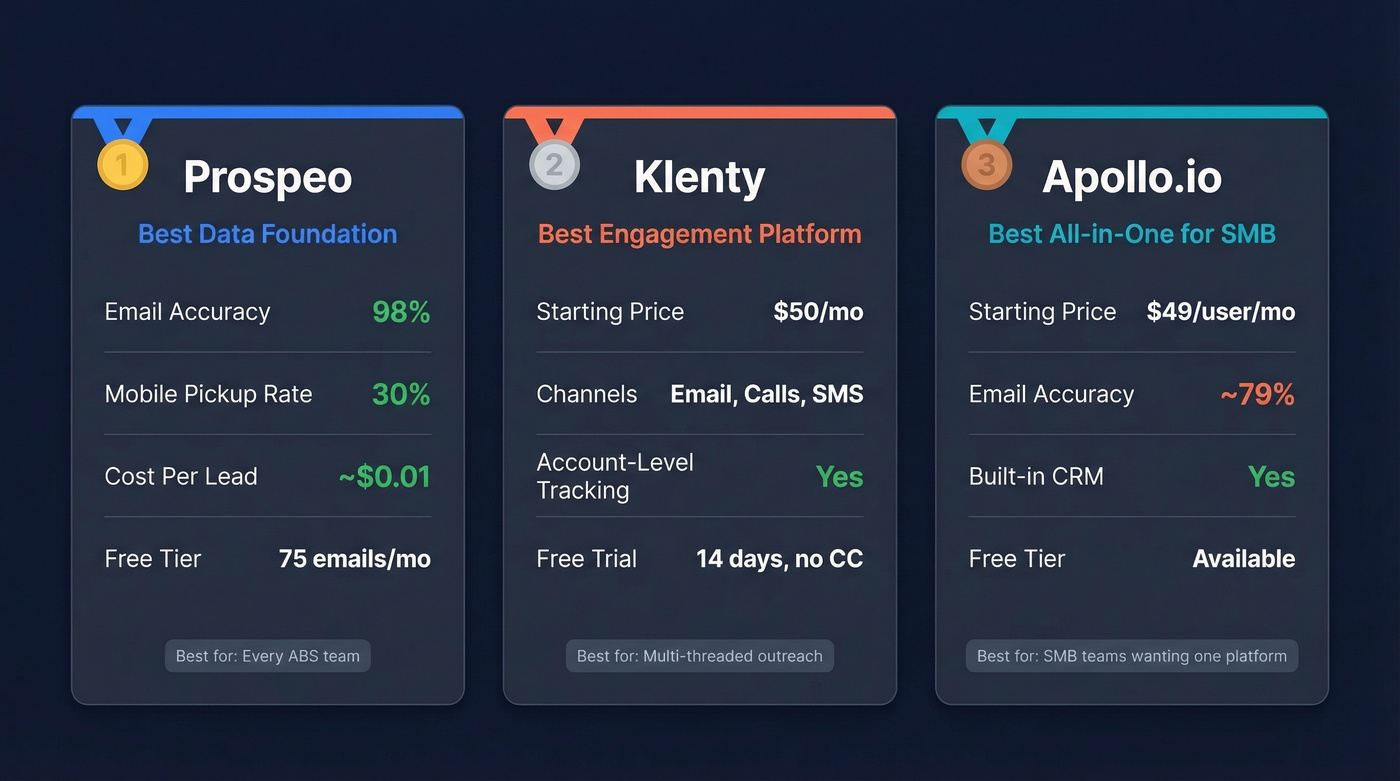
- Prospeo - Best data foundation for ABS. 98% email accuracy, 30% mobile pickup rate, ~$0.01/lead.
- Klenty - Best engagement platform purpose-built for account-based execution. Starts at $50/month.
- Apollo.io - Best all-in-one for SMB teams that need data + engagement without enterprise pricing.
ABS vs ABM - Why It Matters
ABS and ABM aren't synonyms. ABM is marketing air cover: targeted ads, content syndication, account-level engagement scoring. ABS is sales execution - multi-threaded outreach to specific humans, coordinated plays across the buying committee, deal progression tracking. ITSMA research shows 87% of marketers say ABM delivers higher ROI than other strategies, but that ROI only materializes when sales can actually execute against the accounts marketing identifies.
If you’re building the sales side of that motion, it helps to align on what “sales execution” actually means in practice - see sales execution.
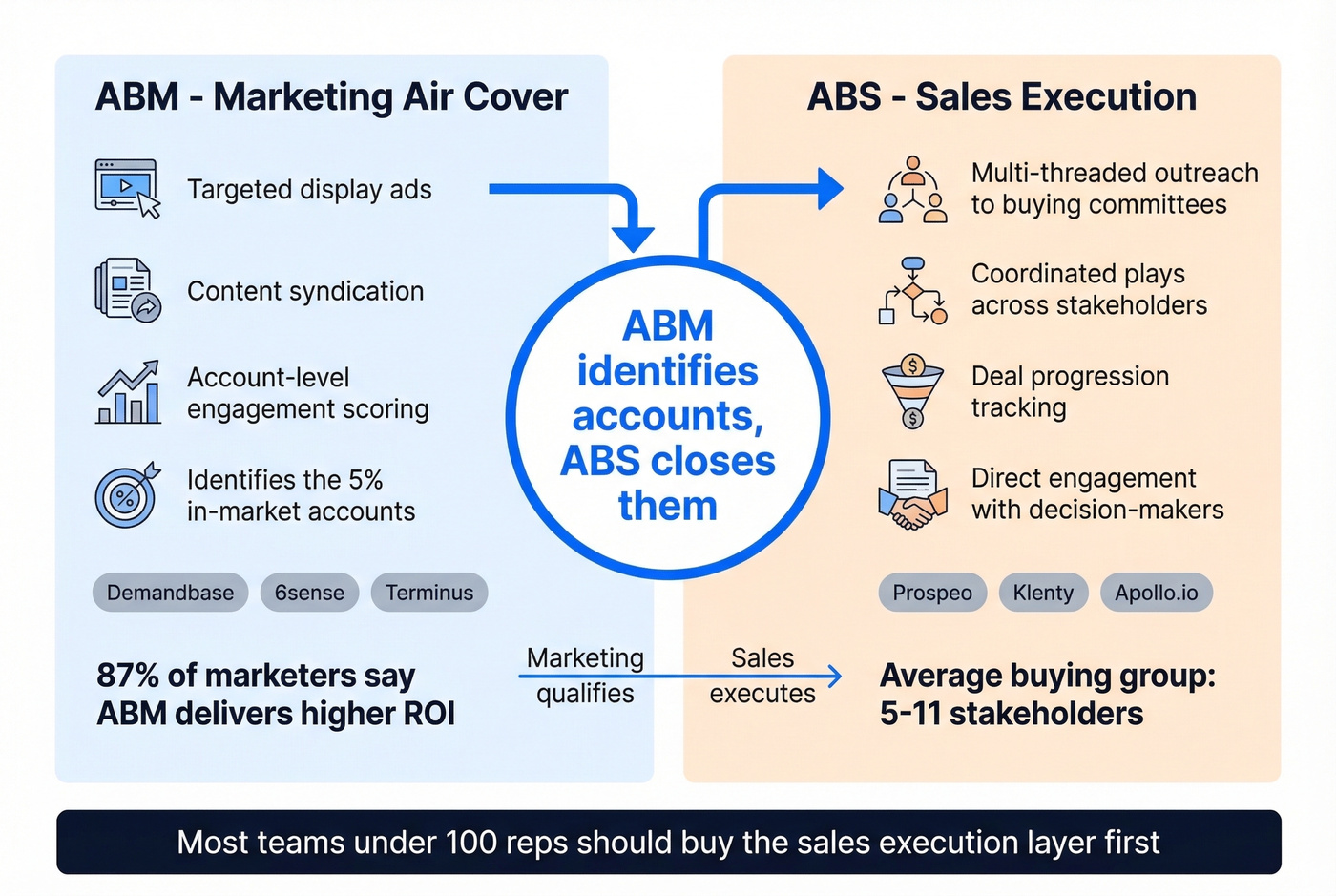
Only about 5% of your target accounts are in-market at any given time. ABM platforms help you identify that 5%. ABS tools help your reps close them by reaching the CFO, the VP of Engineering, and the procurement lead with coordinated outreach. Marketing platforms orchestrate awareness; sales tools drive direct engagement with decision-makers.
If your average deal size is under $25K, you probably don't need a six-figure ABM platform. You need accurate data and a good sequencer. Most teams under 100 reps should buy the sales execution layer first and add marketing orchestration later.
What Your ABS Stack Needs
Forget the 8-capability frameworks you'll find elsewhere. Your ABS stack has three layers.
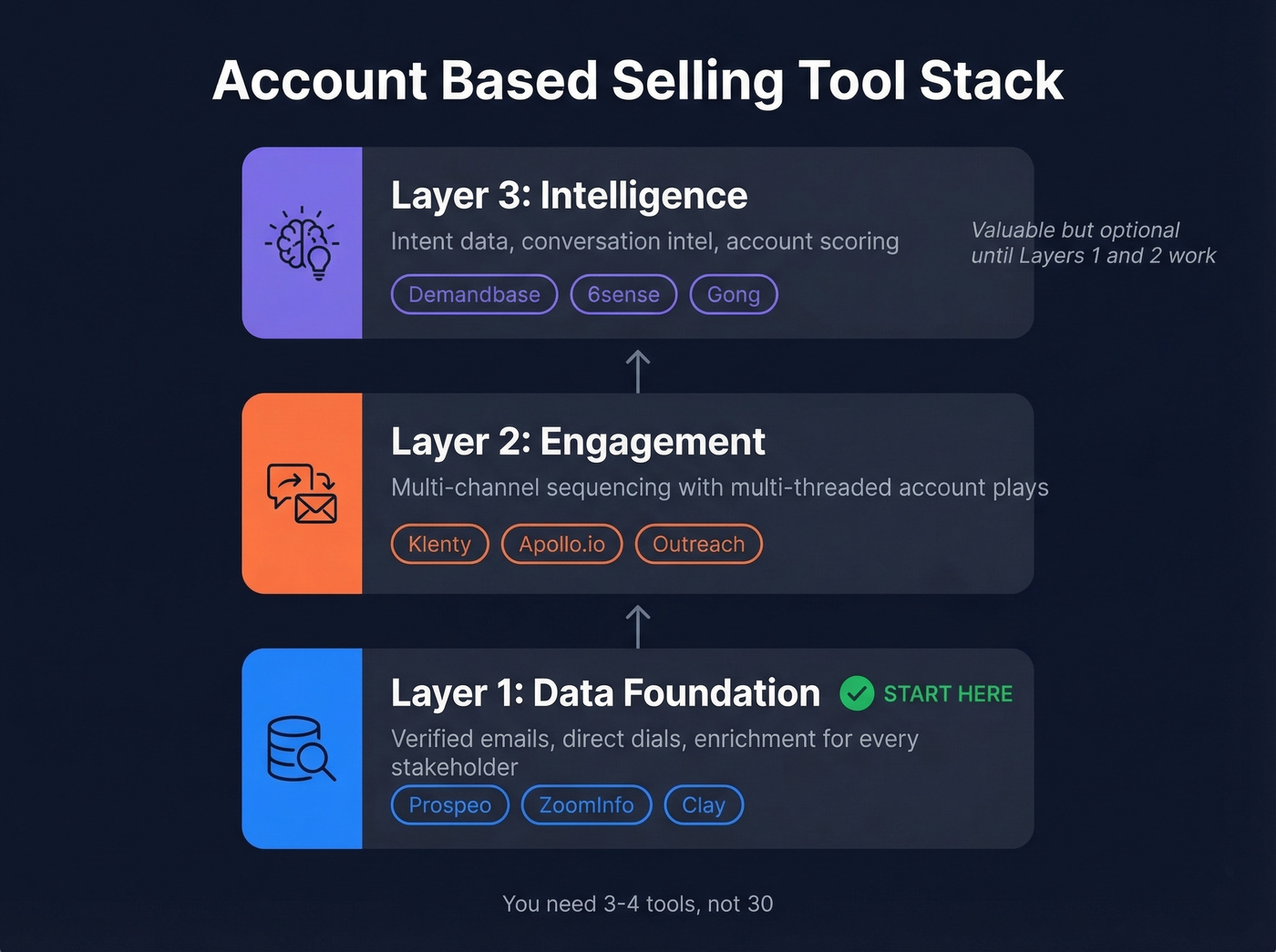
Layer 1: Data Foundation. Verified emails, direct dials, and enrichment for every stakeholder on your target accounts. If 30% of your emails bounce, nothing else matters. (If bounces are a recurring issue, use this email bounce rate guide to diagnose the root cause.)
Layer 2: Engagement. Multi-channel sequencing that supports multi-threaded plays - coordinated cadences against multiple contacts at the same account, with visibility into who's responding and who's ghosting. If you’re standardizing cadences across the team, sequence management is the playbook.
Layer 3: Intelligence. Intent data, conversation intelligence, and account scoring. This layer tells you which accounts to prioritize. It's valuable but optional until Layers 1 and 2 are working.
You need 3-4 tools, not 30. Start with the data layer.

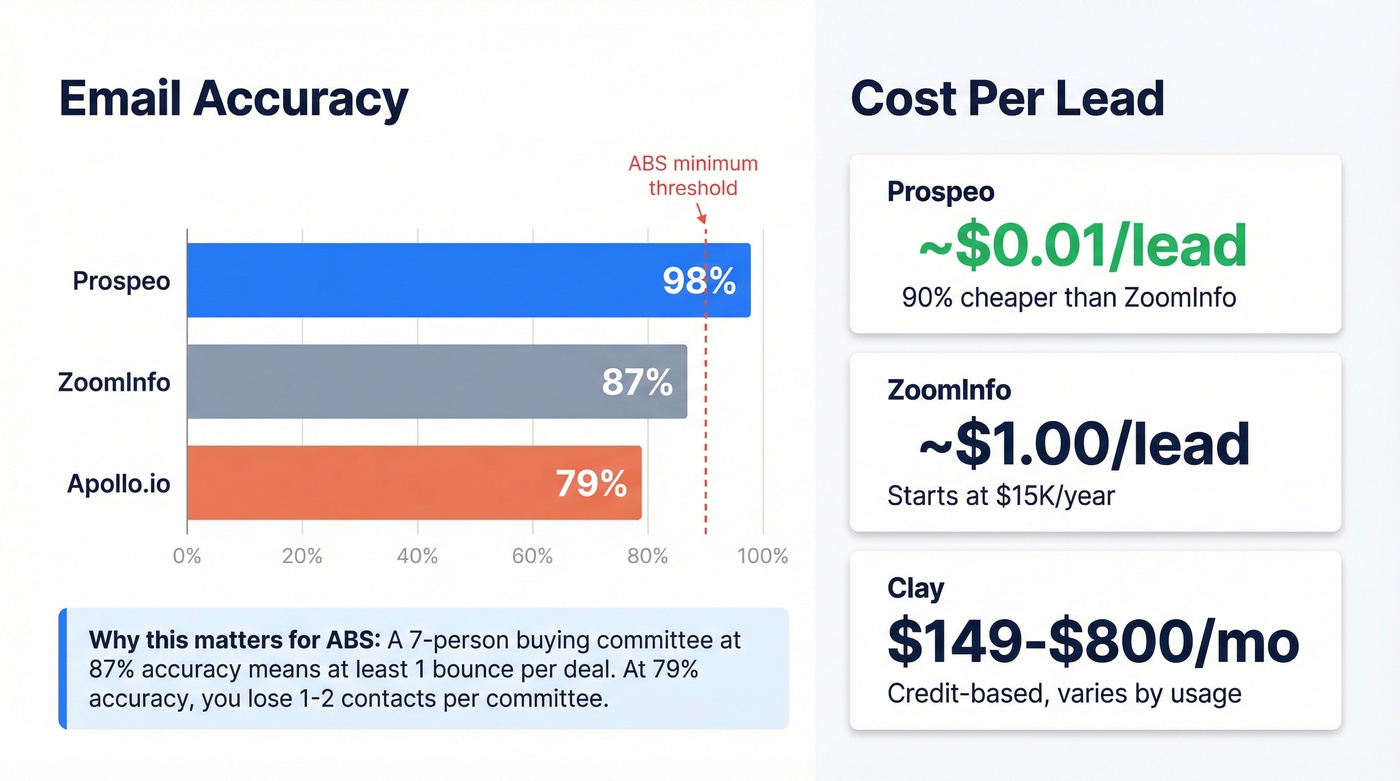
Account-based selling fails when your data fails. A 7-person buying committee with 87% email accuracy means at least one bounce per deal - every single time. Prospeo's 98% email accuracy, 30% mobile pickup rate, and 7-day refresh cycle give your reps verified contact data for every stakeholder, at ~$0.01/lead.
Stop multi-threading into dead inboxes. Start with data that connects.
Best Tools for Account Based Sales
Data Foundation & Enrichment
Prospeo
Your ABS motion lives or dies on data quality. Prospeo's database covers 300M+ professional profiles with 98% email accuracy and a 30% mobile pickup rate. Teams book 26% more meetings compared to ZoomInfo and 35% more compared to Apollo, largely because of the proprietary email-finding infrastructure and 5-step verification process that eliminates bounces before they happen. (If you’re comparing vendors, start with this breakdown of B2B company data providers.)
For ABS specifically, the 30+ search filters include buyer intent powered by Bombora across 15,000 topics, technographics, job changes, and department headcount growth. The 7-day data refresh cycle means you're not emailing someone who left the company six weeks ago - a problem we've seen tank entire account-based campaigns when teams rely on stale databases.

The Meritt proof point tells the story: pipeline tripled from $100K to $300K/week, bounce rate dropped from 35% to under 4%, and connect rates 3x'd to 20-25%.
Pricing runs ~$0.01/lead - 90% cheaper than ZoomInfo's ~$1/lead. Free tier gives you 75 emails/month. No contracts, no sales calls. That accuracy advantage compounds across every stakeholder on a buying committee, making it the strongest data foundation for any ABS stack.
ZoomInfo
ZoomInfo's company data layer - firmographics, org charts, technographic installs - is strong. But email accuracy lands at 87%. For ABS, where you need to reach the right person at the right account, that accuracy gap compounds fast across a 7-person buying committee. One in eight emails bouncing doesn't sound terrible until you multiply it across every deal in your pipeline.
Pricing starts around $15K/year for basic packages and climbs to $25K-$40K+ for mid-market contracts with intent data and mobile numbers.
Best for: Enterprise teams with 20+ reps that need broad company data in a single platform and have $15K+ budgeted for data alone.
Clay
Clay takes a fundamentally different approach: waterfall enrichment across 100+ data sources, layering providers until you get a match. It's powerful for teams with a RevOps person who can build and maintain custom workflows. If you don't have that person, Clay will frustrate you.
Free tier gives you 100 credits/month. Paid plans: $149/month for Starter, $349/month for Explorer, $800/month for Pro.
Sales Engagement & Multi-Threading
Klenty
Most engagement platforms treat contacts as independent records. Klenty treats them as parts of an account - and that distinction makes it the best engagement tool for ABS execution we've tested.
Klenty tracks account stages rather than just lead stages, supports multi-threaded plays across buying committees, and gives reps visibility into which stakeholders have been contacted, responded, or gone dark. Multi-channel cadences cover email, calls, and SMS, with native CRM integrations for Salesforce, HubSpot, and Pipedrive.

Pricing is straightforward and billed annually: Starter at $50/month for email-only, Growth at $70/user/month with multi-channel and CRM integrations, and Pro at $99/user/month adding AI features and 1,000 calling minutes for US/Canada. The 14-day free trial requires no credit card.
Where ZoomInfo's engagement tools feel bolted on, Klenty's feel native. The tradeoff: no built-in data layer, so pair it with a dedicated data provider.
Apollo.io
Apollo is the Swiss Army knife: data, sequencing, a dialer, and a lightweight CRM in one platform. For SMB teams that don't want to stitch together four tools, it's the fastest path to running account-based plays.
The free tier is useful for getting started, and the built-in sequencer handles multi-step email and call cadences. Paid plans run $49/user/month for Basic, $79/user/month for Professional, and $119/user/month for Organization, all billed annually.
The tradeoff is data quality. Apollo's email accuracy sits around 79%, which means one in five emails won't land. For high-volume prospecting, that's manageable. For ABS - where you're targeting specific executives at specific accounts - every bounce hurts. In our testing, teams get the best results pairing Apollo's engagement layer with a higher-accuracy data source for the contact information itself.
SalesLoft
Enterprise-grade sales engagement with deep Salesforce integration. Pricing runs $75-$150/user/month with no free tier. Strong for large teams already in the Salesforce ecosystem, but overkill for most SMBs.
Outreach
Advanced sequencing, A/B testing, and best-in-class analytics for enterprise sales teams. Starts around $100/user/month, with custom pricing for larger deployments. The analytics layer is where Outreach earns its premium - pipeline visibility and rep performance tracking are genuinely ahead of the competition. But the learning curve is steep, and smaller teams rarely use enough features to justify the cost.
Intent Data & Account Intelligence
Demandbase
Demandbase is the most comprehensive account-based selling software on this list - account identification, intent data, advertising, and sales intelligence in one suite. It's also the most expensive by a wide margin.
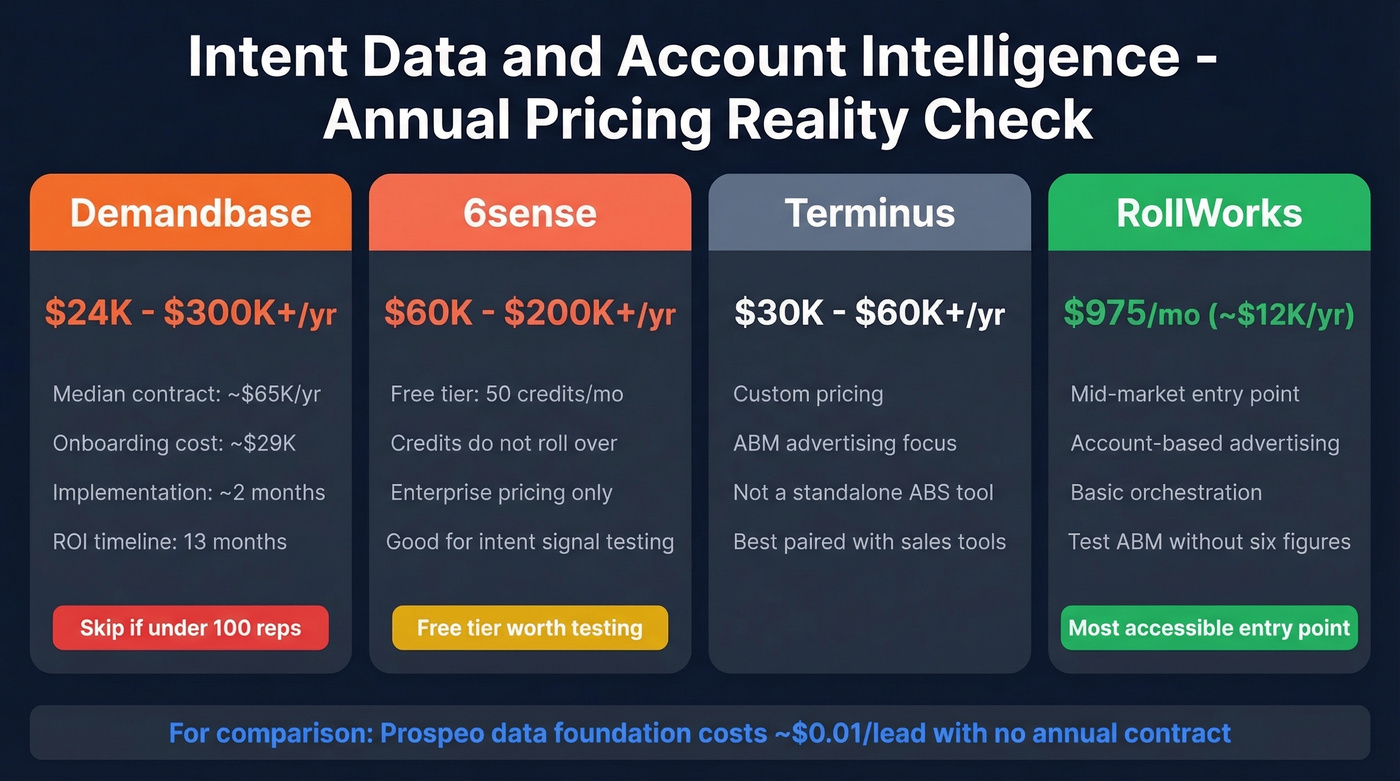
Pricing starts around $24K/year for basic packages, with median contracts landing near $65K/year. Enterprise deployments run $70K-$300K+. Onboarding alone often costs ~$29K, and implementation takes about two months with a median ROI timeline of 13 months. The consensus on r/sales and similar communities is that Demandbase is powerful but expensive, with recurring concerns about precision and transparent tracking.
Skip this if you're a team under 100 reps. You don't need a $65K orchestration platform.
6sense
6sense has a useful free tier - 50 data credits/month, company and people search, sales alerts, and a Chrome extension. That's enough to evaluate whether their intent signals match your ICP. Paid plans are enterprise-priced: $60K-$100K/year starting, scaling to $200K+ for full deployments. Credits don't roll over, which is a consistent frustration.
Skip this if you're not ready for a six-figure annual commitment or if you need data accuracy more than intent signals.
Terminus
ABM advertising and orchestration for account-based ad campaigns. Custom pricing, typically $30K-$60K+/year. Best for teams that want to run targeted display ads alongside sales outreach - not a standalone ABS tool.
RollWorks
Mid-market ABM entry point with account-based advertising and basic orchestration. Starts at $975/month - significantly cheaper than Demandbase or 6sense for teams testing account-based ad strategies without committing six figures.
Deal Progression & Account Planning
Gong
Conversation intelligence that tracks stakeholder engagement across the buying committee. At $100-$150/user/month, it isn't cheap, but for ABS deal progression it's close to essential. You can see which stakeholders are engaged, which are silent, and where deals are stalling.
DemandFarm
Account planning and relationship mapping that fills the gap CRMs leave in whitespace analysis. Runs $30-$60/user/month. If your reps are doing account plans in PowerPoint, DemandFarm is the upgrade.
HubSpot
Free CRM that works as an affordable foundation for ABS. Sales Hub starts at $15/month. Limited ABS-specific features, but the price-to-value ratio for early-stage teams is hard to beat. HubSpot's free tier combined with its account-level reporting makes a practical starting point before investing in dedicated platforms. If you’re still evaluating CRMs, here are more examples of a CRM.
Meritt tripled pipeline from $100K to $300K/week and dropped bounce rates from 35% to under 4% using Prospeo. With 30+ filters including buyer intent across 15,000 topics, technographics, and department headcount growth, you can map and reach entire buying committees - not just one champion who ghosts you.
Layer intent data on top of verified contacts and close the accounts that matter.
Pricing Comparison
Most enterprise platforms won't publish pricing - which tells you everything about their sales process. Here's what you'll actually pay in 2026:
| Tool | Category | Starting Price | Free Tier? | Best For |
|---|---|---|---|---|
| Prospeo | Data | ~$0.01/lead | Yes (75/mo) | Verified emails + dials |
| ZoomInfo | Data | ~$15K/yr | No | Broad company data |
| Clay | Enrichment | $149/mo | Yes (100 credits) | Custom workflows |
| Klenty | Engagement | $50/mo | 14-day trial | ABS multi-threading |
| Apollo.io | All-in-One | $49/user/mo | Yes | SMB data + sequences |
| Salesloft | Engagement | ~$75/user/mo | No | Enterprise Salesforce |
| Outreach | Engagement | ~$100/user/mo | No | Advanced analytics |
| Demandbase | ABM/ABS | ~$24K/yr | No | Enterprise orchestration |
| 6sense | Intent + AI | ~$60K/yr | Yes (50 credits) | Predictive intent |
| Terminus | ABM Ads | ~$30K/yr | No | Account-based ads |
| RollWorks | ABM Ads | $975/mo | No | Mid-market ABM |
| Gong | Conv. Intel | ~$100/user/mo | No | Deal progression |
| DemandFarm | Planning | ~$30/user/mo | No | Relationship mapping |
| HubSpot | CRM | $15/mo | Yes (free CRM) | Affordable foundation |
Recommended Stacks by Team Size
SMB (5-20 reps): Prospeo + Klenty + HubSpot
Total cost: $3K-$5K/year. This stack covers Layers 1 and 2 completely and costs less than a single ZoomInfo seat. In our experience, this combination handles 90% of what SMB teams need for account-based execution.
Mid-Market (20-100 reps): Apollo or Klenty + Gong
Total cost: $15K-$30K/year. Add Gong for conversation intelligence so managers can see which stakeholders are engaged across deals. If you're using Apollo for sequencing, run your contact data through a higher-accuracy verification source first - the 21% miss rate compounds across multi-threaded accounts.
Enterprise (100+ reps): Demandbase or 6sense + Salesloft + Gong
Total cost: $100K-$200K+/year. At this scale, intent data and full orchestration start paying for themselves. Even Demandbase users need verified emails and direct dials that actually connect - layer a dedicated data provider underneath.
Let's be honest: start with the data layer. Everything else is optional until your emails stop bouncing and your reps can actually get prospects on the phone. If you need more top-of-funnel options, start with these outbound lead generation tools.
FAQ
What's the difference between ABS and ABM tools?
ABM tools focus on marketing orchestration - ads, content syndication, and account-level engagement scoring. ABS tools focus on sales execution: multi-threaded outreach, direct dials, buying committee mapping, and deal progression tracking. Most teams should prioritize the sales execution layer first and add marketing orchestration once reps can reliably reach stakeholders.
How many tools do I need for account based selling?
Three tools cover the essentials: a data provider for verified contact info, a sales engagement platform for multi-channel sequencing, and a CRM. Intent data and conversation intelligence are valuable additions once the core stack is working, but they aren't required to start running account-based plays.
What does an ABS tool stack cost?
An SMB stack runs $3K-$5K/year with tools like Prospeo, Klenty, and HubSpot. Mid-market stacks with conversation intelligence cost $15K-$30K/year. Enterprise platforms like Demandbase or 6sense push total spend to $100K-$200K+ annually, before onboarding fees. Match your investment to your average deal size and team headcount, not feature count.
Why does data quality matter more than intent data for ABS?
Intent data tells you which accounts are in-market. But if 30% of your emails bounce and your reps can't reach the CFO by phone, that signal is worthless. Verified emails and direct dials are the prerequisite for every ABS motion - you can't multi-thread into a buying committee without accurate contact data for each stakeholder.
Can I run account based selling without an ABM platform?
Yes. Many teams run effective ABS with a data provider, a sales engagement tool, and a CRM - no six-figure ABM contract required. ABM platforms add value at scale, particularly for intent signals and account-based advertising, but start with accurate data and multi-threaded outreach before committing to enterprise orchestration software.