

Account Executive Introduction Email Templates That Actually Get Replies
Stop obsessing over email copy. Fix your data first. 17% of cold emails never reach the inbox, which means your perfectly crafted account executive introduction email is hitting a spam folder - or worse, a dead address. Most template guides stop at copy and never talk about the upstream problem: deliverability. About one in six of your emails never arrives. Here's how to write AE intro emails that actually land, plus the upstream fix most guides ignore.
What You Need (Quick Version)
AEs face four distinct intro email scenarios: cold prospect, SDR handoff, territory takeover, and multi-threading into a new stakeholder. Each needs a different template. All share the same rules: under 125 words, problem-centric not product-centric, single CTA. None of it matters if your list isn't verified before you hit send.
Why Most AE Intro Emails Get Ignored
The average person receives 15 cold emails per week. Their default response? Nothing. 50.9% never engage, 13.7% delete on sight, and another 10.3% mark you as junk.
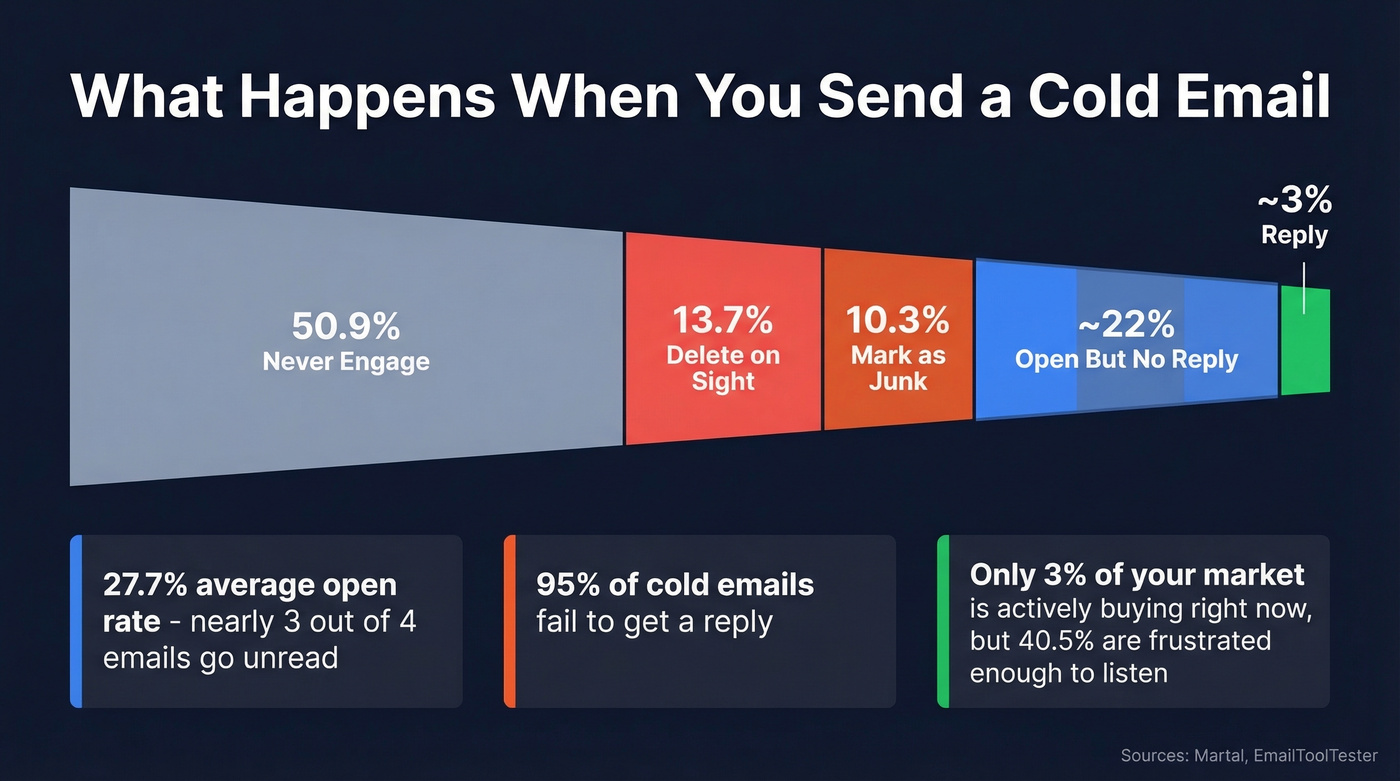
The math works against you. 95% of cold emails fail to generate a reply. Open rates hover around 27.7%, meaning nearly three-quarters of your emails aren't even read. Only about 3% of your market is actively buying at any given moment, though 40.5% are frustrated enough with their status quo to consider a change. That second group is your real addressable audience, and reaching them requires an intro email that speaks to their frustration - not your product's feature list.
What Every AE Intro Email Needs
Non-negotiables:
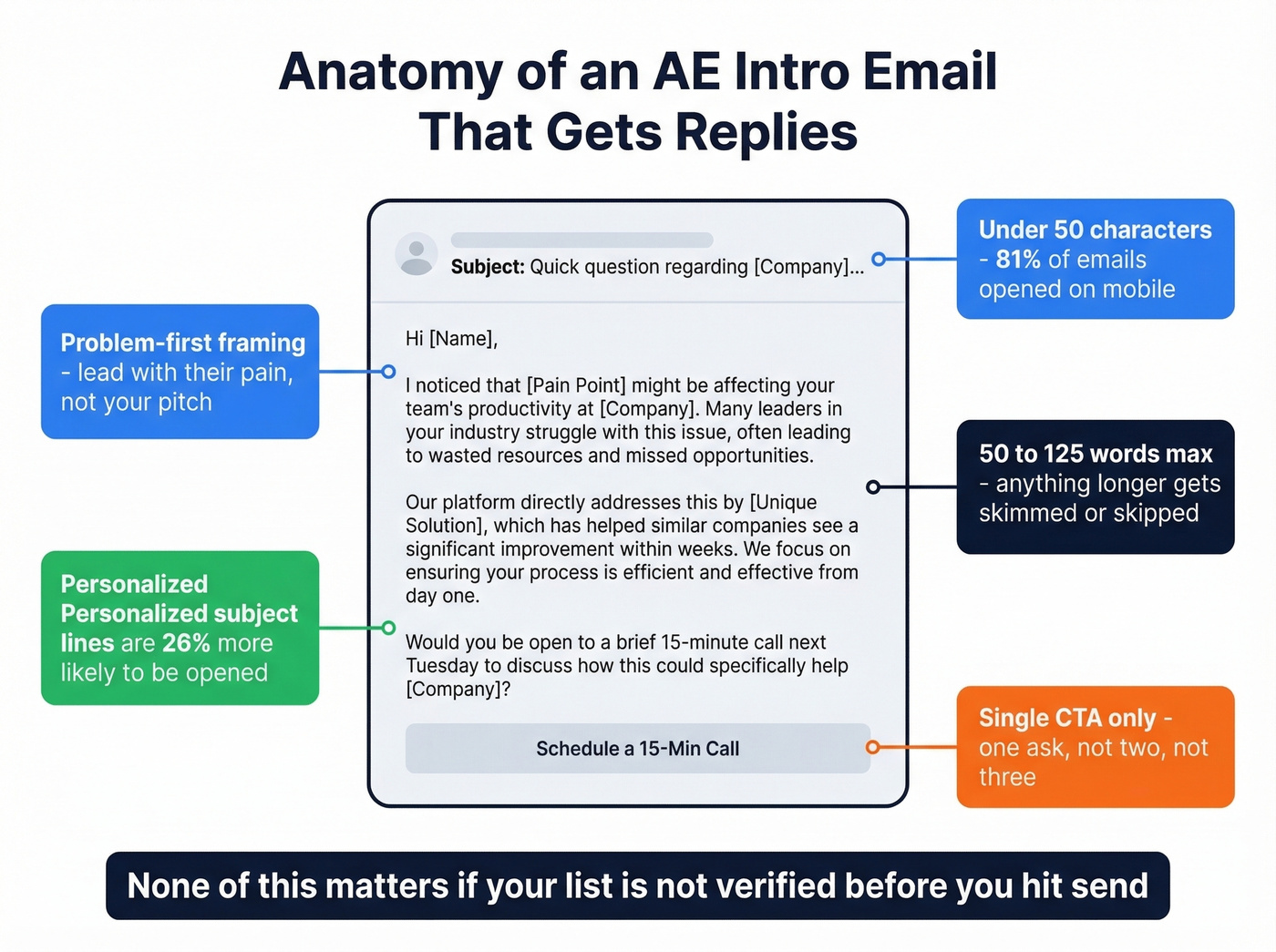
- 50-125 words in the body. Anything longer gets skimmed or skipped.
- Subject line under 50 characters. 81% of emails are opened on mobile - long subjects get truncated. If you need ideas, pull from proven email subject line examples.
- Personalized subject lines. They're 26% more likely to be opened.
- Single CTA. One ask. Not two. Not "let me know or feel free to check out our site." (More rules and examples in this email call to action guide.)
- Problem-first framing. Lead with their pain, not your pitch.

Your AE intro email is only as good as the address it lands on. Prospeo's 5-step verification catches dead addresses, spam traps, and catch-all domains before they torch your sender score - at $0.01 per email with 98% accuracy.
Stop crafting perfect emails that bounce. Verify first.
4 AE Intro Email Templates
Cold Prospect Introduction
Before you write a word, run what sales trainer Leslie Venetz calls the "I/we/our" test. Count how many times your draft says "I," "we," or "our" versus "you" or "your." If you're talking about yourself more than the prospect, rewrite. We've reviewed hundreds of cold emails from AEs on our team - the ones that open with "We're the leading platform for..." get deleted instantly. The best cold intros name a specific problem the prospect likely has and hint at a path forward without pitching features. If you want a broader system, start with these sales prospecting techniques.
Subject: [Specific pain point] at [Company]
Hi [First Name],
[Specific observation about their company or role - one sentence]. Most [title]s I talk to are dealing with [specific problem relevant to their industry].
We helped [similar company or persona] cut [metric] by [result] in [timeframe]. Curious if that's on your radar.
Worth a 15-minute call this week?
[Your name] [Direct phone number]
SDR-to-AE Handoff
Your SDR pinged you: meeting booked, Thursday 2pm, sparse CRM notes. This is where most deals quietly die - not because the prospect lost interest, but because the handoff email was a bare calendar invite with no context. In our experience, the handoff email matters more than the discovery call prep.
The Harris Consulting framework covers the core elements: thank the prospect, confirm the meeting, introduce the AE with a direct phone number, recap the challenges discussed, and clarify who the point of contact is going forward. If you want to be thorough, ask them to review the recap for misunderstandings and include clear next steps. (You can also borrow structure from these handoff email templates.)
Subject: Looking forward to Thursday, [First Name]
Hi [First Name],
Thanks for chatting with [SDR name] - sounds like [challenge 1] and [challenge 2] are top of mind for your team right now.
I'm [Your name], and I'll be joining Thursday's call to dig into those. Calendar invite is on its way. If anything changes, reach me directly at [phone].
I'll be your main point of contact from here. See you Thursday.
[Your name]
Territory / Account Takeover
You just inherited 150 accounts from an AE who left last month. This is the most-asked question on r/sales when AEs take over a book of business - and the drafts people post are almost always too long and too focused on themselves. The worst thing you can do is pretend nothing changed. The second worst? Write a three-paragraph autobiography.
Keep it simple: reassure the customer, share your contact info, suggest a brief call.
Subject: Your new point of contact at [Company]
Hi [First Name],
I'm [Your name], and I'll be your new account executive at [Company] going forward. [Previous AE name] spoke highly of your team and the work you've been doing with [specific project or product].
Nothing changes on your end - I'm here to make sure everything stays on track. My direct line is [phone] and I'm always reachable at [email].
Would a quick 15-minute call next week make sense to get aligned?
[Your name]
Multi-Threading Into a New Stakeholder
Your champion's bought in, but the deal needs sign-off from someone you've never spoken to. This email has to do two things: establish credibility through the existing relationship and frame the conversation around the new stakeholder's specific concerns - not a rehash of the original pitch.
Subject: [Champion name] suggested we connect
Hi [First Name],
[Champion name] and I have been working on [specific initiative] with your team. They mentioned you'd want visibility into [specific area relevant to this stakeholder's role - budget impact, technical fit, rollout timeline].
Rather than forward a thread, I'd love 15 minutes to walk you through what matters for [their function]. Would [day] work?
[Your name] [Direct phone number]
5 Mistakes Killing Your Reply Rate
1. Too much "I/we/our." If your email talks about you more than the prospect, it reads like a pitch. Flip the ratio.
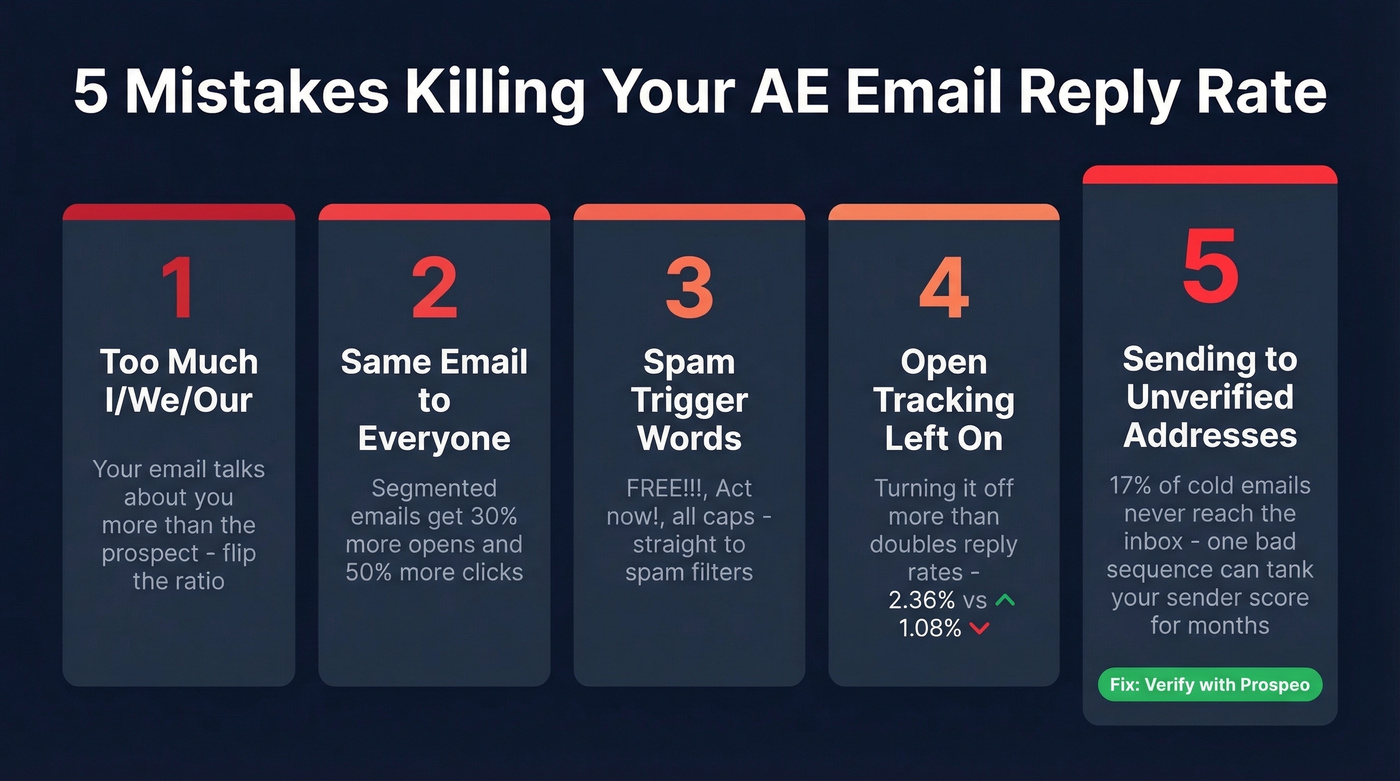
2. Same email to everyone. Segmented emails get 30% more opens and 50% more clicks. A VP of Engineering and a CFO don't care about the same things.
3. Spam trigger words. "FREE!!!", "Act now!", excessive punctuation, all caps - these route you straight to spam filters. If you want to sanity-check language before sending, use an email spam checker.
4. Open tracking left on. A Snov.io analysis of 44M+ emails found that turning off open tracking more than doubled reply rates: 2.36% vs 1.08%. Turn it off. (If you want the technical why, see email tracking pixels.)
5. Sending to unverified addresses. Here's the thing - 17% of cold emails never reach the inbox. If you're launching sequences against an unverified list, you're burning your domain reputation with every bounce. A single bad sequence can tank your sender score for months, and no amount of clever copywriting fixes deliverability. Run your list through a verification tool like Prospeo before hitting send. Snyk's 50 AEs saw bounce rates drop from 35-40% to under 5%, and AE-sourced pipeline jumped 180% after cleaning up their data.

Let's be honest: if your deal sizes sit below five figures, you probably don't need a $30k/year data platform. But you absolutely need verified emails. Data quality is the unsexy prerequisite that separates AEs who book meetings from AEs who wonder why nobody replies. If you're troubleshooting bounces, start with these email bounce rate benchmarks and fixes.
Your Follow-Up Cadence
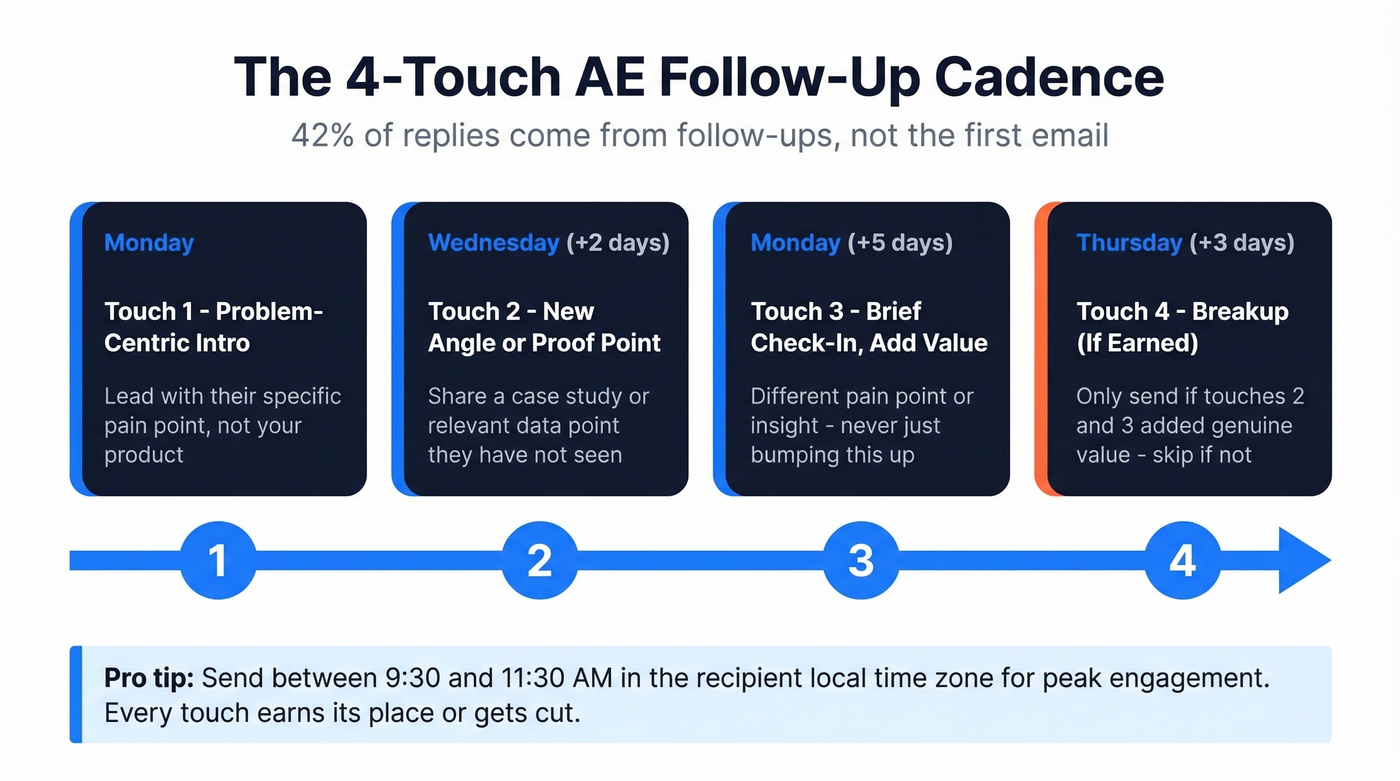
42% of replies come from follow-ups, not the first email. A simple four-touch sequence:
| Touch | Timing | Subject Line Approach |
|---|---|---|
| 1 | Monday AM | Problem-centric intro |
| 2 | Wednesday (+2 days) | New angle or proof point |
| 3 | Monday (+5 days) | Brief check-in, add value |
| 4 | Thursday (+3 days) | Breakup - last touch |
Launch on Monday, follow up midweek. Send between 9:30-11:30 AM in the recipient's local time zone for peak engagement. Each touch should add a new angle - a case study, a relevant insight, a different pain point - not just "bumping this to the top of your inbox." We've watched AEs send five identical "just checking in" follow-ups and wonder why their pipeline is empty. Every touch earns its place or gets cut. For more options, see these sales follow-up templates.
Skip the breakup email entirely if you haven't added genuine value in touches 2 and 3. A guilt-trip "I guess this isn't a priority" closer burns bridges with prospects who might've been ready in six months.
Snyk's 50 AEs dropped bounce rates from 35-40% to under 5% and generated 200+ new opportunities per month after switching to Prospeo's verified data. Every template above works better when it actually reaches the inbox.
Fix the data upstream and watch your reply rates climb.