

Adapt.io vs Gazelle: Which One Do You Actually Need?
"We're choosing between Adapt.io and Gazelle." If that sentence came from your RevOps lead, the conversation is already off track. These tools do fundamentally different jobs, and most comparison pages online just slap them into the same template with half the fields blank because nobody wants to say the obvious thing out loud.
Adapt.io helps you pull contact data you can use for outreach today. Lightcast Gazelle helps you decide which companies deserve your attention in the first place. Pick the wrong one and you'll either have great targets with no usable contacts, or a fat list of emails pointed at companies that aren't buying anything this quarter.
30-Second Verdict
- Adapt.io wins if you need a self-serve contact database with a Chrome extension to pull emails and phones right now.
- Gazelle wins if you need growth intelligence - finding which companies are expanding so you can prioritize territory, verticals, or market entry.
What Each Tool Actually Is
Adapt.io - Contact Database + Enrichment
Adapt.io is a B2B contact database with enrichment and an extension-led workflow. Search, build lists, export to your CRM, run enrichment via CSV or API. It's positioned around contact credits rather than user licenses, which works well for self-serve teams but can quietly get expensive once reps start pulling 50-100 contacts a day.
The database covers 61M+ contacts. On G2, it holds a 4.6/5 from 2,789 reviews - a real sample size. The Chrome extension gets consistent praise ("easy to use" appears 71 times in reviews), and the product is built for teams that want to move fast without heavy implementation.
If you're evaluating this category broadly, start with a shortlist of sales prospecting databases and then compare accuracy and cost per usable contact.
Gazelle - Growth Intelligence, Not a Contact Tool
Lightcast Gazelle (formerly Gazelle.ai) takes a fundamentally different approach. Instead of starting with contacts, it ranks 8M+ international companies by likelihood to expand using its proprietary G-Score - factoring in signals like VC funding, fast revenue growth, key company events, and clustering intelligence. The idea is you pick the right accounts before you ever pull a phone number.
Where Gazelle really separates itself is market context: 18,000+ heatmaps across 900+ industries, plus industry profiles and economic indicators. It's deployed by users in more than 15 countries and shows up in economic development workflows as much as sales workflows. The platform holds a 4.7/5 from 61 G2 reviews - high satisfaction, much smaller pool, and 88% of those reviews are 5-star.
If you're building a repeatable targeting motion, pair this with an Ideal Customer Profile and a simple lead scoring model so the insights actually change rep behavior.
Feature Comparison
| Feature | Adapt.io | Lightcast Gazelle |
|---|---|---|
| Primary use case | Contact discovery & enrichment | Growth/market intelligence |
| Database size | 61M+ contacts | 8M+ ranked companies |
| Filters | Advanced firmographic + technographic | 80+ firmographic, thousands of technographic data points, growth signals |
| Email/phone data | Yes (verify independently) | Limited - often needs external validation |
| Growth scoring | No | Yes (G-Score) |
| Industry heatmaps | No | 18,000+ heatmaps |
| Implementation time | Fast self-serve setup | ~1 month avg |
| G2 rating | 4.6/5 (2,789 reviews) | 4.7/5 (61 reviews) |
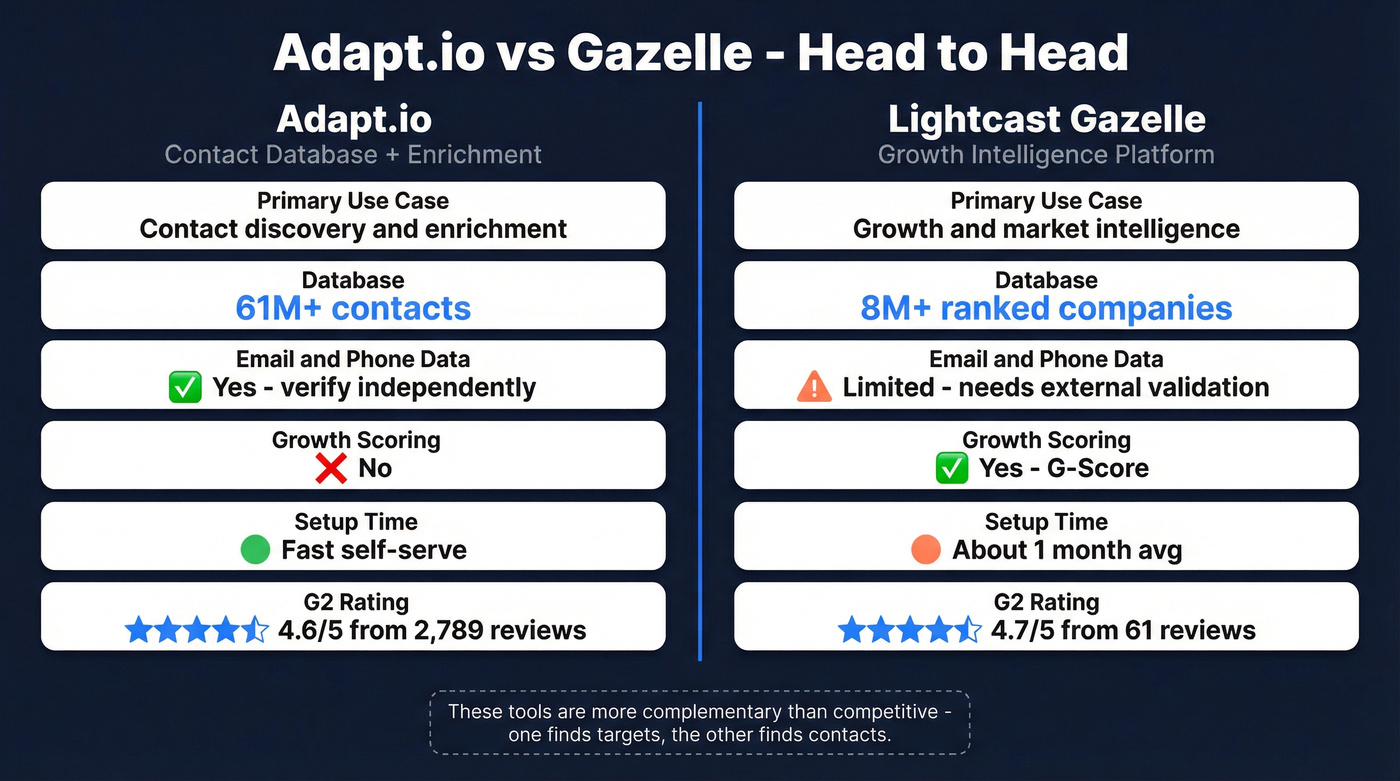
Let's be honest: Adapt.io competes more directly with tools like Apollo or Lusha than it does with Gazelle. Gazelle competes with "where should we play?" platforms - the strategic layer you'd normally bolt onto a data provider. They're complementary more than they're rivals.
If you're trying to operationalize that "strategic layer," it helps to map it into a real lead generation workflow so targeting doesn't live in a separate dashboard.

Whether you pick Gazelle for targeting or Adapt.io for contacts, neither verifies emails at 98% accuracy with a 7-day refresh cycle. Prospeo fills the gap - 300M+ profiles, 143M+ verified emails, and 125M+ verified mobiles at ~$0.01/email. No contracts, no stale data.
Layer verified contact data on top of any intelligence tool you choose.
What Users Actually Say
Adapt.io
The praise is consistent: Chrome extension speed (71 mentions), verification utility (59 mentions), and deliverability/accuracy/support (38 mentions). But the pain points are just as predictable. Limited credits block real usage (34 mentions), unexpected charges and restrictions hit when SDRs ramp up (24 mentions), and some incorrect emails still slip through (14 mentions).
If you're seeing bounces, benchmark against a normal email bounce rate and fix the root cause before scaling volume.
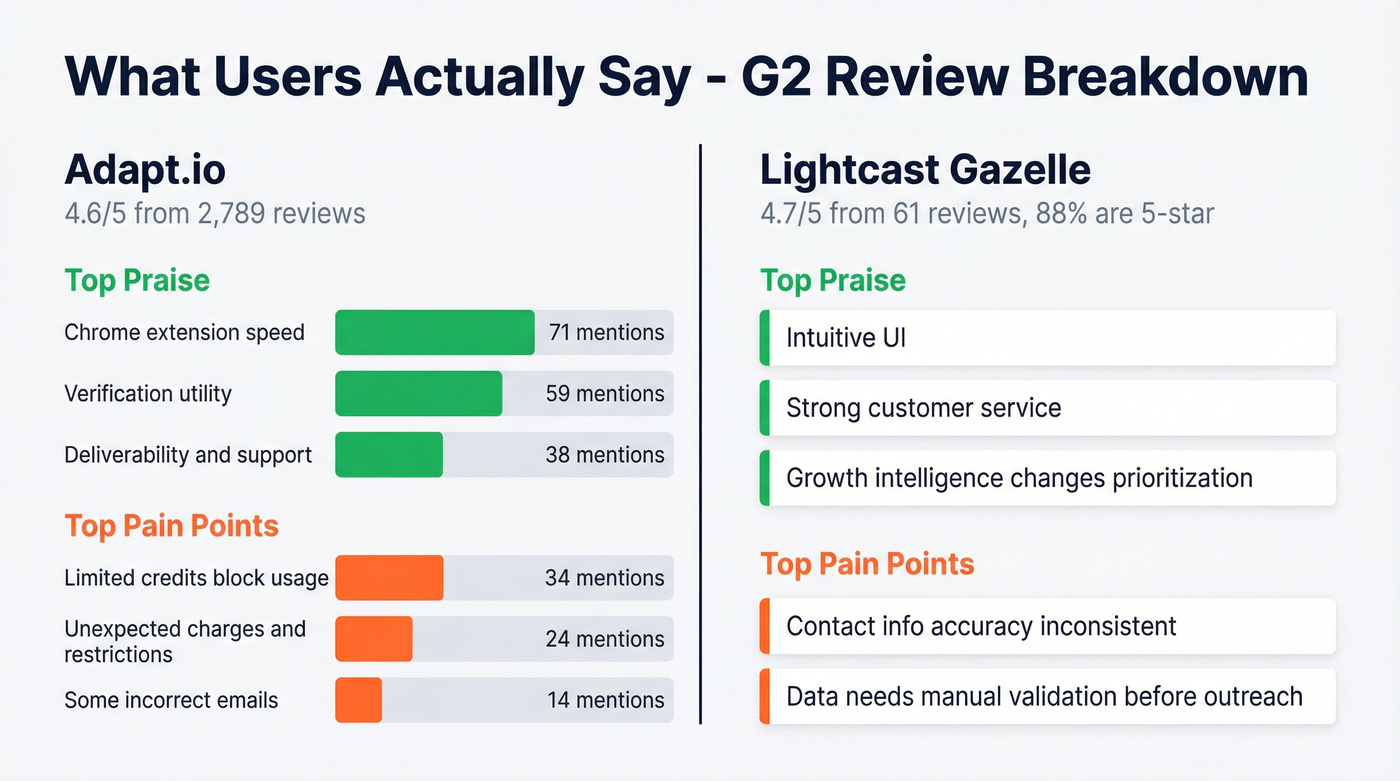
We've watched credit-based tools look cheap in month one, then quietly become expensive once reps hit a rhythm. That's the Adapt.io risk, and it's worth modeling out before you commit.
Gazelle
Gazelle users tell a different story. The UI is intuitive, customer service is strong, and the growth intelligence genuinely changes how teams prioritize accounts. The weak spot is contact info - accuracy can be inconsistent, and reviewers note that data needs manual validation before you can actually use it for outreach.
In our experience, growth scoring only delivers ROI if your team actually changes behavior: territory assignments, routing rules, prioritization frameworks, messaging. Otherwise it's an expensive dashboard nobody opens after Q1.
Most teams searching this comparison actually need both - a targeting layer and a contact layer. The real question is whether you're willing to pay for two tools or find one that covers enough of each.
Pricing and Cost at Scale
| Plan | Adapt.io | Lightcast Gazelle |
|---|---|---|
| Entry price | Free (25 email credits/month) | Contact vendor |
| Mid-tier | $49-$99/month | Quote-based |
| Enterprise | Custom quote | Typically $5K-$25K/year |
| Pricing model | Credit-based | Seats + modules |
| Free trial | 7-day (no credit card) | Available |
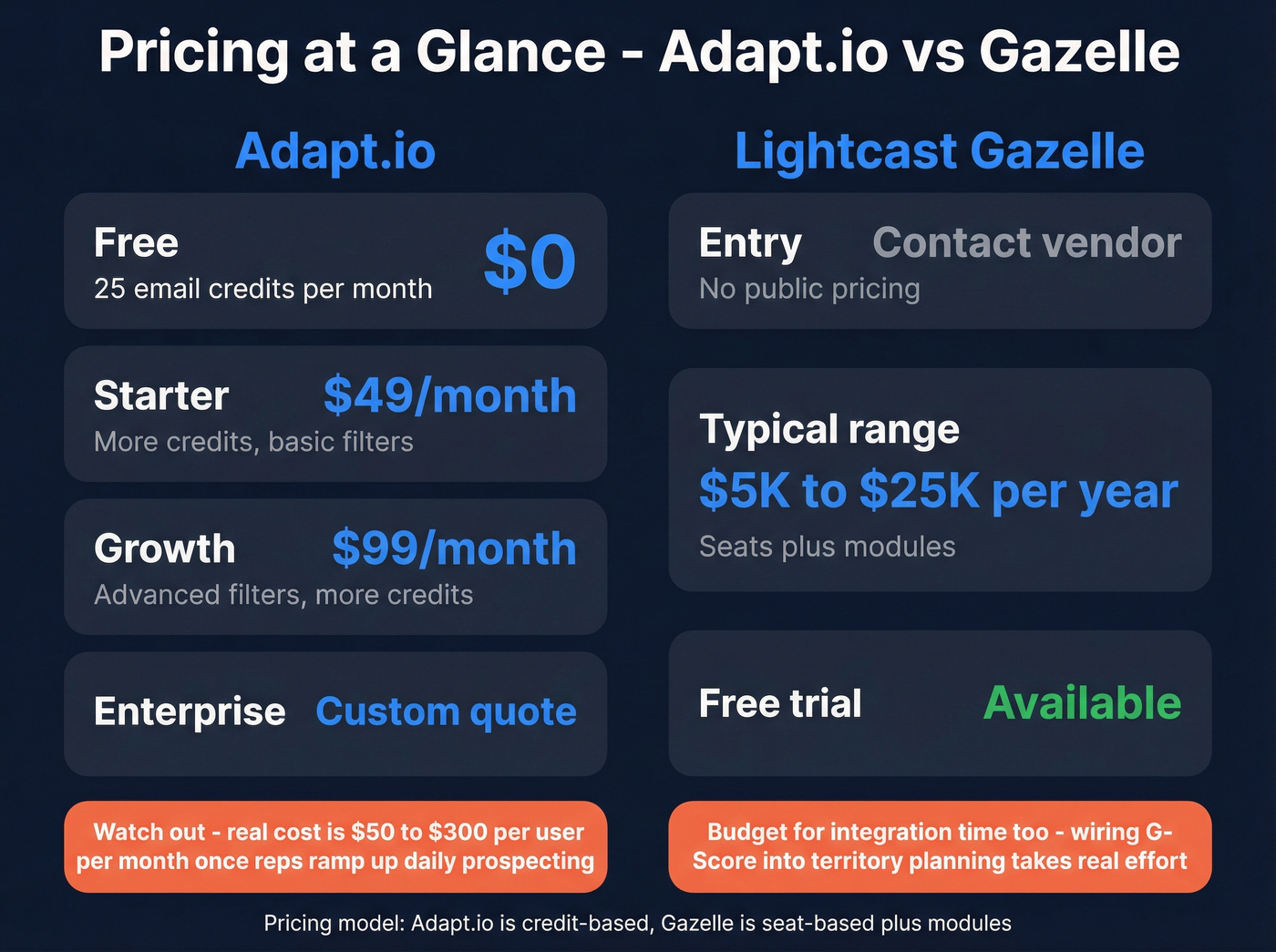
Adapt.io's public tiers run Free, then $49/month and $99/month, then Custom. The scaling reality is credit mechanics - "$49/month" gets expensive fast once multiple reps prospect daily. Teams often end up paying $50-$300/user/month depending on volume.
Gazelle is quote-based and typically lands around $5K-$25K/year depending on seats and modules. Budget for operational cost too: wiring the G-Score into territory planning, account selection, and reporting takes real time. If your team doesn't have someone who'll own that integration, the platform will collect dust.
If you're pressure-testing ROI, tie the spend back to pipeline health and whether targeting changes conversion downstream.
When Neither Fully Solves the Problem
Once you've identified targets with Gazelle or pulled contacts with Adapt.io, the next failure point is predictable: bad emails and stale mobiles tank deliverability and waste rep time. We've seen teams burn sending domains in weeks because they trusted unverified contact data straight out of a database.
If you're scaling cold outreach, follow a real email deliverability guide and add spam trap removal to your list hygiene process.
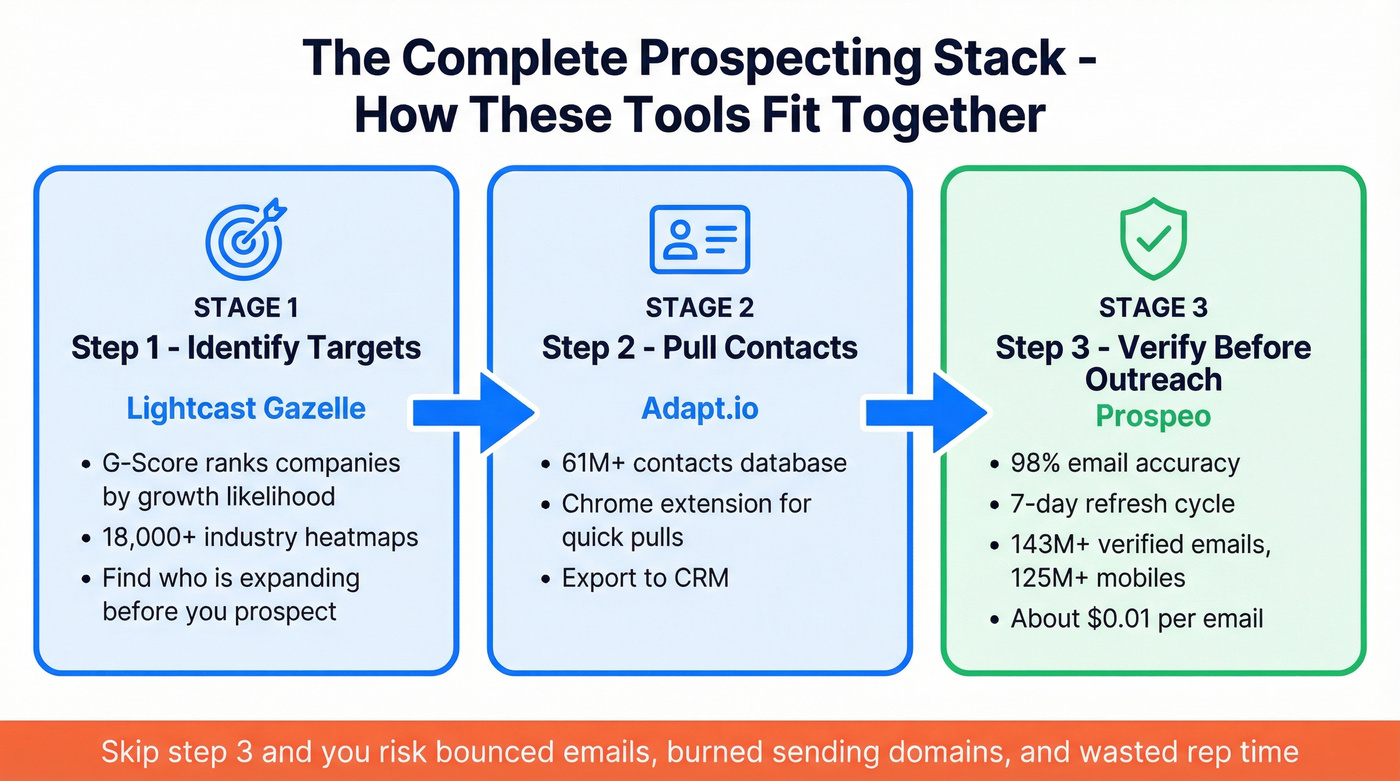
Prospeo delivers 98% email accuracy across 300M+ professional profiles, with 143M+ verified emails and 125M+ verified mobile numbers refreshed on a 7-day cycle versus the 6-week industry average. The Chrome extension (40K+ users) fits the same one-click prospecting workflow, but with verification built in. At roughly $0.01/email, you validate and enrich before outreach instead of hoping your list doesn't bounce.

Growth scoring means nothing if your emails bounce. Teams using unverified Adapt.io or Gazelle exports risk domain reputation on data that's weeks old. Prospeo refreshes every 7 days - not 6 weeks - and delivers 98% email accuracy with built-in catch-all handling and spam-trap removal.
Protect your sending domain. Verify every contact before outreach.
FAQ
Is Lightcast Gazelle the same as Gazelle.ai?
Yes. Gazelle.ai was acquired by Lightcast and rebranded. The product, G-Score methodology, and heatmap features remain the same. Review sites commonly reference both names across listings and historical reviews.
Can I use Adapt.io and Gazelle together?
Yes, and many teams should. Use Gazelle to identify high-growth target accounts, then use a contact database like Adapt.io - or Prospeo's email finder for verified emails and mobiles - to reach the right people at those companies.
What's the biggest data risk with either tool?
Both have user-reported accuracy gaps. Adapt.io users flag incorrect emails despite built-in verification (14 G2 mentions), and Gazelle users say contact info needs manual validation. Run contacts through a verification layer before outreach to protect deliverability and avoid burning your sending domain.
Which tool is better for small outbound teams?
Adapt.io is the faster start - self-serve signup, a free tier, and a Chrome extension that works immediately. Gazelle requires vendor contact, longer onboarding (~1 month), and a higher price floor ($5K+/year). For teams under 5 reps focused on booking meetings now, Adapt.io or a verified-data platform will deliver faster ROI than growth intelligence. Skip Gazelle until you've got enough pipeline volume that account selection becomes the bottleneck, not contact sourcing.