

Advantages of Personal Selling (With Data to Prove Them)
You're in a board meeting. Someone asks why the company still pays reps to have one-on-one conversations when you could just run ads. The answer is conversion math: personal selling converts at 20-40% vs. 1-5% for mass marketing channels. But "trust me, it works" isn't a board-ready answer. The data is.
The Short Version
One-to-one selling converts at 20-40% vs. 1-5% for mass marketing. It costs more per contact ($50-200 vs. $0.10-$5), but the lifetime value math favors it for complex B2B deals where average contract values justify the investment. The catch? It only works if your reps can actually reach the right person with verified data. Otherwise you're burning expensive human hours on bounced emails and wrong numbers.
What Is Personal Selling in 2026?
Personal selling isn't handshakes and golf courses anymore. It's a rep on a Zoom call walking a procurement committee through a tailored demo. It's a personalized Loom video sent to a VP who ghosted your sequence. It's a strategic phone call that unsticks a deal stuck in legal review.
80% of B2B sales interactions now happen virtually. The "personal" part refers to the one-to-one, adaptive nature of the conversation - not the physical proximity. Companies using hybrid sales models see up to 50% higher revenue growth, and 9 out of 10 companies plan to keep hybrid models permanent.
8 Benefits of Personal Selling Backed by Data
Every article ranking for this topic lists "builds trust" and "handles objections" without a single number. That's not insight - it's filler. Here are the actual advantages of personal selling, each anchored to data.
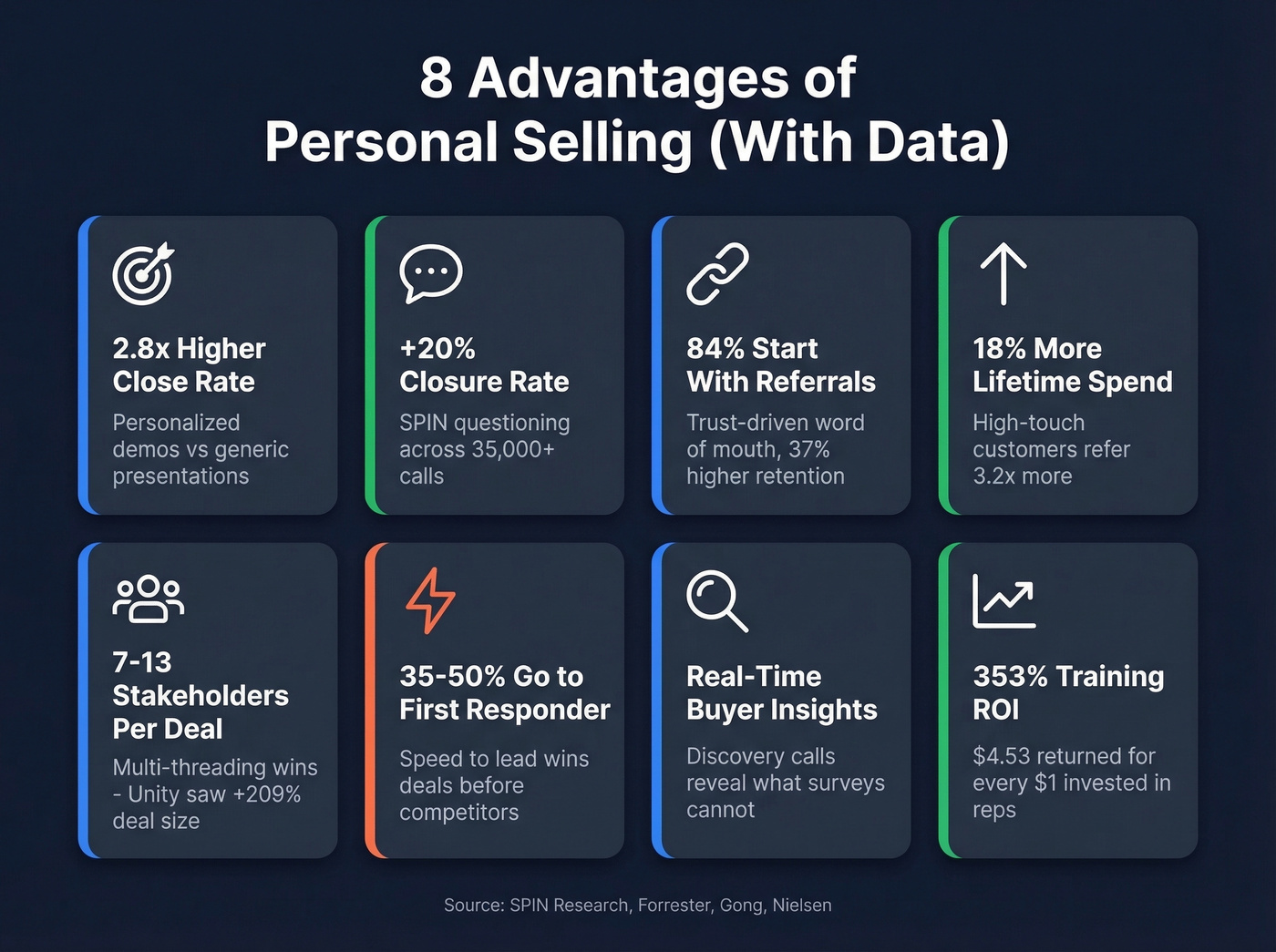
1. Personalization Drives Conversion
A study of 1,200 B2B sales cycles found that personalized demos closed at 2.8x the rate of generic presentations. In practice, that's the difference between a 15% close rate and a 42% close rate. Reps tailor every slide, every pricing scenario, every example to the specific buyer on the screen. Mass marketing can segment audiences. One-to-one selling can customize in real time, mid-sentence, based on a raised eyebrow.
If you want more real-world patterns, see examples of personal selling across modern channels.
2. Real-Time Objection Handling
Neil Rackham's SPIN research - 35,000+ sales calls across 20+ countries over 12 years - found that a structured questioning strategy increases closure rates by 20%. The key isn't having answers to objections. It's hearing the objection live, reading the room, and adapting on the fly. An ad can't do that. An email sequence can't do that.
If you learn one sales framework, make it SPIN. 35,000+ calls don't lie. For a deeper breakdown, use the SPIN Sales Methodology as your baseline.
3. Trust That Generates Referrals
Picture this: a buyer finishes onboarding, loves the product, and their peer at another company asks what they're using. 84% of buying decisions start with a referral, and customers acquired through word-of-mouth have 37% higher retention. Rep-led selling is the only channel that builds the kind of relationship where a buyer picks up the phone and says, "You should talk to my rep." That referral pipeline compounds over years - at zero ad spend.
If referrals are a core motion, build a repeatable referral sales pitch your team can run.
4. Higher Customer Lifetime Value
Customers acquired through high-touch sales spend 18% more over their lifetime and refer 3.2x more new customers than those acquired through impersonal channels. The upfront cost is higher, but the downstream economics are roughly 3x better. For any deal where retention and expansion matter - which is most of B2B SaaS - rep-led selling pays for itself within the first renewal cycle.
This is also why tracking LTV to CAC matters more than cost-per-lead in complex sales.
5. Complex Deal Navigation
The average B2B deal involves 7.4 decision-makers. Forrester puts the number at 13 stakeholders for enterprise purchases. No automated sequence can navigate the politics between a champion, an economic buyer, a legal reviewer, and a technical evaluator who all have different priorities.
When Unity rolled out Clari, win rates jumped 29.9% and average deal size increased 209%. That's what multi-threading across a buying committee looks like in practice. If you need a playbook for that, use a multi-threaded sales approach.
6. Speed Wins Deals
35-50% of sales go to the vendor that responds first. A direct call, a personalized video, a same-day demo - rep-led outreach is the fastest way to establish a human connection before a competitor does.
Even voicemail works. Gong data shows leaving one doubles reply rates from 2.73% to 5.87%. Social sellers generate 45% more opportunities than traditional channels, but the highest-converting social selling still involves a personal conversation, not just a connection request.
To systematize this, align outreach to your sales cycle metrics and response-time SLAs.
7. Real-Time Buyer Insights
Here's an advantage that doesn't show up in conversion metrics but shapes everything else. Reps in live conversations hear what buyers actually care about - the objections marketing didn't anticipate, which competitor keeps coming up, which feature request would close the deal tomorrow.
We've watched this feedback loop transform product roadmaps. No survey or analytics dashboard captures what a 45-minute discovery call reveals. A strong discovery call script helps you capture those insights consistently.
8. Training ROI Compounds
$4.53 returned for every $1 invested in sales training - a 353% ROI.
Companies that provide post-training reinforcement see 34% more first-year reps hit quota. Grammarly saw an 80% increase in conversion rates after investing in structured rep enablement. Unlike ad spend, which stops working the moment you stop paying, investment in rep capability compounds. A seller who masters consultative selling in year one is exponentially more valuable in year three.
To make training stick, standardize your selling process steps and coach to them.

Your reps convert at 20-40% - but only when they reach the right person. Prospeo gives your team 98% accurate emails and 125M+ verified mobile numbers with a 30% pickup rate, so every expensive rep hour is spent in actual conversations, not chasing bounces.
Stop burning rep time on bad data. Start closing.
Personal Selling vs. Digital Channels
The table below shows why one-to-one selling isn't "better" or "worse" - it's a different tool for a different job.
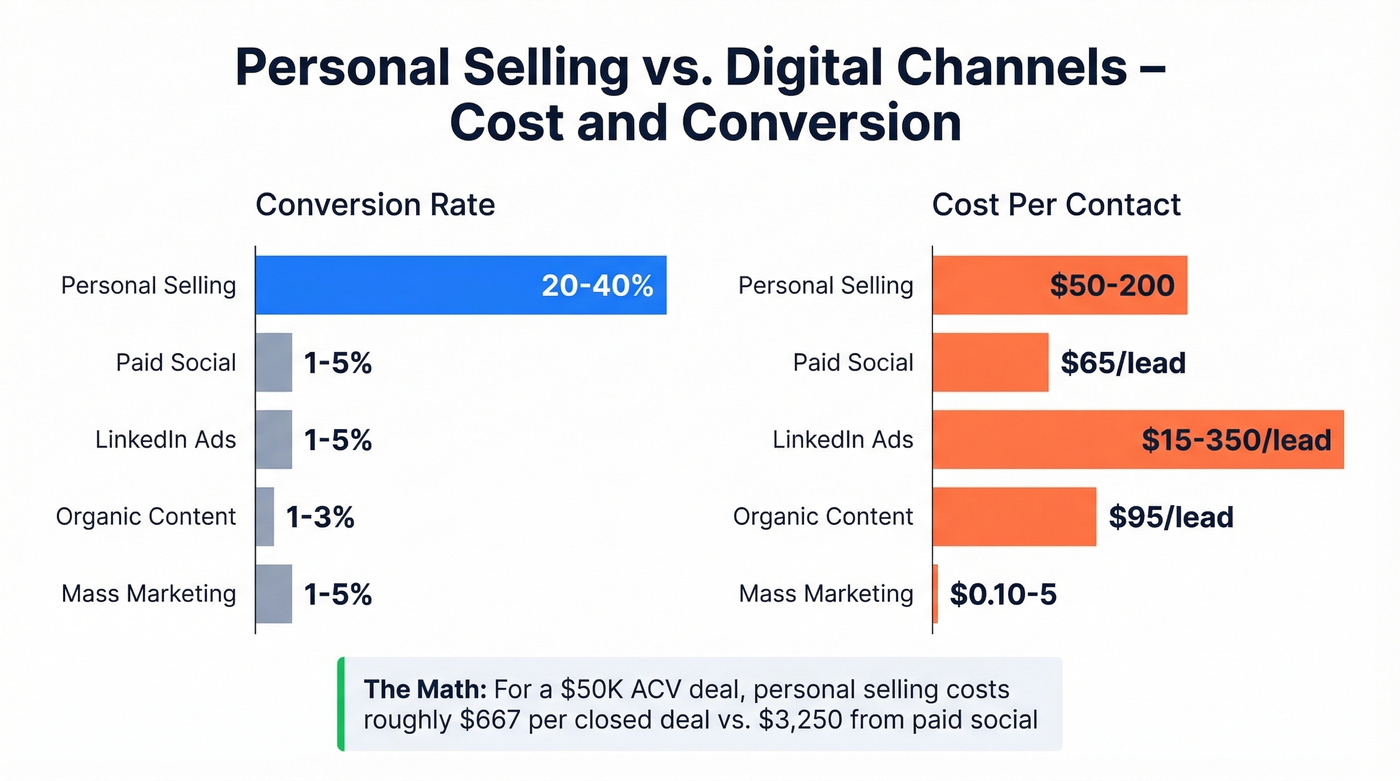
| Channel | Cost/Contact | Conversion | Best For |
|---|---|---|---|
| Personal selling | $50-200 | 20-40% | Complex B2B, high ACV |
| Paid social | ~$65/lead | 1-5% | Awareness + volume |
| LinkedIn ads | $15-$350/lead | 1-5% | Targeted B2B |
| Organic content | ~$95/lead | 1-3% | Long-term inbound |
| Mass marketing | $0.10-5 | 1-5% | High-volume, low ACV |
The takeaway: rep-led selling is 10x more expensive per contact but 4-40x more effective at converting. For a $50K ACV deal, spending $200 at a 30% conversion rate means roughly $667 per closed deal vs. $3,250 per closed deal at 2% from paid social. (If you want to sanity-check your benchmarks, compare against B2B conversion rates.)
The Real Disadvantages (and How to Fix Them)
Let's be honest - rep-led selling has real limitations. Understanding both sides helps you deploy it strategically rather than blindly.
High cost per contact. At $50-200 per interaction, this is the most expensive channel per touch. Reserve it for deals where the ACV justifies the investment. If you're selling a $500/year product, one-to-one selling will destroy your unit economics. For five-figure deals and above, the conversion advantage more than covers the cost.
Hard to scale. One rep can only have so many conversations per day. Inside sales reps can cover 4x the prospects at half the cost of field reps, but there's still a ceiling. Hybrid models solve this - companies combining virtual selling with automated top-of-funnel see up to 50% higher revenue growth.
Dependent on data quality. This is the one that kills deals silently. A rep can't sell if they can't reach the right person. Bad data wastes rep hours fast. Verified contact data from a platform like Prospeo - with 98% email accuracy and 125M+ verified mobile numbers - eliminates wasted outreach so reps spend time in actual conversations instead of chasing dead leads. If you're cleaning up deliverability, start with an email verifier website and a repeatable CRM hygiene routine.
When to Use Personal Selling
Use it when:
- Deal size exceeds $10K and involves multiple stakeholders
- The product requires customization, integration, or complex implementation
- The buyer's problem is nuanced enough that a generic demo won't land
- You're competing against an incumbent and need to build trust fast
- The sales cycle exceeds 30 days and involves negotiation
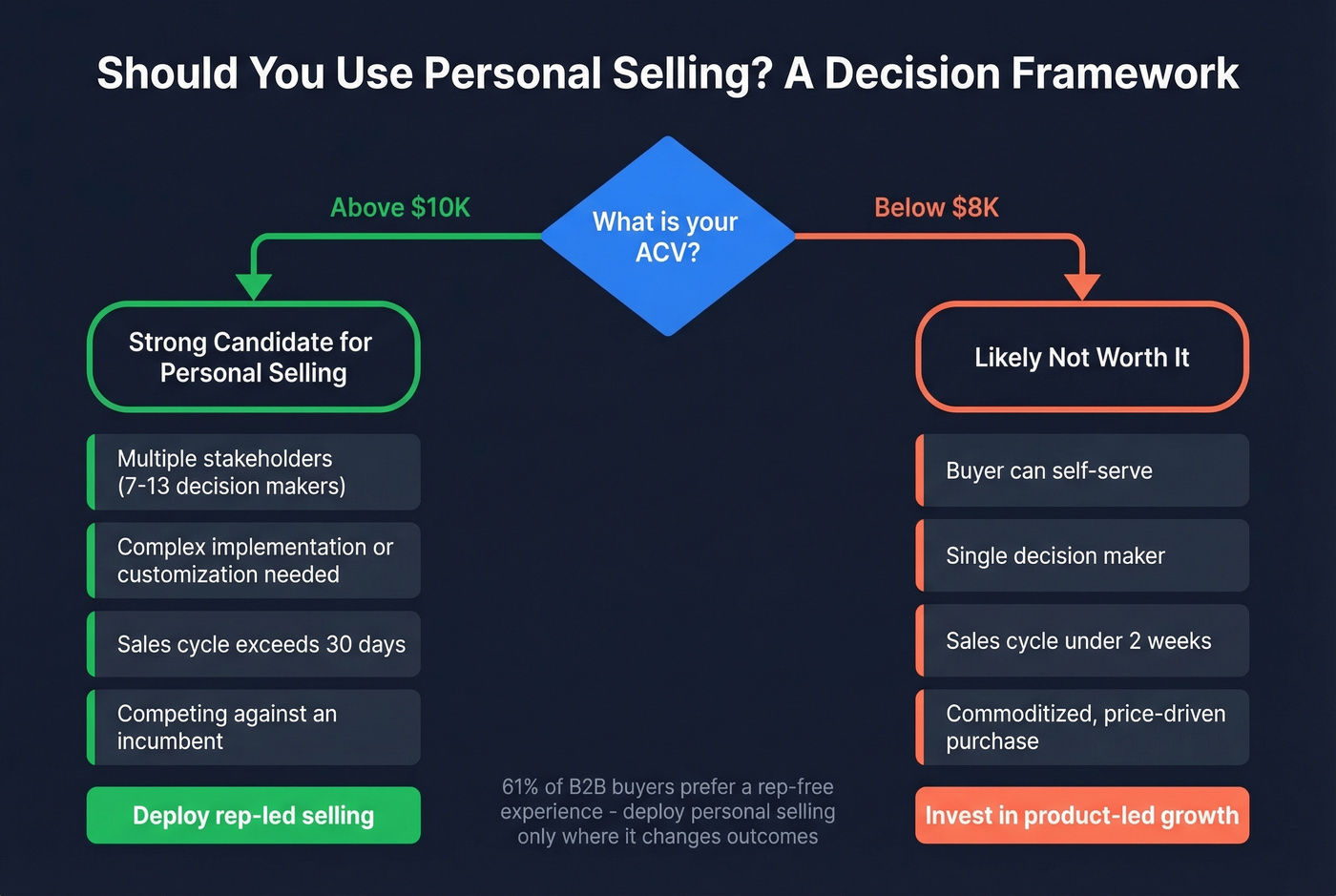
Skip it when your ACV is in the low four figures or below, the buyer can self-serve and clearly prefers to, the sales cycle is under two weeks with a single decision-maker, or your product is commoditized and the buyer is comparing on price alone.
Academic research on direct selling vs. online channels confirms there's no single winner - the companies that grow fastest adopt flexible multichannel approaches. 61% of B2B buyers prefer a rep-free experience. That's not a reason to abandon one-to-one selling. It's a reason to deploy it where it actually changes outcomes.
Here's the thing: if your average deal is under $8K, you probably don't need rep-led selling at all. Invest in product-led growth and save high-touch conversations for expansion deals. Most companies over-invest in one-to-one sales for deals that don't warrant it.
How AI Is Reshaping Rep-Led Sales in 2026
Gartner projects that by 2028, AI will close 70% of sales cycles by automating prospecting, qualification, and routine negotiations. The advantages of personal selling that matter now are the ones AI can't replicate: reading a room, navigating politics between 13 stakeholders, and knowing when to shut up.
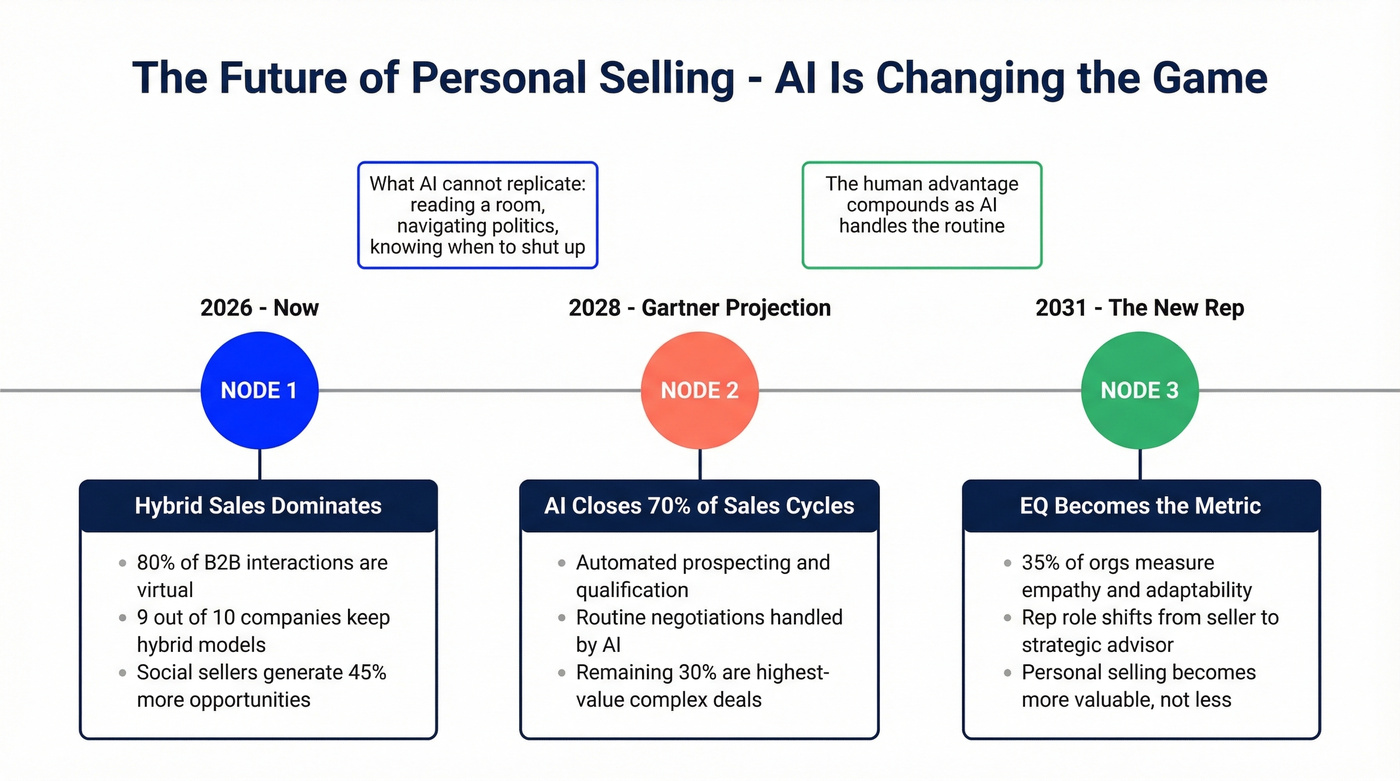
The remaining 30% of deals that need a human are the highest-value, most complex transactions - exactly where rep-led selling is strongest. By 2031, Gartner expects 35% of sales organizations to introduce EQ-related productivity metrics, measuring empathy, adaptability, and relationship depth alongside pipeline and quota. The rep's role is shifting from "seller" to strategic advisor, and that shift makes one-to-one selling more valuable, not less.
All of these advantages collapse if your contact data is wrong. A rep can't build trust with someone they can't reach. In our experience, the reps who close the most aren't the best talkers - they're the ones who reach the right person on the first try. When Snyk's 50 AEs switched to verified data, bounce rates dropped from 35-40% to under 5%, and AE-sourced pipeline increased 180%. That's the difference between personal selling as a theory and personal selling as a revenue engine.
Navigating 7+ stakeholders per deal means your reps need direct access to every decision-maker. Prospeo's 30+ search filters - including buyer intent, job changes, and department headcount - let you map the entire buying committee with verified contact data refreshed every 7 days.
Multi-thread every deal with contacts you can actually reach.
FAQ
What's the biggest advantage of personal selling over advertising?
Real-time adaptation. A rep can read objections, adjust the pitch, and close in a single conversation - advertising can't respond to a buyer's specific concerns. One-to-one selling converts at 20-40% vs. 1-5% for mass channels, making it the highest-converting approach for complex deals.
Is personal selling still effective in 2026?
Yes, but it's hybrid. 80% of B2B sales interactions happen virtually, and companies using hybrid models see up to 50% higher revenue growth. The fundamentals - personalization, trust-building, objection handling - are more valuable than ever as AI handles routine transactions.
What are the main advantages and disadvantages of personal selling?
Core benefits include higher conversion rates (20-40%), real-time objection handling, deeper trust that drives referrals, and higher customer lifetime value. The drawbacks are high cost per contact ($50-200), limited scalability, and dependence on data quality. All three are manageable: target high-ACV deals, adopt hybrid models, and use verified contact data to eliminate wasted outreach.
When should a company avoid personal selling?
When deal sizes are in the low four figures, the buyer prefers self-serve, or the sales cycle is under two weeks. 61% of B2B buyers prefer a rep-free experience - respect that when the deal doesn't warrant high-touch engagement.
What tools make personal selling more effective?
CRMs like Salesforce and HubSpot handle process management. Sales frameworks like SPIN and Challenger provide methodology. Verified data platforms ensure reps reach the right contacts without bounces or wrong numbers - that's the foundation everything else depends on.