

10 Examples of Personal Selling With Real Scripts, Case Studies, and Data
A RevOps lead we work with spent three weeks building a perfect outbound sequence - personalized openers, custom case studies, the works. Then 23% of the emails bounced and half the phone numbers were disconnected. Every example of personal selling skill in the world can't save you when your data is dead on arrival.
Harvard professor Gerald Zaltman's research found that 95% of purchasing decisions are subconscious. That's why personal selling - where a human reads the room, adjusts the pitch, and builds trust in real time - can convert at 20-40% on qualified opportunities, versus under 2% average conversion across e-commerce sites. The gap isn't small. It's a different universe.
What follows: 10 industry-specific examples with word-for-word objection scripts organized by BANT, four named case studies with revenue outcomes, and the five mistakes that kill most deals.
What Is Personal Selling?
Personal selling is any one-to-one interaction where a salesperson adapts their message to a specific buyer in real time - phone calls, video demos, in-person meetings, even highly personalized email threads. Not just the handshake-on-the-showroom-floor image most people picture.
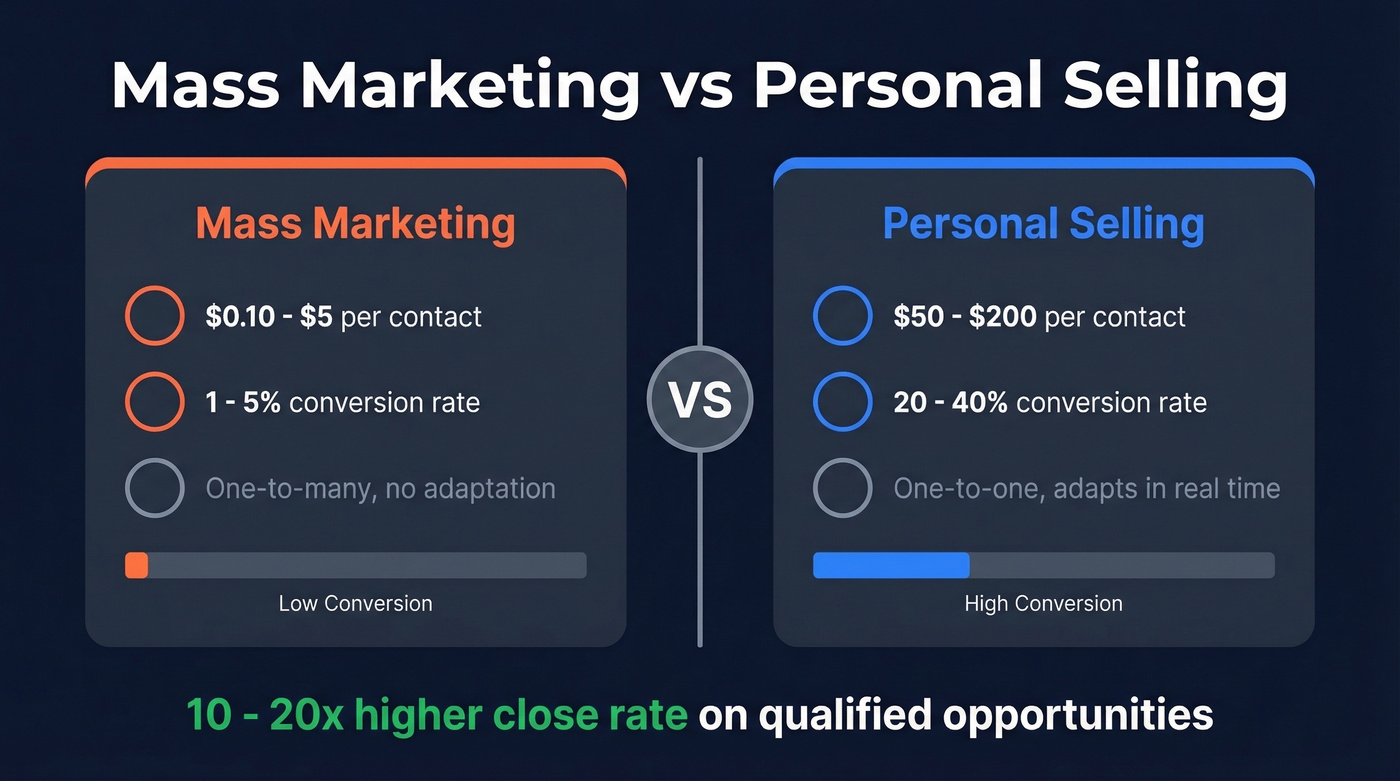
The tradeoff is straightforward. Mass marketing costs $0.10-5 per contact and converts at 1-5%. Personal selling costs $50-200 per contact and converts at 20-40% for qualified opportunities. You're paying more per touch, but closing at 10-20x the rate. For complex products, high-value deals, or anything requiring trust, the math works decisively in its favor.
Types of Personal Selling
Retail and consultative selling sit at opposite ends of the complexity spectrum but share the same DNA. A Rolex associate who learns your preferences and curates options before you ask is doing the same thing as a SaaS rep who diagnoses your workflow bottleneck during discovery. Both adapt in real time to what the buyer actually needs. The difference is cycle length and deal size, not the underlying skill.
The other four types round things out:
- Telemarketing - Outbound reps qualifying leads or cold-calling a target list. Lower cost per touch, higher volume. (If you're building a repeatable motion, a cold calling system helps standardize what works.)
- Direct selling - Think Avon or Tupperware. The rep is the channel - they demo, sell, and deliver in someone's living room.
- Social selling - Engaging prospects through professional networks and content before ever making a pitch. Warm intros, not cold blasts.
- Inside sales - Remote reps running full cycles via phone and video. Inside sales now makes up roughly 40% of high-growth B2B teams, up from 10% in 2017.
The 7-Step Personal Selling Process
Every interaction follows roughly the same arc, whether you're selling enterprise software or luxury watches.
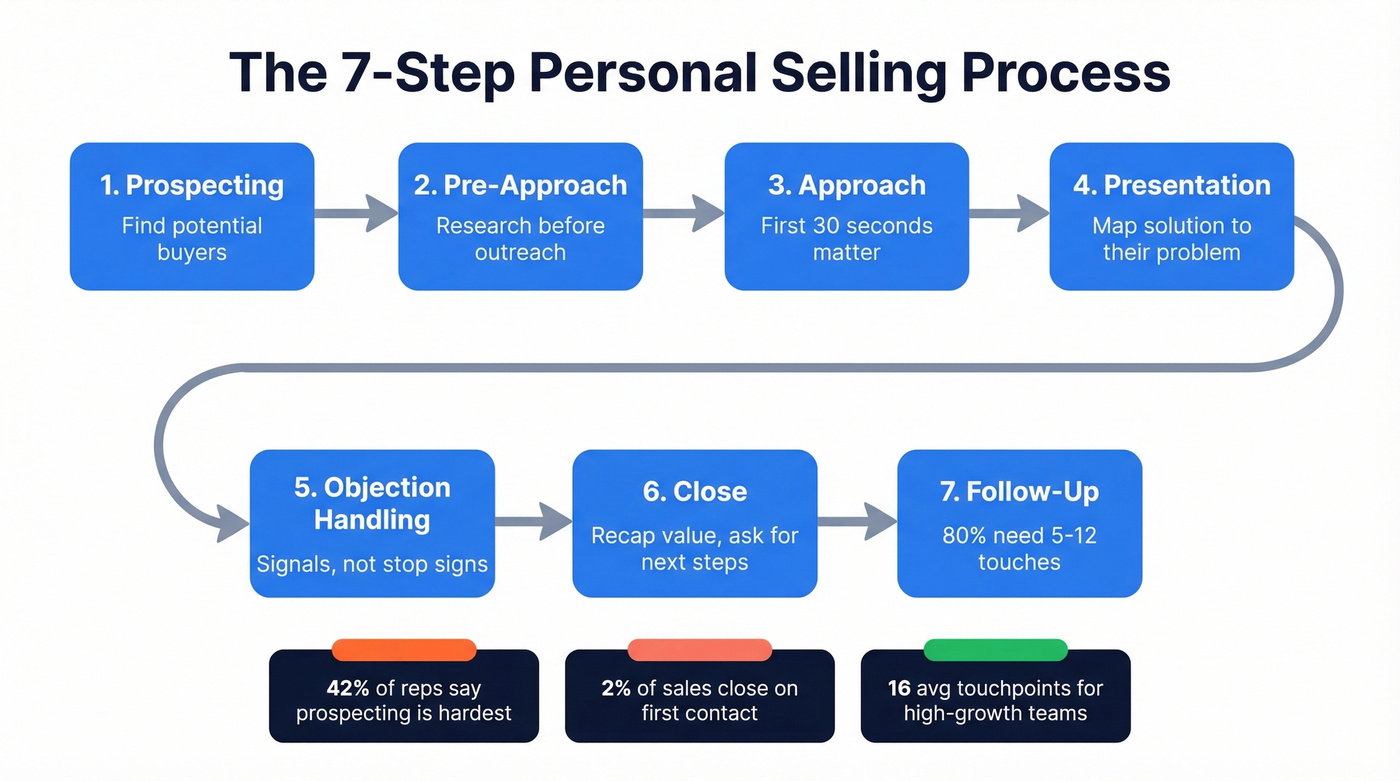
Prospecting. Finding people who might actually buy. 42% of salespeople rank this as the hardest step. A consistent theme on r/sales: never stop prospecting, even when your pipeline feels full. (For a tighter playbook, see these sales prospecting techniques.)
Pre-approach. Research the prospect before you reach out - recent news, tech stack, org chart, pain points. Spend 10-15 minutes per account. But don't waste that effort on bad data. Verify emails and direct dials before you invest time personalizing; tools like Prospeo can handle this with 98% email accuracy and a 7-day refresh cycle. (If bounces are a recurring issue, start with email bounce rate benchmarks and fixes.)
Approach. The first 30 seconds of contact. Lead with relevance, not your product. "I noticed your team just expanded into EMEA - that usually creates X challenge" beats "Hi, I'm calling from..." (If you're using video, this Loom video cold email guide pairs well with personal selling.)
Presentation. Map your solution to their specific problem. This isn't a feature dump. It's a conversation where you demonstrate understanding of their world and show how you change it. (Use a tighter discovery framework with discovery questions.)
Objection handling. Expect resistance. Budget, timing, authority, need - these are signals, not stop signs. Scripts below.
Close. Recap the problem, the solution, and the agreed-upon value, then ask for next steps. (If you want a more structured close, follow these steps to close a sale.)
Follow-up. Only 2% of sales close on first contact. 80% require 5-12 follow-up attempts, yet 44% of reps quit after one. High-growth teams average 16 touchpoints per prospect in a 2-4 week window. Speed and persistence separate closers from everyone else. (If you need copy you can send today, use these sales follow-up templates.)
10 Personal Selling Examples by Industry
SaaS/B2B Tech - Personalized Video Outreach
A B2B software company switched their top 100 target accounts from automated sequences to personalized video messages - 60-second Looms walking through the prospect's own dashboard, naming specific issues. The result: 34% response rate versus 8% from email alone, generating $2.1M in additional pipeline in 90 days. This is one of the clearest examples of personal selling in marketing driving measurable revenue.
Luxury Retail - Consultative In-Store Experience
Walk into a Rolex or Gucci boutique and nobody "sells" you anything. The associate learns your occasion, style history, and budget range, then curates three options. You feel understood, not pitched. It's needs assessment disguised as conversation - and it's one of the highest-converting retail motions because the buyer experiences taste, status, and fit in real time.
Real Estate - Buyer Needs Assessment
Weak agents blast listings based on price range and zip code. Strong agents spend the first meeting asking about lifestyle, commute tolerance, school districts, and deal-breakers - then match properties to life priorities, not square footage. Same inventory, wildly different close rates. (If you're in that niche, these real estate phone scripts for internet leads help with the first contact.)
Financial Services - Retirement Planning
A financial advisor runs a "retirement gap analysis" showing exactly where the prospect's current savings trajectory falls short. The numbers do the selling. When the gap is visual and specific, urgency becomes obvious - no hard pitch required.
Automotive - Test Drive Plus Financing
The best car salespeople don't push features. They get you behind the wheel, then walk through monthly payment scenarios tailored to your budget. The test drive creates emotional commitment; the payment walkthrough removes the rational objection. Two different selling motions in one visit. (Dealership teams often pair this with an auto sales CRM to keep follow-ups tight.)
Pharma/Medical Devices - Rep Detailing
A medical device rep doesn't drop brochures. They attend procedures, train clinicians on technique, and present clinical outcome data relevant to the specific use case. The rep becomes a clinical resource, not a vendor. That distinction is everything in a field where trust directly affects patient outcomes.
Insurance - Needs-Based Recommendation
Instead of quoting the cheapest premium, a strong insurance agent maps coverage to life events: new home, new baby, aging parents. The policy recommendation flows from the conversation, not a rate sheet.
Direct-to-Consumer - Home Demonstrations
Avon and Tupperware built empires on in-home demos where the host's social proof does half the work. The trusted environment lowers resistance, and the live demonstration creates urgency that no catalog can replicate.
Apple Genius Bar - In-Store Consultation
Apple's Genius Bar staff diagnose your problem, explain options in plain language, and sometimes recommend "you don't need to buy anything new." That honesty builds trust fast - and trust is the real product in any consultative sale.
Recruitment - Candidate-to-Role Matching
A great recruiter doesn't blast job descriptions. They understand the candidate's career goals, culture preferences, and compensation floor, then match to specific roles. They're selling the candidate to the company and the company to the candidate simultaneously - dual-sided consultative selling that no job board can replicate.

Every personal selling example above shares one prerequisite: reaching the right person. Prospeo gives you 98% verified emails and 125M+ direct dials on a 7-day refresh cycle - so your personalized scripts actually land in real inboxes, not bounce folders.
Stop perfecting scripts for contacts that don't exist.
Case Studies With Measurable Results
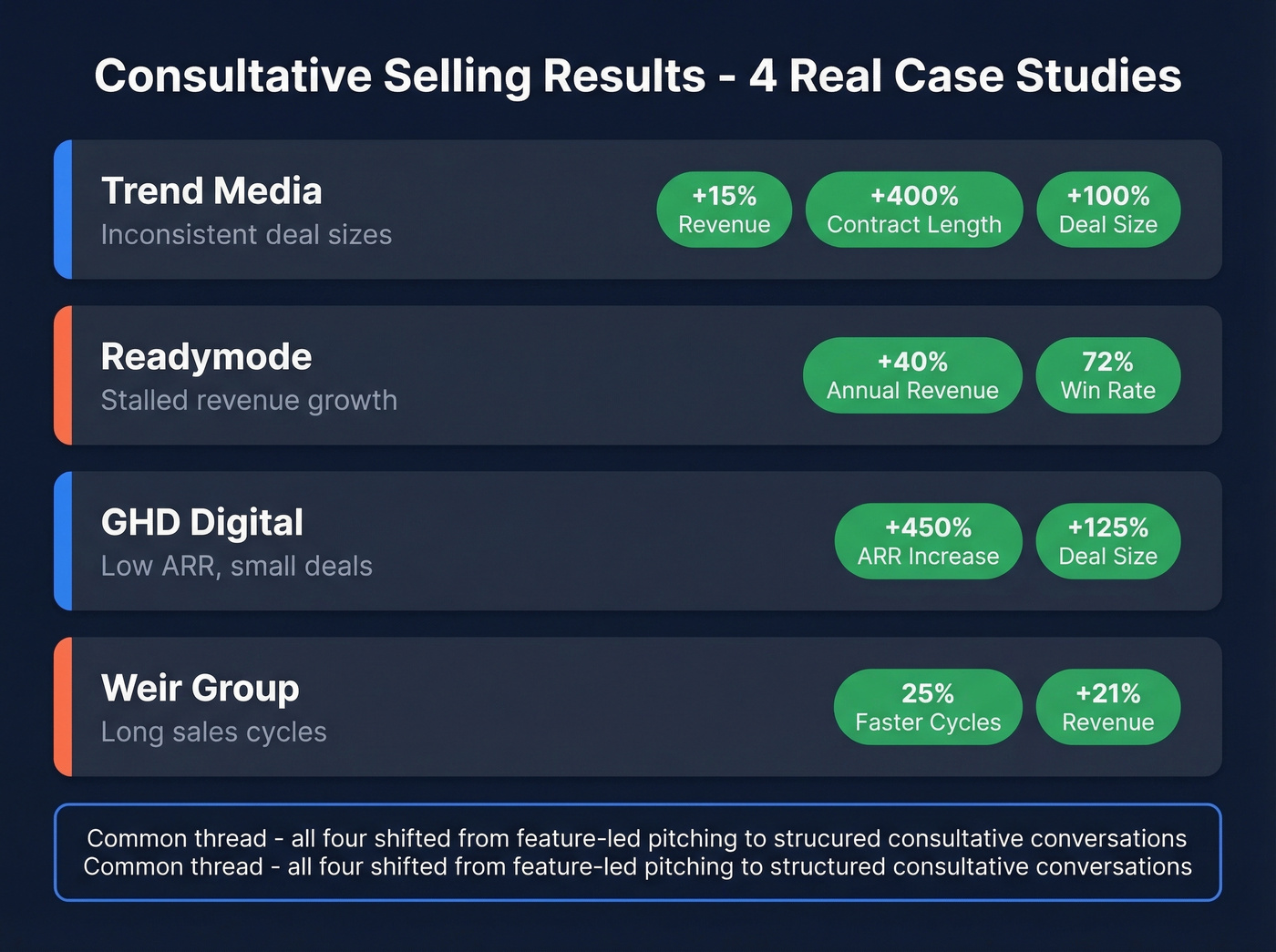
Four companies adopted structured consultative selling methodologies and tracked the outcomes. The results speak for themselves:
| Company | Challenge | Outcome |
|---|---|---|
| Trend Media | Inconsistent deal sizes | 15% rev growth, 400% contract length increase, 100% deal size increase |
| Readymode | Stalled revenue growth | 40% annual rev growth, 72% win rate |
| GHD Digital | Low ARR, small deals | 450% ARR increase, 125% deal size increase |
| Weir Group | Long sales cycles | 25% faster cycles, 21% revenue increase |
The pattern is identical across all four: they moved from feature-led pitching to structured consultative conversations. Trend Media's 400% growth in average contract length stands out - same product, same market, completely different selling approach.
GHD Digital's 450% ARR increase over two years shows what happens when reps stop discounting and start selling value. In our experience, the shift from "here's what our product does" to "here's what changes for you" is the single highest-leverage move a sales team can make. We've watched it transform close rates at companies of every size.
Objection-Handling Scripts
Here's the thing about objections: they're buying signals. A prospect who pushes back is engaged. A prospect who says "looks great, we'll be in touch" is the one you should worry about. Cognism draws a useful distinction between objections (genuine uncertainty) and obstructions (excuses to end the conversation).
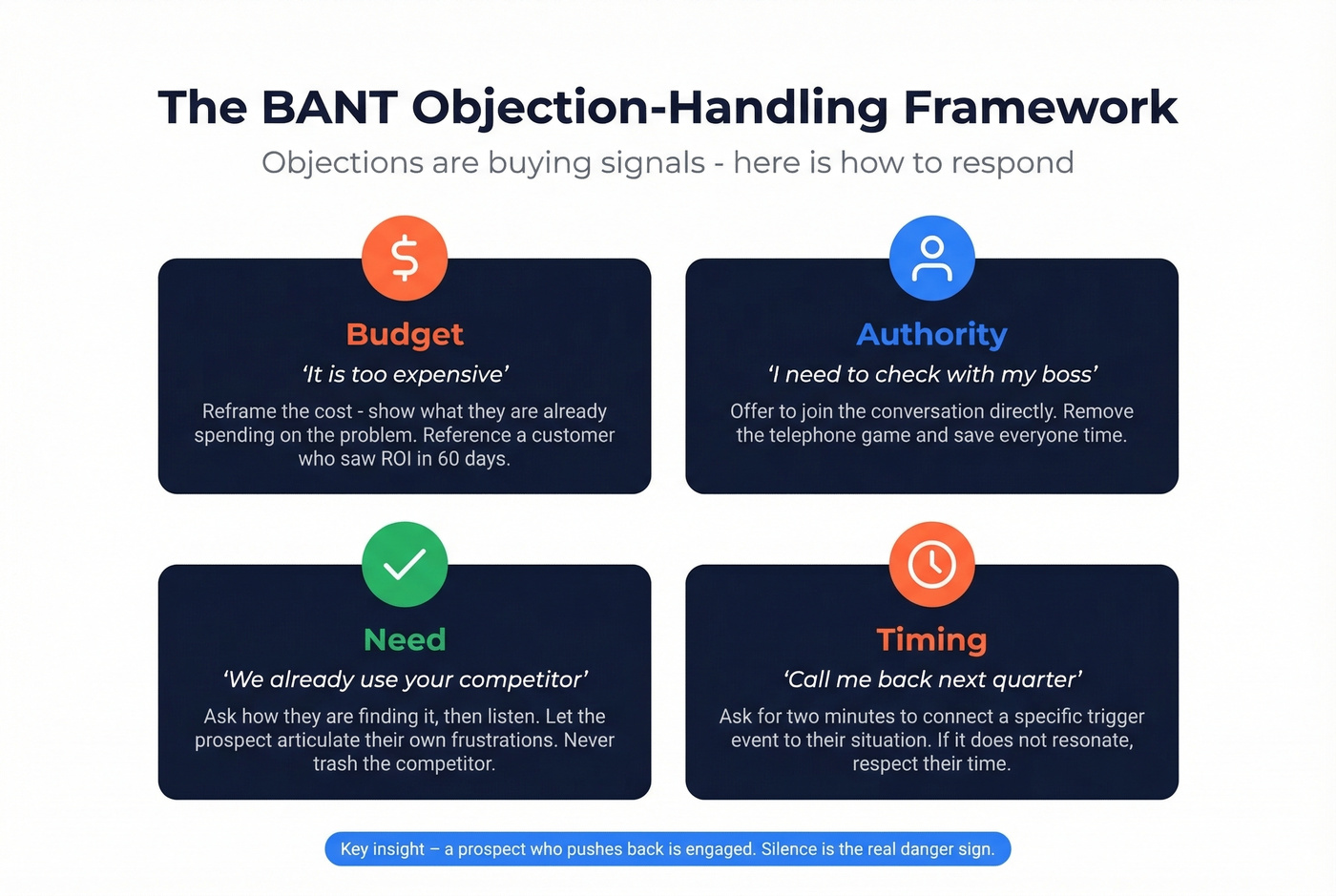
Budget: "It's Too Expensive"
Prospect: "This is outside our budget."
You: "I hear you. Can I ask what you're comparing us to? Most teams find that when they factor in [specific cost they're currently eating], the net investment is actually lower. [Customer name] had the same concern and saw ROI within 60 days."
Authority: "I Need to Check With My Boss"
Prospect: "I can't make this decision alone."
You: "Would it help if I joined that conversation? I can answer technical questions on the spot and save you from playing telephone. What does their calendar look like this week?"
Need: "We're Using Your Competitor"
Prospect: "We already use [competitor]."
You: "How are you finding them?" Then listen. The gaps surface on their own. Don't trash the competitor - let the prospect articulate the frustration.
Timing: "I'm Too Busy Right Now"
Prospect: "Can you call back next quarter?"
You: "Can I take exactly two minutes to explain why [specific trigger event] makes this relevant right now? If it doesn't resonate, I won't call again."
Personal Selling in 2026
This approach isn't about being in the same room anymore. 80% of B2B sales interactions are now virtual, and 9 out of 10 companies plan to keep hybrid models permanently, per McKinsey. Hybrid selling teams see up to 50% higher revenue growth than teams locked into one channel.
Let's be honest: if your deals average under $15K, you probably don't need field sales at all. Inside sales reps cover 4x the prospects at half the cost. Save the steak dinners for enterprise deals where the relationship justifies the expense. For everything else, a great video call with verified contact data beats a mediocre in-person meeting every time.
The 2026 reality is simple. Personal selling is channel-agnostic. It's defined by 1:1 human interaction, real-time adaptation, and trust built through conversation - whether that happens over Zoom, phone, or coffee.
Five Mistakes That Kill Deals
Talking too much. Gong's data is clear: top-closing B2B reps speak 43% of the time. Average reps hit 65%. If you're talking more than half the call, you're losing.
Giving up after one follow-up. 80% of sales need 5+ touches. 44% of reps make one attempt and move on. You're abandoning the vast majority of your pipeline because the second call feels awkward. Get over it. (This is also why the importance of follow-up in sales is so lopsided.)
Leading with features instead of outcomes. Nobody cares that your platform has 47 integrations. They care that their reps will save 6 hours a week on data entry. We've seen teams completely transform their close rates just by rewriting their pitch decks around outcomes instead of features.
Accepting "not interested" at face value. The consensus on r/sales is consistent: always ask "why." "Not interested" is a reflex, not a decision. "What specifically isn't a fit?" surfaces the real objection.
Skipping prospect research. 57% of the buying journey is already complete before a prospect talks to sales - they've done their homework. If you haven't done yours, you're starting behind. Ten minutes of research puts you in the top 5% of salespeople before you open your mouth.
Tools That Make Personal Selling Scale
Personal selling is inherently high-touch, but the right tools keep it sustainable across three categories.
CRM tracks every interaction so nothing falls through the cracks. Salesforce and HubSpot are the defaults - pick based on team size and budget. (If you're comparing options, here are more examples of a CRM with pricing.)
Verified contact data ensures you're reaching real people. Prospeo covers 300M+ professional profiles with 98% email accuracy and 125M+ verified mobile numbers. One customer, Meritt, tripled their pipeline from $100K to $300K per week after switching, with bounce rates dropping from 35% to under 4%. (If you're evaluating vendors, start with data enrichment services.)

Sales engagement platforms like Outreach or Salesloft automate the cadence - follow-up sequences, reminders, multi-channel touches - so reps can focus on the conversations that actually close deals. Skip these if your team is under five reps; the overhead isn't worth it at that scale. (If you're building your stack, this SDR tool roundup can help.)
Step 2 of personal selling is pre-approach research. But 23% bounce rates and disconnected numbers destroy even the best preparation. Prospeo's 300M+ profiles with 30+ filters let you find, verify, and reach decision-makers for about $0.01 per email - no dead data.
Nail prospecting so your personal selling actually starts a conversation.
FAQ
What's a good example of personal selling?
Personalized video outreach in B2B SaaS is one of the strongest. One company recorded 60-second Looms walking through each prospect's dashboard, naming specific issues - hitting a 34% response rate versus 8% from email and generating $2.1M in pipeline in 90 days. The key ingredient is real-time adaptation to the buyer's situation.
What's the difference between personal selling and direct marketing?
Personal selling is a two-way conversation where the salesperson adapts in real time. Direct marketing is one-way messaging at scale - emails, mailers, ads. The former converts 20-40% of qualified opportunities; the latter averages 1-5%. You're trading cost efficiency for dramatically higher close rates.
What are the main advantages of personal selling?
Customization, real-time objection handling, trust-building, and immediate feedback. A skilled rep can read hesitation, adjust the pitch, and address concerns before they become deal-killers. The tradeoff is higher cost per contact and limited scalability without CRM and verified data platforms to support the workflow.
Is personal selling still effective in 2026?
More than ever. 80% of B2B interactions are now virtual, but they're still 1:1 human conversations. McKinsey's research shows hybrid selling models drive up to 50% higher revenue growth. The medium shifted to video and phone; the principle of adaptive, trust-based selling hasn't changed at all.