

AE Productivity: Fix the 70% Problem in 2026
A RevOps lead we work with pulled her team's calendar data last quarter. Fifty AEs, five-figure quotas, enterprise SaaS. The average rep spent about 11-14 hours a week in actual selling conversations. The rest? CRM updates, internal syncs, prospecting dead leads, and formatting decks nobody reads.
AE productivity isn't a motivation problem - it's a time allocation problem. Salesforce's State of Sales report pegs active selling time at 28-30% of a rep's week, and only 43.5% of sales professionals hit quota. Those two numbers aren't a coincidence; they're cause and effect. Improving account executive efficiency starts with understanding where those hours actually go.
The Short Version
Your SDR hands you 50 leads. A third bounce. Another third are stale. You've just lost an afternoon.
Three highest-ROI moves for AEs this quarter:
- Time-box prospecting and follow-up into dedicated daily blocks. Tasks expand to fill whatever time you give them. (If you need a structure, use time blocking as the default.)
- Verify your contact data before launching any sequence. Bad data wipes out 30-40% of your outreach when emails bounce. (Here’s a deeper walkthrough on how to verify an email address.)
- Use AI for post-call admin - meeting summaries, CRM autofill, follow-up drafts. Don't use it to replace your judgment on deals.
Where Your Week Actually Goes
These numbers come from a composite of Salesforce and SPOTIO analyses. They're directional, but they match what we've seen across dozens of teams.
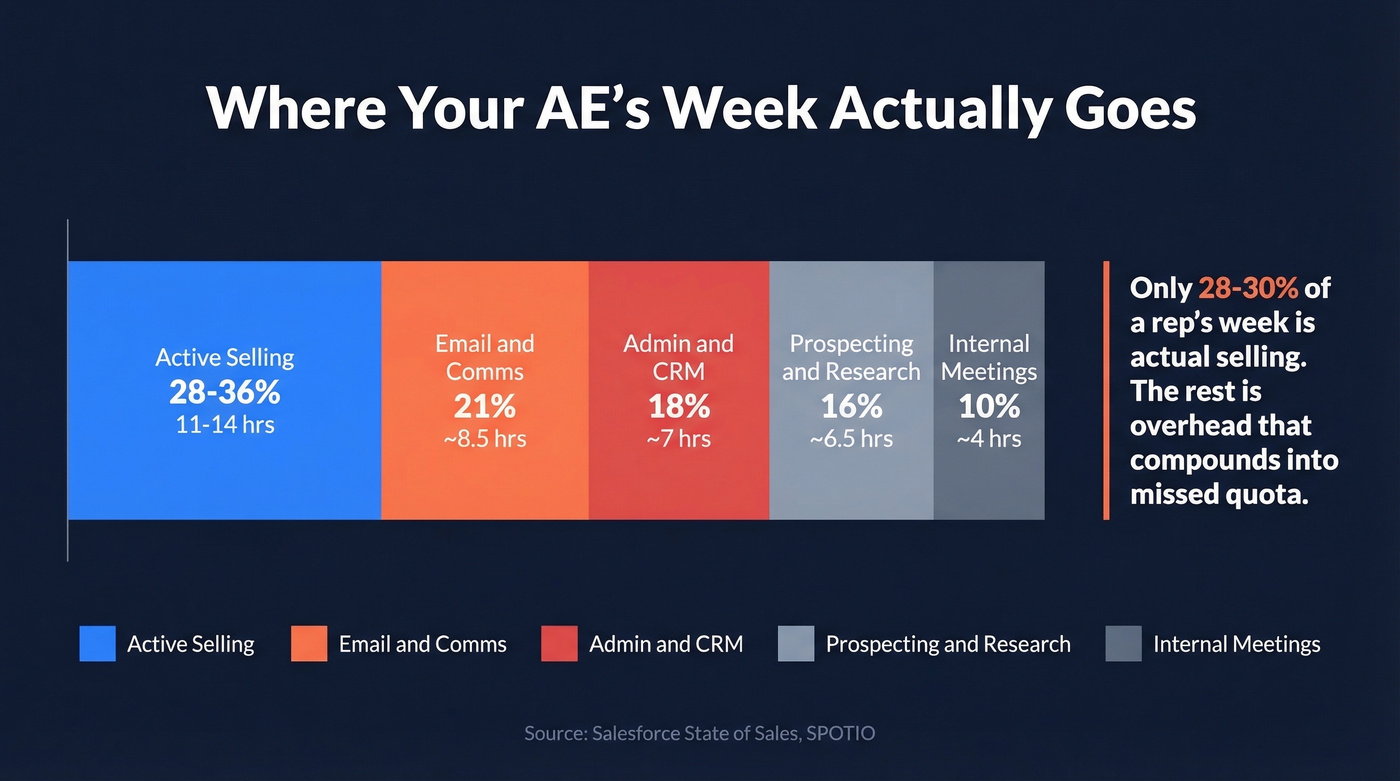
| Activity | % of Week | Hours (~40 hr week) |
|---|---|---|
| Active selling | 28-36% | 11-14 hrs |
| Email / comms | 21% | ~8.5 hrs |
| Admin / CRM | 18% | ~7 hrs |
| Prospecting / research | 16% | ~6.5 hrs |
| Internal meetings | 10% | ~4 hrs |
That "email / comms" bucket is the gut punch. A huge chunk of it isn't selling - it's scheduling, internal coordination, and chasing responses from prospects who never got your first message because the email bounced. If you're serious about account executive time management, this is the first place to audit (and it helps to know the types of email bounces you’re seeing).
What Top AEs Do Differently
Seventeen percent of reps generate 81% of revenue. That's not a bell curve - it's a cliff. (This pattern shows up in most high performance sales datasets.)
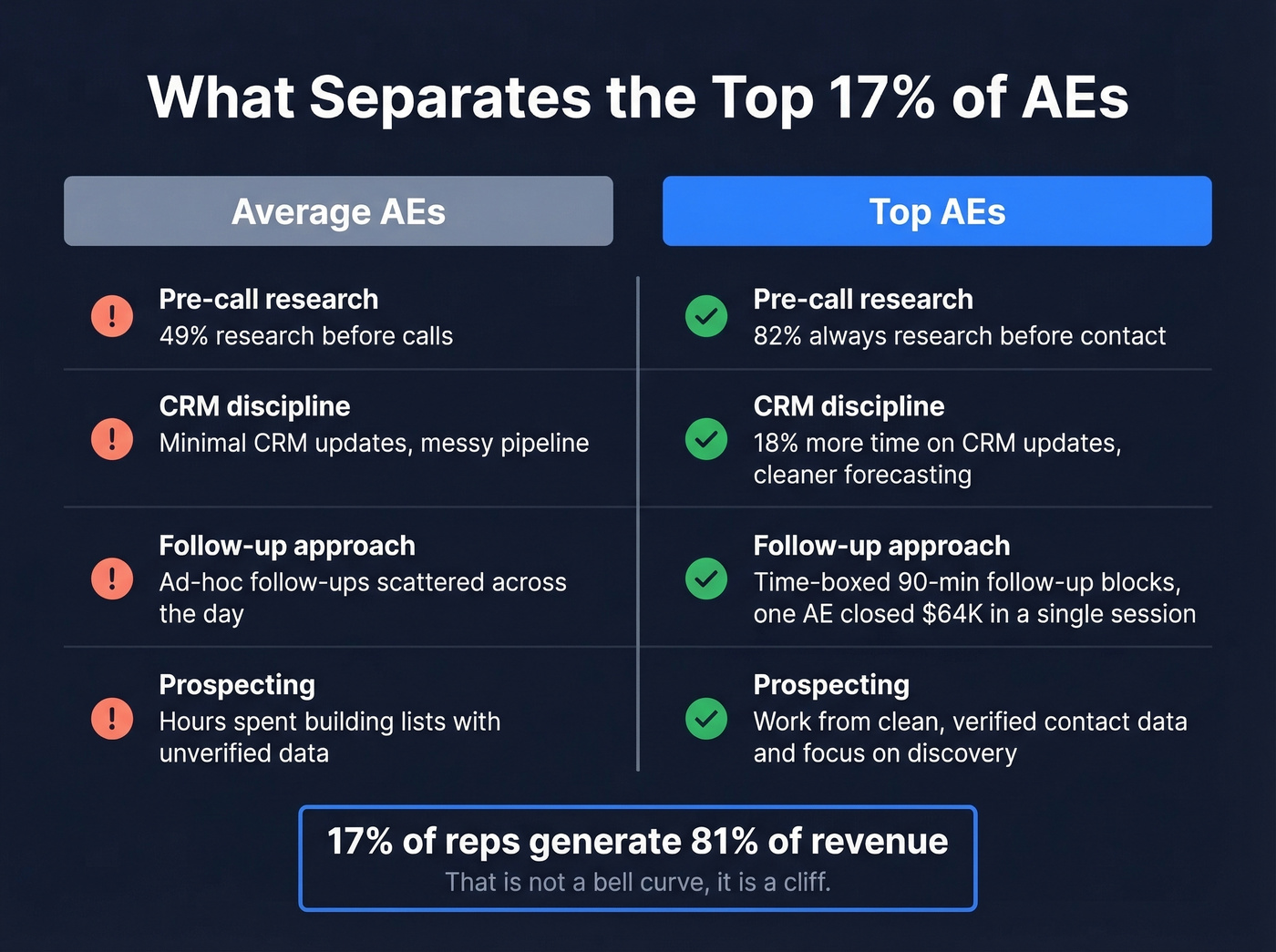
Top performers spend 18% more time updating their CRM than average reps. Sounds counterintuitive until you realize clean CRM data means better forecasting, faster deal reviews, and fewer "wait, where did that opportunity go?" moments in pipeline calls. They also do pre-call research religiously - 82% always research before contact, compared to 49% of everyone else.
AEs on r/sales cite too many meetings and follow-ups as their biggest time drain. Time blocking sounds great until your calendar gets hijacked by internal syncs. But the data backs the discipline: one case study tracked an AE who time-boxed follow-up into a single 90-minute block and closed $64,000 in open quotes that session. The broader pattern showed a 9% close rate improvement within 60 days. It takes 5-10 touches to move most prospects forward, and the reps who systematize those touches simply close more.
Here's the thing: if your average deal size is under $25k, your AEs probably shouldn't be prospecting at all. The math doesn't work. Every hour an AE spends building lists is an hour they're not running discovery or advancing deals. Give them clean, verified data and let them sell. Full-cycle rep productivity suffers most in this segment because reps are stretched across sourcing, qualifying, and closing - three jobs that compete for the same calendar. (If you’re rebuilding the motion, start with an outbound sales playbook.)
The Killer Nobody Audits
Let's do the math. An AE spends 4-6 hours per week prospecting and building sequences. If 35-40% of those contacts bounce, that's 1.5-2 hours per week wasted. Over a month, you've lost a full selling day to emails that never arrived.
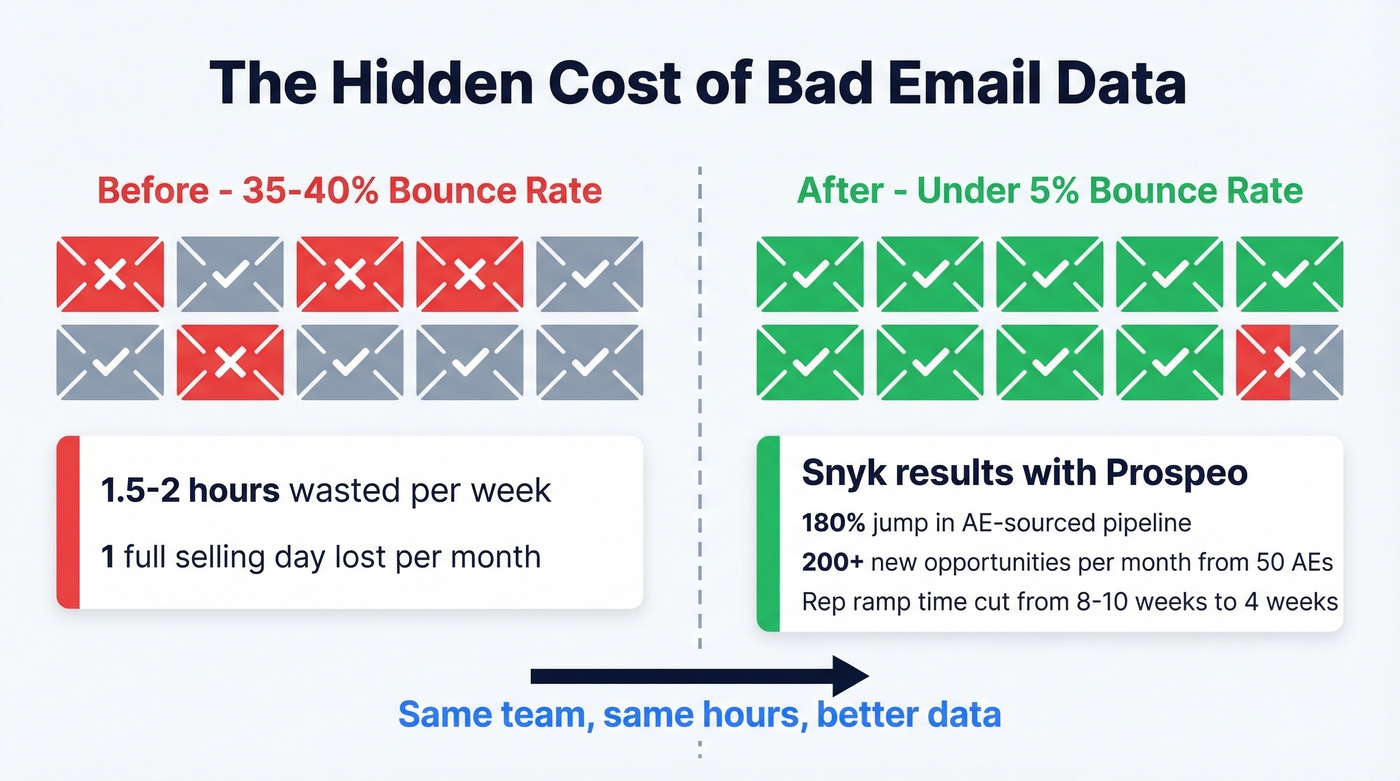
This isn't hypothetical. After Snyk switched to Prospeo for data verification, bounces dropped from 35-40% to under 5%, and AE-sourced pipeline jumped 180% - over 200 new opportunities per month from 50 AEs. GreyScout saw similar results: rep ramp time fell from 8-10 weeks to 4 weeks, and pipeline climbed 140%.
The difference between a 35% bounce rate and a sub-5% bounce rate isn't marginal. It's the difference between a pipeline that compounds and one that leaks. For teams running volume, Prospeo credits cost roughly $0.01 per email with 98% accuracy backed by a 5-step verification process and a 7-day data refresh cycle. (If you want the mechanics, see how to test email bounce before you send.)

Snyk's 50 AEs dropped bounce rates from 35-40% to under 5% and added 200+ new opportunities per month - a 180% jump in AE-sourced pipeline. Same team, same hours, radically different data. Prospeo's 98% email accuracy and 7-day refresh cycle mean your reps spend those 6.5 weekly prospecting hours on contacts who actually exist.
Stop letting bad data steal your AEs' selling hours.
Fix the Workflow Before You Buy Another Tool
29% of sales pros say reducing their tech stack would make them more efficient. That should give every RevOps leader pause. (This is also why RevOps best practices usually start with process mapping, not procurement.)
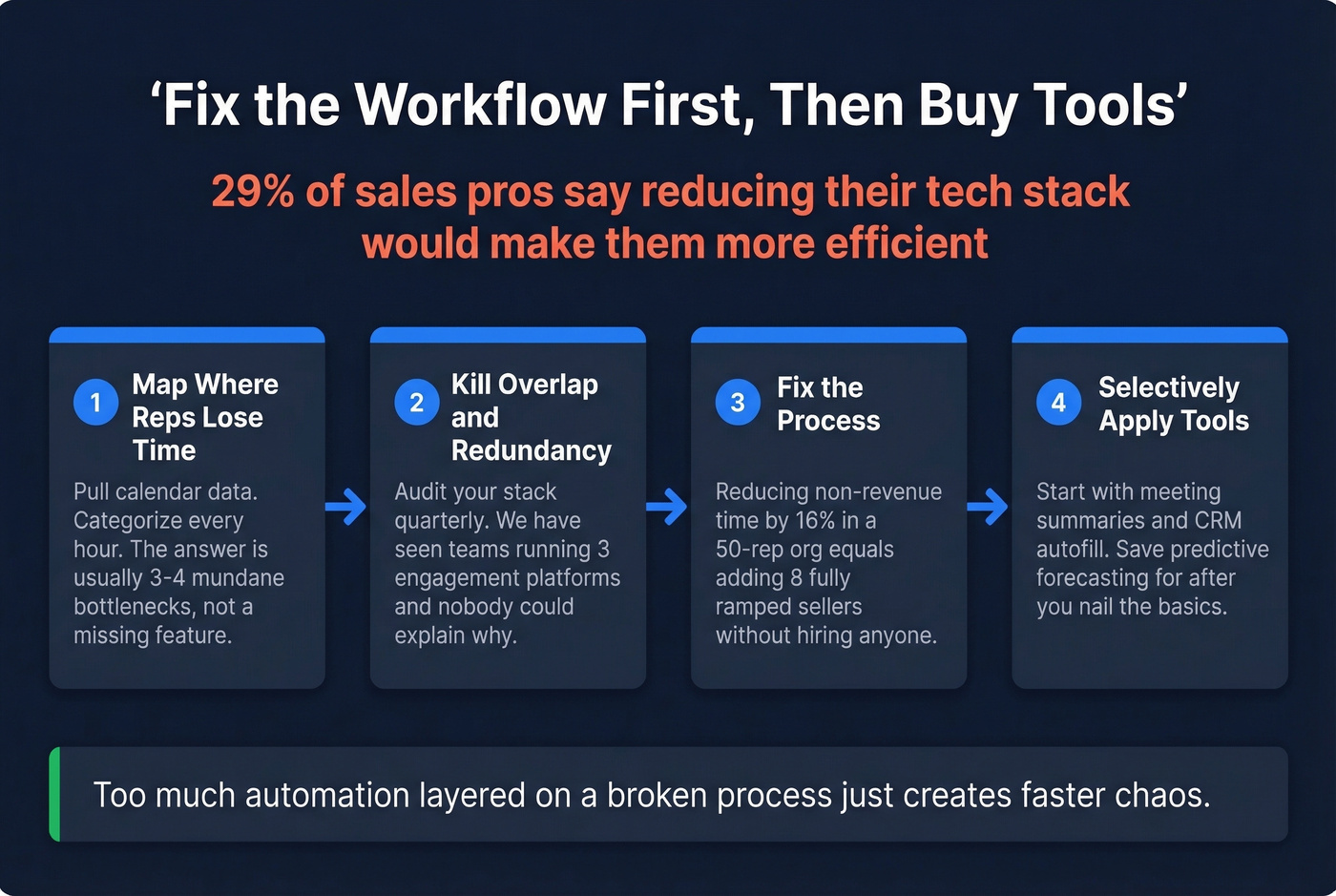
Blue Ridge Partners surveyed 150+ commercial leaders at mid-sized software companies and found that top performers reduced non-revenue time by about 16%. In a 50-rep org, that's the equivalent of adding 8 fully ramped sellers - improving both revenue per rep and ramp time - without hiring anyone. The biggest time sinks weren't exotic: manual CRM hygiene, forecast reconciliation, account research, and internal coordination.
Fix the workflow first, then selectively apply tools. Too much automation layered on a broken process just creates faster chaos. Before you buy another platform, map where your reps actually lose time. The answer is usually three or four mundane bottlenecks, not a missing feature.
Tools That Actually Help
A third of field sales teams aren't using AI at all. That's striking given the data: reps who partner effectively with AI are 3.7x more likely to hit quota, reclaiming 6-8 hours per week from post-call admin, CRM updates, and context reconstruction. (If you’re experimenting, start with generative AI in sales and marketing use cases that reduce admin.)
The most adopted use cases tell you where AI delivers: email personalization (30% of teams), conversation intelligence (28%), and automated CRM data entry (24%). Notice what's absent - AI writing your discovery questions or running your negotiations. AI amplifies whatever process you already have, clean or broken.
Start with meeting summaries and CRM autofill. Those are low-risk, high-time-savings applications. Save the predictive forecasting experiments for after you've nailed the basics.
How to Measure AE Productivity
Stop measuring call counts. Start measuring outcomes.
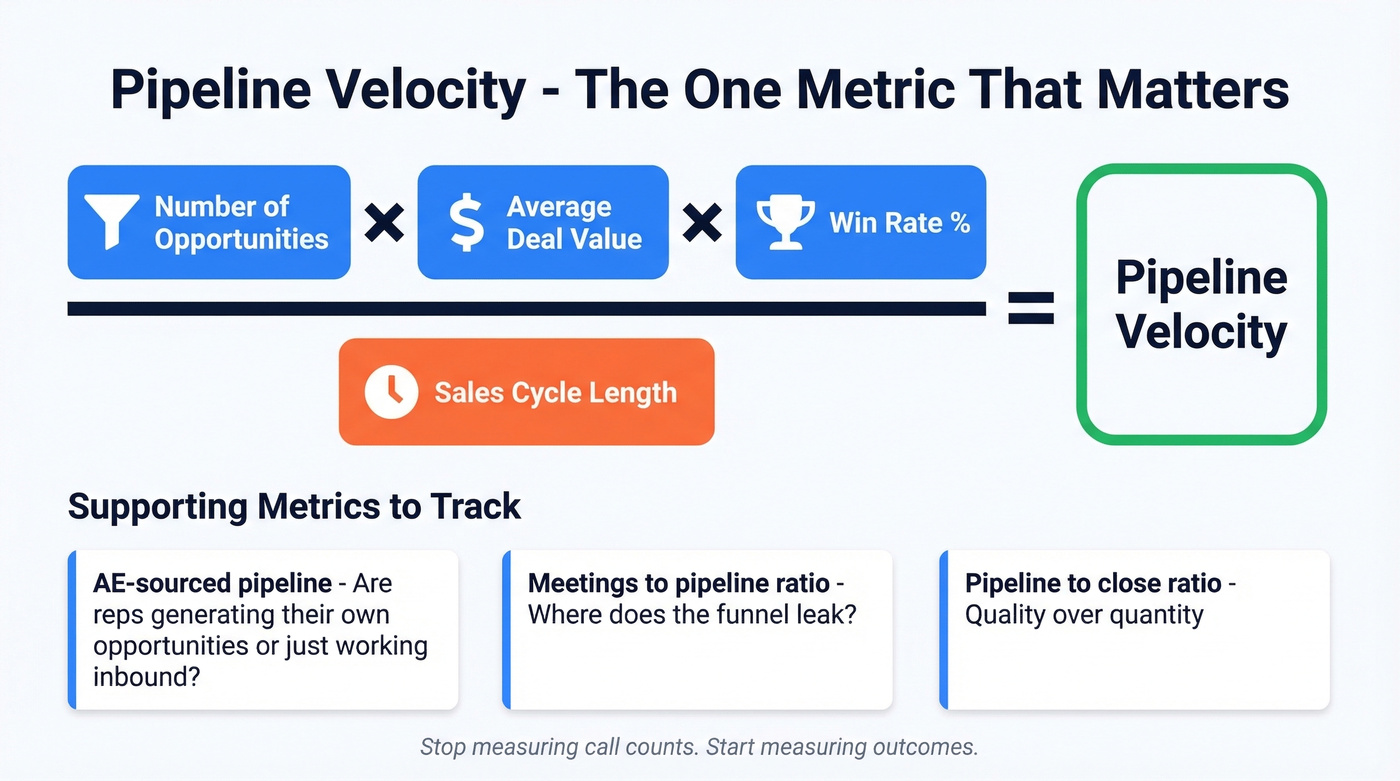
Pipeline velocity is the single best composite metric: (number of opportunities x average deal value x win rate) / sales cycle length. It captures speed, quality, and conversion in one number. Beyond that, track AE-sourced pipeline separately - it tells you whether reps are generating their own opportunities or just working inbound. (If you need a KPI set that doesn’t sprawl, use these sales KPIs as the baseline.)
Activity-to-outcome ratios like meetings-to-pipeline and pipeline-to-close reveal where the funnel leaks without drowning reps in dashboards. Measure pipeline creation and closed revenue, not emails sent.
The AE Productivity Stack
It's common for a mid-market AE's stack to land around $300-500/user/month once you add CRM + engagement + conversation intelligence + scheduling + data. Before adding another tool, ask which of these actually contributes to closed deals.
| Tool | Category | Price Range |
|---|---|---|
| Salesforce | CRM | $25-330/user/mo |
| HubSpot Sales Hub | CRM | $20-150/user/mo |
| Gong | Conversation intel | ~$100-150/user/mo |
| Outreach | Sales engagement | ~$100-130/user/mo |
| Salesloft | Sales engagement | ~$100-130/user/mo (custom) |
| Prospeo | B2B data + verification | Free; ~$0.01/email |
| Calendly | Scheduling | Free; from $16/user/mo |
| ZoomInfo | B2B data | ~$15,000/yr+ |
| Apollo | B2B data + outreach | Free; from $49/mo |
If you're paying ~$15K+/year for ZoomInfo and still running a separate verification step, you're double-paying for data quality you aren't getting. Audit your stack quarterly and kill what doesn't directly touch pipeline or closed revenue. Skip tools that overlap - we've seen teams running three different engagement platforms simultaneously, and nobody could explain why.
Every hour your AEs spend building lists with stale data is an hour they're not closing. Prospeo gives full-cycle reps verified emails at $0.01 each, 125M+ direct dials, and 30+ filters to skip the research grind - so reps focus on discovery calls, not data cleanup.
Give your AEs clean data and watch pipeline velocity compound.
FAQ
What's a good AE productivity benchmark?
About 28-30% active selling time is average. Top teams push above 36% by cutting admin overhead and fixing data quality upstream. If your reps are below 25%, audit internal meetings and CRM busywork first.
How does bad data hurt account executive efficiency?
Bounce rates of 30-40% mean a third of every prospecting block is wasted, costing AEs roughly a full selling day per month. Clean data compounds fast - teams that drop bounces below 5% consistently see double-digit pipeline gains.
What's the biggest time management mistake AEs make?
Letting internal meetings and ad-hoc requests fragment the calendar. The highest-performing reps protect dedicated selling blocks and batch admin tasks into a single daily window rather than context-switching throughout the day.
How do you calculate pipeline velocity?
Pipeline velocity = (number of opportunities x average deal value x win rate) / sales cycle length. It's the single best composite metric for measuring rep output because it captures speed, quality, and conversion in one number.