

Generative AI in Sales and Marketing: What Works, What Doesn't, and What to Do Next
93% of CMOs say they're seeing measurable ROI from generative AI in sales and marketing. Meanwhile, 44% of organizations have already experienced negative consequences - with inaccuracy as the top culprit. That's not a contradiction. It's the reality of a technology that's genuinely powerful and genuinely dangerous, depending entirely on how you deploy it.
McKinsey pegs the economic potential of generative AI at $2.6 trillion to $4.4 trillion annually, with roughly 75% of that value concentrated in four areas: customer operations, marketing and sales, software engineering, and R&D. The average organization using genAI deploys it in two functions, and marketing and sales is the most common. This isn't a side benefit of the AI wave. It's the center of gravity.
What You Need (Quick Version)
- Start with three boring use cases: email drafting, call summarization, and data enrichment/verification. These deliver the fastest, most measurable ROI.
- Fix your data first. Every AI tool you deploy will amplify whatever's already in your CRM - good or bad. Verify your contact list before your AI writes a single email.
- Automate 3-5 high-frequency tasks, then scale - not the other way around. Teams that jump straight to "AI-powered everything" burn budget and trust simultaneously.
AI Adoption Rates in 2026
Adoption is no longer the story. The gap between adoption and impact is.
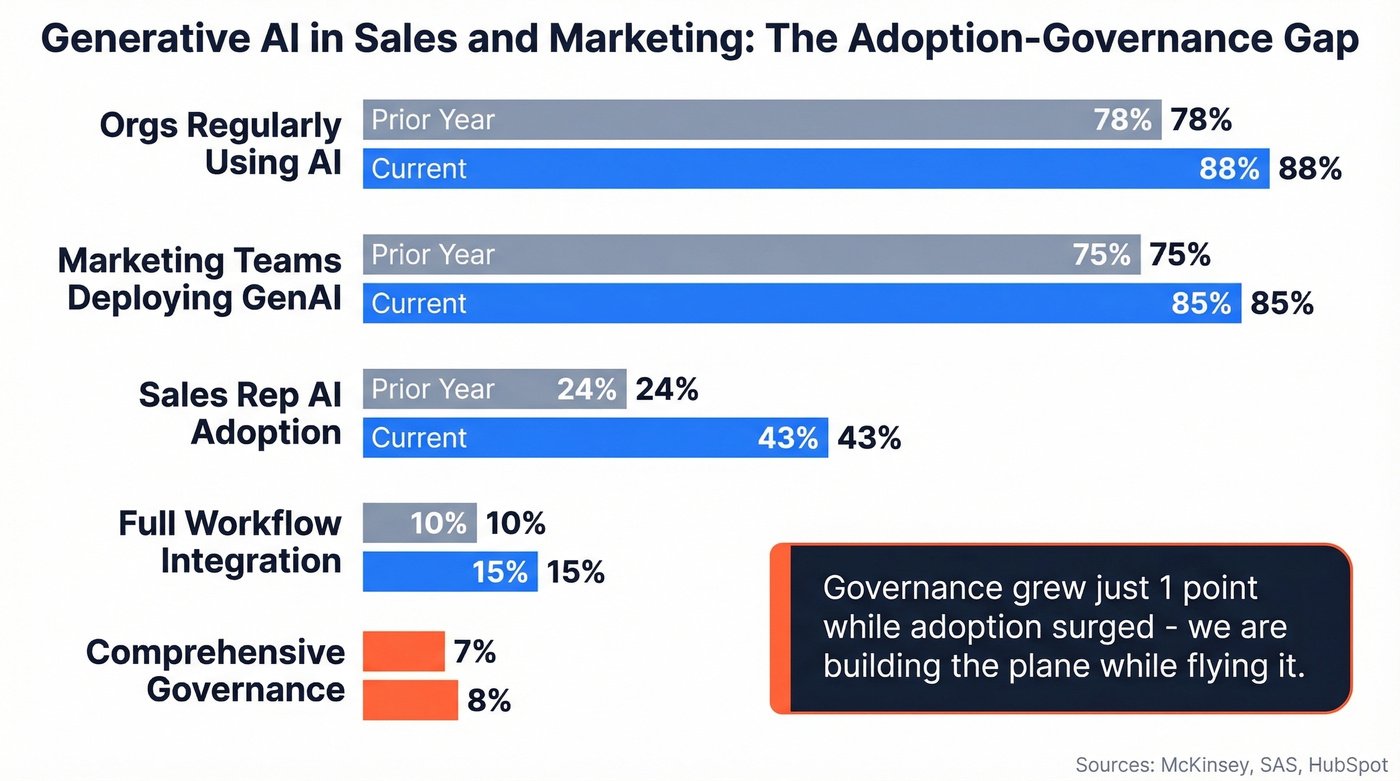
88% of organizations report regular AI use in at least one business function, up from 78% the prior year. Marketing teams have pushed even harder - 85% are deploying genAI in some capacity, up from roughly 75% in 2024. On the sales side, HubSpot tracked rep-level adoption jumping from 24% to 43% in a single year. But only 39% of organizations report enterprise-level EBIT impact from AI. Nearly two-thirds haven't begun scaling AI across the business. Everyone's experimenting. Almost nobody's operationalized.
| Metric | Prior Year | Current | Source |
|---|---|---|---|
| Orgs regularly using AI | 78% | 88% | McKinsey |
| Marketing teams deploying genAI | ~75% | 85% | SAS study via MarTech |
| Sales rep AI adoption | 24% (2023) | 43% (2024) | HubSpot via Cirrus Insight |
| Full workflow integration | 10% | 15% | SAS study via MarTech |
| Comprehensive governance | 7% | 8% | SAS study via MarTech |
That last row should concern you. Governance went from 7% to 8% in a year while adoption surged. We're building the plane while flying it, and almost nobody's installed the safety systems.
The Hype vs. Reality Gap
The Reddit threads tell a different story than the vendor press releases. On r/CRM, the consensus is blunt:
"AI in sales CRM is useful for drafting email replies and not much else. The rest doesn't really work at all... still a lot of work to be done."
On r/DigitalMarketing, practitioners complain that "AI tools" still require massive manual effort, produce generic creative, and can't actually launch or modify campaigns in Google or Meta.
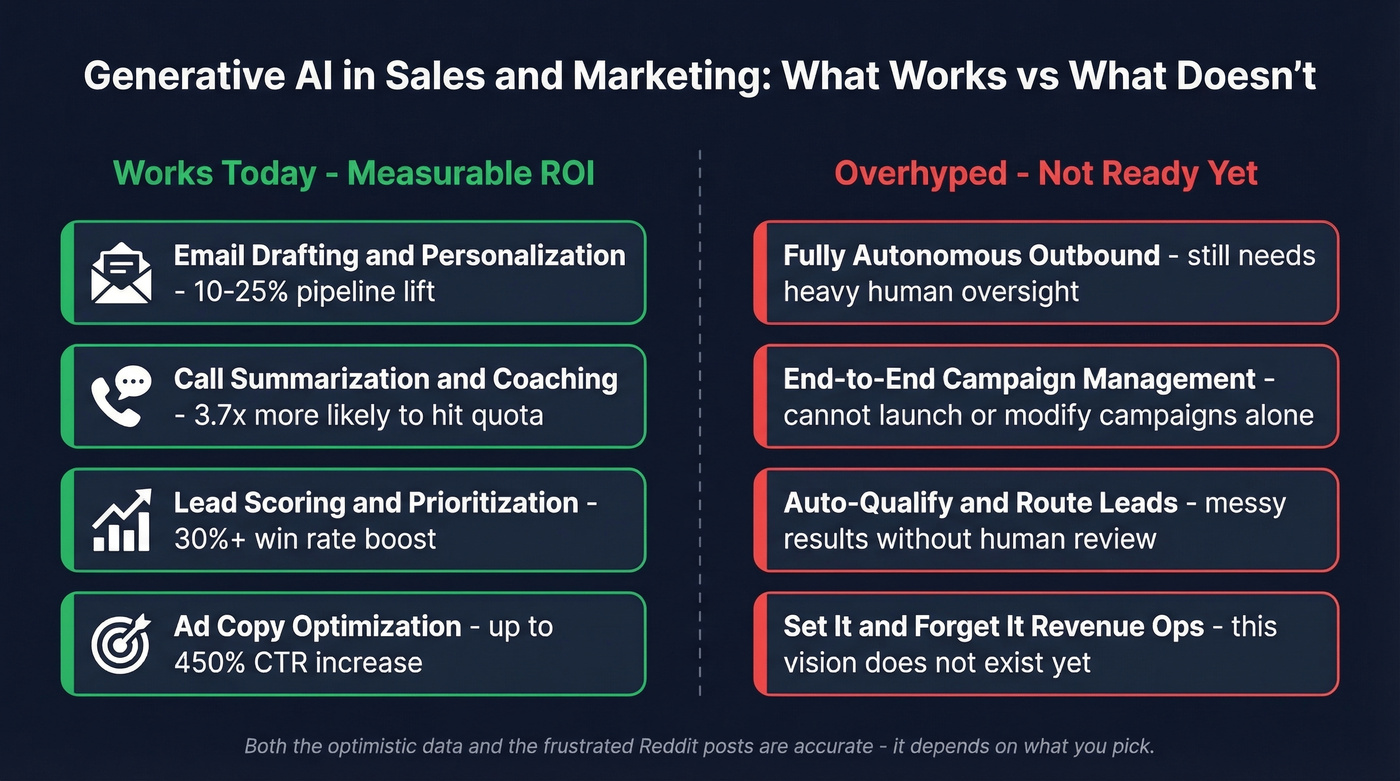
Here's the thing: both the optimistic survey data and the frustrated Reddit posts are accurate. The 93% ROI number reflects CMOs reporting measurable gains from genAI. The frustration shows up when teams expect AI to run their entire go-to-market motion end-to-end, which it absolutely cannot do yet.
The "set it and forget it" vision of AI-powered revenue operations doesn't exist. What does exist is a set of high-frequency tasks where AI delivers genuine, measurable time savings - if you pick the right ones.
Hot take: If your average deal size sits below $10k, you almost certainly don't need a $35k/year agentic AI platform. A verified contact list, a good sending tool, and your CRM's built-in AI features will outperform an enterprise stack you're only using at 15% capacity.
Sales Use Cases That Deliver Today
Outbound Email Personalization
This is where the ROI is most tangible. 54% of teams now use AI to write personalized outbound emails, and effective adopters report a 10-25% lift in pipeline. Cold email remains a top channel - 23% of sales pros say it's the best way to reach prospects.
The tradeoff is real, though. AI-generated emails work well for high-volume, lower-personalization outreach: free trial offers, event invitations, broad ICP targeting. For enterprise deals where you need to reference a prospect's specific tech stack or recent earnings call, AI drafts are a starting point, not a finished product. Treating AI output as final copy tends to hurt response rates over time as recipients learn to pattern-match the generic phrasing.
If you want a deeper playbook, start with AI personalization and then tighten your cold email infrastructure so the output actually lands.
Call Summarization and Coaching
This is the single highest-ROI use case in sales right now, and it's not close. Gartner found that sellers partnering with AI tools are 3.7x more likely to meet quota. LinkedIn's data shows 56% of sales pros use AI daily, and those users are twice as likely to exceed targets.
The mechanism is straightforward: AI summarizes calls, extracts action items, flags coaching moments, and updates CRM records - all tasks that reps historically skip because they're tedious. When reps actually have accurate call notes and next steps in the CRM, managers can coach on real data instead of vibes. We've seen this single change shift pipeline visibility more than any other AI deployment.
Lead Scoring and Pipeline Forecasting
Early AI deployments in sales have boosted win rates by 30%+. The gains come from better prioritization - AI surfaces signals like engagement patterns, firmographic fit, and intent data that humans miss when manually scanning a pipeline of 200+ opportunities. Lead scoring stands out because it directly shortens sales cycles and focuses rep effort where it matters most.
That said, we've watched teams try to let AI auto-qualify and auto-route leads without human oversight, and the results are messy. The scoring models work. Full autopilot doesn't - yet.
If you're rebuilding your process, align scoring to a clear ideal customer profile and track it inside a real sales pipeline management system.
Marketing Use Cases That Deliver Today
Ad Copy and Creative Generation
JPMorgan Chase partnered with Persado and saw a 450% increase in ad click-through rates from AI-optimized copy. Instreamatic's personalized AI audio ads delivered +22 percentage points in brand favorability compared to generic ads. These aren't marginal improvements.
Campaign Optimization
Pinterest's Performance+ campaigns consistently deliver [20%+ CPA reduction](https://www.emarketer.com/content/how-ai-rewired-marketing-2025 - breakout-use-cases-marketing-leaders) versus traditional campaign setups, drawing on their "taste graph" across 600M monthly active users. This is where AI excels - processing billions of signals to optimize bidding, targeting, and creative rotation faster than any human media buyer ever could.
Content Production at Scale
Bloomreach used Jasper to achieve +113% increase in blog output and +40% increase in overall site traffic. Phrasee's email optimization for Novo Nordisk delivered +14% CTR and +24% open rates through AI-generated subject lines. The pattern is consistent: AI doesn't replace content strategy, but it dramatically accelerates production once the strategy is set.
Dynamic Segmentation
Personalization is the benefit marketers feel most immediately. 94% of marketers report improved personalization as the top genAI benefit, and it makes sense - segmentation has always been limited by the manual effort required to create and maintain audience slices. AI collapses that effort from days to minutes, enabling micro-segmentation that was previously only viable for teams with dedicated data science resources.

The article says it clearly: every AI tool amplifies whatever's in your CRM. Prospeo's 7-day data refresh and 98% email accuracy mean your generative AI writes to verified, current contacts - not bounced addresses that torch your domain reputation.
Clean data in, better AI out. Start with 75 free verified emails.
Why Data Quality Kills AI Initiatives
The stat nobody puts in their pitch deck: 44% of organizations have already experienced negative consequences from AI. Inaccuracy is the top reported risk, and it compounds in ways that are uniquely dangerous with generative AI.
Heinz Marketing documented the failure modes that kill B2B AI initiatives: messy CRM data leading to wrong conclusions, AI "filling gaps" by inventing data points, the illusion of accuracy from confident prose, and the tone trap where AI-generated copy erodes trust. Every one of these starts with bad data.
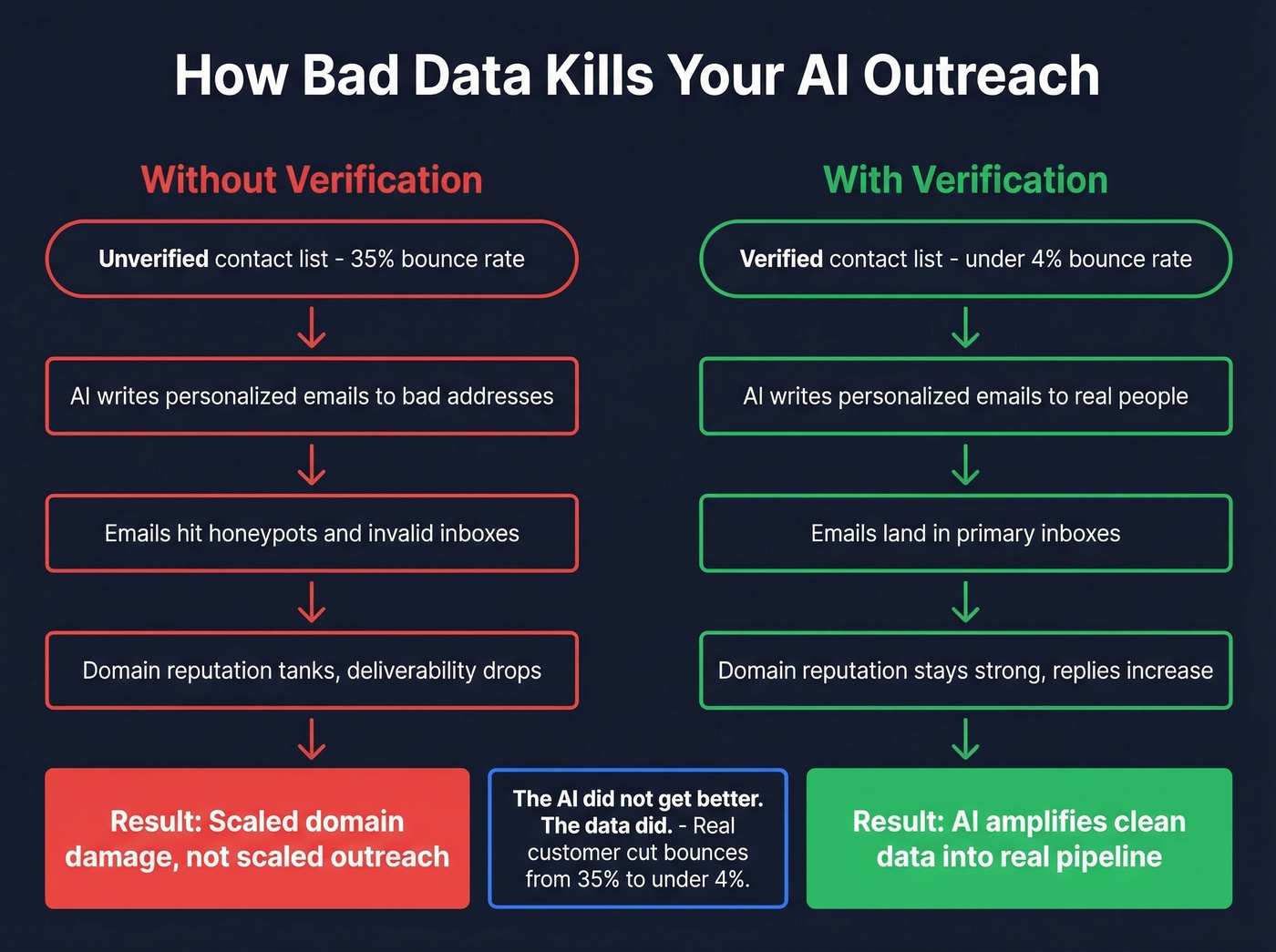
Real talk: your SDRs sending AI-generated emails to unverified addresses isn't scaling outreach. It's scaling domain damage. An AI that writes a beautiful personalized email to a honeypot address doesn't save you time - it gets your domain blacklisted. One of our customers, Meritt, cut bounce rates from 35% to under 4% just by running lists through verification before launching AI-generated sequences. The AI didn't get better. The data did.
If you need to operationalize this, start with an email verifier and keep an eye on domain reputation as you scale volume.
Garbage in, garbage out has always been true. With generative AI, it's confidently-worded garbage out at 10x the volume.
AI Agents - The 2026 Frontier
The next phase is already taking shape. 62% of organizations are experimenting with AI agents, and 23% are scaling an agentic system somewhere in the enterprise. On the marketing side, 21% of teams are testing agentic AI in live environments, and nearly three-quarters expect to implement within two years. Among teams with deeper agentic AI expertise, 98% report measurable ROI - the payoff scales with competence, not just adoption.
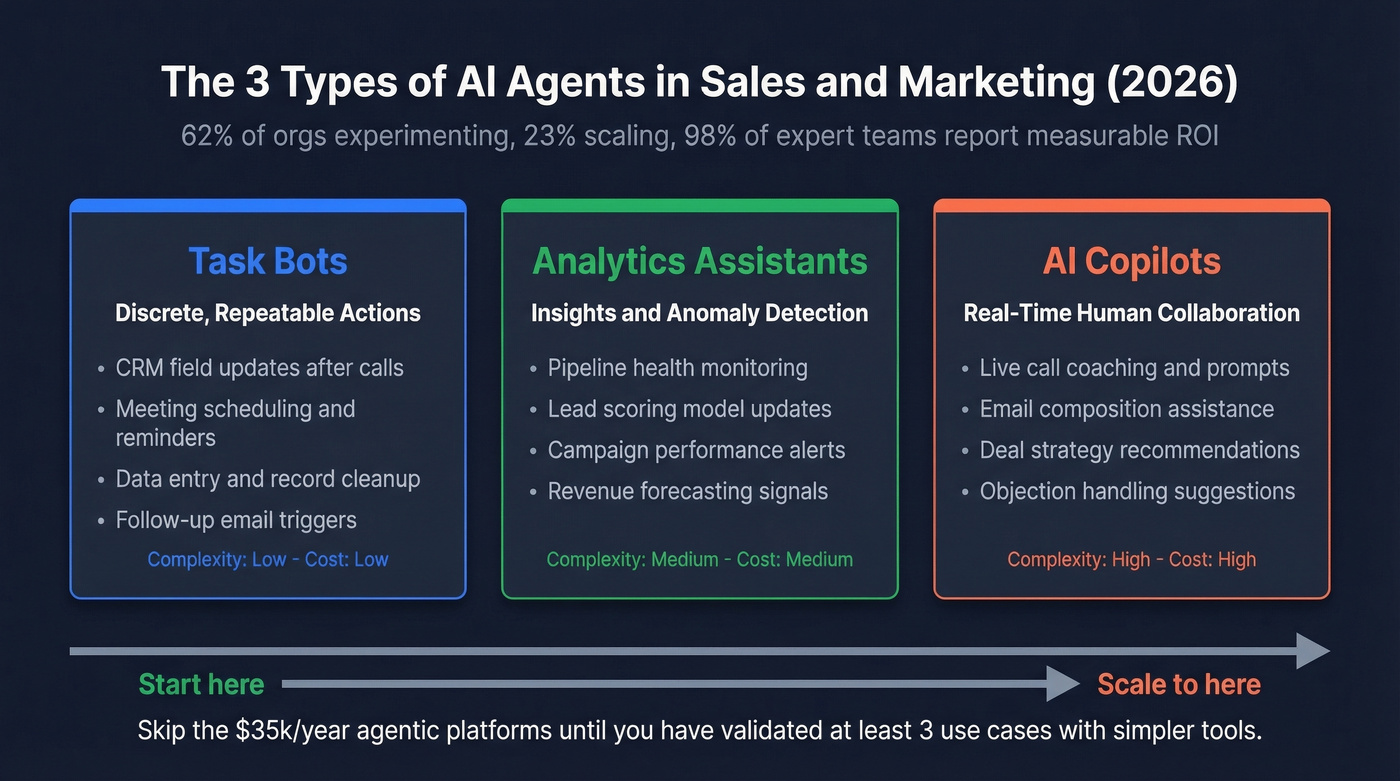
The taxonomy is settling into three categories: task bots that handle discrete, repeatable actions like CRM updates, analytics assistants that surface insights and anomalies from data, and AI copilots that work alongside humans in real time during calls, email composition, and deal strategy.
The cost anchor matters here. Regie.ai starts at $35,000/year for autonomous outbound. Enterprise GTM platforms like Clari and Highspot run $30k-$150k+/year. Skip these until you've validated at least three use cases with self-serve tools. The price curves are compressing fast, and buying enterprise too early means paying for capabilities you won't use for another 12 months.
If you're mapping the category, compare options in AI SDR software and broader AI sales tools before you commit.
The Clean-Automate-Scale Playbook
Most implementation frameworks sound impressive and tell you nothing. This one is deliberately boring because boring is what actually ships.
Phase 1 - Clean (Week 1-2)
Start with CRM hygiene. Deduplicate records, standardize fields, verify contact information. Only 18% of organizations have an enterprise-wide AI governance council with actual decision-making authority - building guardrails early puts you ahead of the vast majority.
Verify every email address in your active outreach lists. Remove contacts that haven't been refreshed in 90+ days. This isn't glamorous work, but it's the foundation everything else depends on. Tools like Prospeo run a 5-step verification process with 98% accuracy and refresh records every 7 days, compared to the 6-week industry average - catching spam traps and honeypots that would torch your domain reputation before your AI writes a single line of copy.
Phase 2 - Automate (Week 3-6)
Group genAI use cases into 2-4 "solution packages," each containing 5-10 specific workflows. A "sales rep copilot" package might include email drafting, call prep summaries, CRM updating, and lead qualification scoring. Pick one package. Implement it fully. Measure results before expanding.
If you're choosing tooling, start with CRM automation software and then layer in outbound email automation once the workflows are stable.
We've watched teams deploy six AI tools simultaneously and end up with conflicting outputs, duplicate workflows, and reps who trust none of them. Don't be that team.
Phase 3 - Scale (Month 2+)
The governance gap is staggering - only 8% comprehensive across the industry. Outreach's ISO/IEC 42001:2023 certification is one framework worth referencing. At minimum, you need humans-in-the-loop for all customer-facing AI output, mandatory brand voice editing on generated content, and clear accountability documentation for AI-generated communications. These aren't nice-to-haves. They're the difference between scaling responsibly and scaling into a PR crisis.
Risks You Can't Ignore
Beyond inaccuracy, the risk landscape includes threats most teams aren't preparing for. Deepfakes in advertising can mislead consumers and erode brand trust overnight. AI-personalized marketing at scale creates the ability to exploit consumer vulnerabilities in ways that weren't possible before. B2C chatbots are already capable of biased or manipulative advice.
Research published in ScienceDirect argues that even EU regulatory frameworks are likely to fall short in protecting consumers from these harms. McKinsey's data flags cybersecurity and explainability as the second and third most common negative consequences after inaccuracy. When your AI generates customer-facing content and you can't explain how it arrived at a recommendation, you've got a liability problem - not just a quality problem.
Deploying AI that generates customer-facing content with no governance model isn't innovation. It's negligence.
Tool Landscape and Pricing
Let's be honest about the 2026 market: the smart approach is best-of-breed, not monolithic. Enterprise AI platforms start at $35k/year, and the data foundation they depend on costs a fraction of that.
| Category | Tool | Starting Price | Best For |
|---|---|---|---|
| Data verification | Prospeo | ~$0.01/email, free tier | Pre-outreach verification |
| Lead sourcing | Apollo | Free-$99/user/mo | High-volume lead lists |
| Sales engagement | Outreach | ~$100-150/user/mo | Multi-channel sequences |
| Conversation intel | Gong | ~$100-150/user/mo | Call coaching, deal intel |
| Content generation | Jasper | ~$49-69/user/mo | Marketing copy at scale |
| CRM with AI | Salesforce Einstein | ~$25-$300+/user/mo | Enterprise pipeline mgmt |
| CRM with AI | HubSpot | Free-$90+/user/mo | Mid-market sales + mktg |
| Agentic platform | Regie.ai | From $35,000/yr | Autonomous enterprise outbound |
| Revenue intel | Clari, Highspot | $30k-150k+/yr | Enablement, forecasting |
Apollo has become the perceived default for lead sourcing - on r/coldemail, the question is basically "is everyone using Apollo or tools that scrape Apollo?" It's a solid starting point for volume, but data accuracy degrades at scale. For teams that need verified data before feeding it into AI workflows, Prospeo returns 50+ data points per contact with a 92% API match rate and integrates natively with Salesforce, HubSpot, Instantly, and Lemlist.
If you're comparing sources, use a ranked list of the best B2B database options and sanity-check vendors against verified contact databases.
AI-personalized outbound only works when the prospect actually exists at that email. Teams using Prospeo's 300M+ verified profiles and intent data across 15,000 topics feed their AI real buyer signals - not stale CRM records from six weeks ago.
Stop letting bad data sabotage your AI pipeline. Prospeo starts at $0.01/email.
FAQ
What's the ROI of generative AI in sales and marketing?
93% of CMOs report measurable ROI, with early sales AI deployments showing 30%+ win rate boosts and 10-25% pipeline lifts. Results depend heavily on data quality - clean, verified contacts drive significantly better outcomes than raw lists fed into AI tools.
What are the biggest risks of using genAI for outreach?
Inaccuracy is the top risk, with 44% of organizations reporting negative consequences. Other critical threats include hallucinated data points, tone that erodes trust, and sending AI-drafted emails to unverified addresses - which damages sender reputation and deliverability.
How should I start using AI in my sales process?
Fix your data first - deduplicate CRM records and verify emails. Then automate three high-frequency tasks: email drafting, call summarization, and lead enrichment. Measure for 4-6 weeks before expanding to additional workflows.
Do I need an enterprise AI platform to get started?
No. Most ROI comes from combining affordable best-of-breed tools - a data verification layer, a sending tool, and your CRM's built-in AI features. Enterprise platforms make sense only after you've validated specific use cases with smaller tools.
What's the difference between AI copilots and AI agents?
Copilots assist humans in real time - suggesting email drafts, surfacing deal insights, recommending next steps. Agents act autonomously - qualifying leads, scheduling follow-ups, updating CRM records without human input. Most teams rely on copilots today; agents remain experimental for most B2B organizations.