

How to Use AI for Finding Leads (Without Burning Your Domain)
AI doesn't find leads. It finds data - names, titles, email addresses, company signals - raw material that becomes a lead only after you verify it, sequence it, and get a reply. Most teams skip verification, blast unverified lists, and torch their sender reputation within a month.
The timing pressure is real. Contact a lead within one hour and you're 7x more likely to qualify them. Wait 24 hours and that number drops 98%. Meanwhile, 69% of the buyer journey now happens anonymously - prospects are researching your category before you even know they exist. So the goal isn't more names. It's reaching the right ones before your competitors do.
What You Actually Need
Three layers, max:
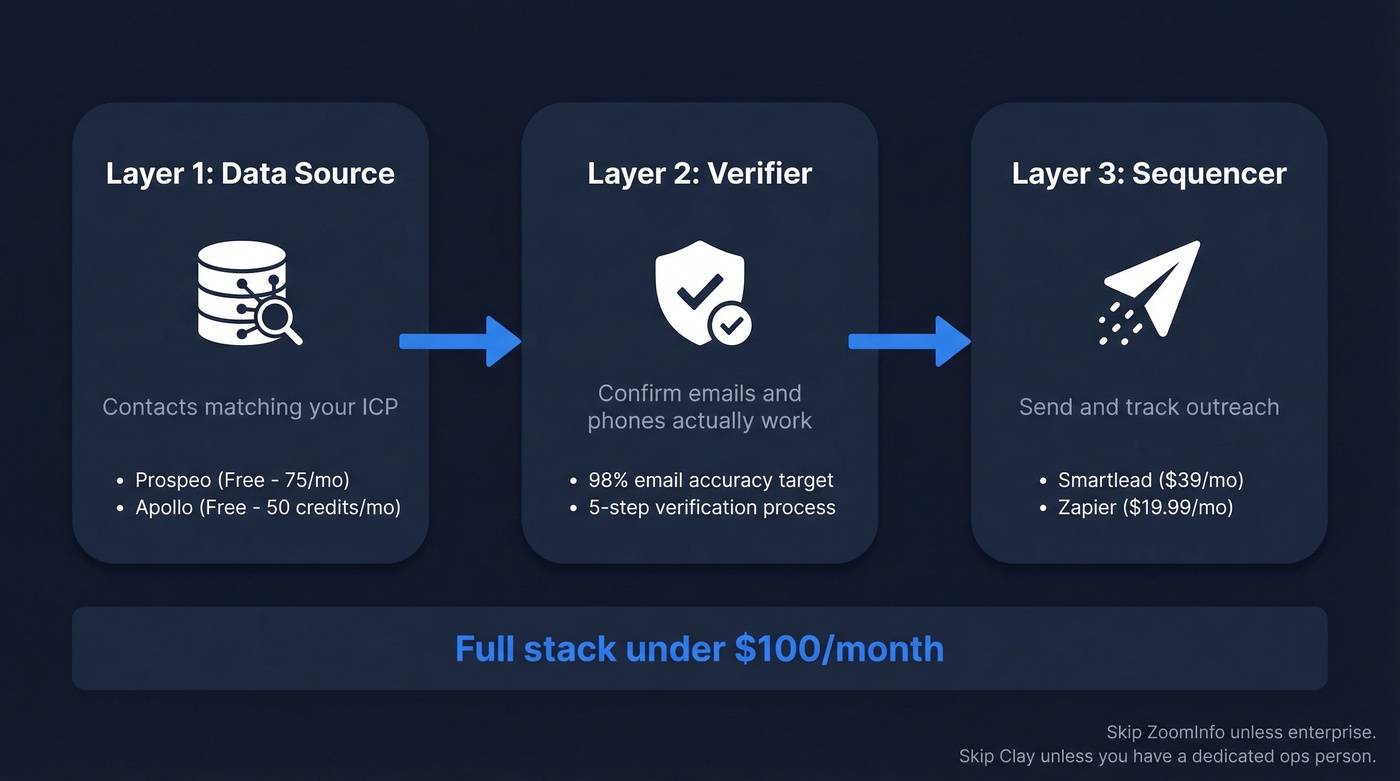
- Data source - contacts matching your ICP
- Verifier - confirmation that emails and phones actually work (use an email verifier)
- Sequencer - sending and tracking outreach
If you're on Prospeo's free tier plus Smartlead ($39/mo) and Zapier ($19.99/mo billed annually), you can keep the core stack under $100/month. Skip ZoomInfo unless you're enterprise. Skip Clay unless you have a dedicated ops person who genuinely enjoys building workflows - and we mean genuinely, because the learning curve is steep.
How AI Actually Surfaces Prospects
Database Search + Intent Filtering
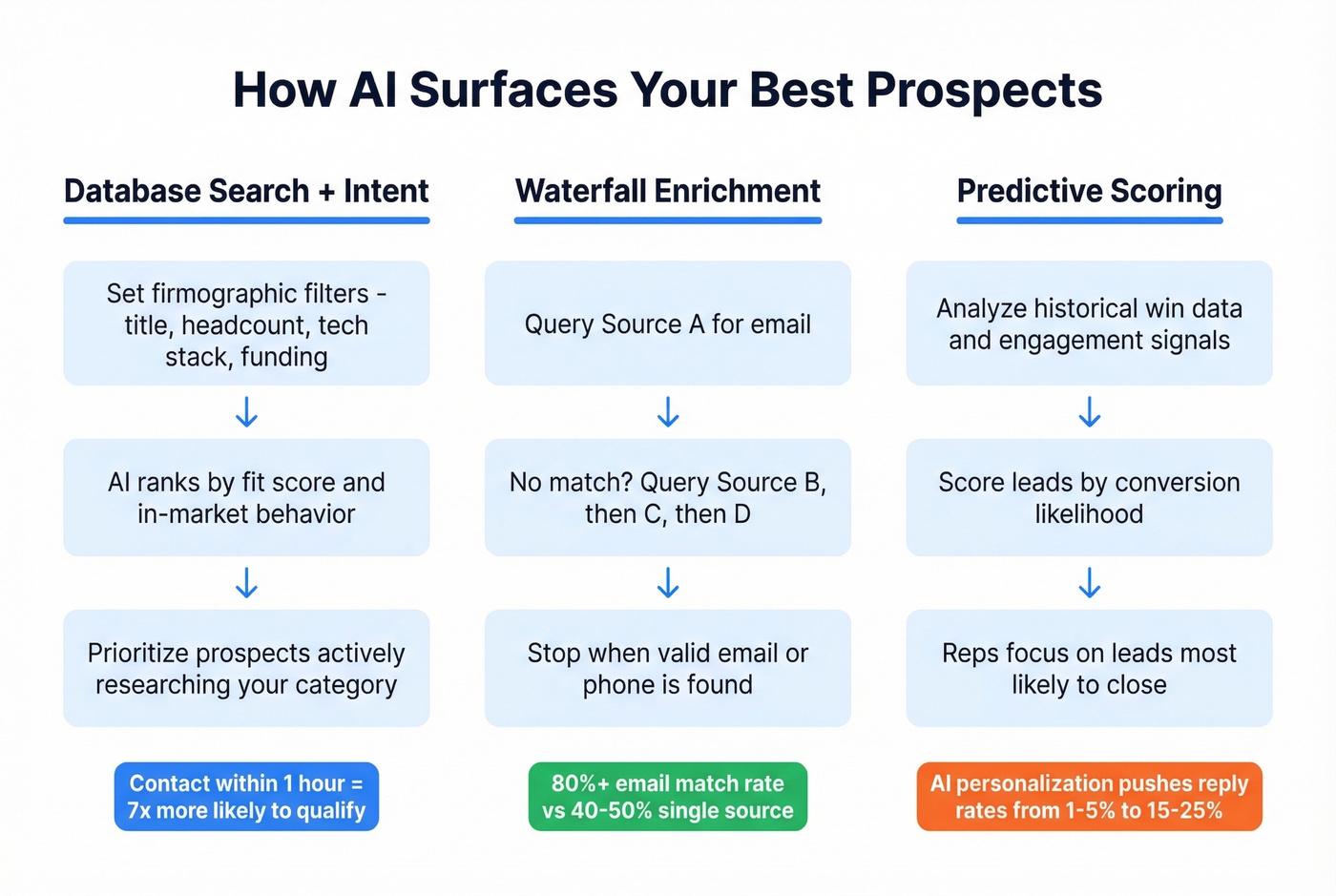
You search a B2B database using firmographic and behavioral filters - job title, headcount, tech stack, funding stage, intent signals. AI-powered search ranks results by fit scores and in-market behavior, so you're not just pulling "VP of Marketing at SaaS companies" but prioritizing the ones actively researching your category right now.
Waterfall Enrichment
Instead of relying on one provider, waterfall enrichment queries multiple sources sequentially until it finds a valid email or phone. Properly configured waterfalls hit 80%+ email match rates versus 40-50% from a single source. Phone numbers are harder - expect 40-60% for direct dials. Clay is the most popular tool here, though the credit math adds up fast.
Predictive Scoring
AI scoring models analyze historical win data, engagement signals, and firmographic patterns to rank leads by conversion likelihood. The practical impact is simple: reps stop wasting mornings on leads that were never going to close. Cold email baseline reply rates sit at 1-5%, but AI-driven personalized campaigns push that to 15-25%.

Your AI stack is only as good as its data layer. Prospeo gives you 300M+ profiles with 30+ filters - intent, technographics, job changes, funding - verified at 98% email accuracy on a 7-day refresh cycle. Start free with 75 verified emails/month.
Build the lead-finding stack this article describes - starting at $0.
The Stack That Works (By Budget)
Under $100/Month
You don't need to spend anything to test your ICP. Prospeo's free tier (75 verified emails/month) plus Apollo's free plan (50 credits/month) for broader search, combined with manual Gmail outreach, is enough to start testing messaging and booking early conversations. Volume is the only limitation - not data quality.

$100-$500/Month
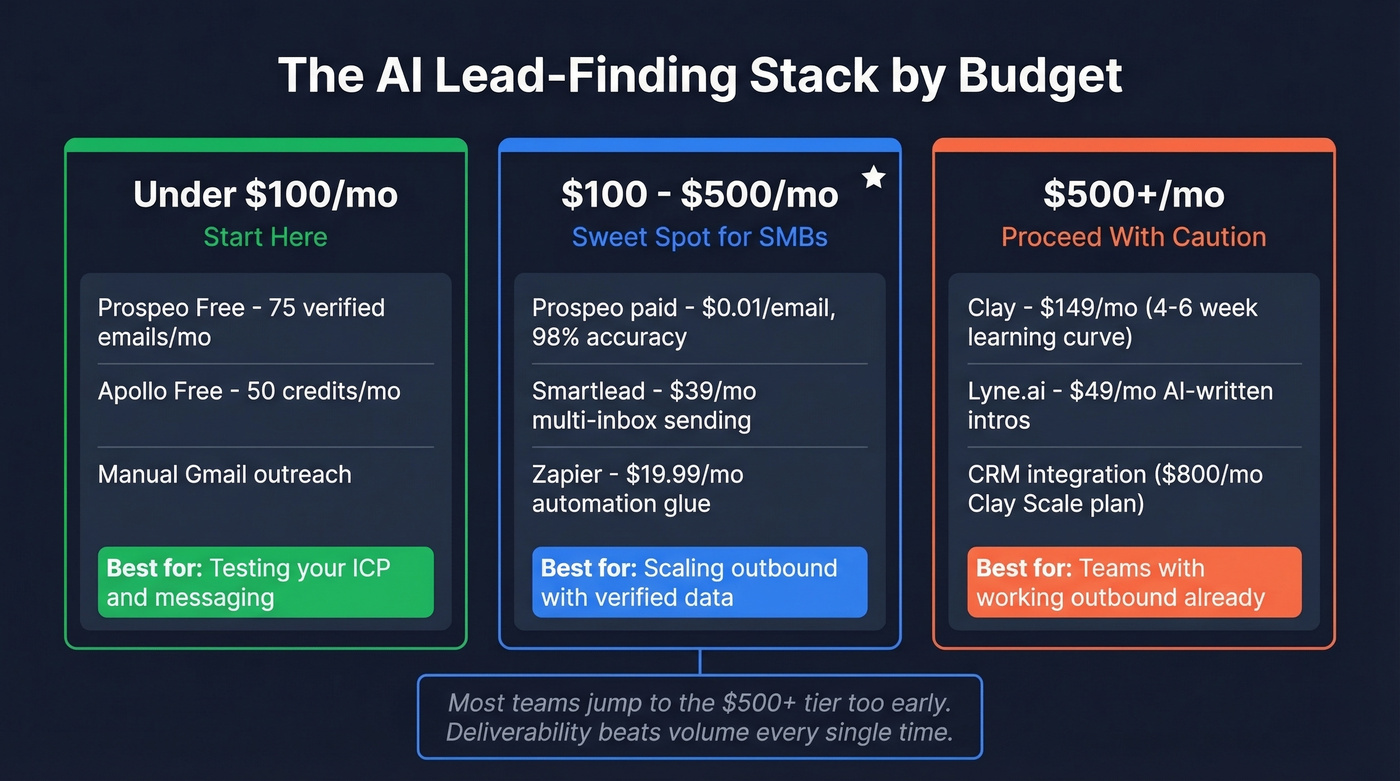
This is where most SMB teams land. At roughly $0.01/email with 98% accuracy, you can scale volume without gambling on deliverability. Add Smartlead ($39/mo) for multi-inbox cold email and Zapier ($19.99/mo billed annually) to connect everything. In our testing, this setup consistently outperforms teams spending 5x more on unverified data - because deliverability beats volume every single time.
$500+/Month: Proceed With Caution
Here's the thing: most teams jump to this tier too early. They add Clay ($149/mo) for waterfall enrichment before they've maxed out what verified data alone can do. Clay has a 4-6 week learning curve, and CRM integration is gated behind their $800/mo Scale plan. If you do go this route, use your primary verified data source for the bulk of contacts and only route the gaps through Clay's waterfall. Add Lyne.ai ($49/mo) for AI-written intros and push everything into your CRM.
For teams that already have a working outbound motion and just need more coverage, this tier makes sense. For everyone else, it's premature optimization.
| Tool | Role | Starting Price | Best For |
|---|---|---|---|
| Prospeo | Data + verification | Free (75/mo) | Verified data, any budget |
| Apollo.io | All-in-one prospecting | Free (50 credits/mo) | Getting started fast |
| Clay | Waterfall enrichment | $149/mo | Complex ops workflows |
| Smartlead | Email sequencing | $39/mo | Multi-inbox cold email |
| Instantly | Email sequencing | ~$30/mo | Simple cold email |
| Lyne.ai | AI personalization | $49/mo | Scaling intros |
| ZoomInfo | Enterprise data | ~$14K+/year | Large teams with budget |
| Zapier | Automation glue | Free / $19.99/mo | Connecting tools |
Verification: The Step Everyone Skips
Every tool in your stack is useless if you're sending to bad emails. One Seamless.AI user reported a 25% bounce rate from an exported list. Apollo's contact data is populated by other users - convenient for coverage, but still something you should independently verify before you send. The consensus on r/sales is blunt: Apollo is a jack of all trades, master of none, and you need independent verification regardless of your data source.
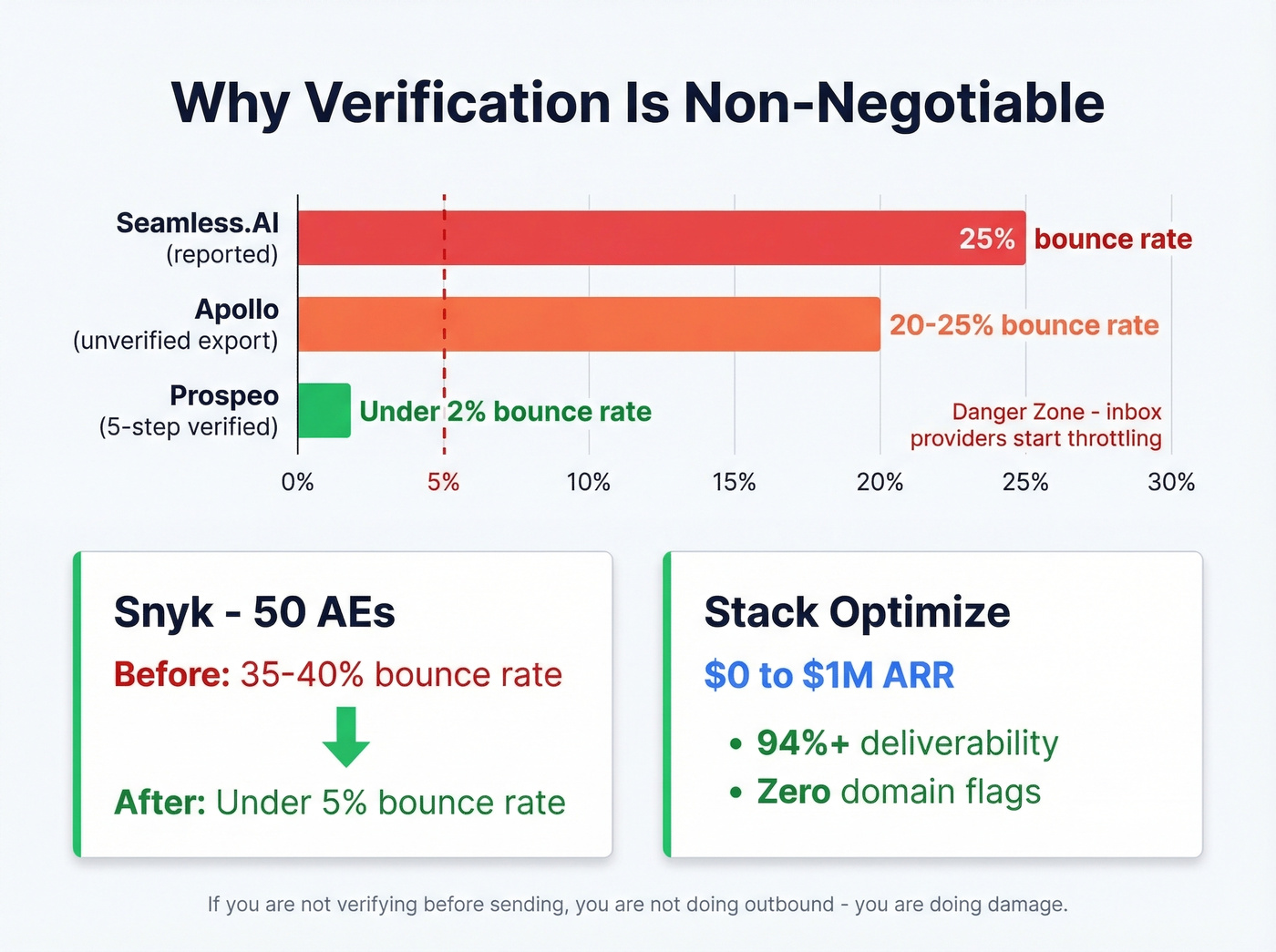
Domain reputation damage compounds fast. If bounce rates climb, inbox providers start throttling you, and recovery can take weeks. We've seen teams lose months of sender reputation progress from a single bad batch. (If you need to audit it, start with how to check domain reputation.)

A proper verification process - catch-all handling, spam-trap removal, honeypot filtering, proprietary infrastructure that doesn't rely on third-party email providers - solves this. If you're troubleshooting bounces, it helps to understand soft bounce rate and spam trap removal. Snyk's team of 50 AEs dropped their bounce rate from 35-40% to under 5% after switching to verified-first data. Stack Optimize built from $0 to $1M ARR running client campaigns at 94%+ deliverability with zero domain flags.
Let's be honest: if you're not verifying before sending, you're not doing outbound. You're doing damage.
Five Mistakes That Kill Results
1. Trusting unverified data. Apollo, Seamless, any database - export and verify before sending. No exceptions.
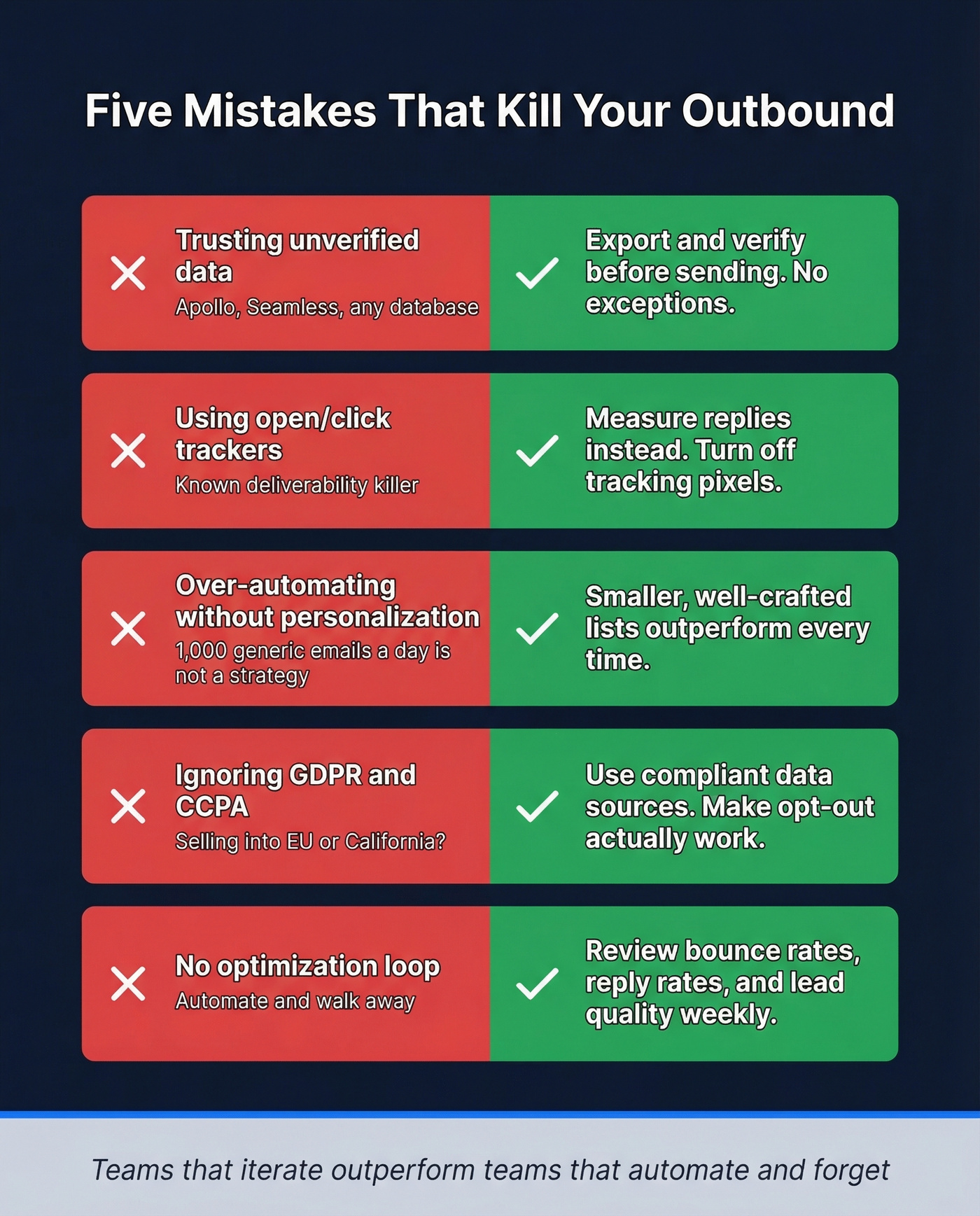
2. Using open/click trackers. Apollo's built-in tracking is a known deliverability killer. Practitioners on r/sales consistently warn against it. Measure replies instead. (If you want safer options, see email tracking tools.)
3. Over-automating without personalization. Sending 1,000 generic emails a day isn't a strategy. It's a fast path to spam folders. Teams that surface ideal prospects with AI but skip personalization still underperform teams with smaller, well-crafted lists.
4. Ignoring GDPR/CCPA. If you're selling into the EU or California, your data source needs to be compliant and your opt-out process needs to actually work. This isn't optional - it's table stakes. (Use a GDPR Compliant Database checklist.)
5. No optimization loop. Review bounce rates, reply rates, and lead quality weekly. Teams that iterate outperform teams that automate and walk away. Every time.
Snyk's 50 AEs cut bounce rates from 35% to under 5%. Stack Optimize hit $1M ARR with zero domain flags. The difference wasn't AI personalization or fancy workflows - it was verified-first data at $0.01/email with 5-step verification.
Stop burning your domain on unverified lists.
FAQ
Can I use AI for finding leads without paying?
Yes. Prospeo's free tier gives you 75 verified emails per month, and Apollo offers 50 free credits. Combined, that's enough to validate your ICP and book early meetings before committing budget. The AI filters work identically on free and paid plans - only volume is capped.
How accurate is AI-generated lead data?
It depends entirely on verification. Unverified databases routinely produce 20-25% bounce rates. A 5-step verification process with catch-all handling and spam-trap removal delivers 98% email accuracy; most single-source tools sit around 79-87%. Always verify before sending - your domain reputation depends on it.
How do I find similar leads once AI surfaces initial matches?
Feed your best-converting contacts back into your data platform and let lookalike filters do the work. Filters for industry, tech stack, headcount, and intent signals surface contacts mirroring your top customers. Expect 2-3x higher reply rates from lookalike lists versus broad-match searches.
Do I need a CRM to use AI lead-finding tools?
Not initially. Most tools export to CSV, which is fine under 500 contacts per month. Once you scale past that, a free CRM like HubSpot prevents duplicate outreach and tracks pipeline. Setup takes an afternoon via Zapier or a native integration.