

AI Guided Selling: What It Actually Takes to Make It Work
Your VP of Sales just came back from a conference convinced the team needs AI guided selling. There's a slide deck with "30% win rate improvement" in bold. There's a vendor demo scheduled for Thursday. And your CRM has 40% stale contacts, three disconnected data sources, and a forecasting model that nobody trusts.
This is where most implementation stories start - and where most of them quietly die.
74% of organizations invested in AI and gen AI last year. The budgets are real. The results, for most sales teams, aren't. Not because the technology doesn't work, but because the foundation underneath it is rotten.
The Short Version
- AI guided selling isn't a product you buy - it's an outcome built on clean data, the right integrations, and change management.
- Most implementations fail because of stale CRM data (30% annual decay), not bad AI. Fix the data layer first.
What Is AI Guided Selling?
AI guided selling delivers prescriptive, context-aware recommendations throughout the sales process. It tells reps who to contact, what message to send, how to structure pricing, and when to act - dynamically, based on deal progression and buyer behavior. DealHub's glossary frames it clearly: this isn't static enablement playbooks sitting in a wiki nobody reads. It's real-time, deal-specific direction that updates as the buyer engages. Or as Dock's guide puts it, continuous enablement in the flow of work - not episodic training sessions reps forget by Friday.
The distinction that matters most: predictive vs. prescriptive. Predictive AI tells you a deal is 60% likely to close. Prescriptive AI tells you to send the ROI calculator to the CFO on Tuesday because she just visited the pricing page twice. Predictive is a dashboard. Prescriptive is a co-pilot.
Most teams think they're buying the co-pilot and end up with the dashboard.
The best guided selling systems ingest email threads, call transcripts, meeting notes, content engagement signals, and buyer intent data to generate recommendations that reflect what's actually happening in the deal - not what a rep remembered to log last week.
Three Maturity Levels
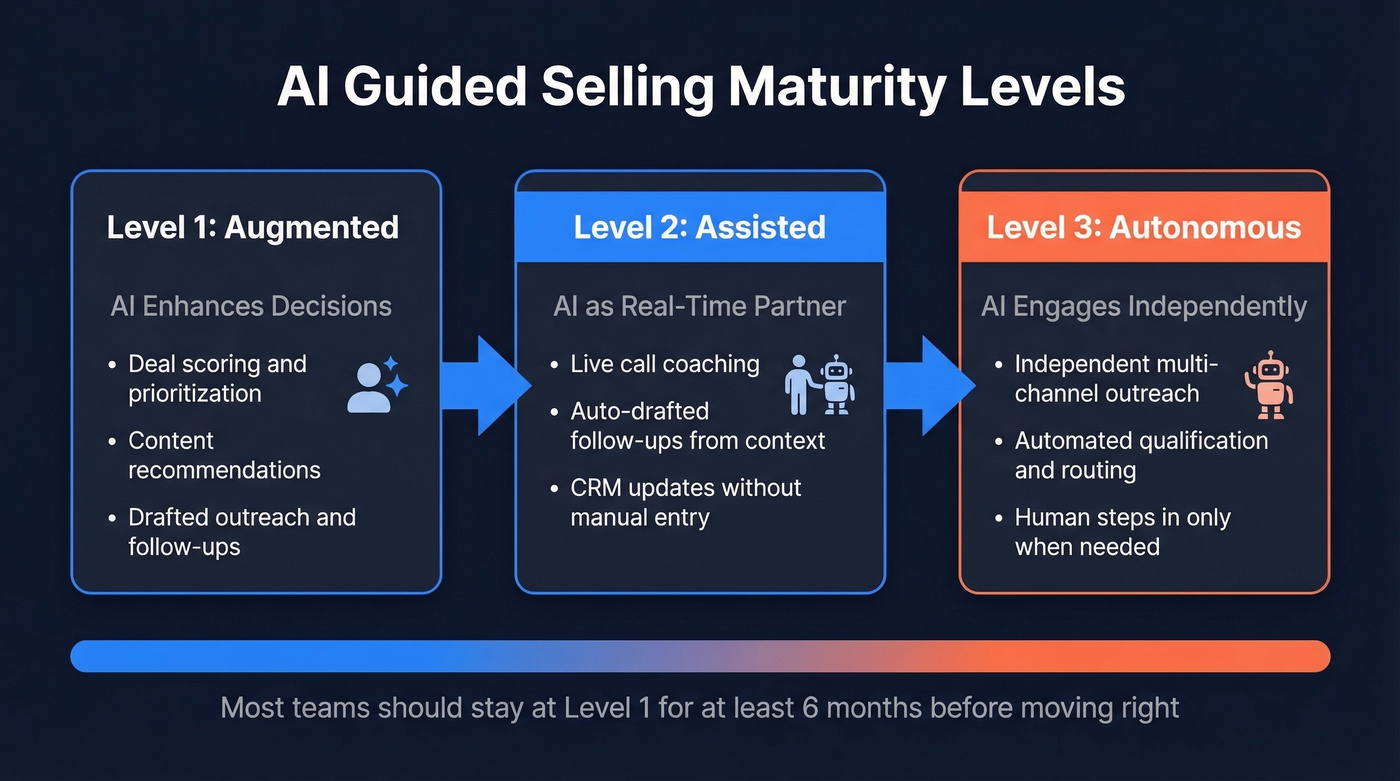
BCG published a framework for agentic selling that maps neatly to where teams actually land. Be honest about where you are before buying tools designed for a level you haven't reached.
Augmented - AI Enhances Decisions
This is where a lot of teams start: AI suggests next-best actions, scores deals, recommends content, and drafts outreach. The rep still makes every decision. Tools at this level include CRM-native features like HubSpot's deal scoring or Salesforce Einstein's opportunity insights. BCG also notes that around 7 in 10 sellers already rely on general-purpose AI tools for tactical tasks like drafting emails, summarizing calls, and writing follow-ups - which is often what "AI in sales" looks like before guided selling becomes truly workflow-embedded.
Assisted - AI as Real-Time Partner
AI participates actively during live interactions - coaching reps on calls, auto-drafting follow-ups based on conversation context, and updating CRM records without manual entry. This requires conversation intelligence integration through platforms like Gong or Salesloft. The jump from augmented to assisted is significant because it demands real-time data pipelines, not batch processing.
Autonomous - AI Engages Independently
AI independently reaches out across channels, handles initial qualification, and routes opportunities to reps only when human judgment is needed. This is the frontier - and it's messy. One widely cited summary of agent research (including a Carnegie Mellon result) puts failure rates around 70% on multi-step office tasks. Without tight guardrails and clean data, autonomous selling creates more problems than it solves.
Here's the thing: most teams should stay at the augmented level for at least six months before even thinking about autonomous. The companies rushing to Level 3 are the same ones whose reps quietly stop trusting the system after it sends tone-deaf outreach to prospects who just went through layoffs.

Your AI guided selling tool is only as good as the data feeding it. With 30% annual CRM decay, most recommendations go stale before reps act on them. Prospeo refreshes 300M+ profiles every 7 days - not every 6 weeks - with 98% email accuracy and 125M+ verified mobiles.
Stop feeding your AI co-pilot garbage data. Start with Prospeo.
Why Most Implementations Fail
It's Q3. Your guided selling tool has been live for 90 days. Reps are ignoring the "next best action" suggestions because the last three recommended calling people who left their companies months ago. We've seen this pattern play out repeatedly - recommendations built on stale CRM data don't just underperform, they actively erode rep trust in the entire system.
If you're trying to fix this systematically, start with data enrichment and a repeatable data validation automation workflow before you touch model tuning.
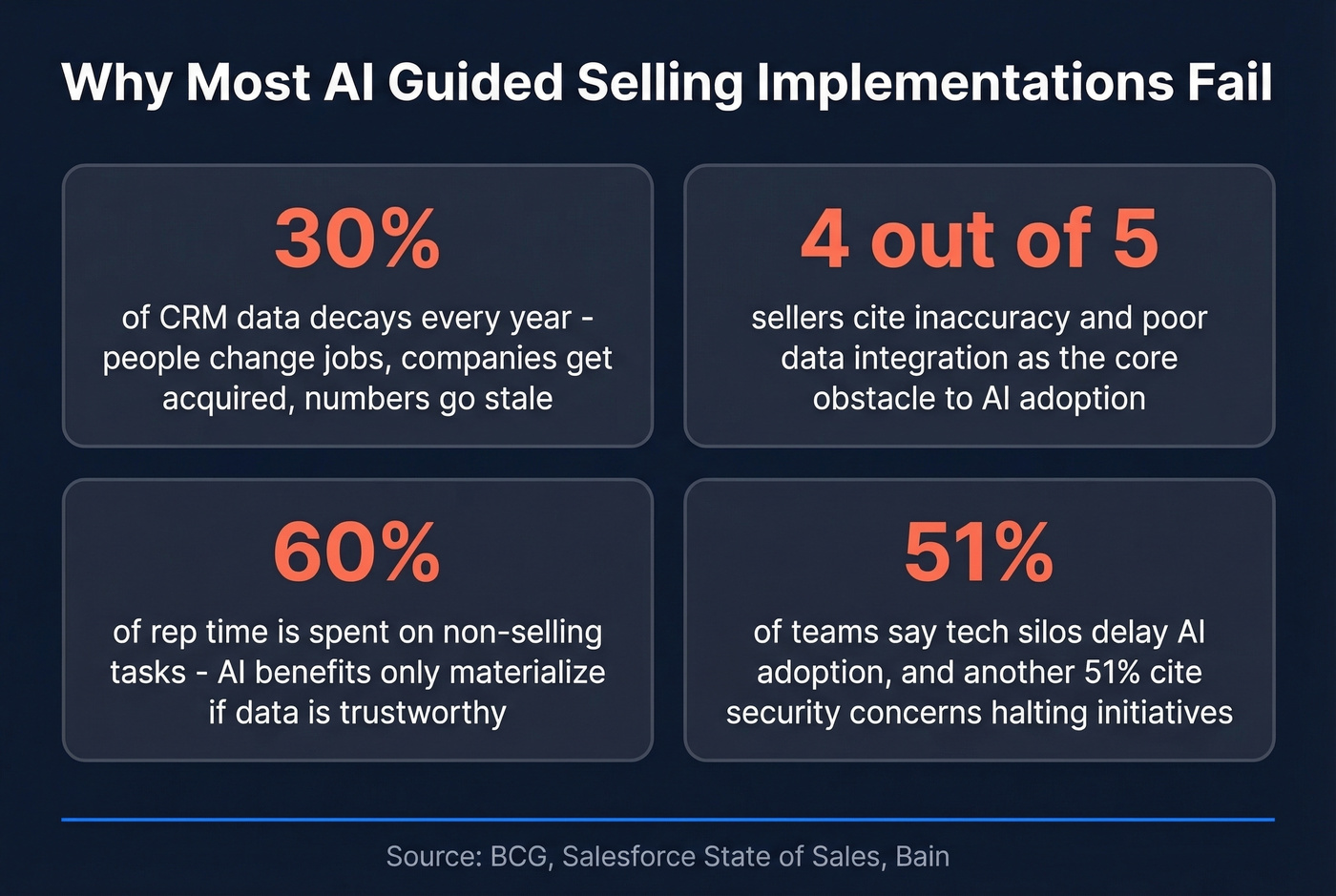
BCG's data is damning: more than 4 out of 5 sellers cite inaccuracy and poor data integration as the core obstacle. Salesforce's State of Sales research reinforces it - 51% cite security concerns halting AI initiatives, and a separate 51% say tech silos delay adoption. Sales reps already spend 60% of their time on non-selling tasks. The core benefits of prescriptive selling - reclaiming that time and focusing reps on revenue-generating activities - only materialize if the data underneath is trustworthy.
Bain's analysis identifies three blockers that kill guided selling before it delivers value: piecemeal use cases that don't move the needle, data spread across systems with low quality control, and frontline reluctance to change behavior. CRM data decays at roughly 30% per year - people change jobs, companies get acquired, phone numbers go stale. Feed that into an AI system and you get confidently wrong recommendations.
Step zero for any guided selling implementation isn't picking a platform. It's fixing the data layer. Prospeo refreshes 300M+ professional profiles every 7 days - the industry average is six weeks. Email accuracy sits at 98%, and the database includes 125M+ verified mobile numbers with a 30% pickup rate. When your guided selling tool recommends calling the VP of Engineering, you want a number that actually connects.
If you're evaluating providers, use a ranked shortlist of the best B2B databases and prioritize a verified contact database over "more records."

Real-World Results
When the data foundation is solid and implementation is thoughtful, the numbers are hard to argue with. Bain benchmarks early AI successes in sales at 30%+ improvement in win rates, and estimates AI could double the time sellers spend actually selling - from roughly 25% today. Sellers with AI tools are 3.7x more likely to meet quota, and 88% of reps using AI agents say the technology increases their odds of hitting sales targets.
To make those gains show up in your numbers, tie the rollout to account executive KPIs and a clear sales performance analysis cadence.
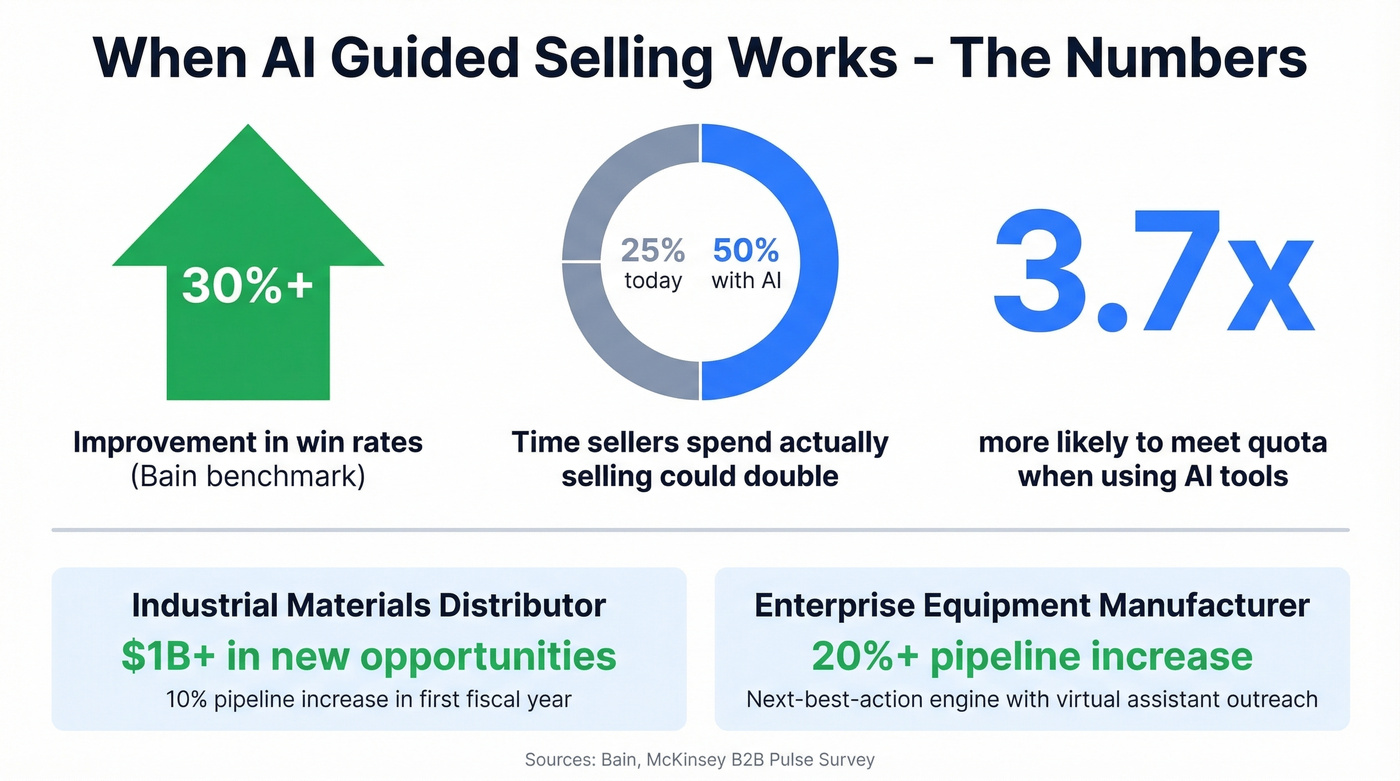
McKinsey's B2B Pulse Survey offers two anonymized case studies worth studying. An industrial materials distributor used gen AI to extract insights from unstructured public data and personalize outreach - producing over $1B in new opportunities and a ~10% pipeline increase in the first fiscal year. An enterprise equipment manufacturer deployed a next-best-action engine predicting maintenance schedules with virtual assistant outreach, increasing pipeline by more than 20% of total revenue.
These examples illustrate what's possible when prescriptive recommendations sit on top of clean, integrated data. Adoption is still early. McKinsey's survey of nearly 4,000 B2B decision-makers across 13 countries shows 19% are implementing gen AI use cases for B2B selling and 23% are in process. The window for competitive advantage is open, but it's closing fast.
Tools and What They Cost
Nobody in this market publishes clean pricing, so here are realistic ranges based on mid-market contracts and community discussions. Skip the tools that don't match your maturity level - buying Gong when you haven't cleaned your CRM is like buying a sports car before paving your driveway.
| Tool | Category | Key Capability | Approx. Pricing |
|---|---|---|---|
| Prospeo | Data quality | 98% emails, 7-day refresh, 125M+ mobiles | Free tier; ~$0.01/email |
| HubSpot Sales Hub | CRM-native | Deal scoring, playbooks, forecasting | $90-$150/user/mo |
| Salesforce Einstein | CRM-native AI | Opportunity scoring, Copilot | $165/user/mo; Copilot ~$50-75/user/mo |
| Gong | Conversation intel | Call analysis, deal intelligence | ~$100-$150/user/mo; $30K-$100K+/yr enterprise |
| Salesloft | Engagement + AI | Conductor AI, cadence optimization | ~$100-$150/user/mo |
| Cognism | Data + AI prospecting | Intent signals, compliance-first | ~$1,000-$3,000/mo |
| Mindtickle | Enablement | AI coaching, readiness scoring | ~$20K-$80K+/yr |
| Seismic (Aura) | Content intel | AI content recommendations | ~$30K-$50K+/yr |
| DealHub | CPQ + guided selling | Pricing guidance, deal rooms | ~$40-$80/user/mo |
For teams already in HubSpot, Sales Hub Professional is the path of least resistance - the guided selling features are native and the data model is unified. Enterprise teams on Salesforce should pair Einstein with Gong for conversation intelligence. Mid-market teams without a CRM commitment get the most flexibility from Salesloft paired with a verified data layer underneath.
If you're comparing categories, start with a shortlist of best AI sales tools and then map them to your RevOps tech stack so you don't create new silos.
Every tool in this table performs better with clean inputs. The data layer isn't optional - it's the multiplier that determines whether your investment delivers ROI or collects dust.
How to Actually Implement It
Bain's guidance is clear: value comes from reimagining end-to-end sales processes, not just automating existing steps. In our experience, the teams that succeed treat this as a six-month transformation project, not a software rollout.
If you need a systems view, align guided selling with CRM automation software and a documented B2B sales pipeline management process.
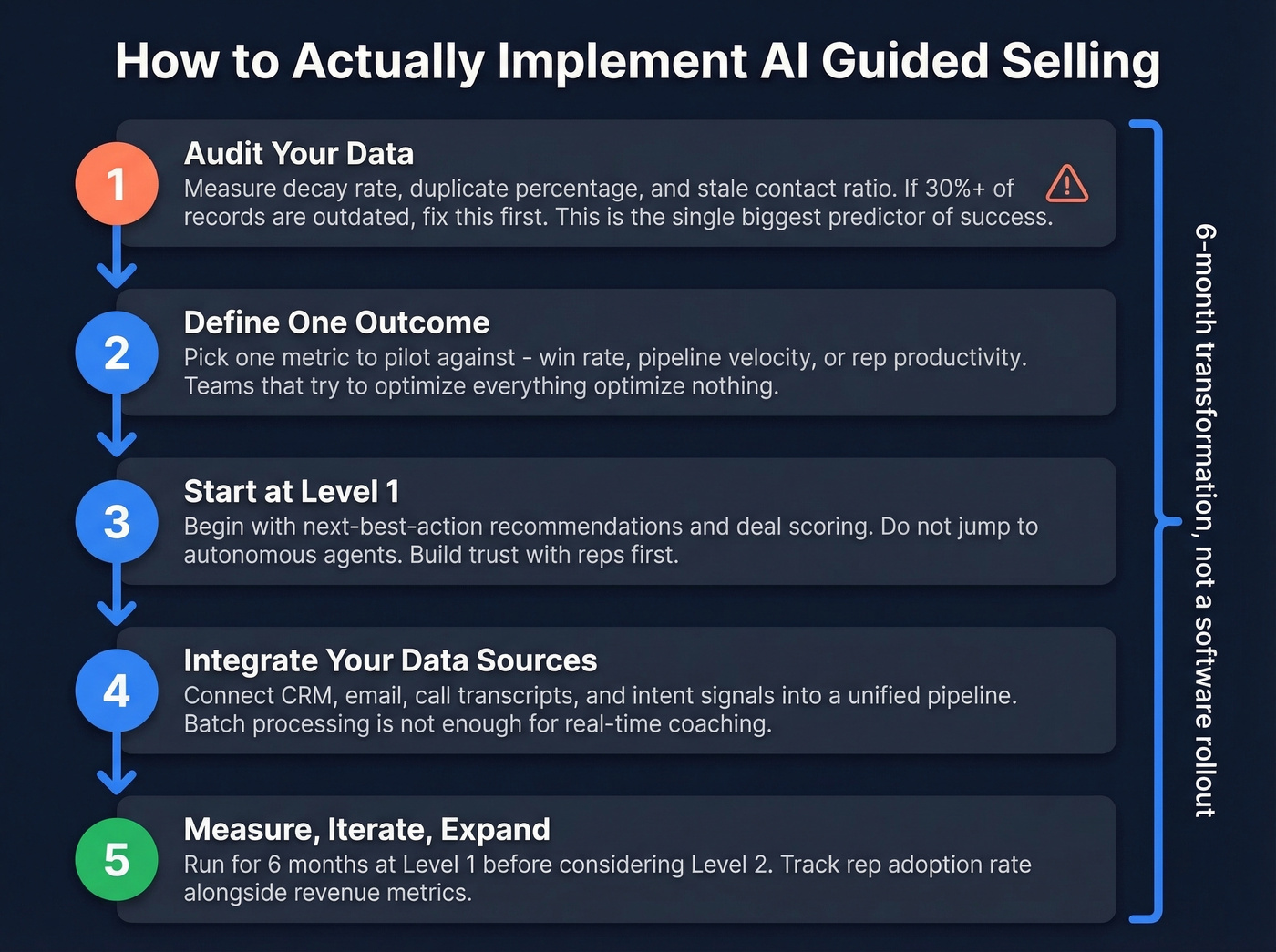
1. Audit your data. Measure your decay rate, duplicate percentage, and stale contact ratio. If 30%+ of records are outdated, fix this before touching any guided selling platform. This is the single biggest predictor of implementation success.
2. Define the outcome. Win rate improvement? Pipeline velocity? Rep productivity? Pick one metric to pilot against. Teams that try to optimize everything simultaneously optimize nothing.
3. Start at Level 1. Next-best-action recommendations and deal scoring. Don't jump to autonomous. BCG's data shows three in four sellers feel under-supported with training - adding complexity before reps trust the basics is a recipe for rejection.
4. Keep humans in the loop. Review AI recommendations weekly. Flag inaccuracies. Retrain. The set-and-forget approach produces robotic messaging, tone-deaf timing, and reps who stop trusting the system entirely. Let's be honest - if your reps don't believe the recommendations, they'll build workarounds within a week and you'll never know until the renewal conversation.
5. Measure at 90 days. Expect weeks for initial value, 30-90 days for advanced pattern recognition, and first-quarter material impact if data is clean and adoption is managed. If you're not seeing signal by day 90, the problem is almost always data quality or change management - not the technology.
When your guided selling system says 'call the VP of Engineering,' you need a number that rings. Prospeo delivers 125M+ verified mobile numbers with a 30% pickup rate - 3x the industry average. At $0.01 per email, fixing your data layer costs less than one bad recommendation.
Give your AI the foundation it needs to actually guide selling.
FAQ
How does AI guided selling differ from a sales chatbot?
AI guided selling provides prescriptive recommendations to human reps - who to call, what to say, how to price a deal - while a sales chatbot interacts directly with buyers to answer questions or qualify leads. Guided selling augments your team's decisions; chatbots replace a conversation. Most B2B sales teams need guided selling first, chatbots second.
How much does guided selling software cost?
Expect $15,000-$100,000+ per year depending on team size and vendor. CRM-native options like HubSpot and Salesforce Einstein start at $90-$165/user/month. The data quality layer underneath can start free and scale from roughly $0.01 per verified email.
What measurable benefits should teams expect?
The most measurable benefits include higher win rates (30%+ in Bain's benchmarks), more time spent on actual selling instead of admin work, and more consistent execution across the team. Reps get context-aware next steps instead of relying on gut instinct, which reduces deal slippage and improves forecast accuracy.
How long until results show up?
Most teams see initial value within weeks if data quality is solid. Advanced pattern recognition across deals takes 30-90 days to mature. Material pipeline impact typically shows in the first full quarter. The biggest delay is usually data cleanup and rep adoption, not tool configuration.