

AI in B2B Marketing: A Practitioner's Guide for 2026
Marketing budgets are growing 1-4% while CEOs expect 15-20% revenue jumps. That math doesn't work without AI - and yet a Forbes Council survey of 250+ participants found 38% are neutral or outright dissatisfied with their AI results. Not because the technology failed them, but because they automated the wrong things first.
That's the most common complaint we hear from B2B teams experimenting with AI, and it's the gap this guide closes.
The Short Version
- Fix your data first. 58% of B2B professionals say data quality is the #1 factor for automation success. Layer AI on dirty data and you automate garbage at scale. If you need a starting point, compare data enrichment options before you automate anything.
- Pick 2-3 use cases tied to funnel stages, not 16 tools tied to vendor demos. Content generation, lead scoring, and intent-based routing cover most teams' first 90 days.
- Follow a phased 90-day rollout - audit, build, launch - with KPIs at every stage.
Where AI Adoption Actually Stands in 2026
87% of B2B marketers are using or testing AI. 71% use GenAI weekly. Those numbers sound like a revolution. They're not.
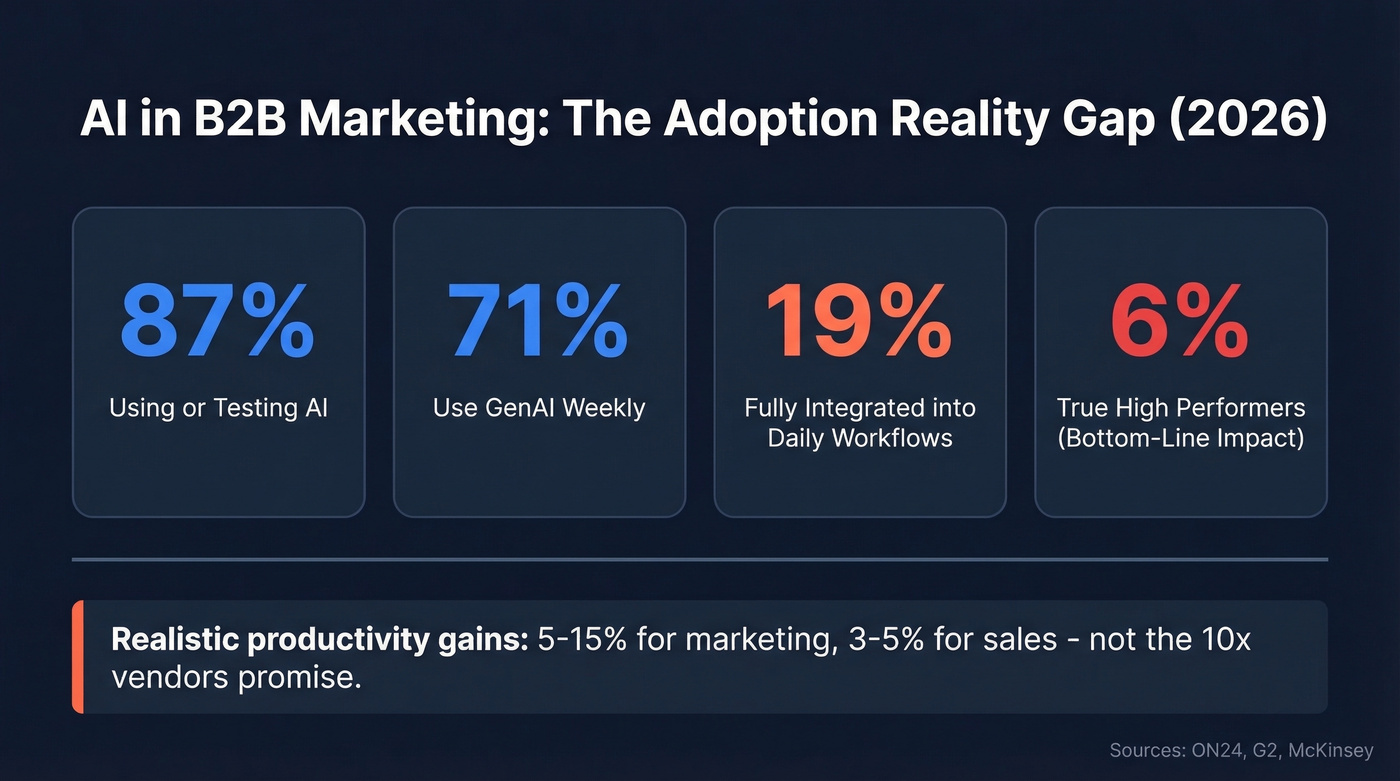
Only 19% of B2B teams have fully integrated AI into daily workflows. Just 6% qualify as "high performers" where AI contributes meaningfully to bottom-line results. McKinsey pegs realistic productivity gains at 5-15% for marketing and 3-5% for sales - meaningful, but nowhere near the 10x miracle vendors promise.
Adoption isn't the problem. Everyone's adopted something. The problem is that most teams bolted a ChatGPT subscription onto broken processes and called it a strategy. The consensus on r/sales and r/marketing is telling - people aren't asking for tool lists anymore, they're asking for real-world workflows. What's missing isn't access to technology. It's a coherent plan for deploying it.
High-Impact Use Cases Across the Funnel
Top of Funnel
Intent data is one of the highest-impact AI applications most teams underuse. Tracking which accounts are actively researching your category - before they fill out a form - lets you prioritize outreach to buyers already warming up. If you're building this motion, start with a clear view of buyer intent signals and how you'll operationalize them. Buyers spend only 17% of their time with suppliers, so timing is everything.
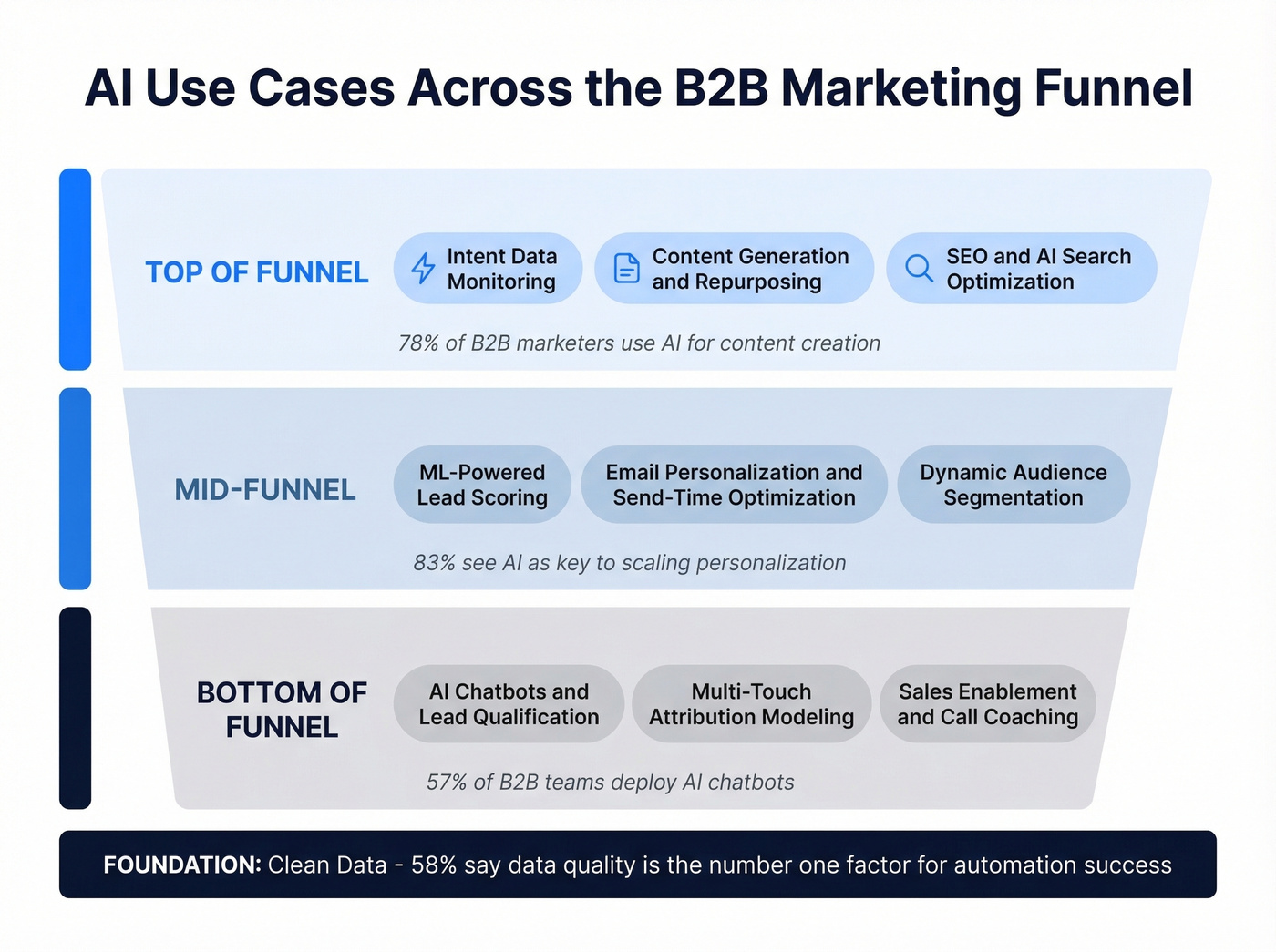
Content generation is the most common use case: 78% of B2B marketers use AI for text creation. But volume isn't the win. The win is using AI to produce variations, test angles, and repurpose across formats faster than a human team could alone.
SEO deserves a reality check. Gartner predicted traditional search volume will drop 25% by 2026 due to AI chatbots, and early data already shows traditional search result clicks dropping from 15% to 8% when an AI summary appears. SEO isn't dead, but the traffic ceiling is lower. Invest in original research and first-party data that AI summaries can't replicate.
Mid-Funnel
Lead scoring powered by machine learning moves beyond static point systems to dynamic models weighing engagement patterns, firmographic fit, and intent signals simultaneously. This is where personalization starts - and 83% of businesses see AI as key to scaling it. For teams that want to go deeper here, AI for demand generation is where most of the compounding wins show up.
AI-powered email is where mid-funnel teams see the fastest wins. Send-time optimization, dynamic personalization, and sequence testing push B2B email benchmarks well above the 43.46% average open rate and 2.09% click rate that most teams settle for. We've seen teams double their reply rates just by layering verified contact data with send-time optimization - no fancy tools required, just clean data and good timing. If you're implementing this, use a dedicated AI email personalization workflow rather than generic prompts.
Bottom of Funnel
AI chatbots are deployed by 57%, and 26% report a 10-20% lift in lead generation. The best implementations qualify visitors in real time and route hot leads to sales within minutes.
Attribution modeling - historically a nightmare of spreadsheets and guesswork - gets meaningfully better when AI processes multi-touch data across a 272-day average B2B buyer journey with 88 touchpoints and 10 stakeholders. That's a sentence worth re-reading. No human analyst can untangle that web manually, and the teams trying to do it in spreadsheets are kidding themselves. Sales enablement is another bottom-of-funnel win: AI-powered call coaching and content recommendations help reps close deals they'd otherwise lose to poor preparation. (If you're tightening the handoff, align on a clean MQL to SQL handoff so AI routing doesn't create chaos.)
The Data Foundation
The AI Agents Frontier
Beyond individual tools, AI agents represent the next inflection point. Daily AI tool usage is up 233% in six months, and Gartner expects 40% of enterprise apps to feature task-specific agents by end of 2026.
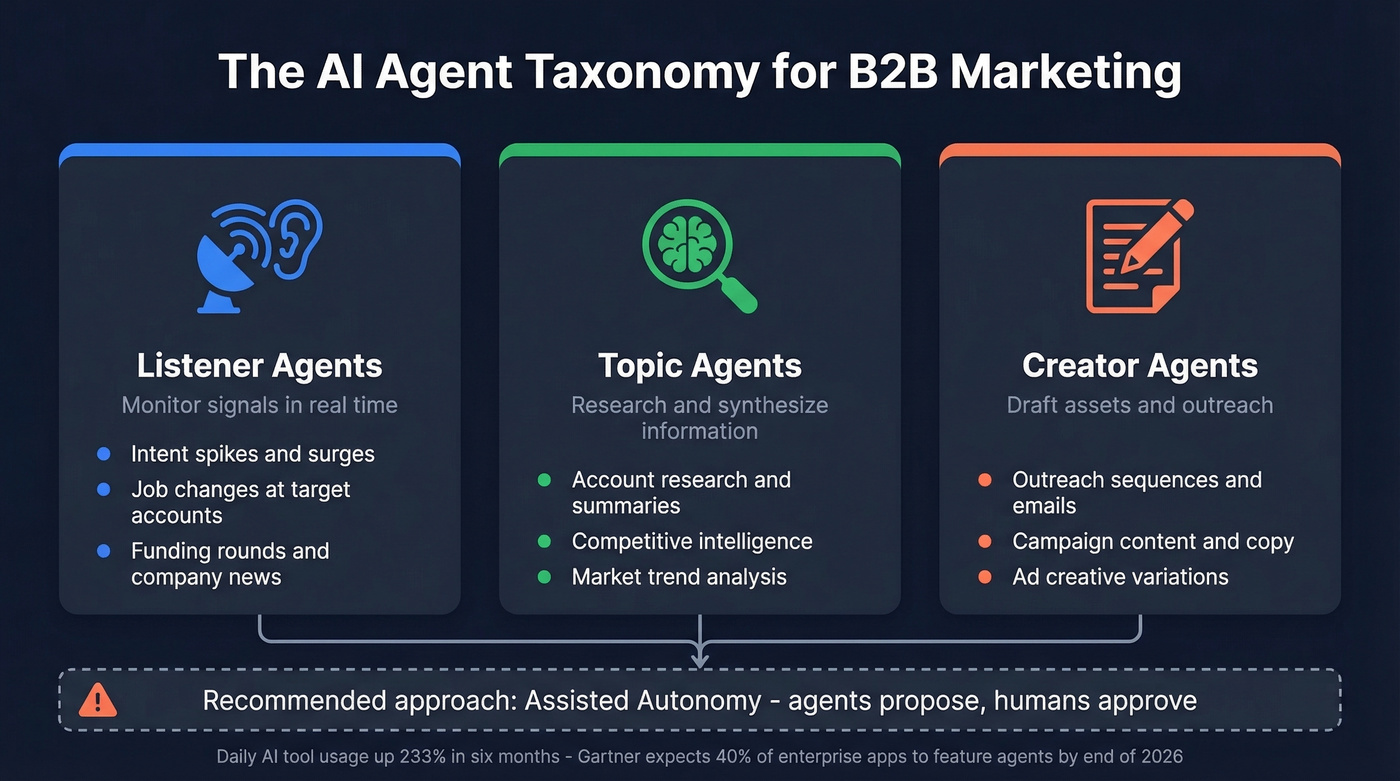
Here's the practical taxonomy: Listener Agents monitor signals like intent spikes, job changes, and funding rounds. Topic Agents research and synthesize account information. Creator Agents draft outreach, content, or campaign assets. If you're formalizing this, it helps to define your intent prediction model and success metrics before you build agents on top.
Let's be honest - most teams aren't ready for fully autonomous agents. The smart approach is "assisted autonomy," where agents propose actions and humans approve them. Map your biggest bottleneck, pilot a single-channel agent, define success metrics, and expand from there. The teams jumping straight to multi-agent orchestration without this foundation are the ones burning budget fastest.

This article makes it clear: AI only works when your data foundation is solid. Prospeo gives you that foundation - 300M+ profiles with 98% email accuracy, intent data across 15,000 topics, and a 7-day refresh cycle so your AI workflows never run on stale records. Teams using Prospeo book 35% more meetings than Apollo users.
Stop feeding your AI stack bad data. Start with Prospeo's verified foundation.
How to Deploy AI in B2B Marketing: 90-Day Plan
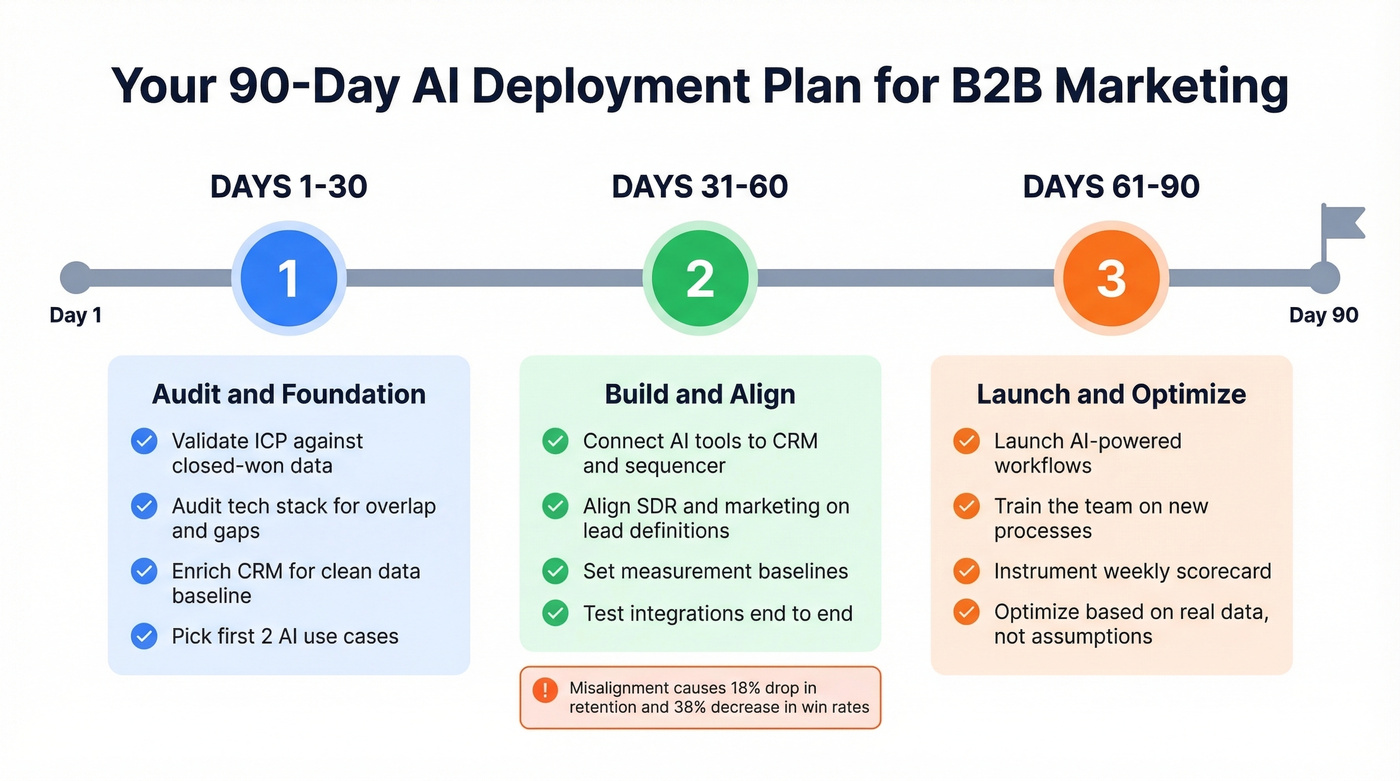
We've seen teams waste months evaluating tools without a framework. Here's the phased approach that consistently works, especially for lean teams of 2-5 marketers - which is the reality for most companies doing $5-10M in revenue. Strategic generalists backed by AI and smart automation beat bloated teams every time. (If you want a parallel framework, a go-to-market strategy timeline can help you sequence dependencies.)
Days 1-30: Audit and Foundation
Validate your ICP definitions against actual closed-won data. If your ICP is fuzzy, tighten it with an Ideal Customer Profile that sales and marketing both agree on. Audit your current tech stack for overlap and gaps - roughly 8.6% of martech solutions disappeared in 2024 alone, so some of your tools are already dead. Run your CRM through enrichment to establish a clean data baseline. Pick your first two AI use cases based on where you're losing the most time or pipeline.
Days 31-60: Build and Align
Build the workflows connecting your chosen AI tools to your CRM and sequencer. If you're shopping here, start with CRM automation software that can actually support your routing and scoring logic. Align SDR and marketing teams on lead definitions, routing rules, and handoff criteria - misalignment drives an 18% drop in customer retention and 38% decrease in win rates. Set measurement baselines for pipeline velocity, channel economics, and conversion rates at each stage.
This phase is where integration either takes root or stalls. The connective tissue between tools matters more than the tools themselves.
Days 61-90: Launch and Optimize
Launch your AI-powered workflows, train the team, and instrument a weekly scorecard. Optimize based on real data, not assumptions. The goal isn't perfection - it's a functioning feedback loop that compounds over time.
| Automate | Keep Human |
|---|---|
| Campaign brief drafts | Messaging and positioning |
| A/B test setup | Customer research |
| Scheduling and formatting | Creative direction |
| Basic reporting | Stakeholder comms |
| Lead routing | Crisis management |
AI Marketing Mistakes That Waste Budget
The biggest budget killer is over-automating without strategy. Automating a broken process just breaks it faster - define objectives and map AI to specific funnel stages before turning anything on. Right behind it: ignoring data quality. If your CRM is full of stale records, every AI tool downstream will underperform. (This is also why choosing a verified contact database matters more than adding another AI layer.)
Then there are the subtler traps. AI won't fix bad messaging, weak personas, or shaky product-market fit - it amplifies whatever you feed it. AI-generated content needs SME fact-checking and brand guardrails; one hallucinated stat in a whitepaper torches your credibility. And the EU AI Act now requires AI literacy training and AI-generated content labeling, so compliance blind spots create real legal exposure.
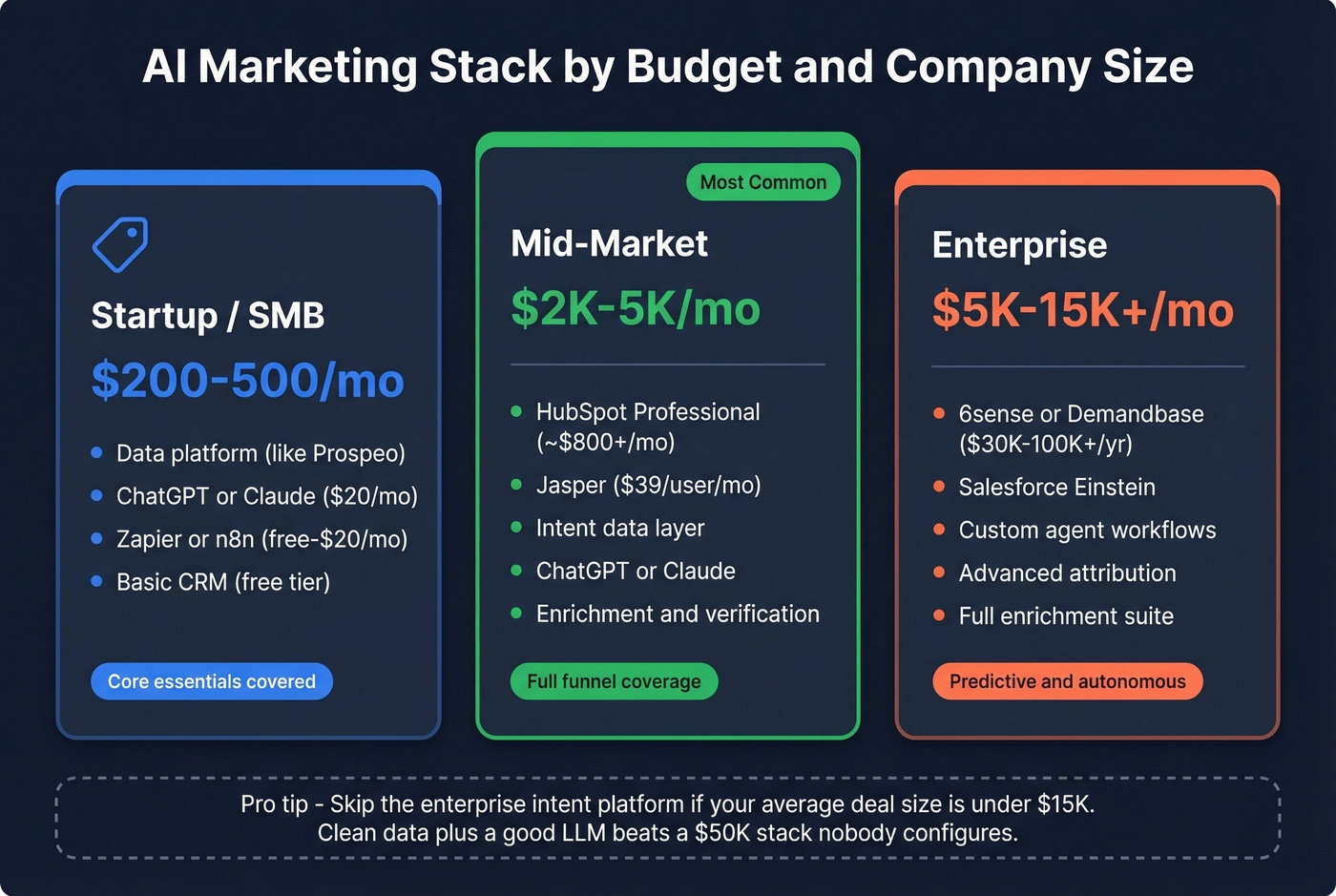
Skip the enterprise intent platform if your average deal size is under $15K. A clean contact database, a good LLM, and disciplined outreach will outperform a $50K stack that nobody on your team has time to configure properly.
Building Your AI Marketing Stack
Before evaluating tools, document what you're actually trying to solve. The martech space is massive and shrinking simultaneously - roughly 8.6% of solutions vanished last year - so anchoring decisions to a clear strategy prevents shiny-object syndrome. If you're comparing providers, start with the best B2B database landscape and work backward from your use cases.

HubSpot's Breeze AI adds an AI layer across Marketing Hub - content generation, lead scoring, and workflow optimization baked into the CRM you're probably already using. Expect around ~$800+/mo for a typical Professional setup.
ChatGPT and Claude are the content and research workhorses. ChatGPT Plus runs $20/mo; Claude's 200K-token context window makes it better for processing long documents and competitive analysis.
| Tool | Best For | Starting Price | AI Capability |
|---|---|---|---|
| Prospeo | Data and prospecting | Free / ~$0.01/email | Intent signals, enrichment |
| HubSpot Breeze | CRM and automation | ~$800+/mo | Scoring, content, workflows |
| ChatGPT / Claude | Content and research | $20/mo | Generation, analysis |
| 6sense | ABM and intent | ~$30K-100K+/yr | Predictive intent |
| Jasper | Content scaling | $39/user/mo | Brand Voice, templates |
| Zapier / n8n | Workflow orchestration | Free / $19.99/mo | Automation, integrations |
| Apollo.io | Prospecting | Free / $49/user/mo | Sequences, scoring |
What to expect to pay by company size:
- Startup/SMB ($200-500/mo): Data platform + ChatGPT/Claude + Zapier covers your core stack.
- Mid-market ($2K-5K/mo): Add HubSpot Professional, Jasper, and an intent data layer.
- Enterprise ($5K-15K+/mo): Add 6sense or Demandbase, Salesforce Einstein, and custom agent workflows.
Your 90-day AI rollout starts with clean CRM data and verified contact info. Prospeo's enrichment API returns 50+ data points per contact at a 92% match rate - for roughly $0.01 per email. Layer in Bombora-powered intent signals across 15,000 topics and you have the listener agents this article describes, ready on day one.
Enrich your CRM, activate intent signals, and launch AI workflows in days - not months.
Compliance You Can't Ignore
The EU AI Act is already in force, and the obligations are concrete:
| Obligation | Effective Since |
|---|---|
| AI literacy training | Feb 2, 2025 |
| AI-generated content labeling | Aug 2, 2025 |
| Documentation and oversight | Aug 2, 2025 |
GDPR compounds the requirements: any AI tool processing personal data needs a clear legal basis, data processing agreements, and opt-out mechanisms. When evaluating tools, GDPR compliance is a hard filter - not a nice-to-have. If you need a checklist, use a GDPR compliant database standard before you onboard vendors.
FAQ
What's the biggest mistake B2B teams make with AI marketing?
Layering AI on dirty data. 58% of B2B professionals identify data quality as the #1 automation success factor. Clean your CRM before investing in any AI tooling - enrichment tools that return 50+ data points per contact can establish a baseline fast.
How much does an AI marketing stack cost?
SMB stacks run $200-500/mo covering a data platform, an LLM, and a workflow tool. Mid-market teams spend $2K-5K/mo adding CRM AI and intent data. Enterprise stacks run $5K-15K+/mo with ABM platforms and custom agents.
Will AI replace B2B marketers?
No. Only 6% of organizations qualify as AI "high performers." The winners pair AI execution speed with human strategy, creative judgment, and relationship-building that machines can't replicate.
How do AI agents differ from marketing automation?
Automation follows predefined rules - if X, then Y. Agents make decisions, adapt to context, and orchestrate multi-step workflows autonomously. Think conveyor belt vs. junior employee who handles ambiguity.
The gap between AI adoption and AI results is closing fast. The teams that close it first - the ones who treat AI in B2B marketing as a discipline rather than a feature - will own the next cycle of growth.