

AI Prompts for Sales That Don't Sound Like AI
You've tried AI for cold emails. You got something that reads like a LinkedIn influencer crossed with a corporate press release - gave up, went back to writing them manually. That's a prompting problem, not an AI problem, and the right prompts fix it in about 10 minutes.
Gartner predicts that by 2028, 60% of B2B seller work will be executed through generative AI - up from less than 5% in 2023. Salesforce found that 81% of sales teams are already experimenting with AI, and AI-assisted teams are 1.3x more likely to see revenue growth. The shift isn't coming. It's here. Sales ops teams use ChatGPT to troubleshoot Salesforce formulas and crunch forecasting data. Frontline reps compress 30-minute pre-call research into 2-3 minute briefs. The gap isn't whether AI works for sales - it's whether you're prompting it well enough to sound like a human who sells for a living.
What You Need (Quick Version)
Before you scroll to the prompts, here's the framework that makes them work:
- Learn one prompting structure (Role + Context + Constraints) instead of hoarding 35 templates you'll never use. You need 10 great prompts, not a bloated library.
- Write constraint-heavy prompts for cold email. The rules that prevent "AI voice" - no exclamation points, no cliche openers, under 100 words - matter more than the prompt itself. Teams running this approach consistently hit 15-20% reply rates. Personalized emails see 26% higher open rates, and AI-assisted email writing drives 15% higher response rates.
- Verify your prospect data before sending. The best AI-written email is worthless if it bounces. This is the step most prompt guides skip entirely.
Here's the thing: sellers spend only 28-30% of their time actually selling. AI won't fix that if you're using it to write mediocre emails faster. These 10 prompts focus on the activities that move pipeline - not busywork at scale. If you want more ideas beyond prompts, pull from these sales activities that consistently move deals forward.
How to Write Effective Sales Prompts
Every effective prompt has five elements. Skip any one of them and you'll get generic output that sounds like it was written by a chatbot - because it was, without guardrails.
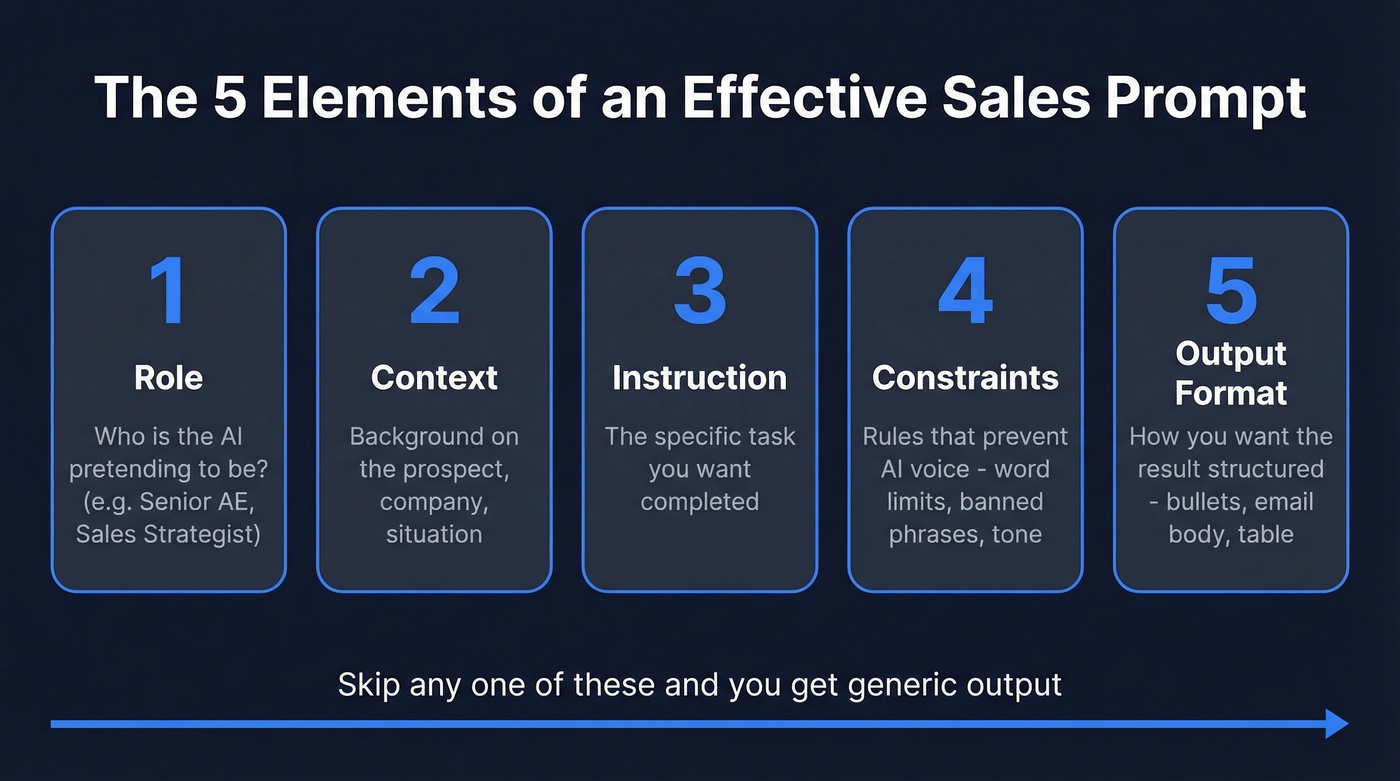
The five elements are Role, Context, Instruction, Constraints, and Output Format. Here's what the difference looks like in practice.
Vague prompt:
"Write a cold email to a VP of Sales about our product."
Structured prompt:
"You're a senior AE at a sales enablement company. Your prospect is a VP of Sales at a 200-person SaaS company that just raised Series B. Write a cold email under 80 words. No exclamation points. No 'hope this finds you well.' First line must reference their recent funding round. End with a low-commitment ask - not a demo request. Output: subject line + email body."
The second prompt produces something you'd actually send. The first produces something you'd delete.
One more concept worth knowing: prompt chaining. Instead of asking AI to do everything in one shot, break it into steps. First prompt: research the company. Second prompt: summarize the three most relevant pain points. Third prompt: write the email using those pain points. Each step feeds the next, and the final output is dramatically better than a single all-in-one request.

The best AI-written cold email still bounces if your data is bad. Prospeo delivers 98% email accuracy with a 7-day refresh cycle - so every prompt-perfected email actually reaches a real inbox.
Stop perfecting prompts for emails that bounce.
The 10 Prompts
Prompt 1: Company Snapshot
Pre-call research is the highest-ROI use case in your stack. Reps on r/sales consistently cite it as where AI saves the most time - turning a 30-minute deep dive into a 2-3 minute brief.
"You're a B2B sales rep preparing for a discovery call with [Company]. Summarize their business model, recent news from the last 6 months, likely pain points for a [their role] leader, and any competitive pressures. Keep it under 300 words. Format: bullet points grouped by category."
Prompt 2: Conversation Hooks
"Based on [Company]'s recent earnings call / press release / job postings [paste URL or text], identify 3 specific talking points I can use to open a discovery call. Each should connect to a problem my product solves: [one-sentence product description]. Format: hook + why it matters to them."
Prompt 3: First-Touch Cold Email
This is the prompt that matters most - and where most prompt lists fail. The secret isn't a clever prompt. It's a set of constraints that prevent AI from defaulting to corporate-speak. If you want a deeper system for this, pair these prompts with a personalized outbound email framework.
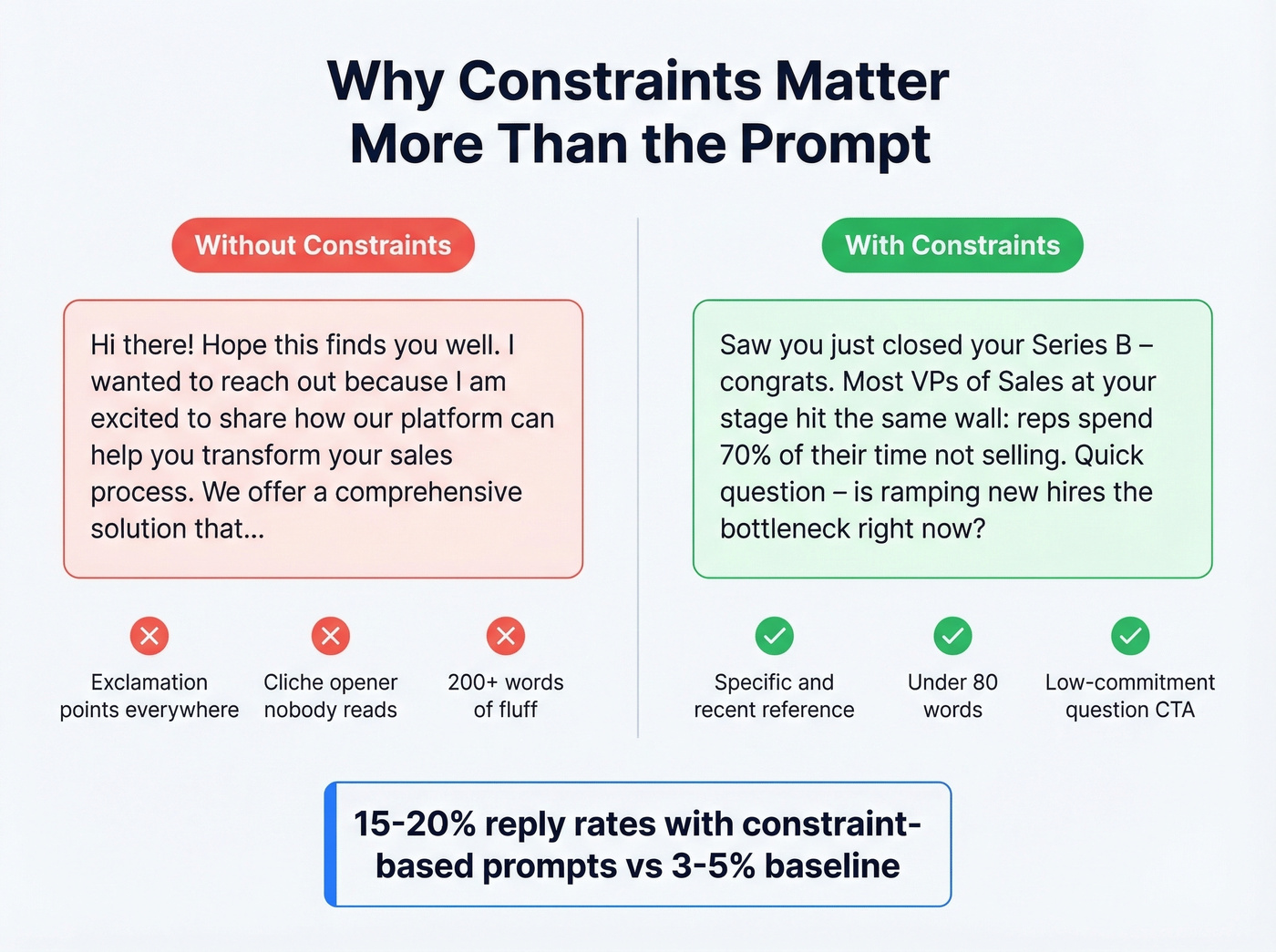
Paste these rules before any email generation request:
- No exclamation points. Ever.
- Ban these phrases: "hope this finds you well," "just reaching out," "I wanted to," "excited to"
- Email must be under 100 words
- First line must reference something specific and recent about the prospect or their company
- End with a low-commitment CTA (question, not a demo request)
- Tone: write like this is the 3rd or 4th email you've sent today - not the first one you've ever written
- Add a personalized P.S. line - personalized P.S. lines can lift response rates by up to 36%
In our experience, Claude nails the "casual professional" tone better than ChatGPT for cold email. ChatGPT tends toward formality unless you stack heavy constraints. With the rules above, both get close - but if you're choosing one tool for outbound copy, Claude is the move.
"[Paste constraint set above] You're a senior AE at [your company]. Write a cold email to [Name], [Title] at [Company]. They recently [specific trigger - funding, job change, product launch]. My product helps [one-sentence value prop]. Output: subject line (under 8 words) + email body."
Prompt 4: Variant Generator
"Here's a cold email I wrote: [paste email]. Generate 3 variations. Each must use a different opening angle and a different CTA. Keep all constraints from the original. Label them A, B, C."
A cold email prompt thread on r/ChatGPTPromptGenius reported 15-20% reply rates across 200+ outreaches using this constraint-based approach. That's 3-5x the typical cold email baseline. For more benchmarks and what “good” looks like, compare against current cold email success rate data.
Prompt 5: Post-Funding Outreach
Cold outreach to a random list gets 3-5% reply rates. Signal-personalized outreach - where you're reaching out because something just happened at the prospect's company - hits 15-25%. The difference is timing and relevance. This is also where buyer intent signals make your first line feel “earned,” not generated.
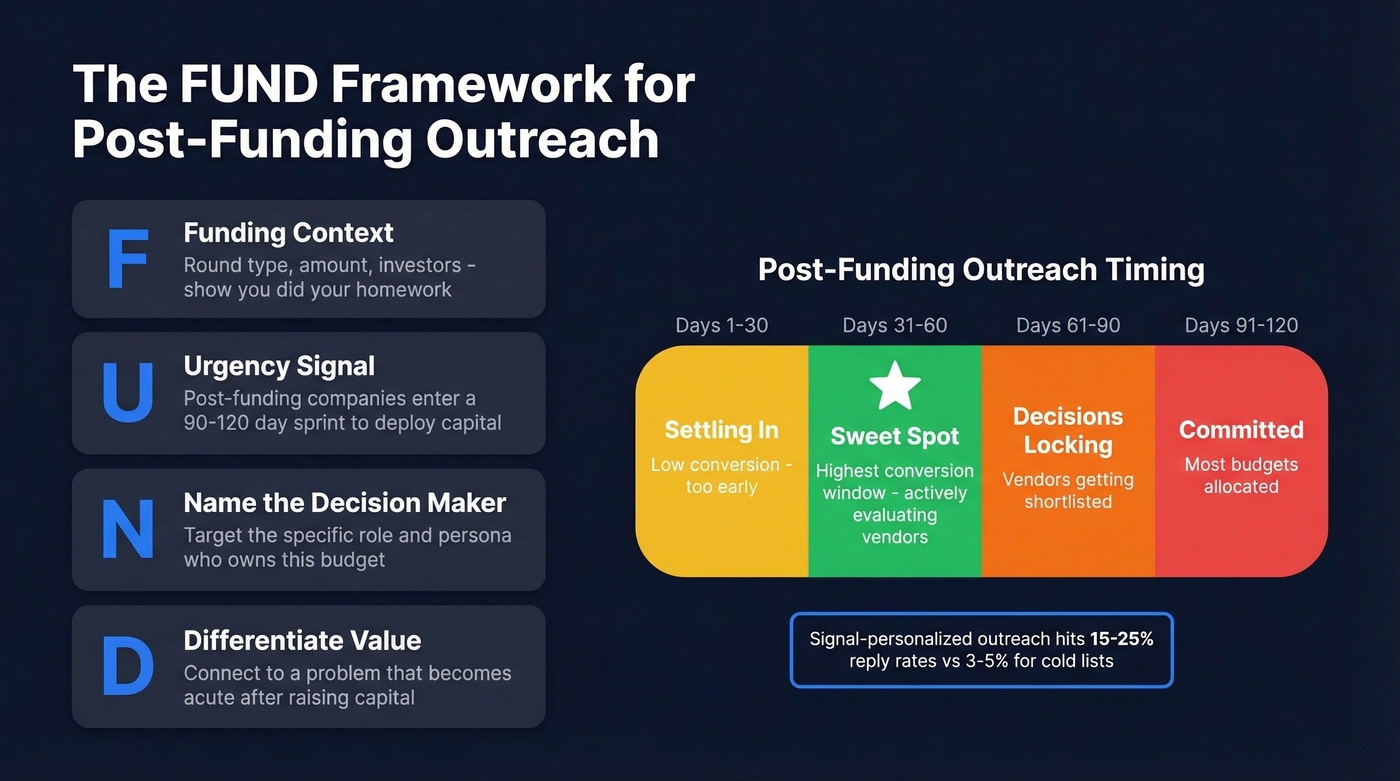
The FUND framework structures this:
- Funding context: round type, amount, investors
- Urgency signal: post-funding companies enter a 90-120 day sprint. Days 31-60 are the highest-conversion window - they're actively evaluating vendors but haven't locked in decisions yet.
- Name the decision maker: specific role and persona
- Differentiate value: the problem that becomes acute after raising capital
"You're a senior AE selling [product category] to [persona]. [Company] just raised a $[amount] [round type] led by [investor]. Using the FUND framework, write a cold email that connects our value prop - [one sentence] - to a problem that becomes urgent post-funding. Under 90 words. No exclamation points. End with a question, not a demo request."
Prompt 6: Signal Research
"Analyze this funding announcement: [paste text or URL]. Extract: (1) likely hiring priorities, (2) technology gaps they'll need to fill, (3) the executive most likely to own [your product category]. Format as a brief I can scan in 60 seconds."
Prompt 7: ICP Definition
"You're a sales strategist. Based on these 10 closed-won deals [paste company names, sizes, industries, deal sizes], define our ideal customer profile. Include: company size range, industry verticals, likely tech stack, buying triggers, and the persona who typically champions the purchase. Format as a one-page brief."
If you want to turn that output into something your team can actually operationalize, use an ideal customer profile scoring approach.
Prompt 8: Objection Roleplay
This is where AI becomes a practice partner, not just a writing tool. Use ChatGPT's voice mode - it's the closest thing to live practice without a real prospect on the line.
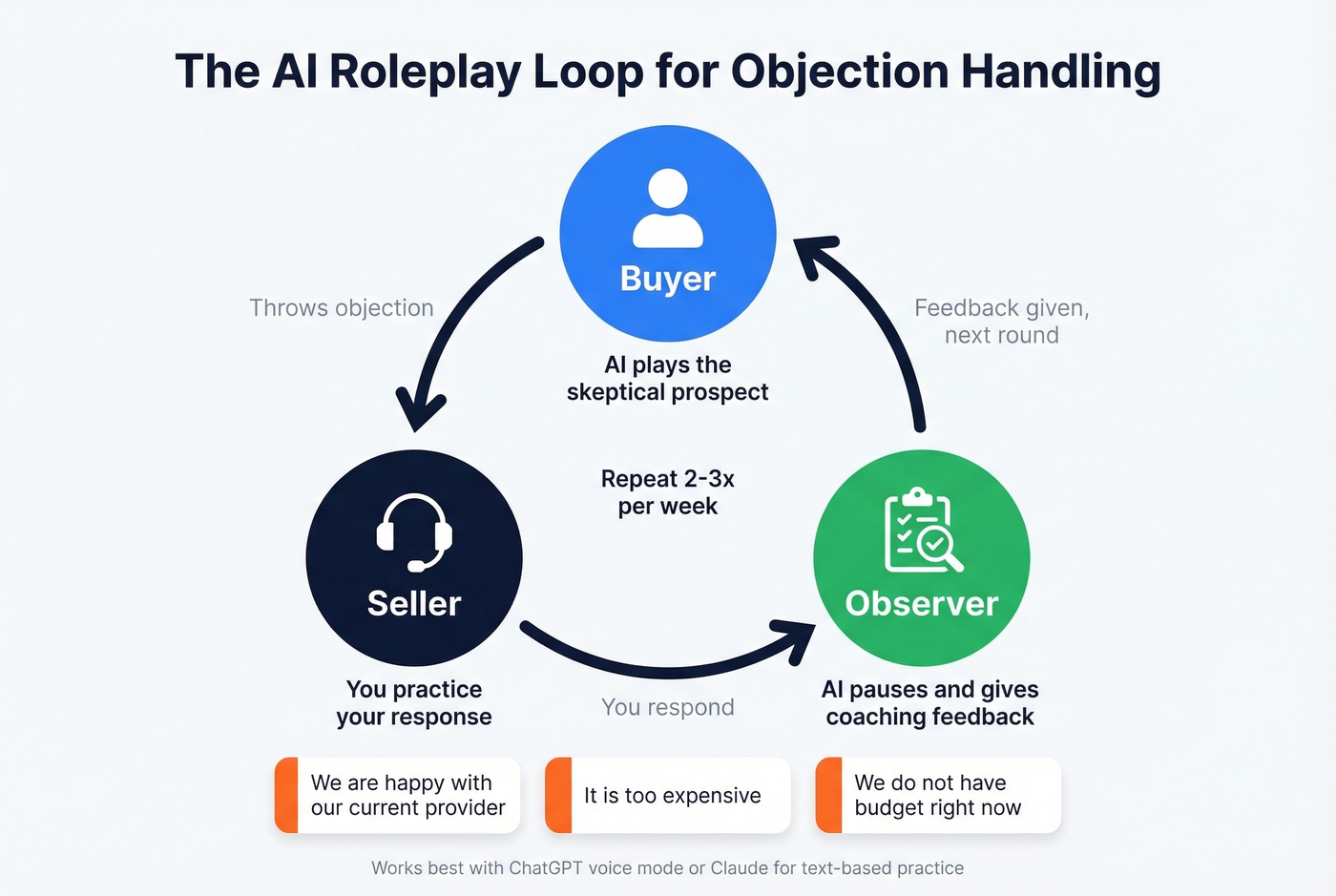
"We're going to roleplay a sales call. You play the Buyer - a [Title] at a [company type] who is [specific situation: evaluating competitors / happy with current provider / under budget pressure]. I'll play the Seller. After each exchange, pause and give me coaching feedback as the Observer: what I did well, what I missed, and what I should try next. Start with the buyer's opening objection: 'We're happy with our current provider.'"
We've seen teams run the "too expensive" and "happy with current provider" scenarios weekly as part of enablement. It doesn't replace live coaching, but it fills the gap between training sessions - and reps who practice objection handling even twice a week show measurably faster ramp times. If you want more structured drills, borrow from these objection handling techniques.
Prompt 9: Follow-Up Sequence
"Write a 3-email follow-up sequence for a prospect who attended a demo but hasn't responded in 5 days. Each email must: (1) avoid the phrase 'just following up,' (2) add new value or a new angle, (3) be under 75 words. Email 3 should be a soft breakup that leaves the door open. Include subject lines."
The breakup email is one of the highest-converting messages in any sequence. AI writes good ones because the format is simple: acknowledge the silence, remove pressure, leave one door open. If you’re building a full cadence, this follow up email sequence strategy pairs well with Prompt 9.
Prompt 10: Deal Velocity Analysis
Most prompt lists focus entirely on messaging. But some of the highest-value sales prompts are analytical - the kind of work that used to require a RevOps analyst and a half-day of spreadsheet wrangling.
"I'm uploading a CSV of our closed-won deals from the last 12 months. Calculate average deal velocity by segment (SMB, Mid-Market, Enterprise). Identify which segment has the shortest sales cycle and highest win rate. Flag any deals that took 2x longer than the segment average and note common characteristics. Output: summary table + 3 actionable recommendations for pipeline prioritization."
This prompt works best in ChatGPT with Code Interpreter or Claude with file upload. Paste or upload your CRM export and let the model do the math. It won't replace your BI tool, but it'll surface patterns in minutes that would take hours to find manually. If you need the underlying math to sanity-check the output, use this pipeline velocity formula.
Prompting Mistakes That Kill Results
Vague prompts produce vague output. "Write me a sales email" gives you something nobody would send. Add role, context, and constraints - every time.
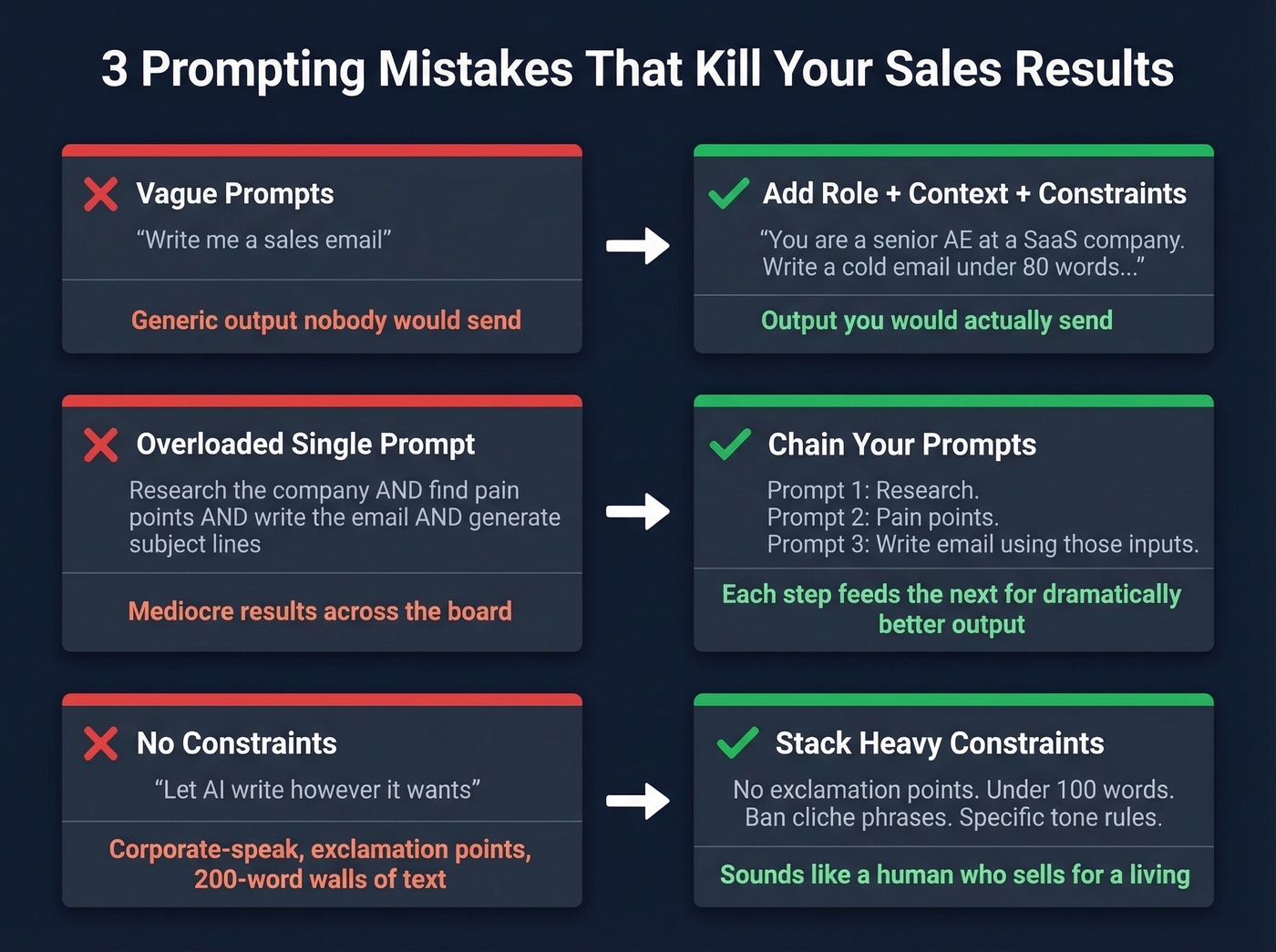
Overloading a single prompt. Asking AI to research a company, identify pain points, write an email, AND generate subject line variants in one prompt produces mediocre results across the board. Chain your prompts instead. I've watched reps try to cram an entire outbound workflow into one prompt and wonder why the output reads like a fever dream.
No constraints means corporate-speak. Without explicit rules about tone, length, and banned phrases, every AI model defaults to the same polished, lifeless voice. The constraints ARE the prompt.
Not iterating. Your first output is a draft, not a final product. Tell the AI what's wrong - "too formal," "make the CTA softer," "cut 30 words" - and run it again. Two or three iterations is normal.
Trusting AI-generated data without verification. AI confidently generates plausible-sounding facts, company details, and contact information that are completely wrong. A lawyer was sanctioned for submitting a filing with fake AI-generated case citations. In sales, the stakes are lower but the principle is the same: AI can surface a name and company, but it can't verify whether that email address still works. Run your lists through email verification before you hit send - a 98% accuracy rate on a 7-day data refresh cycle means you're sending to real inboxes, not bouncing into the void. If you’re comparing options, start with these email verifier tools.
Best Tools for Sales Prompts
The market is shifting from legacy cadence tools to AI-first platforms that handle signals, research, and sequence generation in one workflow. You don't need a $50k platform to start. Here's what matters:
| Tool | Best For | Price | Notes |
|---|---|---|---|
| ChatGPT | Research, roleplay, data analysis | Free - ~$20-30/user/mo | Enable web search for research prompts |
| Claude | Cold email tone | Free - ~$20/mo | Best casual-professional voice |
| Gemini | Google Workspace users | Free - ~$20/mo | Native Gmail/Docs integration |
| Prospeo | Verified data before sending | Free - ~$0.01/email | 98% accuracy, 7-day refresh |
ChatGPT with web search is strong for pre-call research - it pulls recent news, job postings, and company updates in real time. Claude writes better cold emails with fewer constraints needed. Gemini makes sense if your team lives in Google Workspace and wants AI drafts inside Gmail.
What none of these tools do is verify whether the email address you're sending to is real. That's a different problem entirely, and it's the one that tanks your deliverability. Skip this if you're only using AI for internal analysis or roleplay - but for anyone running outbound, data quality isn't optional. If you’re scaling outbound, it’s also worth tightening your outbound email spam prevention basics so good prompts don’t get filtered.
Signal-personalized outreach needs real signals. Prospeo tracks funding rounds, job changes, and buyer intent across 15,000 topics - giving your AI prompts the context they need to hit 15-25% reply rates.
Feed your AI real prospect data, not stale records.
FAQ
Which AI model is best for sales emails?
Claude produces the best cold email tone out of the box - casual and professional without heavy constraint-stacking. ChatGPT catches up when you add explicit rules about tone, length, and banned phrases. For pre-call research, ChatGPT with web search wins. Our recommendation: use both. ChatGPT for research, Claude for writing.
How do I stop AI emails from sounding robotic?
Add constraints, not better instructions. Ban exclamation points, ban cliche openers, cap length at 100 words, and require a specific prospect reference in the first line. The constraints matter more than the prompt itself - teams using this approach report 15-20% reply rates.
Do I need a separate tool for prospect data?
Yes. AI writes the email but can't verify the address is real. Prospeo's free tier includes 75 verified emails per month at 98% accuracy - pair it with your prompts so outreach actually reaches inboxes. Other options like Hunter offer 25 searches per month but cap enrichment features heavily.
Can AI help with deal forecasting?
Deal management prompts - like Prompt 10 above - let you analyze pipeline velocity, flag stalled opportunities, and prioritize segments by win rate. Upload your CRM data and ask the model to surface patterns. It won't replace a dedicated BI tool, but for quick deal health checks it surfaces insights in minutes that would take hours manually.